

The DOI matches its Crossref record; 96 of the 97 references it cites were found in a registry or an index.
Distributed affective space represents multiple emotion categories across the human brain
Open accessPublished version of a preprint
Abstract
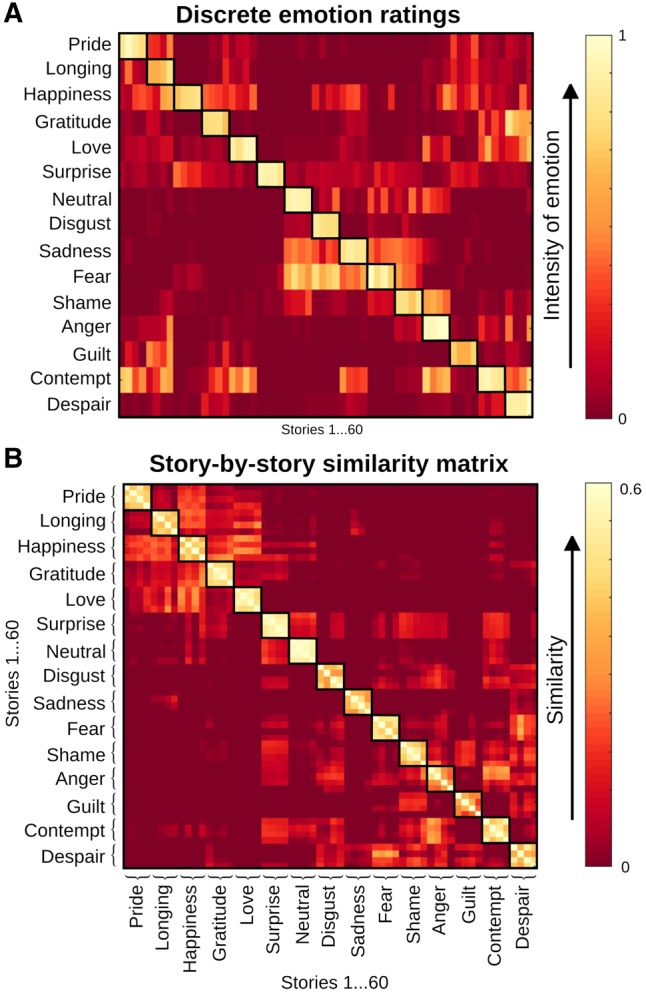
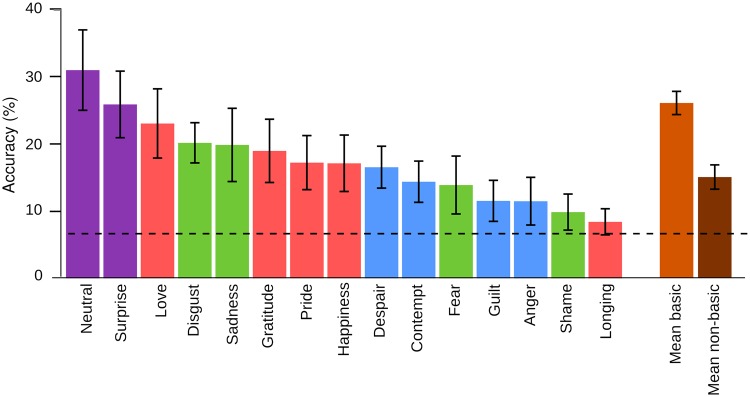
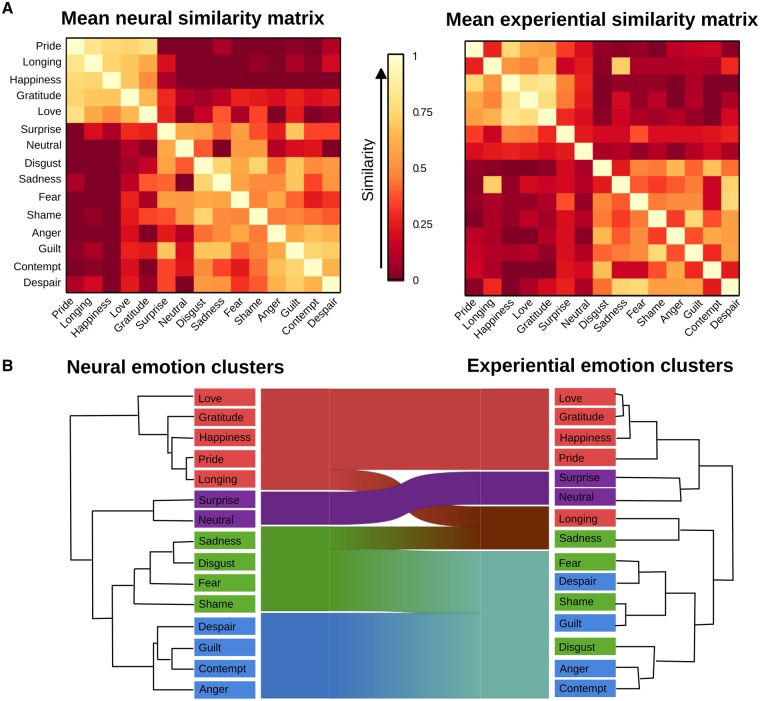
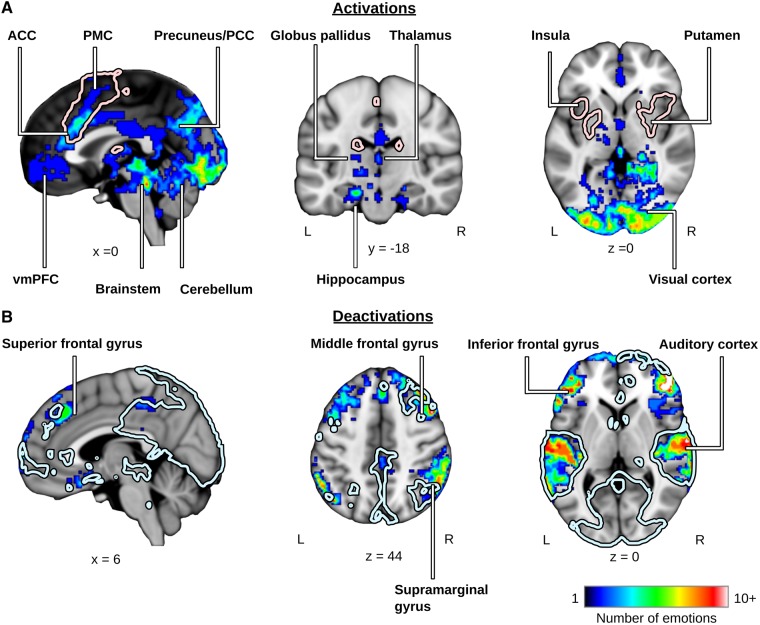
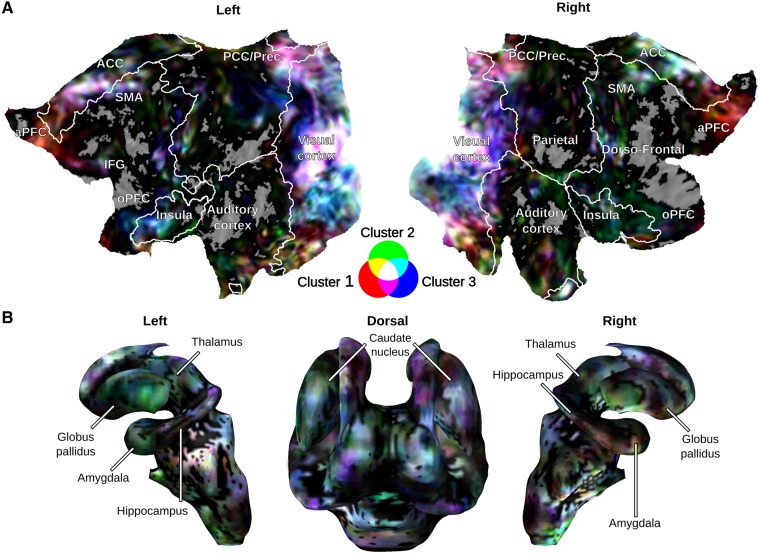
The functional organization of human emotion systems as well as their neuroanatomical basis and segregation in the brain remains unresolved. Here, we used pattern classification and hierarchical clustering to characterize the organization of a wide array of emotion categories in the human brain. We induced 14 emotions (6 'basic', e.g. fear and anger; and 8 'non-basic', e.g. shame and gratitude) and a neutral state using guided mental imagery while participants' brain activity was measured with functional magnetic resonance imaging (fMRI). Twelve out of 14 emotions could be reliably classified from the haemodynamic signals. All emotions engaged a multitude of brain areas, primarily in midline cortices including anterior and posterior cingulate gyri and precuneus, in subcortical regions, and in motor regions including cerebellum and premotor cortex. Similarity of subjective emotional experiences was associated with similarity of the corresponding neural activation patterns. We conclude that different basic and non-basic emotions have distinguishable neural bases characterized by specific, distributed activation patterns in widespread cortical and subcortical circuits. Regionally differentiated engagement of these circuits defines the unique neural activity pattern and the corresponding subjective feeling associated with each emotion.
Overview
The claims and statistics of this paper haven’t been checked yet.
Run the check — free, no account needed. It reads the open-access text and checks the sources it cites.
Integrity signals
Registry
Cites
Statistics
Figures
Verification
Claims the paper makes
The claims and statistics of this paper haven’t been checked yet.
Run the check — free, no account needed. It reads the open-access text and checks the sources it cites.
Claims other papers make about this one
Each is checked against this paper’s own text: does it say what the citing paper says it does?
The cited source says what the claim attributes to it.
In the citing paper
“This suggests that on subjectively experienced level, the universalism extends beyond the canonical”
From Bodily maps of emotions are culturally universal (2020) · cites this paper as Saarimaki et al., 2018
Self-check
Percentages, sums and reported differences re-computed from the paper’s own numbers.
The self-check needs the paper’s full text.
Citations
Cites
Desikan, R. S., Ségonne, F., Fischl, B., Quinn, B. T., Dickerson, B. C., Blacker, D., Buckner, R. L., Dale, A. M., Maguire, R. P., Hyman, B. T., et al. (2006) · NeuroImage · doi:10.1016/j.neuroimage.2006.01.021 · Cited by 13,324
Jenkinson, M., Bannister, P., Brady, M., & Smith, S. (2002) · NeuroImage · doi:10.1006/nimg.2002.1132 · Cited by 11,888 · cited 6×
“, 2001) and transforming the masks to the native space using FLIRT (Jenkinson et al., 2002) with nine degrees of freedom.”
MethodInfluentialJenkinson, M., Beckmann, C. F., Behrens, T. E. J., Woolrich, M. W., & Smith, S. M. (2012) · NeuroImage · doi:10.1016/j.neuroimage.2011.09.015 · Cited by 11,314
Fast robust automated brain extraction
Smith, S. M. (2002) · Human Brain Mapping · doi:10.1002/hbm.10062 · Cited by 10,496 · cited 2×
“, 2002) and non-brain matter was removed using BET (Smith, 2002).”
MethodAn argument for basic emotions
Ekman, P. (1992) · Cognition and Emotion · doi:10.1080/02699939208411068 · Cited by 9,646
Zhang, Y., Brady, M., & Smith, S. M. (2001) · IEEE Transactions on Medical Imaging · doi:10.1109/42.906424 · Cited by 7,628 · cited 1×
“Participant-wise gray matter masks were generated by segmenting the T1-weighted images into gray and white matter and cerebrospinal fluid using the FAST segmentation tool (Zhang et al., 2001) and transforming the masks to the native space using FLIRT (Jenkinson et al.”
MethodCore affect and the psychological construction of emotion.
Russell, J. A. (2003) · Psychological Review · doi:10.1037/0033-295x.110.1.145 · Cited by 6,113 · cited 2×
“Accordingly, the specific number of basic emotions has been debated and the distinction between basic and non-basic emotions has been questioned (e.g. Russell, 2003).”
BackgroundThe feeling of what happens: body and emotion in the making of consciousness
(2000) · Choice Reviews Online · doi:10.5860/choice.37-6553 · Cited by 6,001
Baron‐Cohen, S., Wheelwright, S., Hill, J., Raste, Y., & Plumb, I. (2001) · Journal of Child Psychology and Psychiatry · doi:10.1111/1469-7610.00715 · Cited by 4,555 · cited 1×
“Yet, a wide array of other emotions, including ‘secondary’ or ‘social’ emotions (see reviews and proposed taxonomies in Damasio, 1999; Adolphs, 2002a), also serve adaptive survival functions and are characterized by distinctive facial expressions (Baron-Cohen et al., 2001; Shaw et al., 2005), bodily sensations (Nummen…”
BackgroundBaron‐Cohen, S., Wheelwright, S. J., Hill, J., Raste, Y., & Plumb, I. (2001) · PubMed · Cited by 4,313
Cited by
Sorted by citations
Emotion Recognition for Human-Robot Interaction: Recent Advances and Future Perspectives
Spezialetti, M., Placidi, G., & Rossi, S. (2020) · Frontiers in Robotics and AI · doi:10.3389/frobt.2020.532279 · Cited by 315
Emotion schemas are embedded in the human visual system
Kragel, P. A., Reddan, M. C., LaBar, K. S., & Wager, T. D. (2019) · Science Advances · doi:10.1126/sciadv.aaw4358 · Cited by 214
Movies and narratives as naturalistic stimuli in neuroimaging
Jääskeläinen, I. P., Sams, M. E., Glerean, E., & Ahveninen, J. (2020) · NeuroImage · doi:10.1016/j.neuroimage.2020.117445 · Cited by 202
“Recent evidence indicates that it is possible to classify more specific emotions also, such as love and pride within the “happiness” basic-emotion category (Saarimäki et al., 2018).”
BackgroundSelf-citationChang, L. J., Jolly, E., Cheong, J. H., Rapuano, K. M., Greenstein, N., Chen, P.-H. A., & Manning, J. R. (2021) · Science Advances · doi:10.1126/sciadv.abf7129 · Cited by 177
Semantic Space Theory: A Computational Approach to Emotion
Cowen, A., & Keltner, D. J. (2020) · Trends in Cognitive Sciences · doi:10.1016/j.tics.2020.11.004 · Cited by 189
“Experiences of speci fi c emotions, then, are found to involve multiple interacting systems – situated near DMN and subcortical regions – that enter distinct states in response to perceived threats and opportunities [9,62,80 – 82].”
Metadata
- Authors
- Saarimäki, H., Ejtehadian, L. F., Glerean, E., Jääskeläinen, I. P., Vuilleumier, P., Sams, M., & Nummenmaa, L.
- Affiliations
- Aalto University (FI)
- University of Turku (FI)
- University of Geneva (CH)
- Corresponding author
- Saarimäki, Heini
- ORCID
- Venue
- Social Cognitive and Affective Neuroscience
- Publisher
- Oxford University Press (OUP)
- Published
- 2018-05-01
- Volume
- 13
- Issue
- 5
- Pages
- 471-482
- ISSN
- 1749-5016 (ISSN-L)
- 1749-5024
- PMC
- PMC6007366
- OpenAlex
- W2953286634
- Cited by
- 146
- References
- 97
- Citations by year
- 2026: 6 · 2025: 19 · 2024: 14 · 2023: 19 · 2022: 23 · 2021: 20 · 2020: 31 · 2019: 9 · 2018: 4
- FWCI
- 9.53
- Type
- journal article
- Language
- en
- Open access
- gold
- doi.org
- Licence
- Locations
- Social Cognitive and Affective Neuroscience (publishedVersion, cc-by-nc)
- bioRxiv (Cold Spring Harbor Laboratory) (acceptedVersion)
- Europe PMC (PubMed Central) (publishedVersion, cc-by-nc)
- PubMed Central (publishedVersion, cc-by-nc)
- PubMed (publishedVersion)
- Archive ouverte UNIGE (University of Geneva) (publishedVersion, other-oa)
- Aaltodoc (Aalto University) (submittedVersion, cc-by-nc)
- Archive ouverte UNIGE (University of Geneva) (submittedVersion, cc-by-nc)
- Funders
- Aalto University, Academy of Finland (#265917, #294897, #138145, #276643, #313000)
- Finnish Cultural Foundation (#00140220)
- Swiss National Science Foundation National Center of Competence in Research for Affective Sciences (#51NF40-104897)
- Topics
- Life Sciences › Neuroscience › Cognitive Neuroscience › Neural and Behavioral Psychology Studies
- Physical Sciences › Computer Science › Artificial Intelligence › Emotion and Mood Recognition
- Life Sciences › Neuroscience › Cognitive Neuroscience › Functional Brain Connectivity Studies
- Keywords
- emotion classification, basic emotions, cingulate cortex, precuneus, cerebellum, premotor cortex, subjective emotional experience, emotion induction
- MeSH terms
- Adult, Affect, Brain, Brain Mapping, Cerebellum, Cerebral Cortex, Cerebrovascular Circulation, Emotions, Female, Hemodynamics, Humans, Magnetic Resonance Imaging, Cluster Analysis, Young Adult
About these checks
Registry, retraction, Cites and statistics results are computed, not judged, with one exception: a printed reference that no index lists is read once by a model before it counts as a citation error. Claims are extracted by a model and kept only when their quote appears verbatim in the text; each cited source is then checked, with a model’s help, for whether it says what the claim relies on. Those verdicts can be wrong — read the claim’s quote and the cited source before relying on one.
Statistics and arithmetic are recomputed, not judged.
Confidence bands are shown only for fields calibrated on our annotated test set. None is calibrated yet, so no band is shown.
What counts as a claim ›How we measure confidence ›How we check this ›
Are you an author, or do you see a problem with this page? Request a review
