

Neural and Behavioral Correlates of Aberrant Salience in Individuals at Risk for Psychosis
Open accessThe DOI matches its Crossref record; 44 of the 45 references it cites were found in a registry or an index.
Abstract
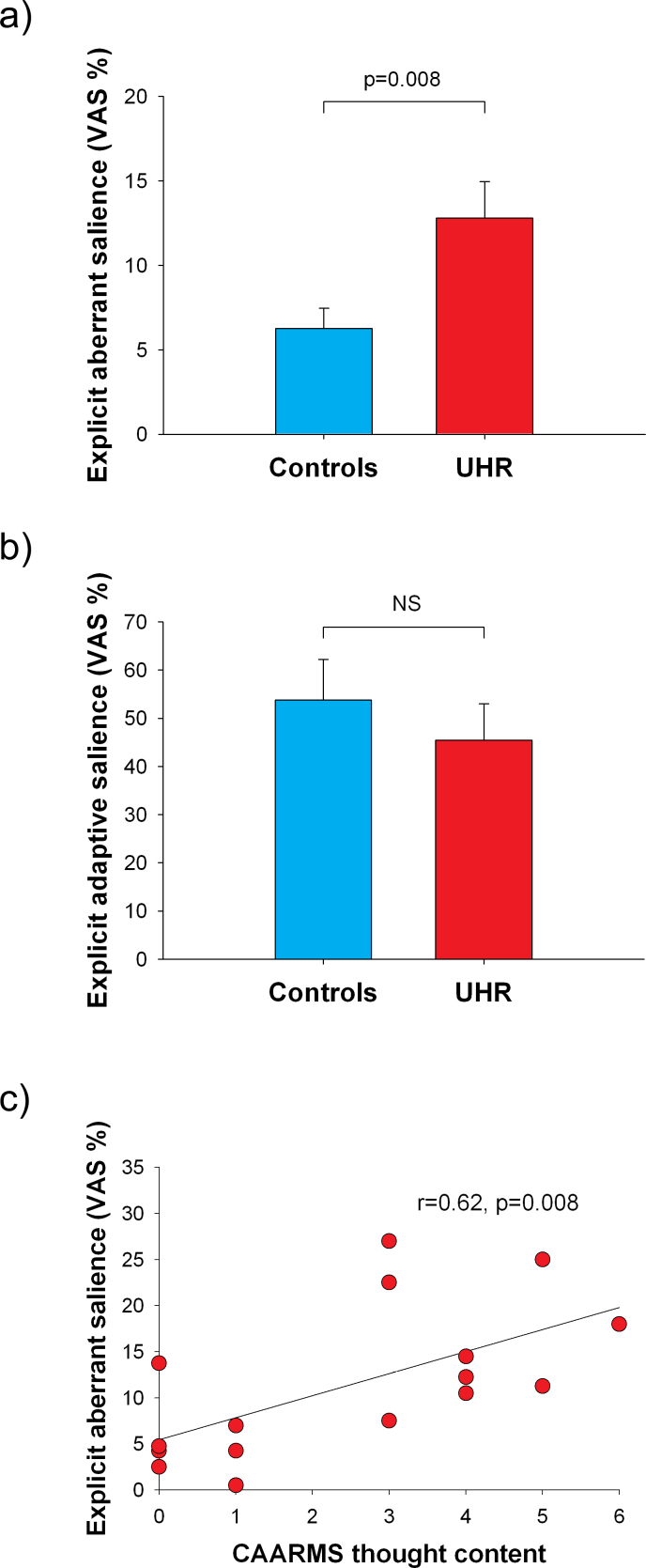
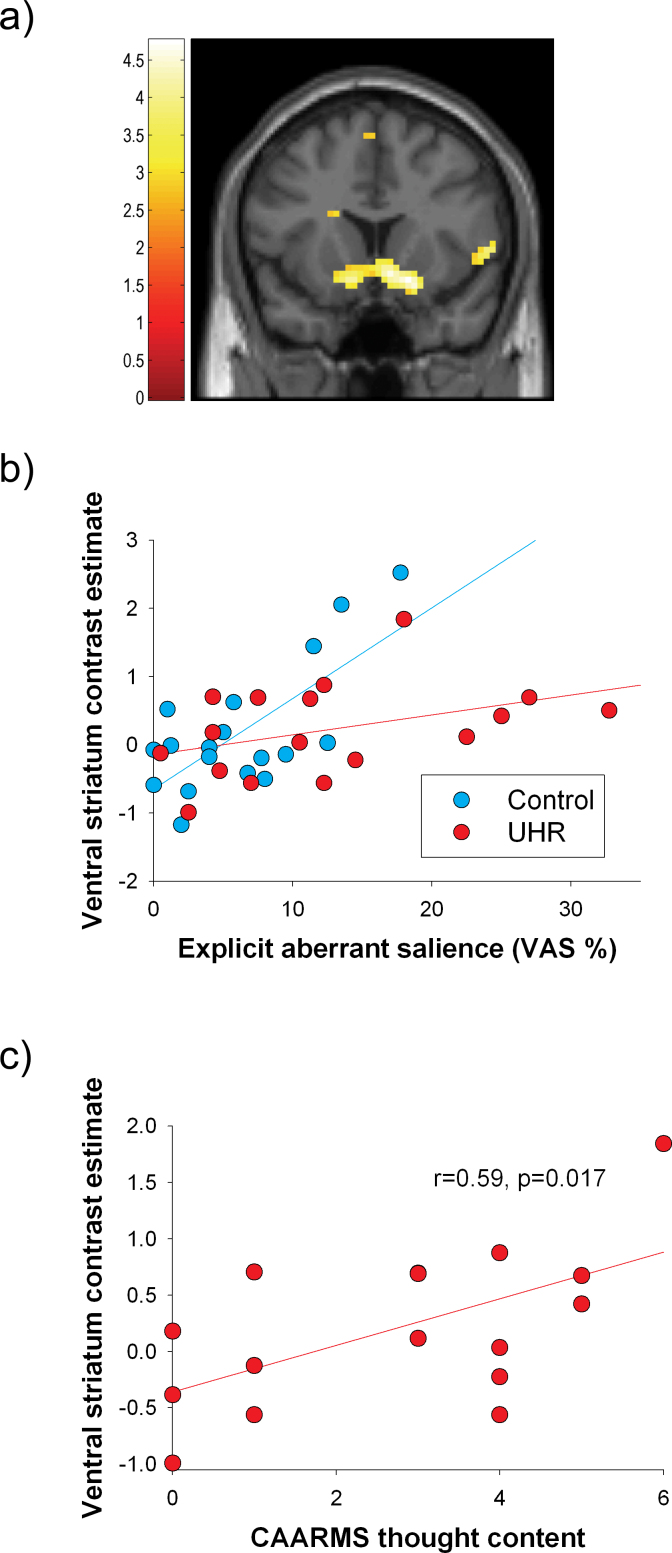
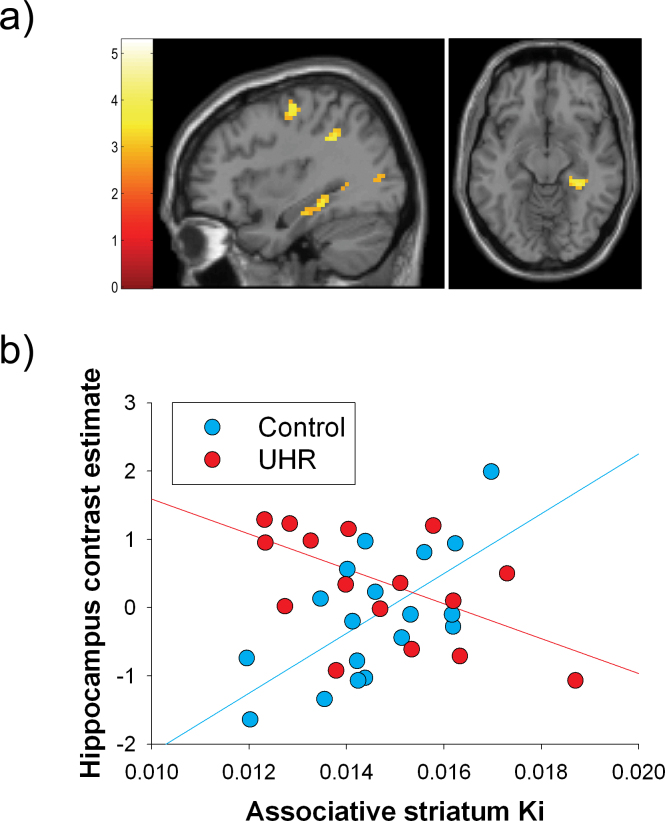
The "aberrant salience" model proposes that psychotic symptoms first emerge when chaotic brain dopamine transmission leads to the attribution of significance to stimuli that would normally be considered irrelevant. This is thought to occur during the prodromal phase of psychotic disorders, but this prediction has not been tested previously. In the present study, we tested this model in 18 healthy volunteers and 18 unmedicated individuals at ultra-high risk of psychosis. Subjects performed the Salience Attribution Test, which provides behavioral measures of adaptive and aberrant motivational salience, during functional magnetic resonance imaging to assess neural responses to relevant and irrelevant stimulus features. On a separate occasion, the same subjects were also studied with [(18)F]fluorodopa positron emission tomography to measure dopamine synthesis capacity. Individuals at ultra-high risk of psychosis were more likely to attribute motivational salience to irrelevant stimulus features (t(26.7) = 2.8, P = .008), and this bias was related to the severity of their delusion-like symptoms (r = .62, P = .008). Ventral striatal responses to irrelevant stimulus features were also correlated with delusion-like symptoms in the ultra-high risk group (r = .59, P = .017). Striatal dopamine synthesis capacity correlated negatively with hippocampal responses to irrelevant stimulus features in ultra-high risk individuals, but this relationship was positive in controls. These data are consistent with the hypothesis that aberrant salience processing underlies psychotic symptoms and involves functional alterations in the striatum, hippocampus, and the subcortical dopamine system.
Overview
The claims and statistics of this paper haven’t been checked yet.
Free: it reads the open-access text and checks the first 5 claims that cite a source we can check. Create a free account to check every claim.
Integrity signals
Registry
Cites
Statistics
Figures
Verification
Claims the paper makes
The claims and statistics of this paper haven’t been checked yet.
Free: it reads the open-access text and checks the first 5 claims that cite a source we can check. Create a free account to check every claim.
Claims other papers make about this one
Each is checked against this paper’s own text: does it say what the citing paper says it does?
The source backs part of the claim, not all of it — or backs it for a different population, condition or comparison.
In the citing paper
“The consequence may be enhanced salience attribution to environmental stimuli, which may underlie delusional and paranoid symptoms, as suggested by others [128,137] .”
From The traumagenic neurodevelopmental model of psychosis revisited (2014) · cites this paper as [137]
Experimental — accuracy not yet measuredThe cited source says what the claim attributes to it.
In the citing paper
“Overall, the tendency is for CHR to show increased explicit (but not implicit, such as that measured with reaction time) aberrant salience compared to controls (80, 82).”
From Aberrant Salience, Information Processing, and Dopaminergic Signaling in People at Clinical High Risk for Psychosis (2020) · cites this paper as [82]
The cited source says what the claim attributes to it.
In the citing paper
“CHR subjects rate irrelevant cues as more relevant than HC do (80, 82),”
From Aberrant Salience, Information Processing, and Dopaminergic Signaling in People at Clinical High Risk for Psychosis (2020) · cites this paper as [82]
The cited source says what the claim attributes to it.
In the citing paper
“Taken together, this evidence indicates altered salience processing (80-83), reward anticipation (7577) and PE-signalling (78, 79) in CHR relative to HC.”
From Aberrant Salience, Information Processing, and Dopaminergic Signaling in People at Clinical High Risk for Psychosis (2020) · cites this paper as [82]
The cited source says what the claim attributes to it.
In the citing paper
“Moreover, VS activation during aberrant salience processing correlates with delusion-like symptoms (82),”
From Aberrant Salience, Information Processing, and Dopaminergic Signaling in People at Clinical High Risk for Psychosis (2020) · cites this paper as [82]
1 more claim about this paper
Create a free account to see every claim other papers make about this one.
Self-check
Percentages, sums and reported differences re-computed from the paper’s own numbers.
The self-check needs the paper’s full text.
Citations
Cites
The Positive and Negative Syndrome Scale (PANSS) for schizophrenia.
Kay, S. R., Fiszbein, A., & Opler, L. A. (1987) · Schizophrenia Bulletin · doi:10.1093/schbul/13.2.261 · Cited by 21,378
(1998) · The Journal of Clinical Psychiatry · Cited by 19,139
(1998) · PubMed · Cited by 10,216
No adjustments are needed for multiple comparisons.
Rothman, K. J. (1990) · Epidemiology · doi:10.1097/00001648-199001000-00010 · Cited by 5,965
The mini international neuropsychiatric interview
Lecrubier, Y., Sheehan, D., Hergueta, T., & Weiller, E. (1998) · European Psychiatry · doi:10.1016/s0924-9338(99)80239-9 · Cited by 5,872
Wechsler Abbreviated Scale of Intelligence
Dumont, R., Willis, J. O., Veizel, K., & Zibulsky, J. (2014) · Encyclopedia of Special Education · doi:10.1002/9781118660584.ese2519 · Cited by 5,521
Maldjian, J. A., Laurienti, P. J., Kraft, R. A., & Burdette, J. H. (2003) · NeuroImage · doi:10.1016/s1053-8119(03)00169-1 · Cited by 5,085
Wechsler Abbreviated Scale of Intelligence
Wechsler, D. (2012) · PsycTESTS Dataset · doi:10.1037/t15170-000 · Cited by 4,596
What is the role of dopamine in reward: hedonic impact, reward learning, or incentive salience?
Berridge, K. C., & Robinson, T. E. (1998) · Brain Research Reviews · doi:10.1016/s0165-0173(98)00019-8 · Cited by 4,127
Kapur, S. (2003) · American Journal of Psychiatry · doi:10.1176/appi.ajp.160.1.13 · Cited by 2,813 · cited 3×
“Two contrast images were generated per participant, representing (1) adaptive reward prediction and (2) aberrant reward prediction.”
Background
Research works printed but not linked: 1
- Nelson HE National Adult Reading Test (NART): Test Manual. Windsor, United Kingdom: NFER-Nelson; 1982
Cited by
Items 201–228 of 228
Structural and functional neuroimaging of schizophrenia
Diaconescu, A. O., Iglesias, S., & Stephan, K. E. (2020) · doi:10.1093/med/9780198713005.003.0060
„Unáhlené závěry“ u psychotických onemocnění: přehledová studie
Rodríguez, M., & Šustová, P. (2021) · PSYCHOLOGIE PRO PRAXI · doi:10.14712/23366486.2021.7
Polese, D., Mazzetta, A., Costanzi, F., Cozza, G., Niolu, C., Causi, F. S. L., Nardo, G. D., Caserta, D., Parisi, P., Siracusano, A., et al. (2026) · Journal of Affective Disorders · doi:10.1016/j.jad.2026.121416
Apathy and impulsivity in neurological and psychiatric disorders
Saleh, Y., & Husain, M. (2025) · Handbook of behavioral neuroscience · doi:10.1016/b978-0-443-29867-7.00041-4
Mitrović, M., & Ćirović, N. (2026) · Psychosis · doi:10.1080/17522439.2026.2723050
Piantadosi, P. T. (2013) · cIRcle (University of British Columbia) · doi:10.14288/1.0074083
Zauchenberger, C.-Z., Vano, L. J., Veronese, M., Osugo, M., Jauhar, S., Brown, K., Howes, O. D., Nour, M. M., & McCutcheon, R. A. (2026) · Biological Psychiatry · doi:10.1016/j.biopsych.2026.08.019
Self-citationSørvig, E. (2018) · NVA (Nasjonalt vitenarkiv)
Pathophysiologische Veränderungen spezifischer neurofunktioneller Systeme bei Schizophrenie
Dechent, A. (2021) · eDiss (Georg-August-Universität Göttingen) · doi:10.53846/goediss-8533
Die Entdeckung der Bedeutung von Bedeutung: Pathologische Salienzattribution in der Schizophrenie
Kätzel, D. (2024) · Nervenheilkunde · doi:10.1055/a-2389-7566
Holl, A. (2025) · heiDOK (Heidelberg University) · doi:10.11588/heidok.00036517
Salience and motivated behaviour in schizophrenia
Neumann, S. R. (2020) · Otago University Research Archive (University of Otago)
Perfiles clínicos en las adicciones comportamentales en mujeres y pacientes con patología dual
Lara Huallipe, M. L. (2023) · Dipòsit Digital de la Universitat de Barcelona (Universitat de Barcelona)
Brain network localization of delusions
Sun, Y., She, M., Yan, L., Wang, Z., Zhang, M., Cai, H., Zhu, J., & Yu, Y. (2026) · Journal of Affective Disorders · doi:10.1016/j.jad.2026.122534
Unveiling the complexity of learning and decision-making
Lin, W.-H. (2024) · Infoscience (Ecole Polytechnique Fédérale de Lausanne) · doi:10.5075/epfl-thesis-10510
Allen, P., Hird, E., Orlov, N. D., Modinos, G., Bossong, M. G., Antoniades, M., Sampson, C., Azis, M., Howes, O. D., Stone, J. M., et al. (2021) · Translational Psychiatry · doi:10.1038/s41398-021-01731-x
Self-citationKnott, T. S., Bowman, E. M., Deiana, S., von Heimendahl, M., Tait, D. S., & Brown, V. J. (2026) · SSRN Electronic Journal · doi:10.2139/ssrn.7524502
De Fenomenologie van Psychose. Een kwalitatieve onderzoek naar beleefde ervaringen van psychose.
Sips, R. (2022) · Lirias (KU Leuven)
An Investigation Into The Neural Nature Of Persecutory Ideation
Wisner, K. (2016) · University of Minnesota Digital Conservancy (University of Minnesota)
Validation d'un outil psychométrique : L'Inventaire de Saillance Aberrante (ISA)
Rod, W., & Dubuis, C. (2019) · IRIS
Gibson, L. E. (2017) · TUScholarShare (Temple University)
The role of trauma, attachment, and voice-hearer’s appraisals: a latent profile analysis
Marotti, J. (2023) · UCL Discovery (University College London)
Neurobiological investigation of salience processing in the prepsychotic state
Wotruba, D. (2015) · Zurich Open Repository and Archive (University of Zurich) · doi:10.5167/uzh-108188
Salienzerleben und Selbstreferentialität
Diner, S. (2017) · Universitätsbibliothek der FU Berlin Hochschulschriftenstelle u. Dokumentenserver · doi:10.17169/refubium-15473
Bayesian Methods and Their Application in Neuroimaging Data
Ge, Y. (2022) · University Libraries (University of Maryland) · doi:10.13016/bzfx-gemy
Psychosis risk is associated with decreased white matter integrity in corticostriatal tracts
Straub, K. T. (2018) · MOspace Institutional Repository (University of Missouri) · doi:10.32469/10355/68992
Metadata
- Authors
- Roiser, J. P., Howes, O. D., Chaddock, C. A., Joyce, E. M., & McGuire, P.
- Affiliations
- University College London (GB)
- King's College London (GB)
- UCL Queen Square Institute of Neurology (GB)
- Corresponding author
- Roiser, Jonathan P.
- Venue
- Schizophrenia Bulletin
- Publisher
- Oxford University Press (OUP)
- Published
- 2012-12-12
- Volume
- 39
- Issue
- 6
- Pages
- 1328-1336
- ISSN
- 0586-7614 (ISSN-L)
- 1745-1701
- PMC
- PMC3796080
- OpenAlex
- W2120310131
- Cited by
- 205
- References
- 45
- Citations by year
- 2026: 5 · 2025: 8 · 2024: 12 · 2023: 8 · 2022: 17 · 2021: 18 · 2020: 23 · 2019: 16 · 2018: 21 · 2017: 14 · 2016: 25 · 2015: 18 · 2014: 15 · 2013: 5
- FWCI
- 8.63
- Type
- journal article
- Language
- en
- Open access
- hybrid
- doi.org
- Licence
- cc-by-nc
- Locations
- Schizophrenia Bulletin (publishedVersion, cc-by-nc)
- Europe PMC (PubMed Central) (publishedVersion, cc-by-nc)
- PubMed Central (publishedVersion, cc-by-nc)
- PubMed (publishedVersion)
- UCL Discovery (University College London) (submittedVersion)
- Research Portal (King's College London) (submittedVersion, other-oa)
- Funders
- University College London
- University of California, San Francisco
- Medical Research Council
- Menzies Centre for Australian Studies, King's College London, University of London
- Topics
- Health Sciences › Medicine › Psychiatry and Mental health › Schizophrenia research and treatment
- Life Sciences › Neuroscience › Cellular and Molecular Neuroscience › Neurotransmitter Receptor Influence on Behavior
- Life Sciences › Neuroscience › Cognitive Neuroscience › Neural and Behavioral Psychology Studies
- Keywords
- aberrant salience
- MeSH terms
- Adult, Basal Ganglia, Delusions, Dihydroxyphenylalanine, Dopamine, Female, Hippocampus, Humans, Magnetic Resonance Imaging, Male, Psychotic Disorders, Risk, Severity of Illness Index, Positron-Emission Tomography, Cerebrum, Young Adult, Functional Neuroimaging, Prodromal Symptoms
About these checks
Registry, retraction, Cites and statistics results are computed, not judged, with one exception: a printed reference that no index lists is read once by a model before it counts as a citation error. Claims are extracted by a model and kept only when their quote appears verbatim in the text; each cited source is then checked, with a model’s help, for whether it says what the claim relies on. Those verdicts can be wrong — read the claim’s quote and the cited source before relying on one.
Statistics and arithmetic are recomputed, not judged.
Confidence bands are shown only for fields calibrated on our annotated test set. None is calibrated yet, so no band is shown.
What counts as a claim ›How we measure confidence ›How we check this ›
Are you an author, or do you see a problem with this page? Request a review
Data sources
Bibliographic data: Semantic Scholar, OpenAlex, Crossref.
Contains information from the Semantic Scholar Academic Graph Datasets, made available under the ODC Attribution License (ODC-BY 1.0).
Semantic Scholar’s data is described in: Kinney, R., et al. (2023). The Semantic Scholar Open Data Platform. arXiv:2301.10140.
