

The DOI matches its Crossref record; 121 of the 123 references it cites were found in a registry or an index.
Visual Hallucinations in the Psychosis Spectrum and Comparative Information From Neurodegenerative Disorders and Eye Disease
Open accessAbstract
Much of the research on visual hallucinations (VHs) has been conducted in the context of eye disease and neurodegenerative conditions, but little is known about these phenomena in psychiatric and nonclinical populations. The purpose of this article is to bring together current knowledge regarding VHs in the psychosis phenotype and contrast this data with the literature drawn from neurodegenerative disorders and eye disease. The evidence challenges the traditional views that VHs are atypical or uncommon in psychosis. The weighted mean for VHs is 27% in schizophrenia, 15% in affective psychosis, and 7.3% in the general community. VHs are linked to a more severe psychopathological profile and less favorable outcome in psychosis and neurodegenerative conditions. VHs typically co-occur with auditory hallucinations, suggesting a common etiological cause. VHs in psychosis are also remarkably complex, negative in content, and are interpreted to have personal relevance. The cognitive mechanisms of VHs in psychosis have rarely been investigated, but existing studies point to source-monitoring deficits and distortions in top-down mechanisms, although evidence for visual processing deficits, which feature strongly in the organic literature, is lacking. Brain imaging studies point to the activation of visual cortex during hallucinations on a background of structural and connectivity changes within wider brain networks. The relationship between VHs in psychosis, eye disease, and neurodegeneration remains unclear, although the pattern of similarities and differences described in this review suggests that comparative studies may have potentially important clinical and theoretical implications.
Overview
The claims and statistics of this paper haven’t been checked yet.
Run the check — free, no account needed. It reads the open-access text and checks the sources it cites.
Integrity signals
Registry
Cites
Statistics
Figures
Verification
Claims the paper makes
The claims and statistics of this paper haven’t been checked yet.
Run the check — free, no account needed. It reads the open-access text and checks the sources it cites.
Claims other papers make about this one
Each is checked against this paper’s own text: does it say what the citing paper says it does?
In the citing paper
“Although the conventional view focuses preferentially on auditory hallucinations in psychosis, epidemiological evidence indicates that hallucinations in the visual domain are very common in, for example, schizophrenia (13).”
From Shift toward prior knowledge confers a perceptual advantage in early psychosis and psychosis-prone healthy individuals (2015) · cites this paper as [13]
In the citing paper
“The authors reported visual hallucinations with a substantial point prevalence of 27% (Waters et al., 2014).”
From What visual illusions teach us about schizophrenia (2014) · cites this paper as Waters et al., 2014
Self-check
Percentages, sums and reported differences re-computed from the paper’s own numbers.
The self-check needs the paper’s full text.
Citations
Cites
J Neuropsychiatry Clin Neurosci
Yudofsky, S. C., & Hales, R. E. (1992) · The Journal of Neuropsychiatry and Clinical Neurosciences · doi:10.1176/jnp.4.4.359 · Cited by 3,818
Yatham, L. N., & Malhi, G. S. (2011) · Oxford University Press eBooks · doi:10.1093/med/9780199562305.001.0001 · Cited by 3,515
Davenport, Y. B., Adland, M. L., Gold, P. W., & Goodwin, F. K. (1984) · The Lancet · doi:10.1016/s0140-6736(84)92810-1 · Cited by 2,925
Jablensky, A., Sartorius, N., Ernberg, G., Anker, M., Korten, A., Cooper, J. E., Day, R., & Bertelsen, A. (1992) · Psychological Medicine. Monograph Supplement · doi:10.1017/s0264180100000904 · Cited by 1,769
Hallucinations in Parkinson's disease: Prevalence, phenomenology and risk factors
Fénelon, G. (2000) · Brain · doi:10.1093/brain/123.4.733 · Cited by 1,035
Bleuler, E., & Brill, A. A. (1976) · Medical Entomology and Zoology · Cited by 908
Strauss (1969) revisited: a psychosis continuum in the general population?
van Os, J., Hanssen, M., Bijl, R. V., & Ravelli, A. (2000) · Schizophrenia Research · doi:10.1016/s0920-9964(99)00224-8 · Cited by 893
The Early Symptoms of Schizophrenia
Chapman, J. (1966) · British Journal of Psychiatry · doi:10.1192/bjp.112.484.225 · Cited by 675 · cited 1×
“…Malitz et al (1962)8 100 9 50 Vitols et al (1963)9 110 13 35 Goldberg et al (1965)10 270 18 45 Mott et al (1965)11 50 24 66 Small et al (1966)12 50 30 66 Chapman (1966)13 a 40 a Holmboe and Astrup (1967)14 255 25 79 Jansson (1968)15 293 13 25 Goodwin et al (1971)16 45 59 82 Eggers (1973)17 a 44 71…”
Low-Dose Clozapine for the Treatment of Drug-Induced Psychosis in Parkinson's Disease
The Parkinson Study Group (1999) · New England Journal of Medicine · doi:10.1056/nejm199903113401003 · Cited by 618
Neural synchrony indexes disordered perception and cognition in schizophrenia
Spencer, K., Nestor, P. G., Perlmutter, R., Niznikiewicz, M. A., Klump, M. C., Frumin, M., Shenton, M. E., & McCarley, R. W. (2004) · Proceedings of the National Academy of Sciences · doi:10.1073/pnas.0406074101 · Cited by 601
Research works printed but not linked: 6
- Feinberg, 1962, A comparison of the visual hallucinations in schizophrenia with those induced by mescaline and LSD-25, Hallucinations, 64
- Malitz, 1962, A comparison of drug-induced hallucinations with those seen in spontaneously occurring psychosis
- Eggers, Verlaufsweisen Kindlicher and Praepuberaler Schizophrenien. Monographie aus dem Gesamtgebiet der Psychiatrye V
- Huber, 1979, Schizophrenie. Eine verlaufs- und sozialpsychiatrische Langzeitstudie
- Owens, 1989, Methods: patient series and quasi-experimental designs, 189
- Osis, 1977, At the Hour of Death
Cited by
Sorted by citations
Items 301–326 of 326
Pepin, G., Lœvenbruck, H., Chauvin, A., Jacquet, C., Eichenlaub, J., & Bortolon, C. (2025) · Consciousness and Cognition · doi:10.1016/j.concog.2025.103974
Morin, A., Carle, G., Ponchel, A., Fernández‐Eulate, G., & Nadjar, Y. (2024) · Figshare · doi:10.6084/m9.figshare.26619193
Morin, A., Carle, G., Ponchel, A., Fernández‐Eulate, G., & Nadjar, Y. (2024) · Figshare · doi:10.6084/m9.figshare.26619190
Psychotic symptoms of sexual nature as core psychopathology in schizophrenia: Case series
Sharma, A., Thakur, M. R., Garg, B., & Prasad, S. (2025) · Indian Journal of Psychiatry · doi:10.4103/indianjpsychiatry_378_25
Imagery-Focused Therapy for Visual Hallucinations: The Clinical Protocol
Paulik, G., & Taylor, C. D. J. (2025) · Cognitive and Behavioral Practice · doi:10.1016/j.cbpra.2025.12.004
Compensatory hallucinogenesis across three neuropsychiatric disorders: a Bayesian account
Vin, R., Galbraith, J., Seabury, R. D., Yi, H. Y., Hernández-Busot, G., Oland, L., Epié, B., Trainer, A. E., Fredericks, C. A., & Powers, A. R. (2026) · Brain Communications · doi:10.1093/braincomms/fcag001 · Cited by 1
Dudley, R. E. J., Sargeant, S., Gibbs, C., Prentice, L., McCartney, L., Aynsworth, C., Maskey, M., & Skeggs, A. L. (2026) · BMJ Open · doi:10.1136/bmjopen-2025-107535 · Cited by 1
Self-citationPepin, G., Bortolon, C., Chauvin, A., Lœvenbruck, H., & Eichenlaub, J. (2026) · Sleep Medicine · doi:10.1016/j.sleep.2026.108916
Leptourgos, P. (2018) · theses.fr (ABES) · doi:10.70675/dafacdb1z9072z4ec2z8cebz0ca09b93b7ce · Cited by 3
Thomas, F. (2020) · theses.fr (ABES) · doi:10.70675/984ec26az65fbz4764z9c32zf9e18cb6d5f7
Disrupted agency, objects, and intimations of the posthuman in first-person narrative
Caracciolo, M. (2026) · Neohelicon · doi:10.1007/s11059-026-00850-y
Beyond Charles Bonnet Syndrome: A Scoping Review of Psychotic Symptoms in Vision Loss
Floros, G. D., Petrou, P., & Mylona, I. (2026) · ALPHA PSYCHIATRY · doi:10.31083/ap47195
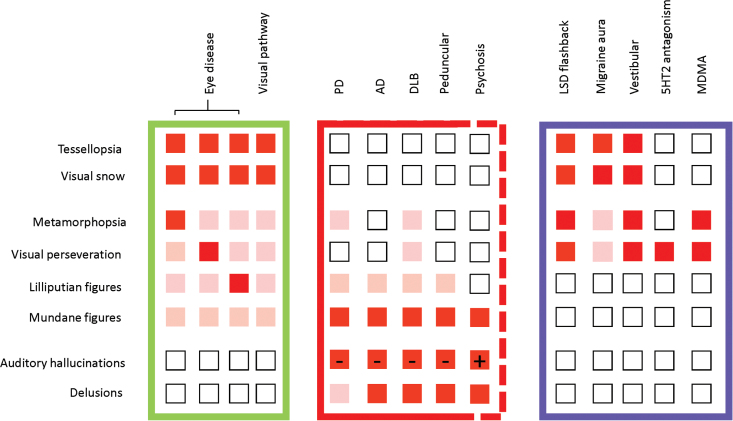
“[38], comparing VH across the psychotic spectrum, eye disease, neurodegenerative disease and the general population.”
InfluentialYates, J. R. (2026) · Springer eBooks · doi:10.1007/978-3-032-15602-0_3
Contrast sensitivity and subjective visual disturbances across the psychosis continuum
Zhang, Y., Brascamp, J. W., Bao, J. Y., Quackenbush, W., Delay, C., Jones, S., Carter, N. T., Silverstein, S. M., Keane, B. P., & Thakkar, K. N. (2026) · Cognitive Neuropsychiatry · doi:10.1080/13546805.2026.2678602
“Visual hallucinations occur in approximately 27% of individuals with a schizophrenia spectrum disorder (Waters et al., 2014) and refer to visual perception in the absence of corresponding sensory input.”
Retinal Origins of Aberrant Salience in Schizophrenia: The Perceptual Theory
Adámek, P., Rudolfová, V., Malenínská, K., & Horáček, J. (2026) · Biological Psychiatry Global Open Science · doi:10.1016/j.bpsgos.2026.100764
“Visual symptoms occur in approximately 60% of cases (114), ranging from 4% to 80.3% across studies depending on assessment and onset (115,116).”
InfluentialИнтегративная оценка дефицита зрительных функций при шизофрении: мета-аналитический подход
Владимировна, Б. Е., Shurupova, E. Y., & Зеленская, О. С. (2026) · Review of pedagogical research · doi:10.58224/2687-0428-2026-8-6-58-68
Sensory horizons, reality monitoring, and the higher-order nature of consciousness: A critical look
Axel Cleeremans, B., & Dołęga, K. (2026) · Behavioral and Brain Sciences · doi:10.1017/s0140525x25103415
坂東, 千., Okamoto, N., Chibaatar, E., Ide, S., Yoshimura, R., & Ikenouchi‐Sugita, A. (2026) · BMC Psychiatry · doi:10.1186/s12888-026-08334-0
“In contrast to visual hallucinations, illusions are characterized by the presence of a real sensory input underlying perception [1].”
Olson, R. K. N., & Wichlinski, L. J. (2026) · Psychiatry · doi:10.1080/00332747.2026.2680659
“This is about half the estimated prevalence of auditory halluci-nations—although visual hallucinations and auditory hallucinations are correlated, which may suggest similar underlying mechanisms (Waters et al., 2014).”
Aynsworth, C., Dudley, R. E. J., Sargeant, S., Humpston, C. S., & Waite, F. (2026) · Psychology and Psychotherapy Theory Research and Practice · doi:10.1111/papt.70074
Self-citationHewitt, T., Seth, A. K., & Schwartzman, D. J. (2026) · Royal Society Open Science · doi:10.1098/rsos.260647 · Cited by 1
Visual dysfunction and psychosis: A systematic review and meta-analysis
Escelsior, A., Zizzi, A., Dibiase, G., Ploner, L., Ferrante, A., Inuggi, A., Guglielmo, R., da Silva, B. P., Gori, M., Amore, M., et al. (2026) · Schizophrenia Research · doi:10.1016/j.schres.2026.08.032
Li, Z., Gong, J.-X., Fang, J., Huang, C., Pu, Y.-J., Xie, P., & Zhou, A.-B. (2026) · Vision Research · doi:10.1016/j.visres.2026.108912 · Cited by 1
Neurometabolic Differences in Psychosis Observed with 7 T Magnetic Resonance Spectroscopy
Schallmo, M., Demro, C., Killebrew, K. W., Sheldon, A. A., Olman, C. A., Sponheim, S. R., & Marjańska, M. (2026) · Schizophrenia Bulletin · doi:10.1093/schbul/sbag137
“28 – 30 Although altered visual perception among PwPP is well documented, 31 – 35 the neural bases of visual dysfunction remain unclear.”
Case report of visual hallucinations in anxiety.
Sachdeva, A., Ankit, S., & Manish, K. (2015) · Europe PMC (PubMed Central) · doi:10.11919/j.issn.1002-0829.215011
“Recent articles and reviews have estimated the point prevalence of visual hallucinations in schizophrenia,([5]) bipolar affective disorder,([5]) delirium,[6] and dementia with Lewy body.”
Background
Metadata
- Authors
- Waters, F., Collerton, D., ffytche, D. H., Jardri, R., Pins, D., Dudley, R., Blom, J. D., Mosimann, U. P., Eperjesi, F., Ford, S., & Larøi, F.
- Affiliations
- The University of Western Australia (AU)
- Cumbria Northumberland Tyne and Wear NHS Foundation Trust (GB)
- King's College London (GB)
- Centre Hospitalier Universitaire de Lille (FR)
- University of Groningen (NL)
- University of Bern (CH)
- Aston University (GB)
- Sir Charles Gairdner Hospital (AU)
- University of Liège (BE)
- Corresponding author
- Waters, Flavie
- ORCID
- Venue
- Schizophrenia Bulletin
- Publisher
- Oxford University Press (OUP)
- Published
- 2014-06-13
- Volume
- 40
- Issue
- Suppl_4
- Pages
- S233-S245
- ISSN
- 0586-7614 (ISSN-L)
- 1745-1701
- PMC
- PMC4141306
- OpenAlex
- W2146834289
- Cited by
- 325
- References
- 123
- Citations by year
- 2026: 21 · 2025: 33 · 2024: 23 · 2023: 33 · 2022: 33 · 2021: 31 · 2020: 37 · 2019: 29 · 2018: 19 · 2017: 20 · 2016: 26 · 2015: 12 · 2014: 8
- FWCI
- 12.27
- Type
- journal article
- Language
- en
- Open access
- hybrid
- doi.org
- Licence
- cc-by
- Locations
- Schizophrenia Bulletin (publishedVersion, cc-by)
- PubMed Central (publishedVersion, cc-by)
- UWA Profiles and Research Repository (UWA) (publishedVersion, other-oa)
- PubMed (publishedVersion)
- University of Groningen research database (University of Groningen / Centre for Information Technology) (publishedVersion)
- HAL (submittedVersion, other-oa)
- Aston Publications Explorer (Aston University) (submittedVersion)
- Bern Open Repository and Information System (University of Bern) (submittedVersion, cc-by)
- Research Portal (King's College London) (submittedVersion, other-oa)
- ORBi (University of Liège) (submittedVersion)
- University of Groningen research database (University of Groningen / Centre for Information Technology) (submittedVersion)
- Newcastle University ePrints (Newcastle Univesity)
- Open Access CRIS of the University of Bern
- Funders
- Coordenação de Aperfeiçoamento de Pessoal de Nível Superior
- Topics
- Life Sciences › Neuroscience › Cognitive Neuroscience › Hallucinations in medical conditions
- Health Sciences › Medicine › Psychiatry and Mental health › Schizophrenia research and treatment
- Life Sciences › Neuroscience › Cognitive Neuroscience › Visual perception and processing mechanisms
- Keywords
- visual hallucinations, psychosis spectrum
- MeSH terms
- Affective Disorders, Psychotic, Brain, Eye Diseases, Hallucinations, Humans, Schizophrenia, Schizophrenic Psychology, Severity of Illness Index, Visual Cortex, Neurodegenerative Diseases
About these checks
Registry, retraction, Cites and statistics results are computed, not judged, with one exception: a printed reference that no index lists is read once by a model before it counts as a citation error. Claims are extracted by a model and kept only when their quote appears verbatim in the text; each cited source is then checked, with a model’s help, for whether it says what the claim relies on. Those verdicts can be wrong — read the claim’s quote and the cited source before relying on one.
Statistics and arithmetic are recomputed, not judged.
Confidence bands are shown only for fields calibrated on our annotated test set. None is calibrated yet, so no band is shown.
What counts as a claim ›How we measure confidence ›How we check this ›
Are you an author, or do you see a problem with this page? Request a review
