

The DOI matches its Crossref record; 49 of the 50 references it cites were found in a registry or an index.
Psychosis, Delusions and the “Jumping to Conclusions” Reasoning Bias: A Systematic Review and Meta-analysis
Open accessAbstract
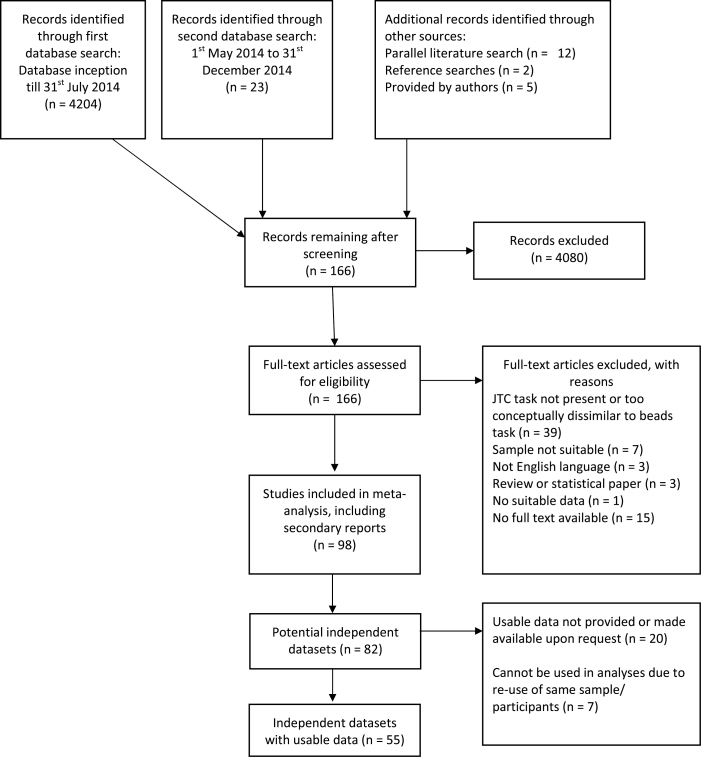
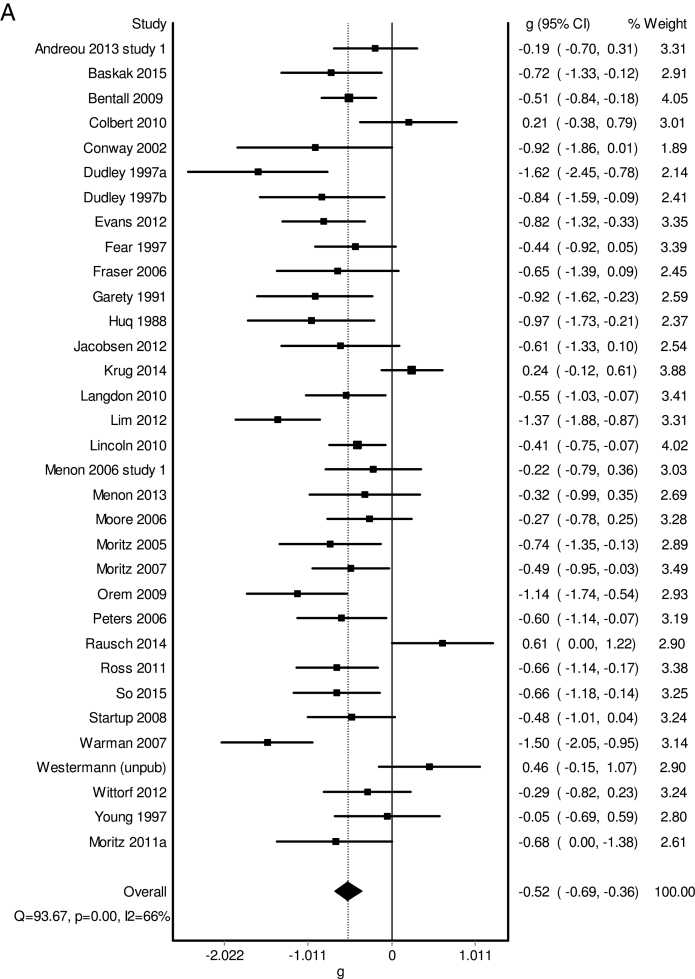
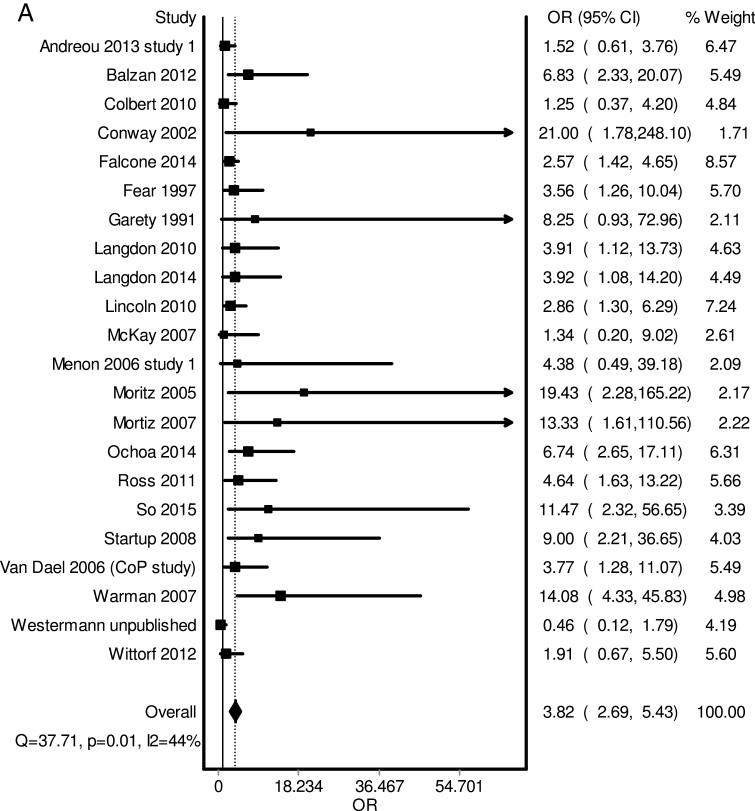
We did a systematic review and meta-analysis to investigate the magnitude and specificity of the "jumping to conclusions" (JTC) bias in psychosis and delusions. We examined the extent to which people with psychosis, and people with delusions specifically, required less information before making decisions. We examined (1) the average amount of information required to make a decision and (2) numbers who demonstrated an extreme JTC bias, as assessed by the "beads task." We compared people with psychosis to people with and without nonpsychotic mental health problems, and people with psychosis with and without delusions. We examined whether reduced data-gathering was associated with increased delusion severity. We identified 55 relevant studies, and acquired previously unpublished data from 16 authors. People with psychosis required significantly less information to make decisions than healthy individuals (k= 33,N= 1935,g= -0.53, 95% CI -0.69, -0.36) and those with nonpsychotic mental health problems (k= 13,N= 667,g= -0.58, 95% CI -0.80, -0.35). The odds of extreme responding in psychosis were between 4 and 6 times higher than the odds of extreme responding by healthy participants and participants with nonpsychotic mental health problems. The JTC bias was linked to a greater probability of delusion occurrence in psychosis (k= 14,N= 770, OR 1.52, 95% CI 1.12, 2.05). There was a trend-level inverse association between data-gathering and delusion severity (k= 18;N= 794;r= -.09, 95% CI -0.21, 0.03). Hence, nonaffective psychosis is characterized by a hasty decision-making style, which is linked to an increased probability of delusions.
Overview
The claims and statistics of this paper haven’t been checked yet.
Run the check — free, no account needed. It reads the open-access text and checks the sources it cites.
Integrity signals
Registry
Cites
Statistics
Figures
Verification
Claims the paper makes
The claims and statistics of this paper haven’t been checked yet.
Run the check — free, no account needed. It reads the open-access text and checks the sources it cites.
Claims other papers make about this one
Each is checked against this paper’s own text: does it say what the citing paper says it does?
In the citing paper
“The typical finding is that those induced to experience negative affect reported significantly more paranoid thoughts and a more pronounced Jumping to Conclusions bias (JTC, for a review see [36] when compared to participants who were not induced to experience negative affect [35, 36].”
From A structural equation model of the relationship between insomnia, negative affect, and paranoid thinking (2017) · cites this paper as [36]
Self-check
Percentages, sums and reported differences re-computed from the paper’s own numbers.
The self-check needs the paper’s full text.
Citations
Cites
Meta-analysis in clinical trials
DerSimonian, R., & Laird, N. (1986) · Controlled Clinical Trials · doi:10.1016/0197-2456(86)90046-2 · Cited by 39,552
Cochrane Handbook for Systematic Reviews of Interventions: Cochrane Book Series
(2008) · doi:10.1002/9780470712184 · Cited by 25,048
Borenstein, M., Hedges, L. V., Higgins, J. P. T., & Rothstein, H. R. (2009) · doi:10.1002/9780470743386 · Cited by 14,225
Borenstein, M., Hedges, L. V., Higgins, J. P. T., & Rothstein, H. R. (2021) · doi:10.1002/9781119558378 · Cited by 9,799
The environment and disease: association or causation?
Hill, A. B. (2015) · Journal of the Royal Society of Medicine · doi:10.1177/0141076814562718 · Cited by 7,804
Varese, F., Smeets, F., Drukker, M., Lieverse, R., Lataster, T., Viechtbauer, W., Read, J., van Os, J., & Bentall, R. P. (2012) · Schizophrenia Bulletin · doi:10.1093/schbul/sbs050 · Cited by 2,436
Harbord, R. M., & Higgins, J. P. T. (2008) · The Stata Journal: Promoting communications on statistics and Stata · doi:10.1177/1536867x0800800403 · Cited by 897
Suspicious minds: The psychology of persecutory delusions
Freeman, D. (2007) · Clinical Psychology Review · doi:10.1016/j.cpr.2006.10.004 · Cited by 814
Peters, E. R., Joseph, S. A., & Garety, P. A. (1999) · Schizophrenia Bulletin · doi:10.1093/oxfordjournals.schbul.a033401 · Cited by 771
Sterne, J. A., Egger, M., & Moher, D. (2008) · Cochrane Handbook for Systematic Reviews of Interventions · doi:10.1002/9780470712184.ch10 · Cited by 651
Cited by
Sorted by citations
Items 101–200 of 353
Nucleus accumbens activation is linked to salience in social decision making
Schmidt, S. N. L., Fenske, S. C., Kirsch, P., & Mier, D. U. (2018) · European Archives of Psychiatry and Clinical Neuroscience · doi:10.1007/s00406-018-0947-6 · Cited by 18
Buck, B., Gagen, E. C., Luther, L., Kukla, M., & Lysaker, P. H. (2019) · Journal of Clinical Psychology · doi:10.1002/jclp.22904 · Cited by 20
Dynamic Representation of the Subjective Value of Information
Kobayashi, K., Lee, S., Filipowicz, A. L. S., McGaughey, K. D., Kable, J. W., & Nassar, M. R. (2021) · Journal of Neuroscience · doi:10.1523/jneurosci.0423-21.2021 · Cited by 17
Nicholas Furl, A., Coltheart, M., & McKay, R. (2024) · Oxford University Press eBooks · doi:10.1093/oso/9780198872221.003.0012 · Cited by 19
Thinking dispositions and cognitive reflection performance in schizotypy
Broyd, A., Ettinger, U., & Thoma, V. (2019) · Judgment and Decision Making · doi:10.1017/s193029750000293x · Cited by 18
The relationship between jumping to conclusions and social cognition in first-episode psychosis
Díaz-Cutraro, L., López‐Carrilero, R., García‐Mieres, H., Ferrer-Quintero, M., Verdaguer-Rodríguez, M., Barajas, A., Grasa, E., Pousa, E., Lorente, E., Barrigón, M. L., et al. (2022) · Schizophrenia · doi:10.1038/s41537-022-00221-3 · Cited by 18
A prefrontal thalamocortical readout for conflict-related executive dysfunction in schizophrenia
Huang, A., Wimmer, R. D., Lam, N. H., Wang, B., Suresh, S., Roeske, M. J., Pleger, B., Halassa, M. M., & Woodward, N. D. (2024) · Cell Reports Medicine · doi:10.1016/j.xcrm.2024.101802 · Cited by 18
Prochwicz, K., Kłosowska, J., & Dembińska, A. (2020) · Frontiers in Psychiatry · doi:10.3389/fpsyt.2020.00307 · Cited by 22
Moritz, S., Menon, M., Andersen, D., Woodward, T. S., & Gallinat, J. (2017) · Cognitive Therapy and Research · doi:10.1007/s10608-017-9868-3 · Cited by 17
Andreou, C., Steinmann, S., Leicht, G., Kolbeck, K., Moritz, S., & Mulert, C. (2018) · NeuroImage Clinical · doi:10.1016/j.nicl.2018.07.004 · Cited by 17
Mikus, N., Lamm, C., & Mathys, C. (2025) · Biological Psychiatry · doi:10.1016/j.biopsych.2024.08.021 · Cited by 16
Bredemeier, K., McCole, K., Luther, L., Beck, A. T., & Grant, P. M. (2018) · Journal of Psychopathology and Behavioral Assessment · doi:10.1007/s10862-018-9714-2 · Cited by 16
Jumping to conclusions in the less-delusion-prone? Further evidence from a more reliable beads task
McLean, B. F., Balzan, R. P., & Mattiske, J. K. (2020) · Consciousness and Cognition · doi:10.1016/j.concog.2020.102956 · Cited by 17
McLean, B. F., Mattiske, J. K., & Balzan, R. P. (2020) · Journal of Behavior Therapy and Experimental Psychiatry · doi:10.1016/j.jbtep.2020.101562 · Cited by 16
The influence of anxiety on exploration: A review of computational modeling studies
Chou, K.-P., Wilson, R. C., & Smith, R. S. (2024) · Neuroscience & Biobehavioral Reviews · doi:10.1016/j.neubiorev.2024.105940 · Cited by 18
Samson, C., Livet, A., Gilker, A., Potvin, S., Sicard, V., & Lecomte, T. (2024) · PLoS ONE · doi:10.1371/journal.pone.0314965 · Cited by 18
Clinical insight in first-episode psychosis: Clinical, neurocognitive and metacognitive predictors
Pousa, E., Brébion, G., López‐Carrilero, R., Ruiz, A. I., Grasa, E., Barajas, A., Peláez, T., Alfonso-Gutiérrrez-Zotes, Lorente, E., Barrigón, M. L., et al. (2022) · Schizophrenia Research · doi:10.1016/j.schres.2022.08.007 · Cited by 15
Social identification and paranoia
Greenburgh, A., Zamperetti, L., Bell, V., & Raihani, N. (2024) · Royal Society Open Science · doi:10.1098/rsos.231961 · Cited by 13
Turner, D. T., MacBeth, A. M., Larkin, A., Moritz, S., Livingstone, K., Campbell, A., & Hutton, P. (2018) · Schizophrenia Bulletin · doi:10.1093/schbul/sby136 · Cited by 14
Self-citationPersons with first episode psychosis have distinct profiles of social cognition and metacognition
Ferrer-Quintero, M., Fernández, D., López‐Carrilero, R., Birulés, I., Barajas, A., Lorente-Rovira, E., Díaz-Cutraro, L., Verdaguer-Rodríguez, M., García‐Mieres, H., Sevilla‐Llewellyn‐Jones, J., et al. (2021) · Schizophrenia · doi:10.1038/s41537-021-00187-8 · Cited by 14
Paranoia: From Passive Social-Threat Perception to Misattunement in Social Interaction
Hajdúk, M., Sasson, N. J., Park, S., & Pinkham, A. E. (2024) · Clinical Psychological Science · doi:10.1177/21677026231218639 · Cited by 16
Why is belief in God not a delusion?
Ross, R. M., & McKay, R. (2017) · Religion Brain & Behavior · doi:10.1080/2153599x.2016.1249917 · Cited by 14
The role of cognitive and metacognitive factors in non‐clinical paranoia and negative affect
Sellers, R., Emsley, R., Adrian Wells, A., & Morrison, A. P. (2017) · Psychology and Psychotherapy Theory Research and Practice · doi:10.1111/papt.12154 · Cited by 15
Strube, W., Marshall, L., Quattrocchi, G., Little, S. J., Cimpianu, C.-L., Ulbrich, M., Schneider-Axmann, T., Falkai, P., Hasan, A., & Bestmann, S. (2020) · Biological Psychiatry · doi:10.1016/j.biopsych.2020.03.018 · Cited by 15
Müller, H., Betz, L. T., & Bechdolf, A. (2020) · Neuroscience & Biobehavioral Reviews · doi:10.1016/j.neubiorev.2020.09.025 · Cited by 14
Abbott, J., Middlemiss, M., Bruce, V., Smailes, D., & Dudley, R. E. J. (2018) · Journal of Behavior Therapy and Experimental Psychiatry · doi:10.1016/j.jbtep.2018.02.007 · Cited by 14
Self-citationCorral, L., Labad, J., Ochoa, S., Cabezas, Á., Muntané, G., Valero, J., Sánchez‐Gistau, V., Ahuir, M., Gallardo‐Pujol, D., Crosas, J. M., et al. (2021) · Frontiers in Psychiatry · doi:10.3389/fpsyt.2020.596625 · Cited by 14
Strube, W., Cimpianu, C.-L., Ulbrich, M., Öztürk, Ö., Schneider-Axmann, T., Falkai, P., Marshall, L., Bestmann, S., & Hasan, A. (2021) · Schizophrenia Bulletin · doi:10.1093/schbul/sbab108 · Cited by 12
Dickson, J. M., Barsky, J., Kinderman, P., King, D., & Taylor, P. J. (2016) · Psychiatry Research · doi:10.1016/j.psychres.2016.02.006 · Cited by 12
Self-citationCaravaggio, F., Gerretsen, P., Mar, W., Chung, J., Plitman, E., Nakajima, S., Kim, J., Iwata, Y., Patel, R., Chakravarty, M., et al. (2017) · Psychoneuroendocrinology · doi:10.1016/j.psyneuen.2017.03.020 · Cited by 12
Investigation of sex differences in delusion-associated cognitive biases
de Vos, C., Leanza, L., Mackintosh, A., Lüdtke, T., Balzan, R. P., Moritz, S., & Andreou, C. (2018) · Psychiatry Research · doi:10.1016/j.psychres.2018.12.121 · Cited by 11
Lüdtke, T., Platow-Kohlschein, H., Rüegg, N., Berger, T., Moritz, S., & Westermann, S. (2020) · Frontiers in Psychiatry · doi:10.3389/fpsyt.2020.00228 · Cited by 12
Differential relationship of jumping-to-conclusions and incorrigibility with delusion severity
Andreou, C., Veckenstedt, R., Lüdtke, T., Bozikas, V. P., & Moritz, S. (2018) · Psychiatry Research · doi:10.1016/j.psychres.2018.04.014 · Cited by 12
Vanessa Acuña, P., Álvaro Cavieres, F., Marcelo Arancibia, M., Escobar, C., Moritz, S., Gawęda, Ł., Lamarca, M., Berna, F. S., König, C., & Ochoa, S. (2024) · Clinical Psychology & Psychotherapy · doi:10.1002/cpp.3065 · Cited by 11
Functional brain networks underlying probabilistic reasoning and delusions in schizophrenia
Fouladirad, S., Chen, L., Roes, M., Chinchani, A. M., Percival, C. M., Khangura, J., Zahid, H. B., Moscovitz, A. M., Arreaza, L., Wun, C., et al. (2022) · Psychiatry Research Neuroimaging · doi:10.1016/j.pscychresns.2022.111472 · Cited by 15
Lüdtke, T., Hedelt, K. S., & Westermann, S. (2023) · Journal of Behavior Therapy and Experimental Psychiatry · doi:10.1016/j.jbtep.2023.101885 · Cited by 11
Bayesian Inference, Predictive Coding, and Computational Models of Psychosis
Adams, R. A. (2017) · Elsevier eBooks · doi:10.1016/b978-0-12-809825-7.00007-9 · Cited by 16
Prochwicz, K., & Kłosowska, J. (2017) · Psychiatry Research · doi:10.1016/j.psychres.2017.09.085 · Cited by 12
Kotowicz, K., Frydecka, D., Gawęda, Ł., Prochwicz, K., Kłosowska, J., Rymaszewska, J., Samochowiec, A., Samochowiec, J., Szczygieł, K., Pawlak, E., et al. (2019) · Early Intervention in Psychiatry · doi:10.1111/eip.12925 · Cited by 11
Sleep problems and worrying precede psychotic symptoms during an online intervention for psychosis
Lüdtke, T., Pfuhl, G., Moritz, S., Rüegg, N., Berger, T., & Westermann, S. (2020) · British Journal of Clinical Psychology · doi:10.1111/bjc.12270 · Cited by 10
Circular inference predicts nonuniform overactivation and dysconnectivity in brain-wide connectomes
Bouttier, V., Duttagupta, S., Denève, S., & Jardri, R. (2021) · Schizophrenia Research · doi:10.1016/j.schres.2020.12.045 · Cited by 14
Croft, J., Teufel, C., Heron, J., Fletcher, P. C., David, A. S., Lewis, G., Moutoussis, M., FitzGerald, T. H. B., Linden, D. E. J., Thompson, A. D., et al. (2021) · Biological Psychiatry Cognitive Neuroscience and Neuroimaging · doi:10.1016/j.bpsc.2021.12.007 · Cited by 11
A Bayesian perspective on delusions: Suggestions for modifying two reasoning tasks
Pfuhl, G. (2016) · Journal of Behavior Therapy and Experimental Psychiatry · doi:10.1016/j.jbtep.2016.08.006 · Cited by 10
Miyata, J., Sasamoto, A., Ezaki, T., Isobe, M., Kochiyama, T., Masuda, N., Mori, Y., Sakai, Y., Sawamoto, N., Tei, S., et al. (2024) · Psychiatry and Clinical Neurosciences · doi:10.1111/pcn.13652 · Cited by 12
Hayashi, R., Kuroda, K., & Inadomi, H. (2022) · Asian Journal of Psychiatry · doi:10.1016/j.ajp.2022.103068 · Cited by 10
Pena-Garijo, J., Palop-Grau, A., Masanet, M. J., Lacruz, M., Plaza, R., Hernández-Merino, A., Villamón, S. E., & Valllina, O. (2022) · Journal of Psychiatric Research · doi:10.1016/j.jpsychires.2022.09.041 · Cited by 10
Damiani, S., Silva, A. A., Donadeo, A., Giovannelli, M. E., Pavone, F., Farinella, E., Rocchetti, M., Politi, P., & Fusar‐Poli, P. (2023) · European Archives of Psychiatry and Clinical Neuroscience · doi:10.1007/s00406-023-01728-1 · Cited by 13
Time will tell: Decision making in premanifest and manifest Huntington’s disease
Heim, B., Peball, M., Carsten Saft, C., Hein, S., Ellmerer, P., Piater, J. M., Seppi, K., & Djamshidian, A. (2020) · Brain and Behavior · doi:10.1002/brb3.1843 · Cited by 10
Pena-Garijo, J., & Monfort-Escrig, C. (2021) · Journal of Psychiatric Research · doi:10.1016/j.jpsychires.2021.01.002 · Cited by 10
The effects of base rate neglect on sequential belief updating and real-world beliefs
Ashinoff, B. K., Buck, J., Woodford, M., & Horga, G. (2022) · PLoS Computational Biology · doi:10.1371/journal.pcbi.1010796 · Cited by 12
van der Leer, L., Hartig, B., Goldmanis, M., & McKay, R. (2017) · Clinical Psychological Science · doi:10.1177/2167702617698811 · Cited by 12
Knolle, F., Sen, P., Culbreth, A., Koch, K., Schmitz-Koep, B., Gürsel, D. A., Wunderlich, K., Avram, M., Berberich, G., Sorg, C., et al. (2024) · Journal of Psychiatry and Neuroscience · doi:10.1503/jpn.240020 · Cited by 9
Le, T. P., Fedechko, T. L., Cohen, A. S., Allred, S., Pham, C. N., Lewis, S. W., & Barkus, E. (2019) · European Psychiatry · doi:10.1016/j.eurpsy.2019.08.006 · Cited by 9
Wu, Z., Jiang, Z., Wang, Z., Ji, Y., Wang, F., Ross, B., Sun, X., Liu, Z., & Long, Y. (2022) · Frontiers in Psychiatry · doi:10.3389/fpsyt.2022.814242 · Cited by 9
Gregersen, M., Rohd, S. B., Jepsen, J. R. M., Brandt, J. M., Søndergaard, A., Hjorthøj, C. R., Knudsen, C. B., Andreassen, A. K., Veddum, L., Ohland, J., et al. (2022) · Schizophrenia Bulletin · doi:10.1093/schbul/sbac060 · Cited by 10
Lybarger, K., Tauscher, J. S., Ding, X., Ben‐Zeev, D., & Cohen, T. (2022) · Workshop on Computational Linguistics and Clinical Psychology (CLPsych) · doi:10.18653/v1/2022.clpsych-1.11 · Cited by 10
Prochwicz, K., Kłosowska, J., & Sznajder, D. (2018) · Comprehensive Psychiatry · doi:10.1016/j.comppsych.2018.02.001 · Cited by 10
Prochwicz, K., & Kłosowska, J. (2018) · Psychiatry Research · doi:10.1016/j.psychres.2018.04.023 · Cited by 11
Aberrant adapting of beliefs under stress: a mechanism relevant to the formation of paranoia?
Krkovic, K., Nowak, U., Kammerer, M. K., Bott, A., & Lincoln, T. M. (2021) · Psychological Medicine · doi:10.1017/s0033291721003524 · Cited by 9
Ward, T., Hardy, A., Holm, R. L., Collett, N., Rus‐Calafell, M., Sacadura, C., McGourty, A., Vella, C., East, A., Rea, M., et al. (2022) · Psychology and Psychotherapy Theory Research and Practice · doi:10.1111/papt.12377 · Cited by 7
Doherty, R., Weber, N., Hillier, C., Ross, R., & Balzan, R. (2025) · Clinical Psychology Review · doi:10.1016/j.cpr.2025.102618 · Cited by 9
Speck, M., & Witthöft, M. (2022) · Journal of Psychosomatic Research · doi:10.1016/j.jpsychores.2022.110808 · Cited by 8
Hillmann, T. E., Ascone, L., Kempkensteffen, J., & Lincoln, T. M. (2016) · Journal of Behavior Therapy and Experimental Psychiatry · doi:10.1016/j.jbtep.2016.08.013 · Cited by 9
Measuring Reasoning in Paranoia: Development of the Fast and Slow Thinking Questionnaire
Hardy, A., Tolmeijer, E., Edwards, V., Ward, T., Freeman, D. H., Emsley, R., Green, C., Rus‐Calafell, M., Greenwood, K., Bebbington, P., et al. (2020) · Schizophrenia Bulletin Open · doi:10.1093/schizbullopen/sgaa035 · Cited by 8
Scheunemann, J., Fischer, R., & Moritz, S. (2021) · Frontiers in Psychiatry · doi:10.3389/fpsyt.2021.612810 · Cited by 8
Andreou, C., Steinmann, S., Kolbeck, K., Rauh, J., Leicht, G., Moritz, S., & Mulert, C. (2018) · NeuroImage · doi:10.1016/j.neuroimage.2018.02.039 · Cited by 8
Mehl, S., Schlier, B., & Lincoln, T. M. (2018) · Zeitschrift für Psychologie · doi:10.1027/2151-2604/a000335 · Cited by 12
Trends in Schizophrenia Diagnosis and Treatment
Gäebel, W., Riesbeck, M., Larach, V. W., Falkai, P., & Zielasek, J. (2018) · Springer eBooks · doi:10.1007/978-3-319-70554-5_35 · Cited by 8
Investigating the jumping to conclusion bias in bipolar disorder
Can, S. S., Atagün, M. İ., Korkmaz, Ş. A., & Soykan, Ç. (2019) · Cognitive Neuropsychiatry · doi:10.1080/13546805.2019.1606708 · Cited by 8
Díaz-Cutraro, L., García‐Mieres, H., López‐Carrilero, R., Ferrer‐García, M., Verdaguer-Rodríguez, M., Barrigón, M. L., Barajas, A., Grasa, E., Pousa, E., Lorente, E., et al. (2021) · Schizophrenia Research · doi:10.1016/j.schres.2020.12.037 · Cited by 9
Selective effects of serotonin on choices to gather more information
Livermore, J. J. A., Holmes, C. L., Cutler, J., Levstek, M., Moga, G., Brittain, J. R., & Campbell-Meiklejohn, D. K. (2021) · Journal of Psychopharmacology · doi:10.1177/0269881121991571 · Cited by 8
Individual differences in belief updating and phasic arousal are related to psychosis proneness
Murphy, P. R., Krkovic, K., Monov, G., Kudlek, N., Lincoln, T. M., & Donner, T. H. (2024) · Communications Psychology · doi:10.1038/s44271-024-00140-2 · Cited by 11
Smigielski, L., Wotruba, D., Treyer, V., Rössler, J., Papiol, S., Falkai, P., Grünblatt, E., Walitza, S., & Wulf Rössler, A. (2021) · Schizophrenia Bulletin · doi:10.1093/schbul/sbab034 · Cited by 7
Xenaki, L., Stefanatou, P., Ralli, E., Hatzimanolis, A., Dimitrakopoulos, S., Soldatos, R. F., Vlachos, I. I., Selaković, M., Foteli, S., Kosteletos, I., et al. (2021) · Schizophrenia Research · doi:10.1016/j.schres.2021.11.039 · Cited by 10
Views of young people with psychosis on using virtual reality assisted therapy. A qualitative study
Holgersen, G., Nordgreen, T., Hegelstad, W. T. V., & Elgen, I. B. (2022) · Early Intervention in Psychiatry · doi:10.1111/eip.13331 · Cited by 9
Kuokkanen, R., Lappalainen, R. I., Repo‐Tiihonen, E., Tiihonen, J., & Aho‐Mustonen, K. (2016) · Journal of Forensic Psychology Practice · doi:10.1080/15228932.2016.1192337 · Cited by 7
Prochwicz, K., Kłosowska, J., & Karpowska, M. (2017) · Psychiatry Research · doi:10.1016/j.psychres.2017.07.007 · Cited by 9
Bastiaens, T., Claes, L., Smits, D., Vanwalleghem, D., & de Hert, M. (2017) · Journal of Nervous and Mental Disease · doi:10.1097/nmd.0000000000000763 · Cited by 5
De-Rationalising DelusionsPreprint
Bell, V., Raihani, N., & Wilkinson, S. (2019) · doi:10.31234/osf.io/4p9zs · Cited by 7
Characterizing the spiral: potential mechanisms in AI-associated delusions
Augustin, M., Pollak, T. A., & Morrin, H. (2026) · NPP—Digital Psychiatry and Neuroscience · doi:10.1038/s44277-026-00065-0 · Cited by 13
Jagtap, S., & Best, M. W. (2023) · Journal of Behavior Therapy and Experimental Psychiatry · doi:10.1016/j.jbtep.2023.101935 · Cited by 6
Moritz, S., Leucht, S., Hoyer, L. N., Schmotz, S., Amitai Abramovitch, A., & Jelinek, L. (2024) · Psychiatry Research · doi:10.1016/j.psychres.2024.116306 · Cited by 6
Halaj, A., Strauss, A. Y., Zalaznik, D., Fradkin, I., Zlotnick, E., Andersson, G., Ebert, D. D., & Huppert, J. D. (2023) · Cognitive Behaviour Therapy · doi:10.1080/16506073.2023.2179539 · Cited by 6
Sánchez‐Gistau, V., Cabezas, Á., Manzanares, N., Solé, M., Corral, L., Vilella, E., & Gutiérrez‐Zotes, A. (2023) · Frontiers in Psychology · doi:10.3389/fpsyg.2023.1127535 · Cited by 6
Dzafic, I., Burianová, H., Martin, A. K., & Mowry, B. J. (2018) · Schizophrenia Research · doi:10.1016/j.schres.2018.06.015 · Cited by 6
QAnon as an Online-Facilitated Cult
Cohen, S. J. (2022) · Journal of Religion and Violence · doi:10.5840/jrv202272197 · Cited by 7
Moritz, S., Göritz, A. S., Franz, C., Sibilis, A., Voßberger, H., Balzan, R. P., & Scheunemann, J. (2022) · Psychiatry Research · doi:10.1016/j.psychres.2022.114862 · Cited by 6
Puveendrakumaran, P., Fervaha, G., Caravaggio, F., & Remington, G. J. (2019) · Psychiatry Research · doi:10.1016/j.psychres.2019.112683 · Cited by 7
Moritz, S., Stojisavlevic, M., Göritz, A. S., Riehle, M., & Scheunemann, J. (2019) · Cognitive Neuropsychiatry · doi:10.1080/13546805.2019.1642863 · Cited by 6
Overly strong priors for socially meaningful visual signals in psychosis pronenessPreprint
Stuke, H., Kress, E., Weilnhammer, V. A., Sterzer, P., & Schmack, K. (2018) · bioRxiv (Cold Spring Harbor Laboratory) · doi:10.1101/473421 · Cited by 6
The contributions of risk-taking and impulsivity to jumping to conclusions in the psychosis spectrum
Gabbert, T., Scheunemann, J., Balzan, R. P., Doehring, N., Elmers, J., & Moritz, S. (2024) · Schizophrenia Research · doi:10.1016/j.schres.2024.04.025 · Cited by 5
Peinado, V., Valiente, C., Contreras, A., Trucharte, A., & Vázquez, C. (2024) · Personality and Individual Differences · doi:10.1016/j.paid.2024.112782 · Cited by 5
Nguyen, P., Diaz, S. A., Friedrich, S., Krause, K., Schneider, S., & Rus‐Calafell, M. (2025) · Early Intervention in Psychiatry · doi:10.1111/eip.70084 · Cited by 5
Delusions: Understanding the Un-understandable
McKenna, P. J. (2017) · Cited by 6
Underwood, R., Mason, L., O’Daly, O., Dalton, J., Simmons, A., Barker, G. J., PETERS, E. R., & Kumari, V. (2021) · Schizophrenia · doi:10.1038/s41537-021-00173-0 · Cited by 5
Thinking style and psychosis proneness do not predict false insights
Grimmer, H. J., Laukkonen, R., Freydenzon, A., von Hippel, W., & Tangen, J. M. (2022) · Consciousness and Cognition · doi:10.1016/j.concog.2022.103384 · Cited by 6
Bayesian reasoning with emotional material in patients with schizophrenia
Romero‐Ferreiro, V., García, R. S., Sánchez‐Morla, E. M., Marı́-Beffa, P., Rodríguez-Gómez, P., Amador, J., Moreno, E. M., Romero, C., Martínez-García, N., & Rodríguez–Jiménez, R. (2022) · Frontiers in Psychology · doi:10.3389/fpsyg.2022.827037 · Cited by 5
Hutton, P., KELLY, J. A., Taylor, C. D. J., Williams, B., Emsley, R., Alexander, C. H., Vikram, A., Saddington, D., McCann, A., Burke, J., et al. (2023) · Pilot and Feasibility Studies · doi:10.1186/s40814-023-01323-0 · Cited by 5
Self-citationMetacognitive training in the acute psychiatric care setting: feasibility, acceptability, and safety
Fischer, R., Nagel, M., Schöttle, D., Lüdecke, D., Lassay, F., Moritz, S., & Scheunemann, J. (2023) · Frontiers in Psychology · doi:10.3389/fpsyg.2023.1247725 · Cited by 6
Metadata
- Authors
- Dudley, R., Taylor, P., Wickham, S., & Hutton, P.
- Affiliations
- Cumbria Northumberland Tyne and Wear NHS Foundation Trust (GB)
- University of Liverpool (GB)
- University of Edinburgh (GB)
- Corresponding author
- Dudley, Robert
- Venue
- Schizophrenia Bulletin
- Publisher
- Oxford University Press (OUP)
- Published
- 2015-10-31
- Volume
- 42
- Issue
- 3
- Pages
- 652-665
- ISSN
- 0586-7614 (ISSN-L)
- 1745-1701
- PMC
- PMC4838082
- OpenAlex
- W2163505421
- Cited by
- 353
- References
- 50
- Citations by year
- 2026: 43 · 2025: 28 · 2024: 29 · 2023: 29 · 2022: 33 · 2021: 43 · 2020: 30 · 2019: 29 · 2018: 38 · 2017: 28 · 2016: 20 · 2015: 1
- FWCI
- 3.99
- Type
- journal article
- Language
- en
- Open access
- hybrid
- doi.org
- Licence
- cc-by-nc
- Locations
- Schizophrenia Bulletin (publishedVersion, cc-by-nc)
- PubMed Central (publishedVersion, cc-by-nc)
- PubMed (publishedVersion)
- Edinburgh Napier Research Repository (Edinburgh Napier University) (submittedVersion, cc-by-nc)
- HighWire Press Open Archive (submittedVersion)
- Research Explorer (The University of Manchester) (submittedVersion, other-oa)
- Edinburgh Research Explorer (University of Edinburgh) (submittedVersion, cc-by-nc)
- Newcastle University ePrints (Newcastle Univesity)
- Topics
- Health Sciences › Medicine › Psychiatry and Mental health › Schizophrenia research and treatment
- Social Sciences › Arts and Humanities › Philosophy › Mental Health and Psychiatry
- Social Sciences › Decision Sciences › General Decision Sciences › Decision-Making and Behavioral Economics
- Keywords
- psychosis, delusions
- MeSH terms
- Decision Making, Delusions, Humans, Psychotic Disorders
About these checks
Registry, retraction, Cites and statistics results are computed, not judged, with one exception: a printed reference that no index lists is read once by a model before it counts as a citation error. Claims are extracted by a model and kept only when their quote appears verbatim in the text; each cited source is then checked, with a model’s help, for whether it says what the claim relies on. Those verdicts can be wrong — read the claim’s quote and the cited source before relying on one.
Statistics and arithmetic are recomputed, not judged.
Confidence bands are shown only for fields calibrated on our annotated test set. None is calibrated yet, so no band is shown.
What counts as a claim ›How we measure confidence ›How we check this ›
Are you an author, or do you see a problem with this page? Request a review
