

The DOI matches its Crossref record; 49 of the 50 references it cites were found in a registry or an index.
Psychosis, Delusions and the “Jumping to Conclusions” Reasoning Bias: A Systematic Review and Meta-analysis
Open accessAbstract
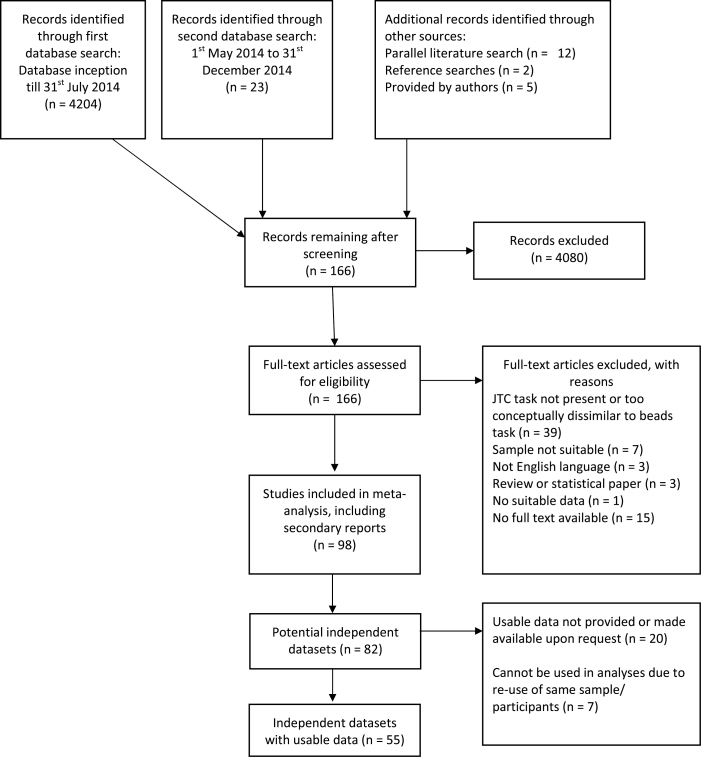
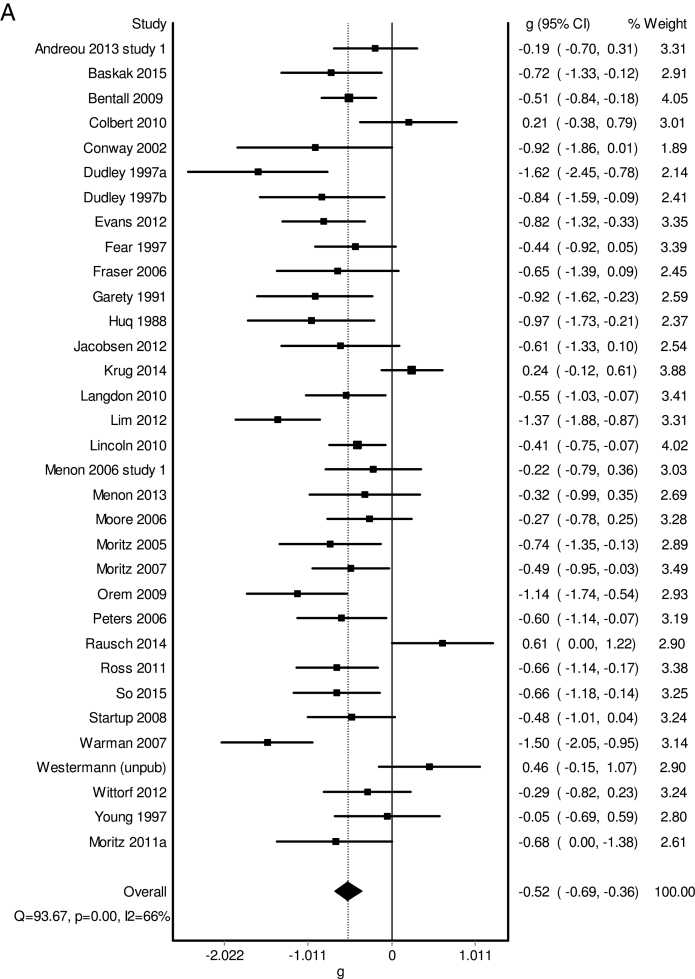
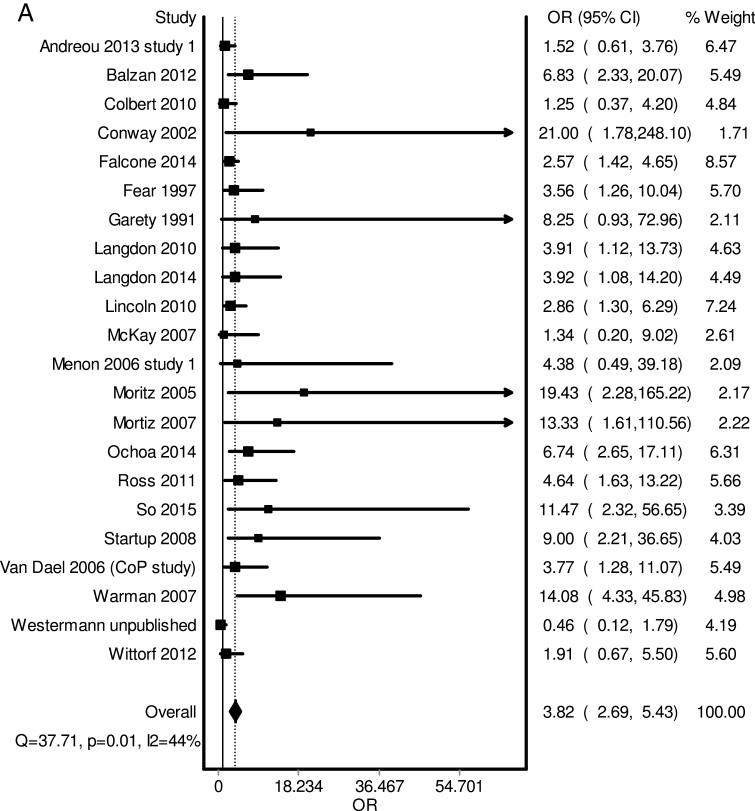
We did a systematic review and meta-analysis to investigate the magnitude and specificity of the "jumping to conclusions" (JTC) bias in psychosis and delusions. We examined the extent to which people with psychosis, and people with delusions specifically, required less information before making decisions. We examined (1) the average amount of information required to make a decision and (2) numbers who demonstrated an extreme JTC bias, as assessed by the "beads task." We compared people with psychosis to people with and without nonpsychotic mental health problems, and people with psychosis with and without delusions. We examined whether reduced data-gathering was associated with increased delusion severity. We identified 55 relevant studies, and acquired previously unpublished data from 16 authors. People with psychosis required significantly less information to make decisions than healthy individuals (k= 33,N= 1935,g= -0.53, 95% CI -0.69, -0.36) and those with nonpsychotic mental health problems (k= 13,N= 667,g= -0.58, 95% CI -0.80, -0.35). The odds of extreme responding in psychosis were between 4 and 6 times higher than the odds of extreme responding by healthy participants and participants with nonpsychotic mental health problems. The JTC bias was linked to a greater probability of delusion occurrence in psychosis (k= 14,N= 770, OR 1.52, 95% CI 1.12, 2.05). There was a trend-level inverse association between data-gathering and delusion severity (k= 18;N= 794;r= -.09, 95% CI -0.21, 0.03). Hence, nonaffective psychosis is characterized by a hasty decision-making style, which is linked to an increased probability of delusions.
Overview
The claims and statistics of this paper haven’t been checked yet.
Run the check — free, no account needed. It reads the open-access text and checks the sources it cites.
Integrity signals
Registry
Cites
Statistics
Figures
Verification
Claims the paper makes
The claims and statistics of this paper haven’t been checked yet.
Run the check — free, no account needed. It reads the open-access text and checks the sources it cites.
Claims other papers make about this one
Each is checked against this paper’s own text: does it say what the citing paper says it does?
In the citing paper
“The typical finding is that those induced to experience negative affect reported significantly more paranoid thoughts and a more pronounced Jumping to Conclusions bias (JTC, for a review see [36] when compared to participants who were not induced to experience negative affect [35, 36].”
From A structural equation model of the relationship between insomnia, negative affect, and paranoid thinking (2017) · cites this paper as [36]
Self-check
Percentages, sums and reported differences re-computed from the paper’s own numbers.
The self-check needs the paper’s full text.
Citations
Cites
Meta-analysis in clinical trials
DerSimonian, R., & Laird, N. (1986) · Controlled Clinical Trials · doi:10.1016/0197-2456(86)90046-2 · Cited by 39,552
Cochrane Handbook for Systematic Reviews of Interventions: Cochrane Book Series
(2008) · doi:10.1002/9780470712184 · Cited by 25,048
Borenstein, M., Hedges, L. V., Higgins, J. P. T., & Rothstein, H. R. (2009) · doi:10.1002/9780470743386 · Cited by 14,225
Borenstein, M., Hedges, L. V., Higgins, J. P. T., & Rothstein, H. R. (2021) · doi:10.1002/9781119558378 · Cited by 9,799
The environment and disease: association or causation?
Hill, A. B. (2015) · Journal of the Royal Society of Medicine · doi:10.1177/0141076814562718 · Cited by 7,804
Varese, F., Smeets, F., Drukker, M., Lieverse, R., Lataster, T., Viechtbauer, W., Read, J., van Os, J., & Bentall, R. P. (2012) · Schizophrenia Bulletin · doi:10.1093/schbul/sbs050 · Cited by 2,436
Harbord, R. M., & Higgins, J. P. T. (2008) · The Stata Journal: Promoting communications on statistics and Stata · doi:10.1177/1536867x0800800403 · Cited by 897
Suspicious minds: The psychology of persecutory delusions
Freeman, D. (2007) · Clinical Psychology Review · doi:10.1016/j.cpr.2006.10.004 · Cited by 814
Peters, E. R., Joseph, S. A., & Garety, P. A. (1999) · Schizophrenia Bulletin · doi:10.1093/oxfordjournals.schbul.a033401 · Cited by 771
Sterne, J. A., Egger, M., & Moher, D. (2008) · Cochrane Handbook for Systematic Reviews of Interventions · doi:10.1002/9780470712184.ch10 · Cited by 651
Cited by
Sorted by citations
Items 301–353 of 353
The Delusional Character, Alfred, during the War in Ruta Sepetys’ Salt to the Sea
Purba, N., Theresia, F., Sinaga, P., & Tambunan, A. R. S. (2023) · Journal of English Language Studies · doi:10.30870/jels.v8i1.18146
Ulrich, S., Lieb, R., & Zander-Schellenberg, T. (2023) · Journal of Behavior Therapy and Experimental Psychiatry · doi:10.1016/j.jbtep.2023.101884
Cesur, E., Moritz, S., Balzan, R. P., Scheunemann, J., Gabbert, T., Aleksandrowicz, A., & Fischer, R. (2023) · Schizophrenia Research · doi:10.1016/j.schres.2023.07.001
Tholl, S., Sojer, C. A., Schmidt, S. N. L., & Mier, D. U. (2023) · doi:10.31234/osf.io/dkyhv
Non-pharmacological Interventions for Mental Disorders
(2024) · Frontiers research topics · doi:10.3389/978-2-8325-4708-3
The lack of Aha! experience can be dependent on the problem difficulty
AKIN, G. Ö., & Cinan, S. (2024) · Psychological Research · doi:10.1007/s00426-024-01960-x
Díaz, D., Briñol, P., Bajo, M., Stavraki, M., Beato‐Fernández, L., & Petty, R. E. (2024) · Scientific Reports · doi:10.1038/s41598-024-66846-9
Neurocomputational underpinnings of suboptimal beliefs in recurrent neural network-based agentsPreprint
Ganeshkumar, M., Manoogian, A., Qian, W., Pehlevan, C., & Rhoads, S. A. (2025) · bioRxiv (Cold Spring Harbor Laboratory) · doi:10.1101/2025.03.13.642273
Ishigaki, T., Nishiguchi, Y., & Shimada, T. (2025) · Current Psychology · doi:10.1007/s12144-025-07691-5
Hutton, P., Taylor, C. D. J., KELLY, J. A., Emsley, R., Vikram, A., Alexander, C. H., McCann, A., Saddington, D., Eliasson, E. T., Burke, J., et al. (2025) · Schizophrenia Research · doi:10.1016/j.schres.2025.06.018
Self-citationChildhood sexual abuse in first-episode psychosis: The relevance in cognitive bias
Vila‐Badia, R., Espinosa, V., Colomer-Salvans, A., Serra‐Arumí, C., Corbella-Sotil, A., Cacho, N. D., Butjosa, A., Ochoa, S., Cuevas‐Esteban, J., Muñoz‐Samons, D., et al. (2025) · Schizophrenia Research · doi:10.1016/j.schres.2025.07.004
Zhu, X., Liu, J., Wei, W., Ma, L., Du, H., Jin, A., He, J., & Li, X. (2025) · Psychology Health & Medicine · doi:10.1080/13548506.2025.2552964
Kuroda, K., Hori, T., & Hayashi, A. (2026) · Community Mental Health Journal · doi:10.1007/s10597-026-01621-w
Toward Metacognitive Balance: A Framework for Cognitive and Social Functioning in Schizophrenia
Han, M., & Gu, H. (2025) · Education and human development · doi:10.5772/intechopen.1012821
Association Between Chronic Pain and Jumping‐to‐Conclusions Behaviour
Schiesewitz, N., Schwarzer, A., Jung, S. H., Forsting, J., & Enax‐Krumova, E. (2025) · Pain Research and Management · doi:10.1155/prm/6870232
Accounting for Emotion in the Psychopathology of Acute Schizophrenia
Margariti, M. M. (2025) · Journal of Integrative Neuroscience · doi:10.31083/jin45123
Hutton, P., KELLY, J. A., Taylor, C. D. J., Williams, B., Emsley, R., Alexander, C. H., Vikram, A., Saddington, D., McCann, A., Burke, J., et al. (2023) · Figshare · doi:10.6084/m9.figshare.23650193
Self-citationAdditional file 1 of Further validation of the Cognitive Biases Questionnaire for psychosis
Samson, C., Achim, A. M., Sicard, V., Gilker, A., Francoeur, A., Franck, N., Cloutier, B., Giguère, C., Jean-Baptiste, F., & Lecomte, T. (2022) · Figshare · doi:10.6084/m9.figshare.20521069
Radovic, S., & Bennet, T. (2026) · Criminal Law and Philosophy · doi:10.1007/s11572-026-09791-0
A corticostriatal circuit updates subjective beliefs about latent task statesPreprint
DeMaegd, M. L., Hocker, D. L., Gurnani, H., Adler-Wachter, M., Schindler, J., Schiereck, S. S., Savin, C., & Constantinople, C. M. (2026) · bioRxiv (Cold Spring Harbor Laboratory) · doi:10.64898/2026.03.12.711369 · Cited by 1
Maciaszek, J., Aleinikova, J., Dybek, A., & Misiak, B. (2026) · Frontiers in Psychiatry · doi:10.3389/fpsyt.2026.1761027
Navarro, V. M., Brugger, S. P., Wolpe, N., Harding, J., Fletcher, P. C., & Teufel, C. (2026) · bioRxiv (Cold Spring Harbor Laboratory) · doi:10.64898/2026.03.23.713603
Jumping to conclusions and social behavior in individuals diagnosed with schizophrenia
Hayashi, R., Takahama, Y., Inadomi, H., Ishii, R., Watanabe, S., Yoshida, K., Okada, H., & Yoshimura, M. (2026) · Schizophrenia Research Cognition · doi:10.1016/j.scog.2026.100434
Attentional bias in paranoia: systematic review and meta-analysis
Eid, L., Hampshire, C., Vamvakas, G., Jacobsen, P. C., Stahl, D. R., & Yiend, J. (2026) · BJPsych Open · doi:10.1192/bjo.2026.10993
Goldmanis, M., McKay, R., van der Leer, L., & Hartig, B. (2017) · OSF Preprints (OSF Preprints)
Aguiar, E., Martins, C., & Castelo-Branco, M. S. (2026) · Neuroscience & Biobehavioral Reviews · doi:10.1016/j.neubiorev.2026.106735
Connors, M. H. (2026) · Elsevier eBooks · doi:10.1016/b978-0-443-29258-3.00017-3
Brasso, C., Colli, G., Bellino, S., Bozzatello, P., Montemagni, C., & Rocca, P. (2026) · Frontiers in Psychiatry · doi:10.3389/fpsyt.2026.1782281
Methodological limitations of jumping to conclusions tasks
Doherty, R., Ross, R. M., & Balzan, R. P. (2026) · Journal of Behavior Therapy and Experimental Psychiatry · doi:10.1016/j.jbtep.2026.102109
Geng, F.-L., Guo, R., & Shao, Y. (2026) · Journal of Psychiatric Research · doi:10.1016/j.jpsychires.2026.05.031
Crawford, M., Terry, R., & Jameel, L. (2026) · Psychology and Psychotherapy Theory Research and Practice · doi:10.1111/papt.70080
Religious Psychopathology: Overview of Clinical, Cultural, and Neurobiological Perspectives
Synadinakis, E., Delis, A., Doska, A., Mourtakos, S., Tzavellas, E., & Doskas, T. K. (2026) · Religions · doi:10.3390/rel17060719
Jumping to Conclusions in First‐Episode Psychosis and Bipolar Disorder
Cesim, E., Demir, M., Eyuboglu, M. S., Demirlek, C., Verim, B., Ozbek, S. U., Süt, E., Kucukakdag, A., Turan, Y. E., İlhan, Ö., et al. (2026) · Early Intervention in Psychiatry · doi:10.1111/eip.70212
Krishnakumar, S., & Kumar, D. (2026) · Journal of Clinical Psychology · doi:10.1002/jclp.70175
Williams, D. R., Wilkinson, S., & Miyazono, K. (2026) · Oxford University Press eBooks · doi:10.1093/9780191976360.003.0001
Williams, D. R., Wilkinson, S., & Miyazono, K. (2026) · Oxford University Press eBooks · doi:10.1093/9780191976360.003.0011
The Puzzle of Popular Delusions
Williams, D. R., Wilkinson, S., & Miyazono, K. (2026) · Oxford University Press eBooks · doi:10.1093/9780191976360.003.0004
The Social Roots of Popular Delusions
Williams, D. R., Wilkinson, S., & Miyazono, K. (2026) · Oxford University Press eBooks · doi:10.1093/9780191976360.003.0005
Williams, D., Wilkinson, S., & Miyazono, K. (2026) · doi:10.1093/9780191976360.001.0001
The Social Insensitivity of Clinical Delusions
Williams, D. R., Wilkinson, S., & Miyazono, K. (2026) · Oxford University Press eBooks · doi:10.1093/9780191976360.003.0010
Williams, D. R., Wilkinson, S., & Miyazono, K. (2026) · Oxford University Press eBooks · doi:10.1093/9780191976360.003.0002
Existing Social Accounts of Clinical Delusions
Williams, D. R., Wilkinson, S., & Miyazono, K. (2026) · Oxford University Press eBooks · doi:10.1093/9780191976360.003.0008
The Social Scaffolding of Popular Delusions
Williams, D. R., Wilkinson, S., & Miyazono, K. (2026) · Oxford University Press eBooks · doi:10.1093/9780191976360.003.0006
Individualistic Accounts of Clinical Delusions
Williams, D. R., Wilkinson, S., & Miyazono, K. (2026) · Oxford University Press eBooks · doi:10.1093/9780191976360.003.0007
Williams, D. R., Wilkinson, S., & Miyazono, K. (2026) · Oxford University Press eBooks · doi:10.1093/9780191976360.002.0005
Why Do We Call People Delusional?
Williams, D. R., Wilkinson, S., & Miyazono, K. (2026) · Oxford University Press eBooks · doi:10.1093/9780191976360.003.0003
The Social Determinants and Focus of Clinical Delusions
Williams, D. R., Wilkinson, S., & Miyazono, K. (2026) · Oxford University Press eBooks · doi:10.1093/9780191976360.003.0009
Cognitive Distortions Are Not Logical Errors: A Conceptual Clarification
Денисова, В. Г., & Petrović, N. (2026) · Journal of Rational-Emotive & Cognitive-Behavior Therapy · doi:10.1007/s10942-026-00668-8
Post-conclusion belief inflexibility bias assessed by a modified beads task in schizophrenia
Mashima, Y., Shinagawa, K., Suzuki, H., Onaya, M., Nakane, J., Uchida, H., Mimura, M., Umeda, S., & Koreki, A. (2026) · Schizophrenia Research · doi:10.1016/j.schres.2026.07.002
Misinterpreting reality: cognitive insight, biases, and the risk for psychosis proneness
Barahmand, U., Davis, S. W., Gebril, A., Akhtar, S., Chai, Y., & Zhou, C. (2026) · Psychosis · doi:10.1080/17522439.2026.2704564
Chen, X., & Yaowu, G. (2026) · Frontiers in Psychiatry · doi:10.3389/fpsyt.2026.1931821
Reduced visual scanpath is associated with inferential reasoning task in schizophrenia
Gadelha, A. L. D. C., Coutinho, L., Morelli-Calixto, R., Ziebold, C., de Figueiredo, V. M. E. S., Abduch, F., Sato, J. R., & Gadelha, A. (2026) · Journal of Psychiatric Research · doi:10.1016/j.jpsychires.2026.09.025
Metadata
- Authors
- Dudley, R., Taylor, P., Wickham, S., & Hutton, P.
- Affiliations
- Cumbria Northumberland Tyne and Wear NHS Foundation Trust (GB)
- University of Liverpool (GB)
- University of Edinburgh (GB)
- Corresponding author
- Dudley, Robert
- Venue
- Schizophrenia Bulletin
- Publisher
- Oxford University Press (OUP)
- Published
- 2015-10-31
- Volume
- 42
- Issue
- 3
- Pages
- 652-665
- ISSN
- 0586-7614 (ISSN-L)
- 1745-1701
- PMC
- PMC4838082
- OpenAlex
- W2163505421
- Cited by
- 353
- References
- 50
- Citations by year
- 2026: 43 · 2025: 28 · 2024: 29 · 2023: 29 · 2022: 33 · 2021: 43 · 2020: 30 · 2019: 29 · 2018: 38 · 2017: 28 · 2016: 20 · 2015: 1
- FWCI
- 3.99
- Type
- journal article
- Language
- en
- Open access
- hybrid
- doi.org
- Licence
- cc-by-nc
- Locations
- Schizophrenia Bulletin (publishedVersion, cc-by-nc)
- PubMed Central (publishedVersion, cc-by-nc)
- PubMed (publishedVersion)
- Edinburgh Napier Research Repository (Edinburgh Napier University) (submittedVersion, cc-by-nc)
- HighWire Press Open Archive (submittedVersion)
- Research Explorer (The University of Manchester) (submittedVersion, other-oa)
- Edinburgh Research Explorer (University of Edinburgh) (submittedVersion, cc-by-nc)
- Newcastle University ePrints (Newcastle Univesity)
- Topics
- Health Sciences › Medicine › Psychiatry and Mental health › Schizophrenia research and treatment
- Social Sciences › Arts and Humanities › Philosophy › Mental Health and Psychiatry
- Social Sciences › Decision Sciences › General Decision Sciences › Decision-Making and Behavioral Economics
- Keywords
- psychosis, delusions
- MeSH terms
- Decision Making, Delusions, Humans, Psychotic Disorders
About these checks
Registry, retraction, Cites and statistics results are computed, not judged, with one exception: a printed reference that no index lists is read once by a model before it counts as a citation error. Claims are extracted by a model and kept only when their quote appears verbatim in the text; each cited source is then checked, with a model’s help, for whether it says what the claim relies on. Those verdicts can be wrong — read the claim’s quote and the cited source before relying on one.
Statistics and arithmetic are recomputed, not judged.
Confidence bands are shown only for fields calibrated on our annotated test set. None is calibrated yet, so no band is shown.
What counts as a claim ›How we measure confidence ›How we check this ›
Are you an author, or do you see a problem with this page? Request a review
