

The DOI matches its Crossref record; 49 of the 50 references it cites were found in a registry or an index.
Psychosis, Delusions and the “Jumping to Conclusions” Reasoning Bias: A Systematic Review and Meta-analysis
Open accessAbstract
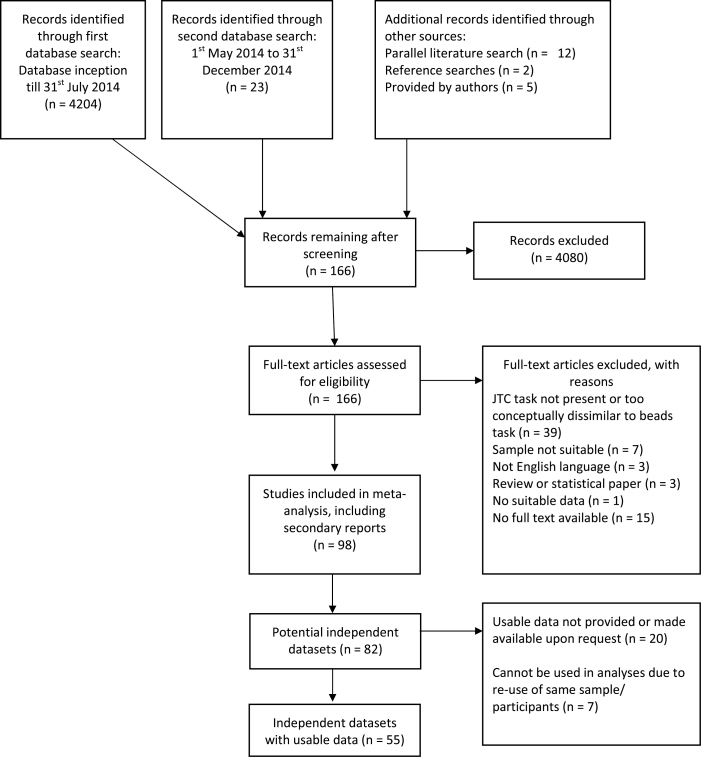
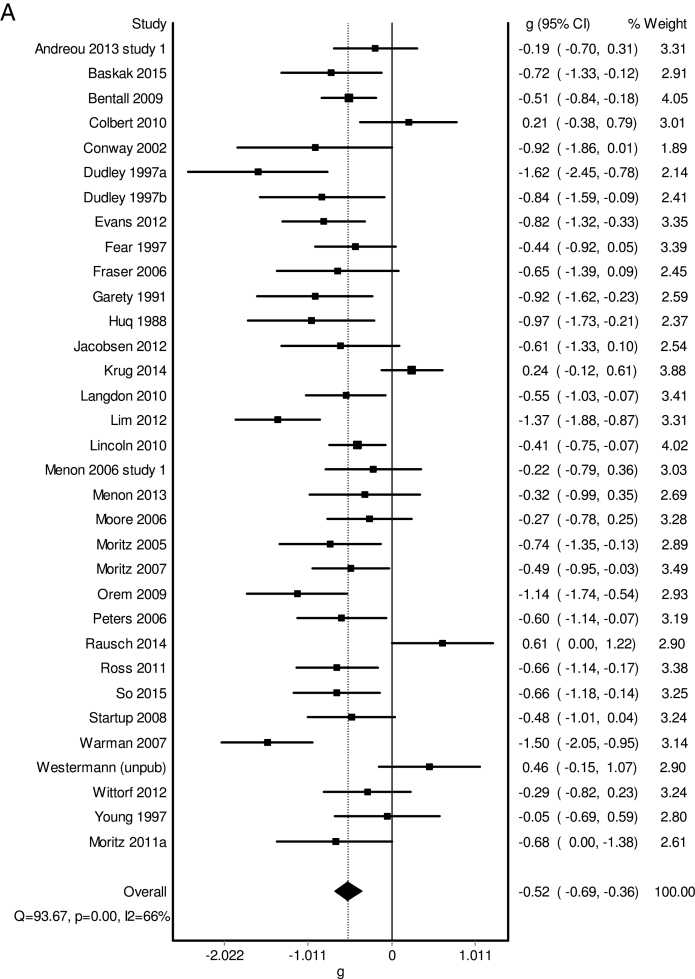
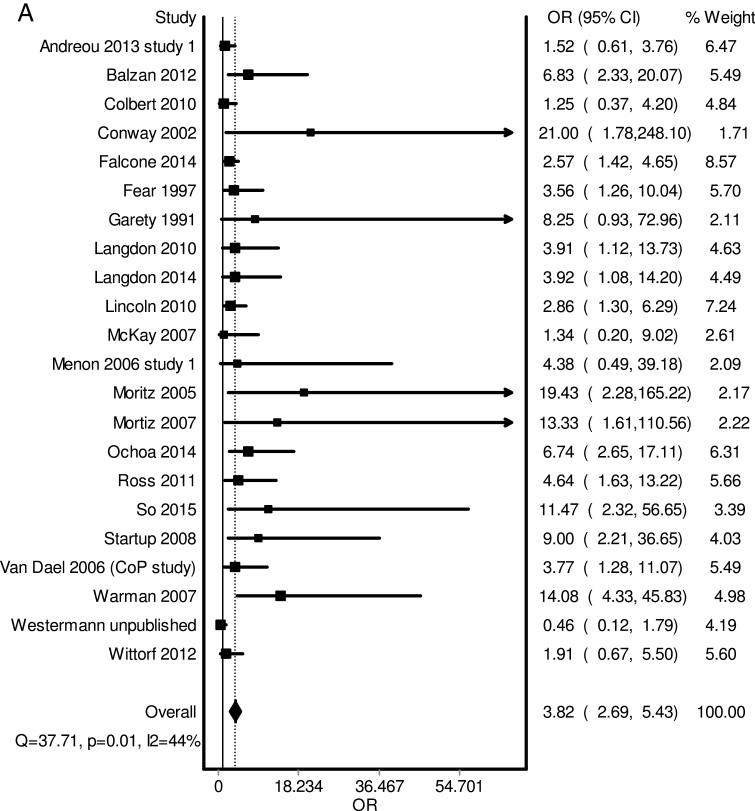
We did a systematic review and meta-analysis to investigate the magnitude and specificity of the "jumping to conclusions" (JTC) bias in psychosis and delusions. We examined the extent to which people with psychosis, and people with delusions specifically, required less information before making decisions. We examined (1) the average amount of information required to make a decision and (2) numbers who demonstrated an extreme JTC bias, as assessed by the "beads task." We compared people with psychosis to people with and without nonpsychotic mental health problems, and people with psychosis with and without delusions. We examined whether reduced data-gathering was associated with increased delusion severity. We identified 55 relevant studies, and acquired previously unpublished data from 16 authors. People with psychosis required significantly less information to make decisions than healthy individuals (k= 33,N= 1935,g= -0.53, 95% CI -0.69, -0.36) and those with nonpsychotic mental health problems (k= 13,N= 667,g= -0.58, 95% CI -0.80, -0.35). The odds of extreme responding in psychosis were between 4 and 6 times higher than the odds of extreme responding by healthy participants and participants with nonpsychotic mental health problems. The JTC bias was linked to a greater probability of delusion occurrence in psychosis (k= 14,N= 770, OR 1.52, 95% CI 1.12, 2.05). There was a trend-level inverse association between data-gathering and delusion severity (k= 18;N= 794;r= -.09, 95% CI -0.21, 0.03). Hence, nonaffective psychosis is characterized by a hasty decision-making style, which is linked to an increased probability of delusions.
Overview
The claims and statistics of this paper haven’t been checked yet.
Run the check — free, no account needed. It reads the open-access text and checks the sources it cites.
Integrity signals
Registry
Cites
Statistics
Figures
Verification
Claims the paper makes
The claims and statistics of this paper haven’t been checked yet.
Run the check — free, no account needed. It reads the open-access text and checks the sources it cites.
Claims other papers make about this one
Each is checked against this paper’s own text: does it say what the citing paper says it does?
The source backs part of the claim, not all of it — or backs it for a different population, condition or comparison.
In the citing paper
“The typical finding is that those induced to experience negative affect reported significantly more paranoid thoughts and a more pronounced Jumping to Conclusions bias (JTC, for a review see [36] when compared to participants who were not induced to experience negative affect [35, 36].”
From A structural equation model of the relationship between insomnia, negative affect, and paranoid thinking (2017) · cites this paper as [36]
Experimental — accuracy not yet measured
Self-check
Percentages, sums and reported differences re-computed from the paper’s own numbers.
The self-check needs the paper’s full text.
Citations
Cites
Meta-analysis in clinical trials
DerSimonian, R., & Laird, N. (1986) · Controlled Clinical Trials · doi:10.1016/0197-2456(86)90046-2 · Cited by 39,552
Cochrane Handbook for Systematic Reviews of Interventions: Cochrane Book Series
(2008) · doi:10.1002/9780470712184 · Cited by 25,048
Borenstein, M., Hedges, L. V., Higgins, J. P. T., & Rothstein, H. R. (2009) · doi:10.1002/9780470743386 · Cited by 14,225
Borenstein, M., Hedges, L. V., Higgins, J. P. T., & Rothstein, H. R. (2021) · doi:10.1002/9781119558378 · Cited by 9,799
The environment and disease: association or causation?
Hill, A. B. (2015) · Journal of the Royal Society of Medicine · doi:10.1177/0141076814562718 · Cited by 7,804
Varese, F., Smeets, F., Drukker, M., Lieverse, R., Lataster, T., Viechtbauer, W., Read, J., van Os, J., & Bentall, R. P. (2012) · Schizophrenia Bulletin · doi:10.1093/schbul/sbs050 · Cited by 2,436
Harbord, R. M., & Higgins, J. P. T. (2008) · The Stata Journal: Promoting communications on statistics and Stata · doi:10.1177/1536867x0800800403 · Cited by 897
Suspicious minds: The psychology of persecutory delusions
Freeman, D. (2007) · Clinical Psychology Review · doi:10.1016/j.cpr.2006.10.004 · Cited by 814
Peters, E. R., Joseph, S. A., & Garety, P. A. (1999) · Schizophrenia Bulletin · doi:10.1093/oxfordjournals.schbul.a033401 · Cited by 771
Sterne, J. A., Egger, M., & Moher, D. (2008) · Cochrane Handbook for Systematic Reviews of Interventions · doi:10.1002/9780470712184.ch10 · Cited by 651
Cited by
Sorted by citations
Items 201–300 of 353
Hua, J. P. Y., Karcher, N. R., & Kerns, J. G. (2019) · Cognitive Neuropsychiatry · doi:10.1080/13546805.2019.1682984 · Cited by 5
Salto a conclusiones y formación de delirios en psicosis: un análisis crítico
López‐Silva, P., & Álvaro Cavieres, F. (2021) · Psiquiatría Biológica · doi:10.1016/j.psiq.2020.12.002 · Cited by 5
A cognitive model of delusion propensity through dysregulated correlation detection
Harrison, A. W., Shou, Y., & Christensen, B. K. (2021) · Schizophrenia Research · doi:10.1016/j.schres.2021.08.025 · Cited by 4
Dietrichkeit, M., Flint, K., Krieger, E. C., Grzella, K., Nagel, M., & Moritz, S. (2018) · The Cognitive Behaviour Therapist · doi:10.1017/s1754470x18000090 · Cited by 5
Delusion-Like Beliefs and Data Quality: Are Classic Cognitive Biases Artefacts of Carelessness?Preprint
Sulik, J., Ross, R. M., Balzan, R. P., & McKay, R. (2021) · doi:10.31234/osf.io/ntsve · Cited by 5
A Bayesian model of the jumping-to-conclusions bias and its relationship to psychopathology
Tan, N., Shou, Y., Chen, J., & Christensen, B. K. (2023) · Cognition & Emotion · doi:10.1080/02699931.2023.2287091 · Cited by 6
Díaz-Cutraro, L., Verdaguer-Rodríguez, M., García‐Mieres, H., Ferrer-Quintero, M., López‐Carrilero, R., Palma, C., Lamarca, M., Espinosa, V., Barrigón, M. L., González‐Higueras, F., et al. (2025) · Schizophrenia · doi:10.1038/s41537-025-00579-0 · Cited by 4
The effect of task difficulty on decision-making
Serrano-Guerrero, E., Testal, J. F. R., Rodríguez, A. M., & Ruíz-Veguilla, M. (2018) · Journal of Experimental Psychopathology · doi:10.1177/2043808718787420 · Cited by 4
Hahn, S., Moritz, S., Elmers, J., & Scheunemann, J. (2021) · Schizophrenia Research · doi:10.1016/j.schres.2021.09.013 · Cited by 5
The Effect of Situational Experiment Conditions on Hasty Decision Making in the ‘Beads Task’
Klevjer, K., & Pfuhl, G. (2023) · Brain Sciences · doi:10.3390/brainsci13020359 · Cited by 4
Examining Cognitive Biases Uniquely Associated with Schizotypy
Zahid, A., & Best, M. W. (2023) · Psychopathology · doi:10.1159/000529742 · Cited by 7
Jumping to Conclusions: Mechanisms of Cognitive Control in Decision-Making Under Uncertainty
Shih, P.-C., Pérez-Santiago, Á., Peña, D., Wazne, D., & Román, S. (2025) · Behavioral Science · doi:10.3390/bs15020226 · Cited by 5
Scheunemann, J., Schilling, L., Andreou, C., & Moritz, S. (2025) · Clinical Psychology & Psychotherapy · doi:10.1002/cpp.70051 · Cited by 5
Metakognitives Training für Psychose
Schlechte, M., Moritz, S., Veckenstedt, R., König, C., Berna, F. S., Gawęda, Ł., Vanessa Acuña, P., Lamarca, M., Ochoa, S., & Fischer, R. (2025) · Die Psychotherapie · doi:10.1007/s00278-025-00774-5 · Cited by 4
Developing algorithmic psychiatry via multi-level spanning computational models
Halassa, M. M., Frank, M. J., Garety, P. A., Öngür, D., Airan, R. D., Sanacora, G., Dzirasa, K., Suresh, S., Fitzpatrick, S. M., & Rothman, D. L. (2025) · Cell Reports Medicine · doi:10.1016/j.xcrm.2025.102094 · Cited by 6
Daren, A., Mętel, D., Błądziński, P., Kalisz, A., Pionke, R., Krężołek, M., Frydecka, D., Misiak, B., Cechnicki, A., & Gawęda, Ł. (2021) · Psychiatria Polska · doi:10.12740/pp/131533 · Cited by 4
Schülke, R., Schmitter, C. V., & Straube, B. (2023) · Journal of Psychiatry and Neuroscience · doi:10.1503/jpn.220184 · Cited by 4
Pugliese, V., de Filippis, R., Aloi, M., Carbone, E. A., Rania, M., Segura‐Garcìa, C., & Fazio, P. D. (2023) · Revista de Psiquiatría y Salud Mental · doi:10.1016/j.sjpmh.2023.07.001 · Cited by 4
Moritz, S., & Schneider, B. C. (2016) · Current Treatment Options in Psychiatry · doi:10.1007/s40501-016-0081-x · Cited by 5
Further validation of the Cognitive Biases Questionnaire for psychosis
Samson, C., Achim, A. M., Sicard, V., Gilker, A., Francoeur, A., Franck, N., Cloutier, B., Giguère, C., Jean-Baptiste, F., & Lecomte, T. (2022) · BMC Psychiatry · doi:10.1186/s12888-022-04203-8 · Cited by 3
Altered neural response to social awkwardness in schizophrenia spectrum disorders
Przysinda, E., Shovestul, B. J., Saxena, A., Dong, X., Reda, S., Dudek, E., Lamberti, J. S., Lalor, E. C., & Dodell‐Feder, D. (2024) · Social Cognitive and Affective Neuroscience · doi:10.1093/scan/nsae094 · Cited by 3
Active information sampling in health and disease
Attaallah, B., Petitet, P., & Husain, M. (2025) · Neuroscience & Biobehavioral Reviews · doi:10.1016/j.neubiorev.2025.106197 · Cited by 3
On the multi-causal nature of jumping to conclusions in psychosis
Moritz, S., Wille, L., Göritz, A. S., Gabbert, T., Doherty, R., Balzan, R. P., & Scheunemann, J. (2025) · Journal of Behavior Therapy and Experimental Psychiatry · doi:10.1016/j.jbtep.2025.102057 · Cited by 3
Fan, M., Liu, Z., Wei, A., Gao, R.-J., Luan, P., & He, X. (2025) · Neuropsychiatric Disease and Treatment · doi:10.2147/ndt.s545022 · Cited by 3
Indecision and recency-weighted evidence integration in non-clinical and clinical settings
del Río, M., Trudel, N., Prabhu, G., Hunt, L. T., Moutoussis, M., Dolan, R. J., & Hauser, T. U. (2026) · Nature Human Behaviour · doi:10.1038/s41562-025-02385-1 · Cited by 5
Espinosa, V., Naides, N., López‐Carrilero, R., Vila‐Badia, R., Colomer-Salvans, A., Barajas, A., Barrigón, M. L., Birulés, I., Butjosa, A., Díaz-Cutraro, L., et al. (2024) · Archives of Women s Mental Health · doi:10.1007/s00737-024-01425-5 · Cited by 3
Mehl, S., Rief, W., Soll, D., & Pytlik, N. (2025) · BMC Research Notes · doi:10.1186/s13104-025-07136-z · Cited by 7
Suicide Prevention Measures at High-Risk Locations: A Goal-Directed Motivation Perspective
Joyner, L. C., Mackenzie, J., Willis, A., Phillips, P., Cliffe, B., Marsh, I., Pettersen, E., Hawton, K. E., & Marzano, L. (2025) · Behavioral Sciences · doi:10.3390/bs15081009 · Cited by 3
Mehl, S. (2022) · Forensische Psychiatrie Psychologie Kriminologie · doi:10.1007/s11757-022-00710-2 · Cited by 4
Evidence for Spinozan “Unbelieving” in the Right Inferior Prefrontal Cortex
Bernhard, R. M., Frankland, S., Plunkett, D., Sievers, B., & Greene, J. D. (2023) · Journal of Cognitive Neuroscience · doi:10.1162/jocn_a_01964 · Cited by 5
Panula, J. M., Lindgren, M., Kieseppä, T., Suvisaari, J., & Raij, T. T. (2023) · Schizophrenia Research · doi:10.1016/j.schres.2023.02.001 · Cited by 3
Tholl, S., Sojer, C. A., Schmidt, S. N. L., & Mier, D. (2024) · Frontiers in Psychology · doi:10.3389/fpsyg.2024.1284595 · Cited by 3
O’Connell, J., & Jackson, H. J. (2017) · Psychosis · doi:10.1080/17522439.2017.1405063 · Cited by 3
People with schizophrenia use less information to interpret ambiguous social situations
Álvaro Cavieres, F., Vanessa Acuña, P., Wachtendorff, C., & Maldonado, R. (2021) · Journal of Behavior Therapy and Experimental Psychiatry · doi:10.1016/j.jbtep.2021.101690 · Cited by 3
Unlocking design potential: Design with people diagnosed with schizophrenia
Lindberg, S., Jormfeldt, H., & Bergquist, M. (2017) · Informatics for Health and Social Care · doi:10.1080/17538157.2017.1363762 · Cited by 3
Delusion and Dopamine: Neuronal Insights in Psychotropic Drug Therapy
Huber, M. K., Schwitzer, J., Kirchler, E., & Lepping, P. (2020) · Springer eBooks · doi:10.1007/978-3-319-56015-1_411-1 · Cited by 4
Balzan, R. P., & Moritz, S. (2017) · Journal of Behavior Therapy and Experimental Psychiatry · doi:10.1016/j.jbtep.2017.01.005 · Cited by 3
Delusions and epistemic style: a neurodiversity approach to reasoning in schizophrenia
Flores, C. (2025) · Synthese · doi:10.1007/s11229-025-04979-8 · Cited by 2
Wilkinson, H. R., Johns, L., Batchelor, R., & Lau‐Zhu, A. (2025) · The British Journal of Psychiatry · doi:10.1192/bjp.2025.86 · Cited by 3
Stark, L., Goecke, B., Jaggy, A., Krummenauer, J., Kuntze, S., Golle, J., & Nagengast, B. (2025) · Journal of Experimental Child Psychology · doi:10.1016/j.jecp.2025.106346 · Cited by 2
The relationships between anxiety, psychotic-like experiences and autism: a systematic review
Rowe, M., Shergill, S. S., & Maitra, R. (2025) · Frontiers in Psychology · doi:10.3389/fpsyg.2025.1549886 · Cited by 4
Scaramozzino, F., McKay, R., & Nicholas Furl, A. (2025) · Cognitive Neuropsychiatry · doi:10.1080/13546805.2025.2587020 · Cited by 3
The simulation heuristic, paranoia, and social anxiety in a non-clinical sample
Rose, M. R., Ellett, L., Huddy, V. C., & Brown, G. P. (2018) · Journal of Behavior Therapy and Experimental Psychiatry · doi:10.1016/j.jbtep.2018.08.006 · Cited by 2
SAĞLAM, M. Y., & Şehitoğlu, Y. (2021) · İnsan ve Sosyal Bilimler Dergisi · doi:10.53048/johass.995230 · Cited by 2
AKIN, G. Ö., & Cinan, S. (2022) · Consciousness and Cognition · doi:10.1016/j.concog.2022.103279 · Cited by 2
The psychology of being a beginner
Sanchez, C. J. (2022) · Social and Personality Psychology Compass · doi:10.1111/spc3.12659 · Cited by 2
Reasoning biases and delusional ideation in the general population: A longitudinal study
Kuhn, S. A. K., Andreou, C., Elbel, G., Lieb, R., & Zander-Schellenberg, T. (2023) · Schizophrenia Research · doi:10.1016/j.schres.2023.03.009 · Cited by 2
Ogunwale, A., Pienaar, L., & Oluwaranti, O. (2023) · Frontiers in Psychiatry · doi:10.3389/fpsyt.2023.1084773 · Cited by 3
Arciszewska, A., Cechnicki, A., Frydecka, D., Kruk, D., & Gawęda, Ł. (2024) · Brain Sciences · doi:10.3390/brainsci14030256 · Cited by 2
Erickson, M. A., Bansal, S., Li, C., Waltz, J. A., Corlett, P. R., & Gold, J. M. (2024) · Biological Psychiatry Global Open Science · doi:10.1016/j.bpsgos.2024.100394 · Cited by 2
Peinado, V., Shevlin, M. E., Valiente, C., Espinosa, R., & Trucharte, A. (2024) · Psychiatry Research · doi:10.1016/j.psychres.2024.116276 · Cited by 2
Amin, F., König, C., Zhang, J., Kalinichenko, L. S., Königsmann, S., Brunsberg, V., Riemensperger, T. D., Müller, C. P., & Gerber, B. (2025) · Journal of Neuroscience · doi:10.1523/jneurosci.1498-24.2024 · Cited by 2
Jumping to conclusions in persistent pain using a somatosensory modification of the beads task
Parkes, C., Bezzina, O., Chapman, A., Luteran, A., Freeston, M. H., & Robinson, L. J. (2019) · Journal of Psychosomatic Research · doi:10.1016/j.jpsychores.2019.109819 · Cited by 2
Cortical Disinhibition, Attractor Dynamics, and Belief Updating in Schizophrenia
Adams, R. A. (2019) · Springer series in cognitive and neural systems · doi:10.1007/978-3-030-18830-6_8 · Cited by 2
Korkmaz, Ş. A., & Can, S. S. (2020) · Journal of Cognitive Psychology · doi:10.1080/20445911.2020.1764570 · Cited by 2
Schizotypy is associated with difficulty maintaining multiple hypotheses
Griffiths, O., & Balzan, R. P. (2020) · Quarterly Journal of Experimental Psychology · doi:10.1177/1747021820982256 · Cited by 2
Psychotische Störungen und Schizophrenie
Clamor, A., Frantz, I., & Lincoln, T. M. (2020) · Springer eBooks · doi:10.1007/978-3-662-61814-1_44 · Cited by 3
Functional outcomes and subjective recovery of jumping to conclusions in schizophrenia
Watanabe, S., Taniguchi, T., & Sugihara, M. (2021) · Schizophrenia Research Cognition · doi:10.1016/j.scog.2021.100212 · Cited by 2
Zander-Schellenberg, T., Kuhn, S. A. K., Möller, J., Meyer, A. H., Huber, C. G., Lieb, R., & Andreou, C. (2021) · PLoS ONE · doi:10.1371/journal.pone.0261296 · Cited by 3
Data gathering ability contributes to visual organization and probabilistic reasoning
Bernadyn, T. F., & Feigenson, K. A. (2018) · Heliyon · doi:10.1016/j.heliyon.2018.e00582 · Cited by 5
Lavigne, K. M., Deng, J., Raucher‐Chéné, D., Hotte‐Meunier, A., Voyer, C., Sarraf, L., Lepage, M., & Sauvé, G. (2023) · doi:10.31234/osf.io/te6fx · Cited by 2
The Epistemic Innocence of Elaborated Delusions Re-Examined
Kittel, M. (2023) · Review of Philosophy and Psychology · doi:10.1007/s13164-023-00675-z · Cited by 1
Umehara, H., Takeda, T., Yoshida, L., Matsuura, K., Okumura-Fujita, M., Tominaga, R., Abe, Y., Masuda, T., Yamada, N., & Numata, S. (2023) · The Journal of Medical Investigation · doi:10.2152/jmi.70.115 · Cited by 1
Bleier, A., Seethaler, M., Bermpohl, F., Majić, T., & Mick, I. (2024) · Journal of Psychiatric Research · doi:10.1016/j.jpsychires.2024.02.006 · Cited by 1
Watanabe, S., Taniguchi, T., & Sugihara, M. (2024) · Cognitive Neuropsychiatry · doi:10.1080/13546805.2024.2367269 · Cited by 1
Cannabis use and cognitive biases in people with first-episode psychosis and their siblings
Roldan, L., Sánchez‐Gutiérrez, T., Fernández‐Arias, I., Rodríguez-Toscano, E., López, G., Merchán‐Naranjo, J., Calvo, A., Rapado‐Castro, M., Parellada, M., Moreno, C., et al. (2024) · Psychological Medicine · doi:10.1017/s0033291724001715 · Cited by 1
Metacognitive and Related Approaches in the Treatment of Schizophrenia-Spectrum Disorders
Fiszdon, J. M., Martin, A. M. S., & Kurtz, M. M. (2025) · Annual Review of Clinical Psychology · doi:10.1146/annurev-clinpsy-061724-085601 · Cited by 2
Posterior parietal cortex modulates perceptual decisions depending on psychotic phenotype
Scaramozzino, F., McKay, R., & Nicholas Furl, A. (2025) · Neuropsychologia · doi:10.1016/j.neuropsychologia.2025.109348 · Cited by 1
Pena-Garijo, J., Masanet, M. J., Palop-Grau, A., & Lacruz, M. (2026) · Schizophrenia Research Cognition · doi:10.1016/j.scog.2025.100416 · Cited by 1
Pena-Garijo, J., Lacruz, M., Masanet, M. J., & Palop-Grau, A. (2026) · Clinical Psychology & Psychotherapy · doi:10.1002/cpp.70226 · Cited by 1
Goncalves, A., Lamarca, M., Moritz, S., Gawęda, Ł., Vanessa Acuña, P., König, C., Berna, F. S., & Ochoa, S. (2026) · Schizophrenia Research Cognition · doi:10.1016/j.scog.2026.100440 · Cited by 1
Massicotte, D., Livet, A., Lahlou, M., Potvin, S., & Lecomte, T. (2026) · Schizophrenia Bulletin · doi:10.1093/schbul/sbag066 · Cited by 1
Treuer, T., & Incze, A. (2026) · Journal of Behavioral Addictions · doi:10.1556/2006.2026.00080 · Cited by 1
Psychotic episode concurrent with interaction with a large language model (llm): a case report
Başaran, A. S., & Çoşar, B. (2026) · BMC Psychiatry · doi:10.1186/s12888-026-08288-3 · Cited by 1
Is delusional imperviousness a backfire effect of being disbelieved?
Arnold, K. (2016) · Psychosis · doi:10.1080/17522439.2016.1166515 · Cited by 1
Vers une psychologie janétienne des psychoses ?
Baudin, G., & Réveillère, C. (2019) · European Journal of Trauma & Dissociation · doi:10.1016/j.ejtd.2018.12.003 · Cited by 2
Martinez, D. C. T., Laloyaux, J., Favrod, J., Silva, B., Libera, C. D., Lar⊘i, F., Bonsack, C., & Golay, P. (2021) · Swiss Archives of Neurology Psychiatry and Psychotherapy · doi:10.4414/sanp.2021.03215 · Cited by 1
Peinado, V., Valiente, C., Espinosa, R., Trucharte, A., & Contreras, A. (2023) · Psychosis · doi:10.1080/17522439.2023.2234449 · Cited by 1
Schizophrenia and the Error-Prediction Model of Thought Insertion
López‐Silva, P., & Álvaro Cavieres, F. (2023) · Oxford University Press eBooks · doi:10.1093/med/9780192896162.003.0008 · Cited by 2
Bortolotti, L. (2024) · Review of Philosophy and Psychology · doi:10.1007/s13164-024-00760-x · Cited by 2
Cognitive and social cognitive deficits in paranoia
Polner, B., Pengue, A., Kéri, S., & Moustafa, A. A. (2019) · Elsevier eBooks · doi:10.1016/b978-0-12-815315-4.00002-1 · Cited by 1
Scaramozzino, F., McKay, R., & Nicholas Furl, A. (2024) · medRxiv · doi:10.1101/2024.03.14.24304279 · Cited by 1
Delusion and affective framing
Gunn, R. (2018) · University of Birmingham Institutional Research Archive (University of Birmingham)
Cognitieve therapie bij auditief verbale hallucinaties en wanen
van der Gaag, M. (2019) · Bohn Stafleu van Loghum eBooks · doi:10.1007/978-90-368-2021-9_14
Characteristics of Delirium in Patients with Hearing Disturbances
Jo, Y. T., Joo, S. W., Lee, J. S., & Joo, Y. H. (2019) · 신경정신의학 · doi:10.4306/jknpa.2019.58.3.209
Allgemeine Grundlagen (Modul 1)
Gäebel, W., Hasan, A., & Falkai, P. (2019) · Springer eBooks · doi:10.1007/978-3-662-59380-6_1
Cluster A Heterogeneity: Author Rejoinder to Commentaries on Cluster A Personality Disorders
Kerns, J. G. (2020) · Cambridge University Press eBooks · doi:10.1017/9781108333931.040
Apego, neurocognición y cognición social en el espectro de la esquizofrenia
Monfort-Escrig, C. (2021) · doi:10.6035/14109.2021.151500
„Unáhlené závěry“ u psychotických onemocnění: přehledová studie
Rodríguez, M., & Šustová, P. (2021) · PSYCHOLOGIE PRO PRAXI · doi:10.14712/23366486.2021.7
Theoretische Annahmen: Kognitive Verzerrungen bei Wahn
Moritz, S., Krieger, E. C., Bohn, F., & Veckenstedt, R. (2017) · Springer eBooks · doi:10.1007/978-3-662-52998-0_3
Psychoneurobiology Research and Personalized Treatment of Schizophrenia
Sumiyoshi, T. (2022) · MDPI eBooks · doi:10.3390/books978-3-0365-2858-8
Opoka, S. M., & Lincoln, T. M. (2021) · Elsevier eBooks · doi:10.1016/b978-3-437-21352-6.00016-x
Evidence for Spinozan "unbelieving" in the inferior prefrontal cortexPreprint
Bernhard, R. M., Frankland, S., Plunkett, D., Sievers, B., & Greene, J. D. (2022) · doi:10.31234/osf.io/bs9tf
Theoretische Annahmen: Kognitive Verzerrungen bei Wahn
Moritz, S., Krieger, E. C., Bohn, F., Elmers, J., & Veckenstedt, R. (2022) · Psychotherapie: Manuale · doi:10.1007/978-3-662-64467-6_3
Delusion and Dopamine: Neuronal Insights in Psychotropic Drug Therapy
Huber, M. K., Schwitzer, J., Kirchler, E., & Lepping, P. (2022) · Springer eBooks · doi:10.1007/978-3-030-62059-2_411
A Dynamic-Maturational Framework for the Study of Psychosis and Attachment Theory
Jack, A. H., & Wilson, S. A. (2022) · Journal of Experimental Psychopathology · doi:10.1177/20438087221142456 · Cited by 1
Bentall, R. P. (2023) · Oxford University Press eBooks · doi:10.1093/med-psych/9780197542521.003.0016
Metadata
- Authors
- Dudley, R., Taylor, P., Wickham, S., & Hutton, P.
- Affiliations
- Cumbria Northumberland Tyne and Wear NHS Foundation Trust (GB)
- University of Liverpool (GB)
- University of Edinburgh (GB)
- Corresponding author
- Dudley, Robert
- Venue
- Schizophrenia Bulletin
- Publisher
- Oxford University Press (OUP)
- Published
- 2015-10-31
- Volume
- 42
- Issue
- 3
- Pages
- 652-665
- ISSN
- 0586-7614 (ISSN-L)
- 1745-1701
- PMC
- PMC4838082
- OpenAlex
- W2163505421
- Cited by
- 353
- References
- 50
- Citations by year
- 2026: 43 · 2025: 28 · 2024: 29 · 2023: 29 · 2022: 33 · 2021: 43 · 2020: 30 · 2019: 29 · 2018: 38 · 2017: 28 · 2016: 20 · 2015: 1
- FWCI
- 3.99
- Type
- journal article
- Language
- en
- Open access
- hybrid
- doi.org
- Licence
- cc-by-nc
- Locations
- Schizophrenia Bulletin (publishedVersion, cc-by-nc)
- PubMed Central (publishedVersion, cc-by-nc)
- PubMed (publishedVersion)
- Edinburgh Napier Research Repository (Edinburgh Napier University) (submittedVersion, cc-by-nc)
- HighWire Press Open Archive (submittedVersion)
- Research Explorer (The University of Manchester) (submittedVersion, other-oa)
- Edinburgh Research Explorer (University of Edinburgh) (submittedVersion, cc-by-nc)
- Newcastle University ePrints (Newcastle Univesity)
- Topics
- Health Sciences › Medicine › Psychiatry and Mental health › Schizophrenia research and treatment
- Social Sciences › Arts and Humanities › Philosophy › Mental Health and Psychiatry
- Social Sciences › Decision Sciences › General Decision Sciences › Decision-Making and Behavioral Economics
- Keywords
- psychosis, delusions
- MeSH terms
- Decision Making, Delusions, Humans, Psychotic Disorders
About these checks
Registry, retraction, Cites and statistics results are computed, not judged, with one exception: a printed reference that no index lists is read once by a model before it counts as a citation error. Claims are extracted by a model and kept only when their quote appears verbatim in the text; each cited source is then checked, with a model’s help, for whether it says what the claim relies on. Those verdicts can be wrong — read the claim’s quote and the cited source before relying on one.
Statistics and arithmetic are recomputed, not judged.
Confidence bands are shown only for fields calibrated on our annotated test set. None is calibrated yet, so no band is shown.
What counts as a claim ›How we measure confidence ›How we check this ›
Are you an author, or do you see a problem with this page? Request a review
