

Linking Light Exposure and Subsequent Sleep: A Field Polysomnography Study in Humans
Open accessThe DOI matches its Crossref record; 74 of the 78 references it cites were found in a registry or an index.
Abstract
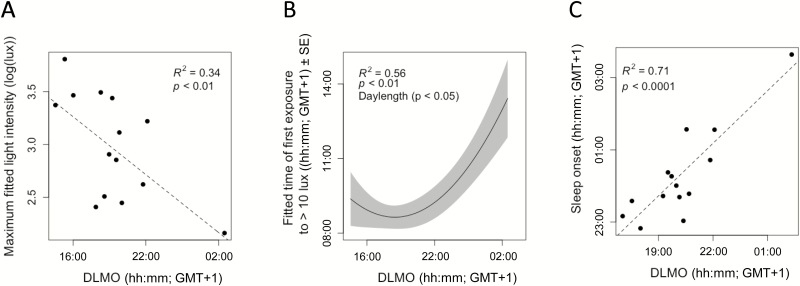
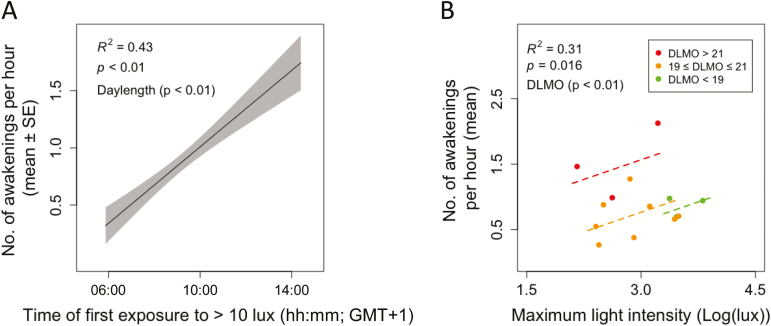
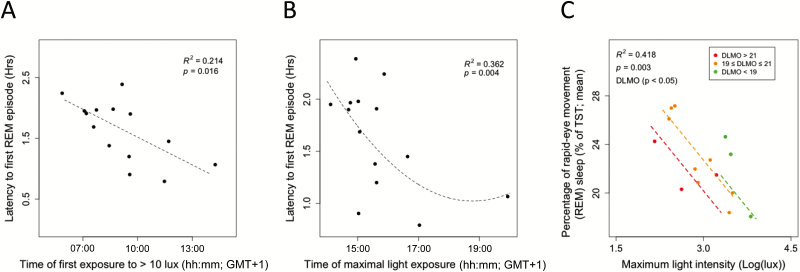
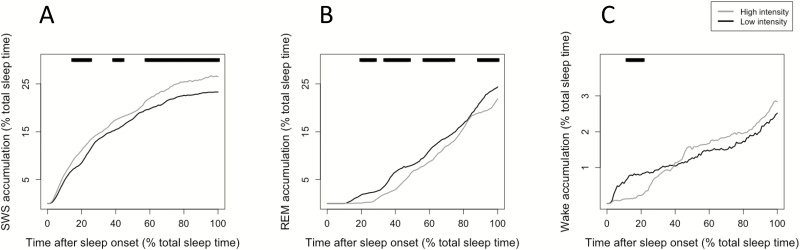
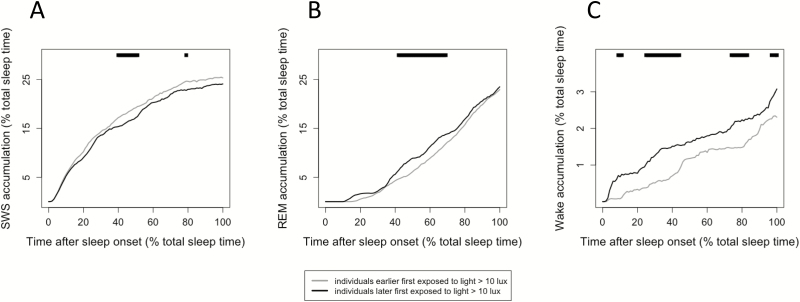
Study objectives: To determine the effect of light exposure on subsequent sleep characteristics under ambulatory field conditions. Methods: Twenty healthy participants were fitted with ambulatory polysomnography (PSG) and wrist-actigraphs to assess light exposure, rest-activity, sleep quality, timing, and architecture. Laboratory salivary dim-light melatonin onset was analyzed to determine endogenous circadian phase. Results: Later circadian clock phase was associated with lower intensity (R2 = 0.34, χ2(1) = 7.19, p < .01), later light exposure (quadratic, controlling for daylength, R2 = 0.47, χ2(3) = 32.38, p < .0001), and to later sleep timing (R2 = 0.71, χ2(1) = 20.39, p < .0001). Those with later first exposure to more than 10 lux of light had more awakenings during subsequent sleep (controlled for daylength, R2 = 0.36, χ2(2) = 8.66, p < .05). Those with later light exposure subsequently had a shorter latency to first rapid eye movement (REM) sleep episode (R2 = 0.21, χ2(1) = 5.77, p < .05). Those with less light exposure subsequently had a higher percentage of REM sleep (R2 = 0.43, χ2(2) = 13.90, p < .001) in a clock phase modulated manner. Slow-wave sleep accumulation was observed to be larger after preceding exposure to high maximal intensity and early first light exposure (p < .05). Conclusions: The quality and architecture of sleep is associated with preceding light exposure. We propose that light exposure timing and intensity do not only modulate circadian-driven aspects of sleep but also homeostatic sleep pressure. These novel ambulatory PSG findings are the first to highlight the direct relationship between light and subsequent sleep, combining knowledge of homeostatic and circadian regulation of sleep by light. Upon confirmation by interventional studies, this hypothesis could change current understanding of sleep regulation and its relationship to prior light exposure. Clinical trial details: This study was not a clinical trial. The study was ethically approved and nationally registered (NL48468.042.14).
Overview
The claims and statistics of this paper haven’t been checked yet.
Free: it reads the open-access text and checks the first 5 claims that cite a source we can check. Create a free account to check every claim.
Integrity signals
Registry
Cites
Statistics
Figures
Verification
Claims the paper makes
The claims and statistics of this paper haven’t been checked yet.
Free: it reads the open-access text and checks the first 5 claims that cite a source we can check. Create a free account to check every claim.
Claims other papers make about this one
Each is checked against this paper’s own text: does it say what the citing paper says it does?
The source backs part of the claim, not all of it — or backs it for a different population, condition or comparison.
In the citing paper
“Several studies report that daytime exposure to white light enriched in short-wavelength content was associated with increased evening fatigue [91], and sleep quality [16, 39, 91], decreased sleep-onset latency [39], and increased slow-wave sleep accumulation [92], which is related to the dissipation of the homeostatic sleep pressure [1, 14, 34].”
From Effects of light on human circadian rhythms, sleep and mood (2019) · cites this paper as [92]
Experimental — accuracy not yet measuredThe cited source says what the claim attributes to it.
In the citing paper
“In this context, Wams and colleagues [92] report that participants with later exposure to light >10 lx had more nocturnal awakenings and less slow-wave sleep.”
From Effects of light on human circadian rhythms, sleep and mood (2019) · cites this paper as [92]
Self-check
Percentages, sums and reported differences re-computed from the paper’s own numbers.
The self-check needs the paper’s full text.
Citations
Cites
Fitting Linear Mixed-Effects Models Using lme4
Bates, D., Mächler, M., Bolker, B., & Walker, S. (2015) · Journal of Statistical Software · doi:10.18637/jss.v067.i01 · Cited by 86,835
The Pittsburgh Sleep Quality Index: a new instrument for psychiatric practice and research
Buysse, D. J., Reynolds, C. F., Monk, T. H., Berman, S. R., & Kupfer, D. J. (1989) · Psychiatry Research · doi:10.1016/0165-1781(89)90047-4 · Cited by 35,234
Simultaneous Inference in General Parametric Models
Hothorn, T., Bretz, F., & Westfall, P. (2008) · Biometrical Journal · doi:10.1002/bimj.200810425 · Cited by 13,847 · cited 1×
“The resulting p-values were corrected for multiplicity using the single-step method.(61) Throughout the results section, all results are written as +quadratic term if the quadratic of the independent variable (either light parameter or DLMO) significantly contributed to the model; +daylength if daylength significantly…”
MethodPhototransduction by retinal ganglion cells that set the circadian clock
Berson, D. M., Dunn, F. A., & Takao, M. (2002) · Science · doi:10.1126/science.1067262 · Cited by 3,629 · cited 1×
“In mammals, light information is projected to the circadian pacemaker or synchronizer (located in the hypothalamic suprachiasmatic nucleus, SCN(1)) via intrinsically photosensitive retinal ganglion cells (ipRGCs).(2) Light entrainment is modulated, not only by the duration of light exposure, but also by its intensity…”
BackgroundLife between Clocks: Daily Temporal Patterns of Human Chronotypes
Roenneberg, T., Wirz-Justice, A., & Merrow, M. (2003) · Journal of Biological Rhythms · doi:10.1177/0748730402239679 · Cited by 2,662
Fitting Linear Mixed-Effects Models Using lme4
Bates, D. M., Maechler, M., Bolker, B. M., & Walker, S. (2014) · arXiv (Cornell University) · doi:10.3929/ethz-b-000105397 · Cited by 2,541
A psychometric evaluation of the Beck Depression Inventory–II.
Dozois, D. J. A., Dobson, K. S., & Ahnberg, J. L. (1998) · Psychological Assessment · doi:10.1037/1040-3590.10.2.83 · Cited by 1,517
Exogenous and Endogenous Components in Circadian Rhythms
Aschoff, J. (1960) · Cold Spring Harbor Symposia on Quantitative Biology · doi:10.1101/sqb.1960.025.01.004 · Cited by 1,479 · cited 1×
“Moreover, according to Aschoff’s rule, diurnal animals will lengthen intrinsic period with lower light intensity.(69,70) Although we only found that lower maximal light intensities were associated with subsequent longer rest durations, studies with high intensity light interventions have previously focused on the timi…”
BackgroundChang, A.-M., Aeschbach, D., Duffy, J. F., & Czeisler, C. A. (2015) · Proceedings of the National Academy of Sciences · doi:10.1073/pnas.1418490112 · Cited by 1,430
Timing of human sleep: recovery process gated by a circadian pacemaker
Daan, S., Beersma, D. G., & Borbely, A. A. (1984) · American Journal of Physiology-Regulatory, Integrative and Comparative Physiology · doi:10.1152/ajpregu.1984.246.2.r161 · Cited by 1,419 · cited 1×
“These relationships are most probably due to the influence of light on the entrainment of the circadian clock, which drives process C in sleep regulation, which in turn will shift the timing of sleep.(6,7) Because humans have on average an intrinsic circadian period longer than 24 hours (24.”
BackgroundSelf-citation
Research works printed but not linked: 4
- Daan S, Hut RA Circadian Clock, Program, Oscillator, Pacemaker, Synchroniser? In: Honma K, Honma S, eds. Circadian Clocks. Hokkaido University Press; 2016: 21– 32.
- Dijk D, Edgar DM Circadian and homeostatic control of wakefulness and sleep. In: Turek F, Zee P, eds. Regulation of Sleep and Wakefulness. New York: Marcel Dekker, Inc; 1999: 111– 147.
- Cleveland WS, Grosse E, Shyu WM Local regression models. In: Chambers JM, Hastie TJ, eds. Statistical Models in S. Wadsworth & Brooks/Cole. California, USA: Pacific Grove; 1992.
- de la Iglesia HO, Fernández-Duque E, Golombek DA Access to electric light is associated with shorter sleep duration in a traditionally hunter-gatherer community. J Biol Rhythms. 2015; 30(4): 342– 350. 26092820 PMC5320422 · DOI · Paper page
Cited by
Items 101–143 of 143
Hébert, M., Lavigne, A.-A., Auclair, J., Martin, J.-S., Francis, K., Gagnon, J. D., Dubois, M.-A., & Laberge, L. (2023) · Journal of Occupational and Environmental Medicine · doi:10.1097/jom.0000000000002849 · Cited by 5
“In fact, one study that compared light exposure and sleep using polysomnography proposed that the timing and intensity of light exposure modulate aspects of sleep determined not only by the circadian clock but also by the homeostatic pressure.(27) Future studies should include polysomnography and explore whether the a…”
BackgroundHe, M., Chen, H., Li, S., Ru, T., Chen, Q., & Zhou, G. (2023) · Journal of Sleep Research · doi:10.1111/jsr.14113 · Cited by 4
“For instance, either a higher level or a larger amount of light during biological day was associated with better nocturnal sleep (He et al., 2022; Shishegar et al., 2021; Wams et al., 2017).”
Rhythms of light: Understanding the role of circadian timing in alertness and cognitive performance
Lok, R. (2025) · Handbook of clinical neurology · doi:10.1016/b978-0-323-90918-1.00016-2 · Cited by 5
The sleep pattern of medical students: examining the impact of excessive Internet use
Alghannami, A., Alrashed, A., Alshehri, R., Alotaibi, S. R., Alharbi, M., Mukaddem, A., & Agha, S. (2021) · International Journal of Medicine in Developing Countries · doi:10.24911/ijmdc.51-1618422863 · Cited by 4
Influence of Socioeconomic Status and Stress Over Quality of Sleep: A Systematic ReviewPreprint
Sosso, F. A. E., Jagannath, A., Oliveira, F., Surani, & Mysliwiec, V. (2018) · Preprints.org · doi:10.20944/preprints201810.0641.v1 · Cited by 4
Metadata recommendations for light logging and dosimetry datasets
Spitschan, M., Hammad, G. H., Blume, C., Schmidt, C., Skene, D. J., Wulff, K., Santhi, N., Zauner, J., & Münch, M. Y. (2024) · BMC Digital Health · doi:10.1186/s44247-024-00113-9 · Cited by 4
“In addition to its syn-chronising effect, light exposure can also modulate melatonin [4–7], alertness [8–10] and cognitive performance [11], and influence sleep architecture [12], thermoregulation and the cardiovascular system [13].”
BackgroundCui, Y., Liu, Y., Kwan, M., & Zheng, L. (2026) · Environmental Research · doi:10.1016/j.envres.2026.124443 · Cited by 3
Xiao, J., Chen, D., Yu, S., Wang, H., Sun, Y., Wang, H., Gou, Z., & Wang, J. (2024) · Nature and Science of Sleep · doi:10.2147/nss.s472988 · Cited by 2
Lau, P. H., Levitan, R. D., Quilty, L. C., Kloiber, S. M., Zai, G. C., & Laposa, J. M. (2024) · Journal of Affective Disorders · doi:10.1016/j.jad.2024.09.121 · Cited by 3
The Treatment of Sleep Problems Using Melatonin
MacLean, J. E., & Malow, B. A. (2022) · Springer eBooks · doi:10.1007/978-3-030-99134-0_15 · Cited by 3
Wearing an Eye Mask During Overnight Sleep Improves Episodic Learning and AlertnessPreprint
Greco, V., Bergamo, D., Cuoccio, P., Konkoly, K. R., Lombardo, K. M., & Lewis, P. A. (2022) · bioRxiv (Cold Spring Harbor Laboratory) · doi:10.1101/2022.01.20.477083 · Cited by 2
Macaya, D., & Kryger, M. H. (2022) · Sleep Health · doi:10.1016/j.sleh.2022.02.002 · Cited by 2
Open-source Python module for the analysis of personalized light exposure dataPreprint
Hammad, G. H., Wulff, K., Skene, D. J., Münch, M. Y., & Spitschan, M. (2023) · doi:10.31219/osf.io/msk9n · Cited by 2
Simulated natural daylight and twilight modulate activity and light sampling behaviour in mice
Steel, L. C. E., Hankins, M. W., Foster, F., & Peirson, S. N. (2026) · BMC Biology · doi:10.1186/s12915-026-02517-7 · Cited by 1
“In addition, our data raises the possibility that changes in daytime light exposure could be altering sleep homeostatic pressure, leading to changes in subsequent sleep behaviour, as has been observed in humans [92, 93].”
Human data at odds and in confirmation of the two-process model of sleep regulation—a perspective
Dijk, D. (2026) · npj Biological Timing and Sleep · doi:10.1038/s44323-026-00083-3 · Cited by 1
“Thus,lighthasbeenreportedtoincreasetherateatwhichwakefulness leadstothebuildupofsleeppressureasindexedbySWA,which,according tothe2PM,isamarkerofsleephomoeostasis 29,30 .”
Light, Sleep, Alertness and Performance
van Bommel, W. (2019) · Springer eBooks · doi:10.1007/978-3-030-17195-7_6 · Cited by 1
The effect of restricted and free-living conditions on light exposure and sleep in older adults
Pun, T. B., Rahimi, M. M., Wassing, R., Phillips, C. L., Marshall, N. S., Comas, M., D'Rozario, A. L., Hoyos, C. M., Grunstein, R. R., & Gordon, C. J. (2024) · Chronobiology International · doi:10.1080/07420528.2024.2419849 · Cited by 1
“Research shows that increased light exposure in the morning with reduced light at night strengthens circadian rhythms and concomitantly promotes sleep (Ancoli-Israel et al. 2003b; González and Aston-Jones 2006; Wams et al. 2017).”
Xin, L., Wei, X., & Zhang, L. (2025) · Behavioral Sciences · doi:10.3390/bs15060770 · Cited by 1
“Pertinent studies have shown that exposure to white light, rich in short wavelengths during the day, correlates with enhanced evening fatigue and improved sleep quality (Viola et al., 2008), diminished sleep onset latency, and an increased accrual of slow-wave sleep (Wams et al., 2017).”
Biller, A. M., Fatima, N., Hamberger, C., Hainke, L., Plankl, V., Nadeem, A., Kramer, A., Hecht, M., & Spitschan, M. (2024) · medRxiv · doi:10.1101/2024.02.09.24302573 · Cited by 1
Hunt, L. C., Fritz, J., Herf, M., Herf, L., & Vetter, C. (2021) · bioRxiv (Cold Spring Harbor Laboratory) · doi:10.1101/2021.08.11.455859 · Cited by 1
“All these measures are first calculated on a per-day basis, or for periods extending a couple of hours before sleep onset and/or after sleep offset (Reid et al., 2014; Wams et al., 2017), and then averaged over the whole study period.”
BackgroundEsquivel, A. O. (2011) · El Viejo topo
van Bommel, W. (2021) · Springer eBooks · doi:10.1007/978-3-642-27851-8_389-1 · Cited by 1
delucca, G. (2022) · OSF Preprints (OSF Preprints) · doi:10.31219/osf.io/cdqxh
Sleep Patterns and Sleep Disturbances During the Lockdown Periods
Salfi, F., & Ferrara, M. (2023) · Progress in Sleep Research · doi:10.1007/978-981-99-0240-8_7
van Bommel, W. (2023) · Springer eBooks · doi:10.1007/978-3-030-89862-5_389
A review of the effect of phone use on sleep and methods to sleep better
Chen, S. (2024) · Theoretical and Natural Science · doi:10.54254/2753-8818/29/20240805
Borghi, S., Torre, A. L., Messina, C., Sconfienza, L. M., Banfi, G., & Vitale, J. A. (2024) · Journal of Aging and Physical Activity · doi:10.1123/japa.2023-0330
Kramer, D. (2024) · Springer eBooks · doi:10.1007/978-3-031-66139-6_7
The Treatment of Dually Diagnosed Individuals with Sleep Disturbances and Intellectual Disabilities
Monceaux, B., Smith, K., & McPherson, P. (2024) · Autism and child psychopathology series · doi:10.1007/978-3-031-66902-6_16
Nelson, R. J. (2025) · Oxford University Press eBooks · doi:10.1093/9780197639979.003.0004
Colored Light Exposure Ensues Chronotype-Based Responses: Evidence From QEEG Analysis
Vani, V. D., Ojha, P., Gadhvi, M. A., & Dixit, A. (2025) · Physiological Research · doi:10.33549/physiolres.935548 · Cited by 1
“The effects of daytime exposure to short-wavelength light has been found to be associated with increased evening fatigue, decreased sleep-onset latency, and higher slow-wave sleep accumulation [12-14].”
Assessing Sleep Architecture in Rural Eastern Cape Villagers of South Africa Using ŌURA Ring Data
Kilius, E., Li, M. F., & Samson, D. R. (2026) · American Journal of Human Biology · doi:10.1002/ajhb.70215
“Field PSG studies of quantitative sleep measures in non-industrialized societies are few (Buguet et al. 2019; Samson et al. 2017; Wams et al. 2017).”
Yıldırım, E., & Polat, F. (2026) · HERD Health Environments Research & Design Journal · doi:10.1177/19375867261438793
“For example, dim lighting has been reported to improve sleep quality (Wams et al., 2017), reduce negative emotional responses during labor (Silva & Shimo, 2017), and shorten the duration of labor (Maria et al., 2022).”
Zhang, Y., Li, G., Wang, J., & Liu, G. (2026) · Research Quarterly for Exercise and Sport · doi:10.1080/02701367.2026.2663969
Do we know how much we can help ourselves by using preventive exposure to solar radiation?
Turko, P., Szejda, J., Kret, J., Antoszewski, B., & Fijałkowska, M. (2026) · Polish Annals of Medicine · doi:10.31648/paom/210224
Loock, A.-S., Lazar, R., Spitschan, M., & Blume, C. (2026) · Scientific Reports · doi:10.1038/s41598-026-58842-y · Cited by 2
“For both versions, sum scores range from 4 to 20, with higher scores reflecting more frequent sleep disturbances or greater sleep-related daytime impairment.”
Gatera, G., Lanham, J., & Chellappa, S. L. (2026) · SLEEP · doi:10.1093/sleep/zsag183
Light exposure and sleep architecture in real-world settings
Akgun, S. G., Gemici, B., Roddis, C., Bickerstaff, L., Baño‐Otálora, B., Milosavljevic, N., Brown, T. M., Lucas, R. J., & Didikoğlu, A. (2026) · npj Biological Timing and Sleep · doi:10.1038/s44323-026-00087-z · Cited by 1
Analysis of real-world eye level light exposure through spectacle lens
Kobia‐Acquah, E., Prince, C., Pic, E., Coughlan, D., Hazle, J., & Barrau, C. (2026) · npj Biological Timing and Sleep · doi:10.1038/s44323-026-00095-z
Sleep Duration and Sun Exposure in Portuguese Children: Associations With Obesity Indicators
dos Santos, E. A., Machado‐Rodrigues, A. M., Rodrigues, D., Silva, R., Nogueira, H. G. D. S. M., & Padez, C. M. P. (2026) · American Journal of Human Biology · doi:10.1002/ajhb.70333
Moen, L. V., Holme, A. N., Nilsen, K. B., Sallinen, M., Matre, D., & Haugen, F. (2026) · Occupational and Environmental Medicine · doi:10.1136/oemed-2026-111002
Ming-Yi, S., Lim, J. M.-Y., Liang, S.-N., Kumari, Y., & Kalavally, V. (2026) · Research Square · doi:10.21203/rs.3.rs-10233757/v1
Metadata
- Authors
- Wams, E. J., Woelders, T., Marring, I., van Rosmalen, L., Beersma, D. G. M., Gordijn, M. C. M., & Hut, R. A.
- Affiliations
- University of Groningen (NL)
- Corresponding author
- Wams, Emma J
- Venue
- Sleep
- Publisher
- Oxford University Press (OUP)
- Published
- 2017-10-11
- Volume
- 40
- Issue
- 12
- ISSN
- 0161-8105 (ISSN-L)
- 1550-9109
- PMC
- PMC5806586
- OpenAlex
- W2766454292
- Cited by
- 143
- References
- 78
- Citations by year
- 2026: 14 · 2025: 12 · 2024: 23 · 2023: 16 · 2022: 24 · 2021: 21 · 2020: 14 · 2019: 11 · 2018: 7
- FWCI
- 5.37
- Type
- journal article
- Language
- en
- Open access
- hybrid
- doi.org
- Licence
- cc-by-nc
- Locations
- SLEEP (publishedVersion, cc-by-nc)
- PubMed Central (publishedVersion, cc-by-nc)
- PubMed (publishedVersion)
- University of Groningen research database (University of Groningen / Centre for Information Technology) (submittedVersion, cc-by-nc)
- Funders
- Nederlandse Organisatie voor Wetenschappelijk Onderzoek (12185)
- Topics
- Life Sciences › Neuroscience › Endocrine and Autonomic Systems › Circadian rhythm and melatonin
- Social Sciences › Psychology › Experimental and Cognitive Psychology › Sleep and related disorders
- Life Sciences › Neuroscience › Cognitive Neuroscience › Sleep and Wakefulness Research
- Keywords
- light exposure, sleep timing, circadian phase, light intensity, sleep architecture, REM sleep, slow-wave sleep, sleep latency, sleep awakenings, homeostatic sleep pressure, dim light melatonin onset, ambulatory polysomnography
- MeSH terms
- Adult, Circadian Rhythm, Female, Humans, Lighting, Male, Melatonin, Saliva, Sleep, Sleep, REM, Polysomnography, Actigraphy, Circadian Clocks
About these checks
Registry, retraction, Cites and statistics results are computed, not judged, with one exception: a printed reference that no index lists is read once by a model before it counts as a citation error. Claims are extracted by a model and kept only when their quote appears verbatim in the text; each cited source is then checked, with a model’s help, for whether it says what the claim relies on. Those verdicts can be wrong — read the claim’s quote and the cited source before relying on one.
Statistics and arithmetic are recomputed, not judged.
Confidence bands are shown only for fields calibrated on our annotated test set. None is calibrated yet, so no band is shown.
What counts as a claim ›How we measure confidence ›How we check this ›
Are you an author, or do you see a problem with this page? Request a review
Data sources
Bibliographic data: Semantic Scholar, OpenAlex, Crossref.
Contains information from the Semantic Scholar Academic Graph Datasets, made available under the ODC Attribution License (ODC-BY 1.0).
Semantic Scholar’s data is described in: Kinney, R., et al. (2023). The Semantic Scholar Open Data Platform. arXiv:2301.10140.
