

Cognitive and behavioral therapy for insomnia increases the use of continuous positive airway pressure therapy in obstructive sleep apnea participants with comorbid insomnia: a randomized clinical trial
Open accessThe DOI matches its Crossref record; 55 of the 56 references it cites were found in a registry or an index, and 1 are not checked yet; 12 of the 29 sources its claims cite were checked for support.
Abstract
Study Objectives: Insomnia and obstructive sleep apnea (OSA) commonly co-occur which makes OSA difficult to treat with continuous positive airway pressure (CPAP). We conducted a randomized controlled trial in participants with OSA and co-occurring insomnia to test the hypothesis that initial treatment with cognitive and behavioral therapy for insomnia (CBT-i), versus treatment as usual (TAU) would improve insomnia symptoms and increase subsequent acceptance and use of CPAP. Methods: One hundred and forty-five participants with OSA (apnea-hypopnea index ≥ 15) and comorbid insomnia were randomized to either four sessions of CBT-i, or TAU, before commencing CPAP therapy until 6 months post-randomization. Primary between-group outcomes included objective average CPAP adherence and changes in objective sleep efficiency by 6 months. Secondary between-group outcomes included rates of immediate CPAP acceptance/rejection, and changes in; sleep parameters, insomnia severity, and daytime impairments by 6 months. Results: Compared to TAU, participants in the CBT-i group had 61 min greater average nightly adherence to CPAP (95% confidence interval [CI] = 9 to 113; p = 0.023, d = 0.38) and higher initial CPAP treatment acceptance (99% vs. 89%; p = 0.034). The CBT-i group showed greater improvement of global insomnia severity, and dysfunctional sleep-related cognitions by 6 months (both: P < 0.001), and greater improvement in sleep impairment measures immediately following CBT-i. There were no between-group differences in sleep outcomes, or daytime impairments by 6 months. Conclusions: In OSA participants with comorbid insomnia, CBT-i prior to initiating CPAP treatment improves CPAP use and insomnia symptoms compared to commencing CPAP without CBT-i. OSA patients should be evaluated for co-occurring insomnia and considered for CBT-i before commencing CPAP therapy. adherence. © Sleep Research Society 2019.
Verified 2026-11-22 · 1 reference not checked yet
Overview
CoChat Summary
TL;DR
In adults with moderate/severe OSA and comorbid insomnia, four sessions of CBT-i before starting CPAP increased average nightly CPAP use by about 61 min and reduced immediate CPAP rejection compared with treatment as usual. CBT-i also improved insomnia severity and dysfunctional sleep-related cognitions, but not objective sleep or daytime impairment outcomes by 6 months.
Key findings
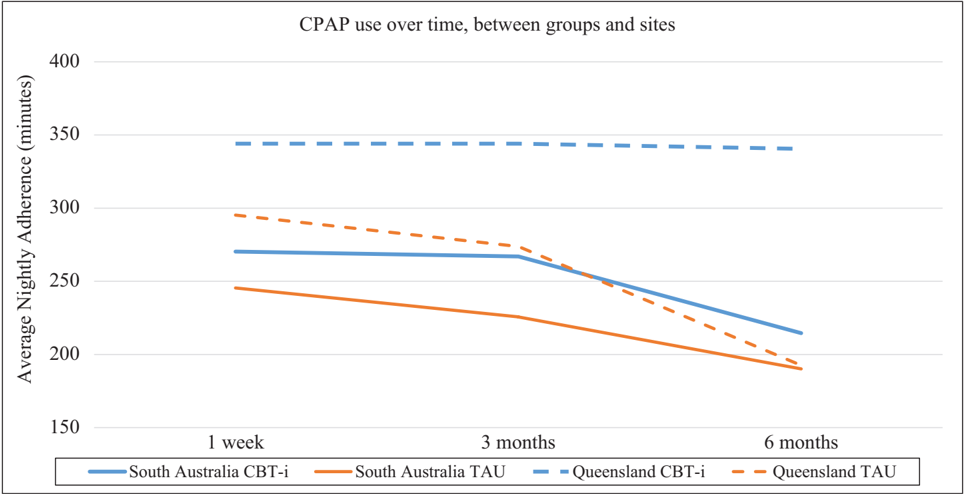
- Average nightly CPAP use was 60.7 min higher in the CBT-i group (M = 265.2, 95% CI 226.2–304.2) than the TAU group (M = 204.5, 95% CI 166.3–242.7; p = 0.023, Cohen’s d = 0.38); the abstract reports 61 min.
- Immediate CPAP rejection was higher in TAU (n = 8, 11%, CI 3.8–18.2) than CBT-i (n = 1, 1.4%, CI −1.3–4.1; Fisher’s p = 0.034), an 87% reduction. After excluding immediate rejecters, there was no significant difference in overall nightly CPAP use (mean difference = 39 min, CI −12 to 90; p = 0.131, d = 0.25).
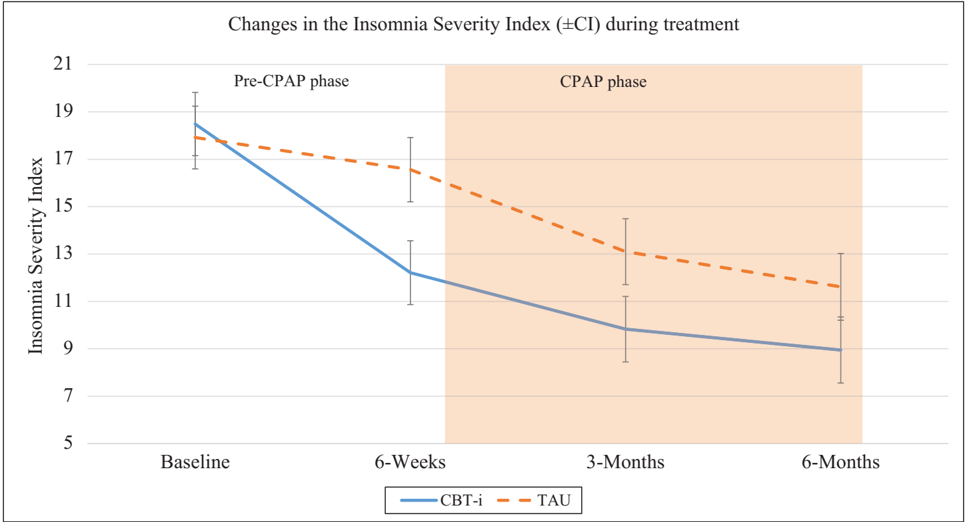
- CBT-i produced greater improvement in global insomnia severity and dysfunctional sleep-related cognitions by 6 months (both p < 0.001). Insomnia remission (ISI < 8) occurred in 53.2% of CBT-i vs 31.7% of TAU (p = 0.02), and positive insomnia response (ISI reduction > 7) in 62.9% vs 38.3% (p = 0.007).
- No between-group differences were found in PSG sleep outcomes or daytime impairment by 6 months; by 6 weeks there was a trend toward greater reduction in wake after sleep onset in CBT-i (26 min vs 4.9 min; overall interaction p = 0.078).
Methods
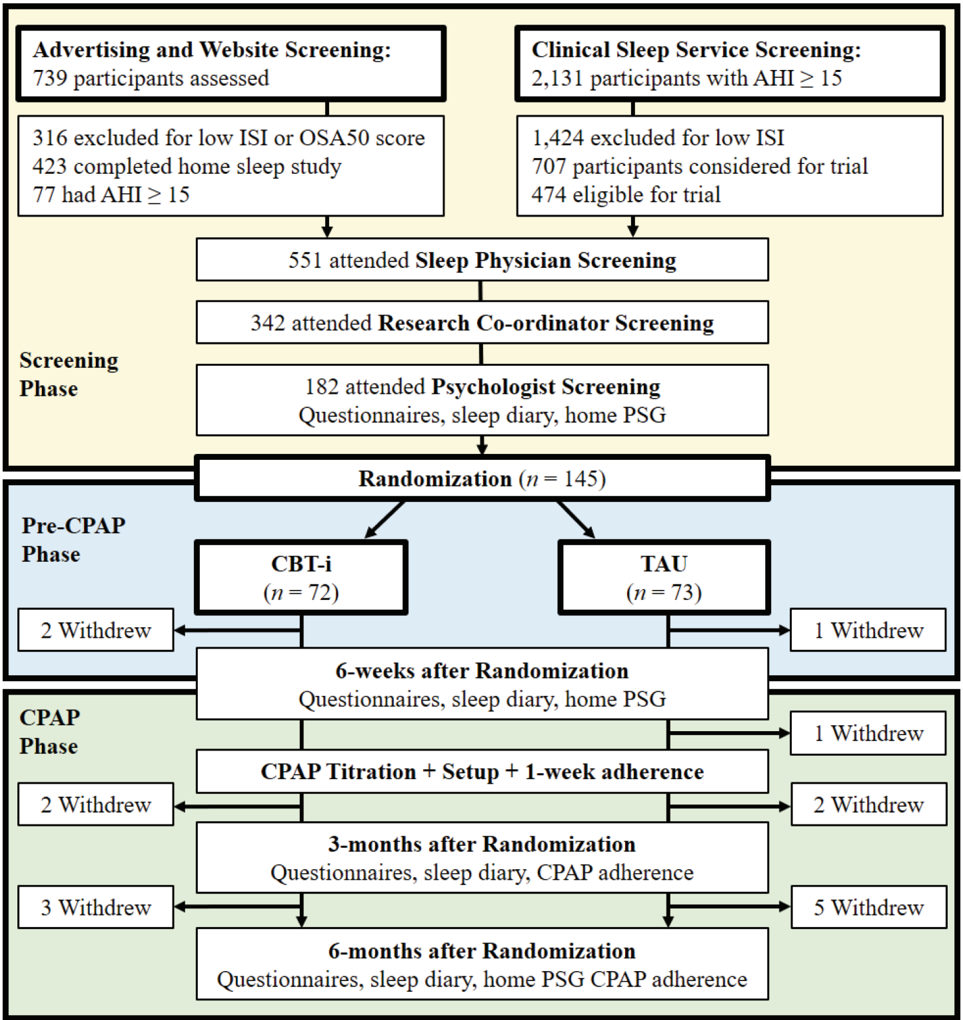
- Randomized controlled trial at two Australian teaching hospital sites (Adelaide and Brisbane) between November 2013 and April 2016. One hundred forty-five participants with OSA (AHI ≥ 15/h) and comorbid insomnia were randomized to four weekly 45-min CBT-i sessions or TAU before commencing CPAP, with follow-up to 6 months.
- Inclusion criteria included age 18–75 years, AHI ≥ 15/h on full-night PSG, physician-confirmed OSA and CPAP recommendation, and psychologist-established insomnia by ICSD-III criteria with ISI ≥ 14 and ISI subscore ≥ 4. Randomization used minimization to balance insomnia severity, AHI, gender, site, prior CPAP use, and age.
- Primary outcomes were average objective nightly CPAP adherence and change in objective sleep efficiency by 6 months. Linear mixed model intention-to-treat analyses were used, with Fisher’s exact test for immediate CPAP acceptance/rejection.
Limitations
- Stated: no placebo control was used during the CBT-i phase; objective sleep efficiency was measured by home PSG and partly depended on self-reported time in bed; and the sample had moderate/severe OSA and formally diagnosed insomnia, so results may not generalize to mild OSA or COMISA patients without formal insomnia diagnostic criteria.
- Evident from results/discussion: the average CPAP adherence advantage was largely driven by fewer immediate CPAP rejecters; among participants who accepted CPAP, there was no significant between-group difference in average adherence, though a trend suggested less decline in the CBT-i group over time (interaction p = 0.092).
- Evident from results: the group-by-time interaction for the primary CPAP adherence outcome was not statistically significant (overall interaction p = 0.171), despite the significant main group effect.
Model-written summary. Check it against the paper before relying on it.
Integrity signals
Registry
Cites
Statistics
Figures
Verification
Claims the paper makes
9 Valid · 1 Not valid · 11 Not checked · 65 Own results and interpretations
The cited sources support only part of this claim — read each source’s verdict below.
In the paper
“Preliminary evidence suggests that CBT-i is an effective treatment for insomnia in the presence of comorbid OSA [32,33].”
§ Cognitive and behavioral therapy for insomnia increases the use of continuous positive airway pressure therapy in obstructive sleep apnea participants with comorbid insomnia: a randomized clinical trial > Introduction
What the sources say
- Partly supportedcites [32] 32. Fung CH, et al. Efficacy of cognitive behavioral therapy for insomnia in older adults with occult sleep-disordered breathing. Psychosom Med. 2016;78(5):629-639. sourceExperimental — accuracy not yet measured
The Discussion reports that CBT-I improved sleep in older veterans with insomnia and untreated mild, occult sleep-disordered breathing. This supports preliminary efficacy in that group, but the claim extends it to comorbid OSA generally, without the study’s limits on severity and population. The indexed passages provide section labels but no page numbers. (LLM, conf=0.84)
- Not checked — no full text of the sourcecites [33] 33. Sweetman A, et al. Does comorbid obstructive sleep apnea impair the effectiveness of cognitive and behavioral therapy for insomnia? Sleep Med. 2017;39:38-46. source
states a possible cause- Asserted: passes — The authors put it forward as true.
- Checkable: passes — It can be checked against evidence.
- Load-bearing: passes — The paper’s conclusions depend on it.
- Based: passes — The paper gives a reason why it holds.
- Partly supported
Every source the paper cites for this claim was checked and supports it.
In the paper
“Although CPAP effectively stabilizes the upper airway and improves the clinical manifestations of OSA [17], patient acceptance and long-term adherence to CPAP remains a significant barrier to treatment.”
§ Cognitive and behavioral therapy for insomnia increases the use of continuous positive airway pressure therapy in obstructive sleep apnea participants with comorbid insomnia: a randomized clinical trial > Introduction
What the sources say
- Supportedcites [18] 18. Weaver TE, et al. Adherence to continuous positive airway pressure therapy: the challenge to effective treatment. Proc Am Thorac Soc. 2008;5(2):173-178. source
The discussion of CPAP use states that many patients refuse treatment because it requires a mask and machine, and calls this nonacceptance a crucial cause of nonadherence. The “Patterns of CPAP Adherence” section adds that use established in the first week predicts long-term use. Together, these passages support the claim that acceptance and sustained adherence are barriers to effective treatment. (LLM, conf=0.92)
plain- Asserted: passes — The authors put it forward as true.
- Checkable: passes — It can be checked against evidence.
- Load-bearing: passes — The paper’s conclusions depend on it.
- Based: passes — The paper gives a reason why it holds.
- Supported
A result the paper reports from its own data — it cites no other source for it, so there is none to check. The quote shows it is in the paper.
In the paper
“There was no between-group difference in rates of CPAP use during the 6-month PSG.”
§ Cognitive and behavioral therapy for insomnia increases the use of continuous positive airway pressure therapy in obstructive sleep apnea participants with comorbid insomnia: a randomized clinical trial > Polysomnographic sleep parameters
plain- Asserted: passes — The authors put it forward as true.
- Checkable: passes — It can be checked against evidence.
- Load-bearing: unclear — It is unclear whether the paper’s conclusions depend on it.
- Based: passes — The paper gives a reason why it holds.
A result the paper reports from its own data — it cites no other source for it, so there is none to check. The quote shows it is in the paper.
In the paper
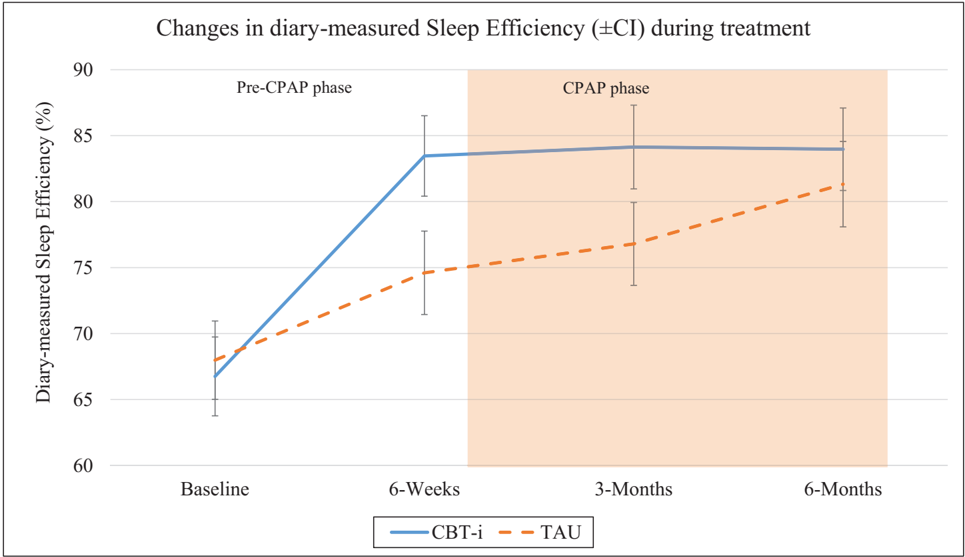
“Compared to TAU, participants in the CBT-i group reported significantly greater improvements in diarymeasured sleep onset latency, wake after sleep onset, and sleep efficiency from baseline to 6 weeks (Table 3, Figure 2).”
§ Cognitive and behavioral therapy for insomnia increases the use of continuous positive airway pressure therapy in obstructive sleep apnea participants with comorbid insomnia: a randomized clinical trial > CBT-i implementation and efficacy
plainstates a cause- Asserted: passes — The authors put it forward as true.
- Checkable: passes — It can be checked against evidence.
- Load-bearing: passes — The paper’s conclusions depend on it.
- Based: passes — The paper gives a reason why it holds.
37 more claims
Create a free account to see all 86 claims and every source verdict.
- It may state two separate claims as one. 23
- Probably not a substantial claim. 29
- The quote only partly states this claim. 1
Claims other papers make about this one
Each is checked against this paper’s own text: does it say what the citing paper says it does?
The cited source says what the claim attributes to it.
In the citing paper
“The ISI [54] is a brief, and valuable questionnaire measure of insomnia presence and severity, which has been utilized in several hundred insomnia treatment studies, including COMISA research [52,63,64,65].”
From Co-morbid insomnia and sleep apnea (COMISA): Prevalence, consequences, methodological considerations, and recent randomized controlled trials (2019) · cites this paper as [64]
The cited source says what the claim attributes to it.
In the citing paper
“Compared to the control group, we found that the CBTi group showed significantly greater improvement of sleep-diary parameters, the ISI, and dysfunctional sleep-related beliefs from pre- to post-CBTi, and subsequently showed greater initial acceptance of CPAP, and 61 min greater use by 6 months follow-up [64].”
From Co-morbid insomnia and sleep apnea (COMISA): Prevalence, consequences, methodological considerations, and recent randomized controlled trials (2019) · cites this paper as [64]
The cited source says what the claim attributes to it.
In the citing paper
“This ‘nocturnal’ score has also recently been investigated in other insomnia research [66,67], and has previously been utilized in several COMISA treatment studies [52,63,64].”
From Co-morbid insomnia and sleep apnea (COMISA): Prevalence, consequences, methodological considerations, and recent randomized controlled trials (2019) · cites this paper as [64]
The cited source says what the claim attributes to it.
In the citing paper
“Although several early pilot studies and a randomized controlled trial (RCT) reported mixed findings [69,75,76,77], more recent quasi-experimental and RCT data support the effectiveness of CBTi in COMISA patients [52,64,78,79].”
From Co-morbid insomnia and sleep apnea (COMISA): Prevalence, consequences, methodological considerations, and recent randomized controlled trials (2019) · cites this paper as [64]
The cited source says what the claim attributes to it.
In the citing paper
“Finally, our recent RCT data from 145 COMISA patients with moderate and severe OSA, indicated that CBTi leads to greater improvement in ISI scores, diary-measured sleep parameters, and dysfunctional beliefs and attitudes about sleep by post-treatment, compared to a no-treatment control group [64].”
From Co-morbid insomnia and sleep apnea (COMISA): Prevalence, consequences, methodological considerations, and recent randomized controlled trials (2019) · cites this paper as [64]
1 more claim about this paper
Create a free account to see every claim other papers make about this one.
Statistics recomputed
Every reported test result, recomputed from its test statistic and degrees of freedom. A result shows as not adding up only once an independent check has confirmed it.
- Consistentt(158.36) = 2.3reported p = .023 · recomputed p = .023
“t(158.36)= 2.30, p = .023”
- Consistentt(151.2) = -1.52reported p = .131 · recomputed p = .131
“t(151.2) = -1.52,p = .131”
Self-check
Percentages, sums and reported differences re-computed from the paper’s own numbers.
Each contradiction between two passages listed here was confirmed by an independent check.
Rated major: it would touch a result — a value a result rests on, reported and recomputed p-values on opposite sides of the significance level, two passages that conflict with no sign which is right, or a cited work retracted before this paper was published.
In the paper
§ Cognitive and behavioral therapy for insomnia increases the use of continuous positive airway pressure therapy in obstructive sleep apnea participants with comorbid insomnia: a randomized clinical trial > Polysomnographic sleep parameters
“Changes in objective sleep efficiency, sleep onset latency, wake after sleep onset, and total sleep time from baseline to 6 months and baseline to 6 weeks were not different between groups (Table 2).”
§ Cognitive and behavioral therapy for insomnia increases the use of continuous positive airway pressure therapy in obstructive sleep apnea participants with comorbid insomnia: a randomized clinical trial > Conclusion
“| WASO (min) | 95.7 | 69.7 | 63.8^ | .56 | 82.1 | 77.2 | 69.3 | .23 | .078 | | .078 | .037 |”
Citations
Cites
A New Method for Measuring Daytime Sleepiness: The Epworth Sleepiness Scale
Johns, M. W. (1991) · Sleep · doi:10.1093/sleep/14.6.540 · Cited by 17,364
Validation of the Insomnia Severity Index as an outcome measure for insomnia research
Bastien, C. (2001) · Sleep Medicine · doi:10.1016/s1389-9457(00)00065-4 · Cited by 8,067
(1995) · Cited by 6,909
(2007) · Cited by 6,530
Increased Prevalence of Sleep-Disordered Breathing in Adults
Peppard, P. E., Young, T., Barnet, J. H., Palta, M., Hagen, E. W., & Hla, K. M. (2013) · American Journal of Epidemiology · doi:10.1093/aje/kws342 · Cited by 4,618
Epidemiology of insomnia: what we know and what we still need to learn
Ohayon, M. M. (2002) · Sleep Medicine Reviews · doi:10.1053/smrv.2002.0186 · Cited by 3,743
Nieto, F. J. (2000) · JAMA · doi:10.1001/jama.283.14.1829 · Cited by 3,369
Adult Obstructive Sleep Apnea Task Force of the American Academy of Sleep Medicine, Epstein, L. J., Kristo, D., Strollo, P. J., Friedman, N., Malhotra, A., Patil, S. P., Ramar, K., Rogers, R., Schwab, R. J., et al. (2009) · Journal of Clinical Sleep Medicine · doi:10.5664/jcsm.27497 · Cited by 3,360
Depression Anxiety Stress Scales
Lovibond, S. H., & Lovibond, P. F. (2011) · PsycTESTS Dataset · doi:10.1037/t01004-000 · Cited by 2,416
CPAP for Prevention of Cardiovascular Events in Obstructive Sleep Apnea
McEvoy, R. D., Antic, N. A., Heeley, E., Luo, Y., Ou, Q., Zhang, X., Mediano, O., Chen, R., Drager, L. F., Liu, Z., et al. (2016) · New England Journal of Medicine · doi:10.1056/nejmoa1606599 · Cited by 2,101
Self-citation
Research works printed but not linked: 2
- 4. American Academy of Sleep Medicine. International Classification of Sleep Disorders, 3rd ed.: Diagnostic and Coding Manual. Westchester, IL: American Academy of Sleep Medicine; 2014.
- 21. Smith SS, et al. Sleep onset insomnia is associated with reduced adherence to CPAP therapy. Sleep Biol Rhythms. 2009;7:A74.
Cited by
Items 101–150 of 150
Cruz, M. G. M. E. (2026) · European Heart Journal · doi:10.1093/eurheartj/ehag032 · Cited by 1
New definition, diagnostic criteria, and diagnostic workflows for patients with suspected COMISA
Zhang, Y., & Kushida, C. A. (2026) · Sleep Medicine · doi:10.1016/j.sleep.2026.108871 · Cited by 1
Jindal, R. D. (2026) · Journal of Clinical Sleep Medicine · doi:10.1007/s44470-026-00093-9 · Cited by 1
Zhang, Y., Wang, J., Zhang, J., Huang, J., Lu, W., Zeng, Z., Shi, S., Zhang, Y., Cui, X., & Kushida, C. A. (2026) · Sleep Medicine Reviews · doi:10.1016/j.smrv.2026.102301 · Cited by 2
Management of Insomnia Disorder
Carlson, G. E., Zeidler, M. R., & Martin, J. L. (2022) · Respiratory medicine · doi:10.1007/978-3-030-93739-3_13 · Cited by 1
The Future of Sleep Medicine: A Patient-Centered Model of Care
Fields, B. G., & Rosen, I. M. (2022) · Respiratory medicine · doi:10.1007/978-3-030-93739-3_4 · Cited by 1
Gouin, J. (2022) · Springer eBooks · doi:10.1007/978-3-030-93146-9_17 · Cited by 1
Insomnia and Hypoglossal Nerve Stimulation
Dabboussi, T., Manchanda, S., Parker, N. P., Chernyak, Y., & Stahl, S. M. (2023) · Current Sleep Medicine Reports · doi:10.1007/s40675-023-00255-8 · Cited by 2
Shaha, D. P., Ee, J. S., Pham, C. K., Choi, L. S., Dogbey, G. Y., & Pogorzelski, N. (2024) · Military Medicine · doi:10.1093/milmed/usae133 · Cited by 1
Gonzalo Labarca, T., Henríquez‐Beltrán, M., & Solomons, D. (2025) · Seminars in Respiratory and Critical Care Medicine · doi:10.1055/a-2591-5502 · Cited by 2
Special Cases in Hypoglosal Nerve Implantation
Baptista, P., Thaler, E. R., Tschopp, K. P., & de Linera-Alperi, M. Á. (2022) · Springer eBooks · doi:10.1007/978-3-030-89504-4_20 · Cited by 1
Management of obstructive sleep apnea/hypopnea syndrome in neurocognitive disorders
Barrett, J., Sarangi, A., & Nelson, J. R. (2021) · The Southwest Respiratory and Critical Care Chronicles · doi:10.12746/swrccc.v9i39.849
Alternative and Complementary Treatments for Obstructive Sleep Apnea
Kawala, C. R., Humphreys, C. J., Khaper, T., & Ryan, C. M. (2021) · American Journal of Respiratory and Critical Care Medicine · doi:10.1164/rccm.202102-0452rr
CBT-I in patients with obstructive sleep apnea
Crew, E. C. (2021) · Elsevier eBooks · doi:10.1016/b978-0-12-822872-2.00001-3 · Cited by 1
Особенности строительства берегозащитных сооружений в городе
Новиков, В. Ю. (2014) · Интернет-журнал Науковедение
CBT for Insomnia Co‐morbid with Other Sleep Disorders
Palagini, L., & Baglioni, C. (2022) · Wiley eBooks · doi:10.1002/9781119891192.ch16
Soft Styles of Motivating Patients to Adopt CPAP
Khullar, A. (2022) · Springer eBooks · doi:10.1007/978-3-030-93146-9_4
Role of the Behavioral Sleep Specialist Psychologist in Promoting CPAP Adherence
Zalai, D. (2022) · Springer eBooks · doi:10.1007/978-3-030-93146-9_6
Role of the Physician in CPAP Adherence and CPAP Trials
Buckley, L. H., & Catterall, J. R. (2022) · Springer eBooks · doi:10.1007/978-3-030-93146-9_7 · Cited by 1
Akinnusi, M. E., & El-Solh, A. (2023) · Elsevier eBooks · doi:10.1016/b978-0-323-85726-0.00032-6
Diagnosis and Management of OSA Comorbid with Insomnia (COMISA)
Gupta, R. M., & Saini, L. K. (2023) · Progress in Sleep Research · doi:10.1007/978-981-99-7901-1_8
Chung, S. (2024) · Sleep Medicine Research · doi:10.17241/smr.2023.01949
Direct to Psychology Stepped Care Model in the Multidisciplinary Sleep Service: Study protocolPreprint
Winter, S., Crocker, S., Rolls, T., Curtin, D., Haratsis, J. M., Rautenberg, T. A., & Szollosi, I. (2024) · Research Square · doi:10.21203/rs.3.rs-4667738/v1
Ee, J. S., Pham, C. K., Shaha, D. P., Mounts, C. W., Dogbey, G. Y., & Pogorzelski, N. (2024) · Military Medicine · doi:10.1093/milmed/usae126
Lau, P. H., Marway, O. S., & Carney, C. E. (2025) · Cambridge University Press eBooks · doi:10.1017/9781009086264.011
(2000) · Time to knit · doi:10.1016/j.ccol.2020.12.021
Zielonka, K., Jasińska, J., Dądela, B., Markowski, M., Śliwa, N., Majewska, E. M., Kawalska, E., Gnitecki, S., Janczura, S., & Borowski, M. (2025) · Quality in Sport · doi:10.12775/qs.2025.40.59647
Fleming, L., Crawford, M., Martin, B., Patience, M., & Fisher-Hicks, S. (2025) · Oxford University Press eBooks · doi:10.1093/oxfordhb/9780197602751.013.30
He, X., Gu, L., Xu, Y., Zhai, Y., Gu, R., Sheng, E., Dai, B., Xia, Q., & Liu, Y. (2025) · BMC Psychiatry · doi:10.1186/s12888-025-07123-5
Xiao, L., Sarbajna, R., Kuyntjes, S., Cithiravel, N., Amin, R., Chiang, J., Baker, A., & Narang, I. (2025) · Sleep Medicine · doi:10.1016/j.sleep.2025.106745
Ghag, K., Santarossa, A., & Kotelnikova, Y. (2025) · Discover Psychology · doi:10.1007/s44202-025-00428-2
Scott, H., Tun, T. T., Bickley, K., Haycock, J., Dunbar, C., Liebich, T., Micic, G., Lovato, N., Mercer, J., Lack, L. C., et al. (2025) · Behavioral Sleep Medicine · doi:10.1080/15402002.2025.2569364
“These data have previously been used to examine the effect of co-morbid sleep apnea (Sweetman et al., 2017) co-morbid psychiatric symptoms (Sweetman, 2019) and sex (Scott et al., 2024) on treatment response to CBT-I.”
Self-citationThe Management of COMISA (Comorbid Insomnia and Sleep Apnea)
Liao, T.-W., & Chuang, L. (2025) · Springer eBooks · doi:10.1007/978-981-95-2648-2_23
Zhang, C., Liu, Y., Guo, X., Shen, Y., & Ma, J. (2025) · Postgraduate Medical Journal · doi:10.1093/postmj/qgaf203 · Cited by 1
Pacheco, A. P., Dammen, T., Munkhaugen, J., Papageorgiou, C., Kværner, K. J., & Støme, L. N. (2025) · BMJ Open · doi:10.1136/bmjopen-2024-092811 · Cited by 1
Bae, H., Choo, Y.-S., Lee, S., & Joo, E. Y. (2025) · Journal of Sleep Medicine · doi:10.13078/jsm.250027
Sun, Z., Zhao, L., Zhao, Z., Xue, X., Cai, W., Rui, D., Ma, Y., Yang, Y., Zhang, M., Zhang, G., et al. (2026) · Sleep Medicine · doi:10.1016/j.sleep.2026.108877 · Cited by 1
Anttalainen, U., Lammintausta, A., & Saaresranta, T. (2026) · Current Pulmonology Reports · doi:10.1007/s13665-026-00409-3 · Cited by 1
Insomnia Symptoms Should Not Lower Suspicion for Obstructive Sleep Apnea
Gu, M., Ren, Q., Wang, X., et al. (2026) · Mayo Clinic Proceedings · doi:10.1016/j.mayocp.2026.05.005
In Reply: Insomnia Symptoms Should Not Lower Suspicion for Obstructive Sleep Apnea
Junna, M. R., Lipford, M. C., & Auger, R. R. (2026) · Mayo Clinic Proceedings · doi:10.1016/j.mayocp.2026.05.006
A multilevel CPAP support strategy implemented within a large stroke clinical trial (sleep SMART)
Brown, D. L., Durmer, J. S., Aloia, M. S., Hankla, R. M., Novitski, K., Sickler, J. B., Considine, S., Delacroix, E., Ong, J. C., Baran, A. S., et al. (2026) · Frontiers in Sleep · doi:10.3389/frsle.2026.1832143
“Cognitive behavioral therapy for insomnia prior to initiation of CPAP (Sweetman et al., 2019) and peer support through interactive voice response (Parthasarathy et al., 2025) are emerging interventions to improve CPAP use.”
Fisher, H. M., & Stalls, J. M. (2026) · Current Sleep Medicine Reports · doi:10.1007/s40675-026-00386-8 · Cited by 1
“Interestingly, Sweetman et al. (2019) showed that for individuals with comorbid OSA and chronic insomnia, initial treatment with CBTI can improve CPAP adherence and insomnia symptoms [87].”
Insomnia and Obstructive Sleep Apnea: The Role of COMISA in Cardiology
Mikhailova, O. O., Elfimova, E. M., Litvin, A. Y., & Chazova, I. E. (2026) · Systemic Hypertension · doi:10.38109/2075-082x-2026-2-41-47
Association between COMISA and cardiovascular disease: Evidence from the TURKAPNE registry
Peker, Y., Pıhtılı, A., Kıyan, E., Tasbakan, M. S., Arbatlı, S., Aydın, Ş., Çilli, A., Dursunoğlu, N., Baran, B., Basoglu, Ö. K., et al. (2026) · PLoS ONE · doi:10.1371/journal.pone.0354810 · Cited by 1
Association of Comorbid Insomnia With Enhanced BP Reduction With CPAP Therapy in Patients With OSA
Li, S., Jiao, Y., Zhou, Z., Zhang, H., Lou, L., Wang, C., Xie, J., & Wu, H. (2026) · CHEST Journal · doi:10.1016/j.chest.2026.07.5226
Obstructive sleep apnea pharmacology
Sunwoo, B. Y., Schmickl, C. N., & Malhotra, A. (2026) · Canadian Journal of Respiratory Critical Care and Sleep Medicine · doi:10.1080/24745332.2026.2695024
Aligning obstructive sleep apnoea care with underlying drivers: A lifestyle-metabolic perspective
Melaku, Y. A., Sweetman, A., Metse, A. P., Manger, S., Haycock, J., Appleton, S., Zhao, L., Wilson, C., Lawson, J., Royans, M., et al. (2026) · Sleep Medicine Reviews · doi:10.1016/j.smrv.2026.102355
Self-citationWang, Y., Liu, T., Hu, R., Zhao, W., & 赵碧霞 (2026) · BMC Pulmonary Medicine · doi:10.1186/s12890-026-04571-x
Xu, J., Tian, Y., Luo, W., Zhai, Z., Wang, X., Wang, T., Xu, Q., 胡兴越, & Zhang, L. (2026) · Frontiers in Medicine · doi:10.3389/fmed.2026.1948049
Metadata
- Authors
- Sweetman, A., Lack, L., Catcheside, P. G., Antic, N. A., Smith, S., Chai-Coetzer, C. L., Douglas, J., O’grady, A., Dunn, N., Robinson, J., Paul, D., Williamson, P., & McEvoy, R. D.
- Affiliations
- Flinders University (AU)
- The University of Queensland (AU)
- The Adelaide Institute for Sleep Health: A Centre of Research Excellence, College of Medicine and Public Health, Flinders University of South Australia, Bedford Park, South Australia, Australia
- Prince Charles Hospital (AU)
- Corresponding author
- Sweetman, Alexander
- Venue
- Sleep
- Publisher
- Oxford University Press (OUP)
- Published
- 2019-08-12
- Volume
- 42
- Issue
- 12
- ISSN
- 0161-8105 (ISSN-L)
- 1550-9109
- OpenAlex
- W2967584826
- Cited by
- 149
- References
- 55
- Citations by year
- 2026: 19 · 2025: 30 · 2024: 14 · 2023: 14 · 2022: 31 · 2021: 19 · 2020: 17 · 2019: 4
- FWCI
- 20.87
- Type
- journal article
- Language
- en
- Open access
- hybrid
- doi.org
- Licence
- Locations
- SLEEP (publishedVersion, cc-by)
- PubMed (publishedVersion)
- Adelaide Research & Scholarship (AR&S) (University of Adelaide) (submittedVersion)
- Funders
- Australian Research Council Future Fellowship (FT120100510)
- Philips Respironics
- Re-timer
- Topics
- Social Sciences › Psychology › Experimental and Cognitive Psychology › Sleep and related disorders
- Health Sciences › Medicine › Physiology (medical) › Obstructive Sleep Apnea Research
- Health Sciences › Dentistry › Oral Surgery › Temporomandibular Joint Disorders
- Keywords
- obstructive sleep apnea, insomnia comorbidity, continuous positive airway pressure, CPAP adherence, CPAP acceptance, sleep efficiency, insomnia severity, daytime dysfunction, usual care
- MeSH terms
- Adult, Aged, Australia, Female, Follow-Up Studies, Humans, Sleep Initiation and Maintenance Disorders, Male, Middle Aged, Sleep, Comorbidity, Cognitive Behavioral Therapy, Sleep Apnea, Obstructive, Continuous Positive Airway Pressure, Young Adult
About these checks
Registry, retraction, Cites and statistics results are computed, not judged, with one exception: a printed reference that no index lists is read once by a model before it counts as a citation error. Claims are extracted by a model and kept only when their quote appears verbatim in the text; each cited source is then checked, with a model’s help, for whether it says what the claim relies on. Those verdicts can be wrong — read the claim’s quote and the cited source before relying on one.
The claim verdicts this report counts are experimental: their accuracy is not yet measured.
A language model drew the claims from the paper on 2026-10-11, under version 3 of the claim definition (model deepseek-v4.1-flash, prompt extract-v3).
A second model labelled each claim on 2026-10-11 (model jev-1.13-20260917, definition revision gold-guideline-v0.2).
Cited sources are checked with a language model’s help (gpt-6-sol).
Statistics and arithmetic are recomputed, not judged.
Confidence bands are shown only for fields calibrated on our annotated test set. None is calibrated yet, so no band is shown.
What counts as a claim ›How we measure confidence ›How we check this ›
Are you an author, or do you see a problem with this page? Request a review
Data sources
Bibliographic data: Semantic Scholar, OpenAlex, Crossref.
Contains information from the Semantic Scholar Academic Graph Datasets, made available under the ODC Attribution License (ODC-BY 1.0).
Semantic Scholar’s data is described in: Kinney, R., et al. (2023). The Semantic Scholar Open Data Platform. arXiv:2301.10140.
