

Mindfulness-based Cognitive Therapy and Persistent Pain in Women Treated for Primary Breast Cancer: Exploring Possible Statistical Mediators: Results From a Randomized Controlled Trial
Open accessThe DOI matches its Crossref record; 46 of the 46 references it cites were found in a registry or an index.
Abstract
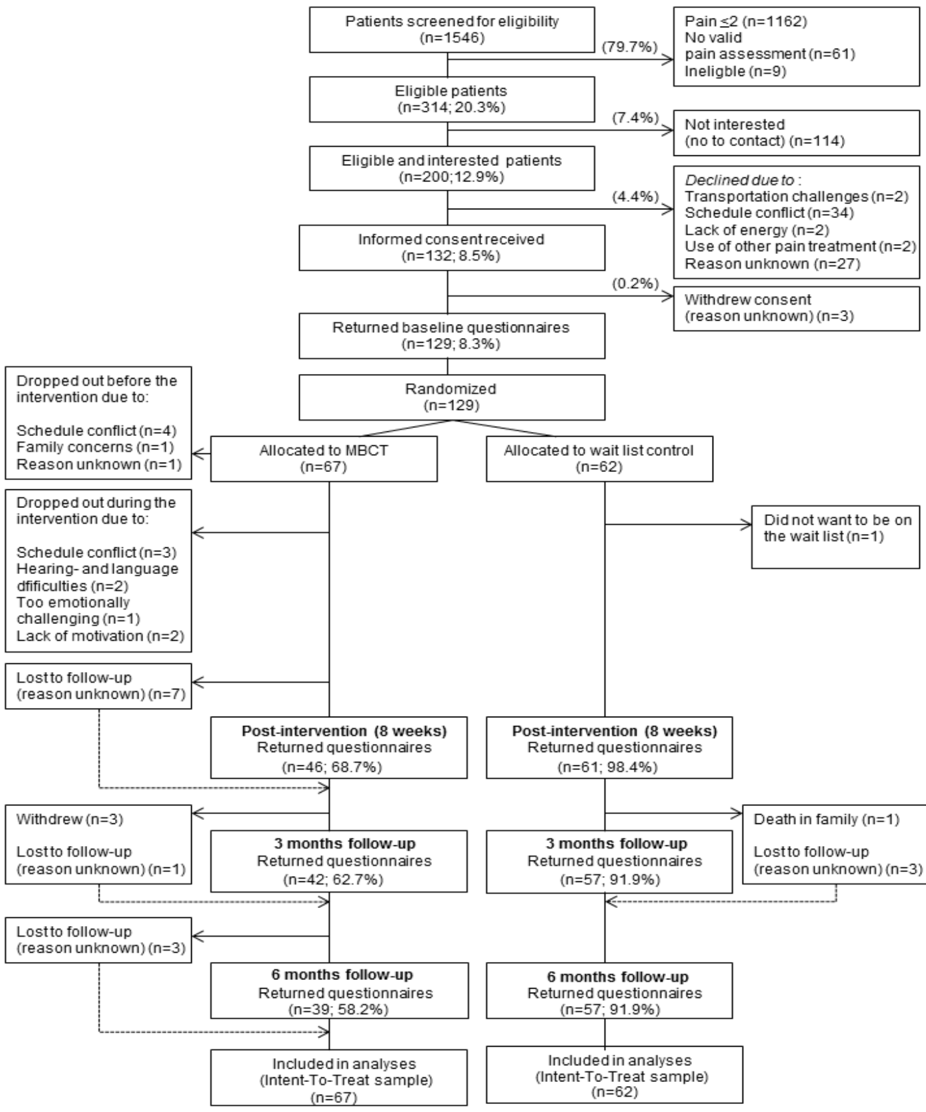
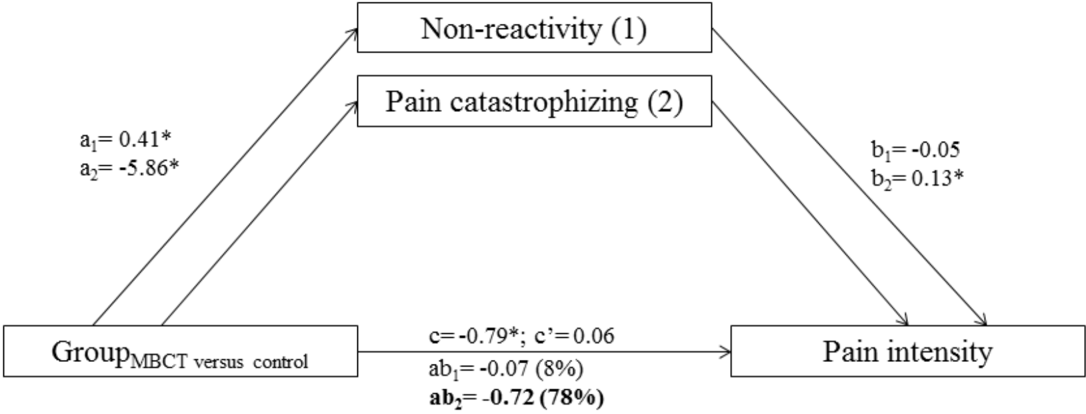
OBJECTIVES: The aim of this study was to investigate possible statistical mediators in a randomized controlled trial of mindfulness-based cognitive therapy (MBCT) on pain intensity in women treated for primary breast cancer. MATERIALS AND METHODS: The sample consisted of 129 women treated for breast cancer, presenting with persistent pain, who were randomly assigned to MBCT or a wait-list control. We previously reported a statistically significant and robust effect of MBCT on pain intensity (11-point numeric rating scale), which was included as the primary outcome. The proposed mediators were mindfulness (the Five Facet Mindfulness Questionnaire), self-compassion (the Short-Form Self-Compassion Scale), and pain catastrophizing (the Pain Catastrophizing Scale). Measurement points included baseline (T1), postintervention (T2), and 3- (T3) and 6-month (T4) follow-ups. All indirect effects of the mediators were tested in separate Multilevel Models, using the product-of-coefficients approach with bias-corrected confidence intervals (95% BSCI). The statistically significant mediators were then included in a multiple mediator model. RESULTS: Statistically significant indirect effects were found for mindfulness nonreactivity (B=-0.17, BSCI [-0.32 to -0.04]) and pain catastrophizing (B=-0.76, BSCI [-1.25 to -0.47]). No statistically significant indirect effect was found for self-compassion (B=-0.09, BSCI [-0.30 to 0.04]). In a multiple mediator model, including mindfulness nonreactivity and pain catastrophizing, only pain catastrophizing remained statistically significant (B=-0.72, BSCI [-1.19 to -0.33]), explaining 78% of the effect. DISCUSSION: The results of the present study may have clinical implications. An increased focus on the proposed mediators may optimize the clinical use of MBCT for persistent pain in women treated for breast cancer.
Overview
The claims and statistics of this paper haven’t been checked yet.
Free: it reads the open-access text and checks the first 5 claims that cite a source we can check. Create a free account to check every claim.
Integrity signals
Registry
Cites
Statistics
Figures
Verification
Claims the paper makes
The claims and statistics of this paper haven’t been checked yet.
Free: it reads the open-access text and checks the first 5 claims that cite a source we can check. Create a free account to check every claim.
Claims other papers make about this one
Each is checked against this paper’s own text: does it say what the citing paper says it does?
The source backs part of the claim, not all of it — or backs it for a different population, condition or comparison.
In the citing paper
“However, the reports revealed that employing this method also reduced psychological tensions and stress related to physical symptoms in individuals prone to addiction, cancer patients, and people with other physical diseases [18].”
From Effectiveness of Mindfulness-based Stress Reduction Intervention in Distress Tolerance and Sensation-seeking in Adolescents With a Drug-addicted Parent (2022) · cites this paper as [18]
Experimental — accuracy not yet measuredThe cited source says what the claim attributes to it.
In the citing paper
“the previously mentioned RCT on the effect of MBCT on pain after BC treatment found that reductions in pain catastrophising explained a significant proportion of the achieved pain reduction,55”
From Optimising psychological treatment for pain after breast cancer: a factorial design study protocol in Denmark (2023) · cites this paper as [55]
Self-check
Percentages, sums and reported differences re-computed from the paper’s own numbers.
The self-check needs the paper’s full text.
Citations
Cites
Baron, R. M., & Kenny, D. A. (1986) · Journal of Personality and Social Psychology · doi:10.1037/0022-3514.51.6.1173 · Cited by 91,532
Preacher, K. J., & Hayes, A. F. (2008) · Behavior Research Methods · doi:10.3758/brm.40.3.879 · Cited by 34,117
Asymptotic Confidence Intervals for Indirect Effects in Structural Equation Models
Sobel, M. E. (1982) · Sociological Methodology · doi:10.2307/270723 · Cited by 12,810
Missing data: our view of the state of the art
Schafer, J. L., & Graham, J. W. (2002) · Psychological Methods · doi:10.1037/1082-989x.7.2.147 · Cited by 11,638
Mindfulness-based interventions in context: Past, present, and future
Kabat-Zinn, J. (2003) · Clinical Psychology: Science and Practice · doi:10.1093/clipsy.bpg016 · Cited by 8,615
The Pain Catastrophizing Scale: Development and validation.
Sullivan, M. J. L., Bishop, S. R., & Pivik, J. (1995) · Psychological Assessment · doi:10.1037//1040-3590.7.4.524 · Cited by 8,227
Using Self-Report Assessment Methods to Explore Facets of Mindfulness
Baer, R. A., Smith, G. T., Hopkins, J., Krietemeyer, J., & Toney, L. (2006) · Assessment · doi:10.1177/1073191105283504 · Cited by 7,511
MacKinnon, D. P., Fairchild, A. J., & Fritz, M. S. (2007) · Annual Review of Psychology · doi:10.1146/annurev.psych.58.110405.085542 · Cited by 5,688
Kabat-Zinn, J. (1982) · General Hospital Psychiatry · doi:10.1016/0163-8343(82)90026-3 · Cited by 4,255
Construction and factorial validation of a short form of the Self-Compassion Scale
Raes, F., Pommier, E., Neff, K. D., & Van Gucht, D. (2011) · Clinical Psychology & Psychotherapy · doi:10.1002/cpp.702 · Cited by 2,997
Research works printed but not linked: 1
- Segal Z, Williams J, Teasdale J. Mindfulness-based cognitive therapy for depression. 1st ed. New York: The Guilford Press; 2002.
Cited by
Cillessen, L., Johannsen, M., Speckens, A. E. M., & Zachariae, R. (2019) · Psycho-Oncology · doi:10.1002/pon.5214 · Cited by 326
“2017(44) Breast; stage 0 to IV; 26 mo since diagnosis; with distress 134 MBCR (113) SET (104) SMS (54) Chambers et al.”
BackgroundSelf-citationPsychological Interventions for the Treatment of Chronic Pain in Adults
Driscoll, M. A., Edwards, R. R., Becker, W. C., Kaptchuk, T. J., & Kerns, R. D. (2021) · Psychological Science in the Public Interest · doi:10.1177/15291006211008157 · Cited by 176
Nissen, E. R., O'Connor, M., Kaldo, V., Højris, I., Borre, M., Zachariae, R., & Mehlsen, M. (2020) · Psycho-Oncology · doi:10.1002/pon.5237 · Cited by 136
“We chose iMBCT as our group has previously found MBCT to be well‐accepted and efficacious for treating persistent pain in breast cancer survivors.(20,21) We compared iMBCT with waitlist CAU controls at post intervention and 6 months follow‐up.”
MethodSelf-citationKılıç, A., Hudson, J., McCracken, L. M., Ruparelia, R., Fawson, S., & Hughes, L. D. (2021) · Behavior Therapy · doi:10.1016/j.beth.2020.08.001 · Cited by 98
Maindet, C., Burnod, A., Minello, C., George, B., Allano, G., & Lemaire, A. (2019) · Supportive Care in Cancer · doi:10.1007/s00520-019-04829-7 · Cited by 118
Metadata
- Authors
- Johannsen, M., O’Connor, M., O’Toole, M. S., Jensen, A. B., & Zachariae, R.
- Affiliations
- Aarhus University (DK)
- Aarhus University Hospital (DK)
- Corresponding author
- Johannsen, Maja
- O’Connor, Maja
- O’Toole, Mia S.
- Zachariae, Robert
- Venue
- The Clinical Journal of Pain
- Published
- 2018-01
- Volume
- 34
- Issue
- 1
- Pages
- 59-67
- ISSN
- 0749-8047 (ISSN-L)
- OpenAlex
- W2611934286
- Cited by
- 41
- References
- 46
- Citations by year
- 2025: 4 · 2024: 3 · 2023: 9 · 2022: 5 · 2021: 6 · 2020: 3 · 2019: 7 · 2018: 1
- FWCI
- 4.74
- Type
- journal article
- Language
- en
- Open access
- green
- pure.au.dk
- Licence
- cc-by-nc-nd
- Locations
- Clinical Journal of Pain (publishedVersion)
- PubMed (publishedVersion)
- Funders
- Kræftens Bekæmpelse (R49-A2564-11-S15)
- Rigshospitalet
- Topics
- Social Sciences › Psychology › Clinical Psychology › Mindfulness and Compassion Interventions
- Health Sciences › Medicine › Oncology › Cancer survivorship and care
- Health Sciences › Health Professions › Physical Therapy, Sports Therapy and Rehabilitation › Musculoskeletal pain and rehabilitation
- Keywords
- mindfulness-based cognitive therapy, chronic pain, breast cancer, pain catastrophizing, self-compassion, breast cancer survivors, cancer pain
- MeSH terms
- Adult, Aged, Breast Neoplasms, Female, Follow-Up Studies, Humans, Middle Aged, Pain, Pain Measurement, Patient Compliance, Surveys and Questionnaires, Retrospective Studies, Time Factors, Cognitive Behavioral Therapy, Linear Models, Treatment Outcome, Catastrophization, Mindfulness
About these checks
Registry, retraction, Cites and statistics results are computed, not judged, with one exception: a printed reference that no index lists is read once by a model before it counts as a citation error. Claims are extracted by a model and kept only when their quote appears verbatim in the text; each cited source is then checked, with a model’s help, for whether it says what the claim relies on. Those verdicts can be wrong — read the claim’s quote and the cited source before relying on one.
Statistics and arithmetic are recomputed, not judged.
Confidence bands are shown only for fields calibrated on our annotated test set. None is calibrated yet, so no band is shown.
What counts as a claim ›How we measure confidence ›How we check this ›
Are you an author, or do you see a problem with this page? Request a review
How to cite
Cite CoChat for the checks on this page, and the paper for its own findings.
- This page
- CoChat. (2026). Citation check: Mindfulness-based Cognitive Therapy and Persistent Pain in Women Treated for Primary Breast Cancer: Exploring Possible Statistical Mediators: Results From a Randomized Controlled Trial. https://app.cochat.ai/papers/10.1097/ajp.0000000000000510
- The paper
- Johannsen, M., O’Connor, M., O’Toole, M. S., Jensen, A. B., & Zachariae, R. (2018). Mindfulness-based Cognitive Therapy and Persistent Pain in Women Treated for Primary Breast Cancer: Exploring Possible Statistical Mediators: Results From a Randomized Controlled Trial. The Clinical Journal of Pain. https://doi.org/10.1097/ajp.0000000000000510
Data sources
Bibliographic data: Semantic Scholar, OpenAlex, Crossref.
Contains information from the Semantic Scholar Academic Graph Datasets, made available under the ODC Attribution License (ODC-BY 1.0).
Semantic Scholar’s data is described in: Kinney, R., et al. (2023). The Semantic Scholar Open Data Platform. arXiv:2301.10140.
