

The Multimodal Assessment Model of Pain: A Novel Framework for Further Integrating the Subjective Pain Experience Within Research and Practice
Open accessThe DOI matches its Crossref record; 104 of the 108 references it cites were found in a registry or an index.
Abstract
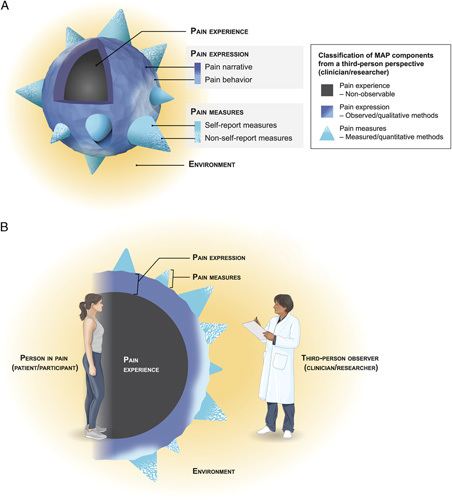
OBJECTIVES: Pain assessment is enigmatic. Although clinicians and researchers must rely upon observations to evaluate pain, the personal experience of pain is fundamentally unobservable. This raises the question of how the inherent subjectivity of pain can and should be integrated within assessment. Current models fail to tackle key facets of this problem, such as what essential aspects of pain are overlooked when we only rely on numeric forms of assessment, and what types of assessment need to be prioritized to ensure alignment with our conceptualization of pain as a subjective experience. We present the multimodal assessment model of pain (MAP) as offering practical frameworks for navigating these challenges. METHODS: This is a narrative review. RESULTS: MAP delineates qualitative (words, behaviors) and quantitative (self-reported measures, non-self-reported measures) assessment and regards the qualitative pain narrative as the best available root proxy for inferring pain in others. MAP offers frameworks to better address pain subjectivity by: (1) delineating separate criteria for identifying versus assessing pain. Pain is identified through narrative reports, while comprehensive assessment is used to infer why pain is reported; (2) integrating compassion-based and mechanism-based management by both validating pain reports and assessing underlying processes; (3) conceptualizing comprehensive pain assessment as both multidimensional and multimodal (listening/observing and measuring); and (4) describing how qualitative data help validate and contextualize quantitative pain measures. DISCUSSION: MAP is expected to help clinicians validate pain reports as important and legitimate, regardless of other findings, and help our field develop more comprehensive, valid, and compassionate approaches to assessing pain.
Overview
The claims and statistics of this paper haven’t been checked yet.
Free: it reads the open-access text and checks the first 5 claims that cite a source we can check. Create a free account to check every claim.
Integrity signals
Registry
Cites
Statistics
Figures
Verification
Claims the paper makes
The claims and statistics of this paper haven’t been checked yet.
Free: it reads the open-access text and checks the first 5 claims that cite a source we can check. Create a free account to check every claim.
Claims other papers make about this one
Each is checked against this paper’s own text: does it say what the citing paper says it does?
The check wasn’t confident either way, so it gives no verdict — never disputed.
In the citing paper
“the single best predictor of longevity is how patients describe their status of health [10,69].”
From Exploring emotional well-being, spiritual, religious and personal beliefs and telomere length in chronic pain patients—A pilot study with cross-sectional design (2024) · cites this paper as [10]
Experimental — accuracy not yet measured
Self-check
Percentages, sums and reported differences re-computed from the paper’s own numbers.
The self-check needs the paper’s full text.
Citations
Cites
The McGill Pain Questionnaire: Major properties and scoring methods
Melzack, R. (1975) · Pain · doi:10.1016/0304-3959(75)90044-5 · Cited by 6,845
Qualitative research in health care: Assessing quality in qualitative research
Mays, N. (2000) · BMJ · doi:10.1136/bmj.320.7226.50 · Cited by 3,742
Core outcome measures for chronic pain clinical trials: IMMPACT recommendations
Dworkin, R. H., Turk, D. C., Farrar, J. T., Haythornthwaite, J. A., Jensen, M. P., Katz, N. P., Kerns, R. D., Stucki, G., Allen, R. R., Bellamy, N., et al. (2005) · Pain · doi:10.1016/j.pain.2004.09.012 · Cited by 3,732
Core outcome domains for chronic pain clinical trials: IMMPACT recommendations
Turk, D. C., Dworkin, R. H., Allen, R. R., Bellamy, N., Brandenburg, N., Carr, D. B., Cleeland, C., Dionne, R., Farrar, J. T., Galer, B. S., et al. (2003) · Pain · doi:10.1016/j.pain.2003.08.001 · Cited by 3,510
Dworkin, R. H., Turk, D. C., Wyrwich, K. W., Beaton, D., Cleeland, C. S., Farrar, J. T., Haythornthwaite, J. A., Jensen, M. P., Kerns, R. D., Ader, D. N., et al. (2008) · The Journal of Pain · doi:10.1016/j.jpain.2007.09.005 · Cited by 3,471
Qualitative Research: Rigour and qualitative research
Mays, N., & Pope, C. (1995) · BMJ · doi:10.1136/bmj.311.6997.109 · Cited by 2,715
Pope, C., & Mays, N. (1995) · BMJ · doi:10.1136/bmj.311.6996.42 · Cited by 2,336
Narrative Medicine: A Model for Empathy, Reflection, Profession, and Trust
Charon, R. (2001) · JAMA · doi:10.1001/jama.286.15.1897 · Cited by 2,190
The Nature of Suffering and the Goals of Medicine
Cassel, E. J. (1982) · New England Journal of Medicine · doi:10.1056/nejm198203183061104 · Cited by 2,137
Language and meaning: Data collection in qualitative research.
Polkinghorne, D. E. (2005) · Journal of Counseling Psychology · doi:10.1037/0022-0167.52.2.137 · Cited by 1,867
Research works printed but not linked: 5
- International Association for Study of Pain (IASP). International Association for Study of Pain Task Force on Taxonomy Classification of Chronic Pain. Seattle: IASP Press; 1994.
- Carpenter C Suto M Qualitative Research for Occupational and Physical Therapists: A Practical Guide. Oxford, UK: Blackwell Publishing Ltd; 2008.
- Upshur RE Morse JM Swanson JM Kuzel AJ The status of qualitative research as evidence. The Nature of Qualitative Evidence. Thousand Oaks, CA: Sage; 2001: 5– 26.
- Fordyce WE Behavioral Methods for Chronic Pain and Illness. Saint Louis: The C. V. Mosby Company; 1976.
- Carr DB Loeser JD Morris DB Narrative, Pain, and Suffering. Seattle, WA: IASP Press; 2005.
Cited by
Davis, K. D., Aghaeepour, N., Ahn, A. H., Angst, M. S., Borsook, D., Brenton, A., Burczynski, M. E., Crean, C., Edwards, R., Gaudilliere, B., et al. (2020) · Nature Reviews Neurology · doi:10.1038/s41582-020-0362-2 · Cited by 496
An enactive approach to pain: beyond the biopsychosocial model
Stilwell, P., & Harman, K. (2019) · Phenomenology and the Cognitive Sciences · doi:10.1007/s11097-019-09624-7 · Cited by 162
Investigating intraindividual pain variability: methods, applications, issues, and directions
Mun, C. J., Suk, H. W., Davis, M. C., Karoly, P., Finan, P. H., Tennen, H. A., & Jensen, M. P. (2019) · Pain · doi:10.1097/j.pain.0000000000001626 · Cited by 135
“Pain experience is fundamentally subjective and cannot be observed by those who are not experiencing it.(96) Hence, to better understand pain, it is important to use multimodal assessments and investigate the context and process of pain reports (see Refs.”
BackgroundCan insects feel pain? A review of the neural and behavioural evidence
(2022) · Advances in Insect Physiology · doi:10.1016/bs.aiip.2022.10.001 · Cited by 121
Zebhauser, P. T., Hohn, V. D., & Ploner, M. (2022) · Pain · doi:10.1097/j.pain.0000000000002825 · Cited by 143
“119 To improve assessment and guide treat-ment of chronic pain, the quest for objective measures of acute and chronic pain has gained increasing attention.”
Metadata
- Authors
- Wideman, T. H., Edwards, R. R., Walton, D. M., Martel, M. O., Hudon, A., & Seminowicz, D. A.
- Affiliations
- School of Physical and Occupational Therapy
- Harvard University (US)
- Western University (CA)
- McGill University (CA)
- University of Waterloo (CA)
- University of Maryland, Baltimore (US)
- Corresponding author
- Wideman, Timothy H.
- ORCID
- Venue
- The Clinical Journal of Pain
- Published
- 2019-03
- Volume
- 35
- Issue
- 3
- Pages
- 212-221
- ISSN
- 0749-8047 (ISSN-L)
- PMC
- PMC6382036
- OpenAlex
- W2901160456
- Cited by
- 187
- References
- 108
- Citations by year
- 2026: 25 · 2025: 50 · 2024: 30 · 2023: 22 · 2022: 23 · 2021: 20 · 2020: 10 · 2019: 7
- FWCI
- 2.27
- Type
- journal article
- Language
- en
- Open access
- hybrid
- doi.org
- Licence
- Locations
- Clinical Journal of Pain (publishedVersion, cc-by-nc-nd)
- Europe PMC (PubMed Central) (publishedVersion, other-oa)
- PubMed Central (publishedVersion, cc-by-nc-nd)
- PubMed (publishedVersion)
- Funders
- Canadian Institutes of Health Research
- Topics
- Health Sciences › Medicine › Anesthesiology and Pain Medicine › Pain Management and Opioid Use
- Health Sciences › Medicine › Pediatrics, Perinatology and Child Health › Pediatric Pain Management Techniques
- Health Sciences › Health Professions › Physical Therapy, Sports Therapy and Rehabilitation › Musculoskeletal pain and rehabilitation
- Keywords
- pain assessment, pain identification, multidimensional pain assessment
- MeSH terms
- Humans, Models, Theoretical, Pain, Pain Measurement
About these checks
Registry, retraction, Cites and statistics results are computed, not judged, with one exception: a printed reference that no index lists is read once by a model before it counts as a citation error. Claims are extracted by a model and kept only when their quote appears verbatim in the text; each cited source is then checked, with a model’s help, for whether it says what the claim relies on. Those verdicts can be wrong — read the claim’s quote and the cited source before relying on one.
Statistics and arithmetic are recomputed, not judged.
Confidence bands are shown only for fields calibrated on our annotated test set. None is calibrated yet, so no band is shown.
What counts as a claim ›How we measure confidence ›How we check this ›
Are you an author, or do you see a problem with this page? Request a review
How to cite
Cite CoChat for the checks on this page, and the paper for its own findings.
- This page
- CoChat. (2026). Citation check: The Multimodal Assessment Model of Pain: A Novel Framework for Further Integrating the Subjective Pain Experience Within Research and Practice. https://app.cochat.ai/papers/10.1097/ajp.0000000000000670
- The paper
- Wideman, T. H., Edwards, R. R., Walton, D. M., Martel, M. O., Hudon, A., & Seminowicz, D. A. (2019). The Multimodal Assessment Model of Pain: A Novel Framework for Further Integrating the Subjective Pain Experience Within Research and Practice. The Clinical Journal of Pain. https://doi.org/10.1097/ajp.0000000000000670
Data sources
Bibliographic data: Semantic Scholar, OpenAlex, Crossref.
Contains information from the Semantic Scholar Academic Graph Datasets, made available under the ODC Attribution License (ODC-BY 1.0).
Semantic Scholar’s data is described in: Kinney, R., et al. (2023). The Semantic Scholar Open Data Platform. arXiv:2301.10140.
