

The Multimodal Assessment Model of Pain: A Novel Framework for Further Integrating the Subjective Pain Experience Within Research and Practice
Open accessThe DOI matches its Crossref record; 104 of the 108 references it cites were found in a registry or an index.
Abstract
OBJECTIVES: Pain assessment is enigmatic. Although clinicians and researchers must rely upon observations to evaluate pain, the personal experience of pain is fundamentally unobservable. This raises the question of how the inherent subjectivity of pain can and should be integrated within assessment. Current models fail to tackle key facets of this problem, such as what essential aspects of pain are overlooked when we only rely on numeric forms of assessment, and what types of assessment need to be prioritized to ensure alignment with our conceptualization of pain as a subjective experience. We present the multimodal assessment model of pain (MAP) as offering practical frameworks for navigating these challenges. METHODS: This is a narrative review. RESULTS: MAP delineates qualitative (words, behaviors) and quantitative (self-reported measures, non-self-reported measures) assessment and regards the qualitative pain narrative as the best available root proxy for inferring pain in others. MAP offers frameworks to better address pain subjectivity by: (1) delineating separate criteria for identifying versus assessing pain. Pain is identified through narrative reports, while comprehensive assessment is used to infer why pain is reported; (2) integrating compassion-based and mechanism-based management by both validating pain reports and assessing underlying processes; (3) conceptualizing comprehensive pain assessment as both multidimensional and multimodal (listening/observing and measuring); and (4) describing how qualitative data help validate and contextualize quantitative pain measures. DISCUSSION: MAP is expected to help clinicians validate pain reports as important and legitimate, regardless of other findings, and help our field develop more comprehensive, valid, and compassionate approaches to assessing pain.
Overview
The claims and statistics of this paper haven’t been checked yet.
Free: it reads the open-access text and checks the first 5 claims that cite a source we can check. Create a free account to check every claim.
Integrity signals
Registry
Cites
Statistics
Figures
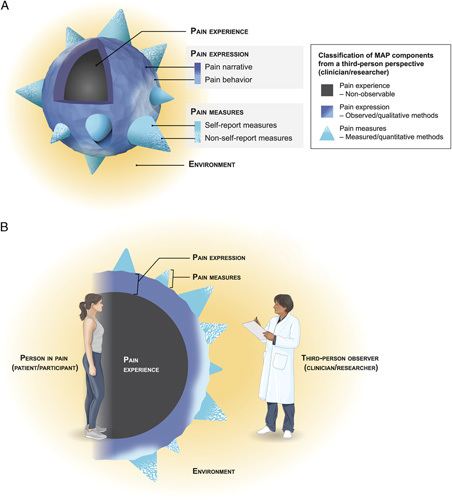
Verification
Claims the paper makes
The claims and statistics of this paper haven’t been checked yet.
Free: it reads the open-access text and checks the first 5 claims that cite a source we can check. Create a free account to check every claim.
Claims other papers make about this one
Each is checked against this paper’s own text: does it say what the citing paper says it does?
The check wasn’t confident either way, so it gives no verdict — never disputed.
In the citing paper
“the single best predictor of longevity is how patients describe their status of health [10,69].”
From Exploring emotional well-being, spiritual, religious and personal beliefs and telomere length in chronic pain patients—A pilot study with cross-sectional design (2024) · cites this paper as [10]
Experimental — accuracy not yet measured
Self-check
Percentages, sums and reported differences re-computed from the paper’s own numbers.
The self-check needs the paper’s full text.
Citations
Cites
The McGill Pain Questionnaire: Major properties and scoring methods
Melzack, R. (1975) · Pain · doi:10.1016/0304-3959(75)90044-5 · Cited by 6,845
Qualitative research in health care: Assessing quality in qualitative research
Mays, N. (2000) · BMJ · doi:10.1136/bmj.320.7226.50 · Cited by 3,742
Core outcome measures for chronic pain clinical trials: IMMPACT recommendations
Dworkin, R. H., Turk, D. C., Farrar, J. T., Haythornthwaite, J. A., Jensen, M. P., Katz, N. P., Kerns, R. D., Stucki, G., Allen, R. R., Bellamy, N., et al. (2005) · Pain · doi:10.1016/j.pain.2004.09.012 · Cited by 3,732
Core outcome domains for chronic pain clinical trials: IMMPACT recommendations
Turk, D. C., Dworkin, R. H., Allen, R. R., Bellamy, N., Brandenburg, N., Carr, D. B., Cleeland, C., Dionne, R., Farrar, J. T., Galer, B. S., et al. (2003) · Pain · doi:10.1016/j.pain.2003.08.001 · Cited by 3,510
Dworkin, R. H., Turk, D. C., Wyrwich, K. W., Beaton, D., Cleeland, C. S., Farrar, J. T., Haythornthwaite, J. A., Jensen, M. P., Kerns, R. D., Ader, D. N., et al. (2008) · The Journal of Pain · doi:10.1016/j.jpain.2007.09.005 · Cited by 3,471
Qualitative Research: Rigour and qualitative research
Mays, N., & Pope, C. (1995) · BMJ · doi:10.1136/bmj.311.6997.109 · Cited by 2,715
Pope, C., & Mays, N. (1995) · BMJ · doi:10.1136/bmj.311.6996.42 · Cited by 2,336
Narrative Medicine: A Model for Empathy, Reflection, Profession, and Trust
Charon, R. (2001) · JAMA · doi:10.1001/jama.286.15.1897 · Cited by 2,190
The Nature of Suffering and the Goals of Medicine
Cassel, E. J. (1982) · New England Journal of Medicine · doi:10.1056/nejm198203183061104 · Cited by 2,137
Language and meaning: Data collection in qualitative research.
Polkinghorne, D. E. (2005) · Journal of Counseling Psychology · doi:10.1037/0022-0167.52.2.137 · Cited by 1,867
An fMRI-Based Neurologic Signature of Physical Pain
Wager, T. D., Atlas, L. Y., Lindquist, M. A., Roy, M., Woo, C.-W., & Kross, E. (2013) · New England Journal of Medicine · doi:10.1056/nejmoa1204471 · Cited by 1,597
Quantitative sensory testing: a comprehensive protocol for clinical trials
Rolke, R., Magerl, W., Campbell, K. A., Schalber, C., Caspari, S., Birklein, F., & Treede, R. ‐. (2006) · European Journal of Pain · doi:10.1016/j.ejpain.2005.02.003 · Cited by 1,520
1987 Volvo Award in Clinical Sciences: A New Clinical Model for the Treatment of Low-Back Pain
WADDELL, G. (1987) · Spine · doi:10.1097/00007632-198709000-00002 · Cited by 1,245
The Nature of Suffering and the Goals of Medicine
Cassell, E. J. (1998) · Loss, Grief & Care · doi:10.1300/j132v08n01_18 · Cited by 1,182
Melzack, R., & Torgerson, W. S. (1971) · Anesthesiology · doi:10.1097/00000542-197101000-00017 · Cited by 928
Updating the definition of pain
Williams, A. C. D. C., & Craig, K. D. (2016) · Pain · doi:10.1097/j.pain.0000000000000613 · Cited by 744
Werner, A., & Malterud, K. (2003) · Social Science & Medicine · doi:10.1016/s0277-9536(02)00520-8 · Cited by 696
Value of quantitative sensory testing in neurological and pain disorders: NeuPSIG consensus
Backonja, M. “., Attal, N., Baron, R., Bouhassira, D., Drangholt, M., Dyck, P. J., Edwards, R. R., Freeman, R., Gracely, R., Haanpaa, M. H., et al. (2013) · Pain · doi:10.1016/j.pain.2013.05.047 · Cited by 574
An Interdisciplinary Expert Consensus Statement on Assessment of Pain in Older Persons
Hadjistavropoulos, T., Herr, K., Turk, D. C., Fine, P. G., Dworkin, R. H., Helme, R., Jackson, K., Parmelee, P. A., Rudy, T. E., Lynn Beattie, B., et al. (2007) · The Clinical Journal of Pain · doi:10.1097/ajp.0b013e31802be869 · Cited by 560
Towards a mechanism-based classification of pain?
Woolf, C. J., Bennett, G. J., Doherty, M., Dubner, R., Kidd, B., Koltzenburg, M., Lipton, R., Loeser, J. D., Payne, R., & Torebjork, E. (1998) · Pain · doi:10.1016/s0304-3959(98)00099-2 · Cited by 553
Supporting Patient Autonomy: The Importance of Clinician-patient Relationships
Entwistle, V. A., Carter, S. M., Cribb, A., & McCaffery, K. (2010) · Journal of General Internal Medicine · doi:10.1007/s11606-010-1292-2 · Cited by 540
Turk, D. C., Dworkin, R. H., Revicki, D., Harding, G., Burke, L. B., Cella, D., Cleeland, C. S., Cowan, P., Farrar, J. T., Hertz, S., et al. (2008) · Pain · doi:10.1016/j.pain.2007.09.002 · Cited by 517
Herr, K., Coyne, P. J., McCaffery, M., Manworren, R., & Merkel, S. (2011) · Pain Management Nursing · doi:10.1016/j.pmn.2011.10.002 · Cited by 510
McCracken, L. M., & Morley, S. (2014) · The Journal of Pain · doi:10.1016/j.jpain.2013.10.014 · Cited by 464
Accuracy of the Pain Numeric Rating Scale as a Screening Test in Primary Care
Krebs, E. E., Carey, T. S., & Weinberger, M. (2007) · Journal of General Internal Medicine · doi:10.1007/s11606-007-0321-2 · Cited by 460
Synnott, A., O’Keeffe, M., Bunzli, S., Dankaerts, W., O'Sullivan, P., & O'Sullivan, K. (2015) · Journal of Physiotherapy · doi:10.1016/j.jphys.2015.02.016 · Cited by 412
Assessment of Chronic Pain: Domains, Methods, and Mechanisms
Fillingim, R. B., Loeser, J. D., Baron, R., & Edwards, R. R. (2016) · The Journal of Pain · doi:10.1016/j.jpain.2015.08.010 · Cited by 409
The new subjective medicine: taking the patient's point of view on health care and health
Sullivan, M. (2003) · Social Science & Medicine · doi:10.1016/s0277-9536(02)00159-4 · Cited by 408
Management of chronic pain in older adults
Reid, M. C., Eccleston, C., & Pillemer, K. (2015) · BMJ · doi:10.1136/bmj.h532 · Cited by 405
Hadjistavropoulos, T., & Craig, K. D. (2002) · Behaviour Research and Therapy · doi:10.1016/s0005-7967(01)00072-9 · Cited by 382
Alperstein, D., & Sharpe, L. (2016) · The Journal of Pain · doi:10.1016/j.jpain.2015.10.021 · Cited by 342
Understanding stigma and chronic pain: a-state-of-the-art review
De Ruddere, L., & Craig, K. D. (2016) · Pain · doi:10.1097/j.pain.0000000000000512 · Cited by 330 · cited 8×
“(2) MAP delineates qualitative expressions of pain (words, behaviors) from quantitative measures of pain and assumes that”
BackgroundResultInfluentialPain assessment in elderly adults with dementia
Hadjistavropoulos, T., Herr, K., Prkachin, K. M., Craig, K. D., Gibson, S. J., Lukas, A., & Smith, J. H. (2014) · The Lancet Neurology · doi:10.1016/s1474-4422(14)70103-6 · Cited by 319
Mechanism-based Pain Diagnosis: Issues for Analgesic Drug Development
Woolf, C. J., & Max, M. B. (2001) · Anesthesiology · doi:10.1097/00000542-200107000-00034 · Cited by 306
Can Quantitative Sensory Testing Move Us Closer to Mechanism-Based Pain Management?
Cruz-Almeida, Y., & Fillingim, R. B. (2014) · Pain Medicine · doi:10.1111/pme.12230 · Cited by 302
Brain imaging tests for chronic pain: medical, legal and ethical issues and recommendations
Davis, K. D., Flor, H., Greely, H. T., Iannetti, G. D., Mackey, S., Ploner, M., Pustilnik, A., Tracey, I., Treede, R.-D., & Wager, T. D. (2017) · Nature Reviews Neurology · doi:10.1038/nrneurol.2017.122 · Cited by 302
Developing patient-reported outcome measures for pain clinical trials: IMMPACT recommendations
Turk, D. C., Dworkin, R. H., Burke, L. B., Gershon, R., Rothman, M., Scott, J., Allen, R. R., Atkinson, H. J., Chandler, J., Cleeland, C., et al. (2006) · Pain · doi:10.1016/j.pain.2006.09.028 · Cited by 301
Intensity of Chronic Pain — The Wrong Metric?
Ballantyne, J. C., & Sullivan, M. D. (2015) · New England Journal of Medicine · doi:10.1056/nejmp1507136 · Cited by 284
Pain Assessment as a Social Transaction: Beyond the “Gold Standard”
Schiavenato, M., & Craig, K. D. (2010) · The Clinical Journal of Pain · doi:10.1097/ajp.0b013e3181e72507 · Cited by 232
Physical Symptoms and Physician-Experienced Difficulty in the Physician–Patient Relationship
Hahn, S. R. (2001) · Annals of Internal Medicine · doi:10.7326/0003-4819-134-9_part_2-200105011-00014 · Cited by 221
Assessment of patients' reporting of pain: an integrated perspective
Turk, D. C., & Okifuji, A. (1999) · The Lancet · doi:10.1016/s0140-6736(99)01309-4 · Cited by 206
Expressing pain: The communication and interpretation of facial pain signals
Prkachin, K. M., & Craig, K. D. (1995) · Journal of Nonverbal Behavior · doi:10.1007/bf02173080 · Cited by 201
The stigmatisation of people with chronic back pain
Holloway, I., Sofaer-Bennett, B., & Walker, J. (2007) · Disability and Rehabilitation · doi:10.1080/09638280601107260 · Cited by 196 · cited 6×
“root proxy for inferring the experience of pain (3) Subjective reports of pain cannot be invalidated by other”
BackgroundResultInfluentialMaking Sense of Low Back Pain and Pain-Related Fear
Bunzli, S., Smith, A., Schütze, R., Lin, I., & O'Sullivan, P. (2017) · Journal of Orthopaedic & Sports Physical Therapy · doi:10.2519/jospt.2017.7434 · Cited by 189
Provider Judgments of Patients in Pain: Seeking Symptom Certainty
Tait, R. C., Chibnall, J. T., & Kalauokalani, D. (2009) · Pain Medicine · doi:10.1111/j.1526-4637.2008.00527.x · Cited by 187
Assessing Pain by Facial Expression: Facial Expression as Nexus
Prkachin, K. M. (2009) · Pain Research and Management · doi:10.1155/2009/542964 · Cited by 184
Stigma Experienced by People with Nonspecific Chronic Low Back Pain: A Qualitative Study
Slade, S. C., Molloy, E., & Keating, J. L. (2009) · Pain Medicine · doi:10.1111/j.1526-4637.2008.00540.x · Cited by 183 · cited 1×
“management by both validating pain reports and assessing underlying processes; (3) conceptualizing comprehensive pain assessment as both multidimensional and multimodal (listening/observing and measuring); and (4) describing how qualitative data help validate and contextualize quantitative pain measures.”
BackgroundLoeser, J. D. (2000) · The Clinical Journal of Pain · doi:10.1097/00002508-200006001-00002 · Cited by 173
Perceiving Pain in Others: Automatic and Controlled Mechanisms
Craig, K. D., Versloot, J., Goubert, L., Vervoort, T., & Crombez, G. (2010) · The Journal of Pain · doi:10.1016/j.jpain.2009.08.008 · Cited by 168
Must we reduce pain intensity to treat chronic pain?
Sullivan, M. D., & Ballantyne, J. C. (2016) · Pain · doi:10.1097/j.pain.0000000000000336 · Cited by 164
Social communication model of pain
Craig, K. D. (2015) · Pain · doi:10.1097/j.pain.0000000000000185 · Cited by 162
Bad Is More Powerful than Good: The Nocebo Response in Medical Consultations
Greville-Harris, M., & Dieppe, P. A. (2014) · The American Journal of Medicine · doi:10.1016/j.amjmed.2014.08.031 · Cited by 156
Patients’ experiences of chronic non-malignant musculoskeletal pain: a qualitative systematic review
Toye, F., Seers, K., Allcock, N., Briggs, M., Carr, E., Andrews, J., & Barker, K. (2013) · British Journal of General Practice · doi:10.3399/bjgp13x675412 · Cited by 156
Mechanisms of Disease: mechanism-based classification of neuropathic pain—a critical analysis
Finnerup, N. B., & Jensen, T. S. (2006) · Nature Clinical Practice Neurology · doi:10.1038/ncpneuro0118 · Cited by 153
Bunzli, S., Smith, A. J., Schütze, R., & O’Sullivan, P. (2015) · BMJ Open · doi:10.1136/bmjopen-2015-008847 · Cited by 152
Validating pain communication: current state of the science
Edmond, S. N., & Keefe, F. J. (2015) · Pain · doi:10.1097/01.j.pain.0000460301.18207.c2 · Cited by 151
Main, C. J. (2015) · Pain · doi:10.1097/j.pain.0000000000000457 · Cited by 146
Christiansen, S., Oettingen, G., Dahme, B., & Klinger, R. (2010) · Pain · doi:10.1016/j.pain.2009.12.015 · Cited by 141
Cepeda, M. S., Chapman, C. R., Miranda, N., Sanchez, R., Rodriguez, C. H., Restrepo, A. E., Ferrer, L. M., Linares, R. A., & Carr, D. B. (2008) · Journal of Pain and Symptom Management · doi:10.1016/j.jpainsymman.2007.08.011 · Cited by 135
Toye, F., Seers, K., Hannink, E., & Barker, K. (2017) · BMC Medical Research Methodology · doi:10.1186/s12874-017-0392-7 · Cited by 127
Bunzli, S., Smith, A., Watkins, R., Schütze, R., & O’Sullivan, P. (2015) · The Clinical Journal of Pain · doi:10.1097/ajp.0000000000000143 · Cited by 109
Biomarkers for chronic pain and analgesia. Part 1: the need, reality, challenges, and solutions.
Borsook, D., Becerra, L. R., & Hargreaves, R. (2011) · PubMed · Cited by 106
What should be the core outcomes in chronic pain clinical trials?
Turk, D. C., & Dworkin, R. H. (2004) · Arthritis Research · doi:10.1186/ar1196 · Cited by 98
Doctors and patients in pain: Conflict and collaboration in opioid prescription in primary care
Esquibel, A. Y., & Borkan, J. (2014) · Pain · doi:10.1016/j.pain.2014.09.018 · Cited by 98
Agnew, D., & Merskey, H. (1976) · Pain · doi:10.1016/0304-3959(76)90048-8 · Cited by 95
Perceived stereotyping and seeking care for chronic vulvar pain
Nguyen, R. H. N., Turner, R. M., Rydell, S. A., MacLehose, R. F., & Harlow, B. L. (2013) · Pain Medicine · doi:10.1111/pme.12151 · Cited by 92
Toyé, F., Seers, K., & Barker, K. L. (2017) · BMJ Open · doi:10.1136/bmjopen-2017-018411 · Cited by 91
Yu, L., Norton, S., & McCracken, L. M. (2017) · The Journal of Pain · doi:10.1016/j.jpain.2017.01.005 · Cited by 88
Communicating the experience of pain: the role of analogy
Schott, D. G. (2004) · Pain · doi:10.1016/j.pain.2004.01.037 · Cited by 85
Ethical Perspectives on Pain and Suffering
Ferrell, B. (2005) · Pain Management Nursing · doi:10.1016/j.pmn.2005.06.001 · Cited by 77
Pain Measurement and Brain Activity: Will Neuroimages Replace Pain Ratings?
Robinson, M. E., Staud, R., & Price, D. D. (2013) · The Journal of Pain · doi:10.1016/j.jpain.2012.05.007 · Cited by 74
Ethical dilemmas in pain management
FERRELL, B. R., Novy, D. M., Sullivan, M. D., Banja, J. D., Dubois, M. Y., Gitlin, M. C., Hamaty, D., Lebovits, A., Lipman, A. G., Lippe, P. M., et al. (2001) · Journal of Pain · doi:10.1054/jpai.2001.21596 · Cited by 73
Borsook, D., Becerra, L. R., & Hargreaves, R. J. (2011) · PubMed · Cited by 70
Sullivan, M. D., & FERRELL, B. R. (2004) · Journal of Pain · doi:10.1016/j.jpain.2004.10.006 · Cited by 67
Dewar, A., White, M., Posade, S. T., & Dillon, W. (2003) · Health Expectations · doi:10.1046/j.1369-6513.2003.00208.x · Cited by 63
Clarke, A., Anthony, G., Gray, D., Jones, D., McNamee, P., Schofield, P., Smith, B. H., & Martin, D. (2012) · BMC Geriatrics · doi:10.1186/1471-2318-12-78 · Cited by 55
When does pain matter? Acknowledging the subjectivity of clinical significance
Birnie, K. A., McGrath, P. J., & Chambers, C. T. (2012) · Pain · doi:10.1016/j.pain.2012.07.033 · Cited by 54
Diller, A. (1980) · Pain · doi:10.1016/0304-3959(80)90025-1 · Cited by 51
Describing pain with physical disability: Narrative interviews and the McGill Pain Questionnaire
Dudgeon, B. J., Ehde, D. M., Cardenas, D. D., Engel, J. M., Hoffman, A. J., & Jensen, M. P. (2005) · Archives of Physical Medicine and Rehabilitation · doi:10.1016/j.apmr.2004.01.034 · Cited by 51
Pasero, C., Quinlan-Colwell, A. D., Rae, D., Broglio, K., & Drew, D. J. (2016) · Pain Management Nursing · doi:10.1016/j.pmn.2016.08.002 · Cited by 50
What Does It Mean to Call Chronic Pain a Brain Disease?
Sullivan, M. D., Cahana, A., Derbyshire, S. W. G., & Loeser, J. D. (2013) · Journal of Pain · doi:10.1016/j.jpain.2012.02.012 · Cited by 45
The Pain—Suffering Association, A Review
Fishbain, D. A., Lewis, J. E., & Gao, J. (2015) · Pain Medicine · doi:10.1111/pme.12686 · Cited by 43
Ways of talking about experiences of pain among older patients following orthopaedic surgery
Bergh, I. H., Jakobsson, E., Sjöström, B., & Steen, B. C. (2005) · Journal of Advanced Nursing · doi:10.1111/j.1365-2648.2005.03607.x · Cited by 36
Tuck, N. L., Johnson, M. H., & Bean, D. J. (2018) · Journal of Pain · doi:10.1016/j.jpain.2018.07.002 · Cited by 34
McCracken, L. M., Davies, M., Scott, W., Paroli, M., Harris, S., & Sanderson, K. (2015) · Pain Medicine · doi:10.1111/pme.12623 · Cited by 31
Assessing pain in nonverbal older adults
Booker, S. Q., & Haedtke, C. (2016) · Nursing · doi:10.1097/01.nurse.0000480619.08039.50 · Cited by 30
Schütze, R., Rees, C., Slater, H., Smith, A., & O'Sullivan, P. (2017) · British Journal of Health Psychology · doi:10.1111/bjhp.12240 · Cited by 30
Using qualitative methods to access the pain experience
Morse, J. M. (2014) · British Journal of Pain · doi:10.1177/2049463714550507 · Cited by 29
The Problem of Pain in the Clinicopathological Method
Sullivan, M. D. (1998) · Clinical Journal of Pain · doi:10.1097/00002508-199809000-00005 · Cited by 29
Bačkonja, M., & Farrar, J. T. (2015) · Pain Medicine · doi:10.1111/pme.12748 · Cited by 25
A note on the description of pain and its causes
Boyd, D. B., & Merskey, H. (1978) · Pain · doi:10.1016/0304-3959(78)90019-2 · Cited by 25
Mackey, S. C. (2013) · The Journal of Pain · doi:10.1016/j.jpain.2013.01.001 · Cited by 24
Unrelieved pain: an ethical and epistemological analysis of distrust in patients.
Peter, E. H., & Watt‐Watson, J. (2002) · PubMed · Cited by 22
The Education of Pain Physicians
Loeser, J. D. (2014) · Pain Medicine · doi:10.1111/pme.12335 · Cited by 21
Purcell, T. B. (1991) · Emergency Medicine Clinics of North America · doi:10.1016/s0733-8627(20)30208-x · Cited by 17
Exaggerated Pain Behavior: By What Standard?
Sullivan, M. D. (2004) · Clinical Journal of Pain · doi:10.1097/00002508-200411000-00008 · Cited by 16
Is Chronic Pain a Disease? Evaluating Pain and Nociception Through Self-Report and Neuroimaging
Davis, K. D. (2013) · Journal of Pain · doi:10.1016/j.jpain.2013.01.002 · Cited by 15
Is there a purely biological core to pain experience?
Sullivan, M. D., & Derbyshire, S. W. G. (2015) · Pain · doi:10.1097/j.pain.0000000000000357 · Cited by 12
Improving ACL Reconstruction Outcomes
Wilk, K. E., Spindler, K. P., McCarty, E. C., Grooms, D. R., & Silbernagel, K. G. (2017) · Journal of Orthopaedic and Sports Physical Therapy · doi:10.2519/jospt.webinars.2017.0404 · Cited by 5
Wideman, T. H., Hudon, A., & Walton, D. M. (2018) · Pain · doi:10.1097/j.pain.0000000000001181 · Cited by 4
Self-citationMaking an ethical plan for treating patients in pain
Quinlan-Colwell, A. D. (2013) · Nursing · doi:10.1097/01.nurse.0000431122.07851.e0 · Cited by 3
The Added Value of Qualitative Methodologies for Studying Emotional Disclosure About Pain
Wideman, T. H., Hudon, A., & Bostick, G. P. (2018) · Journal of Pain · doi:10.1016/j.jpain.2018.05.001 · Cited by 3
Self-citationMaking an ethical plan for treating patients in pain
Quinlan-Colwell, A. D. (2013) · The Nurse Practitioner · doi:10.1097/01.npr.0000437582.88592.c2 · Cited by 2
Craig, K. D., & Williams, A. C. D. C. (2018) · Pain · doi:10.1097/j.pain.0000000000001182 · Cited by 2
Research works printed but not linked: 5
- International Association for Study of Pain (IASP). International Association for Study of Pain Task Force on Taxonomy Classification of Chronic Pain. Seattle: IASP Press; 1994.
- Carpenter C Suto M Qualitative Research for Occupational and Physical Therapists: A Practical Guide. Oxford, UK: Blackwell Publishing Ltd; 2008.
- Upshur RE Morse JM Swanson JM Kuzel AJ The status of qualitative research as evidence. The Nature of Qualitative Evidence. Thousand Oaks, CA: Sage; 2001: 5– 26.
- Fordyce WE Behavioral Methods for Chronic Pain and Illness. Saint Louis: The C. V. Mosby Company; 1976.
- Carr DB Loeser JD Morris DB Narrative, Pain, and Suffering. Seattle, WA: IASP Press; 2005.
Cited by
Davis, K. D., Aghaeepour, N., Ahn, A. H., Angst, M. S., Borsook, D., Brenton, A., Burczynski, M. E., Crean, C., Edwards, R., Gaudilliere, B., et al. (2020) · Nature Reviews Neurology · doi:10.1038/s41582-020-0362-2 · Cited by 496
An enactive approach to pain: beyond the biopsychosocial model
Stilwell, P., & Harman, K. (2019) · Phenomenology and the Cognitive Sciences · doi:10.1007/s11097-019-09624-7 · Cited by 162
Investigating intraindividual pain variability: methods, applications, issues, and directions
Mun, C. J., Suk, H. W., Davis, M. C., Karoly, P., Finan, P. H., Tennen, H. A., & Jensen, M. P. (2019) · Pain · doi:10.1097/j.pain.0000000000001626 · Cited by 136
“Pain experience is fundamentally subjective and cannot be observed by those who are not experiencing it.(96) Hence, to better understand pain, it is important to use multimodal assessments and investigate the context and process of pain reports (see Refs.”
BackgroundCan insects feel pain? A review of the neural and behavioural evidence
(2022) · Advances in Insect Physiology · doi:10.1016/bs.aiip.2022.10.001 · Cited by 121
Zebhauser, P. T., Hohn, V. D., & Ploner, M. (2022) · Pain · doi:10.1097/j.pain.0000000000002825 · Cited by 143
“119 To improve assessment and guide treat-ment of chronic pain, the quest for objective measures of acute and chronic pain has gained increasing attention.”
Metadata
- Authors
- Wideman, T. H., Edwards, R. R., Walton, D. M., Martel, M. O., Hudon, A., & Seminowicz, D. A.
- Affiliations
- School of Physical and Occupational Therapy
- Harvard University (US)
- Western University (CA)
- McGill University (CA)
- University of Waterloo (CA)
- University of Maryland, Baltimore (US)
- Corresponding author
- Wideman, Timothy H.
- ORCID
- Venue
- The Clinical Journal of Pain
- Published
- 2019-03
- Volume
- 35
- Issue
- 3
- Pages
- 212-221
- ISSN
- 0749-8047 (ISSN-L)
- PMC
- PMC6382036
- OpenAlex
- W2901160456
- Cited by
- 187
- References
- 108
- Citations by year
- 2026: 25 · 2025: 50 · 2024: 30 · 2023: 22 · 2022: 23 · 2021: 20 · 2020: 10 · 2019: 7
- FWCI
- 2.27
- Type
- journal article
- Language
- en
- Open access
- hybrid
- doi.org
- Licence
- Locations
- Clinical Journal of Pain (publishedVersion, cc-by-nc-nd)
- Europe PMC (PubMed Central) (publishedVersion, other-oa)
- PubMed Central (publishedVersion, cc-by-nc-nd)
- PubMed (publishedVersion)
- Funders
- Canadian Institutes of Health Research
- Topics
- Health Sciences › Medicine › Anesthesiology and Pain Medicine › Pain Management and Opioid Use
- Health Sciences › Medicine › Pediatrics, Perinatology and Child Health › Pediatric Pain Management Techniques
- Health Sciences › Health Professions › Physical Therapy, Sports Therapy and Rehabilitation › Musculoskeletal pain and rehabilitation
- Keywords
- pain assessment, pain identification, multidimensional pain assessment
- MeSH terms
- Humans, Models, Theoretical, Pain, Pain Measurement
About these checks
Registry, retraction, Cites and statistics results are computed, not judged, with one exception: a printed reference that no index lists is read once by a model before it counts as a citation error. Claims are extracted by a model and kept only when their quote appears verbatim in the text; each cited source is then checked, with a model’s help, for whether it says what the claim relies on. Those verdicts can be wrong — read the claim’s quote and the cited source before relying on one.
Statistics and arithmetic are recomputed, not judged.
Confidence bands are shown only for fields calibrated on our annotated test set. None is calibrated yet, so no band is shown.
What counts as a claim ›How we measure confidence ›How we check this ›
Are you an author, or do you see a problem with this page? Request a review
Data sources
Bibliographic data: Semantic Scholar, OpenAlex, Crossref.
Contains information from the Semantic Scholar Academic Graph Datasets, made available under the ODC Attribution License (ODC-BY 1.0).
Semantic Scholar’s data is described in: Kinney, R., et al. (2023). The Semantic Scholar Open Data Platform. arXiv:2301.10140.
