

Pain Catastrophizing Throughout the Perioperative Period in Adolescents With Idiopathic Scoliosis
Open accessThe DOI matches its Crossref record; 42 of the 42 references it cites were found in a registry or an index.
Abstract
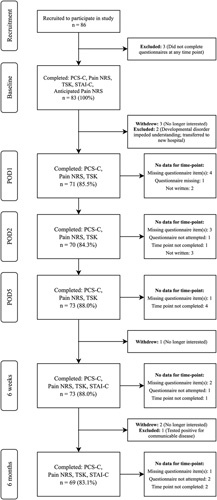
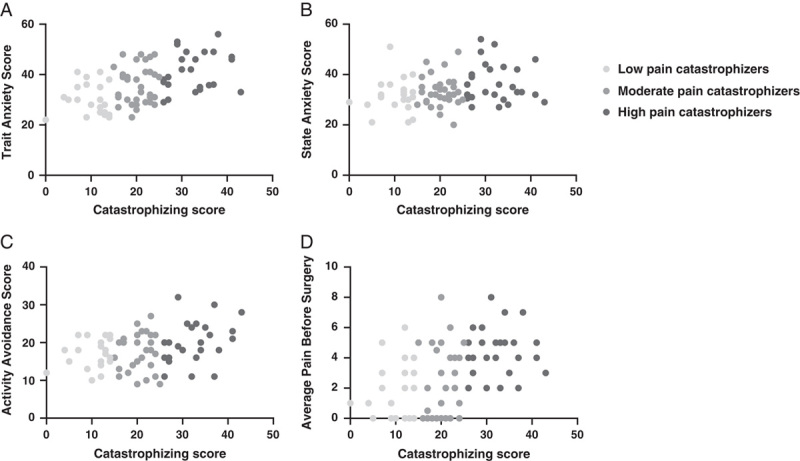
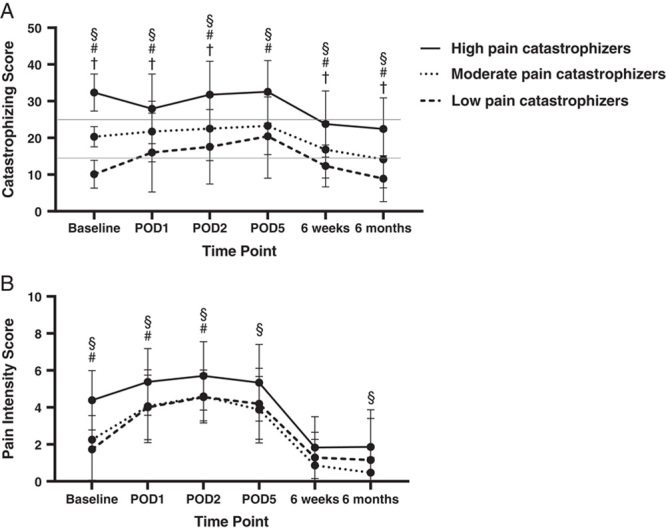
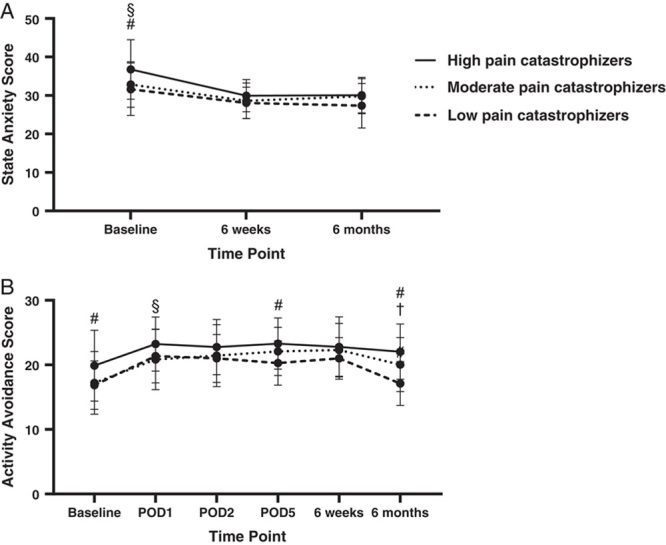
Objectives: Pain catastrophizing in children and adolescents has been associated to unfavorable postsurgical outcomes. However, pain catastrophizing is rarely measured throughout the perioperative period. Using a prospective longitudinal approach, the present study aimed to identify how pain catastrophizing changes over the perioperative period in pediatric surgical patients with adolescent idiopathic scoliosis. Materials and Methods: Adolescent patients undergoing spinal fusion surgery completed the Pain Catastrophizing Scale for Children and additional questionnaires to assess pain intensity, state and trait anxiety, and kinesiophobia before surgery, and 1, 2, 5 days, 6 weeks, and 6 months after surgery. Results: Patients who had higher levels of pain catastrophizing before surgery were more likely to be anxious, avoid activity that may cause pain, report higher pain intensity before surgery and anticipate more pain after surgery. Low pain catastrophizers increased into a moderate level of pain catastrophizing before decreasing after discharge from the hospital. Meanwhile, moderate and high pain catastrophizers both decreased into lower and moderate levels of catastrophizing, respectively, after discharge from the hospital. Discussion: These findings demonstrate that pain catastrophizing in adolescents changes over the perioperative period. Observing changes in pain catastrophizing throughout the perioperative period may help in recognizing when patients are most vulnerable during this time. Decreasing pain catastrophizing before surgery or in the acute postoperative period through therapies that target pain catastrophizing may help reduce the patient’s likelihood of experiencing unfavorable postoperative outcomes.
Overview
The claims and statistics of this paper haven’t been checked yet.
Free: it reads the open-access text and checks the first 5 claims that cite a source we can check. Create a free account to check every claim.
Integrity signals
Registry
Cites
Statistics
Figures
Verification
Claims the paper makes
The claims and statistics of this paper haven’t been checked yet.
Free: it reads the open-access text and checks the first 5 claims that cite a source we can check. Create a free account to check every claim.
Claims other papers make about this one
Each is checked against this paper’s own text: does it say what the citing paper says it does?
The cited source says what the claim attributes to it.
In the citing paper
“individual patient factors can impact pediatric PC scores; 64”
From Virtual psychoeducation for improvement of pain catastrophizing in pediatric presurgical patients and caregivers: a proof-of-concept study (2023) · cites this paper as [64]
The cited source says what the claim attributes to it.
In the citing paper
“Research has showed that pediatric PC is dynamic and that different trajectories of change throughout the perioperative period exist. 64”
From Virtual psychoeducation for improvement of pain catastrophizing in pediatric presurgical patients and caregivers: a proof-of-concept study (2023) · cites this paper as [64]
The cited source says what the claim attributes to it.
In the citing paper
“PC in adolescents has been shown to change over time during the perioperative period reflecting that a painful and stressful experience such as surgery may trigger a change in that variable. 64”
From Virtual psychoeducation for improvement of pain catastrophizing in pediatric presurgical patients and caregivers: a proof-of-concept study (2023) · cites this paper as [64]
Self-check
Percentages, sums and reported differences re-computed from the paper’s own numbers.
The self-check needs the paper’s full text.
Citations
Cites
The Pain Catastrophizing Scale: Development and validation.
Sullivan, M. J. L., Bishop, S. R., & Pivik, J. (1995) · Psychological Assessment · doi:10.1037//1040-3590.7.4.524 · Cited by 8,227 · cited 1×
“The main findings revealed that (1) the PCS-C scores of low pain catastrophizers before surgery increased to a moderate level of catastrophizing during the acute postoperative period, before decreasing back to low scores after discharge from the hospital, (2) the PCS-C scores of moderate pain catastrophizers remain re…”
BackgroundCore outcome measures for chronic pain clinical trials: IMMPACT recommendations
Dworkin, R. H., Turk, D. C., Farrar, J. T., Haythornthwaite, J. A., Jensen, M. P., Katz, N. P., Kerns, R. D., Stucki, G., Allen, R. R., Bellamy, N., et al. (2005) · Pain · doi:10.1016/j.pain.2004.09.012 · Cited by 3,732
Regression Towards Mediocrity in Hereditary Stature.
Galton, F. (1886) · The Journal of the Anthropological Institute of Great Britain and Ireland · doi:10.2307/2841583 · Cited by 1,454
Pain catastrophizing: a critical review.
Quartana, P. J., Campbell, C. M., & Edwards, R. R. (2009) · Expert Review of Neurotherapeutics · doi:10.1586/ern.09.34 · Cited by 1,405
Reliability Generalization of Scores on the Spielberger State-Trait Anxiety Inventory
Barnes, L. L. B., Harp, D., & Jung, W. S. (2002) · Educational and Psychological Measurement · doi:10.1177/0013164402062004005 · Cited by 947
Kain, Z. N., Mayes, L. C., Caldwell-Andrews, A. A., Karas, D. E., & McClain, B. C. (2006) · Pediatrics · doi:10.1542/peds.2005-2920 · Cited by 819
The child version of the pain catastrophizing scale (PCS-C): a preliminary validation
Crombez, G., Bijttebier, P., Eccleston, C., Mascagni, T., Mertens, G., Goubert, L., & Verstraeten, K. (2003) · Pain · doi:10.1016/s0304-3959(03)00121-0 · Cited by 652
Swinkels-Meewisse, E. J. C. M., Swinkels, R. A. H. M., Verbeek, A. L. M., Vlaeyen, J. W. S., & Oostendorp, R. A. B. (2003) · Manual Therapy · doi:10.1054/math.2002.0484 · Cited by 530
Rachlin, H. (1985) · Behavioral and Brain Sciences · doi:10.1017/s0140525x00019488 · Cited by 296
Pediatric fear-avoidance model of chronic pain: Foundation, application and future directions
Asmundson, G. J., Noel, M., Petter, M., & Parkerson, H. A. (2012) · Pain Research and Management · doi:10.1155/2012/908061 · Cited by 237
Research works printed but not linked: 1
- Spielberger CD. Manual for the State-trait Anxiety Inventory. Palo Alto, CA: Consulting Psychologists Press; 1983.
Cited by
When thinking about pain contributes to suffering: the example of pain catastrophizing
Haythornthwaite, J. A., Campbell, C. M., & Edwards, R. R. (2024) · Pain · doi:10.1097/j.pain.0000000000003372 · Cited by 36
Chronic Postsurgical Pain in Children and Adolescents: A Call for Action
Einhorn, L. M., Krishnan, P., Poirier, C., & Ingelmo, P. M. (2024) · Journal of Pain Research · doi:10.2147/jpr.s464009 · Cited by 25
Sieberg, C. B., Lunde, C. E., Wong, C., Manganella, J. L., Starkweather, A. R., Sethna, N. F., & Perry, M. (2022) · Pain Management Nursing · doi:10.1016/j.pmn.2022.11.001 · Cited by 17
Validity and Reliability of the Tampa Scale for Kinesiophobia for Adolescents with Heart Disease
WHITE, D. A., BLACK, W. R., Cramer, E., Malloy-Walton, L. E., Walton, M. M., Martis, L. B., Enneking, B., Teson, K. M., Watson, J. S., & Gross‐Toalson, J. (2025) · Medicine & Science in Sports & Exercise · doi:10.1249/mss.0000000000003642 · Cited by 11
Zachariades, F., Maras, D., Mervitz, D., Martelli, B., Prayal-Brown, A., Hayawi, L., Barrowman, N., & Lamontagne, C. (2023) · Canadian Journal of Anesthesia/Journal canadien d anesthésie · doi:10.1007/s12630-023-02583-3 · Cited by 4
Metadata
- Authors
- Chabot, B., Sweatman, H., Ocay, D. D., Premachandran, S., Roy, M., & Ferland, C. E.
- Affiliations
- Psychology
- McGill University (CA)
- Shriners Hospitals for Children - Canada (CA)
- Corresponding author
- Chabot, Bianca
- Roy, Mathieu
- Venue
- The Clinical Journal of Pain
- Published
- 2021-07-09
- Volume
- 37
- Issue
- 9
- Pages
- 688-697
- ISSN
- 0749-8047 (ISSN-L)
- PMC
- PMC8360666
- OpenAlex
- W3182811017
- Cited by
- 12
- References
- 42
- Citations by year
- 2026: 5 · 2025: 1 · 2024: 4 · 2023: 1 · 2022: 1
- FWCI
- 1.48
- Type
- journal article
- Language
- en
- Open access
- hybrid
- doi.org
- Licence
- Locations
- Clinical Journal of Pain (publishedVersion, cc-by-nc-nd)
- PubMed Central (publishedVersion, cc-by-nc-nd)
- PubMed (publishedVersion)
- Topics
- Health Sciences › Medicine › Pediatrics, Perinatology and Child Health › Pediatric Pain Management Techniques
- Health Sciences › Health Professions › Physical Therapy, Sports Therapy and Rehabilitation › Musculoskeletal pain and rehabilitation
- Health Sciences › Medicine › Surgery › Scoliosis diagnosis and treatment
- Keywords
- pain catastrophizing, adolescent idiopathic scoliosis, spinal fusion, perioperative period, postoperative pain, kinesiophobia, anxiety, pain intensity, pediatric surgery
- MeSH terms
- Adolescent, Child, Humans, Postoperative Pain, Prospective Studies, Scoliosis, Catastrophization, Perioperative Period
About these checks
Registry, retraction, Cites and statistics results are computed, not judged, with one exception: a printed reference that no index lists is read once by a model before it counts as a citation error. Claims are extracted by a model and kept only when their quote appears verbatim in the text; each cited source is then checked, with a model’s help, for whether it says what the claim relies on. Those verdicts can be wrong — read the claim’s quote and the cited source before relying on one.
Statistics and arithmetic are recomputed, not judged.
Confidence bands are shown only for fields calibrated on our annotated test set. None is calibrated yet, so no band is shown.
What counts as a claim ›How we measure confidence ›How we check this ›
Are you an author, or do you see a problem with this page? Request a review
How to cite
Cite CoChat for the checks on this page, and the paper for its own findings.
- This page
- CoChat. (2026). Citation check: Pain Catastrophizing Throughout the Perioperative Period in Adolescents With Idiopathic Scoliosis. https://app.cochat.ai/papers/10.1097/ajp.0000000000000962
- The paper
- Chabot, B., Sweatman, H., Ocay, D. D., Premachandran, S., Roy, M., & Ferland, C. E. (2021). Pain Catastrophizing Throughout the Perioperative Period in Adolescents With Idiopathic Scoliosis. The Clinical Journal of Pain. https://doi.org/10.1097/ajp.0000000000000962
Data sources
Bibliographic data: Semantic Scholar, OpenAlex, Crossref.
Contains information from the Semantic Scholar Academic Graph Datasets, made available under the ODC Attribution License (ODC-BY 1.0).
Semantic Scholar’s data is described in: Kinney, R., et al. (2023). The Semantic Scholar Open Data Platform. arXiv:2301.10140.
