

The DOI matches its Crossref record, with a small difference in title or year; 31 of the 32 references it cites were found in a registry or an index.
Cognitive Behavioral Therapy for Prenatal Insomnia: A Randomized Controlled Trial
Open accessAbstract
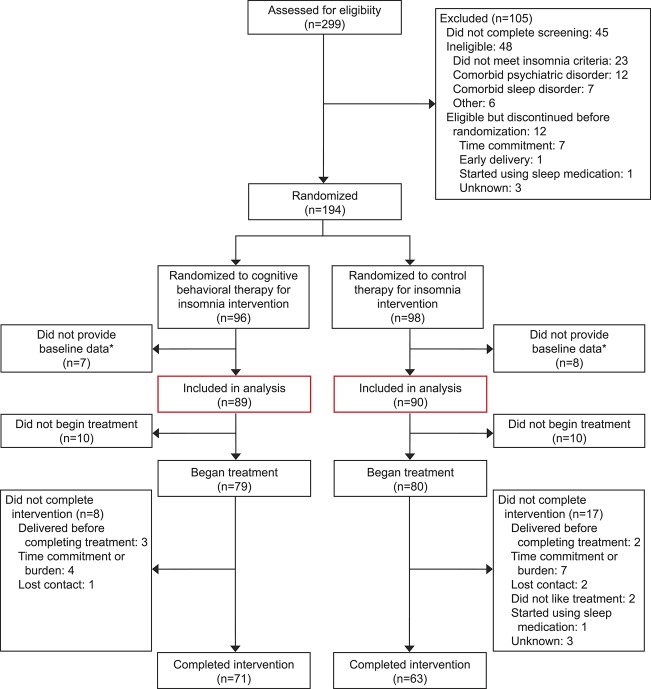
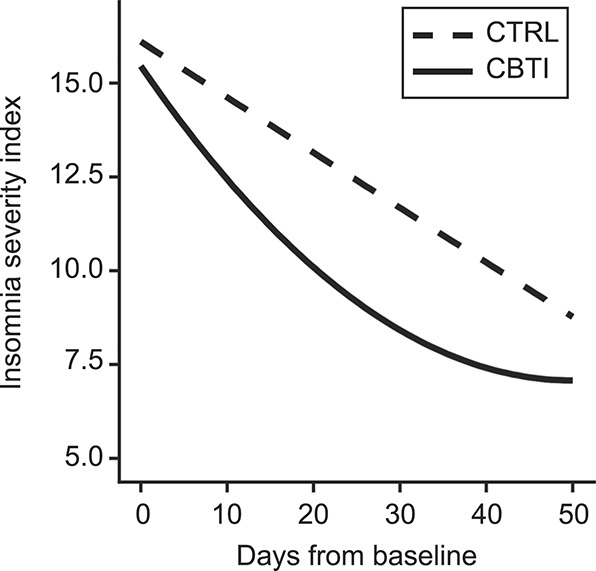
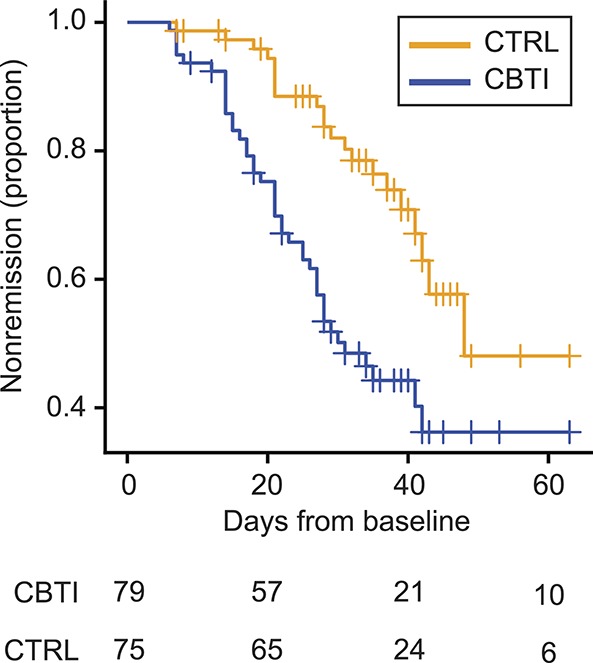
OBJECTIVE: To evaluate the effectiveness of cognitive behavioral therapy for insomnia during pregnancy. METHODS: Randomized, unmasked, 3-site controlled trial. Participants were randomly allocated to cognitive behavioral therapy for insomnia (a first-line, empirically supported psychosocial intervention that addresses sleep-related behaviors and cognitions) or a control intervention consisting of imagery exercises that paired patient-identified distressing nighttime experiences with patient-identified neutral images. Participants were eligible if they met diagnostic criteria for insomnia disorder and were between 18 and 32 weeks of gestation. Patients were ineligible if they met diagnostic criteria for major psychiatric disorders, including depression, or were receiving nonstudy treatments that could affect sleep (or both). The primary outcome was the Insomnia Severity Index score, a validated brief questionnaire, with scores between 14 and 21 representing clinically meaningful insomnia of moderate severity, scores higher than 21 representing severe insomnia, and scores less than 8 representing no insomnia. Secondary outcomes included remission of insomnia (Insomnia Severity Index score less than 8), objectively measured and self-reported time awake (ie, total wake time), and the Edinburgh Postnatal Depression Scale score. All outcomes were measured weekly. Analysis included 48 participants who did not complete treatment. We estimated that 184 women would be required to have 80% power, with a two-tailed test, to detect a moderate Cohen's d effect size (.5) with α=.05. RESULTS: Between May 2013 and April 2017, 194 pregnant women were randomized and 149 completed treatment; 179 with available baseline data (92%) were ultimately analyzed, 89 in the cognitive therapy group and 90 in the control group. Women assigned to cognitive behavioral therapy for insomnia experienced significantly greater reductions in insomnia severity (scores decreased from 15.4±4.3 to 8.0±5.2 in the cognitive behavioral therapy group vs from 15.9±4.4 to 11.2±4.9 in the control therapy group [ P <.001, d=0.5]). Remission of insomnia (to an Insomnia Severity Index score less than 8) disorder was attained by 64% of women in the cognitive behavioral therapy for insomnia group vs 52% in the control group. Women receiving cognitive behavioral therapy for insomnia experienced faster remission of insomnia disorder, with a median of 31 days vs 48 days in the control therapy ( P <.001). Cognitive behavioral therapy for insomnia led to significantly greater reduction in self-reported but not objective total wake time and a small but significantly greater decline in Edinburgh Postnatal Depression Scale scores vs the control group. CONCLUSION: Cognitive behavioral therapy for insomnia is an effective nonpharmacologic treatment for insomnia during pregnancy. CLINICAL TRIAL REGISTRATION: ClinicalTrials.gov, NCT01846585.
Overview
The claims and statistics of this paper haven’t been checked yet.
Run the check — free, no account needed. It reads the open-access text and checks the sources it cites.
Integrity signals
Registry
Cites
Statistics
Figures

Verification
Claims the paper makes
The claims and statistics of this paper haven’t been checked yet.
Run the check — free, no account needed. It reads the open-access text and checks the sources it cites.
Claims other papers make about this one
Each is checked against this paper’s own text: does it say what the citing paper says it does?
The cited source says what the claim attributes to it.
In the citing paper
“Preliminary evidence suggests that behavioral approaches such as cognitive behavioral therapy for insomnia (CBT-I) are efficacious in pregnancy [9, 10].”
From Online prenatal trial in mindfulness sleep management (OPTIMISM): Protocol for a pilot randomized controlled trial (2020) · cites this paper as [10]
Self-check
Percentages, sums and reported differences re-computed from the paper’s own numbers.
The self-check needs the paper’s full text.
Citations
Cites
(1998) · The Journal of Clinical Psychiatry · Cited by 19,139
Detection of Postnatal Depression: Development of the 10-item Edinburgh Postnatal Depression Scale
Cox, J. L., Holden, J. M., & Sagovsky, R. (1987) · British Journal of Psychiatry · doi:10.1192/bjp.150.6.782 · Cited by 14,183
(1998) · PubMed · Cited by 10,216
Validation of the Insomnia Severity Index as an outcome measure for insomnia research
Bastien, C. (2001) · Sleep Medicine · doi:10.1016/s1389-9457(00)00065-4 · Cited by 8,067
Morin, C. M., Belleville, G., Bélanger, L., & Ivers, H. (2011) · Sleep · doi:10.1093/sleep/34.5.601 · Cited by 4,620
Baglioni, C., Battagliese, G., Feige, B., Spiegelhalder, K., Nissen, C., Voderholzer, U., Lombardo, C., & Riemann, D. (2011) · Journal of Affective Disorders · doi:10.1016/j.jad.2011.01.011 · Cited by 2,779
The consensus sleep diary: standardizing prospective sleep self-monitoring
Carney, C. E., Buysse, D. J., Ancoli-Israel, S., Edinger, J. D., Krystal, A. D., Lichstein, K. L., & Morin, C. M. (2012) · Sleep · doi:10.5665/sleep.1642 · Cited by 2,172
Qaseem, A., Kansagara, D., Forciea, M. A., Cooke, M., Denberg, T. D., & for the Clinical Guidelines Committee of the American College of Physicians* (2016) · Annals of Internal Medicine · doi:10.7326/m15-2175 · Cited by 1,965
Recommendations for a standard research assessment of insomnia
Buysse, D. J., Ancoli-Israel, S., Edinger, J. D., Lichstein, K. L., & Morin, C. M. (2006) · Sleep · doi:10.1093/sleep/29.9.1155 · Cited by 1,206
Treatment of Chronic Insomnia by Restriction of Time in Bed
(1987) · Sleep · doi:10.1093/sleep/10.1.45 · Cited by 948
Cited by
Sorted by citations
Elevated depression and anxiety symptoms among pregnant individuals during the COVID-19 pandemic
Lebel, C., MacKinnon, A., Bagshawe, M., Tomfohr-Madsen, L., & Giesbrecht, G. (2020) · Journal of Affective Disorders · doi:10.1016/j.jad.2020.07.126 · Cited by 1,017
Felder, J. N., Epel, E. S., Neuhaus, J. M., Krystal, A. D., & Prather, A. A. (2020) · JAMA Psychiatry · doi:10.1001/jamapsychiatry.2019.4491 · Cited by 181
A randomized controlled trial of digital cognitive behavioral therapy for insomnia in pregnant women
Kalmbach, D. A., Cheng, P., O'Brien, L. M., Swanson, L. M., Sangha, R., Sen, S., Guille, C., Cuamatzi-Castelan, A., Henry, A. L., Roth, T., et al. (2020) · Sleep Medicine · doi:10.1016/j.sleep.2020.03.016 · Cited by 154
Interventions for sleep problems during pregnancy: A systematic review
Bacaro, V., Benz, F., Pappaccogli, A., Bartolo, P. D., Johann, A. F., Palagini, L., Lombardo, C., Feige, B., Riemann, D. W., & Baglioni, C. (2019) · Sleep Medicine Reviews · doi:10.1016/j.smrv.2019.101234 · Cited by 152
Moderators of Cognitive Behavioral Treatment for Insomnia on Depression and Anxiety Outcomes
Mirchandaney, R., Barete, R., & Asarnow, L. D. (2022) · Current Psychiatry Reports · doi:10.1007/s11920-022-01326-3 · Cited by 130
Self-citation
Metadata
- Authors
- Manber, R., Bei, B., Simpson, N., Asarnow, L., Rangel, E., Sit, A., & Lyell, D.
- Affiliations
- Santa Clara Valley Medical Center (US)
- Corresponding author
- Manber, Rachel
- Venue
- Obstetrics & Gynecology
- Published
- 2019-05
- Volume
- 133
- Issue
- 5
- Pages
- 911-919
- ISSN
- 0029-7844 (ISSN-L)
- PMC
- PMC6485299
- OpenAlex
- W2939327841
- Cited by
- 145
- References
- 32
- Citations by year
- 2026: 12 · 2025: 21 · 2024: 12 · 2023: 21 · 2022: 37 · 2021: 23 · 2020: 12 · 2019: 6
- FWCI
- 22.90
- Type
- journal article
- Language
- en
- Open access
- hybrid
- doi.org
- Licence
- Locations
- Obstetrics and Gynecology (publishedVersion, cc-by-nc-nd)
- Europe PMC (PubMed Central) (publishedVersion, cc-by-nc-nd)
- PubMed Central (publishedVersion, cc-by-nc-nd)
- PubMed (publishedVersion)
- Minerva Access (University of Melbourne) (submittedVersion, cc-by-nc-nd)
- Monash University Research Portal (Monash University) (submittedVersion, other-oa)
- Funders
- Australasian Sleep Association
- National Institutes of Health
- Medical Research Council
- National Health and Medical Research Council
- National Institute of Nursing Research (R01NR013662)
- Topics
- Social Sciences › Psychology › Experimental and Cognitive Psychology › Sleep and related disorders
- Health Sciences › Medicine › Public Health, Environmental and Occupational Health › Maternal Mental Health During Pregnancy and Postpartum
- Health Sciences › Medicine › Pediatrics, Perinatology and Child Health › Infant Health and Development
- Keywords
- cognitive behavioral therapy for insomnia, insomnia severity, insomnia remission, sleep behavior, postpartum depression, Insomnia Severity Index, psychosocial interventions
- MeSH terms
- Adult, California, Female, Gestational Age, Humans, Sleep Initiation and Maintenance Disorders, Pregnancy, Pregnancy Complications, Prenatal Care, Surveys and Questionnaires, Remission Induction, Severity of Illness Index, Cognitive Behavioral Therapy, Patient Outcome Assessment
About these checks
Registry, retraction, Cites and statistics results are computed, not judged, with one exception: a printed reference that no index lists is read once by a model before it counts as a citation error. Claims are extracted by a model and kept only when their quote appears verbatim in the text; each cited source is then checked, with a model’s help, for whether it says what the claim relies on. Those verdicts can be wrong — read the claim’s quote and the cited source before relying on one.
Statistics and arithmetic are recomputed, not judged.
Confidence bands are shown only for fields calibrated on our annotated test set. None is calibrated yet, so no band is shown.
What counts as a claim ›How we measure confidence ›How we check this ›
Are you an author, or do you see a problem with this page? Request a review
