

The DOI matches its Crossref record; 7 of the 7 references it cites were found in a registry or an index.
Low-blood pressure phenotype underpins the tendency to reflex syncope
Open accessPublished version of a preprint
Abstract
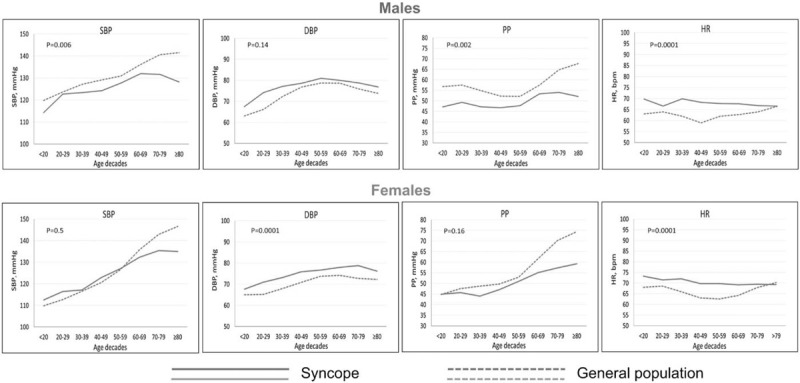
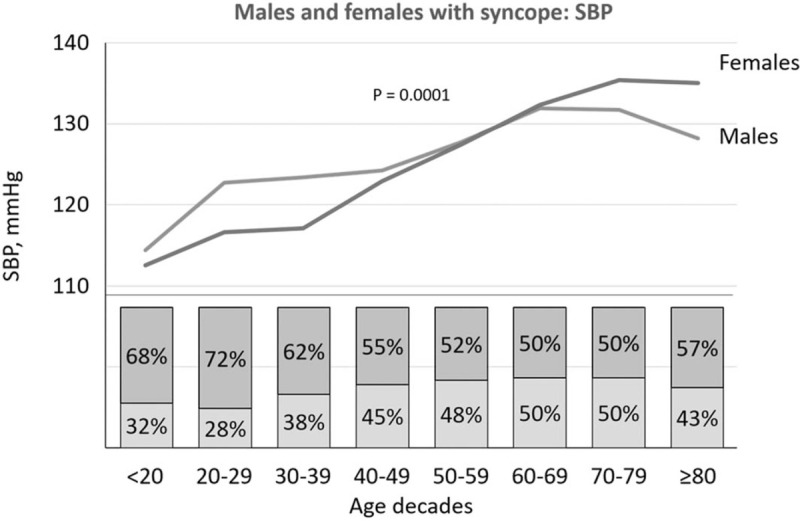
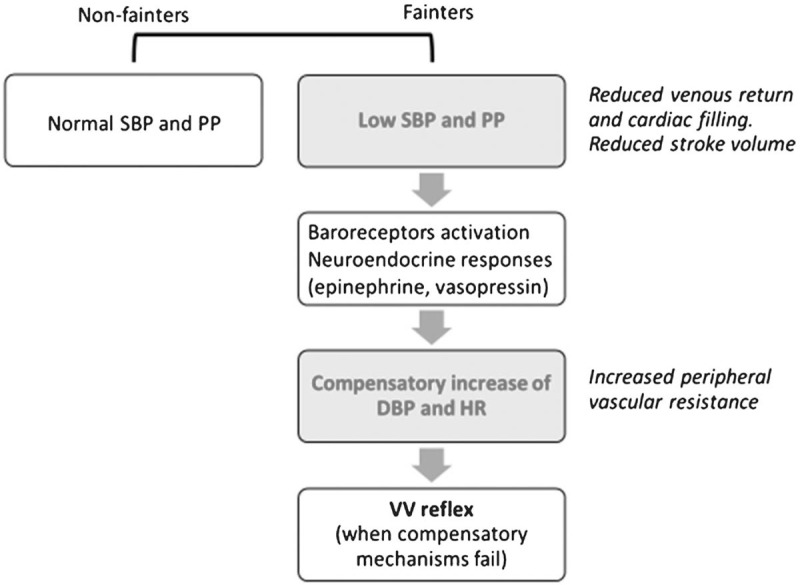
Background: We hypothesized that cardiovascular physiology differs in reflex syncope patients compared with the general population, predisposing such individuals to vasovagal reflex. Methods: In this multicohort cross-sectional study, we compared aggregate data of resting SBP, DBP, pulse pressure (PP) and heart rate (HR), collected from six community-based cohort studies (64 968 observations) with those from six databases of reflex syncope patients (6516 observations), subdivided by age decades and sex. Results: Overall, in male individuals with reflex syncope, SBP (−3.4 mmHg) and PP (−9.2 mmHg) were lower and DBP (+2.8 mmHg) and HR (+5.1 bpm) were higher than in the general population; the difference in SBP was higher at ages above 60 years. In female individuals, PP (−6.0 mmHg) was lower and DBP (+4.7 mmHg) and HR (+4.5 bpm) were higher than in the general population; differences in SBP were less pronounced, becoming evident only above 60 years. Compared with male individuals, SBP in female individuals exhibited slower increase until age 40 years, and then demonstrated steeper increase that continued throughout remaining life. Conclusion: The patients prone to reflex syncope demonstrate a different resting cardiovascular haemodynamic profile as compared with a general population, characterized by lower SBP and PP, reflecting reduced venous return and lower stroke volume, and a higher HR and DBP, suggesting the activation of compensatory mechanisms. Our data contribute to a better understanding why some individuals with similar demographic characteristics develop reflex syncope and others do not. Video abstract: http://links.lww.com/HJH/B580.
Overview
The claims and statistics of this paper haven’t been checked yet.
Run the check — free, no account needed. It reads the open-access text and checks the sources it cites.
Integrity signals
Registry
Cites
Statistics
Figures
Verification
Claims the paper makes
The claims and statistics of this paper haven’t been checked yet.
Run the check — free, no account needed. It reads the open-access text and checks the sources it cites.
Claims other papers make about this one
Each is checked against this paper’s own text: does it say what the citing paper says it does?
The check wasn’t confident either way, so it gives no verdict — never disputed.
In the citing paper
“It may be most beneficial in patients with POTS accompanied by low blood pressure.50”
From Diagnosis and management of postural orthostatic tachycardia syndrome (2022) · cites this paper as [50]
Experimental — accuracy not yet measured
Self-check
Percentages, sums and reported differences re-computed from the paper’s own numbers.
The self-check needs the paper’s full text.
Citations
Cites
A Randomized Trial of Intensive versus Standard Blood-Pressure Control
The SPRINT Research Group (2015) · New England Journal of Medicine · doi:10.1056/nejmoa1511939 · Cited by 6,325
2018 ESC Guidelines for the diagnosis and management of syncope
Brignole, M., Moya, A., de Lange, F. J., Deharo, J.-C., Elliott, P. M., Fanciulli, A., Fedorowski, A., Furlan, R., Kenny, R. A., Martín, A., et al. (2018) · European Heart Journal · doi:10.1093/eurheartj/ehy037 · Cited by 1,951
Self-citationBrignole, M., Menozzi, C., Moya, A., Andresen, D., Blanc, J. J., Krahn, A. D., Wieling, W., Beiras, X., Deharo, J. C., Russo, V., et al. (2012) · Circulation · doi:10.1161/circulationaha.111.082313 · Cited by 437
Self-citationThe elusive pathophysiology of neurally mediated syncope
Mosqueda-Garcia, R., Furlan, R., MD, J. T., & Fernandez-Violante, R. (2000) · Circulation · doi:10.1161/01.cir.102.23.2898 · Cited by 383
Self-citationFinucane, C., O’Connell, M. D. L., Fan, C. W., Savva, G. M., Soraghan, C. J., Nolan, H., Cronin, H., & Kenny, R. A. (2014) · Circulation · doi:10.1161/circulationaha.114.009831 · Cited by 219
Fludrocortisone for the Prevention of Vasovagal Syncope
Sheldon, R., Raj, S. R., Rose, M. S., Morillo, C. A., Krahn, A. D., Medina, E., Talajic, M., Kus, T., Seifer, C. M., Lelonek, M., et al. (2016) · Journal of the American College of Cardiology · doi:10.1016/j.jacc.2016.04.030 · Cited by 155
Sutton, R., & Brignole, M. (2014) · European Heart Journal · doi:10.1093/eurheartj/ehu255 · Cited by 127
Self-citation
Research works printed but not linked: 21
- Mathias, 2001, Observations on recurrent syncope and presyncope in 641 patients, Lancet, 357, 348, 10.1016/S0140-6736(00)03642-4 · DOI
- Vaddadi, 2011, Recurrent postural vasovagal syncope: sympathetic nervous system phenotypes, Circ Arrhythm Electrophysiol, 4, 711, 10.1161/CIRCEP.111.962332 · DOI · Paper page
- Jacob, 2018, Cardiovascular autonomic profile in women with constitutional hypotension, J Hypertens, 36, 2068, 10.1097/HJH.0000000000001790 · DOI
- Sheldon, 2006, Prevention of Syncope Trial (POST): a randomized, placebo-controlled study of metoprolol in the prevention of vasovagal syncope, Circulation, 113, 1164, 10.1161/CIRCULATIONAHA.105.535161 · DOI · Paper page
- Raj, 2012, Rationale for the prevention of syncope trial IV: assessment of midodrine, Clin Auton Res, 22, 275, 10.1007/s10286-012-0167-5 · DOI
- Raj, 2016, Rationale for the assessment of metoprolol in the Prevention of Vasovagal Syncope in Aging Subjects Trial (POST5), Am Heart J, 174, 89, 10.1016/j.ahj.2016.01.017 · DOI
- Sheldon, 2019, A proof of principle study of atomoxetine for the prevention of vasovagal syncope: the Prevention of Syncope Trial VI, Europace, 21, 1733, 10.1093/europace/euz250 · DOI
- Fedorowski, 2010, A dedicated investigation unit improves management of syncopal attacks (Syncope Study of Unselected Population in Malmo--SYSTEMA I), Europace, 12, 1322, 10.1093/europace/euq168 · DOI
- Ungar, 2010, Early and late outcome of treated patients referred for syncope to emergency department: the EGSYS 2 follow-up study, Eur Heart J, 31, 2021, 10.1093/eurheartj/ehq017 · DOI
- Boyd, 2013, Cohort profile: the ’children of the 90s’--the index offspring of the Avon longitudinal study of parents and children, Int J Epidemiol, 42, 111, 10.1093/ije/dys064 · DOI · Paper page
- Hamrefors, 2019, Susceptibility to diarrhea is related to hemodynamic markers of sympathetic activation in the general population, Scand J Gastroenterol, 54, 1426, 10.1080/00365521.2019.1697742 · DOI
- Holmen, 2016, Blood pressure changes during 22-year of follow-up in large general population - the HUNT Study, Norway, BMC Cardiovasc Disord, 16, 94, 10.1186/s12872-016-0257-8 · DOI
- Bergstrom, 2015, The Swedish CArdioPulmonary BioImage Study: objectives and design, J Intern Med, 278, 645, 10.1111/joim.12384 · DOI
- Di Bari, 1999, Heart failure in community-dwelling older persons: aims, design and adherence rate of the ICARe Dicomano project: an epidemiologic study. Insufficienza Cardiaca negli Anziani Residenti a Dicomano, J Am Geriatr Soc, 47, 664, 10.1111/j.1532-5415.1999.tb01587.x · DOI
- Weissler, 1957, Vasodepressor syncope; factors influencing cardiac output, Circulation, 15, 875, 10.1161/01.CIR.15.6.875 · DOI · Paper page
- Lindenberger, 2019, Cardiovascular biomarkers and echocardiographic findings at rest and during graded hypovolemic stress in women with recurrent vasovagal syncope, J Cardiovasc Electrophysiol, 30, 2936, 10.1111/jce.14207 · DOI
- Jardine, 2018, The pathophysiology of the vasovagal response, Heart Rhythm, 15, 921, 10.1016/j.hrthm.2017.12.013 · DOI
- Kohno, 2019, Greater early epinephrine rise with head-up posture: a marker of increased syncope susceptibility in vasovagal fainters, J Cardiovasc Electrophysiol, 30, 289, 10.1111/jce.13792 · DOI
- Chaddha, 2016, The role of the baroreflex in tilt table testing: outcome and type of response, JACC Clin Electrophysiol, 2, 812, 10.1016/j.jacep.2016.05.001 · DOI
- Ji, 2020, Sex differences in blood pressure trajectories over the life course, JAMA Cardiol, 5, 19, 10.1001/jamacardio.2019.5306 · DOI · Paper page
- Kaufmann, 2020, Baroreflex dysfunction, N Engl J Med, 382, 163, 10.1056/NEJMra1509723 · DOI
Cited by
Sorted by citations
Diagnosis and management of postural orthostatic tachycardia syndrome
Raj, S. R., Fedorowski, A., & Sheldon, R. S. (2022) · Canadian Medical Association Journal · doi:10.1503/cmaj.211373 · Cited by 95
Self-citationSinus Tachycardia: a Multidisciplinary Expert Focused Review
Mayuga, K. A., Fedorowski, A., Ricci, F., Gopinathannair, R., Dukes, J. W., Gibbons, C., Hanna, P., Sorajja, D., Chung, M., Benditt, D., et al. (2022) · Circulation: Arrhythmia and Electrophysiology · doi:10.1161/circep.121.007960 · Cited by 59
Self-citation
Metadata
- Authors
- Brignole, M., Rivasi, G., Sutton, R., Kenny, R. A., Morillo, C. A., Sheldon, R., Raj, S. R., Ungar, A., Furlan, R., van Dijk, G., Hamdan, M., Hamrefors, V., Engström, G., Park, C., Soranna, D., Zambon, A., Parati, G., & Fedorowski, A.
- Affiliations
- IRCCS Istituto Auxologico Italiano (IT)
- Azienda Ospedaliero-Universitaria Careggi (IT)
- Hammersmith Hospital (GB)
- Trinity College Dublin (IE)
- University of Calgary (CA)
- Humanitas University (IT)
- Leiden University Medical Center (NL)
- University of Wisconsin–Madison (US)
- Lund University (SE)
- MRC Unit for Lifelong Health and Ageing (GB)
- Corresponding author
- Parati, Gianfranco
- Fedorowski, Artur
- ORCID
- Venue
- Journal of Hypertension
- Published
- 2021-02-04
- Volume
- 39
- Issue
- 7
- Pages
- 1319-1325
- ISSN
- 0263-6352 (ISSN-L)
- 1473-5598
- PMC
- PMC8183486
- OpenAlex
- W3126530869
- Cited by
- 55
- References
- 7
- Citations by year
- 2026: 4 · 2025: 10 · 2024: 10 · 2023: 14 · 2022: 13 · 2021: 4
- FWCI
- 9.63
- Type
- journal article
- Language
- en
- Open access
- hybrid
- doi.org
- Licence
- Locations
- Journal of Hypertension (publishedVersion, cc-by-nc-nd)
- medRxiv (acceptedVersion)
- PubMed Central (publishedVersion, cc-by-nc-nd)
- PubMed (publishedVersion)
- BOA (University of Milano-Bicocca) (submittedVersion)
- Lund University Publications (Lund University) (submittedVersion)
- Spiral (Imperial College London) (submittedVersion, cc-by-nc-nd)
- Funders
- Wellcome Trust (217065/Z/19/Z)
- Medical Research Council (MC_PC_15018, MC_PC_19009)
- Topics
- Health Sciences › Medicine › Cardiology and Cardiovascular Medicine › Cardiovascular Syncope and Autonomic Disorders
- Health Sciences › Medicine › Cardiology and Cardiovascular Medicine › Heart Rate Variability and Autonomic Control
- Health Sciences › Medicine › Cardiology and Cardiovascular Medicine › Cardiovascular Health and Disease Prevention
- Keywords
- reflex syncope, vasovagal reflex, resting blood pressure, pulse pressure, heart rate, diastolic blood pressure, cardiovascular hemodynamics, sex differences, age differences, venous return, stroke volume
- MeSH terms
- Adult, Blood Pressure, Cross-Sectional Studies, Female, Humans, Male, Phenotype, Reflex, Syncope
About these checks
Registry, retraction, Cites and statistics results are computed, not judged, with one exception: a printed reference that no index lists is read once by a model before it counts as a citation error. Claims are extracted by a model and kept only when their quote appears verbatim in the text; each cited source is then checked, with a model’s help, for whether it says what the claim relies on. Those verdicts can be wrong — read the claim’s quote and the cited source before relying on one.
Statistics and arithmetic are recomputed, not judged.
Confidence bands are shown only for fields calibrated on our annotated test set. None is calibrated yet, so no band is shown.
What counts as a claim ›How we measure confidence ›How we check this ›
Are you an author, or do you see a problem with this page? Request a review
How to cite
Cite CoChat for the checks on this page, and the paper for its own findings.
- This page
- CoChat. (2026). Citation check: Low-blood pressure phenotype underpins the tendency to reflex syncope. https://app.cochat.ai/papers/10.1097/hjh.0000000000002800
- The paper
- Brignole, M., Rivasi, G., Sutton, R., Kenny, R. A., Morillo, C. A., Sheldon, R., Raj, S. R., Ungar, A., Furlan, R., van Dijk, G., Hamdan, M., Hamrefors, V., Engström, G., Park, C., Soranna, D., Zambon, A., Parati, G., & Fedorowski, A. (2021). Low-blood pressure phenotype underpins the tendency to reflex syncope. Journal of Hypertension. https://doi.org/10.1097/hjh.0000000000002800
