

Effects of virtual reality on psychophysical measures of pain: superiority to imagination and nonimmersive conditions
Open accessThe DOI matches its Crossref record; 46 of the 47 references it cites were found in a registry or an index.
Abstract
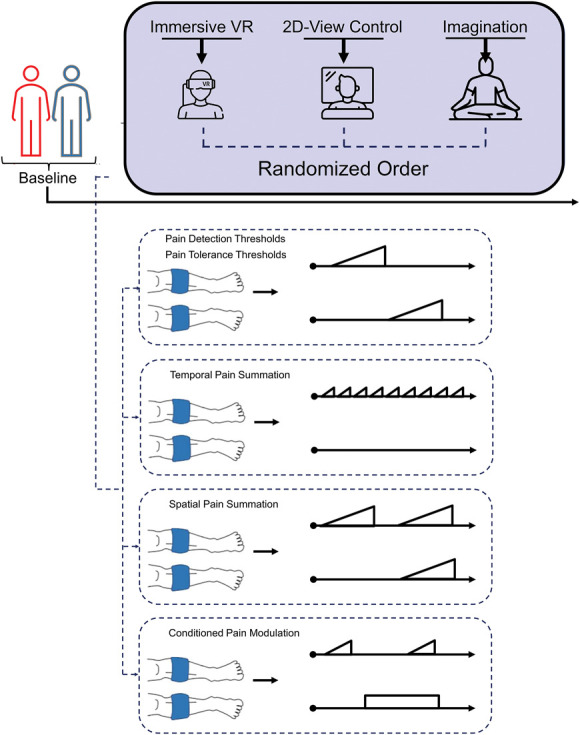
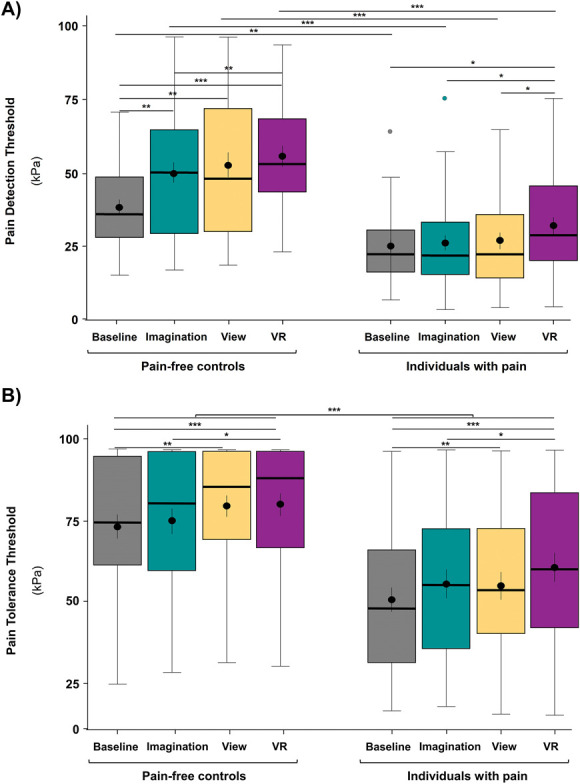
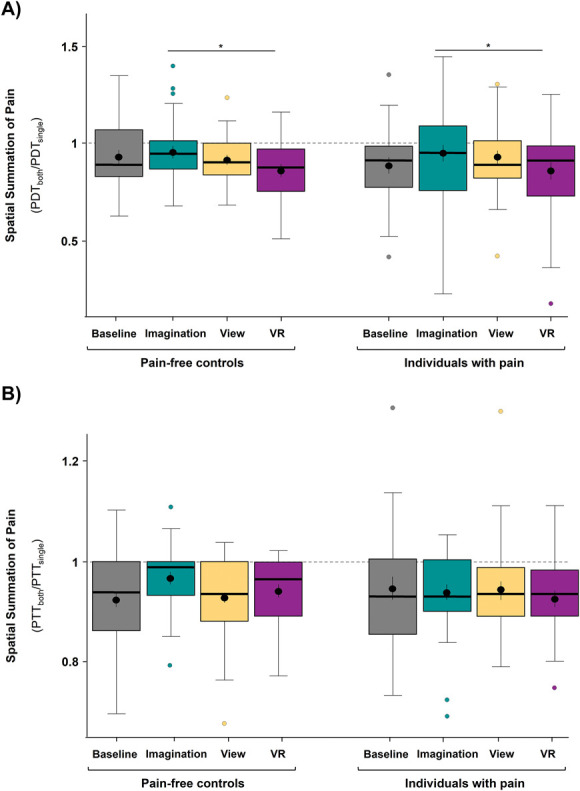
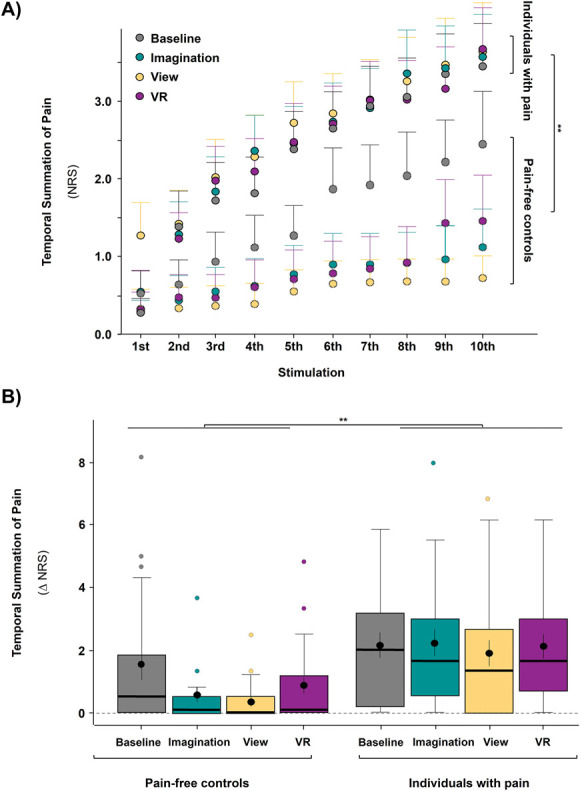
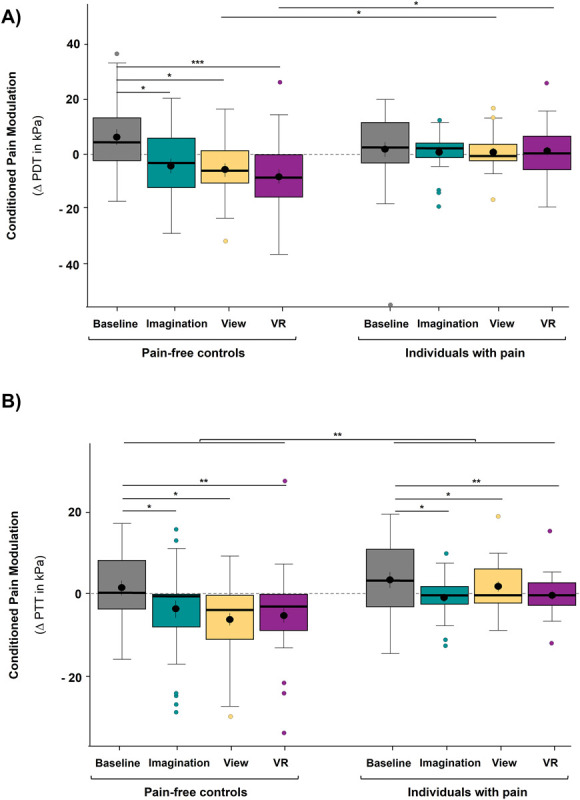
Virtual reality (VR) has been shown to be effective in pain management. However, to date, little is known about the mechanisms by which immersive experiences influence pain processing. The aim of this study was to investigate the direct effects of an immersive VR environment on the perception of experimental pain in individuals with chronic pain and pain-free controls. The immersion in a VR landscape was compared with mental imagery and a nonimmersive control condition. Using a randomized within-crossover design, pressure pain detection and tolerance thresholds, spatial and temporal summation (SSP, TSP), and conditioned pain modulation (CPM) were measured in 28 individuals with chronic pain and 31 pain-free controls using phasic cuff pressure on the legs. Direct comparison between the groups showed that although individuals with pain had significantly lower pain thresholds, reduced CPM effects, and increased TSP, the VR condition had the same pain-inhibitory effect on pain thresholds as in pain-free controls. Conditioned pain modulation effects were reduced by all conditions compared with baseline. There were no significant differences between conditions and baseline for TSP and SSP. Overall, pain modulatory effects were largest for VR and smallest for imagery. These results demonstrate that immersion in a VR environment has an increasing effect on pain thresholds, reduces pain inhibition in a CPM paradigm, and has no effects on TSP. This applies for participants with chronic pain and pain-free controls. These VR effects exceeded the effects of mental imagery on the nonimmersive control condition. This indicates that VR effectively modulates pain perception in both patients and controls irrespective of differences in pain perception.
Overview
The claims and statistics of this paper haven’t been checked yet.
Free: it reads the open-access text and checks the first 5 claims that cite a source we can check. Create a free account to check every claim.
Integrity signals
Registry
Cites
Statistics
Figures
Verification
Claims the paper makes
The claims and statistics of this paper haven’t been checked yet.
Free: it reads the open-access text and checks the first 5 claims that cite a source we can check. Create a free account to check every claim.
Claims other papers make about this one
Each is checked against this paper’s own text: does it say what the citing paper says it does?
The source backs part of the claim, not all of it — or backs it for a different population, condition or comparison.
In the citing paper
“The more immersive the VR, the greater the analgesic effect.25,27,29,43,44”
From A Pilot Study of Virtual Reality in Hemodialysis for Mitigating Pain and Anxiety: User Experiences and Perceptions (2025) · cites this paper as [43]
Experimental — accuracy not yet measured
Self-check
Percentages, sums and reported differences re-computed from the paper’s own numbers.
The self-check needs the paper’s full text.
Citations
Cites
Controlling the False Discovery Rate: A Practical and Powerful Approach to Multiple Testing
Benjamini, Y., & Hochberg, Y. (1995) · Journal of the Royal Statistical Society Series B: Statistical Methodology · doi:10.1111/j.2517-6161.1995.tb02031.x · Cited by 109,482 · cited 7×
“However, for SSP PDT , the robust ANOVA failed to show a significant main effect for the different test conditions (F[3, 28.36] 5 0.2189, P 5 0.882) so that these results should be interpreted with caution.”
BackgroundMethodResultInfluentialGrading the severity of chronic pain
Von Korff, M., Ormel, J., Keefe, F. J., & Dworkin, S. F. (1992) · Pain · doi:10.1016/0304-3959(92)90154-4 · Cited by 3,022
Schmider, E., Ziegler, M., Danay, E., Beyer, L., & Bühner, M. (2010) · Methodology · doi:10.1027/1614-2241/a000016 · Cited by 1,290
Robust statistical methods in R using the WRS2 package
Mair, P., & Wilcox, R. (2020) · Behavior Research Methods · doi:10.3758/s13428-019-01246-w · Cited by 1,082 · cited 11×
“Furthermore, individuals without pain showed significant higher PDT scores in the VR condition compared with the imagery condition (t[30] 5 2 3.376, P 5 0.008).”
MethodResultInfluentialYarnitsky, D. (2010) · Current Opinion in Anaesthesiology · doi:10.1097/aco.0b013e32833c348b · Cited by 745 · cited 1×
“10,49 The CPM protocol in this study included rapidly ramping up pressure on the nondominant leg, which was constant from then on, and simultaneously steadily increasing pressure on the dominant leg to capture the conditioned PDT and PTT.”
MethodPrice, D. D., Hu, J. W., Dubner, R., & Gracely, R. H. (1977) · Pain · doi:10.1016/0304-3959(77)90035-5 · Cited by 589 · cited 1×
“38 In our study, TSP was assessed once by applying 10 cuff stimuli on the dominant leg.”
MethodConditioned Pain Modulation in Populations With Chronic Pain: A Systematic Review and Meta-Analysis
Lewis, G. N., Rice, D. A., & McNair, P. J. (2012) · The Journal of Pain · doi:10.1016/j.jpain.2012.07.005 · Cited by 561 · cited 5×
“10,12,27,34,36,45 However, little is known about the influence of an immersive environment on these parameters.”
BackgroundResultInfluentialArendt-Nielsen, L., & Yarnitsky, D. (2009) · The Journal of Pain · doi:10.1016/j.jpain.2009.02.002 · Cited by 547 · cited 2×
“These measures were taken using a 5-point Likert scale ([1] very poor; [2] poor; [3] neutral; [4] good; [5] very good).”
BackgroundMethodAssessment of mechanisms in localized and widespread musculoskeletal pain
Graven-Nielsen, T., & Arendt-Nielsen, L. (2010) · Nature Reviews Rheumatology · doi:10.1038/nrrheum.2010.107 · Cited by 547
Phantom limb pain, cortical reorganization and the therapeutic effect of mental imagery
MacIver, K., Lloyd, D. M., Kelly, S., Roberts, N., & Nurmikko, T. (2008) · Brain · doi:10.1093/brain/awn124 · Cited by 453
Cited by
Mapping Metaverse Research to the Sustainable Development Goal of Good Health and Well-Being
Raman, R., Hughes, L., Mandal, S., Das, P., & Nedungadi, P. (2024) · IEEE Access · doi:10.1109/access.2024.3502171 · Cited by 35
Smith, A. K., Wyles, K. J., Medina, S., Clarke, S., Schofield, P., & Hughes, S. (2024) · European Journal of Pain · doi:10.1002/ejp.4727 · Cited by 29
“Importantly, using immersive VR natural landscapes can produce stronger analgesic effects compared to non-immersive and imagined landscapes in both chronic pain patients and healthy participants (Tesarz et al., 2024).”
The Efficacy of Virtual Reality on the Rehabilitation of Musculoskeletal Diseases: Umbrella Review
Tang, P., Cao, Y., Vithran, D. T. A., Xiao, W., Wen, T., Liu, S., & Li, Y. (2025) · Journal of Medical Internet Research · doi:10.2196/64576 · Cited by 32
“For example, age, severity of the condition, and comorbidities may influence how well a patient responds to VR rehabilitation [44].”
Guerra-Armas, J., Flores-Cortés, M., Ceniza-Bordallo, G., & Matamala-Gomez, M. (2024) · Multimodal Technologies and Interaction · doi:10.3390/mti8080066 · Cited by 8
Pérez, S. E. M., Canosa, C. P., Aguiar, I. P., Rodríguez, A. M. M., & Pérez, I. M. M. (2025) · Osteology · doi:10.3390/osteology5010008 · Cited by 9
Virtual reality as a promising method of pain relief in patients with venous leg ulcers
Spyrka, K., Rojczyk, E., Brela, J., Sieroń, A., & Kucharzewski, M. (2024) · International Wound Journal · doi:10.1111/iwj.70082 · Cited by 8
“33 A similar research procedure to the one used in pre-sent experiment was developed by Brazilian scientists.”
MethodTsigarides, J., Grove, V., Chipping, J. R., Dainty, J. R., Miles, S., Shenker, N., Sami, S. A. K., & MacGregor, A. J. (2025) · British Journal of Pain · doi:10.1177/20494637241310696 · Cited by 8
“15 Small feasibility studies investigating attention-based VR (interventions primarily aimed at engaging attention through VR activities) in heterogenous chronic pain cohorts have shown promising results.”
Factors influencing the hypoalgesic effects of virtual reality
Shafir, R., Watson, L., Felix, R. B., Muhammed, S., Fisher, J. P., Hu, P. F.-M., Wang, Y., & Colloca, L. (2025) · Pain · doi:10.1097/j.pain.0000000000003549 · Cited by 7
Guerra-Armas, J., Flores-Cortés, M., Mamud-Meroni, L., Tarcaya, G. E., Matamala-Gomez, M., Stanton, T. R., Touche, R. L., Meulders, A., & Velasco, E. (2026) · Pain · doi:10.1097/j.pain.0000000000004049 · Cited by 5
Rodríguez de Galvis, S., Guerrero Rodríguez, E., Audije-Gil, J., Hernández, S., Argilés-Huguet, M., Botella, A., Burgos Villulas, M., Casaux-Huertas, A., González Sánchez, I., Marín López, M. T., et al. (2025) · Patient Preference and Adherence · doi:10.2147/ppa.s517622 · Cited by 3
“25,27,29,43,44 When the patient is fully immersed in the situation and feels as if they are part of the virtual world, it makes the experience more engaging.”
Raghuraman, N., Shafir, R., Colloca, G., Kier, C., Brawn, B., Varshney, A., Murthi, S. B., Wang, Y., & Colloca, L. (2026) · The Lancet Regional Health - Americas · doi:10.1016/j.lana.2026.101385 · Cited by 4
“5,7 We capitalized on sound-based content in our VR study because sound plays a crucial role in shaping emotional, cognitive, and sensory experiences.”
Adeyanju, Q. A., Bellew, B., & Teixeira, M. J. C. (2026) · BMC Musculoskeletal Disorders · doi:10.1186/s12891-026-09599-y · Cited by 1
“5 Anxiety and pain level before and after sessions to modulate pain perception through immersive distraction techniques [36, 37].”
Bird, J. M., Lima, P., Grice, J. L., & Hughes, S. (2026) · Virtual Reality · doi:10.1007/s10055-026-01336-z · Cited by 1
Holsteg, S., Korbanka, T. A., Karger, A., Giel, K., Dinger, U., & Behrens, S. C. (2026) · PPmP - Psychotherapie · Psychosomatik · Medizinische Psychologie · doi:10.1055/a-2862-9035 · Cited by 1
Use of Virtual Reality Glasses During Healthcare: An Integrative Review
Sousa, V. T. D. S., Nogueira, M. R. D. N., Braga, H. F. G. M., Leite, A. C. R. D. M., Joventino, E. S., & de Vasconcelos, P. F. (2025) · CIN Computers Informatics Nursing · doi:10.1097/cin.0000000000001242 · Cited by 1
Touche, R. L., Paris‐Alemany, A., & Guerra-Armas, J. (2024) · Journal of MOVE and Therapeutic Science · doi:10.37382/jomts.v5i2.1152 · Cited by 1
“…con RV y el nivel de inmersión, presencia e interactividad que nos ofrecen los sistemas de RV inmersiva se correlaciona directamente con la cantidad medida de efecto hipoalgésico en comparación con la RV no inmersiva (Gutierrez-Maldonado et al., 2011; Hoffman, 2021; Tesarz et al., 2023).”
BackgroundTesarz, J., Reichert, J., Herpel, C., et al. (2024) · Pain · doi:10.1097/j.pain.0000000000003296
Self-citationReply to Daungsupawong and Wiwanitkit
Shafir, R., Watson, L., Felix, R. B., et al. (2025) · Pain · doi:10.1097/j.pain.0000000000003626
Salvador-Huerta, C., Jordán-López, J., Azanon-Nogueira, P., García-Lucas, C., Amer-Cuenca, J. J., & Lisón, J. F. (2026) · PLoS ONE · doi:10.1371/journal.pone.0348346
Agustín, R. M., Gadea-Blázquez, A., Millán-Magariños, E., Escriche-Escuder, A., Tronchoni-Crespo, B., & Guerra-Armas, J. (2026) · Journal of Clinical Medicine · doi:10.3390/jcm15145683
“While chronic pain conditions are often associated with impaired conditioned pain modulation (CPM) [29], healthy individuals tend to exhibit more efficient endogenous pain modulation, which may influence the magnitude of IVR-induced hypoalgesia [30,31].”
Arias-Álvarez, G., Castaño, C. Y. M., Hurtado, O. L. M., et al. (2026) · Virtual Worlds · doi:10.3390/virtualworlds5030039
Metadata
- Authors
- Tesarz, J., Herpel, C., Meischner, M., Drusko, A., Friederich, H.-C., Flor, H., & Reichert, J.
- Affiliations
- Heidelberg University (DE)
- University Hospital Heidelberg (DE)
- Corresponding author
- Tesarz, Jonas
- ORCID
- Venue
- Pain
- Published
- 2023-10-25
- Volume
- 165
- Issue
- 4
- Pages
- 796-810
- ISSN
- 0304-3959 (ISSN-L)
- 1872-6623
- PMC
- PMC10949219
- OpenAlex
- W4387935722
- Semantic Scholar
- 7605fedfe7048f7fe1bde539eb2b31d79d09cbef
- Cited by
- 21
- References
- 46
- Citations by year
- 2026: 8 · 2025: 7 · 2024: 6
- FWCI
- 3.64
- Type
- journal article
- Language
- en
- Open access
- hybrid
- doi.org
- Licence
- Locations
- Pain (publishedVersion, cc-by-nc-nd)
- PubMed Central (publishedVersion, cc-by-nc-nd)
- PubMed (publishedVersion)
- Funders
- Deutsche Forschungsgemeinschaft
- Bundesministerium für Bildung und Forschung (01EC1904A, FKZ:01 EC1904A)
- Topics
- Physical Sciences › Computer Science › Human-Computer Interaction › Virtual Reality Applications and Impacts
- Health Sciences › Medicine › Anesthesiology and Pain Medicine › Pain Management and Treatment
- Health Sciences › Medicine › Pediatrics, Perinatology and Child Health › Pediatric Pain Management Techniques
- Keywords
- virtual reality, experimental pain, chronic pain, pain perception, pain threshold, conditioned pain modulation, temporal summation, spatial summation, mental imagery, immersion, pain inhibition
- MeSH terms
- Virtual Reality, Humans, Imagination, Pain Measurement, Pain Threshold, Chronic Pain
About these checks
Registry, retraction, Cites and statistics results are computed, not judged, with one exception: a printed reference that no index lists is read once by a model before it counts as a citation error. Claims are extracted by a model and kept only when their quote appears verbatim in the text; each cited source is then checked, with a model’s help, for whether it says what the claim relies on. Those verdicts can be wrong — read the claim’s quote and the cited source before relying on one.
Statistics and arithmetic are recomputed, not judged.
Confidence bands are shown only for fields calibrated on our annotated test set. None is calibrated yet, so no band is shown.
What counts as a claim ›How we measure confidence ›How we check this ›
Are you an author, or do you see a problem with this page? Request a review
Data sources
Bibliographic data: Semantic Scholar, OpenAlex, Crossref.
Contains information from the Semantic Scholar Academic Graph Datasets, made available under the ODC Attribution License (ODC-BY 1.0).
Semantic Scholar’s data is described in: Kinney, R., et al. (2023). The Semantic Scholar Open Data Platform. arXiv:2301.10140.
