

Effects of virtual reality on psychophysical measures of pain: superiority to imagination and nonimmersive conditions
Open accessThe DOI matches its Crossref record; 46 of the 47 references it cites were found in a registry or an index.
Abstract
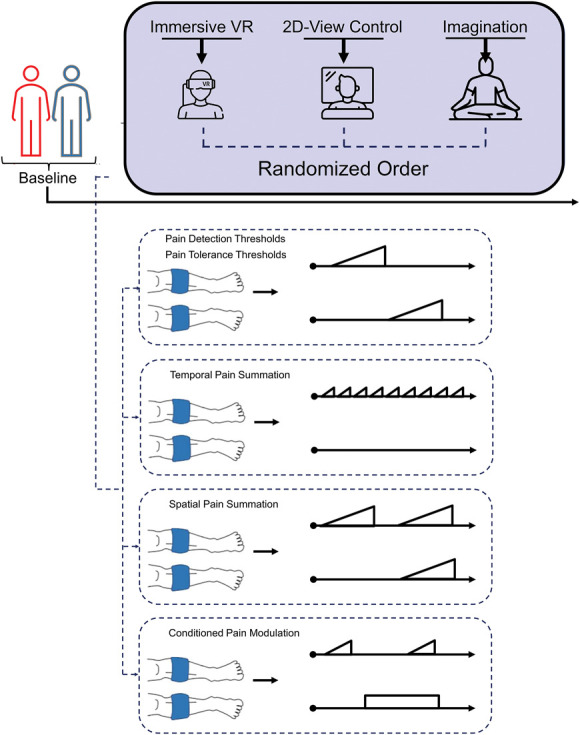
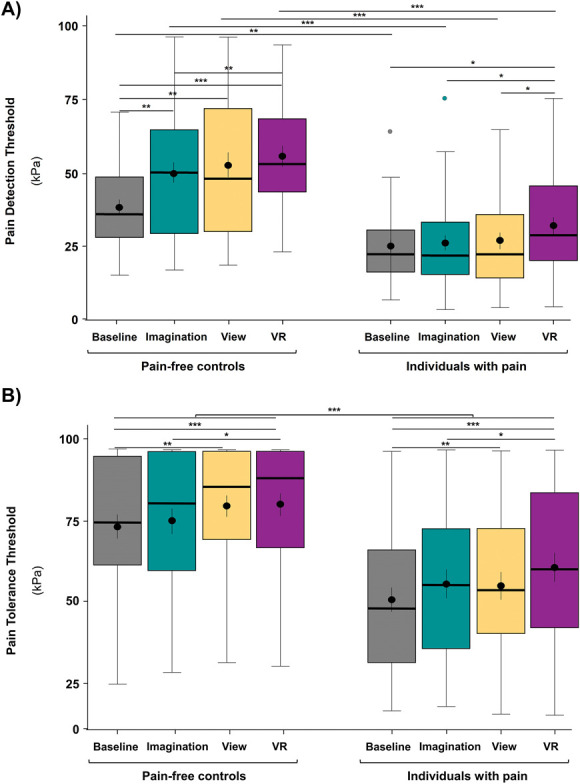
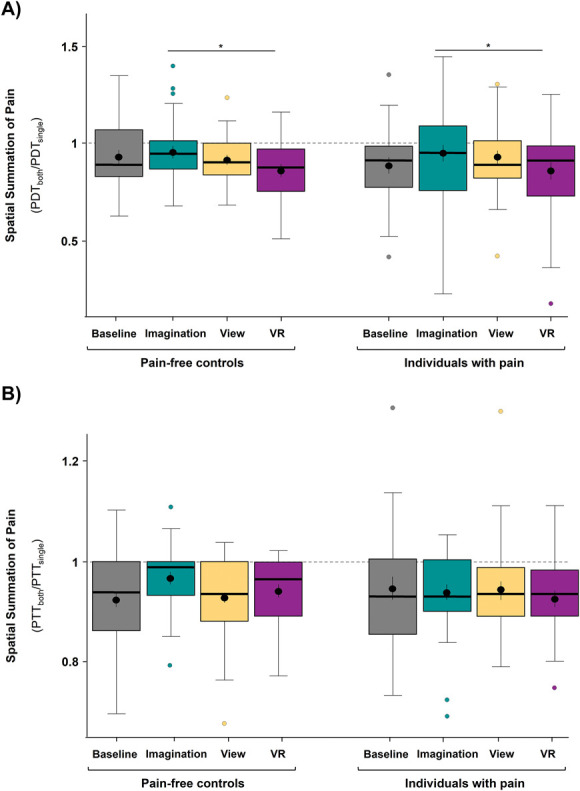
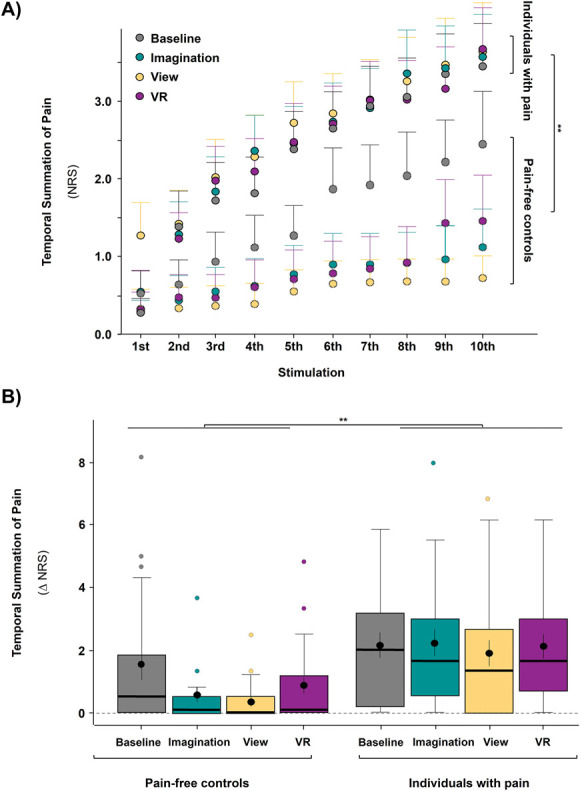
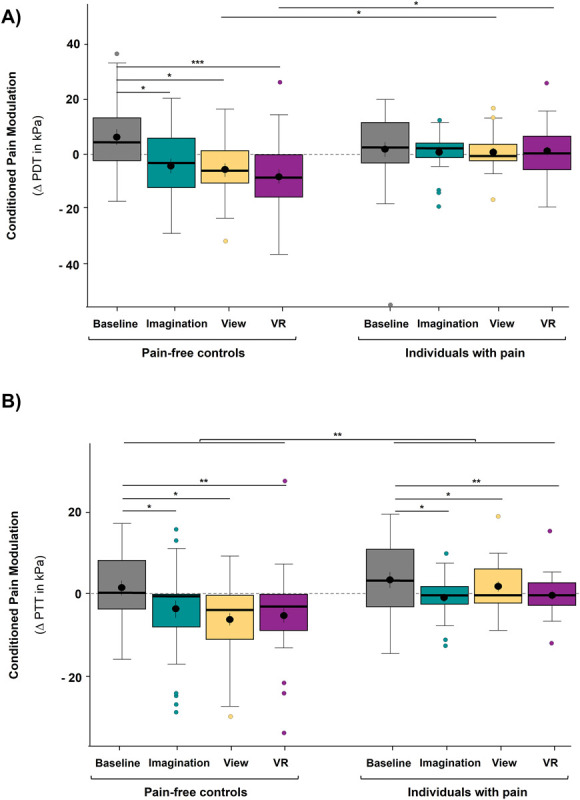
Virtual reality (VR) has been shown to be effective in pain management. However, to date, little is known about the mechanisms by which immersive experiences influence pain processing. The aim of this study was to investigate the direct effects of an immersive VR environment on the perception of experimental pain in individuals with chronic pain and pain-free controls. The immersion in a VR landscape was compared with mental imagery and a nonimmersive control condition. Using a randomized within-crossover design, pressure pain detection and tolerance thresholds, spatial and temporal summation (SSP, TSP), and conditioned pain modulation (CPM) were measured in 28 individuals with chronic pain and 31 pain-free controls using phasic cuff pressure on the legs. Direct comparison between the groups showed that although individuals with pain had significantly lower pain thresholds, reduced CPM effects, and increased TSP, the VR condition had the same pain-inhibitory effect on pain thresholds as in pain-free controls. Conditioned pain modulation effects were reduced by all conditions compared with baseline. There were no significant differences between conditions and baseline for TSP and SSP. Overall, pain modulatory effects were largest for VR and smallest for imagery. These results demonstrate that immersion in a VR environment has an increasing effect on pain thresholds, reduces pain inhibition in a CPM paradigm, and has no effects on TSP. This applies for participants with chronic pain and pain-free controls. These VR effects exceeded the effects of mental imagery on the nonimmersive control condition. This indicates that VR effectively modulates pain perception in both patients and controls irrespective of differences in pain perception.
Overview
The claims and statistics of this paper haven’t been checked yet.
Free: it reads the open-access text and checks the first 5 claims that cite a source we can check. Create a free account to check every claim.
Integrity signals
Registry
Cites
Statistics
Figures
Verification
Claims the paper makes
The claims and statistics of this paper haven’t been checked yet.
Free: it reads the open-access text and checks the first 5 claims that cite a source we can check. Create a free account to check every claim.
Claims other papers make about this one
Each is checked against this paper’s own text: does it say what the citing paper says it does?
The source backs part of the claim, not all of it — or backs it for a different population, condition or comparison.
In the citing paper
“The more immersive the VR, the greater the analgesic effect.25,27,29,43,44”
From A Pilot Study of Virtual Reality in Hemodialysis for Mitigating Pain and Anxiety: User Experiences and Perceptions (2025) · cites this paper as [43]
Experimental — accuracy not yet measured
Self-check
Percentages, sums and reported differences re-computed from the paper’s own numbers.
The self-check needs the paper’s full text.
Citations
Cites
Controlling the False Discovery Rate: A Practical and Powerful Approach to Multiple Testing
Benjamini, Y., & Hochberg, Y. (1995) · Journal of the Royal Statistical Society Series B: Statistical Methodology · doi:10.1111/j.2517-6161.1995.tb02031.x · Cited by 109,482 · cited 7×
“However, for SSP PDT , the robust ANOVA failed to show a significant main effect for the different test conditions (F[3, 28.36] 5 0.2189, P 5 0.882) so that these results should be interpreted with caution.”
BackgroundMethodResultInfluentialGrading the severity of chronic pain
Von Korff, M., Ormel, J., Keefe, F. J., & Dworkin, S. F. (1992) · Pain · doi:10.1016/0304-3959(92)90154-4 · Cited by 3,022
Schmider, E., Ziegler, M., Danay, E., Beyer, L., & Bühner, M. (2010) · Methodology · doi:10.1027/1614-2241/a000016 · Cited by 1,290
Robust statistical methods in R using the WRS2 package
Mair, P., & Wilcox, R. (2020) · Behavior Research Methods · doi:10.3758/s13428-019-01246-w · Cited by 1,082 · cited 11×
“Furthermore, individuals without pain showed significant higher PDT scores in the VR condition compared with the imagery condition (t[30] 5 2 3.376, P 5 0.008).”
MethodResultInfluentialYarnitsky, D. (2010) · Current Opinion in Anaesthesiology · doi:10.1097/aco.0b013e32833c348b · Cited by 745 · cited 1×
“10,49 The CPM protocol in this study included rapidly ramping up pressure on the nondominant leg, which was constant from then on, and simultaneously steadily increasing pressure on the dominant leg to capture the conditioned PDT and PTT.”
MethodPrice, D. D., Hu, J. W., Dubner, R., & Gracely, R. H. (1977) · Pain · doi:10.1016/0304-3959(77)90035-5 · Cited by 589 · cited 1×
“38 In our study, TSP was assessed once by applying 10 cuff stimuli on the dominant leg.”
MethodConditioned Pain Modulation in Populations With Chronic Pain: A Systematic Review and Meta-Analysis
Lewis, G. N., Rice, D. A., & McNair, P. J. (2012) · The Journal of Pain · doi:10.1016/j.jpain.2012.07.005 · Cited by 561 · cited 5×
“10,12,27,34,36,45 However, little is known about the influence of an immersive environment on these parameters.”
BackgroundResultInfluentialArendt-Nielsen, L., & Yarnitsky, D. (2009) · The Journal of Pain · doi:10.1016/j.jpain.2009.02.002 · Cited by 547 · cited 2×
“These measures were taken using a 5-point Likert scale ([1] very poor; [2] poor; [3] neutral; [4] good; [5] very good).”
BackgroundMethodAssessment of mechanisms in localized and widespread musculoskeletal pain
Graven-Nielsen, T., & Arendt-Nielsen, L. (2010) · Nature Reviews Rheumatology · doi:10.1038/nrrheum.2010.107 · Cited by 547
Phantom limb pain, cortical reorganization and the therapeutic effect of mental imagery
MacIver, K., Lloyd, D. M., Kelly, S., Roberts, N., & Nurmikko, T. (2008) · Brain · doi:10.1093/brain/awn124 · Cited by 453
Mallari, B., Spaeth, E. K., Goh, H., & Boyd, B. S. (2019) · Journal of Pain Research · doi:10.2147/jpr.s200498 · Cited by 374 · cited 1×
“22 However, although VR is already being used in pain management, 11,26,31,37,48 knowledge of its specific impact on pain perception is largely unknown.”
BackgroundGraven‐Nielsen, T., Wodehouse, T., Langford, R. M., Arendt‐Nielsen, L., & Kidd, B. L. (2012) · Arthritis & Rheumatism · doi:10.1002/art.34466 · Cited by 340 · cited 1×
“17”
Gupta, A., Scott, K., & Dukewich, M. (2018) · Pain Medicine · doi:10.1093/pm/pnx109 · Cited by 340 · cited 1×
“6,18 As participants move their head to look around, the computer updates the displayed images so that participants experience a surrounding 3D-stereo scene that changes dynamically.”
BackgroundVirtual Reality as a Clinical Tool for Pain Management
Pourmand, A., Davis, S., Marchak, A., Whiteside, T., & Sikka, N. (2018) · Current Pain and Headache Reports · doi:10.1007/s11916-018-0708-2 · Cited by 326
Abnormal endogenous pain modulation is a shared characteristic of many chronic pain conditions
Staud, R. (2012) · Expert Review of Neurotherapeutics · doi:10.1586/ern.12.41 · Cited by 290 · cited 1×
“13,36,42 The fact that the immersive setting also works for individuals with chronic pain, that is, especially for individuals with deficient CPM and increased pain sensitivity, is of relevance for 2 important reasons.”
BackgroundEvidence for central sensitization in chronic whiplash: A systematic literature review
Van Oosterwijck, J., Nijs, J., Meeus, M., & Paul, L. (2013) · European Journal of Pain · doi:10.1002/j.1532-2149.2012.00193.x · Cited by 257
Immersive Virtual Reality and Virtual Embodiment for Pain Relief
Matamala-Gomez, M., Donegan, T., Bottiroli, S., Sandrini, G., Sanchez-Vives, M. V., & Tassorelli, C. (2019) · Frontiers in Human Neuroscience · doi:10.3389/fnhum.2019.00279 · Cited by 244 · cited 1×
“33 However, little is known about the interaction of such a virtual manipulation with the perception of pain.”
BackgroundEffect of variance ratio on ANOVA robustness: Might 1.5 be the limit?
Blanca, M. J., Alarcón, R., Arnau, J., Bono, R., & Bendayan, R. (2018) · Behavior Research Methods · doi:10.3758/s13428-017-0918-2 · Cited by 228 · cited 2×
“These measures were taken using a 5-point Likert scale ([1] very poor; [2] poor; [3] neutral; [4] good; [5] very good).”
MethodGraven-Nielsen, T., Vaegter, H. B., Finocchietti, S., Handberg, G., & Arendt-Nielsen, L. (2015) · Pain · doi:10.1097/j.pain.0000000000000294 · Cited by 211
(2004) · PubMed Central · Cited by 186
Virtual reality for persistent pain: A new direction for behavioral pain management
Keefe, F. J., Huling, D. A., Coggins, M. J., Keefe, D. F., Rosenthal, Z. M., Herr, N. R., & Hoffman, H. G. (2012) · Pain · doi:10.1016/j.pain.2012.05.030 · Cited by 177 · cited 1×
“22 However, although VR is already being used in pain management, 11,26,31,37,48 knowledge of its specific impact on pain perception is largely unknown.”
BackgroundPetersen, K. K., Graven-Nielsen, T., Simonsen, O., Laursen, M. B., & Arendt-Nielsen, L. (2016) · Pain · doi:10.1097/j.pain.0000000000000531 · Cited by 170
Potvin, S., & Marchand, S. (2016) · Pain · doi:10.1097/j.pain.0000000000000573 · Cited by 166 · cited 2×
“10,12,27,34,36,45 However, little is known about the influence of an immersive environment on these parameters.”
BackgroundDisentangling motor execution from motor imagery with the phantom limb
Raffin, E., Mattout, J., Reilly, K. T., & Giraux, P. (2012) · Brain · doi:10.1093/brain/awr337 · Cited by 143 · cited 1×
“40,46 Although these psychological interventions are increasingly being used in the management of pain, little is known about their influence on the contributing mechanisms that either facilitate or inhibit nociceptive experiences, as assessed by TSP, SSP, and CPM.”
BackgroundVirtual reality for acute and chronic pain management in adult patients: a narrative review
Chuan, A., Zhou, J. J., Hou, R. M., Stevens, C. J., & Bogdanovych, A. (2021) · Anaesthesia · doi:10.1111/anae.15202 · Cited by 135 · cited 1×
“6,18 As participants move their head to look around, the computer updates the displayed images so that participants experience a surrounding 3D-stereo scene that changes dynamically.”
BackgroundVaegter, H. B., & Graven-Nielsen, T. (2016) · Pain · doi:10.1097/j.pain.0000000000000543 · Cited by 122 · cited 1×
“21,23,35,43,44 Within each test condition (baseline, imagery, view, and VR), 4 pain paradigms were measured: (1) general deep tissue pain sensitivity on the right leg and on the left leg (PDT: pain detection threshold, PTT: pain tolerance threshold), (2) spatial and (3) temporal summation of pain…”
MethodFernandes, C., Pidal-Miranda, M., Samartin-Veiga, N., & Carrillo‐de‐la‐Peña, M. T. (2019) · Pain · doi:10.1097/j.pain.0000000000001664 · Cited by 121 · cited 1×
“10,12,27,34,36,45 However, little is known about the influence of an immersive environment on these parameters.”
BackgroundVirtual reality distraction for acute pain in children
Lambert, V., Boylan, P., Boran, L., Hicks, P., Kirubakaran, R., Devane, D., & Matthews, A. (2020) · Cochrane Database of Systematic Reviews · doi:10.1002/14651858.cd010686.pub2 · Cited by 116 · cited 2×
“22 However, although VR is already being used in pain management, 11,26,31,37,48 knowledge of its specific impact on pain perception is largely unknown.”
BackgroundInfluentialGerhardt, A., Eich, W., Treede, R., & Tesarz, J. (2016) · Pain · doi:10.1097/j.pain.0000000000000777 · Cited by 114
Self-citationUser‐independent assessment of conditioning pain modulation by cuff pressure algometry
Graven‐Nielsen, T., Izumi, M., Petersen, K. K., & Arendt‐Nielsen, L. (2017) · European Journal of Pain · doi:10.1002/ejp.958 · Cited by 100 · cited 1×
“Cuff algometry has proven to be a valid and reliable tool for measuring pain perception and pain-modulating mechanisms, 9,15,16,28 and a close relationship between changes in cuff algometry and clinical pain conditions has been demonstrated.”
MethodColloca, L., Raghuraman, N., Wang, Y., Akintola, T., Brawn, B., Colloca, G., Kier, C., Varshney, A., & Murthi, S. B. (2020) · Pain · doi:10.1097/j.pain.0000000000001900 · Cited by 98 · cited 9×
“For example, if a link could be established between VR and CPM in patients with pain, this knowledge could be used in the future to specifically activate deficient CPM using VR.”
BackgroundResultInfluentialAttentional Modulation of Spatial Integration of Pain: Evidence for Dynamic Spatial Tuning
Quevedo, A. S., & Coghill, R. C. (2007) · The Journal of Neuroscience · doi:10.1523/jneurosci.3356-07.2007 · Cited by 89
McPhee, M., Vaegter, H., & Graven-Nielsen, T. (2019) · Pain · doi:10.1097/j.pain.0000000000001737 · Cited by 89
Wittkopf, P. G., Lloyd, D. M., Coe, O., Yacoobali, S., & Billington, J. (2020) · Disability and Rehabilitation · doi:10.1080/09638288.2019.1610803 · Cited by 80
Testing Repeated Measures Hypotheses When Covariance Matrices are Heterogeneous
Keselman, H. J., Carriere, K. C., & Lix, L. M. (1993) · Journal of Educational Statistics · doi:10.3102/10769986018004305 · Cited by 69 · cited 1×
“…the F-statistic tends to be robust against violations of the normality assumption 41 and (in case of equal sample sizes) also against violations of homoscedasticity, 4,24 we additionally employed a robust mixed ANOVA 30 for every variable violating the assumptions to ensure validity of our results.”
MethodMental imagery-induced attention modulates pain perception and cortical excitability
Volz, M. S., Suarez-Contreras, V., Portilla, A. S., & Fregni, F. (2015) · BMC Neuroscience · doi:10.1186/s12868-015-0146-6 · Cited by 65 · cited 3×
“Post hoc tests to compare the 2 groups in all conditions showed that individuals with pain only differed regarding the CPM PDT scores during the view (t[46.12] 5 2 2.620, P 5 0.”
BackgroundMethodInfluentialEccleston, C., Fisher, E., Liikkanen, S., Sarapohja, T., Stenfors, C., Jääskeläinen, S. K., Rice, A. S. C., Mattila, L., Blom, T., & Bratty, J. R. (2022) · Pain · doi:10.1097/j.pain.0000000000002617 · Cited by 64 · cited 1×
“22 However, although VR is already being used in pain management, 11,26,31,37,48 knowledge of its specific impact on pain perception is largely unknown.”
BackgroundVaegter, H. B., Andersen, T. E., Harvold, M., Andersen, P. G., & Graven-Nielsen, T. (2018) · The Clinical Journal of Pain · doi:10.1097/ajp.0000000000000543 · Cited by 45 · cited 1×
“21,23,35,43,44 Within each test condition (baseline, imagery, view, and VR), 4 pain paradigms were measured: (1) general deep tissue pain sensitivity on the right leg and on the left leg (PDT: pain detection threshold, PTT: pain tolerance threshold), (2) spatial and (3) temporal summation of pain…”
MethodCummins, T. M., Kucharczyk, M. M., Graven‐Nielsen, T., & Bannister, K. (2020) · European Journal of Pain · doi:10.1002/ejp.1580 · Cited by 45 · cited 1×
“Cuff algometry has proven to be a valid and reliable tool for measuring pain perception and pain-modulating mechanisms, 9,15,16,28 and a close relationship between changes in cuff algometry and clinical pain conditions has been demonstrated.”
Methodde la Coba, P., Montoro, C. I., del Paso, G. A. R., & Galvez-Sánchez, C. M. (2022) · Annals of Medicine · doi:10.1080/07853890.2022.2075560 · Cited by 38
Kermavnar, T., Power, V., de Eyto, A., & O'Sullivan, L. W. (2018) · Soft Robotics · doi:10.1089/soro.2017.0088 · Cited by 34
Effects of repeated conditioning pain modulation in healthy volunteers
Hoegh, M., Petersen, K. K., & Graven‐Nielsen, T. (2018) · European Journal of Pain · doi:10.1002/ejp.1279 · Cited by 31
Nonlinear increase of pain in distance-based and area-based spatial summation
Adamczyk, W. M., Manthey, L., Domeier, C., Szikszay, T. M., & Luedtke, K. (2021) · Pain · doi:10.1097/j.pain.0000000000002186 · Cited by 23 · cited 8×
“…free) with individuals with pain showing significantly lower PDT (F [1, 57] 5 22.946., P , 0.001, h p2 5 0.29, 95% CI 0.11, 0.46) and lower PTT (F[1, 57] 5 14.143, P , 0.001, h p2 5 0.20, 95% CI 0.05, 0.37) scores than those without pain, suggesting an overall higher pain sensitivity in these…”
BackgroundMethodInfluentialCuff Algometry for Estimation of Hyperalgesia and Pain Summation
Lindskou, T. A., Christensen, S. W., & Graven‐Nielsen, T. (2016) · Pain Medicine · doi:10.1093/pm/pnw168 · Cited by 20 · cited 2×
“28 Here, this was achieved by activating pressure cuffs on the dominant and nondominant legs simultaneously.”
MethodHolden, S., Petersen, K. K., Arendt‐Nielsen, L., & Graven‐Nielsen, T. (2019) · European Journal of Pain · doi:10.1002/ejp.1408 · Cited by 13 · cited 1×
“16,20,35”
Interface Pressure Behavior During Painful Cuff Algometry
Manafi-Khanian, B., Arendt‐Nielsen, L., Petersen, K. K., Samani, A., & Graven‐Nielsen, T. (2016) · Pain Medicine · doi:10.1093/pm/pnv063 · Cited by 11
Test-retest reliability of cuff pressure pain algometry in patients with knee osteoarthritis.
Jørgensen, T. S., Hangaard, S., Bliddal, H., et al. (2016) · PubMed · Cited by 2
Cited by
Mapping Metaverse Research to the Sustainable Development Goal of Good Health and Well-Being
Raman, R., Hughes, L., Mandal, S., Das, P., & Nedungadi, P. (2024) · IEEE Access · doi:10.1109/access.2024.3502171 · Cited by 35
Smith, A. K., Wyles, K. J., Medina, S., Clarke, S., Schofield, P., & Hughes, S. (2024) · European Journal of Pain · doi:10.1002/ejp.4727 · Cited by 29
“Importantly, using immersive VR natural landscapes can produce stronger analgesic effects compared to non-immersive and imagined landscapes in both chronic pain patients and healthy participants (Tesarz et al., 2024).”
The Efficacy of Virtual Reality on the Rehabilitation of Musculoskeletal Diseases: Umbrella Review
Tang, P., Cao, Y., Vithran, D. T. A., Xiao, W., Wen, T., Liu, S., & Li, Y. (2025) · Journal of Medical Internet Research · doi:10.2196/64576 · Cited by 32
“For example, age, severity of the condition, and comorbidities may influence how well a patient responds to VR rehabilitation [44].”
Guerra-Armas, J., Flores-Cortés, M., Ceniza-Bordallo, G., & Matamala-Gomez, M. (2024) · Multimodal Technologies and Interaction · doi:10.3390/mti8080066 · Cited by 8
Pérez, S. E. M., Canosa, C. P., Aguiar, I. P., Rodríguez, A. M. M., & Pérez, I. M. M. (2025) · Osteology · doi:10.3390/osteology5010008 · Cited by 9
Metadata
- Authors
- Tesarz, J., Herpel, C., Meischner, M., Drusko, A., Friederich, H.-C., Flor, H., & Reichert, J.
- Affiliations
- Heidelberg University (DE)
- University Hospital Heidelberg (DE)
- Corresponding author
- Tesarz, Jonas
- ORCID
- Venue
- Pain
- Published
- 2023-10-25
- Volume
- 165
- Issue
- 4
- Pages
- 796-810
- ISSN
- 0304-3959 (ISSN-L)
- 1872-6623
- PMC
- PMC10949219
- OpenAlex
- W4387935722
- Semantic Scholar
- 7605fedfe7048f7fe1bde539eb2b31d79d09cbef
- Cited by
- 21
- References
- 46
- Citations by year
- 2026: 8 · 2025: 7 · 2024: 6
- FWCI
- 3.64
- Type
- journal article
- Language
- en
- Open access
- hybrid
- doi.org
- Licence
- Locations
- Pain (publishedVersion, cc-by-nc-nd)
- PubMed Central (publishedVersion, cc-by-nc-nd)
- PubMed (publishedVersion)
- Funders
- Deutsche Forschungsgemeinschaft
- Bundesministerium für Bildung und Forschung (01EC1904A, FKZ:01 EC1904A)
- Topics
- Physical Sciences › Computer Science › Human-Computer Interaction › Virtual Reality Applications and Impacts
- Health Sciences › Medicine › Anesthesiology and Pain Medicine › Pain Management and Treatment
- Health Sciences › Medicine › Pediatrics, Perinatology and Child Health › Pediatric Pain Management Techniques
- Keywords
- virtual reality, experimental pain, chronic pain, pain perception, pain threshold, conditioned pain modulation, temporal summation, spatial summation, mental imagery, immersion, pain inhibition
- MeSH terms
- Virtual Reality, Humans, Imagination, Pain Measurement, Pain Threshold, Chronic Pain
About these checks
Registry, retraction, Cites and statistics results are computed, not judged, with one exception: a printed reference that no index lists is read once by a model before it counts as a citation error. Claims are extracted by a model and kept only when their quote appears verbatim in the text; each cited source is then checked, with a model’s help, for whether it says what the claim relies on. Those verdicts can be wrong — read the claim’s quote and the cited source before relying on one.
Statistics and arithmetic are recomputed, not judged.
Confidence bands are shown only for fields calibrated on our annotated test set. None is calibrated yet, so no band is shown.
What counts as a claim ›How we measure confidence ›How we check this ›
Are you an author, or do you see a problem with this page? Request a review
Data sources
Bibliographic data: Semantic Scholar, OpenAlex, Crossref.
Contains information from the Semantic Scholar Academic Graph Datasets, made available under the ODC Attribution License (ODC-BY 1.0).
Semantic Scholar’s data is described in: Kinney, R., et al. (2023). The Semantic Scholar Open Data Platform. arXiv:2301.10140.
