

Clinical- and Cost-effectiveness of Telemedicine in Type 2 Diabetes Mellitus: A Systematic Review and Meta-analysis
Open accessThe DOI matches its Crossref record, with a small difference in title or year; 64 of the 65 references it cites were found in a registry or an index.
Abstract
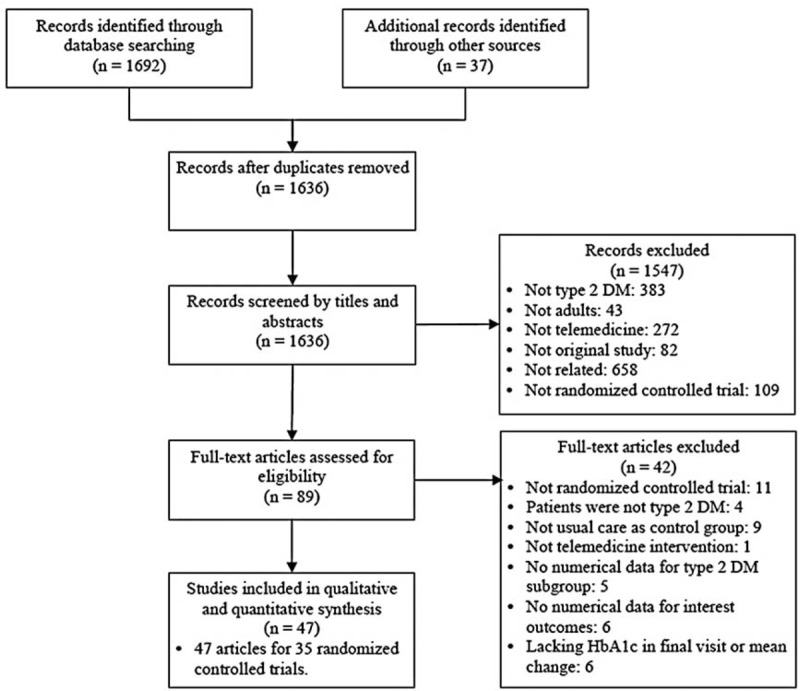
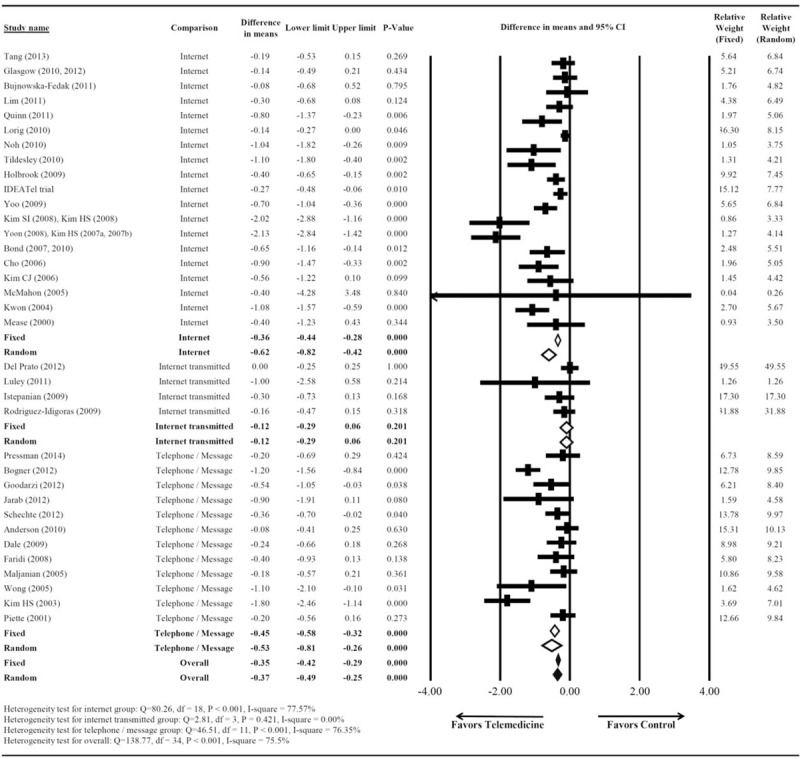
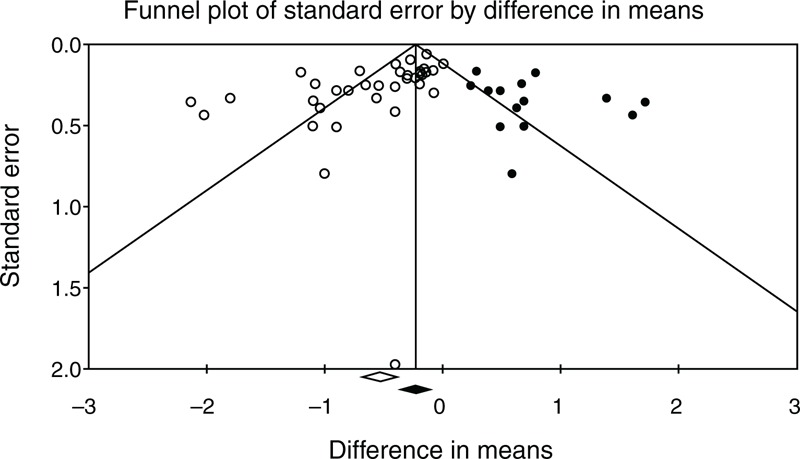
Emerging telemedicine programs offer potential low-cost solutions to the management of chronic disease. We sought to evaluate the clinical effectiveness and cost effectiveness of telemedicine approaches on glycemic control in patients with type 2 diabetes mellitus. Using terms related to type 2 diabetes and telemedicine, MEDLINE, Cochrane, EMBASE, and CINAHL Plus were searched to identify relevant studies published through February 28, 2014. Data from identified clinical trials were pooled according to telemedicine approach, and evaluated using conventional meta-analytical methods. We identified 47 articles, from 35 randomized controlled trials, reporting quantitative outcomes for hemoglobin A1c (HbA1c). Twelve of the 35 studies provided intervention via telephone, either in the form of a call or a text message; 19 studies tested internet-based programs, employing video-conferencing and/or informational websites; and four studies used interventions involving electronically transmitted recommendations made by clinicians in response to internet-based reporting by patients. Overall, pooled results from these studies revealed a small, but statistically significant, decrease in HbA1c following intervention, compared to conventional treatment (pooled difference in means=-0.37, 95% CI=-0.49 to -0.25, Z=-6.08, P<0.001). Only two of the 35 studies included assessment of cost-effectiveness. These studies were disparate, both in terms of overall expense and relative cost-effectiveness. Optimization of telemedicine approaches could potentially allow for more effective self-management of disease in type 2 diabetes patients, though evidence to-date is unconvincing. Furthermore, significant publication bias was detected, suggesting that the literature should be interpreted cautiously.
Overview
The claims and statistics of this paper haven’t been checked yet.
Free: it reads the open-access text and checks the first 5 claims that cite a source we can check. Create a free account to check every claim.
Integrity signals
Registry
Cites
Statistics
Figures
Verification
Claims the paper makes
The claims and statistics of this paper haven’t been checked yet.
Free: it reads the open-access text and checks the first 5 claims that cite a source we can check. Create a free account to check every claim.
Claims other papers make about this one
Each is checked against this paper’s own text: does it say what the citing paper says it does?
The source backs part of the claim, not all of it — or backs it for a different population, condition or comparison.
In the citing paper
“while the other six reviews concluded that remote monitoring was more effective than face-to-face care [14–19].”
From Telemedicine in the OECD: An umbrella review of clinical and cost-effectiveness, patient experience and implementation (2020) · cites this paper as [18]
Experimental — accuracy not yet measuredThe source backs part of the claim, not all of it — or backs it for a different population, condition or comparison.
In the citing paper
“This was the most commonly described telehealth component in the included systematic reviews and was associated with improved clinical outcomes in diabetes and heart failure [33,35,36,38,42,44,54,58]; however, findings for asthma and COPD were mostly neutral or inconsistent [61-63,65,66,68,69].”
From Telehealth Interventions to Support Self-Management of Long-Term Conditions: A Systematic Metareview of Diabetes, Heart Failure, Asthma, Chronic Obstructive Pulmonary Disease, and Cancer (2017) · cites this paper as [54]
Experimental — accuracy not yet measuredThe source backs part of the claim, not all of it — or backs it for a different population, condition or comparison.
In the citing paper
“Among 3 reviews [25, 32, 34], 2 have indicated a positive effect of cost savings due to less travel, wait times and increased access to services.”
From Effect of virtual care in type 2 diabetes management – a systematic umbrella review of systematic reviews and meta-analysis (2025) · cites this paper as [25]
Experimental — accuracy not yet measuredThe cited source says what the claim attributes to it.
In the citing paper
“Included studies in the second review produced very different incremental cost-effectiveness ratio (ICER) values of $491 and $29,869 for remote monitoring in patients with Type 2 diabetes [18].”
From Telemedicine in the OECD: An umbrella review of clinical and cost-effectiveness, patient experience and implementation (2020) · cites this paper as [18]
The cited source says what the claim attributes to it.
In the citing paper
“Of seven 2-star reviews [29,30,33,42,46,52,54], 4 were meta-analyses, all of which showed significant reductions in HbA1c compared with controls, although the effect sizes were small.”
4 more claims about this paper
Create a free account to see every claim other papers make about this one.
Self-check
Percentages, sums and reported differences re-computed from the paper’s own numbers.
The self-check needs the paper’s full text.
Citations
Cites
Liberati, A., Altman, D. G., Tetzlaff, J., Mulrow, C., Gøtzsche, P. C., Ioannidis, J. P. A., Clarke, M., Devereaux, P. J., Kleijnen, J., & Moher, D. (2009) · PLoS Medicine · doi:10.1371/journal.pmed.1000100 · Cited by 28,164
Liberati, A., Altman, D. G., Tetzlaff, J., Mulrow, C., Gøtzsche, P. C., Ioannidis, J. P. A., Clarke, M., Devereaux, P. J., Kleijnen, J., & Moher, D. (2009) · Annals of Internal Medicine · doi:10.7326/0003-4819-151-4-200908180-00136 · Cited by 10,349
Estimating the mean and variance from the median, range, and the size of a sample
Hozo, S. P., Djulbegovic, B., & Hozo, I. (2005) · BMC Medical Research Methodology · doi:10.1186/1471-2288-5-13 · Cited by 9,062
McCambridge, J., Witton, J., & Elbourne, D. R. (2014) · Journal of Clinical Epidemiology · doi:10.1016/j.jclinepi.2013.08.015 · Cited by 2,748
Verhagen, A. P., de Vet, H. C. W., de Bie, R. A., Kessels, A. G. H., Boers, M., Bouter, L. M., & Knipschild, P. G. (1998) · Journal of Clinical Epidemiology · doi:10.1016/s0895-4356(98)00131-0 · Cited by 2,379
Standards of Medical Care in Diabetes—2012
(2012) · Diabetes Care · doi:10.2337/dc12-s011 · Cited by 2,240
Gerontechnology acceptance by elderly Hong Kong Chinese: A senior technology acceptance model (STAM)
Chen, K., & Chan, A. H. S. (2014) · Ergonomics · doi:10.1080/00140139.2014.895855 · Cited by 679 · cited 1×
“Furthermore, while type 1 DM is first diagnosed in childhood, with patients acquiring self-management skills at a young age, type 2 DM is most frequently associated with an older population, more often unfamiliar with and averse to the technologies utilized in telemedicine.(15,16) To more clearly evaluate the potentia…”
MethodQuinn, C. C., Shardell, M. D., Terrin, M. L., Barr, E. A., Ballew, S. H., & Gruber-Baldini, A. L. (2011) · Diabetes Care · doi:10.2337/dc11-0366 · Cited by 650
Twenty years of telemedicine in chronic disease management – an evidence synthesis
Wootton, R. (2012) · Journal of Telemedicine and Telecare · doi:10.1258/jtt.2012.120219 · Cited by 545 · cited 3×
“Indeed, we are presently seeing unprecedented opportunities to reach previously underserved communities through telemedicine, and much has been discussed in the literature about the utility of such approaches in the control of chronic diseases, like type 2 DM. Undoubtedly, telemedicine holds the potential to significa…”
BackgroundSystematic review of cost effectiveness studies of telemedicine interventions
Whitten, P. S., Mair, F. S., Haycox, A., May, C. R., Williams, T. L., & Hellmich, S. (2002) · BMJ · doi:10.1136/bmj.324.7351.1434 · Cited by 526 · cited 3×
“Indeed, we are presently seeing unprecedented opportunities to reach previously underserved communities through telemedicine, and much has been discussed in the literature about the utility of such approaches in the control of chronic diseases, like type 2 DM. Undoubtedly, telemedicine holds the potential to significa…”
Background
Research works printed but not linked: 3
- World Health Organization. Telemedicine – Opportunities and Developments in Member States. Global Observatory for eHealth Series. vol. 2: 2014 2; Available from: http://www.whoint/goe/publications/ehealth_series_vol2/en/.
- Institute of Medicine. The Role of Telehealth in an Evolving Health Care Environment: Workshop Summary. Washington, DC: The National Academies Press; 2012. 24901186
- Glasgow RE Kurz D King D Outcomes of minimal and moderate support versions of an internet-based diabetes self-management support program. J Gen Intern Med 2010; 25: 1315– 1322. 20714820 PMC2988142 · DOI · Paper page
Cited by
Items 201–233 of 233
Telemonitoring improves diabetes control, but more work is needed
Wakefield, B. J. (2016) · Evidence-Based Nursing · doi:10.1136/eb-2016-102560 · Cited by 1
Experience with Telemedicine Systems in Chronic Illness: What Can We Learn
Briscoe, J. A., & Quezada, S. M. (2015) · Springer eBooks · doi:10.1007/978-3-319-22285-1_2 · Cited by 1
“[20] Reduction in Hgb A1c”
BackgroundInfluentialPerspectives in Digital Health and Precision Medicine
Gabbrielli, F., Russo, G., Minco, L. D., Casciello, M., & Gensini, G. F. (2017) · TELe-Health · doi:10.1007/978-3-319-28661-7_7
A robust automatic mechanism for electrocardiogram interpretation in telehealthcare
Ho, T., & Lai, F. (2017) · Annual International Conference of the IEEE Engineering in Medicine and Biology Society (EMBC) · doi:10.1109/embc.2017.8037612
“It has been indicated by many studies that the telehealthcare service could offer clinical effectiveness and cost-effectiveness for many types of patients, such as patients with heart failure [6], chronic cardiovascular disease [11, 12], chronic obstructive pulmonary disease [17], Parkinson's disease [18], type 2 diab…”
BackgroundEvaluación de barreras de autocuidado en Diabetes Mellitus tipo 2
Baustista, J. C. (2015) · Repositorio Institucional de la Universidad de Málaga (University of Málaga)
Glaser, E. (2017) · Papyrus : Institutional Repository (Université de Montréal) · doi:10.71781/30367
Wickramasinghe, S. I. (2019) · The University of Queensland · doi:10.14264/uql.2019.757
Osman, M. A. (2018) · ERA: Education and Research Archive (University of Alberta) · doi:10.7939/r3h708g6d
Diabetes Management in the Digital Age; Text Messaging in Rural North Carolina
Elfering, J., & Churchwell, W. (2018) · Carolina Digital Repository (University of North Carolina at Chapel Hill) · doi:10.17615/3hbe-1a47
Beatty, J. R. (2020) · ScholarWorks - UA (University of Alaska System) · Cited by 2
Telenutrition: The Fine Line Between Nutritional Coaching and an Effective Professional Practice
Rodríguez‐Castelán, J., & Luna-Vázquez, F. (2021) · Advances in medical education, research, and ethics (AMERE) book series · doi:10.4018/978-1-7998-8783-6.ch002
Alkhathami, K. M. (2022) · Journal of Medicine and Health Studies · doi:10.37881/jmahs.114
“Besides, telehealth aids healthcare professionals in educating and providing services to individuals whose access to healthcare services is hindered by geographical barriers.[4] In the Kingdom of Saudi Arabia (KSA), e-health has been designated a sizeable budget by the Ministry of Health (MOH); however, the percentage…”
BackgroundProceedings of the 22nd International Conference of Public Health Sciences
(2023) · Journal of Health Research · doi:10.56808/2586-940x.1049
Dughmosh, R., Mahmood, S., Othman, M. M., Abune'meh, E. A., Islam, N., Hamad, N. A., & Al-Jayyousi, G. F. (2023) · Telemedicine Journal and e-Health · doi:10.1089/tmj.2023.0080
“38 The findings of the survey showed that the number of hotline services provided was the highest after the lockdown, and other restrictions were implemented throughout the country and when all outpatient appointments were first delivered through telephone consultations.”
Innovations in Older Adult Care and Health Service Management: A Focus on China
Balasubramanian, M., Shafei, A., & Liang, Z. (2024) · Frontiers research topics · doi:10.3389/978-2-8325-4917-9
Dilek, A. L. A. Y. (2024) · Arşiv Kaynak Tarama Dergisi · doi:10.17827/aktd.1518583
Teleconsulta e a Satisfação: O Impacto numa População com Diabetes Mellitus
Vasques, A., Evangelista, D., Barroso, M., Medo, C., Gonçalves, C., & Sintra, I. (2024) · Revista Portuguesa de Endocrinologia Diabetes e Metabolismo · doi:10.26497/ao230035
BARBOSA, L. P., Rocha, G. D. G., Gress, M. F., Pinheiro, E. D. A., Lopes, L. D. S. G., Farias, L. A. G. M., Castelo, M. H. C. G., & Ponte, C. M. M. (2025) · Revista Interagir · doi:10.12662/1809-5771ri.128.5109.p31-34.2025
Hazime, D., Raffi, L., & Burner, E. (2026) · Interactive Journal of Medical Research · doi:10.2196/65113
“In addition, investing in mHealth platforms could alleviate the financial burden on health care systems by reducing the frequency of costly acute unscheduled care visits and hospitalizations [32,33].”
Kazawa, K., Osaki, K., Rahman, M. M., & Moriyama, M. (2020) · Figshare · doi:10.6084/m9.figshare.11979408
Xie, W., Dai, P., Qin, Y., Wu, M., Yang, B., & Yu, X. (2020) · Figshare · doi:10.6084/m9.figshare.12096672
Xie, W., Dai, P., Qin, Y., Wu, M., Yang, B., & Yu, X. (2020) · Figshare · doi:10.6084/m9.figshare.12096657
Xie, W., Dai, P., Qin, Y., Wu, M., Yang, B., & Yu, X. (2020) · Figshare · doi:10.6084/m9.figshare.12096663
Xie, W., Dai, P., Qin, Y., Wu, M., Yang, B., & Yu, X. (2020) · Figshare · doi:10.6084/m9.figshare.12096666
Diabetes Management in the Digital Age; Text Messaging in Rural North Carolina
Churchwell, W., & Elfering, J. (2018) · Carolina Digital Repository (University of North Carolina at Chapel Hill)
Wong, A. K. C., Chen, S.-C., Wong, F. K. Y., Liang, J., Tong, D. W. K., Liu, L. Z., Chan, M. L., Wong, M. K., Wong, B. C., Hui, V. C. C., et al. (2026) · npj Digital Medicine · doi:10.1038/s41746-026-02424-9
Yarleque, M. T. R. (2022) · LA Referencia (Red Federada de Repositorios Institucionales de Publicaciones Científicas)
Enhancing Type 2 Diabetes Management Involving Healthcare Professionals in Primary Care
Li, M., & Wang, L. (2026) · Healthcare · doi:10.3390/healthcare14162633
“Prior reviews had confirmed that information-technology-based diabetes management yielded positive clinical outcomes [166,167].”
Okaniwa, F., Chen, F., & Yoshida, H. (2025) · JMIR mhealth and uhealth · doi:10.2196/76036
Sciepuro, R., Cyls, D., Czarnowska, M., & Czarnowska, N. (2026) · International Journal of Innovative Technologies in Social Science · doi:10.31435/ijitss.3(51).2026.6305
Piloto innovador para el monitoreo de pacientes crónicos en domicilio mediante Internet de las Cosas
Saldarriaga, C. A. L., Guerrero, J. D. V., Hernandez, L. F. D., Boetsév, A. I., & Macías, A. R. (2024) · REDIIS / Revista de Investigación e Innovación en Salud · doi:10.23850/rediis.v10i10.6947 · Cited by 1
Amelia, R., Andayani, T. M., & Rahmawati, F. (2026) · Jurnal Farmasi Sains dan Terapan · doi:10.33508/jfst.v13i1.8745
Noack, E. M., Ondersma, S. J., Wieder, P., & Müller, F. (2026) · Zeitschrift für Evidenz Fortbildung und Qualität im Gesundheitswesen · doi:10.1016/j.zefq.2026.08.011
Metadata
- Authors
- Zhai, Y.-K., Zhu, W.-J., Cai, Y.-L., Sun, D.-X., & Zhao, J.
- Affiliations
- Zhengzhou University (CN)
- Corresponding author
- Zhao, Jie
- ORCID
- Zhao, Jie
- Venue
- Medicine
- Published
- 2014-12
- Volume
- 93
- Issue
- 28
- Pages
- e312
- ISSN
- 0025-7974 (ISSN-L)
- PMC
- PMC4603080
- OpenAlex
- W2048921463
- Semantic Scholar
- daa38a0b9a2cb880ea9394edd285dfb5b48f2b85
- Cited by
- 221
- References
- 65
- Citations by year
- 2026: 2 · 2025: 12 · 2024: 8 · 2023: 19 · 2022: 32 · 2021: 30 · 2020: 32 · 2019: 17 · 2018: 21 · 2017: 20 · 2016: 23 · 2015: 5
- FWCI
- 2.50
- Type
- journal article
- Language
- en
- Open access
- gold
- doi.org
- Licence
- cc-by-nc-nd
- Locations
- Medicine (publishedVersion, cc-by-nc-nd)
- PubMed Central (publishedVersion, cc-by-nc-nd)
- PubMed (publishedVersion)
- Funders
- Zhengzhou University
- Innovation Scientists and Technicians Troop Construction Projects of Henan Province
- Topics
- Health Sciences › Medicine › Public Health, Environmental and Occupational Health › Telemedicine and Telehealth Implementation
- Health Sciences › Health Professions › General Health Professions › Mobile Health and mHealth Applications
- Health Sciences › Medicine › Endocrinology, Diabetes and Metabolism › Diabetes Management and Education
- Keywords
- telemedicine, type 2 diabetes, glycemic control, HbA1c, cost-effectiveness, telephone-delivered intervention, text messaging intervention, online intervention, videoconferencing, self-management, publication bias
- MeSH terms
- Blood Glucose, Diabetes Mellitus, Type 2, Humans, Self Care, Reproducibility of Results, Telemedicine
About these checks
Registry, retraction, Cites and statistics results are computed, not judged, with one exception: a printed reference that no index lists is read once by a model before it counts as a citation error. Claims are extracted by a model and kept only when their quote appears verbatim in the text; each cited source is then checked, with a model’s help, for whether it says what the claim relies on. Those verdicts can be wrong — read the claim’s quote and the cited source before relying on one.
Statistics and arithmetic are recomputed, not judged.
Confidence bands are shown only for fields calibrated on our annotated test set. None is calibrated yet, so no band is shown.
What counts as a claim ›How we measure confidence ›How we check this ›
Are you an author, or do you see a problem with this page? Request a review
Data sources
Bibliographic data: Semantic Scholar, OpenAlex, Crossref.
Contains information from the Semantic Scholar Academic Graph Datasets, made available under the ODC Attribution License (ODC-BY 1.0).
Semantic Scholar’s data is described in: Kinney, R., et al. (2023). The Semantic Scholar Open Data Platform. arXiv:2301.10140.
