

Association between muscle strength and type 2 diabetes mellitus in adults in Korea: Data from the Korea national health and nutrition examination survey (KNHANES) VI
Open accessThe DOI matches its Crossref record, with a small difference in title or year; 33 of the 33 references it cites were found in a registry or an index.
Abstract
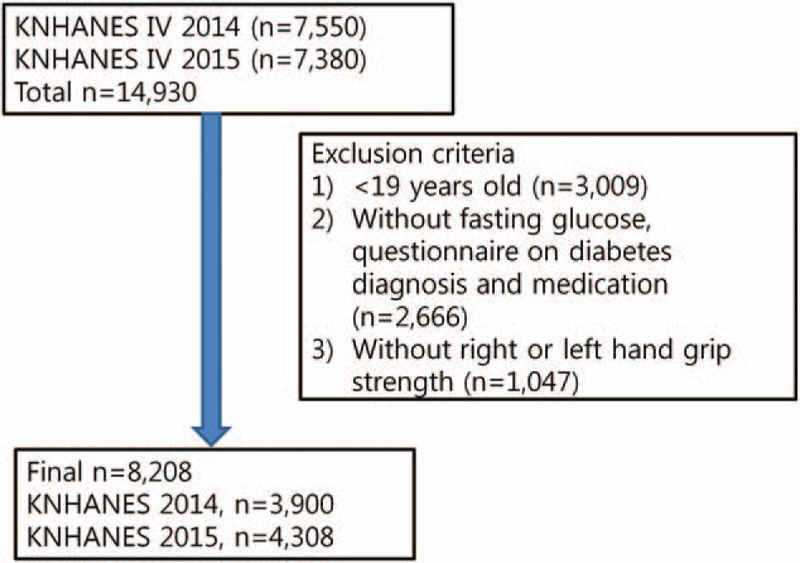
Diabetes mellitus (DM) is a significant chronic disease, and health burden from DM is increasing. Recently, studies on the relationship between handgrip strength, which is a measuring tool for muscle strength, and type 2 DM were published. However, the results have been conflicting. In addition, few studies that used data from adults in Korea have been conducted. Thus, this study aimed to identify the association between handgrip strength as well as type 2 DM and insulin resistance in adults using data from the Korea National Health and Nutrition Examination Survey (KNHANES) 2014 to 2015. Inflammation is a condition affecting the muscle strength of individuals with type 2 DM; therefore, its mediating effects were also examined.We included 8208 participants aged between 19 and 80 years who had undergone a handgrip test and had received information about type 2 DM. General linear and binary logistic regression models were used to examine the association between handgrip strength and type 2 DM variables. In addition, mediation analysis was conducted to estimate the role of inflammation in the relationship between handgrip strength and type 2 DM.After adjusting for age, sex, education, alcohol consumption, lifetime smoking, obesity, and aerobic physical activity, handgrip strength was inversely associated with fasting glucose, HbA1c, and fasting insulin levels as well as the homeostasis model assessment of insulin resistance (HOMA-IR) score. Multivariable logistic regression analyses showed that handgrip strength was significantly inversely associated with type 2 DM and insulin resistance. The high-sensitivity C-reactive protein (hs-CRP), an inflammation-related biomarker, mediated approximately 10% of the association between handgrip strength and type 2 DM.Using large, well-defined, nationally representative cross-sectional data on adults in Korea, we found that handgrip strength, which is an indicator of muscle strength, was associated with type 2 DM.
Overview
The claims and statistics of this paper haven’t been checked yet.
Free: it reads the open-access text and checks the first 5 claims that cite a source we can check. Create a free account to check every claim.
Integrity signals
Registry
Cites
Statistics
Figures
Verification
Claims the paper makes
The claims and statistics of this paper haven’t been checked yet.
Free: it reads the open-access text and checks the first 5 claims that cite a source we can check. Create a free account to check every claim.
Claims other papers make about this one
Each is checked against this paper’s own text: does it say what the citing paper says it does?
In the citing paper
“Handgrip strength normalized by body weight was inversely associated with insulin resistance and type 2 diabetes (101).”
From Health Consequences of Sarcopenic Obesity: A Narrative Review (2020) · cites this paper as [101]
Self-check
Percentages, sums and reported differences re-computed from the paper’s own numbers.
The self-check needs the paper’s full text.
Citations
Cites
Matthews, D. R., Hosker, J. P., Rudenski, A. S., Naylor, B. A., Treacher, D. F., & Turner, R. C. (1985) · Diabetologia · doi:10.1007/bf00280883 · Cited by 31,502 · cited 1×
“HOMA-IR was calculated using the following formula: HOMAIR= [fasting glucose (mg/dL) fasting insulin (mIU/L)]/40.([21]) The cut-off value of HOMA-IR was 2.”
MethodVos, T., Abajobir, A. A., Abate, K. H., Abbafati, C., Abbas, K. M., Abd-Allah, F., Abdulkader, R. S., Abdulle, A. M., Abebo, T. A., Abera, S. F., et al. (2017) · The Lancet · doi:10.1016/s0140-6736(17)32154-2 · Cited by 13,220
(2004) · The Lancet · doi:10.1016/s0140-6736(03)15268-3 · Cited by 12,717
C-Reactive Protein, Interleukin 6, and Risk of Developing Type 2 Diabetes Mellitus
Pradhan, A. D. (2001) · JAMA · doi:10.1001/jama.286.3.327 · Cited by 4,433
Roberts, H. C., Denison, H. J., Martin, H. J., Patel, H. P., Syddall, H., Cooper, C., & Sayer, A. A. (2011) · Age and Ageing · doi:10.1093/ageing/afr051 · Cited by 3,001 · cited 2×
“Handgrip strength is a simple and cost-effective tool utilized to measure muscular strength, and it has been useful for the diagnosis of sarcopenia in epidemiologic studies.([8]) Some studies have reported that early mid-life handgrip strength is associated with functional limitation and disability 25 years later.”
BackgroundMethodData Resource Profile: The Korea National Health and Nutrition Examination Survey (KNHANES)
Kweon, S., Kim, Y., Jang, M.-J., Kim, Y., Kim, K., Choi, S., Chun, C., Khang, Y.-H., & Oh, K. (2014) · International Journal of Epidemiology · doi:10.1093/ije/dyt228 · Cited by 2,189
Self-citationEconomic Costs of Diabetes in the U.S. in 2012
American Diabetes Association (2013) · Diabetes Care · doi:10.2337/dc12-2625 · Cited by 2,163
Leong, D. P., Teo, K. K., Rangarajan, S., Lopez-Jaramillo, P., Avezum, A., Orlandini, A., Seron, P., Ahmed, S. H., Rosengren, A., Kelishadi, R., et al. (2015) · The Lancet · doi:10.1016/s0140-6736(14)62000-6 · Cited by 1,876
Midlife Hand Grip Strength as a Predictor of Old Age Disability
Rantanen, T. (1999) · JAMA · doi:10.1001/jama.281.6.558 · Cited by 1,476
Umpierre, D. (2011) · JAMA · doi:10.1001/jama.2011.576 · Cited by 1,358
Age-related and disease-related muscle loss: The effect of diabetes, obesity, and other diseases
Kalyani, R. R., Corriere, M., & Ferrucci, L. (2014) · The Lancet Diabetes & Endocrinology · doi:10.1016/s2213-8587(14)70034-8 · Cited by 1,102 · cited 1×
“The loss of muscle mass and strength leads to a decreased surface area for glucose transport and to the exacerbation of insulin resistance.([27]) Inflammation, which is an important factor of insulin resistance, is related to low muscular strength.”
BackgroundTing, D. S. W., Cheung, G. C. M., & Wong, T. Y. (2016) · Clinical & Experimental Ophthalmology · doi:10.1111/ceo.12696 · Cited by 1,066
Hicks, R., & Tingley, D. (2011) · The Stata Journal: Promoting communications on statistics and Stata · doi:10.1177/1536867x1201100407 · Cited by 739
Schaap, L. A., Pluijm, S. M. F., Deeg, D. J. H., Harris, T. B., Kritchevsky, S. B., Newman, A. B., Colbert, L. H., Pahor, M., Rubin, S. M., Tylavsky, F. A., et al. (2009) · The Journals of Gerontology Series A: Biological Sciences and Medical Sciences · doi:10.1093/gerona/glp097 · Cited by 683
Type 2 diabetes and quality of life
Trikkalinou, A., Papazafiropoulou, A. K., & Melidonis, A. (2017) · World Journal of Diabetes · doi:10.4239/wjd.v8.i4.120 · Cited by 597
Balducci, S. (2010) · Archives of Internal Medicine · doi:10.1001/archinternmed.2010.380 · Cited by 329
Muscle Oxidative Capacity Is a Better Predictor of Insulin Sensitivity than Lipid Status
Bruce, C. R., Anderson, M. J., Carey, A. L., Newman, D. G., Bonen, A., Kriketos, A. D., Cooney, G. J., & Hawley, J. A. (2003) · The Journal of Clinical Endocrinology & Metabolism · doi:10.1210/jc.2003-030791 · Cited by 234
Celis-Morales, C. A., Lyall, D. M., Anderson, J., Iliodromiti, S., Fan, Y., Ntuk, U. E., Mackay, D. F., Pell, J. P., Sattar, N., & Gill, J. M. R. (2016) · European Heart Journal · doi:10.1093/eurheartj/ehw249 · Cited by 216
Diabetes and CKD in the United States population, 2009-2014
Zelnick, L. R., Weiss, N. S., Kestenbaum, B. R., Robinson-Cohen, C., Heagerty, P. J., Tuttle, K., Hall, Y. N., Hirsch, I. B., & de Boer, I. H. (2017) · Clinical Journal of the American Society of Nephrology · doi:10.2215/cjn.03700417 · Cited by 181 · cited 1×
“Numerous studies have shown that DM is an important cause of vision loss,([2]) chronic kidney disease,([3]) lower limb amputation,([4]) and other long-term consequences that have a significant effect on the quality of life of an individual.”
BackgroundMuscle grip strength predicts incident type 2 diabetes: Population-based cohort study
Li, J. J., Wittert, G., Vincent, A. D., Atlantis, E. E., Shi, Z., Appleton, S., Hill, C. L., Jenkins, A. J., Januszewski, A. S., & Adams, R. (2016) · Metabolism · doi:10.1016/j.metabol.2016.03.011 · Cited by 130
Risk of lower limb amputation in a national prevalent cohort of patients with diabetes
Gurney, J., Stanley, J., York, S., Rosenbaum, D., & Sarfati, D. (2017) · Diabetologia · doi:10.1007/s00125-017-4488-8 · Cited by 129
Peterson, M. D., Duchowny, K., Meng, Q., Wang, Y., Chen, X., & Zhao, Y. (2017) · The Journals of Gerontology: Series A · doi:10.1093/gerona/glx031 · Cited by 121
Hamasaki, H., Kawashima, Y., Katsuyama, H., Sako, A., Goto, A., & Yanai, H. (2017) · Scientific Reports · doi:10.1038/s41598-017-07438-8 · Cited by 107
High Oxidative Capacity Due to Chronic Exercise Training Attenuates Lipid-Induced Insulin Resistance
Phielix, E., Meex, R., Ouwens, D. M., Sparks, L., Hoeks, J., Schaart, G., Moonen-Kornips, E., Hesselink, M. K. C., & Schrauwen, P. (2012) · Diabetes · doi:10.2337/db11-1832 · Cited by 99
Muscle Weakness Thresholds for Prediction of Diabetes in Adults
Peterson, M. D., Zhang, P., Choksi, P., Markides, K. S., & Al Snih, S. (2016) · Sports Medicine · doi:10.1007/s40279-015-0463-z · Cited by 78
van der Kooi, A.-L. L. F., Snijder, M. B., Peters, R. J. G., & van Valkengoed, I. G. M. (2015) · PLoS ONE · doi:10.1371/journal.pone.0137739 · Cited by 75
Ntuk, U. E., Celis‐Morales, C. A., Mackay, D. F., Sattar, N., Pell, J. P., & Gill, J. M. R. (2017) · Diabetic Medicine · doi:10.1111/dme.13323 · Cited by 75
Li, S., Zhang, R., Pan, G., Zheng, L., & Li, C. (2017) · Pediatric Diabetes · doi:10.1111/pedi.12596 · Cited by 70
Xu, L., & Hao, Y. T. (2017) · Scientific Reports · doi:10.1038/s41598-017-01073-z · Cited by 57
Agostinis‐Sobrinho, C., Moreira, C. M. M., Abreu, S., Lopes, L., Sardinha, L. B., Oliveira‐Santos, J., Oliveira, A., Mota, J. A. P. S., & Santos, R. (2016) · Scandinavian Journal of Medicine and Science in Sports · doi:10.1111/sms.12805 · Cited by 53
Yun, K.-J., Han, K., Kim, M. K., Park, Y.-M., Baek, K.-H., Song, K.-H., & Kwon, H.-S. (2016) · PLOS ONE · doi:10.1371/journal.pone.0154593 · Cited by 52
The Association Between Muscle Weakness and Incident Diabetes in Older Mexican Americans
McGrath, R., Vincent, B. M., Al Snih, S., Markides, K. S., & Peterson, M. D. (2017) · Journal of the American Medical Directors Association · doi:10.1016/j.jamda.2017.01.017 · Cited by 44
Loprinzi, P. D., & Loenneke, J. P. (2015) · Journal of Physical Activity and Health · doi:10.1123/jpah.2015-0241 · Cited by 23
Cited by
Grip Strength: An Indispensable Biomarker For Older Adults
Bohannon, R. W. (2019) · Clinical Interventions in Aging · doi:10.2147/cia.s194543 · Cited by 994
Physical activity and exercise: Strategies to manage frailty
Angulo, J., El Assar, M., Álvarez-Bustos, A., & Rodríguez-Mañas, L. (2020) · Redox Biology · doi:10.1016/j.redox.2020.101513 · Cited by 771
Health Consequences of Sarcopenic Obesity: A Narrative Review
Roh, E., & Choi, K. M. (2020) · Frontiers in Endocrinology · doi:10.3389/fendo.2020.00332 · Cited by 304
“Handgrip strength normalized by body weight was inversely associated with insulin resistance and type 2 diabetes (101).”
BackgroundPark, H. M., Lee, H. S., Lee, Y.-J., & Lee, J.-H. (2021) · Diabetes Research and Clinical Practice · doi:10.1016/j.diabres.2021.109042 · Cited by 198
Assar, M. E., Laosa, O., & Rodríguez‐Mañas, L. (2018) · Current Opinion in Clinical Nutrition & Metabolic Care · doi:10.1097/mco.0000000000000535 · Cited by 157
Metadata
- Authors
- Lee, M.-R., Jung, S. M., Bang, H., Kim, H. S., & Kim, Y. B.
- Affiliations
- Soonchunhyang University (KR)
- Inje University Ilsan Paik Hospital (KR)
- Corresponding author
- Kim, Yong Bae
- Venue
- Medicine
- Published
- 2018-06
- Volume
- 97
- Issue
- 23
- Pages
- e10984
- ISSN
- 0025-7974 (ISSN-L)
- PMC
- PMC5999476
- OpenAlex
- W2916270890
- Cited by
- 95
- References
- 32
- Citations by year
- 2026: 2 · 2025: 14 · 2024: 15 · 2023: 6 · 2022: 12 · 2021: 19 · 2020: 18 · 2019: 7 · 2018: 2
- FWCI
- 9.14
- Type
- journal article
- Language
- en
- Open access
- gold
- doi.org
- Licence
- cc-by-nc
- Locations
- Medicine (publishedVersion, cc-by-nc)
- Europe PMC (PubMed Central) (publishedVersion, cc-by-nc)
- PubMed Central (publishedVersion, cc-by-nc)
- PubMed (publishedVersion)
- Funders
- Soonchunhyang University
- Topics
- Health Sciences › Medicine › Endocrinology, Diabetes and Metabolism › Diabetes, Cardiovascular Risks, and Lipoproteins
- Health Sciences › Medicine › Endocrinology, Diabetes and Metabolism › Adipokines, Inflammation, and Metabolic Diseases
- Health Sciences › Medicine › Public Health, Environmental and Occupational Health › Physical Activity and Health
- Keywords
- type 2 diabetes, muscle strength, grip strength, insulin resistance, inflammation, C-reactive protein, mediation analysis, HOMA-IR, fasting insulin, HbA1c, Korean adults
- MeSH terms
- Adult, Aged, Aged, 80 and over, Blood Glucose, C-Reactive Protein, Cross-Sectional Studies, Diabetes Mellitus, Type 2, Female, Glycated Hemoglobin, Homeostasis, Humans, Inflammation, Insulin Resistance, Male, Middle Aged, Nutrition Surveys, Hand Strength, Muscle Strength, Republic of Korea
About these checks
Registry, retraction, Cites and statistics results are computed, not judged, with one exception: a printed reference that no index lists is read once by a model before it counts as a citation error. Claims are extracted by a model and kept only when their quote appears verbatim in the text; each cited source is then checked, with a model’s help, for whether it says what the claim relies on. Those verdicts can be wrong — read the claim’s quote and the cited source before relying on one.
Statistics and arithmetic are recomputed, not judged.
Confidence bands are shown only for fields calibrated on our annotated test set. None is calibrated yet, so no band is shown.
What counts as a claim ›How we measure confidence ›How we check this ›
Are you an author, or do you see a problem with this page? Request a review
Data sources
Bibliographic data: Semantic Scholar, OpenAlex, Crossref.
Contains information from the Semantic Scholar Academic Graph Datasets, made available under the ODC Attribution License (ODC-BY 1.0).
Semantic Scholar’s data is described in: Kinney, R., et al. (2023). The Semantic Scholar Open Data Platform. arXiv:2301.10140.
