

Effect of a patient education and rehabilitation program on anxiety, depression and quality of life in muscle invasive bladder cancer patients treated with adjuvant chemotherapy
Open accessThe DOI matches its Crossref record; 20 of the 20 references it cites were found in a registry or an index.
Abstract
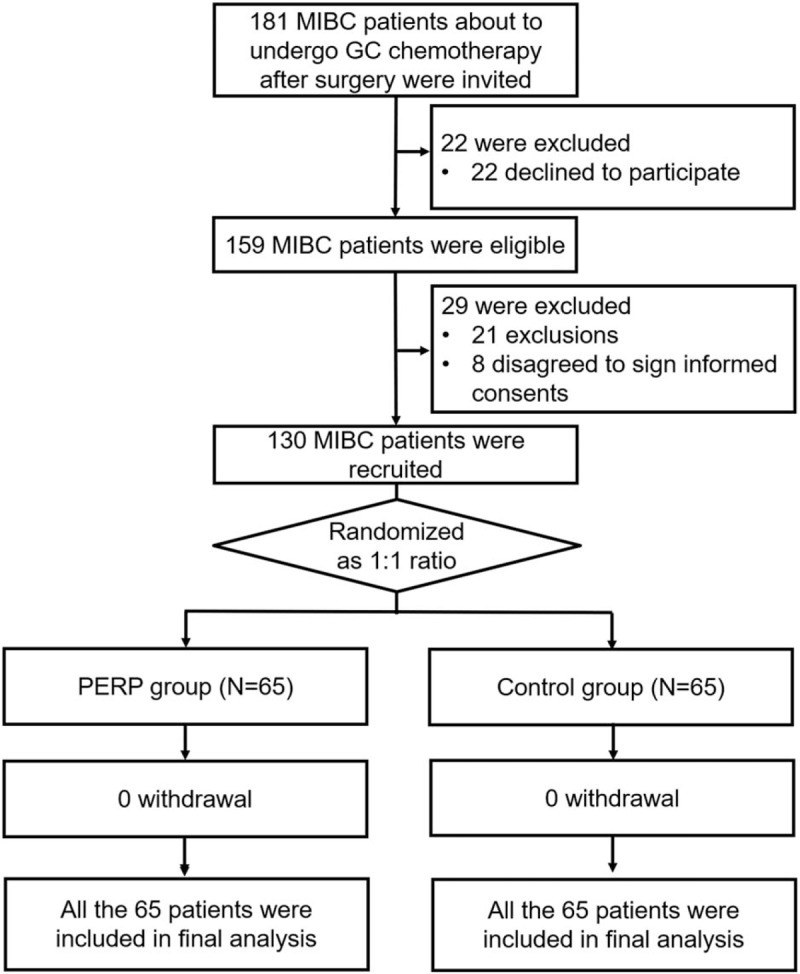
This study aimed to investigate the effect of a patient education and rehabilitation program (PERP) on anxiety, depression, and quality of life in muscle invasive bladder cancer (MIBC) patients underwent adjuvant chemotherapy. One hundred and thirty MIBC patients about to receive adjuvant chemotherapy with 4-cycle gemcitabine and cisplatin (GC) regimen (16 weeks) were consecutively enrolled and randomly allocated into PERP group and control group as 1:1 ratio. Hospital Anxiety and Depression Scale (HADS) anxiety and depression scores and Quality of Life Questionnaire (QLQ-C30) scores were assessed before treatment (W0) and after treatment (W16). After 16-week treatment, PERP group exhibited decreased HADS anxiety score (P = .036), ΔHADS anxiety score (W16-W0) (P < .001) and percentage of anxiety patients (P = .019) compared to control group. And PERP group presented with numerically reduced HADS depression score but without statistical significance (P = .076) compared to control group, while lower ΔHADS depression score (W16-W0) (P = .014) and percentage of depression patients (P = .015) compared to control group. As to quality of life, QLQ-C30 global health status score (P = .032), Δglobal health status score (W16-W0) (P = .003) and Δfunctional score (W16-W0) (P = .005) were higher in PERP group compared to control group. However, no difference of QLQ-C30 functional score (P = .103), QLQ-C30 symptom score (P = .808) or Δsymptom score (W16-W0) (P = .680) was observed between two groups. PERP relieves anxiety, depression and improves quality of life in MIBC patients underwent adjuvant chemotherapy.
Overview
The claims and statistics of this paper haven’t been checked yet.
Free: it reads the open-access text and checks the first 5 claims that cite a source we can check. Create a free account to check every claim.
Integrity signals
Registry
Cites
Statistics
Figures
Verification
Claims the paper makes
The claims and statistics of this paper haven’t been checked yet.
Free: it reads the open-access text and checks the first 5 claims that cite a source we can check. Create a free account to check every claim.
Self-check
Percentages, sums and reported differences re-computed from the paper’s own numbers.
The self-check needs the paper’s full text.
Citations
Cites
1 retracted
Psychotherapy for depression among incurable cancer patients
Akechi, T., Okuyama, T., Onishi, J., Morita, T., & Furukawa, T. A. (2008) · Cochrane Database of Systematic Reviews · doi:10.1002/14651858.cd005537.pub2 · Cited by 198 · cited 2×
“A previous meta-analysis reveals that mental and cognitive intervention is especially effective in reducing depression of cancer patients, and long-term observation shows that the 15year incidence of depression is lower and quality of life is better in intervention group compared with control group.([8]) Another inter…”
BackgroundRetractedThe Hospital Anxiety and Depression Scale
Zigmond, A. S., & Snaith, R. P. (1983) · Acta Psychiatrica Scandinavica · doi:10.1111/j.1600-0447.1983.tb09716.x · Cited by 47,139 · cited 1×
“According to the HADS-anxiety score and HADS-depression score, the severity of anxiety and depression was assessed as follows: 0–7, no anxiety/depression; 8–10, mild anxiety/depression; 11–14, moderate anxiety/depression; 15–21, severe anxiety/ depression.([12]) According to QLQ-C30 Scoring Manual, all scales and sing…”
MethodCancer statistics in China, 2015
Chen, W., Zheng, R., Baade, P. D., Zhang, S., Zeng, H., Bray, F., Jemal, A., Yu, X. Q., & He, J. (2016) · CA: A Cancer Journal for Clinicians · doi:10.3322/caac.21338 · Cited by 17,038
Depression and quality of life in older persons: A review
Sivertsen, H., Bjørkløf, G. H., Engedal, K., Selbæk, G., & Helvik, A.-S. (2015) · Dementia and Geriatric Cognitive Disorders · doi:10.1159/000437299 · Cited by 14,152
Kamat, A. M., Hahn, N. M., Efstathiou, J. A., Lerner, S. P., Malmström, P.-U., Choi, W., Guo, C. C., Lotan, Y., & Kassouf, W. (2016) · The Lancet · doi:10.1016/s0140-6736(16)30512-8 · Cited by 1,421 · cited 1×
“Muscle invasive bladder cancer (MIBC), accounting for 30% of all bladder cancer, is attracting great attention due to highmetastatic rate and mortality.([2]) The current treatment for MIBC is cystectomy with pelvic lymph node dissection (if there is lymph node metastasis), and adjuvant chemotherapy is used to consolid…”
BackgroundScreening for anxiety and depression: reassessing the utility of the Zung scales
Dunstan, D. A., Scott, N., & Todd, A. K. (2017) · BMC Psychiatry · doi:10.1186/s12888-017-1489-6 · Cited by 461 · cited 1×
“Hospital Anxiety and Depression Scale (HADS), SDS/SAS Zung Scale, and Hamilton scale are widely used assessments for emotional symptoms in various medical conditions.([14,15]) However, Hamilton anxiety scale is a psychological questionnaire used by clinicians with specific certification, and SDS/SAS Zung Scale contain…”
MethodA Systematic Review of Neoadjuvant and Adjuvant Chemotherapy for Muscle-invasive Bladder Cancer
Meeks, J. J., Bellmunt, J., Bochner, B. H., Clarke, N. W., Daneshmand, S., Galsky, M. D., Hahn, N. M., Lerner, S. P., Mason, M., Powles, T., et al. (2012) · European Urology · doi:10.1016/j.eururo.2012.05.048 · Cited by 247 · cited 1×
“The current treatment for MIBC is cystectomy with pelvic lymph node dissection (if there is lymph node metastasis), and adjuvant chemotherapy is used to consolidate the treatment and prevent recurrence.([3,4]) However, adjuvant chemotherapy often causes discomfort in patients that promotes the generation of anxiety an…”
BackgroundNelson, C. J., Cho, C., Berk, A. R., Holland, J., & Roth, A. J. (2010) · Journal of Clinical Oncology · doi:10.1200/jco.2009.23.0201 · Cited by 125 · cited 1×
“Hospital Anxiety and Depression Scale (HADS), SDS/SAS Zung Scale, and Hamilton scale are widely used assessments for emotional symptoms in various medical conditions.([14,15]) However, Hamilton anxiety scale is a psychological questionnaire used by clinicians with specific certification, and SDS/SAS Zung Scale contain…”
MethodSuicide in Stroke Survivors: Epidemiology and Prevention
Pompili, M., Venturini, P., Lamis, D. A., Giordano, G., Serafini, G., Murri, M. B., Amore, M., & Girardi, P. (2014) · Drugs & Aging · doi:10.1007/s40266-014-0233-x · Cited by 98 · cited 1×
“However, adjuvant chemotherapy often causes discomfort in patients that promotes the generation of anxiety and depression and reduces the quality of life of patients([5,6]) In addition, mood disorders such as depression and cognitive impairment are reported to be strong contributors to suicide intension.([7]) Therefor…”
BackgroundDo, J., Cho, Y., & Jeon, J. (2015) · Journal of Breast Cancer · doi:10.4048/jbc.2015.18.1.87 · Cited by 56 · cited 1×
“For instance, a four-week, multi-channel nursing project involving psychological intervention and physical rehabilitation alleviates the cancer-related symptoms of breast cancer patients, such as fatigue, pain, nausea, and postoperative muscle strength, and improves the quality of life.([9]) Another program that invol…”
BackgroundLee, Y.-H., Lai, G., Lee, D.-C., Lai, L.-J. T., & Chang, Y.-P. (2018) · Integrative Cancer Therapies · doi:10.1177/1534735418805149 · Cited by 47 · cited 1×
“Another program that involved both psychological and physical rehabilitation activities showed that cancer patients who received 12 weeks of rehabilitation care had higher quality of life indicators than the control group.([11]) In addition, an education program for patients with esophageal cancer also shows that acti…”
BackgroundDepression, Fatigue, and QoL in Colorectal Cancer Patients During and After Treatment
Tung, H., Chao, T., Lin, Y., Wu, S.-F., Lee, H.-Y., Ching, C.-Y., Hung, K.-W., & Lin, T.-J. (2016) · Western Journal of Nursing Research · doi:10.1177/0193945916630256 · Cited by 41 · cited 1×
“According to QLQ-C30 Scoring Manual, all scales and single-item measures were ranged score of 0–100, higher scores in the global health status scale and functional scale indicated better health state and function, while higher score in the symptoms scale indicated worse symptoms.([13])”
MethodKhazaee-Pool, M., Nadrian, H., & Pasha, N. (2012) · Gastroenterology Nursing · doi:10.1097/sga.0b013e3182605f86 · Cited by 35 · cited 1×
“In addition, an education program for patients with esophageal cancer also shows that active patient education and doctor-patient communication can significantly improve the quality of life.([10]) These comprehensive rehabilitation programs among different cancer patients all suggest that these programs can improve th…”
BackgroundPursuing Quality in the Application of Bladder Cancer Quality of Life Research
Mohamed, N., Gilbert, F., Lee, C. T., Sfakianos, J. P., Knauer, C. J., Mehrazin, R., Badr, H., Wittmann, D. A., Downs, T. M., Berry, D. L., et al. (2016) · Bladder Cancer · doi:10.3233/blc-160051 · Cited by 33 · cited 1×
“However, adjuvant chemotherapy often causes discomfort in patients that promotes the generation of anxiety and depression and reduces the quality of life of patients([5,6]) In addition, mood disorders such as depression and cognitive impairment are reported to be strong contributors to suicide intension.”
BackgroundSystematic Review: Depression and Anxiety Prevalence in Bladder Cancer Patients
Vartolomei, L., Ferro, M., Mirone, V., Shariat, S. F., & Vartolomei, M. D. (2018) · Bladder Cancer · doi:10.3233/blc-180181 · Cited by 33 · cited 1×
“However, adjuvant chemotherapy often causes discomfort in patients that promotes the generation of anxiety and depression and reduces the quality of life of patients([5,6]) In addition, mood disorders such as depression and cognitive impairment are reported to be strong contributors to suicide intension.”
BackgroundSjamsudin, E., Maulina, T., Cipta, A., Iskandarsyah, A., Hardianto, A., Nandini, M., Kasim, A., & Yusuf, H. Y. (2018) · Oral and Maxillofacial Surgery · doi:10.1007/s10006-018-0672-3 · Cited by 23 · cited 1×
“Cancer and its treatment not only causes anxiety and depression, but also have a huge impact on patients’ life, which also makes the quality of life of cancer survivors become another important indicator of cancer management and is included in the evaluation for the efficacy of some postoperative rehabilitation nursin…”
BackgroundPark, J., Shin, D. W., Kim, T., Jung, S. I., Nam, J. K., Park, S. C., Hong, S., Jung, J. H., Kim, H.-W., & Kim, W. T. (2017) · Cancer Research and Treatment · doi:10.4143/crt.2016.594 · Cited by 21 · cited 1×
“The reason was that this was a multidimensional instrument for quality of life measurement specifically in cancer patients, and has been widely applied by various clinical trials in cancer field.([16]) A previous meta-analysis reveals that mental and cognitive intervention is especially effective in reducing depressio…”
BackgroundBuscariollo, D. L., Cronin, A. M., Borstelmann, N. A., & Punglia, R. S. (2018) · Breast Cancer Research and Treatment · doi:10.1007/s10549-018-5006-5 · Cited by 20 · cited 1×
“Cancer and its treatment not only causes anxiety and depression, but also have a huge impact on patients’ life, which also makes the quality of life of cancer survivors become another important indicator of cancer management and is included in the evaluation for the efficacy of some postoperative rehabilitation nursin…”
BackgroundKarageorge, A., Murphy, M. J., Newby, J. M., Kirsten, L., Andrews, G., Allison, K., Loughnan, S., Price, M., Shaw, J., Shepherd, H., et al. (2017) · Supportive Care in Cancer · doi:10.1007/s00520-017-3617-8 · Cited by 17 · cited 1×
“5 the anxiety and depression levels of early breast cancer patients who participated in the psychological intervention were improved, and their cooperation in the project were very high.([17]) These studies suggest that education and rehabilitation programs improve anxiety and depression in cancer patients.”
BackgroundShimizu, F., Muto, S., Taguri, M., Ieda, T., Tsujimura, A., Sakamoto, Y., Fujita, K., Okegawa, T., Yamaguchi, R., & Horie, S. (2017) · International Journal of Urology · doi:10.1111/iju.13324 · Cited by 9 · cited 1×
“The current treatment for MIBC is cystectomy with pelvic lymph node dissection (if there is lymph node metastasis), and adjuvant chemotherapy is used to consolidate the treatment and prevent recurrence.([3,4]) However, adjuvant chemotherapy often causes discomfort in patients that promotes the generation of anxiety an…”
Background
Cited by
Management of Anxiety and Depression in Adult Survivors of Cancer: ASCO Guideline Update
Andersen, B. L., Lacchetti, C., Ashing, K., Berek, J. S., Berman, B. S., Bolte, S., Dizon, D. S., Given, B., Nekhlyudov, L., Pirl, W., et al. (2023) · Journal of Clinical Oncology · doi:10.1200/jco.23.00293 · Cited by 318
Thomsen, S. N., Lahart, I. M., Thomsen, L. M., Fridh, M. K., Larsen, A. T. S., Mau‐Sørensen, M., Bolam, K. A., Fairman, C. M., Christensen, J. F., & Simonsen, C. (2023) · EClinicalMedicine · doi:10.1016/j.eclinm.2023.101937 · Cited by 67
Liu, P., & Wang, Z. (2022) · Medicine · doi:10.1097/md.0000000000028765 · Cited by 44
“[18,19] In terms of the in fl uence of anxiety and depression on survival in cancer patients, several studies report that preoperative anxiety and depression are related to worse survival in patients with various cancers (including colorectal cancer [20] and lung cancer [21] ).”
BackgroundZhu, L., Tong, Y. X., Xu, X. S., Xiao, A. T., Zhang, Y. J., & Zhang, S. (2020) · Supportive Care in Cancer · doi:10.1007/s00520-020-05333-z · Cited by 44
Lamb, L. R., Baird, G. L., Roy, I. T., Choi, P., Lehman, C. D., & Miles, R. C. (2021) · The Breast · doi:10.1016/j.breast.2021.11.012 · Cited by 36
Metadata
- Authors
- Li, Z., Wei, D., Zhu, C., & Zhang, Q.
- Affiliations
- Department of Urology Surgery
- Central Hospital of Wuhan (CN)
- Corresponding author
- Zhang, Qing
- Venue
- Medicine
- Published
- 2019-11
- Volume
- 98
- Issue
- 44
- Pages
- e17437
- ISSN
- 0025-7974 (ISSN-L)
- 1536-5964
- PMC
- PMC6946406
- OpenAlex
- W2983929401
- Semantic Scholar
- d488a2176a54e9bc51b66eb7627c8c69651c7f06
- Cited by
- 27
- References
- 20
- Citations by year
- 2026: 4 · 2025: 3 · 2024: 4 · 2023: 2 · 2022: 7 · 2021: 5 · 2020: 2
- FWCI
- 1.46
- Type
- journal article
- Language
- en
- Open access
- gold
- doi.org
- Locations
- Medicine (publishedVersion, cc-by)
- PubMed Central (publishedVersion, cc-by)
- PubMed (publishedVersion)
- Topics
- Health Sciences › Medicine › Oncology › Cancer survivorship and care
- Health Sciences › Medicine › Surgery › Bladder and Urothelial Cancer Treatments
- Health Sciences › Medicine › Cardiology and Cardiovascular Medicine › Cardiac Health and Mental Health
- Keywords
- muscle-invasive bladder cancer, adjuvant chemotherapy, patient education, rehabilitation programs, anxiety, depression, quality of life, gemcitabine, cisplatin
- MeSH terms
- Adult, Age Factors, Aged, Antineoplastic Combined Chemotherapy Protocols, Anxiety, Urinary Bladder Neoplasms, China, Depression, Female, Health Status, Humans, Male, Middle Aged, Neoplasm Invasiveness, Patient Education as Topic, Quality of Life, Socioeconomic Factors, Health Behavior, Comorbidity, Body Mass Index, Chemotherapy, Adjuvant
About these checks
Registry, retraction, Cites and statistics results are computed, not judged, with one exception: a printed reference that no index lists is read once by a model before it counts as a citation error. Claims are extracted by a model and kept only when their quote appears verbatim in the text; each cited source is then checked, with a model’s help, for whether it says what the claim relies on. Those verdicts can be wrong — read the claim’s quote and the cited source before relying on one.
Statistics and arithmetic are recomputed, not judged.
Confidence bands are shown only for fields calibrated on our annotated test set. None is calibrated yet, so no band is shown.
What counts as a claim ›How we measure confidence ›How we check this ›
Are you an author, or do you see a problem with this page? Request a review
Data sources
Bibliographic data: Semantic Scholar, OpenAlex, Crossref.
Contains information from the Semantic Scholar Academic Graph Datasets, made available under the ODC Attribution License (ODC-BY 1.0).
Semantic Scholar’s data is described in: Kinney, R., et al. (2023). The Semantic Scholar Open Data Platform. arXiv:2301.10140.
