

Effectiveness of empowerment-based intervention on HbA1c and self-efficacy among cases with type 2 diabetes mellitus: A meta-analysis of randomized controlled trials
Open accessThe DOI matches its Crossref record, with a small difference in title or year; 36 of the 36 references it cites were found in a registry or an index.
Abstract
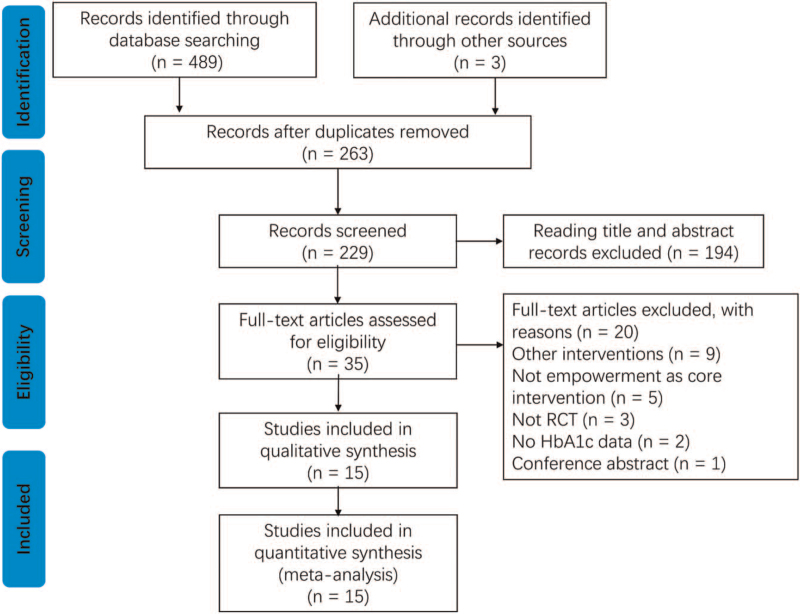
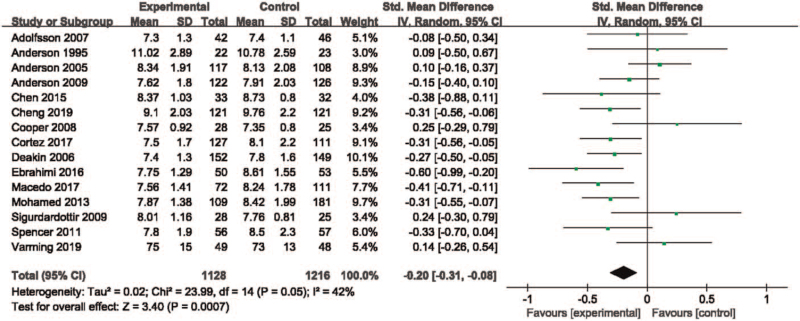
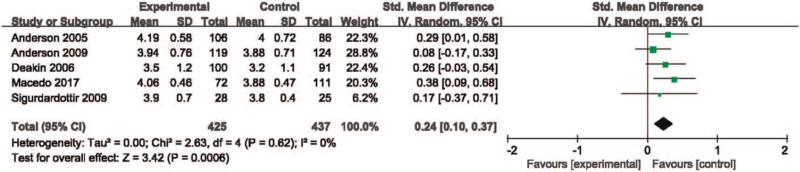
Objective: The aim of this study was to determine the effect of empowerment-based interventions on glucose metabolism control and psychosocial self-efficacy in people with type 2 diabetes mellitus (T2DM). Methods: The Cochrane Library, Embase, PubMed, and Web of Science electronic databases were searched up to 22 February 2021 for randomized controlled trials (RCTs) that evaluated the effectiveness of empowerment-based intervention versus conventional treatment in type 2 diabetes cases. At least two investigators independently screened the literature, extracted data and evaluated the methodological quality. We calculated the pooled effect size using the mean difference (MD) or standard mean difference (SMD) with 95% confidence intervals (CIs) through RevMan V 5.4.1. Results: Fifteen randomized controlled trials (RCTs) were eligible for inclusion in the present study. A total of 2344 adults (1128 in the intervention groups and 1216 in the control) were covered. Five of these studies involved 671 cases of psychosocial self-efficacy, and 4 studies included 622 cases of diabetes knowledge. The meta-analysis showed that compared to routine care, empowerment-based intervention was associated with reduced glycated hemoglobin levels (SMD −0.20; 95% CI −0.31 to −0.08; Z = 3.40, P < .001, I 2 = 42%), increased diabetes empowerment scores (SMD 0.24; 95% CI 0.10–0.37; Z = 3.42, P < .001, I 2 = 0%), and increased diabetes knowledge scores (SMD 0.96; 95% CI 0.55–1.36; Z = 4.61, P < .001, I 2 = 80%). Conclusions: Empowerment-based intervention in adults with T2DM results in improvements in glycated hemoglobin, psychosocial self-efficacy and diabetes knowledge.
Overview
The claims and statistics of this paper haven’t been checked yet.
Free: it reads the open-access text and checks the first 5 claims that cite a source we can check. Create a free account to check every claim.
Integrity signals
Registry
Cites
Statistics
Figures

Verification
Claims the paper makes
The claims and statistics of this paper haven’t been checked yet.
Free: it reads the open-access text and checks the first 5 claims that cite a source we can check. Create a free account to check every claim.
Claims other papers make about this one
Each is checked against this paper’s own text: does it say what the citing paper says it does?
In the citing paper
“Structured education programmes are recommended in patients with diabetes to improve diabetes knowledge, glycaemic control, disease management, and patient empowerment.”
From 2023 ESC guidelines for the management of cardiovascular disease in patients with diabetes. (2023) · cites this paper as [811]
Self-check
Percentages, sums and reported differences re-computed from the paper’s own numbers.
The self-check needs the paper’s full text.
Citations
Cites
Measuring inconsistency in meta-analyses
Higgins, J. P. T., Thompson, S. G., Deeks, J. J., & Altman, D. G. (2003) · BMJ · doi:10.1136/bmj.327.7414.557 · Cited by 63,139
Liberati, A., Altman, D. G., Tetzlaff, J., Mulrow, C., Gøtzsche, P. C., Ioannidis, J. P. A., Clarke, M., Devereaux, P. J., Kleijnen, J., & Moher, D. (2009) · PLoS Medicine · doi:10.1371/journal.pmed.1000100 · Cited by 28,164
Liberati, A., Altman, D. G., Tetzlaff, J., Mulrow, C., Gøtzsche, P. C., Ioannidis, J. P. A., Clarke, M., Devereaux, P. J., Kleijnen, J., & Moher, D. (2009) · Annals of Internal Medicine · doi:10.7326/0003-4819-151-4-200908180-00136 · Cited by 10,349
Stratton, I. M. (2000) · BMJ · doi:10.1136/bmj.321.7258.405 · Cited by 9,059 · cited 1×
“8 related death and 37% for microvascular complications over 10 years.([28]) The ideal HbA1c level can be achieved through a”
BackgroundIDF Diabetes Atlas: Global estimates of diabetes prevalence for 2017 and projections for 2045
Cho, N. H., Shaw, J. E., Karuranga, S., Huang, Y., da Rocha Fernandes, J. D., Ohlrogge, A. W., & Malanda, B. (2018) · Diabetes Research and Clinical Practice · doi:10.1016/j.diabres.2018.02.023 · Cited by 7,283 · cited 1×
“The prevalence of T2DM is rapidly increasing worldwide, leading to increased health care costs and mortality and reduced quality of life.([2]) Individuals with diabetes usually provide 95% or more of the daily care by themselves.”
BackgroundPatient empowerment: myths and misconceptions
Anderson, R. M., & Funnell, M. M. (2010) · Patient Education and Counseling · doi:10.1016/j.pec.2009.07.025 · Cited by 846
Patient Empowerment: Results of a randomized controlled trial
Anderson, R. M., Funnell, M. M., Butler, P. M., Arnold, M. S., Fitzgerald, J. T., & Feste, C. C. (1995) · Diabetes Care · doi:10.2337/diacare.18.7.943 · Cited by 809
Approved IFCC reference method for the measurement of HbA1c in human blood
Jeppsson, J.-O., Kobold, U., Barr, J., Finke, A., Hoelzel, W., Hoshino, T., Miedema, K., Mosca, A., Mauri, P., Paroni, R., et al. (2002) · Clinical Chemistry and Laboratory Medicine · doi:10.1515/cclm.2002.016 · Cited by 655 · cited 1×
“blood glucose, capturing the average glycemia during the previous 6 to 8weeks.([27]) Each 1% reduction in HbA1c levels is associated with reductions in the risk of 21% for diabetes-”
BackgroundThe Diabetes Empowerment Scale: a measure of psychosocial self-efficacy.
Anderson, R. M., Funnell, M. M., Fitzgerald, J. T., & Marrero, D. G. (2000) · Diabetes Care · doi:10.2337/diacare.23.6.739 · Cited by 568
4. Lifestyle Management: Standards of Medical Care in Diabetes—2018
American Diabetes Association (2018) · Diabetes Care · doi:10.2337/dc18-s004 · Cited by 563 · cited 1×
“healthy diet, physical activity, health education and selfmonitoring of blood sugar, not solely medication.([29]) Therefore, we conceived that if individuals were able to reduceHbA1c levels,”
BackgroundEmpowerment: An Idea Whose Time Has Come in Diabetes Education
Funnell, M. M., Anderson, R. M., Arnold, M. S., Barr, P. A., Donnelly, M., Johnson, P. D., Taylor-Moon, D., & White, N. H. (1991) · The Diabetes Educator · doi:10.1177/014572179101700108 · Cited by 516
Does blinding of readers affect the results of meta-analyses?
Berlin, J. A. (1997) · The Lancet · doi:10.1016/s0140-6736(05)62352-5 · Cited by 478 · cited 1×
“Since there was no evidence that blinding could reduce bias in the process of systematic reviews and meta-analysis, extraction was not blinded to the author or institution.([23]) Data were abstracted on the studies, sample size, participant characteristics, empowerment-based intervention (eg, content and duration), ou…”
BackgroundConceptualising patient empowerment: a mixed methods study
Bravo, P., Edwards, A., Barr, P. J., Scholl, I., Elwyn, G., McAllister, M., & the Cochrane Healthcare Quality Research Group, C. U. (2015) · BMC Health Services Research · doi:10.1186/s12913-015-0907-z · Cited by 423
The Diabetes Empowerment Scale-Short Form (DES-SF)
Anderson, R. M., Fitzgerald, J. T., Gruppen, L. D., Funnell, M. M., & Oh, M. S. (2003) · Diabetes Care · doi:10.2337/diacare.26.5.1641-a · Cited by 387
Structured patient education: the Diabetes X‐PERT Programme makes a difference
Deakin, T. A., Cade, J. E., Williams, R., & Greenwood, D. C. (2006) · Diabetic Medicine · doi:10.1111/j.1464-5491.2006.01906.x · Cited by 374
Spencer, M. S., Rosland, A.-M., Kieffer, E. C., Sinco, B. R., Valerio, M., Palmisano, G., Anderson, M., Guzman, J. R., & Heisler, M. (2011) · American Journal of Public Health · doi:10.2105/ajph.2010.300106 · Cited by 357
Compliance and Adherence are Dysfunctional Concepts in Diabetes Care
Anderson, R. M., & Funnell, M. M. (2000) · The Diabetes Educator · doi:10.1177/014572170002600405 · Cited by 232
Patient Empowerment and the Traditional Medical Model: A case of irreconcilable differences?
Anderson, R. M. (1995) · Diabetes Care · doi:10.2337/diacare.18.3.412 · Cited by 216
Self-management support in “real-world” settings: an empowerment-based intervention
Tang, T. S., Funnell, M. M., Brown, M. B., & Kurlander, J. E. (2010) · Patient Education and Counseling · doi:10.1016/j.pec.2009.09.029 · Cited by 178 · cited 8×
“[1,3,9–15] However, other studies have not found the same results using an empowerment approach in T2DM.”
BackgroundInfluentialAnderson, R. M., Funnell, M. M., Nwankwo, R. B., Gillard, M. L., Oh, M. S., & Fitzgerald, J. T. (2005) · PubMed · doi:10.13016/k9xj-wze8 · Cited by 139
Zhao, F., Suhonen, R., Koskinen, S., & Leino‐Kilpi, H. (2017) · Journal of Advanced Nursing · doi:10.1111/jan.13163 · Cited by 125
Anderson, R. M., Funnell, M. M., Aikens, J. E., Krein, S. L., Fitzgerald, J. T., Nwankwo, R., Tannas, C. L., & Tang, T. S. (2009) · Education thérapeutique du patient - Therapeutic patient education · doi:10.1051/tpe/2009002 · Cited by 117
Developing a New Generation of Ongoing Diabetes Self-management Support Interventions
Tang, T. S., Gillard, M. L., Funnell, M. M., Nwankwo, R., Parker, E., Spurlock, D., & Anderson, R. M. (2005) · The Diabetes Educator · doi:10.1177/0145721704273231 · Cited by 107
Mohamed, H., Lenjawi, B. A., Amuna, P., Zotor, F. B., & Elmahdi, H. (2013) · Primary care diabetes · doi:10.1016/j.pcd.2013.05.002 · Cited by 98
Cortez, D. N., Macêdo, M. M. L., Souza, D. A. S., dos Santos, J. C., Afonso, G. D. S., Reis, I. A., & Torres, H. D. C. (2017) · BMC Public Health · doi:10.1186/s12889-016-3937-5 · Cited by 95
A trial of empowerment-based education in type 2 diabetes—Global rather than glycaemic benefits
Cooper, H., Booth, K., & Gill, G. V. (2008) · Diabetes Research and Clinical Practice · doi:10.1016/j.diabres.2008.07.013 · Cited by 92
Patient education in type 2 diabetes—A randomized controlled 1-year follow-up study
Adolfsson, E. T., Walker-Engström, M.-L., Smide, B., & Wikblad, K. (2007) · Diabetes Research and Clinical Practice · doi:10.1016/j.diabres.2006.09.018 · Cited by 89
Cheng, L., Sit, J. W. H., Choi, K.-C., Chair, S.-Y., Li, X., Wu, Y., Long, J., & Yang, H. (2021) · International Journal of Nursing Studies · doi:10.1016/j.ijnurstu.2019.103407 · Cited by 82
Baldoni, N. R., Aquino, J. A., Sanches, C., Oliveira, C. D. L., de Figueiredo, R. C., Cardoso, C. S., Santos, T. R., Alves, G. C. D. S., Fabbro, A. L. D., & Baldoni, A. O. (2016) · Primary care diabetes · doi:10.1016/j.pcd.2016.09.006 · Cited by 63
Ebrahimi, H., Sadeghi, M., Amanpour, F., & Vahedi, H. (2016) · Primary care diabetes · doi:10.1016/j.pcd.2015.09.003 · Cited by 61
Aquino, J. A., Baldoni, N. R., Flôr, C. R., Sanches, C., Di Lorenzo Oliveira, C., Alves, G. C. S., Fabbro, A. L. D., & Baldoni, A. O. (2018) · Primary Care Diabetes · doi:10.1016/j.pcd.2017.10.004 · Cited by 51
Instruments to tailor care of people with type 2 diabetes
Sigurdardottir, A. K., Benediktsson, R., & Jonsdottir, H. (2009) · Journal of Advanced Nursing · doi:10.1111/j.1365-2648.2009.05040.x · Cited by 46
Chen, M.-F., Wang, R., Lin, K., Hsu, H., & Chen, S. (2015) · Applied Nursing Research · doi:10.1016/j.apnr.2014.12.006 · Cited by 46
Macêdo, M. M. L., Cortez, D. N., dos Santos, J. C., Reis, I. A., & Torres, H. D. C. (2017) · Revista da Escola de Enfermagem da USP · doi:10.1590/s1980-220x2016050303278 · Cited by 40
Varming, A. R., Rasmussen, L. B., Husted, G. R., Olesen, K., Grønnegaard, C., & Willaing, I. (2019) · Patient Education and Counseling · doi:10.1016/j.pec.2019.06.014 · Cited by 35
Informal Diabetes Education: Impact on Self-Management and Blood Glucose Control
Gillard, M. L., Nwankwo, R. B., Fitzgerald, J. T., Oh, M. S., Musch, D. C., Johnson, M. W., & Anderson, R. M. (2004) · The Science of Diabetes Self-Management and Care · doi:10.1177/014572170403000121 · Cited by 10
Cited by
2023 ESC guidelines for the management of cardiovascular disease in patients with diabetes.
Marx, N., Federici, M., Schütt, K., Müller-Wieland, D., Ajjan, R. A., Antunes, M. J., Christodorescu, R. M., Crawford, C., Di Angelantonio, E., Eliasson, B., et al. (2023) · European Heart Journal · doi:10.1093/eurheartj/ehad192 · Cited by 1,642
Shaban, M. M., Sharaa, H. M., Amer, F. G. M., & Shaban, M. (2024) · BMC Nursing · doi:10.1186/s12912-024-01787-2 · Cited by 86
Raghav, S., Kumar, S., Ashraf, H., & Khanna, P. (2025) · Frontiers in Public Health · doi:10.3389/fpubh.2025.1571546 · Cited by 53
The Influence of Nursing Interventions on Patient Outcomes: A Systematic Review
Jarelnape, A. A., Ali, Z. T., Fadlala, A. A., Sagiron, E. I., Osman, A. M., Idress, E. A., Balola, H. H., & Albagawi, B. S. (2023) · Saudi Journal of Health Systems Research · doi:10.1159/000534482 · Cited by 40
Ibrahim, A. M., Gano, F. A. E. L., Abdel‐Aziz, H. R., Elneblawi, N. H., Zaghamir, D. E. F., Negm, L. M. M. A., Sweelam, R. K., Ahmed, S. I., Mohamed, H. A. O., Hassabelnaby, F. G. E., et al. (2024) · BMC Nursing · doi:10.1186/s12912-024-02573-w · Cited by 29
Metadata
- Authors
- Chen, Y., Tian, Y., Sun, X., Wang, B., & Huang, X.
- Affiliations
- School of Public Administration, Tianjin Vocational Institute, Tianjin, China
- Tianjin University of Traditional Chinese Medicine (CN)
- Tianjin Medical University General Hospital (CN)
- Tianjin Medical College (CN)
- Tianjin Medical University (CN)
- Venue
- Medicine
- Published
- 2021-09-24
- Volume
- 100
- Issue
- 38
- Pages
- e27353
- ISSN
- 0025-7974 (ISSN-L)
- 1536-5964
- PMC
- PMC8462639
- OpenAlex
- W3199453009
- Cited by
- 26
- References
- 36
- Citations by year
- 2026: 7 · 2025: 5 · 2024: 9 · 2023: 4 · 2022: 1
- FWCI
- 0.54
- Type
- journal article
- Language
- en
- Open access
- gold
- doi.org
- Licence
- Locations
- Medicine (publishedVersion, cc-by-nc)
- Europe PMC (PubMed Central) (publishedVersion, other-oa)
- PubMed Central (publishedVersion, cc-by-nc)
- PubMed (publishedVersion)
- Funders
- the School Fund Project of Tianjin Vocational Institute (20162114)
- Topics
- Health Sciences › Medicine › Endocrinology, Diabetes and Metabolism › Diabetes Management and Education
- Health Sciences › Medicine › Endocrinology, Diabetes and Metabolism › Diabetes Treatment and Management
- Health Sciences › Medicine › Endocrinology, Diabetes and Metabolism › Diabetes Management and Research
- Keywords
- type 2 diabetes, HbA1c, diabetes knowledge, patient empowerment
- MeSH terms
- Empowerment, Diabetes Mellitus, Type 2, Glycated Hemoglobin, Humans, Health Knowledge, Attitudes, Practice, Patient Education as Topic, Patient Participation, Randomized Controlled Trials as Topic, Self Efficacy
About these checks
Registry, retraction, Cites and statistics results are computed, not judged, with one exception: a printed reference that no index lists is read once by a model before it counts as a citation error. Claims are extracted by a model and kept only when their quote appears verbatim in the text; each cited source is then checked, with a model’s help, for whether it says what the claim relies on. Those verdicts can be wrong — read the claim’s quote and the cited source before relying on one.
Statistics and arithmetic are recomputed, not judged.
Confidence bands are shown only for fields calibrated on our annotated test set. None is calibrated yet, so no band is shown.
What counts as a claim ›How we measure confidence ›How we check this ›
Are you an author, or do you see a problem with this page? Request a review
Data sources
Bibliographic data: Semantic Scholar, OpenAlex, Crossref.
Contains information from the Semantic Scholar Academic Graph Datasets, made available under the ODC Attribution License (ODC-BY 1.0).
Semantic Scholar’s data is described in: Kinney, R., et al. (2023). The Semantic Scholar Open Data Platform. arXiv:2301.10140.
