

Efficacy and safety of vortioxetine (Lu AA21004), 15 and 20 mg/day: a randomized, double-blind, placebo-controlled, duloxetine-referenced study in the acute treatment of adult patients with major depressive disorder
Open accessThe DOI matches its Crossref record, with a small difference in title or year; 33 of the 34 references it cites were found in a registry or an index.
Abstract
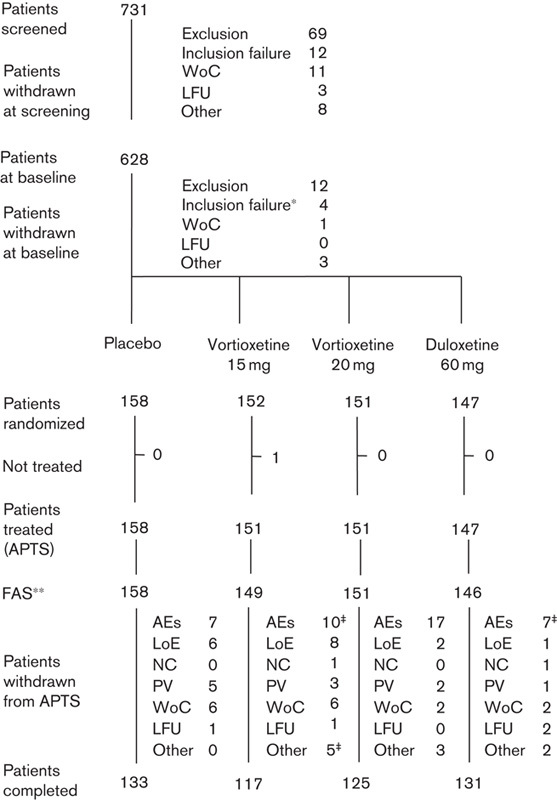
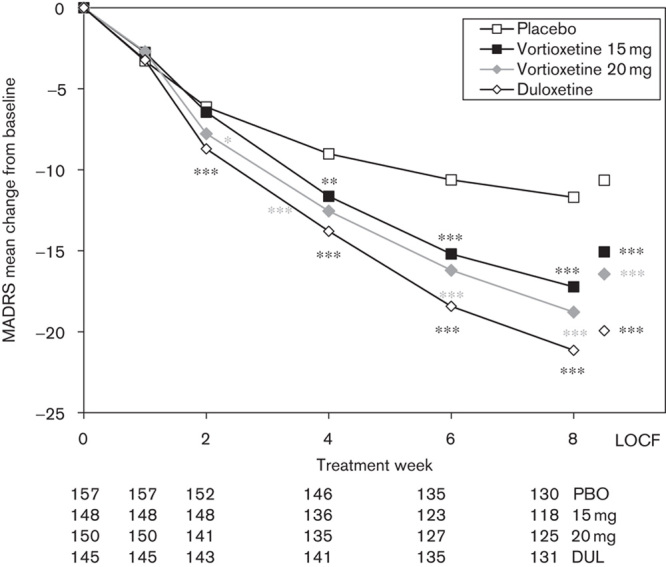
This study assessed the efficacy, tolerability and safety of vortioxetine versus placebo in adults with recurrent major depressive disorder. This double-blind, randomized, placebo-controlled study included 608 patients [Montgomery-Åsberg Depression Rating Scale (MADRS) total score ≥ 26 and Clinical Global Impression - Severity score ≥ 4]. Patients were randomly assigned (1 : 1 : 1 : 1) to vortioxetine 15 mg/day, vortioxetine 20 mg/day, duloxetine 60 mg/day or placebo. The primary efficacy endpoint was change from baseline in MADRS total score at week 8 (mixed model for repeated measurements). Key secondary endpoints were: MADRS responders; Clinical Global Impression - Improvement scale score; MADRS total score in patients with baseline Hamilton Anxiety Rating Scale ≥ 20; remission (MADRS ≤ 10); and Sheehan Disability Scale total score at week 8. On the primary efficacy endpoint, both vortioxetine doses were statistically significantly superior to placebo, with a mean difference to placebo (n = 158) of -5.5 (vortioxetine 15 mg, P < 0.0001, n = 149) and -7.1 MADRS points (vortioxetine 20 mg, P < 0.0001, n = 151). Duloxetine (n = 146) separated from placebo, thus validating the study. In all key secondary analyses, both vortioxetine doses were statistically significantly superior to placebo. Vortioxetine treatment was well tolerated; common adverse events (incidence ≥ 5%) were nausea, headache, diarrhea, dry mouth and dizziness. No clinically relevant changes were seen in clinical safety laboratory values, weight, ECG or vital signs parameters. Vortioxetine was efficacious and well tolerated in the treatment of patients with major depressive disorder.
Overview
The claims and statistics of this paper haven’t been checked yet.
Free: it reads the open-access text and checks the first 5 claims that cite a source we can check. Create a free account to check every claim.
Integrity signals
Registry
Cites
Statistics
Figures
Verification
Claims the paper makes
The claims and statistics of this paper haven’t been checked yet.
Free: it reads the open-access text and checks the first 5 claims that cite a source we can check. Create a free account to check every claim.
Claims other papers make about this one
Each is checked against this paper’s own text: does it say what the citing paper says it does?
The source backs part of the claim, not all of it — or backs it for a different population, condition or comparison.
In the citing paper
“Vortioxetine 20 mg has been shown to be significantly superior to placebo on multiple depression endpoints (MADRS total score, response rate, CGI-I, SDS, and MADRS in patients with high baseline HAM-A) after 8 weeks of treatment in two other studies, one conducted in the USA and the other conducted outside of the USA”
From A randomized, double-blind, duloxetine-referenced study comparing efficacy and tolerability of 2 fixed doses of vortioxetine in the acute treatment of adults with MDD (2015) · cites this paper as Boulenger et al. 2014
Experimental — accuracy not yet measuredThe cited source says what the claim attributes to it.
In the citing paper
“this dose did demonstrate statistically significant improvement over placebo in a previous study conducted outside of the USA”
From A randomized, double-blind, duloxetine-referenced study comparing efficacy and tolerability of 2 fixed doses of vortioxetine in the acute treatment of adults with MDD (2015) · cites this paper as Boulenger et al. 2014
The cited source says what the claim attributes to it.
In the citing paper
“Vortioxetine (1-[2-(2,4-dimethyl-phenylsulfanyl)-phenyl]-piperazine-hydrobromide, Lu AA21004) is a novel antidepressant that has demonstrated efficacy in doses up to 20 mg/d in short-term studies of 6–8 wk duration in adult patients with MDD (Alvarez et al., 2012; Henigsberg et al., 2012; Boulenger et al., 2014).”
From A randomized, double-blind, placebo-controlled study of vortioxetine on cognitive function in depressed adults (2014) · cites this paper as Boulenger et al., 2014
Self-check
Percentages, sums and reported differences re-computed from the paper’s own numbers.
The self-check needs the paper’s full text.
Citations
Cites
A new depression scale designed to be sensitive to change
Montgomery, S. A., & Åsberg, M. (1979) · British Journal of Psychiatry · doi:10.1192/bjp.134.4.382 · Cited by 13,962 · cited 1×
“The primary endpoint was the change from baseline in Montgomery–Åsberg Depression Rating Scale (MADRS) (Montgomery and Åsberg, 1979) total score as primary endpoint after 8 weeks of treatment.”
MethodThe assessment of anxiety states by rating
HAMILTON, M. (1959) · British Journal of Medical Psychology · doi:10.1111/j.2044-8341.1959.tb00467.x · Cited by 11,455
(1976) · Medical Entomology and Zoology · Cited by 8,899
Lecrubier, Y., Sheehan, D., Weiller, E., Amorim, P., Bonora, I., Sheehan, K. H., Janavs, J., & Dunbar, G. (1997) · European Psychiatry · doi:10.1016/s0924-9338(97)83296-8 · Cited by 3,513 · cited 2×
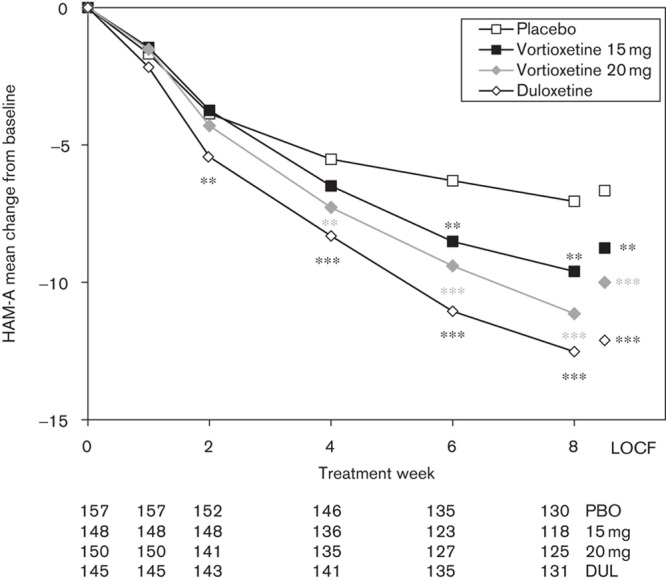
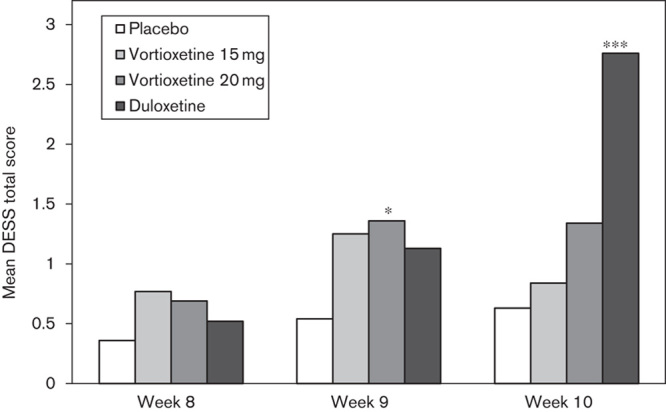
“All the raters underwent formal training in the MADRS and the Mini International Neuropsychiatric Interview, and the scoring conventions for the CGI, the Hamilton Anxiety Rating Scale (HAM-A) (Hamilton, 1959) and the Discontinuation-Emergent Signs and Symptoms checklist (DESS) (Rosenbaum et al., 1998) to maximize inte…”
MethodThe functioning and well-being of depressed patients. Results from the Medical Outcomes Study
Wells, K. B. (1989) · JAMA · doi:10.1001/jama.262.7.914 · Cited by 2,808
The Functioning and Well-being of Depressed Patients: Results From the Medical Outcomes Study
Wells, K. B. (1989) · JAMA · doi:10.1001/jama.1989.03430070062031 · Cited by 2,130
Antidepressant Drug Effects and Depression Severity: A Patient-Level Meta-analysis
Fournier, J. C., DeRubeis, R. J., Hollon, S. D., Dimidjian, S., Amsterdam, J. D., Shelton, R. C., & Fawcett, J. (2010) · JAMA · doi:10.1001/jama.2009.1943 · Cited by 2,009
(1993) · PubMed · Cited by 1,900
Sheehan, D. V., Harnett-Sheehan, K., & Raj, B. A. (1996) · International Clinical Psychopharmacology · doi:10.1097/00004850-199606003-00015 · Cited by 1,440
The Medical Dictionary for Regulatory Activities (MedDRA)
Brown, E. G., Wood, L., & Wood, S. (1999) · Drug Safety · doi:10.2165/00002018-199920020-00002 · Cited by 1,390
Cited by
Items 101–200 of 203
Schneider, C., Breilmann, J., Reuter, B., Becker, T. M., & Kösters, M. (2021) · Acta Psychiatrica Scandinavica · doi:10.1111/acps.13293 · Cited by 14
Carlo, V. D., Vismara, M. E. M., Grancini, B. M., Benatti, B., Bosi, M. F., Colombo, A., Viganò, C. A., & Dell’Osso, B. M. (2020) · Human Psychopharmacology Clinical and Experimental · doi:10.1002/hup.2750 · Cited by 14
Ratajczak, P., Kus, K., Zaprutko, T., Szczepański, M., Rusowicz, S., & Nowakowska, E. (2019) · Acta Neurobiologiae Experimentalis · doi:10.21307/ane-2019-002 · Cited by 13
He, H., Wang, W., Lyu, J., Zheng, J., Guo, L., An, X., Fan, Y., & Ma, X. (2017) · Journal of Psychiatric Research · doi:10.1016/j.jpsychires.2017.10.018 · Cited by 13
Vortioxetine overdose in a suicidal attempt: A case report
Mazza, M. G., Rossetti, A., Botti, R. E., & Clerici, M. (2018) · Medicine · doi:10.1097/md.0000000000010788 · Cited by 13
Kremer, S., Wiesinger, T., Bschor, T., & Baethge, C. (2023) · Psychotherapy and Psychosomatics · doi:10.1159/000533494 · Cited by 12
Depression and Cerebrovascular Disease: Could Vortioxetine Represent a Valid Treatment Option?
Carta, M. G., Pala, A. N., Finco, G., Musu, M., & Moro, M. F. (2015) · Clinical Practice and Epidemiology in Mental Health · doi:10.2174/1745017901511010144 · Cited by 12
Vortioxetina nel trattamento della depressione maggiore
de Bartolomeis, A., Fagiolini, A. M., & Maina, G. (2016) · Rivista di psichiatria · doi:10.1708/2596.26720 · Cited by 13
Zhang, Y., Lai, S., Zhang, J., Wang, Y., Zhao, H., He, J., Huang, D., Chen, G., Qi, Z., Chen, P., et al. (2024) · Journal of Affective Disorders · doi:10.1016/j.jad.2024.01.272 · Cited by 11
Effects of Intrinsic Factors on the Clinical Pharmacokinetics of Vortioxetine
Chen, G., Nomikos, G. G., Affinito, J., Jacobson, W., Zhao, Z., Wang, S., & Xie, J. (2018) · Clinical Pharmacology in Drug Development · doi:10.1002/cpdd.577 · Cited by 11
The diagnosis and therapy of comorbid anxiety and depression disorders in clinical practice
Петрова, Н. Н., & Савицкая, К. С. (2021) · V M BEKHTEREV REVIEW OF PSYCHIATRY AND MEDICAL PSYCHOLOGY · doi:10.31363/2313-7053-2021-1-102-112 · Cited by 11
Zimmerman, M., Balling, C., Chelminski, I., & Dalrymple, K. (2020) · Journal of Affective Disorders · doi:10.1016/j.jad.2019.09.012 · Cited by 10
Montano, C. B., Jackson, W. C., Vanacore, D., & Weisler, R. H. (2022) · Neuropsychiatric Disease and Treatment · doi:10.2147/ndt.s337703 · Cited by 9
Elhenawee, M., Saleh, H., Hussien, E. M., & Derar, A. R. (2020) · IEEE Sensors Journal · doi:10.1109/jsen.2020.2997738 · Cited by 9
Vortioxetine in the treatment of major depressive disorder
Baldwin, D. S., & Hanumanthaiah, V. B. (2015) · Future Neurology · doi:10.2217/fnl.14.69 · Cited by 9
Berardelli, I., Rogante, E., Formica, F., Iannazzo, R., mammoliti, A. V., Riccioni, R., Veizi, S., McIntyre, R. S., & Pompili, M. (2025) · Journal of Psychopharmacology · doi:10.1177/02698811241309612 · Cited by 8
Zimmerman, M., Multach, M. D., Walsh, E. K., Rosenstein, L. K., Gazarian, D., & Clark, H. (2016) · CNS Drugs · doi:10.1007/s40263-016-0314-y · Cited by 8
Antipsychotic Monotherapy for Major Depressive Disorder: A Systematic Review and Meta-Analysis
Nishi, A., Sawada, K., Uchida, H., Mimura, M., & Takeuchi, H. (2022) · Pharmacopsychiatry · doi:10.1055/a-1934-9856 · Cited by 7
Bose, R., Hamdani, S. U., Minhas, F. A., & Herr, K. J. (2022) · Current Medical Research and Opinion · doi:10.1080/03007995.2022.2031146 · Cited by 7
Siddiqui, F., Petersen, J. J., Juul, S., Kamp, C. B., Barbateskovic, M., Moncrieff, J., Horowitz, M. A., Maagaard, M., Katakam, K. K., Gluud, C. N., et al. (2025) · BMJ Open · doi:10.1136/bmjopen-2023-082853 · Cited by 6
Almeida, S. S., Christensen, M. C., Simonsen, K., & Adair, M. (2022) · Journal of Psychopharmacology · doi:10.1177/02698811221132468 · Cited by 7
Zimmerman, M., Clark, H., Multach, M. D., Walsh, E. K., Rosenstein, L. K., & Gazarian, D. (2015) · Journal of Affective Disorders · doi:10.1016/j.jad.2015.10.041 · Cited by 6
Kennedy, S. H., Grouin, J., Cadour, S., Robert, V., & Picarel-Blanchot, F. (2018) · Human Psychopharmacology Clinical and Experimental · doi:10.1002/hup.2646 · Cited by 6
La vortioxétine : un nouvel antidépresseur pour traiter les épisodes dépressifs caractérisés
Colle, R., & Corruble, E. (2015) · L Encéphale · doi:10.1016/j.encep.2015.07.007 · Cited by 7
Gründer, G. (2026) · Pharmacopsychiatry · doi:10.1055/s-00000054 · Cited by 6
Meta-analysis of placebo group dropout in adult antidepressant trials
Li, F., Nasir, M., Olten, B., & Bloch, M. H. (2019) · Progress in Neuro-Psychopharmacology and Biological Psychiatry · doi:10.1016/j.pnpbp.2019.109777 · Cited by 5
Barbosa, E. C., da Silva, G. H. S., Sbardelotto, Â. E. E., Barroso, D. C., de Lima, F. R., Paez, L. E. F. E., Lança, S. B., Petrucci, A. B. C., Guimarães, F. B. D. M., & Nascimento, A. L. (2024) · Asian Journal of Psychiatry · doi:10.1016/j.ajp.2024.104222 · Cited by 5
Gao, S., Xie, X., Fan, L., & Zhang, D. (2023) · Experimental and Therapeutic Medicine · doi:10.3892/etm.2023.12214 · Cited by 5
François, C., Nielsen, R. Z., Danchenko, N., Williams, V. S. L., & Lançon, C. (2017) · Current Medical Research and Opinion · doi:10.1080/03007995.2017.1299701 · Cited by 5
Wang, J., Liu, X., Feng, C., Quan, B., & Fu, H.-R. (2017) · International Journal of Psychiatry in Clinical Practice · doi:10.1080/13651501.2017.1397700 · Cited by 5
RetractedConditional power of antidepressant network meta-analysis
Holper, L. (2021) · BMC Psychiatry · doi:10.1186/s12888-021-03094-5 · Cited by 5
Systematic review of gender bias in vortioxetine clinical trials
Santos-Casado, M., Guisado-Gil, A. B., & Santos‐Ramos, B. (2020) · Progress in Neuro-Psychopharmacology and Biological Psychiatry · doi:10.1016/j.pnpbp.2020.110088 · Cited by 5
The challenges of integrating diverse data sources: A case study in major depression
Lupton‐Smith, C., Yu, W., Zhao, C., Jeon, K., Ringlein, G., Wang, Q., Lemoto, E., Nguyen, T. Q., Gagliardi, J. P., Zandi, P. P., et al. (2025) · Health Services and Outcomes Research Methodology · doi:10.1007/s10742-025-00363-8 · Cited by 4
Weiss, F., Pacciardi, B., D’Alessandro, G., Caruso, V., Maremmani, I., Pini, S., & Perugi, G. (2024) · Journal of Clinical Medicine · doi:10.3390/jcm13020531 · Cited by 4
Levomilnacipran and vortioxetine: Review of new pharmacotherapies for major depressive disorder
Liu, M. T. (2015) · World Journal of Pharmacology · doi:10.5497/wjp.v4.i1.17 · Cited by 4
Effective Vortioxetine Dose Varies with Extent of Antidepressant Use Across Countries
Tegin, C., Tegin, G., & El‐Mallakh, R. S. (2025) · Psychopharmacology Bulletin · doi:10.64719/pb.4559 · Cited by 4
Sankar, K., Viswanathan, S., Mugundan, U. M., Nazar, R. K., Ramasamy, S., & Rajanandh, M. G. (2023) · Health Sciences Review · doi:10.1016/j.hsr.2023.100129 · Cited by 4
Eliaçık, S., & Kaya, A. E. (2024) · Frontiers in Neurology · doi:10.3389/fneur.2024.1398417 · Cited by 4
Experimental Medicine in Psychiatry New Approaches in Schizophrenia, Depression and Cognition
Dawson, G. R. (2015) · Current topics in behavioral neurosciences · doi:10.1007/7854_2015_5016 · Cited by 4
New Treatment Options for Depression: A Primer for Internists
Byun, T. H., Chaliki, S. S., & Poole, K. G. (2019) · The American Journal of Medicine · doi:10.1016/j.amjmed.2019.01.012 · Cited by 4
Behzadifar, M., Dehghan, H., Saki, K., Behzadifar, M., Keshavarzi, A., Saran, M., & Sari, A. A. (2015) · Pharmacology & Pharmacy · doi:10.4236/pp.2015.64024 · Cited by 4
The efficacy of vortioxetine for the treatment of major depressive disorder
Dhir, A., & Sarvaiya, J. (2014) · Expert Review of Neurotherapeutics · doi:10.1586/14737175.2014.987131 · Cited by 4
Zastosowanie wortioksetyny w leczeniu zaburzeń depresyjnych
Siwek, M. (2017) · Homo Politicus (Academy of Humanities and Economics in Lodz) · Cited by 4
Childhood trauma: Unfolding the lifelong impact on mental health
Kuzminskaite, E. (2023) · doi:10.5463/thesis.371 · Cited by 5
Hochstrasser, B., Hasler, G., Baumann, A., Bose, R., Reines, E. H., Kammerer, M. H., & Sousek, A. (2025) · CNS Drugs · doi:10.1007/s40263-025-01207-2 · Cited by 3
Disclosing the potential impact of placebo controls in antidepressant trials
Chen, S. C., McCullumsmith, C. B., & Kim, S. Y. H. (2015) · BJPsych Open · doi:10.1192/bjpo.bp.115.000109 · Cited by 3
Review of a New Multimodal Antidepressant Vortioxetine
Oppa, M., Cesnekova, D., Nosalova, G., & Ondrejka, I. (2016) · Acta Medica Martiniana · doi:10.1515/acm-2016-0011 · Cited by 3
Chronic headache treatment: can we always follow international guidelines?
Владимировна, Л. Н. (2019) · Medical alphabet · doi:10.33667/2078-5631-2019-3-24(399)-5-9 · Cited by 3
Al-Shalabi, R., Hefnawy, M., Alrabiah, H. K., Aljohar, H. I., Mohammed, M., Alanazi, M. M., Almehizia, A. A., Abounassif, M., & Jardan, Y. A. B. (2018) · Current Pharmaceutical Analysis · doi:10.2174/1573412915666181224123749 · Cited by 3
Jacobsen, P. L., Zhong, W., Xu, R., & Nomikos, G. G. (2020) · Journal of Affective Disorders · doi:10.1016/j.jad.2020.01.090 · Cited by 3
Wang, S.-W., Mi, W., Hao, X.-N., Liu, X., Wen, X., Zhao, M., Jiang, H., Wang, W., Li, T., Tan, Z.-L., et al. (2025) · Depression and Anxiety · doi:10.1155/da/6130764 · Cited by 2
Chokka, P. R., Hammer-Helmich, L., Schmidt, S. N., Hubert, M., Reines, E. H., & Grande, I. (2025) · Current Medical Research and Opinion · doi:10.1080/03007995.2025.2503976 · Cited by 2
Sankar, K., Billah, A. A. M., Shanmugasundram, N., Sankar, V., & Viswanathan, S. (2024) · Cureus · doi:10.7759/cureus.53178 · Cited by 2
Assessment and Management of Late-Life Depression
Avari, J., Yuen, G. S., AbdelMalak, B., Mahgoub, N. A., Kalayam, B., & Alexopoulos, G. S. (2014) · Psychiatric Annals · doi:10.3928/00485713-20140306-04 · Cited by 2
Alhuwaydi, A. M. (2020) · Archives of Medical Science · doi:10.5114/aoms.2020.98424 · Cited by 2
Vortioxetine: a comprehensive update on a new-generation antidepressant
Evren, C. (2021) · Dusunen Adam The Journal of Psychiatry and Neurological Sciences · doi:10.14744/dajpns.2021.00115 · Cited by 2
Four Examples of PseudosciencePreprint
Villavicencio, M. (2019) · PhilSci-Archive (University of Pittsburgh) · Cited by 2
A case report on the safety and efficacy of aripiprazole for depression in Brugada syndrome
Fahmy, M., Bessada, Y., Ramsey, C., & Zigun, J. R. (2025) · Mental Health Clinician · doi:10.9740/mhc.2025.04.062 · Cited by 1
Efficacy and adverse effect profile of vortioxetine in major depressive disorder: A meta-analysis
Vijayan, S., Ramanathan, B., Mohan, R., Venkatesan, V., Selvaraj, A., & Coumaravelou, M. (2025) · Journal of Psychopharmacology · doi:10.1177/02698811251375106 · Cited by 1
Li, X., Yang, F., Yuan, L., & Ma, L. (2025) · Frontiers in Pharmacology · doi:10.3389/fphar.2025.1689634 · Cited by 1
Weatherspoon, D. L., Weatherspoon, C. A., & Abbott, B. (2015) · Nursing Clinics of North America · doi:10.1016/j.cnur.2015.07.006 · Cited by 1
(2016) · Drug and Therapeutics Bulletin · doi:10.1136/dtb.2016.3.0387 · Cited by 1
Vortioxetine in major depressive disorder: a guide to its use in the EU
Garnock-Jones, K. P., & Lyseng-Williamson, K. A. (2015) · Drugs & Therapy Perspectives · doi:10.1007/s40267-015-0217-x · Cited by 1
Behzadifar, M., Keshavarzi, A., Tofighian, A., Rastian, M., Zobidi, M., & Sari, A. A. (2015) · Journal of Behavioral and Brain Science · doi:10.4236/jbbs.2015.510041 · Cited by 1
Vortioxetine – an antidepressant with a multifunctional mechanism of action
Wysokiński, A., & Sobów, T. (2016) · Psychiatria i Psychologia Kliniczna · doi:10.15557/pipk.2016.0014 · Cited by 1
(2019) · American Psychiatric Association Publishing eBooks · doi:10.1176/appi.books.9781615372997.as03 · Cited by 1
Ng, C. G., Abousheishaa, A. A., Low, S.-Y., Zainal, N. Z., Thong, K. S., Awaluddin, A., Loo, T. H., Yacob, S., Jaafar, N. R. N., Taib, N. I. A., et al. (2023) · Asian Pacific Journal of Cancer Prevention · doi:10.31557/apjcp.2023.24.8.2583 · Cited by 1
(2024) · American Psychiatric Association Publishing eBooks · doi:10.1176/appi.books.9798894551289.cd03 · Cited by 1
Kirby, J. (2018) · uO Research (University of Ottawa) · doi:10.20381/ruor-21514 · Cited by 1
Zirngibl, C. (2014) · Journal of Depression & Anxiety · doi:10.4172/2167-1044.1000154
Eyler, J. (2016) · Digital Commons - PCOM (Philadelphia College of Osteopathic Medicine)
Vortioxetin — ein neues Antidepressivum?
Cseh, S., Köppl, A., Stegmann, B., & Haen, E. (2016) · NeuroTransmitter · doi:10.1007/s15016-016-5486-7
Variation in analytic transparency in recent efficacy studies of antidepressant medication
Vannoy, S. D., Brodt, M., Cosgrove, L., & Shaughnessy, A. F. (2018) · BMJ Evidence-Based Medicine · doi:10.1136/bmjebm-2018-110947
Origen y consecuencias de la inflamación en depresión
Hernández, D. M. (2017) · LA Referencia (Red Federada de Repositorios Institucionales de Publicaciones Científicas)
Newer Updates in Psychiatry: Focus on Vortioxetine
Paul, I. (2018) · Indian Journal of Private Psychiatry · doi:10.5005/jp-journals-10067-0024
P.311 A systematic review of vortioxetine for major depressive disorder treatment in older people
Byrne, A., Barber, R., & Newby, J. (2019) · European Neuropsychopharmacology · doi:10.1016/j.euroneuro.2019.09.331
(2019) · American Psychiatric Association Publishing eBooks · doi:10.1176/appi.books.9781615372300.as03
(2015) · Australian Prescriber · doi:10.18773/austprescr.2015.037
18-Year-old who attempted suicide by ingesting 300 mg of vortioxetine: A case report
Hachem, S., & Chaaban, T. A. (2022) · Psychiatry Research Case Reports · doi:10.1016/j.psycr.2022.100038
Desfossés, C. Y., & Blier, P. (2024) · American Psychiatric Association Publishing eBooks · doi:10.1176/appi.books.9781615375523.as16
Post-marketing safety surveillance of vortioxetine: a real-world study using the FAERS databasePreprint
Dai, L., Yang, Y., Chen, Y., Yaoqi, W., Beichen, F., Shang, D., & Yu-guan, W. (2024) · doi:10.22541/au.173312476.63511985/v1
Vortioxetine effectiveness in the treated major depressive disorder patients in Saudi Arabia
Garatli, A., Saad, S., Alowesei, R., Xavier, F., Zeina, M., Lofty, W., Khalid, M., Alharthi, N., Talaat, T., & Asiri, S. A. (2025) · Annals of General Psychiatry · doi:10.1186/s12991-025-00585-7
Brantner, C. L., Nguyen, T. Q., Parikh, H., Zhao, C., Hong, H., & Stuart, E. A. (2025) · Journal of the Royal Statistical Society Series C (Applied Statistics) · doi:10.1093/jrsssc/qlaf068
Άγγος, Π. Κ. (2019) · University of Thessaly Institutional Repository (University of Thessaly) · doi:10.26253/heal.uth.7704
Additional file 2 of Conditional power of antidepressant network meta-analysis
Holper, L. (2021) · Figshare · doi:10.6084/m9.figshare.14173874
Additional file 1 of Conditional power of antidepressant network meta-analysis
Holper, L. (2021) · Figshare · doi:10.6084/m9.figshare.14173871
Glomb, I. (2021) · OPen Access Repositorium der Universität Ulm (OPARU) (Ulm University) · doi:10.18725/oparu-38790
Receptor 5-HT1A i ISRS : escurçament de la resposta antidepressiva
Canet, S. O., & Legal, U. A. D. B. D. D. P. I. D. M. (2017) · LA Referencia (Red Federada de Repositorios Institucionales de Publicaciones Científicas)
Review of Newly Registered Oncology Drugs in Hong Kong
CHENG, T., KONG, K., KWAN, H., EWIG, C., IP, R., HO, K., HO, C., FUNG, K., CHUNG, K., CHU, L., et al. (2016) · The HKU Scholars Hub (University of Hong Kong)
The backwoods of clinical and research assessment of psychosis
Berendsen, S. (2021) · UvA-DARE (University of Amsterdam)
Vortioxetina per al tractament de la depressió major en adults
Farmacoterapèutica, P. D. (n.d.) · RECERCAT (Consorci de Serveis Universitaris de Catalunya)
Farmácia Avenida Mais, Porto e Serviços Farmacêuticos do Hospital Lusíadas, Porto
Filipe, E. C. (2023) · Portuguese National Funding Agency for Science, Research and Technology (RCAAP Project by FCT) · doi:10.34626/5km0-kt31
Wiesinger, T. (2025) · Kölner Universitäts PublikationsServer (Universität zu Köln)
Kammerer, M. H., Hasler, G., Hochstrasser, B., Baumann, A., & Sousek, A. (2026) · Clinical Drug Investigation · doi:10.1007/s40261-026-01537-z
Rôle du récepteur 5-HT3 dans la physiopathologie de la dépression et son traitement
Martin, V. (2016) · theses.fr (ABES) · doi:10.70675/561aa2e1z2972z4b1dz8597z8f4246e992c2
Wang, Q., & Hong, H. (2026) · Statistics in Medicine · doi:10.1002/sim.70510
Rôle des récepteurs 5-HT4 dans la modulation de la plasticité synaptique au sein du gyrus denté
Es-Safi, S. (2025) · theses.fr (ABES) · doi:10.70675/954404efzad5fz445dz86aez41d9d3dd8e65
Vaishnavi, V., Kumar, T. P., Valluru, R., Syamala, Y., Siva, C., & Bhavana, R. (2026) · SA pharmaceutical journal. · doi:10.36303/sapj.3549
Comparative effectiveness of antidepressants for depression using EHRs from two health systems
Hong, H., Zhao, C., Jeon, K., Goicoechea, E. B., Lupton‐Smith, C., Ringlein, G., Zandi, P. P., Gagliardi, J. P., Goes, F. S., Goldstein, B. A., et al. (2026) · BMC Psychiatry · doi:10.1186/s12888-026-08159-x
วอทิออกซีทีน: ยาต้านเศร้าชนิดใหม่ที่ออกฤทธิ์ได้หลายรูปแบบ
Suansanae, T., & Boonlue, T. (2024) · Thai Journal of Hospital Pharmacy
Metadata
- Authors
- Boulenger, J.-P., Loft, H., & Olsen, C. K.
- Affiliations
- Centre Hospitalier Universitaire de Montpellier (FR)
- Lundbeck (Denmark) (DK)
- Corresponding author
- Boulenger, Jean-Philippe
- Venue
- International Clinical Psychopharmacology
- Published
- 2014-05
- Volume
- 29
- Issue
- 3
- Pages
- 138-149
- ISSN
- 0268-1315 (ISSN-L)
- PMC
- PMC3979887
- OpenAlex
- W2001782289
- Cited by
- 176
- References
- 34
- Citations by year
- 2026: 4 · 2025: 14 · 2024: 10 · 2023: 11 · 2022: 11 · 2021: 10 · 2020: 7 · 2019: 15 · 2018: 14 · 2017: 17 · 2016: 16 · 2015: 29 · 2014: 16
- FWCI
- 15.42
- Type
- journal article
- Language
- en
- Open access
- hybrid
- doi.org
- Licence
- cc-by-nc-nd
- Locations
- International Clinical Psychopharmacology (publishedVersion, cc-by-nc-nd)
- Europe PMC (PubMed Central) (publishedVersion, cc-by-nc-nd)
- PubMed Central (publishedVersion, cc-by-nc-nd)
- PubMed (publishedVersion)
- Funders
- H. Lundbeck A/S
- Topics
- Health Sciences › Medicine › Pharmacology (medical) › Treatment of Major Depression
- Social Sciences › Psychology › Experimental and Cognitive Psychology › Anxiety, Depression, Psychometrics, Treatment, Cognitive Processes
- Health Sciences › Medicine › Psychiatry and Mental health › Bipolar Disorder and Treatment
- Keywords
- vortioxetine, major depressive disorder, duloxetine, antidepressant efficacy, drug safety, tolerability, dose comparison, recurrent depression, adverse events, remission, disability
- MeSH terms
- Duloxetine Hydrochloride, Vortioxetine, Adolescent, Adult, Aged, Major Depressive Disorder, Double-Blind Method, Female, Headache, Humans, Male, Middle Aged, Nausea, Piperazines, Psychiatric Status Rating Scales, Sulfides, Thiophenes, Treatment Outcome, Selective Serotonin Reuptake Inhibitors, Internationality, Young Adult
About these checks
Registry, retraction, Cites and statistics results are computed, not judged, with one exception: a printed reference that no index lists is read once by a model before it counts as a citation error. Claims are extracted by a model and kept only when their quote appears verbatim in the text; each cited source is then checked, with a model’s help, for whether it says what the claim relies on. Those verdicts can be wrong — read the claim’s quote and the cited source before relying on one.
Statistics and arithmetic are recomputed, not judged.
Confidence bands are shown only for fields calibrated on our annotated test set. None is calibrated yet, so no band is shown.
What counts as a claim ›How we measure confidence ›How we check this ›
Are you an author, or do you see a problem with this page? Request a review
Data sources
Bibliographic data: Semantic Scholar, OpenAlex, Crossref.
Contains information from the Semantic Scholar Academic Graph Datasets, made available under the ODC Attribution License (ODC-BY 1.0).
Semantic Scholar’s data is described in: Kinney, R., et al. (2023). The Semantic Scholar Open Data Platform. arXiv:2301.10140.
