

Long-acting injectable versus daily oral antipsychotic treatment trials in schizophrenia: pragmatic versus explanatory study designs
Open accessThe DOI matches its Crossref record, with a small difference in title or year; 29 of the 29 references it cites were found in a registry or an index.
Abstract
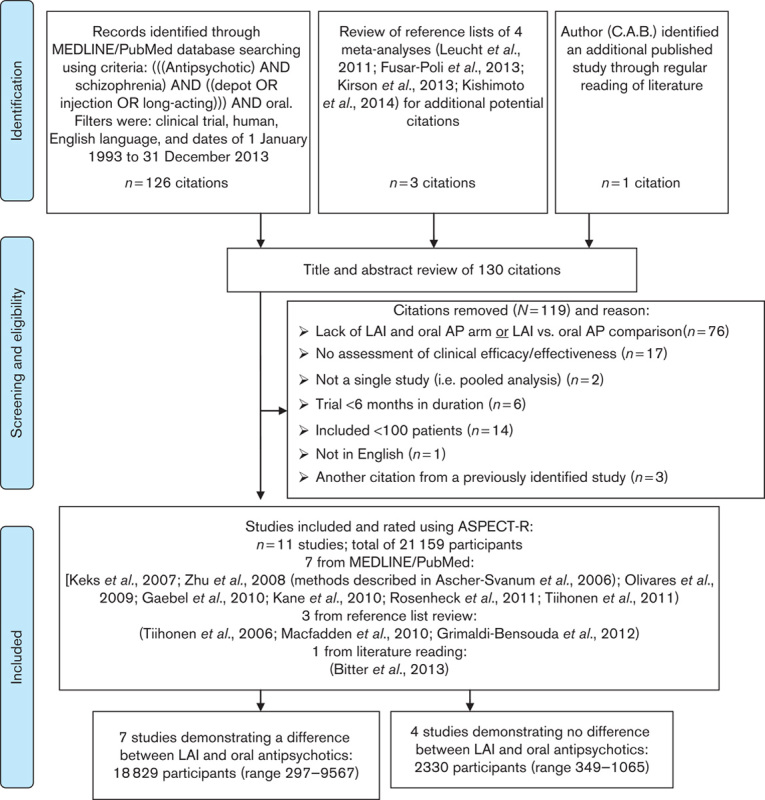
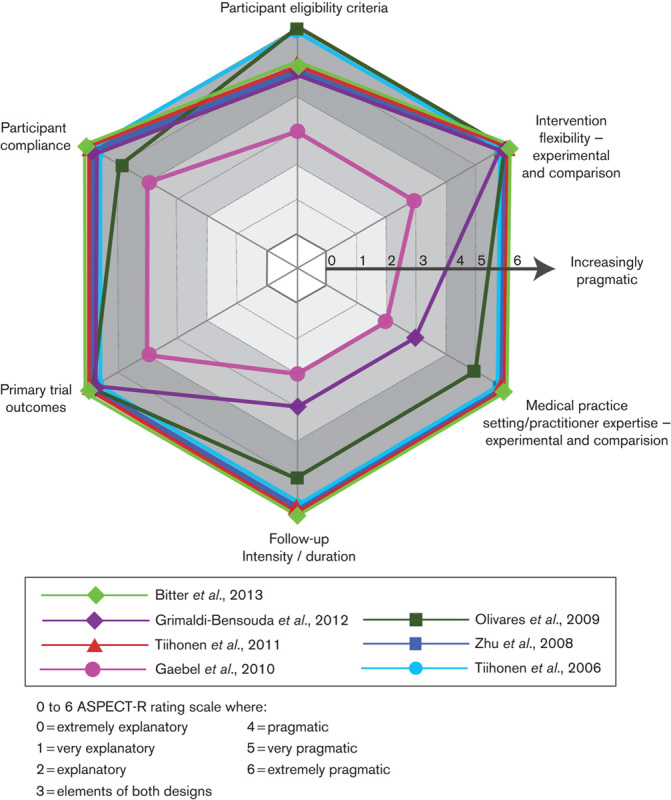
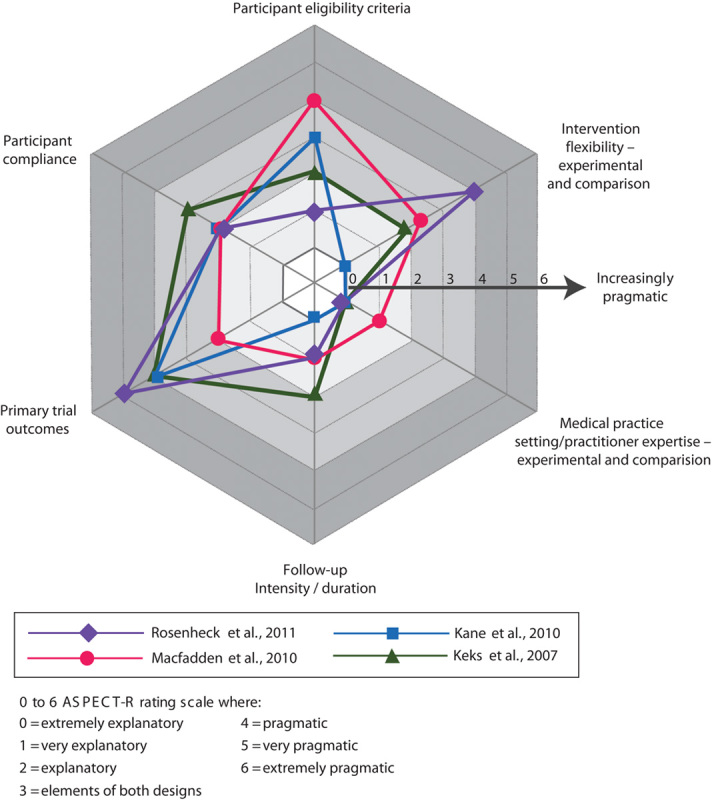
Trial design characteristics related to the explanatory : pragmatic spectrum may contribute toward the inconsistent results reported in studies comparing long-acting injectable (LAI) versus daily oral antipsychotic (AP) treatments in schizophrenia. A novel approach examined the hypothesis that a more pragmatic design is important to show the advantages of LAI versus oral APs. A literature search identified comparative studies assessing the clinical efficacy/effectiveness of LAI versus oral APs in more than 100 schizophrenia patients, with 6-month or more duration/follow-up, and published between January 1993 and December 2013 (n=11). Each study's design was rated using the six-domain ASPECT-R (A Study Pragmatic : Explanatory Characterization Tool-Rating). Nonparametric Wilcoxon rank-sum tests compared ratings of studies supporting (n=7) and not supporting (n=4) a LAI advantage. ASPECT-R total and domain scores were significantly higher (more pragmatic) in studies finding a LAI versus oral AP treatment advantage than those that did not. The rank order of this significance among domains was as follows: 'participant compliance assessment' (P=0.005), 'medical practice setting/practitioner expertise' (P=0.006), 'intervention flexibility' (P=0.007), 'follow-up intensity/duration' (P=0.009), 'primary trial outcomes' (P=0.012), and 'participant eligibility' (P=0.015). Findings support that more pragmatic, less explanatory design features are important to show advantages for LAI treatment. Explanatory studies may introduce features that obscure advantages related to adherence.
Overview
The claims and statistics of this paper haven’t been checked yet.
Free: it reads the open-access text and checks the first 5 claims that cite a source we can check. Create a free account to check every claim.
Integrity signals
Registry
Cites
Statistics
Figures
Verification
Claims the paper makes
The claims and statistics of this paper haven’t been checked yet.
Free: it reads the open-access text and checks the first 5 claims that cite a source we can check. Create a free account to check every claim.
Self-check
Percentages, sums and reported differences re-computed from the paper’s own numbers.
The self-check needs the paper’s full text.
Citations
Cites
Cicchetti, D. V. (1994) · Psychological Assessment · doi:10.1037/1040-3590.6.4.284 · Cited by 9,349
A pragmatic–explanatory continuum indicator summary (PRECIS): a tool to help trial designers
Thorpe, K. E., Zwarenstein, M., Oxman, A. D., Treweek, S., Furberg, C. D., Altman, D. G., Tunis, S., Bergel, E., Harvey, I., Magid, D. J., et al. (2009) · Journal of Clinical Epidemiology · doi:10.1016/j.jclinepi.2008.12.011 · Cited by 1,389
Tiihonen, J., Haukka, J., Taylor, M., Haddad, P. M., Patel, M. X., & Korhonen, P. (2011) · American Journal of Psychiatry · doi:10.1176/appi.ajp.2011.10081224 · Cited by 619
Kane, J. M., Kishimoto, T., & Correll, C. U. (2013) · World Psychiatry · doi:10.1002/wps.20060 · Cited by 520
Self-citationKishimoto, T., Nitta, M., Borenstein, M., Kane, J. M., & Correll, C. U. (2013) · The Journal of Clinical Psychiatry · doi:10.4088/jcp.13r08440 · Cited by 427 · cited 3×
“Although mirror-image studies, which arguably include more broadly representative patient populations, have reported advantages on the basis of this difference in modality (Kishimoto et al., 2013), randomized-controlled trials have frequently failed to show advantages (Fusar-Poli et al.”
BackgroundResultInfluentialSelf-citationLeucht, C., Heres, S., Kane, J. M., Kissling, W., Davis, J. M., & Leucht, S. (2011) · Schizophrenia Research · doi:10.1016/j.schres.2010.11.020 · Cited by 419
Kishimoto, T., Robenzadeh, A., Leucht, C., Leucht, S., Watanabe, K., Mimura, M., Borenstein, M., Kane, J. M., & Correll, C. U. (2014) · Schizophrenia Bulletin · doi:10.1093/schbul/sbs150 · Cited by 395
Self-citationTiihonen, J., Walhbeck, K., Lönnqvist, J., Klaukka, T., Ioannidis, J. P. A., Volavka, J., & Haukka, J. (2006) · BMJ · doi:10.1136/bmj.38881.382755.2f · Cited by 385
Long-Acting Risperidone and Oral Antipsychotics in Unstable Schizophrenia
Rosenheck, R. A., Krystal, J. H., Lew, R., Barnett, P. G., Fiore, L., Valley, D., Thwin, S. S., Vertrees, J. E., & Liang, M. H. (2011) · New England Journal of Medicine · doi:10.1056/nejmoa1005987 · Cited by 214
Zipursky, R. B., Menezes, N. M., & Streiner, D. L. (2014) · Schizophrenia Research · doi:10.1016/j.schres.2013.08.001 · Cited by 211
Kane, J. M., Detke, H. C., Naber, D., Sethuraman, G., Lin, D. Y., Bergstrom, R. F., & McDonnell, D. (2010) · American Journal of Psychiatry · doi:10.1176/appi.ajp.2009.07081221 · Cited by 197
Kirson, N. Y., Weiden, P. J., Yermakov, S., Huang, W., Samuelson, T., Offord, S. J., Greenberg, P. E., & Wong, B. J. O. (2013) · The Journal of Clinical Psychiatry · doi:10.4088/jcp.12r08167 · Cited by 174
Olivares, J. M., Rodriguez-Morales, A., Diels, J., Povey, M., Jacobs, A., Zhao, Z., & Lam, A. (2009) · European Psychiatry · doi:10.1016/j.eurpsy.2008.12.002 · Cited by 141 · cited 5×
“In five of the seven studies concluding a benefit of LAI compared with daily oral AP treatment, all domains were rated as more pragmatic (i.e. ASPECT-R ratings of 4, 5, or 6; Tiihonen et al., 2006; Zhu et al., 2008; Olivares et al., 2009; Tiihonen et al., 2011; Bitter et al., 2013).”
BackgroundMethodInfluentialKane, J. M., Kishimoto, T., & Correll, C. U. (2013) · Journal of Clinical Epidemiology · doi:10.1016/j.jclinepi.2013.01.012 · Cited by 131 · cited 1×
“A literature search identified comparative studies assessing the clinical efficacy/effectiveness of LAI versus oral APs in more than”
BackgroundSelf-citationIntegrating real-life studies in the global therapeutic research framework
Roche, N., Reddel, H. K., Agustí, A. G. N., Bateman, E. D., Krishnan, J. A., Martin, R. J., Papi, A. A., Postma, D. S., Thomas, M. D., Brusselle, G., et al. (2013) · The Lancet Respiratory Medicine · doi:10.1016/s2213-2600(13)70199-1 · Cited by 128
Gäebel, W., Schreiner, A., Bergmans, P., de Arce, R., Rouillon, F., Cordes, J., Eriksson, L., & Smeraldi, E. (2010) · Neuropsychopharmacology · doi:10.1038/npp.2010.111 · Cited by 119
Ascher‐Svanum, H., Zhu, B., Faries, D. E., Landbloom, R. P., Swartz, M. S., & Swanson, J. W. (2006) · BMC Psychiatry · doi:10.1186/1471-244x-6-8 · Cited by 115
Grimaldi‐Bensouda, L., Rouillon, F., Astruc, B., Rossignol, M., Bénichou, J., Falissard, B., Limosin, F., Beaufils, B., Vaïva, G., Verdoux, H., et al. (2011) · Schizophrenia Research · doi:10.1016/j.schres.2011.10.022 · Cited by 91
Fusar-Poli, P., Kempton, M. J., & Rosenheck, R. A. (2013) · International Clinical Psychopharmacology · doi:10.1097/yic.0b013e32835b091f · Cited by 89
Explanatory trials versus pragmatic trials
Sedgwick, P. M. (2014) · BMJ · doi:10.1136/bmj.g6694 · Cited by 86
Tosh, G., Soares-Weiser, K., & Adams, C. E. (2011) · Dialogues in Clinical Neuroscience · doi:10.31887/dcns.2011.13.2/gtosh · Cited by 84
Keks, N. A., Ingham, M., Khan, A., & Karcher, K. (2007) · British Journal of Psychiatry · doi:10.1192/bjp.bp.105.017020 · Cited by 83
Comparison of SGA Oral Medications and a Long-Acting Injectable SGA: The PROACTIVE Study
Buckley, P. F., Schooler, N. R., Goff, D. C., Hsiao, J., Kopelowicz, A., Lauriello, J., Manschreck, T., Mendelowitz, A. J., Miller, D. D., Severe, J. B., et al. (2015) · Schizophrenia Bulletin · doi:10.1093/schbul/sbu067 · Cited by 72
Zhu, B., Ascher-Svanum, H., Shi, L., Faries, D., Montgomery, W., & Marder, S. R. (2008) · Psychiatric Services · doi:10.1176/appi.ps.59.3.315 · Cited by 66
Pros and cons of pragmatic clinical trials
Lurie, J. D., & Morgan, T. S. (2013) · Journal of Comparative Effectiveness Research · doi:10.2217/cer.12.74 · Cited by 57
Intermittent drug techniques for schizophrenia
Sampson, S., Mansour, M., Maayan, N., Soares-Weiser, K., & Adams, C. E. (2013) · Cochrane Database of Systematic Reviews · doi:10.1002/14651858.cd006196.pub2 · Cited by 56
Macfadden, W., Yw, M., Haskins, J. T., Bossie, C. A., & Alphs, L. D. (2010) · PubMed · Cited by 42
Self-citationAlphs, L., Schooler, N., & Lauriello, J. (2014) · Schizophrenia Research · doi:10.1016/j.schres.2014.04.024 · Cited by 38
Self-citationBitter, I., Katona, L., Zámbori, J., Takács, P., Fehér, L., Diels, J., Bacskai, M., Láng, Z., Gyáni, G., & Czobor, P. (2013) · European Neuropsychopharmacology · doi:10.1016/j.euroneuro.2013.02.003 · Cited by 36
Cited by
Guidelines for the Pharmacotherapy of Schizophrenia in Adults
Remington, G., Addington, D., Honer, W., Ismail, Z., Raedler, T., & Teehan, M. (2017) · The Canadian Journal of Psychiatry · doi:10.1177/0706743717720448 · Cited by 332
Kane, J. M., Schooler, N. R., Marcy, P., Correll, C. U., Achtyes, E. D., Gibbons, R. D., & Robinson, D. G. (2020) · JAMA psychiatry · doi:10.1001/jamapsychiatry.2020.2076 · Cited by 208
Self-citationKishimoto, T., Hagi, K., Nitta, M., Leucht, S., Olfson, M., Kane, J. M., & Correll, C. U. (2018) · Schizophrenia Bulletin · doi:10.1093/schbul/sbx090 · Cited by 186
Self-citationKane, J. M., McEvoy, J. P., Correll, C. U., & Llorca, P. (2021) · CNS Drugs · doi:10.1007/s40263-021-00861-6 · Cited by 94
Self-citationBiagi, E., Capuzzi, E., Colmegna, F., Mascarini, A., Brambilla, G., Ornaghi, A., Santambrogio, J., & Clerici, M. (2017) · Advances in Therapy · doi:10.1007/s12325-017-0507-x · Cited by 69
Metadata
- Authors
- Bossie, C. A., Alphs, L. D., & Correll, C. U.
- Affiliations
- Janssen (United States) (US)
- Janssen Scientific Affairs (United States) (US)
- Hofstra University (US)
- Corresponding author
- Bossie, Cynthia A.
- Venue
- International Clinical Psychopharmacology
- Published
- 2015-09
- Volume
- 30
- Issue
- 5
- Pages
- 272-281
- ISSN
- 0268-1315 (ISSN-L)
- PMC
- PMC4525810
- OpenAlex
- W626348225
- Semantic Scholar
- c12577c00ae1460a92ed88b837f9c70c0ed8f3ed
- Cited by
- 33
- References
- 29
- Citations by year
- 2026: 1 · 2025: 4 · 2024: 2 · 2023: 2 · 2022: 3 · 2021: 3 · 2020: 5 · 2019: 3 · 2018: 1 · 2017: 5 · 2016: 3 · 2015: 1
- FWCI
- 2.70
- Type
- journal article
- Language
- en
- Open access
- hybrid
- doi.org
- Licence
- cc-by-nc-nd
- Locations
- International Clinical Psychopharmacology (publishedVersion, cc-by-nc-nd)
- PubMed Central (publishedVersion, cc-by-nc-nd)
- PubMed (publishedVersion)
- Funders
- Janssen Scientific Affairs
- Topics
- Health Sciences › Medicine › Psychiatry and Mental health › Schizophrenia research and treatment
- Physical Sciences › Mathematics › Statistics and Probability › Statistical Methods in Clinical Trials
- Social Sciences › Decision Sciences › Statistics, Probability and Uncertainty › Meta-analysis and systematic reviews
- Keywords
- long-acting injectable antipsychotics, oral antipsychotics, schizophrenia, trial design, participant compliance, medication adherence
- MeSH terms
- Administration, Oral, Delayed-Action Preparations, Humans, Injections, Intramuscular, Research Design, Schizophrenia, Antipsychotic Agents, Pragmatic Clinical Trials as Topic
About these checks
Registry, retraction, Cites and statistics results are computed, not judged, with one exception: a printed reference that no index lists is read once by a model before it counts as a citation error. Claims are extracted by a model and kept only when their quote appears verbatim in the text; each cited source is then checked, with a model’s help, for whether it says what the claim relies on. Those verdicts can be wrong — read the claim’s quote and the cited source before relying on one.
Statistics and arithmetic are recomputed, not judged.
Confidence bands are shown only for fields calibrated on our annotated test set. None is calibrated yet, so no band is shown.
What counts as a claim ›How we measure confidence ›How we check this ›
Are you an author, or do you see a problem with this page? Request a review
Data sources
Bibliographic data: Semantic Scholar, OpenAlex, Crossref.
Contains information from the Semantic Scholar Academic Graph Datasets, made available under the ODC Attribution License (ODC-BY 1.0).
Semantic Scholar’s data is described in: Kinney, R., et al. (2023). The Semantic Scholar Open Data Platform. arXiv:2301.10140.
