

The DOI matches its Crossref record; 47 of the 47 references it cites were found in a registry or an index.
Sexual and social stimuli elicit rapid and contrasting genomic responses
Abstract
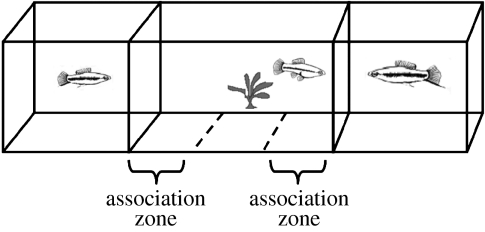
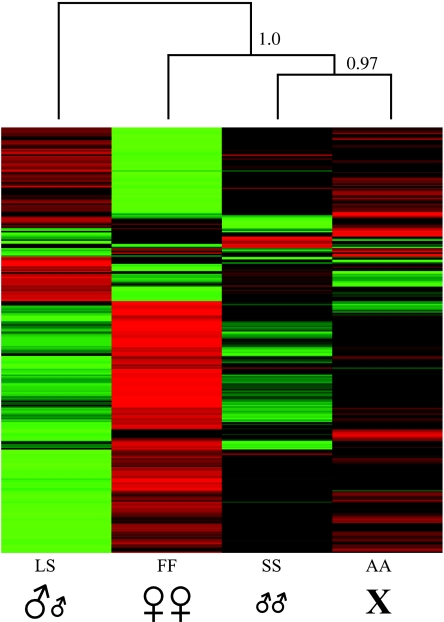
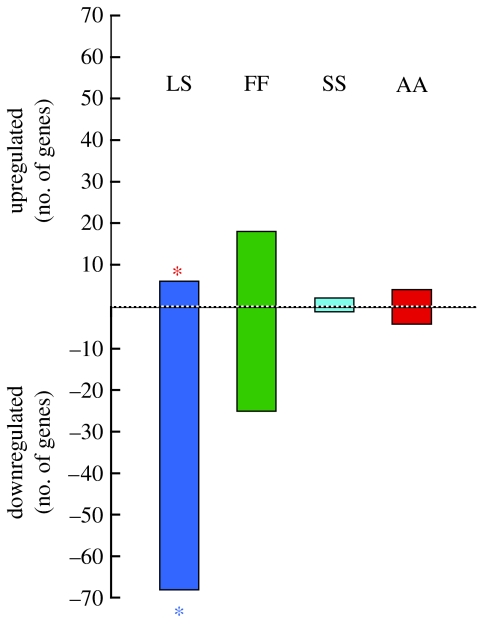
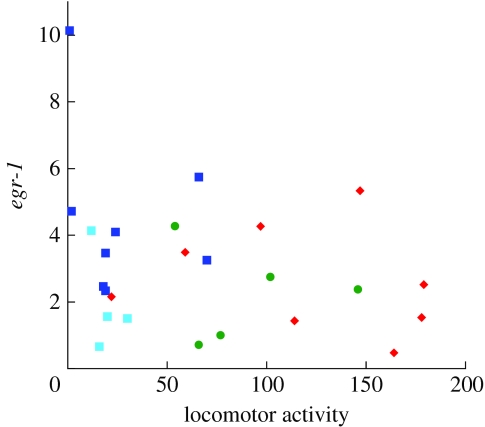
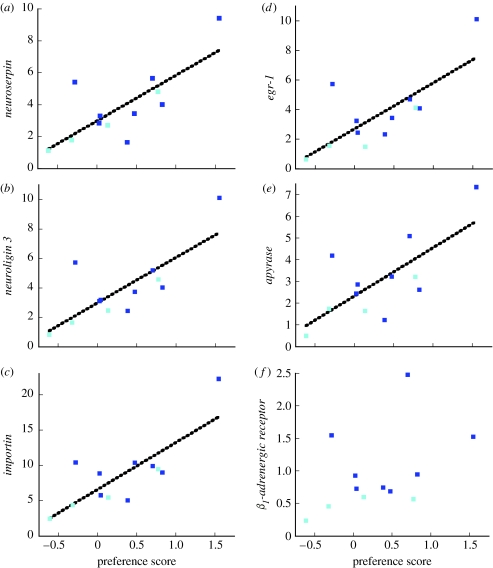
Sensory physiology has been shown to influence female mate choice, yet little is known about the mechanisms within the brain that regulate this critical behaviour. Here we examine preference behaviour of 58 female swordtails, Xiphophorus nigrensis, in four different social environments (attractive and unattractive males, females only, non-attractive males only and asocial conditions) followed by neural gene expression profiling. We used a brain-specific cDNA microarray to identify patterns of genomic response and candidate genes, followed by quantitative PCR (qPCR) examination of gene expression with variation in behaviour. Our microarray results revealed patterns of genomic response differing more between classes of social stimuli than between presence versus absence of stimuli. We identified suites of genes showing diametrically opposed patterns of expression: genes that are turned ‘on’ while females interact with attractive males are turned ‘off’ when interacting with other females, and vice versa. Our qPCR results identified significant predictive relationships between five candidate genes and specific mate choice behaviours (preference and receptivity) across females exposed to males, with no significant patterns identified in female or asocial conditions or with overall locomotor activity. The identification of stimulus- and behaviour-specific responses opens an exciting window into the molecular pathways associated with social behaviour and mechanisms that underlie sexual selection.
Overview
The claims and statistics of this paper haven’t been checked yet.
Run the check — free, no account needed. It reads the open-access text and checks the sources it cites.
Integrity signals
Registry
Cites
Statistics
Figures
Verification
Claims the paper makes
The claims and statistics of this paper haven’t been checked yet.
Run the check — free, no account needed. It reads the open-access text and checks the sources it cites.
Claims other papers make about this one
Each is checked against this paper’s own text: does it say what the citing paper says it does?
In the citing paper
“Many studies have found significant, predictable, and specific changes in brain gene expression profiles associated with behavioral responses to particular environmental stimuli (7–14).”
From Behavior-related gene regulatory networks: A new level of organization in the brain (2020) · cites this paper as [14]
Self-check
Percentages, sums and reported differences re-computed from the paper’s own numbers.
The self-check needs the paper’s full text.
Citations
Cites
Controlling the False Discovery Rate: A Practical and Powerful Approach to Multiple Testing
Benjamini, Y., & Hochberg, Y. (1995) · Journal of the Royal Statistical Society Series B: Statistical Methodology · doi:10.1111/j.2517-6161.1995.tb02031.x · Cited by 109,482
Quantification of mRNA using real-time reverse transcription PCR (RT-PCR): trends and problems
Bustin, S. A. (2002) · Journal of Molecular Endocrinology · doi:10.1677/jme.0.0290023 · Cited by 2,562
Normalization of cDNA microarray data
Smyth, G. K., & Speed, T. (2003) · Methods · doi:10.1016/s1046-2023(03)00155-5 · Cited by 1,871
Sex, Color, and Mate Choice in Guppies
Houde, A. (1998) · Princeton University Press eBooks · doi:10.1515/9780691207261 · Cited by 951
Q-Gene: processing quantitative real-time RT–PCR data
Simon, P. D. (2003) · Bioinformatics · doi:10.1093/bioinformatics/btg157 · Cited by 868
Natural and sexual selection on color patterns in poeciliid fishes
Endler, J. A. (1984) · Developments in environmental biology of fishes · doi:10.1007/978-94-015-7682-6_7 · Cited by 739
Natural and sexual selection on color patterns in poeciliid fishes
Endler, J. A. (1983) · Environmental Biology of Fishes · doi:10.1007/bf00690861 · Cited by 723
Control of Excitatory and Inhibitory Synapse Formation by Neuroligins
Chih, B., Engelman, H., & Scheiffele, P. (2005) · Science · doi:10.1126/science.1107470 · Cited by 715
Lim, M. M., Wang, Z., Olazábal, D. E., Ren, X., Terwilliger, E. F., & Young, L. J. (2004) · Nature · doi:10.1038/nature02539 · Cited by 628
Sex-Dependent Gene Expression and Evolution of the Drosophila Transcriptome
Ranz, J. M., Castillo-Davis, C. I., Meiklejohn, C. D., & Hartl, D. L. (2003) · Science · doi:10.1126/science.1085881 · Cited by 617
Sexual selection for sensory exploitation in the frog Physalaemus pustulosus
Ryan, M. J., Fox, J. H., Wilczynski, W., & Rand, A. S. (1990) · Nature · doi:10.1038/343066a0 · Cited by 583
Natural Behavior Polymorphism Due to a cGMP-Dependent Protein Kinase of Drosophila
Osborne, K. A., Robichon, A., Burgess, E., Butland, S. L., Shaw, R. A., Coulthard, A. B., Pereira, H. S., Greenspan, R. J., & Sokolowski, M. B. (1997) · Science · doi:10.1126/science.277.5327.834 · Cited by 547
Gene Expression Profiles in the Brain Predict Behavior in Individual Honey Bees
Whitfield, C. W., Cziko, A.-M., & Robinson, G. E. (2003) · Science · doi:10.1126/science.1086807 · Cited by 527
Young, L. J., Nilsen, R., Waymire, K. G., MacGregor, G. R., & Insel, T. R. (1999) · Nature · doi:10.1038/23475 · Cited by 488
Genes Regulated by Mating, Sperm, or Seminal Proteins in Mated Female Drosophila melanogaster
McGraw, L. A., Gibson, G. C., Clark, A. G., & Wolfner, M. F. (2004) · Current Biology · doi:10.1016/j.cub.2004.08.028 · Cited by 316
Constitutive expression of zif268 in neocortex is regulated by synaptic activity.
Worley, P. F., Christy, B. A., Nakabeppu, Y., Bhat, R. V., Cole, A. J., & Baraban, J. M. (1991) · Proceedings of the National Academy of Sciences · doi:10.1073/pnas.88.12.5106 · Cited by 300
Sexual Receptivity: Facilitation by Medial Preoptic Lesions in Female Rats
Powers, B., & Valenstein, E. S. (1972) · Science · doi:10.1126/science.175.4025.1003 · Cited by 296
Rapid Behavioral and Genomic Responses to Social Opportunity
Burmeister, S. S., Jarvis, E. D., & Fernald, R. D. (2005) · PLoS Biology · doi:10.1371/journal.pbio.0030363 · Cited by 275
A private ultraviolet channel in visual communication
Cummings, M. E., Rosenthal, G. G., & Ryan, M. J. (2003) · Proceedings of the Royal Society B Biological Sciences · doi:10.1098/rspb.2003.2334 · Cited by 256
Self-citationRenn, S. C. P., Aubin‐Horth, N., & Hofmann, H. A. (2004) · BMC Genomics · doi:10.1186/1471-2164-5-42 · Cited by 212
Self-citationAlternative life histories shape brain gene expression profiles in males of the same population
Aubin‐Horth, N., Landry, C. R., Letcher, B. H., & Hofmann, H. A. (2005) · Proceedings of the Royal Society B Biological Sciences · doi:10.1098/rspb.2005.3125 · Cited by 205
Self-citationMating-responsive genes in reproductive tissues of female Drosophila melanogaster
Mack, P. D., Kapelnikov, A., Heifetz, Y., & Bender, M. T. (2006) · Proceedings of the National Academy of Sciences · doi:10.1073/pnas.0604046103 · Cited by 180
A genome-wide analysis of courting and mating responses inDrosophila melanogasterfemales
Lawniczak, M., & Begun, D. J. (2004) · Genome · doi:10.1139/g04-050 · Cited by 179
Krueger, S., Ghisu, G.-P., Cinelli, P., Gschwend, T. P., Osterwalder, T., Wolfer, D. P., & Sonderegger, P. (1997) · Journal of Neuroscience · doi:10.1523/jneurosci.17-23-08984.1997 · Cited by 173
Townsend, J. P., & Hartl, D. L. (2002) · Genome biology · doi:10.1186/gb-2002-3-12-research0071 · Cited by 159
Sitz und Bedeutung nervöser Zentren für Instinkthandlungen beim Männchen von Gryllus campestris L.
Huber, F. (2010) · Zeitschrift für Tierpsychologie · doi:10.1111/j.1439-0310.1955.tb01513.x · Cited by 150
Madani, R., Kozlov, S. V., Akhmedov, A. T., Cinelli, P., Kinter, J., Lipp, H., Sonderegger, P., & Wolfer, D. P. (2003) · Molecular and Cellular Neuroscience · doi:10.1016/s1044-7431(03)00077-0 · Cited by 148
Quantitative genetic analyses of complex behaviours in Drosophila
Anholt, R. R. H., & Mackay, T. F. C. (2004) · Nature Reviews Genetics · doi:10.1038/nrg1472 · Cited by 142
Genetics and genomics of Drosophila mating behavior
Mackay, T. F. C., Heinsohn, S. L., Lyman, R. F., Moehring, A. J., Morgan, T. J., & Rollmann, S. M. (2005) · Proceedings of the National Academy of Sciences · doi:10.1073/pnas.0501986102 · Cited by 138
Sexual selection on alleles that determine body size in the swordtail Xiphophorus nigrensis
Ryan, M. J., Hews, D. K., & Wagner, W. E. (1990) · Behavioral Ecology and Sociobiology · doi:10.1007/bf00178316 · Cited by 134
Hashimoto, J. G., Beadles-Bohling, A. S., & Wiren, K. M. (2004) · BioTechniques · doi:10.2144/04361bm06 · Cited by 114
Masculinized dominant females in a cooperatively breeding species
Aubin‐Horth, N., Desjardins, J. K., Martei, Y. M., Balshine, S., & Hofmann, H. A. (2007) · Molecular Ecology · doi:10.1111/j.1365-294x.2007.03249.x · Cited by 112
Self-citationAN EXPERIMENTAL ANALYSIS OF THE SEXUAL BEHAVIOR OF THE PRAYING MANTIS (MANTIS RELIGIOSA L.)
Roeder, K. D. (1935) · Biological Bulletin · doi:10.2307/1537420 · Cited by 112
Mong, J. A., Devidze, N., Frail, D. E., O’Connor, L. T., Samuel, M., Choleris, E., Ogawa, S., & Pfaff, D. W. (2002) · Proceedings of the National Academy of Sciences · doi:10.1073/pnas.262663799 · Cited by 111
Etgen, A. M., Ansonoff, M. A., & Quesada, A. (2001) · Hormones and Behavior · doi:10.1006/hbeh.2001.1676 · Cited by 109
Sockman, K. W., Gentner, T. Q., & Ball, G. F. (2002) · Proceedings of the Royal Society B Biological Sciences · doi:10.1098/rspb.2002.2180 · Cited by 108
The effects of female choice and male-male competition on the mating success of male guppies
Houde, A. E. (1988) · Animal Behaviour · doi:10.1016/s0003-3472(88)80171-4 · Cited by 107
Cummings, M. E., & Mollaghan, D. M. (2006) · Animal Behaviour · doi:10.1016/j.anbehav.2006.01.009 · Cited by 102
Self-citationDissecting the complex genetic basis of mate choice
Chenoweth, S. F., & Blows, M. W. (2006) · Nature Reviews Genetics · doi:10.1038/nrg1924 · Cited by 98
Model Systems in Behavioral Ecology
(2002) · Princeton University Press eBooks · doi:10.1515/9780691207247 · Cited by 94
Social cues shift functional connectivity in the hypothalamus
Hoke, K. L., Ryan, M. J., & Wilczynski, W. (2005) · Proceedings of the National Academy of Sciences · doi:10.1073/pnas.0502361102 · Cited by 76
Importin-mediated nuclear transport in neurons
Olofsdotter, K., Thompson, K. R., & Martin, K. C. (2006) · Current Opinion in Neurobiology · doi:10.1016/j.conb.2006.05.001 · Cited by 54
Berger, P., Kozlov, S. V., Cinelli, P., Krueger, S., Vogt, L., & Sonderegger, P. (1999) · Molecular and Cellular Neuroscience · doi:10.1006/mcne.1999.0804 · Cited by 47
8. Variation and Selection in Swordtails
Ryan, M. J., & Rosenthal, G. G. (2002) · Princeton University Press eBooks · doi:10.1515/9780691207247-010 · Cited by 37
Sun, Z., Wu, F., & Schacher, S. (2000) · Journal of Neurobiology · doi:10.1002/1097-4695(200101)46:1<48::aid-neu5>3.0.co;2-3 · Cited by 23
Gene expression polymorphism in Drosophila populations
Michalak, P., Malone, J. H., Lee, I. T., HOSHINO, D., & Ma, D. (2007) · Molecular Ecology · doi:10.1111/j.1365-294x.2007.03201.x · Cited by 22
Quinkert, G., Bang, H., & Reichert, D. (1996) · Helvetica Chimica Acta · doi:10.1002/hlca.19960790504 · Cited by 22
Research works printed but not linked: 1
- Andersson M Sexual selection. 1994 Princeton NJ:Princeton University Press.
Cited by
Social competence: an evolutionary approach
Taborsky, B., & Oliveira, R. F. (2012) · Trends in Ecology & Evolution · doi:10.1016/j.tree.2012.09.003 · Cited by 419
An evolutionary framework for studying mechanisms of social behavior
Hofmann, H. A., Beery, A. K., Blumstein, D. T., Couzin, I. D., Earley, R. L., Hayes, L. D., Hurd, P. L., Lacey, E. A., Phelps, S. M., Solomon, N. G., et al. (2014) · Trends in Ecology & Evolution · doi:10.1016/j.tree.2014.07.008 · Cited by 185
Self-citationRittschof, C. C., Bukhari, S. A., Sloofman, L. G., Troy, J. M., Caetano-Anollés, D., Cash-Ahmed, A., Kent, M., Lu, X., Sanogo, Y. O., Weisner, P. A., et al. (2014) · Proceedings of the National Academy of Sciences · doi:10.1073/pnas.1420369111 · Cited by 163
Behavior-related gene regulatory networks: A new level of organization in the brain
Sinha, S., Jones, B. M., Traniello, I. M., Bukhari, S. A., Halfon, M. S., Hofmann, H. A., Huang, S., Katz, P. S., Keagy, J., Lynch, V. J., et al. (2020) · Proceedings of the National Academy of Sciences · doi:10.1073/pnas.1921625117 · Cited by 85
Self-citationImpact of experience-dependent and -independent factors on gene expression in songbird brain
Drnevich, J., Replogle, K. L., Lovell, P., Hahn, T. P., Johnson, F., Mast, T. G., Nordeen, E., Nordeen, K., Strand, C., London, S. E., et al. (2012) · Proceedings of the National Academy of Sciences · doi:10.1073/pnas.1200655109 · Cited by 57
Metadata
- Authors
- Cummings, M. E., Larkins-Ford, J., Reilly, C. R. L., Wong, R. Y., Ramsey, M., & Hofmann, H. A.
- Affiliations
- Section of Integrative Biology, University of TexasAustin, TX 78712, USA
- Department of Biological Sciences, Hopkins Marine Station, Stanford UniversityPacific Grove, CA 93950, USA
- Venue
- Proceedings of the Royal Society B: Biological Sciences
- Publisher
- The Royal Society
- Published
- 2007-12-05
- Volume
- 275
- Issue
- 1633
- Pages
- 393-402
- ISSN
- 0962-8452
- 1471-2954
- PMC
- PMC2212751
- Cited by
- 118
- References
- 47
- Language
- en
- Licence
- royalsociety.org/journals/ethics-policies/data-sharing-mining/ (tdm)
About these checks
Registry, retraction, Cites and statistics results are computed, not judged, with one exception: a printed reference that no index lists is read once by a model before it counts as a citation error. Claims are extracted by a model and kept only when their quote appears verbatim in the text; each cited source is then checked, with a model’s help, for whether it says what the claim relies on. Those verdicts can be wrong — read the claim’s quote and the cited source before relying on one.
Statistics and arithmetic are recomputed, not judged.
Confidence bands are shown only for fields calibrated on our annotated test set. None is calibrated yet, so no band is shown.
What counts as a claim ›How we measure confidence ›How we check this ›
Are you an author, or do you see a problem with this page? Request a review
Data sources
Bibliographic data: Semantic Scholar, OpenAlex, Crossref.
Contains information from the Semantic Scholar Academic Graph Datasets, made available under the ODC Attribution License (ODC-BY 1.0).
Semantic Scholar’s data is described in: Kinney, R., et al. (2023). The Semantic Scholar Open Data Platform. arXiv:2301.10140.
