

The DOI matches its Crossref record; 66 of the 66 references it cites were found in a registry or an index.
Exposure to visual cues of pathogen contagion changes preferences for masculinity and symmetry in opposite-sex faces
Open accessAbstract
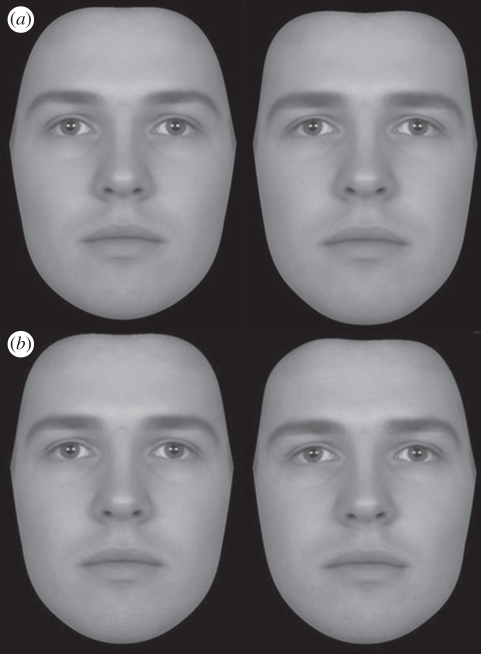
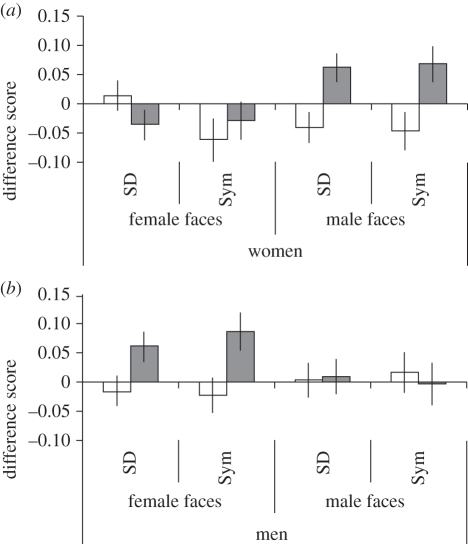
Evolutionary approaches to human attractiveness have documented several traits that are proposed to be attractive across individuals and cultures, although both cross-individual and cross-cultural variations are also often found. Previous studies show that parasite prevalence and mortality/health are related to cultural variation in preferences for attractive traits. Visual experience of pathogen cues may mediate such variable preferences. Here we showed individuals slideshows of images with cues to low and high pathogen prevalence and measured their visual preferences for face traits. We found that both men and women moderated their preferences for facial masculinity and symmetry according to recent experience of visual cues to environmental pathogens. Change in preferences was seen mainly for opposite-sex faces, with women preferring more masculine and more symmetric male faces and men preferring more feminine and more symmetric female faces after exposure to pathogen cues than when not exposed to such cues. Cues to environmental pathogens had no significant effects on preferences for same-sex faces. These data complement studies of cross-cultural differences in preferences by suggesting a mechanism for variation in mate preferences. Similar visual experience could lead to within-cultural agreement and differing visual experience could lead to cross-cultural variation. Overall, our data demonstrate that preferences can be strategically flexible according to recent visual experience with pathogen cues. Given that cues to pathogens may signal an increase in contagion/mortality risk, it may be adaptive to shift visual preferences in favour of proposed good-gene markers in environments where such cues are more evident.
Overview
The claims and statistics of this paper haven’t been checked yet.
Run the check — free, no account needed. It reads the open-access text and checks the sources it cites.
Integrity signals
Registry
Cites
Statistics
Figures
Verification
Claims the paper makes
The claims and statistics of this paper haven’t been checked yet.
Run the check — free, no account needed. It reads the open-access text and checks the sources it cites.
Claims other papers make about this one
Each is checked against this paper’s own text: does it say what the citing paper says it does?
The cited source says what the claim attributes to it.
In the citing paper
“we have also found that viewing cues to disease salience increased preferences for facial cues of long-term health in potential mates, but not same-sex individuals (Little et al. 2011).”
From Parasite-stress promotes in-group assortative sociality: The cases of strong family ties and heightened religiosity (2012) · cites this paper as Little et al. 2011
In the citing paper
“This relationship is consistent with a wide range of additional evidence indicating that individuals are sensitive to disease-connoting cues within their immediate environment, and respond to these cues with functionally adaptive shifts in cognition and behavior [58], [59].”
From Pathogens and Politics: Further Evidence That Parasite Prevalence Predicts Authoritarianism (2013) · cites this paper as [58]
Self-check
Percentages, sums and reported differences re-computed from the paper’s own numbers.
The self-check needs the paper’s full text.
Citations
Cites
Parasites, Bright Males, and the Immunocompetence Handicap
Folstad, I., & Karter, A. J. (1992) · The American Naturalist · doi:10.1086/285346 · Cited by 2,799
Belsky, J., Steinberg, L. D., & Draper, P. (1991) · Child Development · doi:10.1111/j.1467-8624.1991.tb01558.x · Cited by 2,601
Belsky, J., Steinberg, L., & Draper, P. (1991) · Child Development · doi:10.2307/1131166 · Cited by 1,780
Effects of sexual dimorphism on facial attractiveness
Perrett, D. I., Lee, K. J., Penton‐Voak, I. S., Rowland, D., Yoshikawa, S., Burt, D. M., Henzi, S. P., Castles, D. L., & Akamatsu, S. (1998) · Nature · doi:10.1038/29772 · Cited by 1,359
Grammer, K., & Thornhill, R. (1994) · Journal of Comparative Psychology · doi:10.1037/0735-7036.108.3.233 · Cited by 1,110
Thornhill, R., & Gangestad, S. W. (1999) · Trends in Cognitive Sciences · doi:10.1016/s1364-6613(99)01403-5 · Cited by 950
Evidence that disgust evolved to protect from risk of disease
Curtis, V., Aunger, R., & Rabie, T. (2004) · Proceedings of the Royal Society of London. Series B: Biological Sciences · doi:10.1098/rsbl.2003.0144 · Cited by 842
Ache Life History: The Ecology and Demography of a Foraging People.
Howell, N. E., Hill, K. R., & Hurtado, A. M. (1996) · Population and Development Review · doi:10.2307/2137817 · Cited by 841
Prototyping and Transforming Facial Textures for Perception Research
Tiddeman, B. P., Burt, M., & Perrett, D. (2001) · IEEE Computer Graphics and Applications · doi:10.1109/38.946630 · Cited by 838
Menstrual cycle alters face preference
Penton‐Voak, I. S., Perrett, D. I., Castles, D. L., Kobayashi, T., Burt, D. M., Murray, L. K., & Minamisawa, R. (1999) · Nature · doi:10.1038/21557 · Cited by 836
Research works printed but not linked: 1
- 10.1037/0022-3514.59.1.61 · DOI
Cited by
Sorted by citations
Items 101–172 of 172
Lee, A. J., & McGuire, N. K. J. (2023) · Evolutionary Psychology · doi:10.1177/14747049231175073 · Cited by 7
Prejudices: Managing Perceived Threats to Group Life
Neuberg, S. L., & DeScioli, P. (2015) · Wiley eBooks · doi:10.1002/9781119125563.evpsych228 · Cited by 7
Grueter, C. C., Goodman, H., Fay, N., Walker, B., & Coall, D. A. (2023) · Evolutionary Psychological Science · doi:10.1007/s40806-023-00354-3 · Cited by 6
Agreement and Individual Differences in Men’s Preferences for Women’s Facial Characteristics
Jones, B. C. (2014) · Evolutionary psychology · doi:10.1007/978-1-4939-0314-6_4 · Cited by 6
Pathogen disgust predicts homosexual men's preference for feminine cues in male voices in China
Zhang, J., Zheng, L., & Zheng, Y. (2018) · Personality and Individual Differences · doi:10.1016/j.paid.2018.08.026 · Cited by 5
Context matters for attractiveness bias
Lee, J., Adams, G., Li, Y. J., & Gillath, O. (2017) · Behavioral and Brain Sciences · doi:10.1017/s0140525x16000546 · Cited by 4
Arnocky, S. A., Denomme, B., Hodges‐Simeon, C. R., Hlay, J. K., Davis, A. C., & Brennan, H. (2023) · Adaptive Human Behavior and Physiology · doi:10.1007/s40750-022-00209-4 · Cited by 5
Sun, H., Fan, L., & Tybur, J. M. (2025) · Evolution and Human Behavior · doi:10.1016/j.evolhumbehav.2025.106710 · Cited by 3
The Parasite-Stress Theory of Cultural Values and Sociality
Thornhill, R., & Fincher, C. L. (2020) · Cambridge University Press eBooks · doi:10.1017/9781108131797.015 · Cited by 4
Preferring and Detecting Face Symmetry: Comparing Children and Adults Judging Human and Monkey Faces
Little, A. C., & Griffey, J. A. F. (2020) · Symmetry · doi:10.3390/sym12122112 · Cited by 3
Self-citationMate assessment based on physical characteristics: a review and reflection
Watkins, C. D. (2024) · Biological reviews/Biological reviews of the Cambridge Philosophical Society · doi:10.1111/brv.13131 · Cited by 5
Csajbók, Z., Štěrbová, Z., Jonason, P. K., Jelínková, L., Binter, J., & Havlı́ček, J. (2024) · Archives of Sexual Behavior · doi:10.1007/s10508-024-03010-4 · Cited by 3
A silver lining of the epidemic: how contagious disease salience leads to minimalistic consumption
Chen, S., & Ran, Y. (2023) · Environment Development and Sustainability · doi:10.1007/s10668-023-03646-7 · Cited by 3
Saxton, T. K., DeBruine, L. M., Jones, B. C., Little, A. C., & Roberts, S. C. (2013) · Personality and Individual Differences · doi:10.1016/j.paid.2013.02.009 · Cited by 3
Self-citationGildner, T. E. (2018) · Scholars' Bank (University of Oregon) · Cited by 2
Pathogen Disgust and Perceptions of Attractiveness
Beall, A. T. (2021) · Springer eBooks · doi:10.1007/978-3-319-19650-3_2978 · Cited by 3
Knowles, K. K., & Little, A. C. (2019) · Scottish Affairs · doi:10.3366/scot.2019.0297 · Cited by 2
Self-citationViolence exposure is associated with preference for masculine faces: evidence from Senegal
Tureček, P., Černý, V., Diallo, M. Y., Cissé, N., Pokorný, Š., & Kleisner, K. (2025) · Proceedings of the Royal Society B Biological Sciences · doi:10.1098/rspb.2024.3105 · Cited by 2
Mating Systems, Mate Choice, Marriage, Sexual Behavior, and Inbreeding
Thornhill, R., & Fincher, C. L. (2014) · Springer eBooks · doi:10.1007/978-3-319-08040-6_6 · Cited by 3
Relationships between disgust sensitivity and trait preferences in gay men in China
Zheng, L. (2019) · Personality and Individual Differences · doi:10.1016/j.paid.2019.03.037 · Cited by 3
Dixson, B. J. W. (2020) · Adaptive Human Behavior and Physiology · doi:10.1007/s40750-020-00142-4 · Cited by 2
Wen, F., Zuo, B., Wang, Y., Ma, S., Shi-jie, S., & Zhang, H. (2021) · Archives of Sexual Behavior · doi:10.1007/s10508-020-01868-8 · Cited by 2
The disgusted mind : investigating the effects of parasite stress on social behaviour and beliefs
Culpepper, P. D. (2019) · Stirling Online Research Repository (University of Stirling) · Cited by 1
Oxytocin, vasopressin, sociality, and pathogen avoidance
Kavaliers, M., & Choleris, E. (2013) · Cambridge University Press eBooks · doi:10.1017/cbo9781139017855.017 · Cited by 1
Little, A. C. (2014) · Animal Behavior and Cognition · doi:10.12966/abc.08.14.2014 · Cited by 1
Self-citationPathogen stress heightens sensorimotor dimensions in the human collective semantic space
Fu, Z., Chen, H., Liu, Z., Sun, M., Liu, Z., & Bi, Y. (2025) · Communications Psychology · doi:10.1038/s44271-024-00183-5 · Cited by 1
Vásquez-Amézquita, M., Chacón, A. C., Medina-Sarmiento, W., Cepeda, V., Martínez–González, M. B., & Leongómez, J. D. (2025) · Evolution and Human Behavior · doi:10.1016/j.evolhumbehav.2025.106707 · Cited by 1
Yang, H. X., Wan, W., Zhang, F., Yang, N., & Wu, Q. (2025) · Scandinavian Journal of Psychology · doi:10.1111/sjop.70014 · Cited by 1
Women’s preferences for male facial masculinity are not condition-dependent in a large online study
Dongen, S. V., Danckaers, F., Beerten, J., & Huysmans, T. (2019) · DOAJ (DOAJ: Directory of Open Access Journals) · Cited by 1
Women’s Preferences for Men’s Facial Masculinity and Anticipations of Grandparental Care Provision
Saxton, T. K., Lefevre, C. E., & Hönekopp, J. (2020) · Evolutionary Psychological Science · doi:10.1007/s40806-020-00257-7 · Cited by 1
What’s in a Face? Sources of Variation in Human Facial Attractiveness
Welling, L. L. M. (2025) · Springer eBooks · doi:10.1007/978-3-031-82884-3_7 · Cited by 1
The role of facial cues to body size on attractiveness and perceived leadership ability
Re, D. E. (2013) · St Andrews Research Repository (St Andrews Research Repository) · Cited by 1
Variation in men's mate preferences and mating strategies
Kandrik, M. (2017) · Enlighten: Theses (The University of Glasgow) · Cited by 1
Heterogeneity of research results: New perspectives on psychological science
Linden, A. H. (2019) · Northumbria Research Link (Northumbria University) · Cited by 1
Sexual Contact and Sexual Disgust
Tybur, J. M. (2016) · Springer eBooks · doi:10.1007/978-3-319-16999-6_2981-1 · Cited by 2
The Learning and Persistence of Aesthetic Values
Aleem, H. (2021) · DigitalGeorgetown (Georgetown University Library) · Cited by 1
Pathogen Disgust and Perceptions of Attractiveness
Beall, A. T. (2016) · Springer eBooks · doi:10.1007/978-3-319-16999-6_2978-1 · Cited by 1
“Disease Avoidance Hypothesis”
Ackerman, J. M. (2016) · Springer eBooks · doi:10.1007/978-3-319-16999-6_2975-1 · Cited by 1
Fleck, C. R., & Simpson, J. A. (2021) · Springer eBooks · doi:10.1007/978-3-319-19650-3_10 · Cited by 1
Lefevre, C. E. (2013) · St Andrews Research Repository (St Andrews Research Repository)
Face evaluation : perceptual and neurophysiological responses to pro-social attributions
Dzhelyova, M. P. (2013) · St Andrews Research Repository (St Andrews Research Repository)
Anang, C., Camara, S., Cornejo, P., Farcello, C. A., Garcia, I. A., Magnuson, N., McCurdy, W., Muñoz, L., Myroshnychenko, M., Ríos, R., et al. (2011) · Digital Scholarship - UNLV (University of Nevada Reno)
The Putative Son’s Attractiveness Alters the Perceived Attractiveness of the Putative Father
Prokop, P. (2015) · Archives of Sexual Behavior · doi:10.1007/s10508-015-0496-2
Parker, J. (2014) · Open ULeth Scholarship (OPUS) (University of Lethbridge)
Yahaya, A. (2016) · UCL Discovery (University College London)
Thomas, A. G. (2015) · Cronfa (Swansea University) · doi:10.23889/suthesis.41184
DeBruine, L. M., Jones, B. C., Roberts, S. C., Little, A. C., & Watkins, C. D. (2014)
Self-citationPereira, K. J. (2019) · Digital Library of Theses and Dissertations (Universidade de São Paulo) · doi:10.11606/t.47.2019.tde-10092019-152911
Anxiety symptoms and precautionary behaviour across the menstrual cycle: the role of hormones
Fawcett, E. J. (2015) · Knowledge Commons (Lakehead University)
Sulikowski, D. (2021) · Springer eBooks · doi:10.1007/978-3-319-19650-3_2230
Pathogen Load and Attractiveness
Stephen, I. D., & Stevenson, R. J. (2021) · Springer eBooks · doi:10.1007/978-3-319-19650-3_2791
Pathogen Load and Attractiveness
Stephen, I. D., & Stevenson, R. J. (2019) · Springer eBooks · doi:10.1007/978-3-319-16999-6_2791-1
Fleck, C. R., & Simpson, J. A. (2016) · Springer eBooks · doi:10.1007/978-3-319-16999-6_10-1
Ackerman, J. M. (2021) · Springer eBooks · doi:10.1007/978-3-319-19650-3_2975
Sulikowski, D. (2020) · Springer eBooks · doi:10.1007/978-3-319-16999-6_2230-1
Sexual Contact and Sexual Disgust
Tybur, J. M. (2021) · Springer eBooks · doi:10.1007/978-3-319-19650-3_2981
(2022) · Cambridge University Press eBooks · doi:10.1017/9781108943567.002
Attractiveness of Facial Symmetry in the Context of the Dominant Visual Field
Démuthová, S., & Démuth, A. (2023) · European journal of behavioral sciences · doi:10.33422/ejbs.v6i4.1140
Women’s Preferences: Precopulatory Adaptations
Sacco, D. F., Brown, M., Boykin, K., Macchione, A. L., Drea, K. M., & Medlin, M. M. (2022) · Cambridge University Press eBooks · doi:10.1017/9781108943567.003
Garza, R., Elizondo, R. G., & Pazhoohi, F. (2024) · Evolutionary Psychological Science · doi:10.1007/s40806-024-00394-3
The Effects of Cues to Ambient Darkness on Women's Willingness to Engage With Physically Strong Men
Brown, M., Wolfe, K., & O’Neil, B. A. (2024) · Scandinavian Journal of Psychology · doi:10.1111/sjop.13075
Facial Masculinity: Traits Conferring Direct Benefit to Offspring
Cady, L. T., & Hill, A. K. (2024) · Springer eBooks · doi:10.1007/978-3-031-08956-5_1419-1
Zhang, J. (2025) · Journal of Homosexuality · doi:10.1080/00918369.2025.2520500
Additional file 3 of Facial and body sexual dimorphism are not interconnected in the Maasai
Butovskaya, M. L., Rostovtseva, V. V., & Mezentseva, A. A. (2022) · Figshare · doi:10.6084/m9.figshare.18070693
Additional file 2 of Facial and body sexual dimorphism are not interconnected in the Maasai
Butovskaya, M. L., Rostovtseva, V. V., & Mezentseva, A. A. (2022) · Figshare · doi:10.6084/m9.figshare.18070690
Additional file 1 of Facial and body sexual dimorphism are not interconnected in the Maasai
Butovskaya, M. L., Rostovtseva, V. V., & Mezentseva, A. A. (2022) · Figshare · doi:10.6084/m9.figshare.18070687
Cues of Abundance Enhance Preference for Facial Masculinity
Keçe, D., & Bowers, R. I. (2026) · Evolutionary Psychological Science · doi:10.1007/s40806-026-00471-9
Using facial cues to produce social decisions. A cognitive and evolutionary approach
Safra, L. (2017) · theses.fr (ABES) · doi:10.70675/47319474zdbe9z43fdzaf6ezc6d9d29319c0 · Cited by 1
Holy swipes: the influence of religiosity on mate choice in online dating
Sheetz, K. L., & Welling, L. L. M. (2026) · Psychology and Sexuality · doi:10.1080/19419899.2026.2714183
Tigue, C. C. (2014) · MacSphere (McMaster University) · doi:10.71548/25264
Metadata
- Authors
- Little, A. C., DeBruine, L. M., & Jones, B. C.
- Affiliations
- University of Stirling (GB)
- University of Aberdeen (GB)
- Corresponding author
- Little, Anthony C.
- Venue
- Proceedings of the Royal Society B Biological Sciences
- Publisher
- The Royal Society
- Published
- 2010-12
- Volume
- 278
- Issue
- 1714
- Pages
- 2032-2039
- ISSN
- 0080-4649 (ISSN-L)
- 0962-8452
- 1471-2954
- PMC
- PMC3107643
- OpenAlex
- W2136596950
- Cited by
- 172
- References
- 65
- Citations by year
- 2026: 2 · 2025: 7 · 2024: 5 · 2023: 5 · 2022: 9 · 2021: 12 · 2020: 15 · 2019: 11 · 2018: 7 · 2017: 16 · 2016: 11 · 2015: 18 · 2014: 17 · 2013: 15 · 2012: 13
- FWCI
- 15.41
- Type
- journal article
- Language
- en
- Open access
- hybrid
- doi.org
- Locations
- Proceedings of the Royal Society B Biological Sciences (publishedVersion, cc-by)
- Europe PMC (PubMed Central) (publishedVersion, cc-by)
- PubMed Central (publishedVersion, cc-by)
- PubMed (publishedVersion)
- Strathprints: The University of Strathclyde institutional repository (University of Strathclyde) (acceptedVersion)
- Stirling Online Research Repository (University of Stirling) (submittedVersion, cc-by)
- ENLIGHTEN (Jurnal Bimbingan dan Konseling Islam) (submittedVersion)
- Topics
- Social Sciences › Psychology › Experimental and Cognitive Psychology › Evolutionary Psychology and Human Behavior
- Life Sciences › Agricultural and Biological Sciences › Ecology, Evolution, Behavior and Systematics › Animal Behavior and Reproduction
- Life Sciences › Neuroscience › Cognitive Neuroscience › Face Recognition and Perception
- Keywords
- parasite prevalence, mate preferences, facial masculinity, facial symmetry, facial attractiveness, visual experience, cross-cultural variation, mate choice, evolutionary psychology
- MeSH terms
- Adolescent, Adult, Analysis of Variance, Communicable Diseases, Cues, Face, Female, Humans, Male, Middle Aged, Sexual Behavior, Sex Characteristics, Visual Perception, Young Adult, Femininity, Masculinity
About these checks
Registry, retraction, Cites and statistics results are computed, not judged, with one exception: a printed reference that no index lists is read once by a model before it counts as a citation error. Claims are extracted by a model and kept only when their quote appears verbatim in the text; each cited source is then checked, with a model’s help, for whether it says what the claim relies on. Those verdicts can be wrong — read the claim’s quote and the cited source before relying on one.
Statistics and arithmetic are recomputed, not judged.
Confidence bands are shown only for fields calibrated on our annotated test set. None is calibrated yet, so no band is shown.
What counts as a claim ›How we measure confidence ›How we check this ›
Are you an author, or do you see a problem with this page? Request a review
