

The DOI matches its Crossref record; 6 of the 6 references it cites were found in a registry or an index.
ATLAS: Analysis Tools for Low-depth and Ancient Samples
Abstract
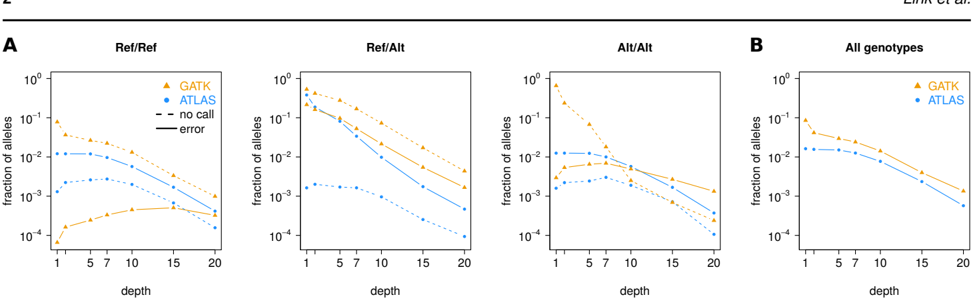
Summary: Post-mortem damage (PMD) obstructs the proper analysis of ancient DNA samples and can currently only be addressed by removing or down-weighting potentially damaged data. Here we present ATLAS, a suite of methods to accurately genotype and estimate genetic diversity from ancient samples, while accounting for PMD. It works directly from raw BAM files and enables the building of complete and customized pipelines for the analysis of ancient and other low-depth samples in a very user-friendly way. Based on simulations we show that, in the presence of PMD, a dedicated pipeline of ATLAS calls genotypes more accurately than the state-of-the-art pipeline of GATK combined with mapDamage 2.0. Availability: ATLAS is an open-source C++ program freely available at https://bitbucket.org/phaentu/atlas . Contact: Daniel.Wegmann@unifr.ch Supplementary information: Supplementary data are available at Bioinformatics online .
Overview
The claims and statistics of this paper haven’t been checked yet.
Run the check — free, no account needed. It reads the open-access text and checks the sources it cites.
Integrity signals
Registry
Cites
Statistics
Figures




Verification
Claims the paper makes
The claims and statistics of this paper haven’t been checked yet.
Run the check — free, no account needed. It reads the open-access text and checks the sources it cites.
Claims other papers make about this one
Each is checked against this paper’s own text: does it say what the citing paper says it does?
The check wasn’t confident either way, so it gives no verdict — never disputed.
In the citing paper
“During the Neolithic (2), the arrival of farming populations dramatically shifted the genetic profile of individuals in Britain towards Anatolian Neolithic Farmers (ANF, yellow).”
From Ancient DNA analysis (2021) · cites this paper as [348]
Experimental — accuracy not yet measuredThe check wasn’t confident either way, so it gives no verdict — never disputed.
In the citing paper
“The gene pool of people who lived in present-day Britain has considerably changed through time, reflecting a complex migration and admixture history.”
From Ancient DNA analysis (2021) · cites this paper as [348]
Experimental — accuracy not yet measuredThe check wasn’t confident either way, so it gives no verdict — never disputed.
In the citing paper
“Then, beginning in the Chalcolithic period and continuing through the Bronze Age (Early Bronze Age, EBA) (3), the genetic profile of individuals in Britain shifted again, this time towards Western Steppe Herders (WSH, pink) from the Pontic steppes associated with the expansion of the Bell Beaker cultural phenomenon across Europe.”
From Ancient DNA analysis (2021) · cites this paper as [348]
Experimental — accuracy not yet measuredThe check wasn’t confident either way, so it gives no verdict — never disputed.
In the citing paper
“During the Paleolithic and Mesolithic periods (1), individuals in Britain genetically resembled Western Hunter Gatherer (WHG, blue) populations found at that time throughout much of Western Europe.”
From Ancient DNA analysis (2021) · cites this paper as [348]
Experimental — accuracy not yet measured
Self-check
Percentages, sums and reported differences re-computed from the paper’s own numbers.
The self-check needs the paper’s full text.
Citations
Cites
Inference of human population history from individual whole-genome sequences
Li, H., & Durbin, R. (2011) · Nature · doi:10.1038/nature10231 · Cited by 2,590
mapDamage2.0: fast approximate Bayesian estimates of ancient DNA damage parameters
Jónsson, H., Ginolhac, A., Schubert, M., Johnson, P. L. F., & Orlando, L. (2013) · Bioinformatics · doi:10.1093/bioinformatics/btt193 · Cited by 1,669
Genotype and SNP calling from next-generation sequencing data
Nielsen, R., Paul, J. S., Albrechtsen, A., & Song, Y. S. (2011) · Nature Reviews Genetics · doi:10.1038/nrg2986 · Cited by 1,396
Genome flux and stasis in a five millennium transect of European prehistory
Gamba, C., Jones, E. R., Teasdale, M. D., McLaughlin, R. L., Gonzalez-Fortes, G., Mattiangeli, V., Domboróczki, L., Kővári, I., Pap, I., Anders, A., et al. (2014) · Nature Communications · doi:10.1038/ncomms6257 · Cited by 667
Separating endogenous ancient DNA from modern day contamination in a Siberian Neandertal
Skoglund, P., Northoff, B. H., Shunkov, M. V., Derevianko, A. P., Pääbo, S., Krause, J., & Jakobsson, M. (2014) · Proceedings of the National Academy of Sciences · doi:10.1073/pnas.1318934111 · Cited by 499
Early farmers from across Europe directly descended from Neolithic Aegeans
Hofmanová, Z., Kreutzer, S., Hellenthal, G., Sell, C., Diekmann, Y., Díez-del-Molino, D., van Dorp, L., López, S., Kousathanas, A., Link, V., et al. (2016) · Proceedings of the National Academy of Sciences · doi:10.1073/pnas.1523951113 · Cited by 488
Self-citation
Research works printed but not linked: 9
- 10.1093/sysbio/syr100 · DOI
- 10.1093/bioinformatics/btr174 · DOI
- Briggs, A. and Stenzel, U. (2007). Patterns of damage in genomic DNA sequences from a Neandertal. Proc. Natl Acad. Sci. USA, 104, 14616–14621. · DOI · Paper page
- 10.1093/nar/gkp829 · DOI
- 10.1038/ng.806 · DOI
- 10.1038/srep17875 · DOI
- 10.1534/genetics.116.189985 · DOI
- 10.1093/bioinformatics/btp352 · DOI · Paper page
- 10.1038/nprot.2014.063 · DOI · Paper page
Cited by
Sorted by citations
Orlando, L., Allaby, R., Skoglund, P., Der Sarkissian, C., Stockhammer, P. W., Ávila-Arcos, M. C., Fu, Q., Krause, J., Willerslev, E., Stone, A. C., et al. (2021) · Nature Reviews Methods Primers · doi:10.1038/s43586-020-00011-0 · Cited by 411
Günther, T., & Nettelblad, C. (2019) · PLOS Genetics · doi:10.1371/journal.pgen.1008302 · Cited by 228
Martiniano, R., Garrison, E., Jones, E. R., Manica, A., & Durbin, R. (2020) · Genome Biology · doi:10.1186/s13059-020-02160-7 · Cited by 128
“There have been previous attempts to mitigate the effects of reference bias and low coverage in aDNA, such as by implementing a model of reference bias in genotyping [11], or by working with genotype likelihoods throughout all downstream population genetic analyses [12].”
MethodsnpAD: an ancient DNA genotype caller
Prüfer, K. (2018) · Bioinformatics · doi:10.1093/bioinformatics/bty507 · Cited by 78
Metadata
- Authors
- Link, V., Kousathanas, A., Veeramah, K., Sell, C., Scheu, A., & Wegmann, D.
- ORCID
- Wegmann, Daniel
- Publisher
- openRxiv
- Published
- 2017-02-02
- Cited by
- 114
- References
- 6
- Type
- Preprint
About these checks
Registry, retraction, Cites and statistics results are computed, not judged, with one exception: a printed reference that no index lists is read once by a model before it counts as a citation error. Claims are extracted by a model and kept only when their quote appears verbatim in the text; each cited source is then checked, with a model’s help, for whether it says what the claim relies on. Those verdicts can be wrong — read the claim’s quote and the cited source before relying on one.
Statistics and arithmetic are recomputed, not judged.
Confidence bands are shown only for fields calibrated on our annotated test set. None is calibrated yet, so no band is shown.
What counts as a claim ›How we measure confidence ›How we check this ›
Are you an author, or do you see a problem with this page? Request a review
