

The DOI matches its Crossref record; 69 of the 69 references it cites were found in a registry or an index.
Estimated transmissibility and impact of SARS-CoV-2 lineage B.1.1.7 in England
Open accessPreprint — published as 10.1126/science.abg3055 · Paper page
Abstract
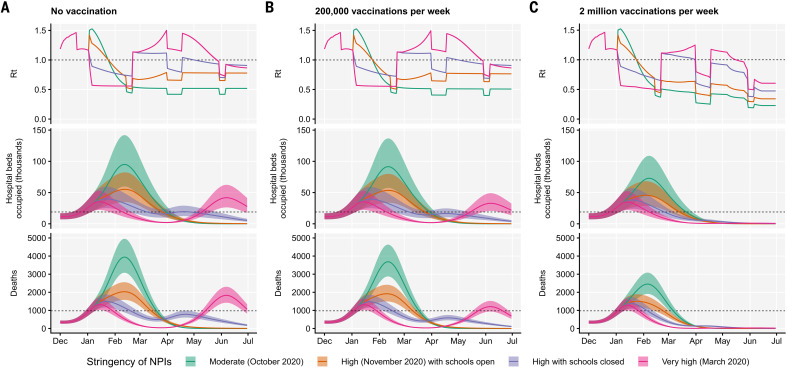
A novel SARS-CoV-2 variant, VOC 202012/01 (lineage B.1.1.7), emerged in southeast England in November 2020 and is rapidly spreading towards fixation. Using a variety of statistical and dynamic modelling approaches, we estimate that this variant has a 43–90% (range of 95% credible intervals 38–130%) higher reproduction number than preexisting variants. A fitted two-strain dynamic transmission model shows that VOC 202012/01 will lead to large resurgences of COVID-19 cases. Without stringent control measures, including limited closure of educational institutions and a greatly accelerated vaccine roll-out, COVID-19 hospitalisations and deaths across England in 2021 will exceed those in 2020. Concerningly, VOC 202012/01 has spread globally and exhibits a similar transmission increase (59–74%) in Denmark, Switzerland, and the United States.
Overview
The claims and statistics of this paper haven’t been checked yet.
Run the check — free, no account needed. It reads the open-access text and checks the sources it cites.
Integrity signals
Registry
Cites
Statistics
Figures
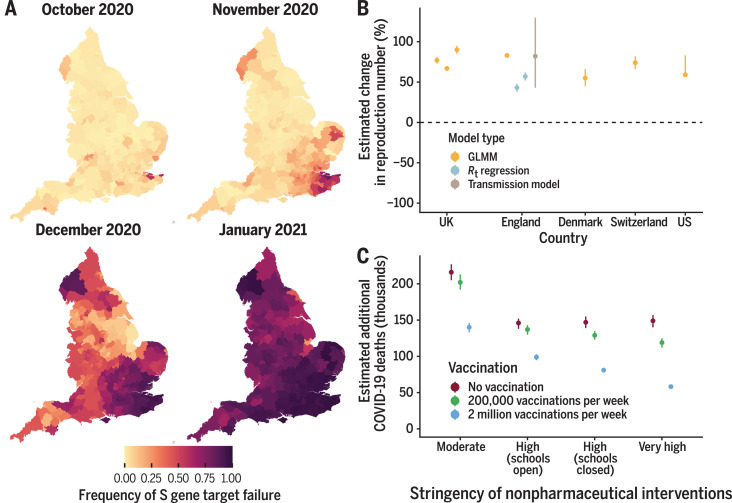
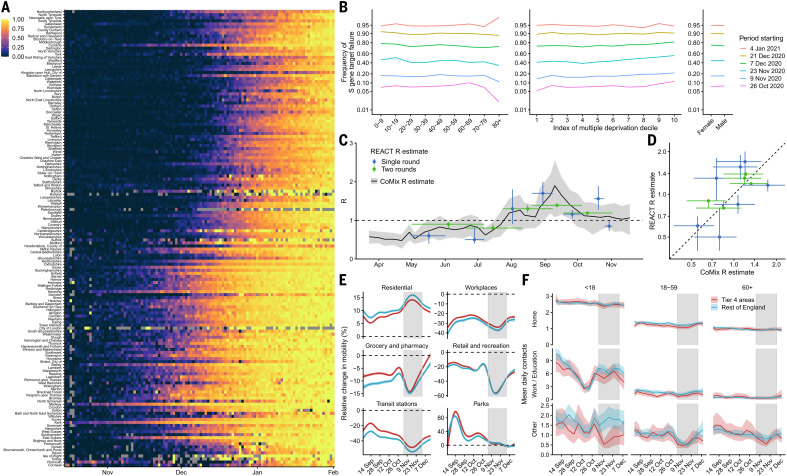
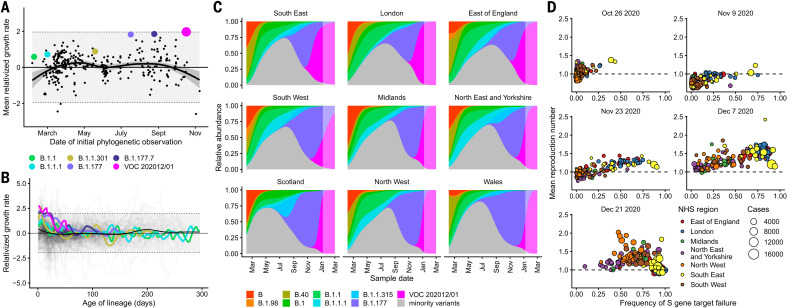
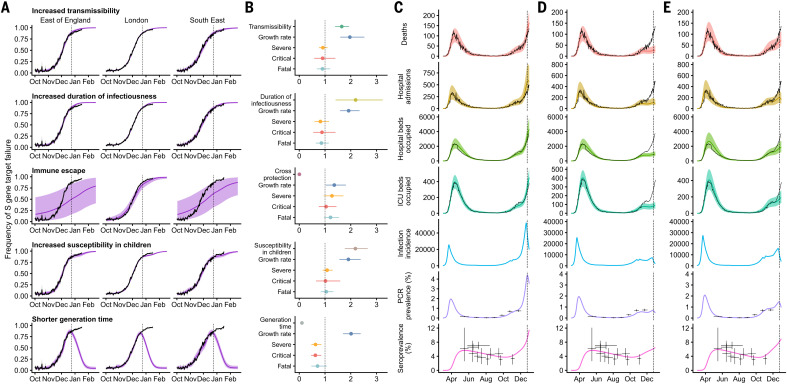
Verification
Claims the paper makes
The claims and statistics of this paper haven’t been checked yet.
Run the check — free, no account needed. It reads the open-access text and checks the sources it cites.
Claims other papers make about this one
Each is checked against this paper’s own text: does it say what the citing paper says it does?
The check wasn’t confident either way, so it gives no verdict — never disputed.
In the citing paper
“In addition, similar results have been reported by others using vaccinee and convalescent plasmas and a variety of different pseudotype and authentic virus assays15,31,45–49.”
From mRNA vaccine-elicited antibodies to SARS-CoV-2 and circulating variants (2021) · cites this paper as [15]
Experimental — accuracy not yet measuredIn the citing paper
“They are frequently sensitive to mutation in these residues and select for K417N, E484K and N501Y mutations in SARS-CoV-2 S protein expression libraries in yeast and VSV 12,15,33.”
From mRNA vaccine-elicited antibodies to SARS-CoV-2 and circulating variants (2021) · cites this paper as [15]
In the citing paper
“Additionally, K417N, Y453F, S477R, N501Y, and D614G represent circulating variants some of which have been associated with rapidly increasing case numbers14,15,19,33–35.”
From mRNA vaccine-elicited antibodies to SARS-CoV-2 and circulating variants (2021) · cites this paper as [15]
Self-check
Percentages, sums and reported differences re-computed from the paper’s own numbers.
The self-check needs the paper’s full text.
Citations
Cites
Early transmission dynamics in Wuhan, China, of novel coronavirus-infected pneumonia
Li, Q., Guan, X., Wu, P., Wang, X., Zhou, L., Tong, Y., Ren, R., Leung, K. S. M., Lau, E. H. Y., Wong, J. Y., et al. (2020) · New England Journal of Medicine · doi:10.1056/nejmoa2001316 · Cited by 16,575
Lauer, S. A., Grantz, K. H., Bi, Q., Jones, F. K., Zheng, Q., Meredith, H. R., Azman, A. S., Reich, N. G., & Lessler, J. (2020) · Annals of Internal Medicine · doi:10.7326/m20-0504 · Cited by 5,970
Ethier, S. N., & Kurtz, T. G. (1986) · Wiley series in probability and statistics · doi:10.1002/9780470316658 · Cited by 3,662
Docherty, A. B., Harrison, E. M., Green, C. A., Hardwick, H. E., Pius, R., Norman, L., Holden, K. A., Read, J. M., Dondelinger, F., Carson, G., et al. (2020) · BMJ · doi:10.1136/bmj.m1985 · Cited by 3,481
Advanced Bayesian Multilevel Modeling with the R Package brms
Bürkner, P.-C. (2018) · The R Journal · doi:10.32614/rj-2018-017 · Cited by 3,015
Social Contacts and Mixing Patterns Relevant to the Spread of Infectious Diseases
Mossong, J., Hens, N., Jit, M., Beutels, P., Auranen, K., Mikolajczyk, R., Massari, M., Salmaso, S., Tomba, G. S., Wallinga, J., et al. (2008) · PLoS Medicine · doi:10.1371/journal.pmed.0050074 · Cited by 2,900
Self-citationProjecting the transmission dynamics of SARS-CoV-2 through the postpandemic period
Kissler, S. M., Tedijanto, C., Goldstein, E., Grad, Y. H., & Lipsitch, M. (2020) · Science · doi:10.1126/science.abb5793 · Cited by 2,611
Estimated transmissibility and impact of SARS-CoV-2 lineage B.1.1.7 in England
Davies, N. G., Abbott, S., Barnard, R. C., Jarvis, C. I., Kucharski, A. J., Munday, J. D., Pearson, C. A. B., Russell, T. W., Tully, D. C., Washburne, A. D., et al. (2021) · Science · doi:10.1126/science.abg3055 · Cited by 2,581
Self-citationA dynamic nomenclature proposal for SARS-CoV-2 lineages to assist genomic epidemiology
Rambaut, A., Holmes, E. C., O’Toole, Á., Hill, V., McCrone, J. T., Ruis, C., du Plessis, L., & Pybus, O. G. (2020) · Nature Microbiology · doi:10.1038/s41564-020-0770-5 · Cited by 2,543
Tegally, H., Wilkinson, E., Giovanetti, M., Iranzadeh, A., Fonseca, V., Giandhari, J., Doolabh, D., Pillay, S., San, E. J., Msomi, N., et al. (2020) · doi:10.1101/2020.12.21.20248640 · Cited by 2,535
Cited by
Sorted by citations
Features, Evaluation and Treatment Coronavirus (COVID-19)
Cascella, M., Rajnik, M., Cuomo, A., Dulebohn, S. C., & Napoli, R. D. (2020) · StatPearls · Cited by 3,351
Mechanisms of SARS-CoV-2 entry into cells
Jackson, C. B., Farzan, M., Chen, B., & Choe, H. (2022) · Nature Reviews Molecular Cell Biology · doi:10.1038/s41580-021-00418-x · Cited by 3,022
Estimated transmissibility and impact of SARS-CoV-2 lineage B.1.1.7 in England
Davies, N. G., Abbott, S., Barnard, R. C., Jarvis, C. I., Kucharski, A. J., Munday, J. D., Pearson, C. A. B., Russell, T. W., Tully, D. C., Washburne, A. D., et al. (2021) · Science · doi:10.1126/science.abg3055 · Cited by 2,581
Self-citationGlobal impact of the first year of COVID-19 vaccination: a mathematical modelling study
Watson, O. J., Barnsley, G., Toor, J., Hogan, A. B., Winskill, P., & Ghani, A. C. (2022) · The Lancet Infectious Diseases · doi:10.1016/s1473-3099(22)00320-6 · Cited by 1,769
Rapid epidemic expansion of the SARS-CoV-2 Omicron variant in southern Africa
Viana, R. P. E. S., Moyo, S. M., Amoako, D. G., Tegally, H., Scheepers, C., Althaus, C. L., Anyaneji, U. J., Bester, P. A., Boni, M. F., Chand, M., et al. (2022) · Nature · doi:10.1038/s41586-022-04411-y · Cited by 1,678
Metadata
- Authors
- Davies, N. G., Abbott, S., Barnard, R. C., Jarvis, C. I., Kucharski, A. J., Munday, J. D., Pearson, C. A. B., Russell, T. W., Tully, D. C., Washburne, A. D., Wenseleers, T., Gimma, A., Waites, W., Wong, K. L. M., van Zandvoort, K., Silverman, J. D., CMMID COVID-19 Working Group, The COVID-19 Genomics UK (COG-UK) Consortium, Diaz-Ordaz, K., Keogh, R., Eggo, R. M., Funk, S., Jit, M., Atkins, K. E., & Edmunds, W. J.
- Affiliations
- London School of Hygiene & Tropical Medicine (GB)
- KU Leuven (BE)
- Pennsylvania State University (US)
- Corresponding author
- Davies, Nicholas G.
- ORCID
- Davies, Nicholas G.
- Abbott, Sam
- Barnard, Rosanna C.
- Jarvis, Christopher I.
- Kucharski, Adam J.
- Munday, James D.
- Pearson, Carl A. B.
- Russell, Timothy W.
- Tully, Damien C.
- Washburne, Alex D.
- Wenseleers, Tom
- Gimma, Amy
- Waites, William
- Wong, Kerry L. M.
- van Zandvoort, Kevin
- Silverman, Justin D.
- Keogh, Ruth
- Eggo, Rosalind M.
- Funk, Sebastian
- Jit, Mark
- Atkins, Katherine E.
- Edmunds, W. John
- Venue
- Science
- Publisher
- openRxiv
- Published
- 2020-12-26
- Volume
- 372
- Issue
- 6538
- ISSN
- 0036-8075 (ISSN-L)
- PMC
- PMC8128288
- OpenAlex
- W3134208712
- Cited by
- 2,557
- References
- 60
- Citations by year
- 2026: 54 · 2025: 90 · 2024: 184 · 2023: 323 · 2022: 839 · 2021: 1060 · 2020: 6
- FWCI
- 233.82
- Type
- journal article
- Language
- en
- Open access
- hybrid
- doi.org
- Licence
- cc-by
- Locations
- Science (publishedVersion, cc-by)
- medRxiv (acceptedVersion, cc-by)
- PubMed Central (publishedVersion, cc-by)
- PubMed (publishedVersion)
- University of Birmingham Research Portal (University of Birmingham) (publishedVersion, cc-by)
- ORCA Online Research @Cardiff (Cardiff University) (acceptedVersion, cc-by)
- Northumbria Research Link (Northumbria University) (acceptedVersion)
- LSHTM Research Online (London School of Hygiene and Tropical Medicine) (acceptedVersion)
- Strathprints: The University of Strathclyde institutional repository (University of Strathclyde) (acceptedVersion)
- Informationszentrum Lebenswissenschaften (ZB MED) (submittedVersion, cc-by)
- Lirias (KU Leuven) (submittedVersion, other-oa)
- Edinburgh Research Explorer (University of Edinburgh) (submittedVersion, cc-by)
- Apollo (University of Cambridge) (submittedVersion)
- Apollo
- Funders
- Bill and Melinda Gates Foundation (INV-016832, OPP1184344, INV-003174)
- University of Kentucky
- University of Bern
- Wellcome Trust (206250, 210758/Z/18/Z, 206250/Z/17/Z, Z/17/Z, 221303/Z/20/Z, 221303, 210758, 218554/Z/19/Z)
- UK Research and Innovation (ES/P010873/1, ES/P010873, MC_PC_19027)
- Universitätsspital Basel
- National Institute for Health Research Health Protection Research Unit (NIHR200908, NIHR200929)
- National Institute for Health and Care Research ((NIHR200929), MR/V027956/1, (NIHR200908), 16/137/109, 16/137/10)
- Research Councils UK (MR/S003975/1, ES/P010873/1)
- Academy of Medical Sciences (AMS-CSF4-Torok)
- University of Warwick
- European Commission (101003688, COVID-19, 19065)
- Public Health England
- CANDU Owners Group
- Eidgenössische Technische Hochschule Zürich
- Hôpitaux Universitaires de Genève
- Université de Sfax
- Foreign, Commonwealth and Development Office (221303/Z/20/Z)
- Medical Research Council (MR/S003975/1, 206250/Z/17/Z, MR/V027956/1, NIHR200908, COVID-19, MC_PC_19065)
- Economic and Social Research Council (ES/P010873/1)
- Statens Serum Institut
- Research England
- National Institute of General Medical Sciences (T32GM145449)
- H2020 European Research Council (757688)
- Health Data Research UK
- Topics
- Physical Sciences › Mathematics › Modeling and Simulation › COVID-19 epidemiological studies
- Health Sciences › Medicine › Infectious Diseases › SARS-CoV-2 and COVID-19 Research
- Physical Sciences › Mathematics › Applied Mathematics › Mathematical and Theoretical Epidemiology and Ecology Models
- Keywords
- SARS-CoV-2, B.1.1.7 variant, reproduction number, SARS-CoV-2 transmission, epidemic forecasting, COVID-19 containment measures, vaccine rollout, school closures, England
- MeSH terms
- COVID-19, SARS-CoV-2, COVID-19 Vaccines, Adolescent, Adult, Aged, Aged, 80 and over, Child, Child, Preschool, Communicable Disease Control, England, Europe, Female, Humans, Infant, Male, Middle Aged, Models, Theoretical, Mutation, Severity of Illness Index, Socioeconomic Factors, United States, Viral Load, Basic Reproduction Number, Young Adult
About these checks
Registry, retraction, Cites and statistics results are computed, not judged, with one exception: a printed reference that no index lists is read once by a model before it counts as a citation error. Claims are extracted by a model and kept only when their quote appears verbatim in the text; each cited source is then checked, with a model’s help, for whether it says what the claim relies on. Those verdicts can be wrong — read the claim’s quote and the cited source before relying on one.
Statistics and arithmetic are recomputed, not judged.
Confidence bands are shown only for fields calibrated on our annotated test set. None is calibrated yet, so no band is shown.
What counts as a claim ›How we measure confidence ›How we check this ›
Are you an author, or do you see a problem with this page? Request a review
