

The DOI matches its Crossref record; 43 of the 43 references it cites were found in a registry or an index.
Genomic characterization and Epidemiology of an emerging SARS-CoV-2 variant in Delhi, India
Open accessPreprint — published as 10.1126/science.abj9932
Abstract
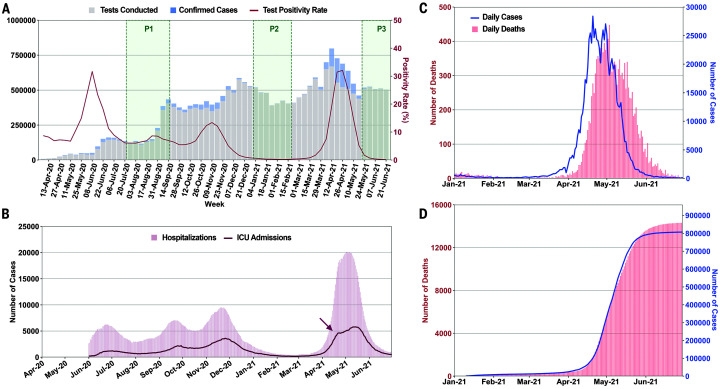
Delhi, the national capital of India, has experienced multiple SARS-CoV-2 outbreaks in 2020 and reached a population seropositivity of over 50% by 2021. During April 2021, the city became overwhelmed by COVID-19 cases and fatalities, as a new variant B.1.617.2 (Delta) replaced B.1.1.7 (Alpha). A Bayesian model explains the growth advantage of Delta through a combination of increased transmissibility and partial reduction of immunity elicited by prior infection (median estimates; ×1.5-fold, 20% reduction). Seropositivity of an employee and family cohort increased from 42% to 86% between March and July 2021, with 27% reinfections, as judged by increased antibody concentration after previous decline. The likely high transmissibility and partial evasion of immunity by the Delta variant contributed to an overwhelming surge in Delhi. One-Sentence Summary: Delhi experienced an overwhelming surge of COVID-19 cases and fatalities peaking in May 2021 as the highly transmissible and immune evasive Delta variant replaced the Alpha variant.
Overview
The claims and statistics of this paper haven’t been checked yet.
Run the check — free, no account needed. It reads the open-access text and checks the sources it cites.
Integrity signals
Registry
Cites
Statistics
Figures


Verification
Claims the paper makes
The claims and statistics of this paper haven’t been checked yet.
Run the check — free, no account needed. It reads the open-access text and checks the sources it cites.
Claims other papers make about this one
Each is checked against this paper’s own text: does it say what the citing paper says it does?
In the citing paper
“Studies in India have estimated that the delta variant could be up to 50% more transmissible than the alpha variant.8”
From Hospital admission and emergency care attendance risk for SARS-CoV-2 delta (B.1.617.2) compared with alpha (B.1.1.7) variants of concern: a cohort study (2022) · cites this paper as [8]
Self-check
Percentages, sums and reported differences re-computed from the paper’s own numbers.
The self-check needs the paper’s full text.
Citations
Cites
IQ-TREE 2: New Models and Efficient Methods for Phylogenetic Inference in the Genomic Era
Minh, B. Q., Schmidt, H. A., Chernomor, O., Schrempf, D., Woodhams, M. D., von Haeseler, A., & Lanfear, R. (2020) · Molecular Biology and Evolution · doi:10.1093/molbev/msaa015 · Cited by 16,873
A new coronavirus associated with human respiratory disease in China
Wu, F., Zhao, S., Yu, B., Chen, Y.-M., Wang, W., Song, Z.-G., Hu, Y., Tao, Z.-W., Tian, J.-H., Pei, Y.-Y., et al. (2020) · Nature · doi:10.1038/s41586-020-2008-3 · Cited by 11,688
Estimating the effects of non-pharmaceutical interventions on COVID-19 in Europe
Flaxman, S. R., Mishra, S., Gandy, A., Unwin, H. J. T., Mellan, T. A., Coupland, H., Whittaker, C., Zhu, H., Berah, T., Eaton, J. W., et al. (2020) · Nature · doi:10.1038/s41586-020-2405-7 · Cited by 3,398
Self-citationNextstrain: real-time tracking of pathogen evolution
Hadfield, J., Megill, C., Bell, S. M., Huddleston, J., Potter, B., Callender, C., Sagulenko, P., Bedford, T., & Neher, R. A. (2018) · Bioinformatics · doi:10.1093/bioinformatics/bty407 · Cited by 3,154
GISAID: Global initiative on sharing all influenza data – from vision to reality
Shu, Y., & McCauley, J. (2017) · Eurosurveillance · doi:10.2807/1560-7917.es.2017.22.13.30494 · Cited by 3,039
Effectiveness of Covid-19 Vaccines against the B.1.617.2 (Delta) Variant
Lopez Bernal, J., Andrews, N., Gower, C., Gallagher, E., Simmons, R., Thelwall, S., Stowe, J., Tessier, E., Groves, N., Dabrera, G., et al. (2021) · New England Journal of Medicine · doi:10.1056/nejmoa2108891 · Cited by 2,889
Immunological memory to SARS-CoV-2 assessed for up to 8 months after infection.
Dan, J. M., Mateus, J., Kato, Y., Hastie, K. M., Yu, E. D., Faliti, C. E., Grifoni, A., Ramirez, S. I., Haupt, S., Frazier, A., et al. (2021) · Science · doi:10.1126/science.abf4063 · Cited by 2,656
Estimated transmissibility and impact of SARS-CoV-2 lineage B.1.1.7 in England
Davies, N. G., Abbott, S., Barnard, R. C., Jarvis, C. I., Kucharski, A. J., Munday, J. D., Pearson, C. A. B., Russell, T. W., Tully, D. C., Washburne, A. D., et al. (2021) · Science · doi:10.1126/science.abg3055 · Cited by 2,581
A dynamic nomenclature proposal for SARS-CoV-2 lineages to assist genomic epidemiology
Rambaut, A., Holmes, E. C., O’Toole, Á., Hill, V., McCrone, J. T., Ruis, C., du Plessis, L., & Pybus, O. G. (2020) · Nature Microbiology · doi:10.1038/s41564-020-0770-5 · Cited by 2,543
Folegatti, P. M., Ewer, K. J., Aley, P. K., Angus, B., Becker, S., Belij-Rammerstorfer, S., Bellamy, D., Bibi, S., Bittaye, M., Clutterbuck, E. A., et al. (2020) · The Lancet · doi:10.1016/s0140-6736(20)31604-4 · Cited by 2,419
Research works printed but not linked: 1
- Ferreira, Isabella et al. SARS-CoV-2 B.1.617 mutations L452 and E484Q are not synergistic for antibody evasion. The Journal of infectious diseases, jiab368.
Cited by
Sorted by citations
Global impact of the first year of COVID-19 vaccination: a mathematical modelling study
Watson, O. J., Barnsley, G., Toor, J., Hogan, A. B., Winskill, P., & Ghani, A. C. (2022) · The Lancet Infectious Diseases · doi:10.1016/s1473-3099(22)00320-6 · Cited by 1,769
Rapid epidemic expansion of the SARS-CoV-2 Omicron variant in southern Africa
Viana, R. P. E. S., Moyo, S. M., Amoako, D. G., Tegally, H., Scheepers, C., Althaus, C. L., Anyaneji, U. J., Bester, P. A., Boni, M. F., Chand, M., et al. (2022) · Nature · doi:10.1038/s41586-022-04411-y · Cited by 1,678
SARS-CoV-2 B.1.617.2 Delta variant replication and immune evasion
Mlcochova, P., Kemp, S. A., Dhar, M. S., Papa, G., Meng, B., Ferreira, I. A. T. M., Datir, R., Collier, D. A., Albecka, A., Singh, S., et al. (2021) · Nature · doi:10.1038/s41586-021-03944-y · Cited by 1,337
Self-citationSARS-CoV-2 variant biology: immune escape, transmission and fitness
Carabelli, A. M., Peacock, T. P., Thorne, L., Harvey, W. T., Hughes, J., de Silva, T. I., Peacock, S. J., Barclay, W., de Silva, T. I., Towers, G. J., et al. (2023) · Nature Reviews Microbiology · doi:10.1038/s41579-022-00841-7 · Cited by 1,386
Markov, P. V., Ghafari, M., Beer, M., Lythgoe, K., Simmonds, P., Stilianakis, N. I., & Katzourakis, A. (2023) · Nature Reviews Microbiology · doi:10.1038/s41579-023-00878-2 · Cited by 1,179
Metadata
- Authors
- Dhar, M. S., Marwal, R., Radhakrishnan, V., Ponnusamy, K., Jolly, B., Bhoyar, R. C., Sardana, V., Naushin, S., Rophina, M., Mellan, T. A., Mishra, S., Whittaker, C., Fatihi, S., Datta, M., Singh, P., Sharma, U., Ujjainiya, R., Batheja, N., Divakar, M. K., Singh, M. K., Imran, M., Senthivel, V., Maurya, R., Jha, N., Mehta, P., Vivekanand, A., Sharma, P., Arvinden, V., Chaudhary, U., Soni, N., Thukral, L., Flaxman, S., Bhatt, S., Pandey, R., Dash, D., Faruq, M., Lall, H., Gogia, H., Madan, P., Kulkarni, S., Chauhan, H., Sengupta, S., Kabra, S., The Indian SARS-CoV-2 Genomics Consortium (INSACOG), Gupta, R. K., Singh, S. K., Agrawal, A., & Rakshit, P.
- Affiliations
- National Center for Disease Control (IN)
- Institute of Genomics and Integrative Biology (IN)
- Imperial College London (GB)
- University of Copenhagen (DK)
- University of Cambridge (GB)
- Corresponding author
- Dhar, Mahesh S
- Marwal, Robin
- Radhakrishnan, VS
- Ponnusamy, Kalaiarasan
- Jolly, Bani
- Bhoyar, Rahul C.
- Agrawal, Anurag
- Rakshit, Partha
- ORCID
- Dhar, Mahesh S
- Marwal, Robin
- Radhakrishnan, VS
- Ponnusamy, Kalaiarasan
- Jolly, Bani
- Bhoyar, Rahul C.
- Sardana, Viren
- Naushin, Salwa
- Rophina, Mercy
- Mellan, Thomas A
- Mishra, Swapnil
- Whittaker, Charles
- Fatihi, Saman
- Singh, Priyanka
- Sharma, Uma
- Ujjainiya, Rajat
- Divakar, Mohit Kumar
- Singh, Manoj K
- Imran, Mohamed
- Senthivel, Vigneshwar
- Maurya, Ranjeet
- Jha, Neha
- Mehta, Priyanka
- Vivekanand, A
- Sharma, Pooja
- Arvinden, VR
- Chaudhary, Urmila
- Thukral, Lipi
- Flaxman, Seth
- Bhatt, Samir
- Pandey, Rajesh
- Dash, Debasis
- Faruq, Mohammed
- Lall, Hemlata
- Madan, Preeti
- Kulkarni, Sanket
- Chauhan, Himanshu
- Sengupta, Shantanu
- Gupta, Ravindra K.
- Singh, Sujeet K
- Agrawal, Anurag
- Rakshit, Partha
- Venue
- Science
- Publisher
- openRxiv
- Published
- 2021-06-03
- Volume
- 374
- Issue
- 6570
- Pages
- 995-999
- ISSN
- 0036-8075 (ISSN-L)
- PMC
- PMC7612010
- OpenAlex
- W3205588626
- Cited by
- 296
- References
- 43
- Citations by year
- 2026: 7 · 2025: 19 · 2024: 38 · 2023: 65 · 2022: 115 · 2021: 51
- FWCI
- 21.30
- Type
- journal article
- Language
- en
- Open access
- hybrid
- doi.org
- Licence
- cc-by
- Locations
- Science (publishedVersion, cc-by)
- medRxiv (acceptedVersion, cc-by)
- PubMed Central (publishedVersion, cc-by)
- PubMed (publishedVersion)
- Research at the University of Copenhagen (University of Copenhagen) (publishedVersion, cc-by)
- Greater South Information System
- Funders
- Wellcome Trust (108082/A/15/Z, 108082)
- Novo Nordisk Fonden (NNF20OC0059309)
- Medical Research Council (MR/R015600/1, MC_PC_19012)
- Engineering and Physical Sciences Research Council (EP/V002910/1, EP/V002910/2)
- Topics
- Health Sciences › Medicine › Infectious Diseases › SARS-CoV-2 and COVID-19 Research
- Physical Sciences › Mathematics › Modeling and Simulation › COVID-19 epidemiological studies
- Health Sciences › Medicine › Infectious Diseases › COVID-19 Clinical Research Studies
- Keywords
- SARS-CoV-2, Delta variant, B.1.1.7 Alpha variant, COVID-19 outbreak, Delhi, genomic profiling, epidemiology, transmissibility, immune evasion, reinfection, seroprevalence, antibody response, Bayesian model
- MeSH terms
- Reinfection, COVID-19, Adolescent, Adult, Child, Humans, India, Phylogeny, Seroepidemiologic Studies, Genome, Viral, Molecular Epidemiology, Young Adult, Immune Evasion
About these checks
Registry, retraction, Cites and statistics results are computed, not judged, with one exception: a printed reference that no index lists is read once by a model before it counts as a citation error. Claims are extracted by a model and kept only when their quote appears verbatim in the text; each cited source is then checked, with a model’s help, for whether it says what the claim relies on. Those verdicts can be wrong — read the claim’s quote and the cited source before relying on one.
Statistics and arithmetic are recomputed, not judged.
Confidence bands are shown only for fields calibrated on our annotated test set. None is calibrated yet, so no band is shown.
What counts as a claim ›How we measure confidence ›How we check this ›
Are you an author, or do you see a problem with this page? Request a review
