CoChat

A new class of polymorphic T6SS effectors and tethers

Open access

Preprint — published as 10.1038/s41467-023-40659-2 · Paper page

The DOI matches its Crossref record; 65 of the 65 references it cites were found in a registry or an index.

Abstract

Bacteria use the type VI secretion system (T6SS) to deliver toxic effectors into bacterial or eukaryotic cells during interbacterial competition, host colonization, or when resisting predation. The identity of many effectors remains unknown. Here, we identify RIX, a new domain that defines a class of polymorphic T6SS cargo effectors. RIX, which is widespread in the Vibrionaceae family, is located at N-termini of proteins containing diverse antibacterial and anti-eukaryotic toxin domains. We demonstrate that RIX-containing proteins are delivered via T6SS into neighboring cells, and that RIX is necessary and sufficient for secretion. We show that RIX-containing proteins can also act as tethers, enabling the T6SS-mediated delivery of other cargo effectors by a previously undescribed mechanism. RIX-containing proteins significantly enlarge the repertoire of known T6SS effectors, especially those with anti-eukaryotic activities. Our findings also suggest that T6SSs may play a major, currently underappreciated, role in interactions between vibrios and eukaryotes.

Overview

The claims and statistics of this paper haven’t been checked yet.

Free: it reads the open-access text and checks the first 5 claims that cite a source we can check. Create a free account to check every claim.

A few free checks a day · papers already verified open instantly · results are public

Integrity signals

Registry

Crossref · 10.1101/2022.10.27.514009

Cites

65 of 65 references verified0 citation errors · 0 not checkable

Statistics

Figures

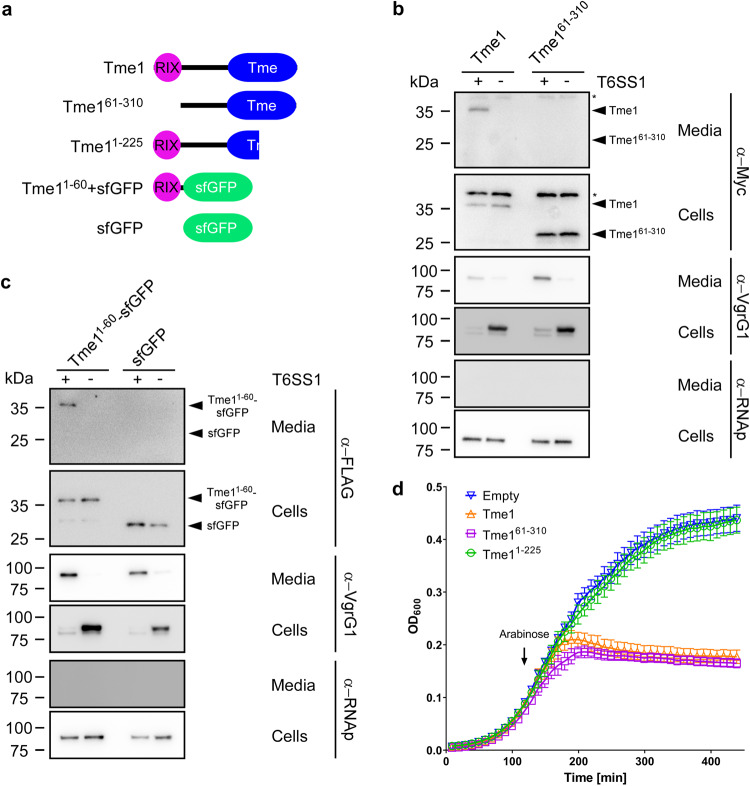
Fig. 1 The N-terminus of Tme1 is necessary and sufficient for T6SS-mediated secretion in V. parahaemolyticus. a Schematic representation of Tme1 truncations and fusion proteins used in this figure. b, c Expression (cells) and secretion (media) of the indicated C-terminal Myc- and FLAG-tagged proteins expressed from pBAD33.1-based plasmids in V. parahaemolyticus BB22OP ∆hns/∆tme1 (T6SS1+; deletion of hns was used to hyper-activate T6SS1) and V. parahaemolyticus BB22OP ∆hns/∆tme1/∆hcp1 (T6SS1−). Samples were grown in MLB supplemented with chloramphenicol and 0.01% (wt/vol) L-arabinose (to induce expression from plasmids) for 3 h at 30 °C. An asterisk denotes a non-specific band detected by the antibody. VgrG1 was used as a T6SS1 secretion positive control; RNA polymerase sigma 70 (RNAp) was used as a loading and lysis control. The experiments were repeated three independent times (b) or two independent times (c) with similar results. Results from representative experiments are shown. d Growth of E. coli BL21 (DE3) containing pPER5 plasmids for the arabinose-inducible expression of the indicated proteins fused to an N-terminal PelB signal peptide (for delivery to the periplasm). An arrow denotes the timepoint (120 min) at which arabinose (0.05% wt/vol) was added to the media. Data are shown as the mean ± SD; n = 4 biological samples. The experiment was repeated four independent times with similar results. Results from a representative experiment are shown. Source data are provided as a Source Data file.
Fig. 1 The N-terminus of Tme1 is necessary and sufficient for T6SS-mediated secretion in V. parahaemolyticus. a Schematic representation of Tme1 truncations and fusion proteins used in this figure. b, c Expression (cells) and secretion (media) of the indicated C-terminal Myc- and FLAG-tagged proteins expressed from pBAD33.1-based plasmids in V. parahaemolyticus BB22OP ∆hns/∆tme1 (T6SS1+; deletion of hns was used to hyper-activate T6SS1) and V. parahaemolyticus BB22OP ∆hns/∆tme1/∆hcp1 (T6SS1−). Samples were grown in MLB supplemented with chloramphenicol and 0.01% (wt/vol) L-arabinose (to induce expression from plasmids) for 3 h at 30 °C. An asterisk denotes a non-specific band detected by the antibody. VgrG1 was used as a T6SS1 secretion positive control; RNA polymerase sigma 70 (RNAp) was used as a loading and lysis control. The experiments were repeated three independent times (b) or two independent times (c) with similar results. Results from representative experiments are shown. d Growth of E. coli BL21 (DE3) containing pPER5 plasmids for the arabinose-inducible expression of the indicated proteins fused to an N-terminal PelB signal peptide (for delivery to the periplasm). An arrow denotes the timepoint (120 min) at which arabinose (0.05% wt/vol) was added to the media. Data are shown as the mean ± SD; n = 4 biological samples. The experiment was repeated four independent times with similar results. Results from a representative experiment are shown. Source data are provided as a Source Data file.CC BY · PubMed Central
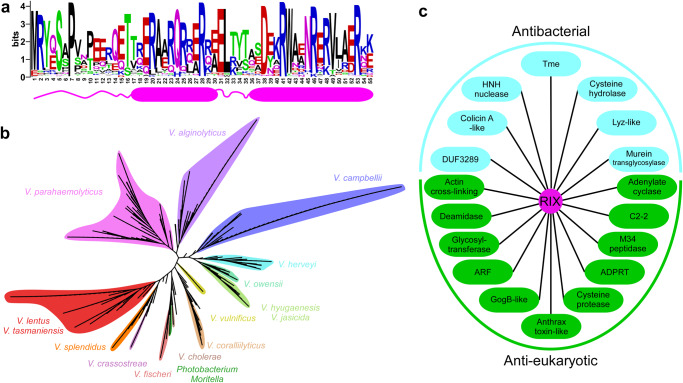
Fig. 2 RIX is found in polymorphic toxins that are widespread in vibrios. a A conserved motif found at the N-terminus of polymorphic toxins (RIX) is illustrated using WebLogo, based on a multiple sequence alignment of sequences homologous to the N-terminal 55 amino acids of Tme1. The position numbers correspond to the amino acids in Tme1. A secondary structure prediction, based on the AlphaFold2 prediction of the Tme1 structure, is shown below. Alpha helices are denoted by cylinders. b Phylogenetic distribution of bacteria encoding a protein with a RIX domain, based on the DNA sequence of rpoB coding for DNA-directed RNA polymerase subunit beta. The evolutionary history was inferred using the neighbor-joining method. c Examples of known and predicted activities and domains found in sequences C-terminal to RIX domains. Lyz, lysozyme; ADPRT, ADP ribosyl transferase; ARF, ADP ribosylation factor.
Fig. 2 RIX is found in polymorphic toxins that are widespread in vibrios. a A conserved motif found at the N-terminus of polymorphic toxins (RIX) is illustrated using WebLogo, based on a multiple sequence alignment of sequences homologous to the N-terminal 55 amino acids of Tme1. The position numbers correspond to the amino acids in Tme1. A secondary structure prediction, based on the AlphaFold2 prediction of the Tme1 structure, is shown below. Alpha helices are denoted by cylinders. b Phylogenetic distribution of bacteria encoding a protein with a RIX domain, based on the DNA sequence of rpoB coding for DNA-directed RNA polymerase subunit beta. The evolutionary history was inferred using the neighbor-joining method. c Examples of known and predicted activities and domains found in sequences C-terminal to RIX domains. Lyz, lysozyme; ADPRT, ADP ribosyl transferase; ARF, ADP ribosylation factor.CC BY · PubMed Central
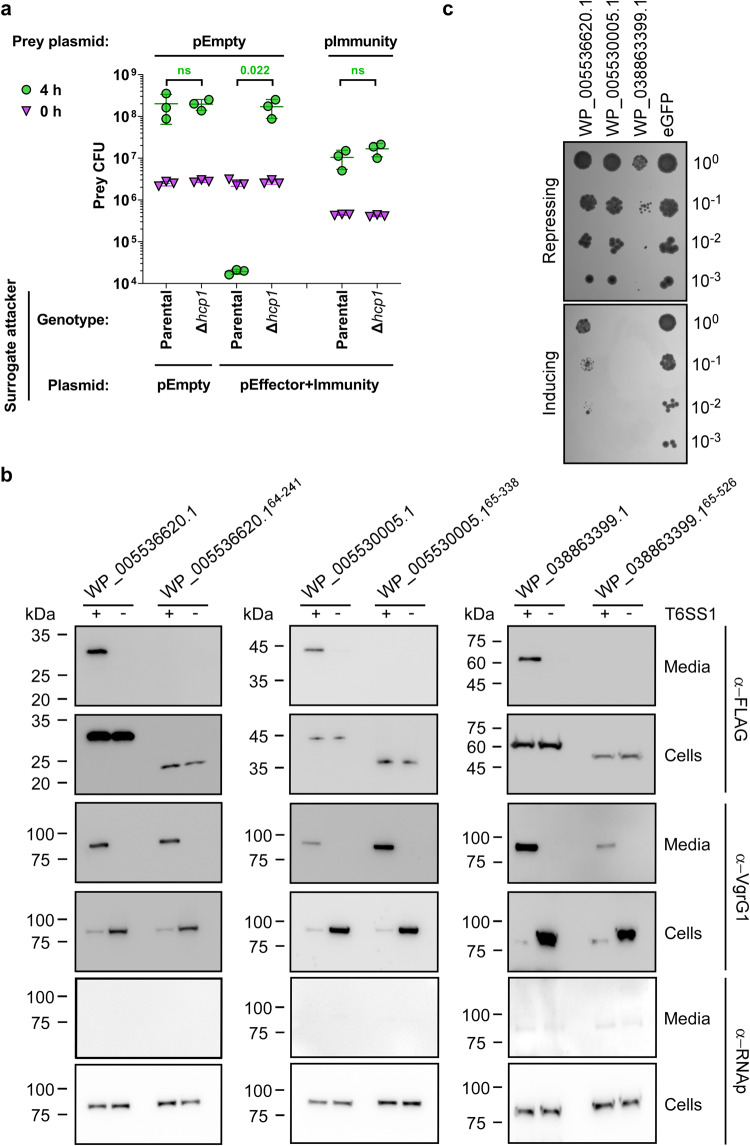
Fig. 3 RIX domain-containing proteins are delivered and secreted by T6SS. a Viability counts (CFU) of V. parahaemolyticus RIMD 2210633 ∆hcp1 prey strains harboring either an empty plasmid (pEmpty) or a plasmid for the arabinose-inducible expression of WP_005534960.1 (pImmunity) before (0 h) and after (4 h) co-incubation with a surrogate attacker strain (V. parahaemolyticus RIMD 2210633 derivative) or its T6SS1− derivative (∆hcp1) carrying an empty plasmid or a plasmid for the arabinose-inducible expression of WP_005534959.1 and WP_005534960.1 (pEffector+Immunity). The statistical significance between samples at the 4 h timepoint was calculated using an unpaired, two-tailed Student’s t-test; ns, no significant difference (p > 0.05). Data are shown as the mean ± SD; n = 3 biological samples. The experiment was repeated three independent times with similar results. Results from a representative experiment are shown. b Expression (cells) and secretion (media) of the indicated C-terminal FLAG-tagged proteins expressed from pBAD33.1F-based plasmids in a V. parahaemolyticus RIMD 2210633-derivative surrogate (T6SS1+) strain or its ∆hcp1 derivative (T6SS1−). Samples were grown in MLB supplemented with chloramphenicol and 0.01% (wt/vol) L-arabinose (to induce expression from plasmids) for 4 h at 30 °C. VgrG1 was used as a T6SS1 secretion positive control; RNA polymerase sigma 70 (RNAp) was used as a loading and lysis control. The experiment was repeated two independent times with similar results. Results from a representative experiment are shown. c Tenfold serial dilutions of yeast strains carrying pGML10 plasmids for the galactose-inducible expression of the indicated C-terminal Myc-tagged protein were spotted on repressing (4% glucose) or inducing (2% wt/vol galactose and 1% wt/vol raffinose) agar plates. eGFP, enhanced GFP. The experiment was repeated three independent times with similar results. Results from a representative experiment are shown. Source data are provided as a Source Data file.
Fig. 3 RIX domain-containing proteins are delivered and secreted by T6SS. a Viability counts (CFU) of V. parahaemolyticus RIMD 2210633 ∆hcp1 prey strains harboring either an empty plasmid (pEmpty) or a plasmid for the arabinose-inducible expression of WP_005534960.1 (pImmunity) before (0 h) and after (4 h) co-incubation with a surrogate attacker strain (V. parahaemolyticus RIMD 2210633 derivative) or its T6SS1− derivative (∆hcp1) carrying an empty plasmid or a plasmid for the arabinose-inducible expression of WP_005534959.1 and WP_005534960.1 (pEffector+Immunity). The statistical significance between samples at the 4 h timepoint was calculated using an unpaired, two-tailed Student’s t-test; ns, no significant difference (p > 0.05). Data are shown as the mean ± SD; n = 3 biological samples. The experiment was repeated three independent times with similar results. Results from a representative experiment are shown. b Expression (cells) and secretion (media) of the indicated C-terminal FLAG-tagged proteins expressed from pBAD33.1F-based plasmids in a V. parahaemolyticus RIMD 2210633-derivative surrogate (T6SS1+) strain or its ∆hcp1 derivative (T6SS1−). Samples were grown in MLB supplemented with chloramphenicol and 0.01% (wt/vol) L-arabinose (to induce expression from plasmids) for 4 h at 30 °C. VgrG1 was used as a T6SS1 secretion positive control; RNA polymerase sigma 70 (RNAp) was used as a loading and lysis control. The experiment was repeated two independent times with similar results. Results from a representative experiment are shown. c Tenfold serial dilutions of yeast strains carrying pGML10 plasmids for the galactose-inducible expression of the indicated C-terminal Myc-tagged protein were spotted on repressing (4% glucose) or inducing (2% wt/vol galactose and 1% wt/vol raffinose) agar plates. eGFP, enhanced GFP. The experiment was repeated three independent times with similar results. Results from a representative experiment are shown. Source data are provided as a Source Data file.CC BY · PubMed Central
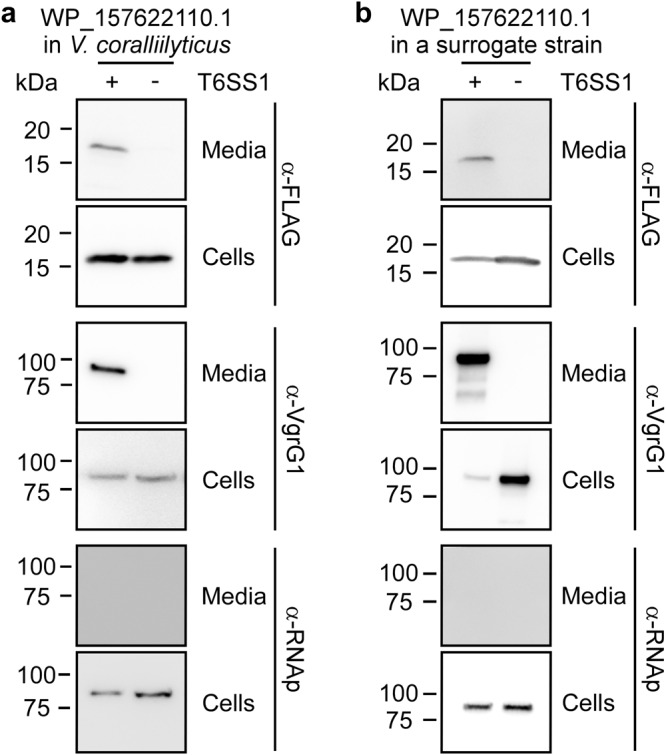
Fig. 4 RIX domain-containing proteins are secreted by their endogenous T6SS. Expression (cells) and secretion (media) of a C-terminal FLAG-tagged WP_157622110.1 expressed from a pBAD33.1F-based plasmid in (a) a V. coralliilyticus BAA-450 wild-type strain (T6SS1+) or its ∆hcp1 derivative (T6SS1−), or (b) a V. parahaemolyticus RIMD 2210633-derivative surrogate (T6SS1+) strain or its ∆hcp1 derivative (T6SS1−). Samples were grown in MLB supplemented with chloramphenicol and 0.05% (wt/vol) L-arabinose (to induce expression from the plasmid) for 4 h at 30 °C. VgrG1 was used as a T6SS1 secretion positive control; RNA polymerase sigma 70 (RNAp) was used as a loading and lysis control. The experiments were repeated three independent times with similar results. Results from representative experiments are shown. Source data are provided as a Source Data file.
Fig. 4 RIX domain-containing proteins are secreted by their endogenous T6SS. Expression (cells) and secretion (media) of a C-terminal FLAG-tagged WP_157622110.1 expressed from a pBAD33.1F-based plasmid in (a) a V. coralliilyticus BAA-450 wild-type strain (T6SS1+) or its ∆hcp1 derivative (T6SS1−), or (b) a V. parahaemolyticus RIMD 2210633-derivative surrogate (T6SS1+) strain or its ∆hcp1 derivative (T6SS1−). Samples were grown in MLB supplemented with chloramphenicol and 0.05% (wt/vol) L-arabinose (to induce expression from the plasmid) for 4 h at 30 °C. VgrG1 was used as a T6SS1 secretion positive control; RNA polymerase sigma 70 (RNAp) was used as a loading and lysis control. The experiments were repeated three independent times with similar results. Results from representative experiments are shown. Source data are provided as a Source Data file.CC BY · PubMed Central
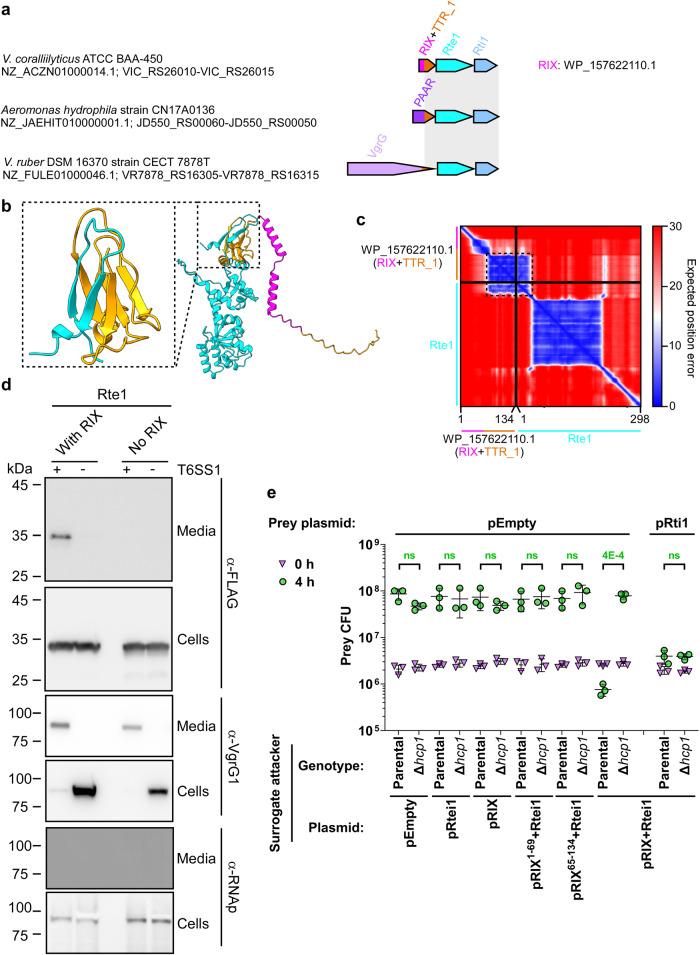
Fig. 5 RIX domain-containing proteins can enable the T6SS-mediated delivery of cargo effectors. a The gene structure of the V. coralliilyticus BAA-450 operon encoding WP_157622110.1. Operons encoding a module homologous to the C-terminal extension of WP_157622110.1, Rte1, and Rti1 are shown below; a gray rectangle denotes the region of homology. Strain names, GenBank accession numbers, and locus tags are provided. Names of encoded proteins or domains are denoted above. TTR, Transthyretin-like. b An AlphaFold2 structure prediction of the complex between WP_157622110.1 (orange; RIX denoted in magenta) and Rte1 (cyan). The interaction interface, corresponding to amino acids 73-134 of WP_157622110.1 (orange) and 1-25 of Rte1 (cyan), is shown inside the dashed rectangle. c The predicted aligned error of the complex shown in (b). Low values indicate well-defined predicted relative position and orientation of two residues. d Expression (cells) and secretion (media) of the C-terminal FLAG-tagged Rte1H94A encoded alone (No RIX) or with WP_157622110.1 (With RIX), expressed from pBAD33.1F-based plasmids in a V. parahaemolyticus RIMD 2210633-derivative surrogate strain (T6SS1+) or its ∆hcp1 derivative strain (T6SS1−). Samples were grown in MLB supplemented with chloramphenicol and 0.01% (wt/vol) L-arabinose (to induce expression from plasmids) for 4 h at 30 °C. VgrG1 was used as a T6SS1 secretion positive control; RNA polymerase sigma 70 (RNAp) was used as a loading and lysis control. The experiment was repeated three independent times with similar results. Results from a representative experiment are shown. e Viability counts (CFU) of V. parahaemolyticus RIMD 2210633 ∆hcp1 prey strains harboring an empty plasmid (pEmpty) or a plasmid for the arabinose-inducible expression of Rti1 (pRti1) before (0 h) and after (4 h) co-incubation with a surrogate attacker V. parahaemolyticus RIMD 2210633 derivative or its T6SS1− derivative (∆hcp1) carrying an empty plasmid or a plasmid for the arabinose-inducible expression of WP_157622110.1 (pRIX), Rte1 and Rti1 (pRtei1), or the operon including WP_157622110.1, Rte1 and Rti1, either in its wild-type form (pRIX-Rtei1), with a stop codon replacing the codon for amino acid 70 in WP_157622110.1 (pRIX1–69-Rtei1), or with WP_157622110.1 starting at amino acid 65 (pRIX65–134-Rtei1). The statistical significance between samples at the 4 h timepoint was calculated using an unpaired, two-tailed Student’s t-test; ns, no significant difference (p > 0.05). Data are shown as the mean ± SD; n = 3 biological samples. The experiment was repeated three independent times with similar results. Results from a representative experiment are shown. Source data are provided as a Source Data file.
Fig. 5 RIX domain-containing proteins can enable the T6SS-mediated delivery of cargo effectors. a The gene structure of the V. coralliilyticus BAA-450 operon encoding WP_157622110.1. Operons encoding a module homologous to the C-terminal extension of WP_157622110.1, Rte1, and Rti1 are shown below; a gray rectangle denotes the region of homology. Strain names, GenBank accession numbers, and locus tags are provided. Names of encoded proteins or domains are denoted above. TTR, Transthyretin-like. b An AlphaFold2 structure prediction of the complex between WP_157622110.1 (orange; RIX denoted in magenta) and Rte1 (cyan). The interaction interface, corresponding to amino acids 73-134 of WP_157622110.1 (orange) and 1-25 of Rte1 (cyan), is shown inside the dashed rectangle. c The predicted aligned error of the complex shown in (b). Low values indicate well-defined predicted relative position and orientation of two residues. d Expression (cells) and secretion (media) of the C-terminal FLAG-tagged Rte1H94A encoded alone (No RIX) or with WP_157622110.1 (With RIX), expressed from pBAD33.1F-based plasmids in a V. parahaemolyticus RIMD 2210633-derivative surrogate strain (T6SS1+) or its ∆hcp1 derivative strain (T6SS1−). Samples were grown in MLB supplemented with chloramphenicol and 0.01% (wt/vol) L-arabinose (to induce expression from plasmids) for 4 h at 30 °C. VgrG1 was used as a T6SS1 secretion positive control; RNA polymerase sigma 70 (RNAp) was used as a loading and lysis control. The experiment was repeated three independent times with similar results. Results from a representative experiment are shown. e Viability counts (CFU) of V. parahaemolyticus RIMD 2210633 ∆hcp1 prey strains harboring an empty plasmid (pEmpty) or a plasmid for the arabinose-inducible expression of Rti1 (pRti1) before (0 h) and after (4 h) co-incubation with a surrogate attacker V. parahaemolyticus RIMD 2210633 derivative or its T6SS1− derivative (∆hcp1) carrying an empty plasmid or a plasmid for the arabinose-inducible expression of WP_157622110.1 (pRIX), Rte1 and Rti1 (pRtei1), or the operon including WP_157622110.1, Rte1 and Rti1, either in its wild-type form (pRIX-Rtei1), with a stop codon replacing the codon for amino acid 70 in WP_157622110.1 (pRIX1–69-Rtei1), or with WP_157622110.1 starting at amino acid 65 (pRIX65–134-Rtei1). The statistical significance between samples at the 4 h timepoint was calculated using an unpaired, two-tailed Student’s t-test; ns, no significant difference (p > 0.05). Data are shown as the mean ± SD; n = 3 biological samples. The experiment was repeated three independent times with similar results. Results from a representative experiment are shown. Source data are provided as a Source Data file.CC BY · PubMed Central

Verification

Claims the paper makes

The claims and statistics of this paper haven’t been checked yet.

Free: it reads the open-access text and checks the first 5 claims that cite a source we can check. Create a free account to check every claim.

A few free checks a day · papers already verified open instantly · results are public

Self-check

Percentages, sums and reported differences re-computed from the paper’s own numbers.

The self-check needs the paper’s full text.

Citations

Cites

Show all 65 references

Research works printed but not linked: 12

  1. Pei TT Intramolecular chaperone-mediated secretion of an Rhs effector toxin by a type VI secretion system Nat. Commun. 2020 11 1 13 32313027 PMC7170923
  2. Cianfanelli FR VgrG and PAAR proteins define distinct versions of a functional type VI secretion system PLoS Pathog. 2016 12 1 27 PMC4924876 27352036
  3. Zheng H-Y Yang L Dong T More than just a spearhead: diverse functions of paar for assembly and delivery of toxins of the contractile injection systems mSystems 2021 6 e0138621 34874771 PMC8651079
  4. Salomon D Type VI secretion system toxins horizontally shared between marine bacteria PLoS Pathog. 2015 11 1 20 PMC4549250 26305100
  5. Ray A Type VI secretion system MIX‐effectors carry both antibacterial and anti‐eukaryotic activities EMBO Rep. 2017 18 e201744226 PMC5666596 28912123
  6. Church SR Lux T Baker-Austin C Buddington SP Michell SL Vibrio vulnificus type 6 secretion system 1 contains anti-bacterial properties PLoS One 2016 11 1 17 PMC5087951 27798649
  7. Cohen, H., Fridman, C. M., Gerlic, M. & Salomon, D. A Vibrio T6SS-Mediated Lethality in an Aquatic Animal Model. Microbiol. Spectr. 10.1128/SPECTRUM.01093-23 (2023). PMC10433976 37310285 · DOI
  8. Drebes Dörr NC Blokesch M Interbacterial competition and anti-predatory behaviour of environmental Vibrio cholerae strains Environ. Microbiol. 2020 22 4485 4504 32885535 PMC7702109
  9. Howard SA The breadth and molecular basis of hcp-driven type vi secretion system effector delivery MBio 2021 12 e0026221 34061601 PMC8262886
  10. Pédelacq J-D Cabantous S Tran T Terwilliger TC Waldo GS Engineering and characterization of a superfolder green fluorescent protein Nat. Biotechnol. 2006 24 79 88 16369541
  11. Li P Acute hepatopancreatic necrosis disease-causing Vibrio parahaemolyticus strains maintain an antibacterial type VI secretion system with versatile effector repertoires Appl. Environ. Microbiol. 2017 83 e00737 17 28432099 PMC5478980
  12. Katoh K Rozewicki J Yamada KD MAFFT online service: Multiple sequence alignment, interactive sequence choice and visualization Brief. Bioinform. 2018 20 1160 1166 PMC6781576 28968734

Cited by

Metadata

Authors
Kanarek, K., Fridman, C. M., Bosis, E., & Salomon, D.
Affiliations
  • Tel Aviv University (IL)
  • Braude College of Engineering Karmiel (IL)
Corresponding author
  • Bosis, Eran
  • Salomon, Dor
Venue
Nature Communications
Publisher
openRxiv
Published
2022-10-27
Volume
14
Issue
1
Pages
4983-4983
ISSN
2041-1723 (ISSN-L)
OpenAlex
W4385950607
Cited by
27
References
65
Citations by year
2026: 6 · 2025: 6 · 2024: 7 · 2023: 8
FWCI
5.01
Type
journal article
Language
en
Open access
Licence
cc-by
Locations
  • Nature Communications (publishedVersion, cc-by)
  • bioRxiv (Cold Spring Harbor Laboratory) (acceptedVersion, cc-by-nd)
  • PubMed Central (publishedVersion, cc-by)
  • PubMed (publishedVersion)
  • RePEc: Research Papers in Economics (submittedVersion)
  • DOAJ (DOAJ: Directory of Open Access Journals) (submittedVersion, cc-by-sa)
Funders
  • Clore Israel Foundation
  • European Commission (HORIZON2020, 714224)
  • Israel Science Foundation (1362/21, 920/17)
  • Tel Aviv University
  • Council for Higher Education
  • Horizon 2020 Framework Programme (714224)
Topics
  • Life Sciences › Immunology and Microbiology › Microbiology › Vibrio bacteria research studies
  • Life Sciences › Biochemistry, Genetics and Molecular Biology › Genetics › Bacterial Genetics and Biotechnology
  • Life Sciences › Immunology and Microbiology › Microbiology › Escherichia coli research studies
Keywords
type VI secretion system, T6SS effectors, Vibrio, Vibrionaceae, bacterial competition, protein secretion
MeSH terms
Animals, Anti-Bacterial Agents, Biological Transport, Eukaryotic Cells, Predatory Behavior, Eukaryota

About these checks

Registry, retraction, Cites and statistics results are computed, not judged, with one exception: a printed reference that no index lists is read once by a model before it counts as a citation error. Claims are extracted by a model and kept only when their quote appears verbatim in the text; each cited source is then checked, with a model’s help, for whether it says what the claim relies on. Those verdicts can be wrong — read the claim’s quote and the cited source before relying on one.

Statistics and arithmetic are recomputed, not judged.

Confidence bands are shown only for fields calibrated on our annotated test set. None is calibrated yet, so no band is shown.

What counts as a claim ›How we measure confidence ›How we check this ›

Are you an author, or do you see a problem with this page? Request a review

Data sources

Bibliographic data: Semantic Scholar, OpenAlex, Crossref.

Contains information from the Semantic Scholar Academic Graph Datasets, made available under the ODC Attribution License (ODC-BY 1.0).

Semantic Scholar’s data is described in: Kinney, R., et al. (2023). The Semantic Scholar Open Data Platform. arXiv:2301.10140.