

A new class of polymorphic T6SS effectors and tethers
Open accessPreprint — published as 10.1038/s41467-023-40659-2 · Paper page
The DOI matches its Crossref record; 1 of the 1 references it cites were found in a registry or an index.
Abstract
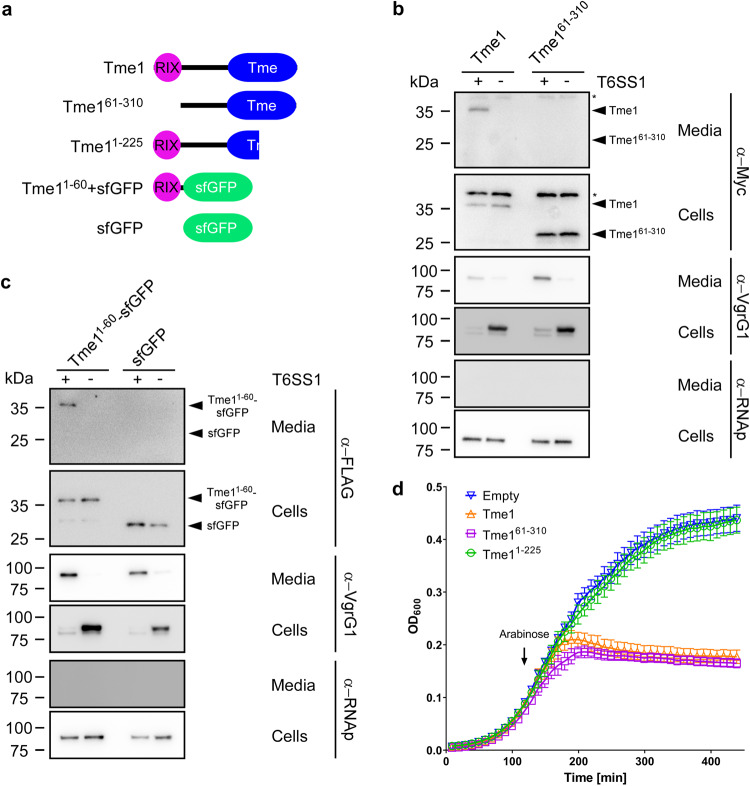
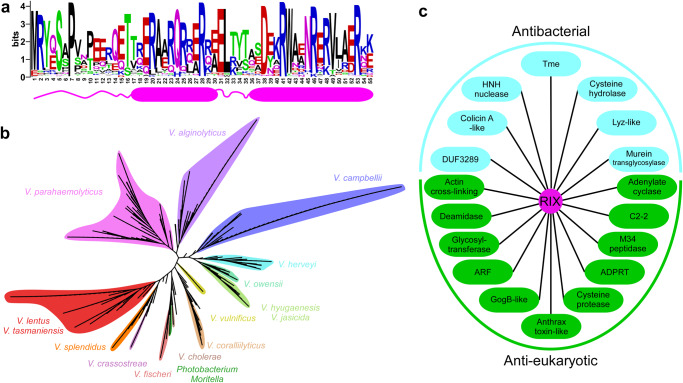
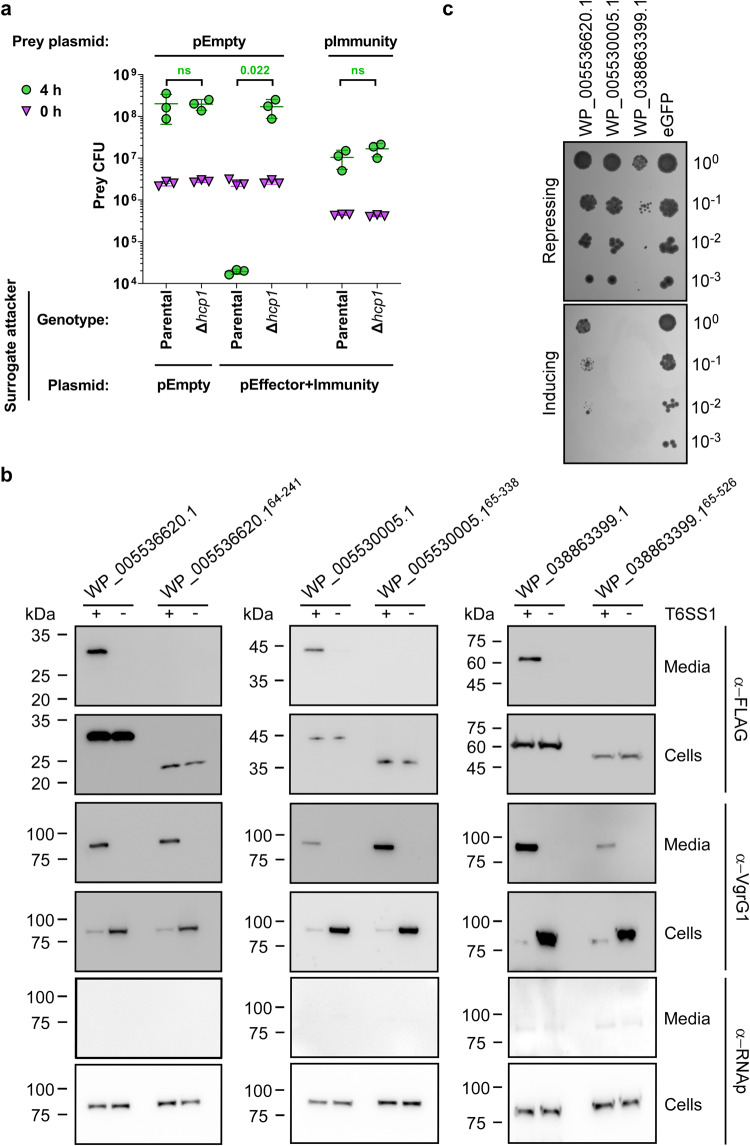
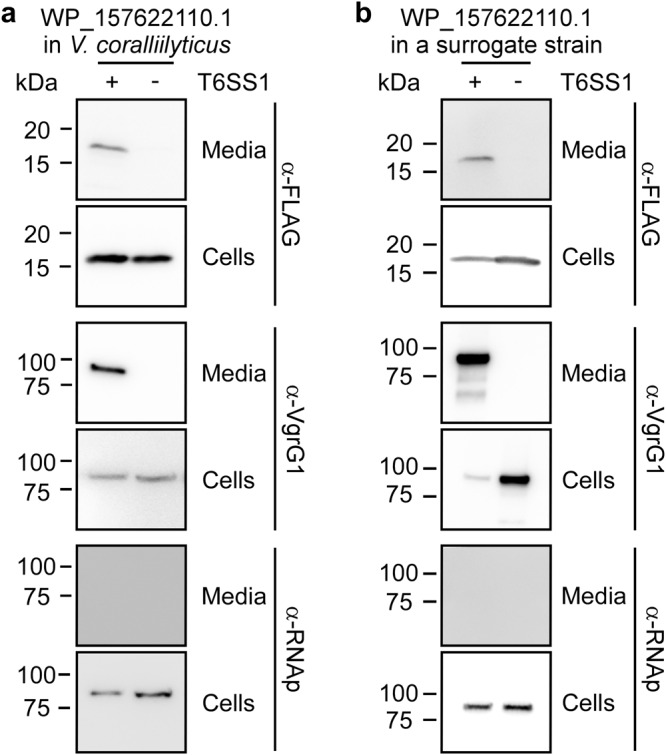
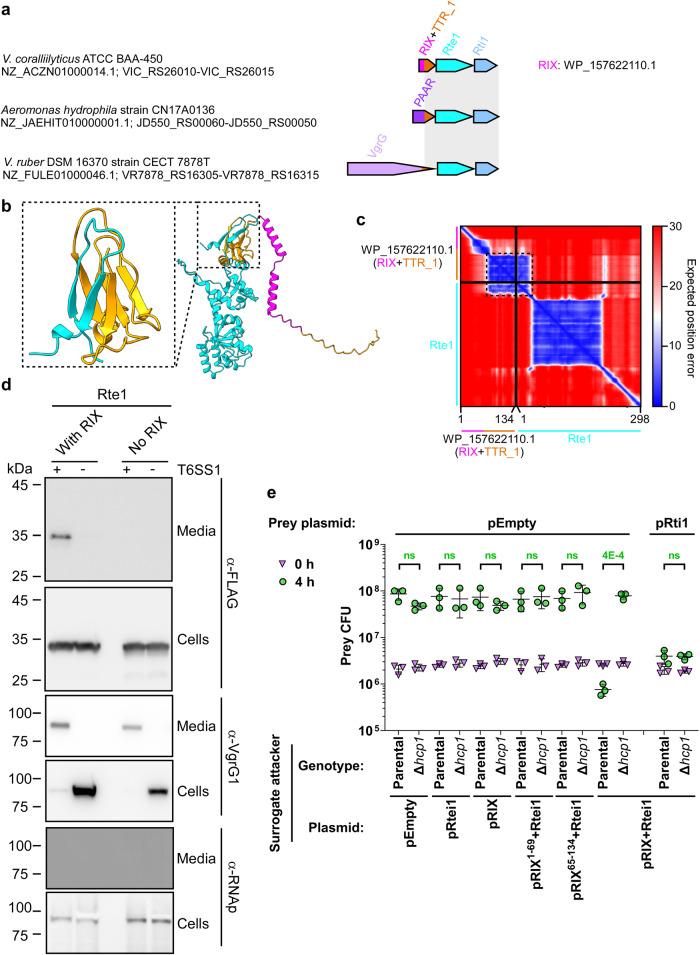
Bacteria use the type VI secretion system (T6SS) to deliver toxic effectors into bacterial or eukaryotic cells during interbacterial competition, host colonization, or when resisting predation. The identity of many effectors remains unknown. Here, we identify RIX, a new domain that defines a class of polymorphic T6SS cargo effectors. RIX, which is widespread in the Vibrionaceae family, is located at N-termini of proteins containing diverse antibacterial and anti-eukaryotic toxin domains. We demonstrate that RIX-containing proteins are delivered via T6SS into neighboring cells, and that RIX is necessary and sufficient for secretion. We show that RIX-containing proteins can also act as tethers, enabling the T6SS-mediated delivery of other cargo effectors by a previously undescribed mechanism. RIX-containing proteins significantly enlarge the repertoire of known T6SS effectors, especially those with anti-eukaryotic activities. Our findings also suggest that T6SSs may play a major, currently underappreciated, role in interactions between vibrios and eukaryotes.
Overview
The claims and statistics of this paper haven’t been checked yet.
Free: it reads the open-access text and checks the first 5 claims that cite a source we can check. Create a free account to check every claim.
Integrity signals
Registry
Cites
Statistics
Figures
Verification
Claims the paper makes
The claims and statistics of this paper haven’t been checked yet.
Free: it reads the open-access text and checks the first 5 claims that cite a source we can check. Create a free account to check every claim.
Self-check
Percentages, sums and reported differences re-computed from the paper’s own numbers.
The self-check needs the paper’s full text.
Citations
Cites
Highly accurate protein structure prediction with AlphaFold
Jumper, J., Evans, R., Pritzel, A., Green, T., Figurnov, M., Ronneberger, O., Tunyasuvunakool, K., Bates, R., Žídek, A., Potapenko, A., et al. (2021) · Nature · doi:10.1038/s41586-021-03819-2 · Cited by 43,764
Research works printed but not linked: 76
- Pukatzki S Identification of a conserved bacterial protein secretion system in Vibrio cholerae using the Dictyostelium host model system Proc. Natl Acad. Sci USA 2006 103 1528 1533 16432199 PMC1345711 · DOI · Paper page
- Mougous JD A virulence locus of Pseudomonas aeruginosa encodes a protein secretion apparatus Science 2006 312 1526 1530 16763151 PMC2800167 · DOI · Paper page
- Hood RD A type VI secretion system of Pseudomonas aeruginosa targets a toxin to bacteria Cell Host Microbe 2010 7 25 37 20114026 PMC2831478 · DOI · Paper page
- Jana B Salomon D Type VI secretion system: a modular toolkit for bacterial dominance Future Microbiol. 2019 14 fmb-2019-0194 31718312 · DOI
- Monjarás Feria J Valvano MA An overview of anti-eukaryotic T6SS effectors Front. Cell. Infect. Microbiol. 2020 10 584751 33194822 PMC7641602 · DOI
- Hachani A Wood TE Filloux A Type VI secretion and anti-host effectors Curr. Opin. Microbiol. 2016 29 81 93 26722980 · DOI · Paper page
- Jurėnas D Journet L Activity, delivery, and diversity of Type VI secretion effectors Mol. Microbiol. 2021 115 383 394 33217073 · DOI · Paper page
- Hernandez RE Gallegos-Monterrosa R Coulthurst SJ Type VI secretion system effector proteins: effective weapons for bacterial competitiveness Cell. Microbiol. 2020 22 e13241 32592518 · DOI · Paper page
- Cherrak, Y., Flaugnatti, N., Durand, E., Journet, L. & Cascales, E. Structure and activity of the type vi secretion system. Microbiol. Spectr. 7, 10.1128/microbiolspec.PSIB-0031-2019 (2019). PMC10957189 31298206 · DOI · Paper page
- Basler M Pilhofer M Henderson GP Jensen GJ Mekalanos JJ Type VI secretion requires a dynamic contractile phage tail-like structure Nature 2012 483 182 186 22367545 PMC3527127 · DOI · Paper page
- Hachani A Allsopp LP Oduko Y Filloux A The VgrG proteins are ‘à la carte’ delivery systems for bacterial type VI effectors J. Biol. Chem. 2014 289 17872 17884 24794869 PMC4067218 · DOI · Paper page
- Shneider MM PAAR-repeat proteins sharpen and diversify the type VI secretion system spike Nature 2013 500 350 353 23925114 PMC3792578 · DOI · Paper page
- Pukatzki S Ma AT Revel AT Sturtevant D Mekalanos JJ Type VI secretion system translocates a phage tail spike-like protein into target cells where it cross-links actin Proc. Natl Acad. Sci. USA 2007 104 15508 15513 17873062 PMC2000545 · DOI · Paper page
- Ma J The Hcp proteins fused with diverse extended-toxin domains represent a novel pattern of antibacterial effectors in type VI secretion systems Virulence 2017 8 1189 1202 28060574 PMC5711352 · DOI · Paper page
- Salomon D Marker for type VI secretion system effectors Proc. Natl Acad. Sci. USA 2014 111 9271 9276 24927539 PMC4078801 · DOI
- Jana B Fridman CM Bosis E Salomon D A modular effector with a DNase domain and a marker for T6SS substrates Nat. Commun. 2019 10 3595 31399579 PMC6688995 · DOI · Paper page
- Russell AB A widespread bacterial type VI secretion effector superfamily identified using a heuristic approach Cell Host Microbe 2012 11 538 549 22607806 PMC3358704 · DOI · Paper page
- Whitney JC Identification, structure, and function of a novel type VI secretion peptidoglycan glycoside hydrolase effector-immunity pair J. Biol. Chem. 2013 288 26616 26624 23878199 PMC3772208 · DOI · Paper page
- Russell AB Diverse type VI secretion phospholipases are functionally plastic antibacterial effectors Nature 2013 496 508 512 23552891 PMC3652678 · DOI · Paper page
- Manera, K., Kamal, F., Burkinshaw, B. & Dong, T. G. Essential functions of chaperones and adaptors of protein secretion systems in Gram-negative bacteria. FEBS J. 10.1111/FEBS.16056 (2021). 34092034 · DOI
- Unterweger D Kostiuk B Pukatzki S Adaptor proteins of type VI secretion system effectors Trends Microbiol. 2017 25 8 10 27856117 · DOI
- Dar Y Jana B Bosis E Salomon D A binary effector module secreted by a type VI secretion system EMBO Rep. 2022 23 e53981 34752000 PMC8728615 · DOI
- Dar Y Salomon D Bosis E The antibacterial and anti-eukaryotic Type VI secretion system MIX-effector repertoire in Vibrionaceae Mar. Drugs 2018 16 433 30400344 PMC6267618 · DOI
- Koskiniemi S Rhs proteins from diverse bacteria mediate intercellular competition Proc. Natl Acad. Sci. USA 2013 110 7032 7037 23572593 PMC3637788 · DOI · Paper page
- Jurėnas D Mounting, structure and autocleavage of a type VI secretion-associated Rhs polymorphic toxin Nat. Commun. 2021 12 6998 34853317 PMC8636562 · DOI
- Pei TT Intramolecular chaperone-mediated secretion of an Rhs effector toxin by a type VI secretion system Nat. Commun. 2020 11 1 13 32313027 PMC7170923
- Cianfanelli FR VgrG and PAAR proteins define distinct versions of a functional type VI secretion system PLoS Pathog. 2016 12 1 27 PMC4924876 27352036
- 10.1038/s41467-019-13889-6 · DOI · Paper page
- 10.1371/journal.ppat.1005464 · DOI · Paper page
- Alcoforado Diniz J Coulthurst SJ Intraspecies competition in Serratia marcescens is mediated by type VI-secreted Rhs effectors and a conserved effector-associated accessory protein J. Bacteriol. 2015 197 2350 2360 25939831 PMC4524185 · DOI
- Zheng H-Y Yang L Dong T More than just a spearhead: diverse functions of paar for assembly and delivery of toxins of the contractile injection systems mSystems 2021 6 e0138621 34874771 PMC8651079
- Fridman CM Keppel K Gerlic M Bosis E Salomon D A comparative genomics methodology reveals a widespread family of membrane-disrupting T6SS effectors Nat. Commun. 2020 11 1085 32109231 PMC7046647 · DOI · Paper page
- Bruto M Vibrio crassostreae, a benign oyster colonizer turned into a pathogen after plasmid acquisition ISME J. 2017 11 1043 1052 27922600 PMC5364345 · DOI · Paper page
- Ben-Haim Y Zicherman-Keren M Rosenberg E Temperature-regulated bleaching and lysis of the coral Pocillopora damicornis by the novel pathogen Vibrio coralliilyticus Appl. Environ. Microbiol. 2003 69 4236 4242 12839805 PMC165124 · DOI
- Haldar S Identification of Vibrio campbellii isolated from diseased farm-shrimps from south India and establishment of its pathogenic potential in an Artemia model Microbiology 2011 157 179 188 20847009 · DOI
- Baker-Austin C Vibrio spp. infections Nat. Rev. Dis. Prim. 2018 4 1 19 30002421 · DOI · Paper page
- Frickey T Lupas A CLANS: a Java application for visualizing protein families based on pairwise similarity Bioinformatics 2004 20 3702 3704 15284097 · DOI · Paper page
- Mirdita M ColabFold: making protein folding accessible to all Nat. Methods 2022 19 679 682 35637307 PMC9184281 · doi:10.1038/s41592-022-01488-1 · Paper page
- Jana B Keppel K Fridman CM Bosis E Salomon D Multiple T6SSs, mobile auxiliary modules, and effectors revealed in a systematic analysis of the Vibrio parahaemolyticus pan-genome mSystems 2022 7 e00723 22 36226968 PMC9765294 · DOI · Paper page
- Siggers KA Lesser CF The yeast saccharomyces cerevisiae: a versatile model system for the identification and characterization of bacterial virulence proteins Cell Host Microbe 2008 4 8 15 18621006 PMC3430985 · DOI · Paper page
- Flaugnatti N Structural basis for loading and inhibition of a bacterial T6 SS phospholipase effector by the VgrG spike EMBO J. 2020 39 e104129 32350888 PMC7265238 · DOI · Paper page
- Flaugnatti N A phospholipase A1 antibacterial Type VI secretion effector interacts directly with the C-terminal domain of the VgrG spike protein for delivery Mol. Microbiol. 2016 99 1099 1118 26714038 · DOI · Paper page
- Hersch SJ Envelope stress responses defend against type six secretion system attacks independently of immunity proteins Nat. Microbiol. 2020 5 706 714 32094588 PMC7190449 · DOI · Paper page
- Zimmermann L A completely reimplemented MPI bioinformatics toolkit with a new HHpred server at its core J. Mol. Biol. 2018 430 2237 2243 29258817 · DOI · Paper page
- Holm L Dali server: structural unification of protein families Nucleic Acids Res. 2022 50 W210 W215 35610055 PMC9252788 · DOI · Paper page
- Barth H Preiss JC Hofmann F Aktories K Characterization of the catalytic site of the adp-ribosyltransferase clostridium botulinum c2 toxin by site-directed mutagenesis J. Biol. Chem. 1998 273 29506 29511 9792657 · DOI · Paper page
- Altindis E Dong T Catalano C Mekalanos J Secretome analysis of vibrio cholerae type vi secretion system reveals a new effector-immunity pair MBio 2015 6 e00075 25759499 PMC4453574 · DOI
- Salomon D Gonzalez H Updegraff BL Orth K Vibrio parahaemolyticus Type VI secretion system 1 Is activated in marine conditions to target bacteria, and is differentially regulated from system 2 PLoS One 2013 8 e61086 23613791 PMC3628861 · DOI · Paper page
- Salomon D Type VI secretion system toxins horizontally shared between marine bacteria PLoS Pathog. 2015 11 1 20 PMC4549250 26305100
- 10.1371/journal.ppat.1004691 · DOI · Paper page
- Ray A Type VI secretion system MIX‐effectors carry both antibacterial and anti‐eukaryotic activities EMBO Rep. 2017 18 e201744226 PMC5666596 28912123
- Speare L Bacterial symbionts use a type VI secretion system to eliminate competitors in their natural host Proc. Natl Acad. Sci. Usa. 2018 115 E8528 E8537 30127013 PMC6130350 · DOI · Paper page
- Church SR Lux T Baker-Austin C Buddington SP Michell SL Vibrio vulnificus type 6 secretion system 1 contains anti-bacterial properties PLoS One 2016 11 1 17 PMC5087951 27798649
- 10.1371/journal.pone.0162755 · DOI · Paper page
- Pan J Integration host factor modulates the expression and function of t6ss2 in vibrio fluvialis Front. Microbiol. 2018 9 962 29867866 PMC5963220 · DOI
- Guillemette, R., Ushijima, B., Jalan, M., Häse, C. C. & Azam, F. Insight into the resilience and susceptibility of marine bacteria to T6SS attack by Vibrio cholerae and Vibrio coralliilyticus. PLoS One15, 10.1371/journal.pone.0227864 (2020). PMC6986712 31990915 · DOI
- Cohen H Post-phagocytosis activation of NLRP3 inflammasome by two novel T6SS effectors Elife 2022 11 e82766 36155655 PMC9545535 · DOI
- Cohen, H., Fridman, C. M., Gerlic, M. & Salomon, D. A Vibrio T6SS-Mediated Lethality in an Aquatic Animal Model. Microbiol. Spectr. 10.1128/SPECTRUM.01093-23 (2023). PMC10433976 37310285 · DOI
- Rubio T Species-specific mechanisms of cytotoxicity toward immune cells determine the successful outcome of Vibrio infections Proc. Natl Acad. Sci. USA 2019 116 14238 14247 31221761 PMC6628822 · DOI
- Piel D Selection of Vibrio crassostreae relies on a plasmid expressing a type 6 secretion system cytotoxic for host immune cells Environ. Microbiol. 2020 22 4198 4211 31390475 · DOI
- Drebes Dörr NC Blokesch M Interbacterial competition and anti-predatory behaviour of environmental Vibrio cholerae strains Environ. Microbiol. 2020 22 4485 4504 32885535 PMC7702109
- Howard SA The breadth and molecular basis of hcp-driven type vi secretion system effector delivery MBio 2021 12 e0026221 34061601 PMC8262886
- Pédelacq J-D Cabantous S Tran T Terwilliger TC Waldo GS Engineering and characterization of a superfolder green fluorescent protein Nat. Biotechnol. 2006 24 79 88 16369541
- Jana B Keppel K Salomon D Engineering a customizable antibacterial T6SS-based platform in Vibrio natriegens EMBO Rep. 2021 22 e53681 34494702 PMC8567230 · DOI
- Hersch SJ Lam L Dong TG Engineered type six secretion systems deliver active exogenous effectors and cre recombinase MBio 2021 12 e0111521 34281388 PMC8406194 · DOI
- Gibson DG Enzymatic assembly of DNA molecules up to several hundred kilobases Nat. Methods 2009 6 343 345 19363495 · DOI · Paper page
- Salomon, D. & Sessa, G. Identification of growth inhibition phenotypes induced by expression of bacterial type III effectors in yeast. J. Vis. Exp. 4–7 10.3791/1865 (2010). PMC3168205 20354502 · DOI
- Li P Acute hepatopancreatic necrosis disease-causing Vibrio parahaemolyticus strains maintain an antibacterial type VI secretion system with versatile effector repertoires Appl. Environ. Microbiol. 2017 83 e00737 17 28432099 PMC5478980
- Bensadoun A Weinstein D Assay of proteins in the presence of interfering materials Anal. Biochem. 1976 70 241 250 1259145 · DOI · Paper page
- Madeira F Search and sequence analysis tools services from EMBL-EBI in 2022 Nucleic Acids Res. 2022 50 W276 W279 35412617 PMC9252731 · DOI · Paper page
- Crooks GE Hon G Chandonia J-M Brenner SE WebLogo: a sequence logo generator Genome Res. 2004 14 1188 1190 15173120 PMC419797 · DOI · Paper page
- Katoh K Misawa K Kuma K Miyata T MAFFT: a novel method for rapid multiple sequence alignment based on fast Fourier transform Nucleic Acids Res. 2002 30 3059 3066 12136088 PMC135756 · DOI · Paper page
- Katoh K Rozewicki J Yamada KD MAFFT online service: Multiple sequence alignment, interactive sequence choice and visualization Brief. Bioinform. 2018 20 1160 1166 PMC6781576 28968734
- Varadi M AlphaFold Protein Structure Database: Massively expanding the structural coverage of protein-sequence space with high-accuracy models Nucleic Acids Res. 2022 50 D439 D444 34791371 PMC8728224 · DOI · Paper page
- Pettersen EF UCSF ChimeraX: Structure visualization for researchers, educators, and developers Protein Sci. 2021 30 70 82 32881101 PMC7737788 · DOI · Paper page
- Marchler-Bauer A CDD: a conserved domain database for interactive domain family analysis Nucleic Acids Res. 2007 35 D237 D240 17135202 PMC1751546 · DOI · Paper page
Cited by
Vibrio parahaemolyticus T6SS2 effector repertoires
Tchelet, D., Keppel, K., Bosis, E., & Salomon, D. (2022) · doi:10.1101/2022.11.17.516722 · Cited by 24
Self-citation
Metadata
- Authors
- Kanarek, K., Fridman, C. M., Bosis, E., & Salomon, D.
- Affiliations
- Tel Aviv University (IL)
- Braude College of Engineering Karmiel (IL)
- Corresponding author
- Bosis, Eran
- Salomon, Dor
- Venue
- Nature Communications
- Publisher
- openRxiv
- Published
- 2022-10-27
- Volume
- 14
- Issue
- 1
- Pages
- 4983-4983
- ISSN
- 2041-1723 (ISSN-L)
- PMC
- PMC10435454
- OpenAlex
- W4385950607
- Cited by
- 27
- References
- 1
- Citations by year
- 2026: 6 · 2025: 6 · 2024: 7 · 2023: 8
- FWCI
- 5.01
- Type
- journal article
- Language
- en
- Open access
- gold
- doi.org
- Licence
- cc-by
- Locations
- Nature Communications (publishedVersion, cc-by)
- bioRxiv (Cold Spring Harbor Laboratory) (acceptedVersion, cc-by-nd)
- PubMed Central (publishedVersion, cc-by)
- PubMed (publishedVersion)
- RePEc: Research Papers in Economics (submittedVersion)
- DOAJ (DOAJ: Directory of Open Access Journals) (submittedVersion, cc-by-sa)
- Funders
- Clore Israel Foundation
- European Commission (HORIZON2020, 714224)
- Israel Science Foundation (1362/21, 920/17)
- Tel Aviv University
- Council for Higher Education
- Horizon 2020 Framework Programme (714224)
- Topics
- Life Sciences › Immunology and Microbiology › Microbiology › Vibrio bacteria research studies
- Life Sciences › Biochemistry, Genetics and Molecular Biology › Genetics › Bacterial Genetics and Biotechnology
- Life Sciences › Immunology and Microbiology › Microbiology › Escherichia coli research studies
- Keywords
- type VI secretion system, T6SS effectors, Vibrio, Vibrionaceae, bacterial competition, protein secretion
- MeSH terms
- Animals, Anti-Bacterial Agents, Biological Transport, Eukaryotic Cells, Predatory Behavior, Eukaryota
About these checks
Registry, retraction, Cites and statistics results are computed, not judged, with one exception: a printed reference that no index lists is read once by a model before it counts as a citation error. Claims are extracted by a model and kept only when their quote appears verbatim in the text; each cited source is then checked, with a model’s help, for whether it says what the claim relies on. Those verdicts can be wrong — read the claim’s quote and the cited source before relying on one.
Statistics and arithmetic are recomputed, not judged.
Confidence bands are shown only for fields calibrated on our annotated test set. None is calibrated yet, so no band is shown.
What counts as a claim ›How we measure confidence ›How we check this ›
Are you an author, or do you see a problem with this page? Request a review
Data sources
Bibliographic data: Semantic Scholar, OpenAlex, Crossref.
Contains information from the Semantic Scholar Academic Graph Datasets, made available under the ODC Attribution License (ODC-BY 1.0).
Semantic Scholar’s data is described in: Kinney, R., et al. (2023). The Semantic Scholar Open Data Platform. arXiv:2301.10140.
