

The DOI matches its Crossref record; 1 of the 1 references it cites were found in a registry or an index.
Differential expansion and retention patterns of LRR-RLK genes across plant evolution
Open accessPreprint — published as 10.1002/pld3.556 · Paper page
Abstract
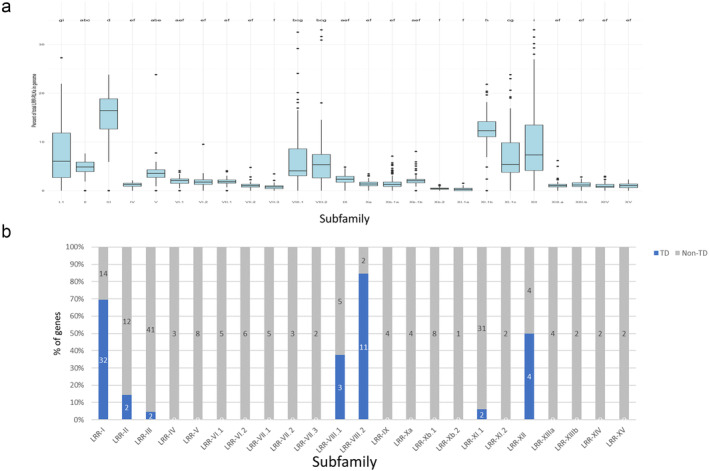
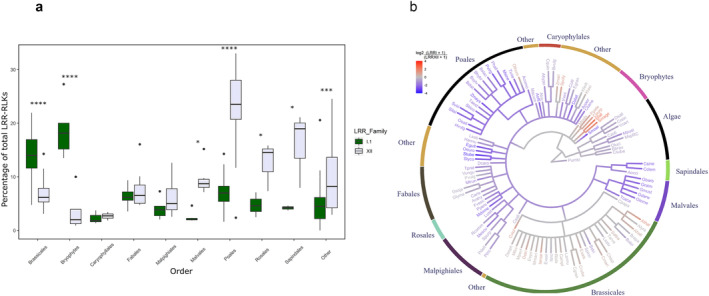
To maximize overall fitness, plants must accurately respond to a host of growth, developmental, and environmental signals throughout their life. Many of these internal and external signals are perceived by the leucine-rich repeat receptor-like kinases, which play roles in regulating growth, development, and immunity. This largest family of receptor kinases in plants can be divided into subfamilies based on conservation of the kinase domain, which demonstrates that shared evolutionary history often indicates shared molecular function. Here we investigate the evolutionary history of this family across the evolution of 112 plant species. We identify lineage-specific expansions of the malectin-domain containing subfamily LRR subfamily I primarily in the Brassicales and bryophytes. Most other plant lineages instead show a large expansion in LRR subfamily XII, which in Arabidopsis is known to contain key receptors in pathogen perception. This striking asymmetric expansion may reveal a dichotomy in the evolutionary history and adaptation strategies employed by plants. A greater understanding of the evolutionary pressures and adaptation strategies acting on members of this receptor family offers a way to improve functional predictions for orphan receptors and simplify identification of novel stress related receptors.
Overview
The claims and statistics of this paper haven’t been checked yet.
Run the check — free, no account needed. It reads the open-access text and checks the sources it cites.
Integrity signals
Registry
Cites
Statistics
Figures
Verification
Claims the paper makes
The claims and statistics of this paper haven’t been checked yet.
Run the check — free, no account needed. It reads the open-access text and checks the sources it cites.
Self-check
Percentages, sums and reported differences re-computed from the paper’s own numbers.
The self-check needs the paper’s full text.
Citations
Cites
Highly accurate protein structure prediction with AlphaFold
Jumper, J., Evans, R., Pritzel, A., Green, T., Figurnov, M., Ronneberger, O., Tunyasuvunakool, K., Bates, R., Žídek, A., Potapenko, A., et al. (2021) · Nature · doi:10.1038/s41586-021-03819-2 · Cited by 43,764
Research works printed but not linked: 60
- 10.1038/s41587-019-0036-z · DOI · Paper page
- 10.1016/j.cub.2013.12.053 · DOI
- 2020, The Evolutionary History of Ephs and Ephrins: Toward Multicellular Organisms, Mol. Biol. Evol, 37, 379, 10.1093/molbev/msz222 · DOI
- 2023, An LRR receptor kinase controls ABC transporter substrate preferences during plant growth-defense decisions, Curr. Biol, 33, 2008, 10.1016/j.cub.2023.04.029 · DOI
- 10.1038/415977a · DOI · Paper page
- 10.1093/nar/gkv416 · DOI
- Buendia, L. , Girardin, A. , Wang, T. , Cottret, L. , and Lefebvre, B. (2018). LysM Receptor-Like Kinase and LysM Receptor-Like Protein Families: An Update on Phylogeny and Functional Characterization. Front. Plant Sci. 9. · DOI
- 10.1093/nar/gkl124 · DOI · Paper page
- 10.1105/tpc.19.00578 · DOI
- Chen, T. (2021). Identification and characterization of the LRR repeats in plant LRR-RLKs. BMC Mol. Cell Biol. 22. · DOI
- 10.1105/tpc.105.036574 · DOI
- 2018, Non-Mycorrhizal Plants: The Exceptions that Prove the Rule, Trends Plant Sci, 23, 577, 10.1016/j.tplants.2018.04.004 · DOI
- 10.1242/dev.00998 · DOI
- Dufayard, J.-F. , Bettembourg, M. , Fischer, I. , Droc, G. , Guiderdoni, E. , Périn, C. , Chantret, N. , and Diévart, A. (2017). New Insights on Leucine-Rich Repeats Receptor-Like Kinase Orthologous Relationships in Angiosperms. Front. Plant Sci. 08. · DOI
- 10.1371/journal.pcbi.1002195 · DOI · Paper page
- 10.1104/pp.15.01470 · DOI
- 10.1093/nar/gkr944 · DOI
- 10.1104/pp.108.122457 · DOI
- 10.1111/j.1365-3040.2011.02390.x · DOI
- 10.4161/cam.4.2.12430 · DOI
- 10.1038/nmeth.4285 · DOI · Paper page
- 10.1093/molbev/mst010 · DOI · Paper page
- 10.1006/jmbi.2000.4315 · DOI · Paper page
- 10.1371/journal.pone.0102245 · DOI
- 10.1104/pp.108.134353 · DOI
- 2018, Rapid improvement of domestication traits in an orphan crop by genome editing, Nat. Plants 2018 410, 4, 766
- 10.4161/cam.4.2.10725 · DOI
- 10.1186/s12862-017-0891-5 · DOI
- 10.1093/NAR/GKAA913 · DOI · Paper page
- 10.1186/s13059-016-0955-7 · DOI
- 10.1104/pp.17.01606 · DOI
- 10.1093/molbev/msu300 · DOI · Paper page
- 10.1242/dev.119677 · DOI
- 10.1104/pp.16.00523 · DOI · Paper page
- 10.1371/journal.pone.0009490 · DOI · Paper page
- 10.1186/s13059-019-1727-y · DOI · Paper page
- 10.3732/ajb.1400119 · DOI · Paper page
- 10.1111/j.2041-210X.2011.00169.x · DOI · Paper page
- 10.1371/journal.pcbi.0020115 · DOI · Paper page
- 10.1101/gad.222702 · DOI
- 10.1038/s41588-019-0389-8 · DOI
- 10.1016/j.cell.2017.08.030 · DOI · Paper page
- 10.1186/1471-2229-12-229 · DOI
- 10.1093/glycob/cwq059 · DOI
- 10.1091/mbc.E08-04-0354 · DOI · Paper page
- Schoch, C.L. et al. (2020). NCBI Taxonomy: a comprehensive update on curation, resources and tools. Database 2020. · DOI · Paper page
- 10.1073/pnas.181141598 · DOI · Paper page
- Shiu, S.-H. , Karlowski, W.M. , Pan, R. , Tzeng, Y.-H. , Mayer, K.F.X. , and Li, W.-H. (2004). Comparative Analysis of the Receptor-Like Kinase Family in Arabidopsis and Rice. Plant Cell Online 16. · DOI · Paper page
- 10.3732/ajb.0800079 · DOI · Paper page
- 10.1038/cr.2014.161 · DOI
- 10.1016/j.plantsci.2010.06.017 · DOI
- 10.1111/j.1365-313X.2005.02437.x · DOI
- 2020, Soy and Arabidopsis receptor-like kinases respond to polysaccharide signals from Spodoptera species and mediate herbivore resistance, Commun. Biol, 3, 224, 10.1038/s42003-020-0959-4 · DOI
- 2019, Investigation of evolutionary and expressional relationships in the function of the leucine-rich repeat receptor-like protein kinase gene family (LRR-RLK) in the radish (Raphanus sativus L, Sci. Rep, 9, 6937, 10.1038/s41598-019-43516-9 · DOI
- 10.1016/j.cell.2019.07.038 · DOI
- 2021, Malectin/Malectin-like domain-containing proteins: A repertoire of cell surface molecules with broad functional potential, Cell Surf, 7, 100056, 10.1016/j.tcsw.2021.100056 · DOI
- Yeh, Y.-H. , Chang, Y.-H. , Huang, P.-Y. , Huang, J.-B. , and Zimmerli, L. (2015). Enhanced Arabidopsis pattern-triggered immunity by overexpression of cysteine-rich receptor-like kinases. Front. Plant Sci. 6. · DOI
- Yeh, Y.-H. , Panzeri, D. , Kadota, Y. , Huang, Y.-C. , Huang, P.-Y. , Tao, C.-N. , Roux, M. , Chien, H.-C. , Chin, T.-C. , Chu, P.-W. , Zipfel, C. , and Zimmerli, L. (2016). The Arabidopsis Malectin-Like/LRR-RLK IOS1 is Critical for BAK1-Dependent and BAK1-Independent Pattern-Triggered Immunity. Plant Cell: tpc.00313.2016. · DOI
- 10.1104/pp.17.01266 · DOI
- 10.1016/j.cell.2006.03.037 · DOI · Paper page
Metadata
- Authors
- Kileeg, Z., Haldar, A., Khan, H., Qamar, A., & Mott, G. A.
- Affiliations
- University of Toronto (CA)
- Corresponding author
- Mott, G. Adam
- Venue
- Plant Direct
- Publisher
- openRxiv
- Published
- 2023-07-26
- Volume
- 7
- Issue
- 12
- Pages
- e556-e556
- ISSN
- 2475-4455 (ISSN-L)
- PMC
- PMC10739070
- OpenAlex
- W4390110941
- Cited by
- 13
- References
- 1
- Citations by year
- 2026: 2 · 2025: 5 · 2024: 4 · 2023: 2
- FWCI
- 2.04
- Type
- journal article
- Language
- en
- Open access
- gold
- doi.org
- Licence
- cc-by-nc
- Locations
- Plant Direct (publishedVersion, cc-by-nc)
- bioRxiv (Cold Spring Harbor Laboratory) (acceptedVersion, cc-by-nc-nd)
- PubMed Central (publishedVersion, cc-by-nc)
- PubMed (publishedVersion)
- DOAJ (DOAJ: Directory of Open Access Journals) (submittedVersion, cc-by-sa)
- Funders
- Natural Sciences and Engineering Research Council of Canada
- Topics
- Life Sciences › Agricultural and Biological Sciences › Plant Science › Plant Molecular Biology Research
- Life Sciences › Agricultural and Biological Sciences › Plant Science › Plant-Microbe Interactions and Immunity
- Life Sciences › Biochemistry, Genetics and Molecular Biology › Genetics › Chromosomal and Genetic Variations
- Keywords
- leucine-rich repeat receptor-like kinases, gene family expansion, plant evolution, Brassicales, bryophytes, pathogen perception, orphan receptors, plant immunity
About these checks
Registry, retraction, Cites and statistics results are computed, not judged, with one exception: a printed reference that no index lists is read once by a model before it counts as a citation error. Claims are extracted by a model and kept only when their quote appears verbatim in the text; each cited source is then checked, with a model’s help, for whether it says what the claim relies on. Those verdicts can be wrong — read the claim’s quote and the cited source before relying on one.
Statistics and arithmetic are recomputed, not judged.
Confidence bands are shown only for fields calibrated on our annotated test set. None is calibrated yet, so no band is shown.
What counts as a claim ›How we measure confidence ›How we check this ›
Are you an author, or do you see a problem with this page? Request a review
Data sources
Bibliographic data: Semantic Scholar, OpenAlex, Crossref.
Contains information from the Semantic Scholar Academic Graph Datasets, made available under the ODC Attribution License (ODC-BY 1.0).
Semantic Scholar’s data is described in: Kinney, R., et al. (2023). The Semantic Scholar Open Data Platform. arXiv:2301.10140.
