

Reservoir ecosystems support large pools of fish biomass
Open accessPreprint — published as 10.1038/s41598-024-59730-z · Paper page
The DOI matches its Crossref record; its reference list is not available.
Abstract
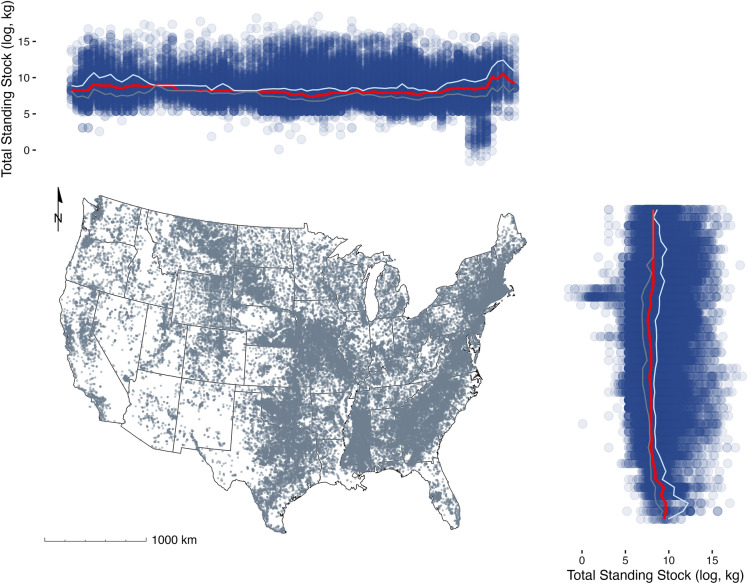
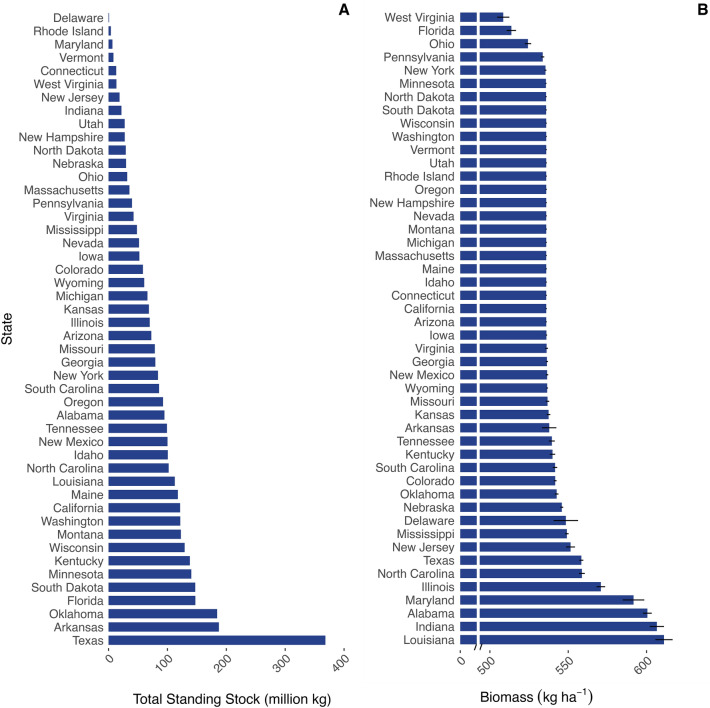
Humans increasingly dominate Earth’s natural freshwater ecosystems, and many freshwater fisheries resources are imperiled and at-risk of collapse. Yet despite this, the productive capacity of intensively modified freshwater ecosystems is rarely studied. We digitized, and provide open access to, a legacy database containing empirical fish biomass from 1,127 surveys on 301 USA reservoirs. In parallel, we developed a slate of reservoir classification schemas that were deployed to better understand distributions of biomass and secondary production. By fusing these data products, we generated a predictive capacity for understanding the scope of fisheries biomass and secondary production across all USA reservoirs. We estimate total potential fish total standing stock in USA reservoirs is 3.4 billion (B) kg, and annual secondary production is 4.5 B kg y -1 . In southern USA alone, total standing stock and secondary production are 1.9 B kg and 2.5 B kg y -1 , respectively. We also observe non-linear trends in reservoir fish production and biomass over time, indicating that these ecosystems are quite dynamic. Results demonstrate that reservoirs represent globally relevant pools of freshwater fisheries, in part due to their immense spatial and limnetic footprint. This study further shows that reservoir ecosystems play major roles in food security, and fisheries conservation, even though they are frequently overlooked by freshwater scientists. We encourage additional effort be expended to effectively manage reservoir environments for the good of humanity, biodiversity, and fishery conservation. Significance Statement: Globally, many freshwater fishes and fisheries resources are imperiled and at-risk of collapse. However, previous research overwhelmingly focuses on freshwater fisheries in natural rivers and lakes. This study provides evidence that novel and reconciled ecosystems, such as reservoirs, hold massive pools of freshwater fisheries biomass and may have higher ecological value than previously thought. While dams are patently ecological catastrophes, ecosystem services including secondary fish production provided by reservoirs are nonetheless substantial. Indeed, in many locations (e.g., arid regions), reservoirs are the only remaining fisheries resource. We suggest considerable conservation management is warranted for reservoir fisheries worldwide. Data Deposition: Code is available on GitHub ( https://github.com/caparisek/res_biomass_USA ; DOI 10.5281/zenodo.8316696). All data and reservoir classifications are available on Zenodo (DOI 10.5281/zenodo.8317007). Furthermore, data will also be deposited in the Environmental Data Initiative repository upon acceptance of this manuscript.
Overview
The claims and statistics of this paper haven’t been checked yet.
Free: it reads the open-access text and checks the first 5 claims that cite a source we can check. Create a free account to check every claim.
Integrity signals
Registry
Cites
Statistics
Figures
Verification
Claims the paper makes
The claims and statistics of this paper haven’t been checked yet.
Free: it reads the open-access text and checks the first 5 claims that cite a source we can check. Create a free account to check every claim.
Self-check
Percentages, sums and reported differences re-computed from the paper’s own numbers.
The self-check needs the paper’s full text.
Citations
No citation lists for this paper
No citation lists for this paper yet — checked again daily.
References 96 · Cited by 8
Research works printed but not linked: 94
- 10.1073/pnas.1913196116 · DOI
- 2020, Effects of climate and land-use changes on fish catches across lakes at a global scale, Nature Communications, 11, 2526, 10.1038/s41467-020-14624-2 · DOI
- 10.1017/S1368980011000814 · DOI · Paper page
- 10.1073/pnas.1521540113 · DOI · Paper page
- L. Nesper , The Walleye War: The Struggle for Ojibwe Spearfishing and Treaty Rights (University of Nebraska Press, 2002).
- M. Léopold , J. B. Herrenschmidt , R. R. Thaman , The relevance of traditional ecological knowledge for modern management of coral reef fisheries in Melanesia. Proceedings of the 11th International Coral Reef Symposium. National Coral Reef Institute, 1007–1011 (2008).
- 10.1577/1548-8659(1991)120<0770:NEVOTF>2.3.CO;2 · doi:10.1577/1548-8659(1991)120
- 10.1073/pnas.1902796116 · DOI · Paper page
- 2007, Potential impacts of global climate change on freshwater fisheries, Reviews in Fish Biology and Fisheries, 17, 581, 10.1007/s11160-007-9059-5 · DOI · Paper page
- R. Arlinghaus, K. Lorenzen, B. M. Johnson, S. J. Cooke, I. G. Cowx, “Management of freshwater fisheries: addressing habitat, people and fishes” in Freshwater Fisheries Ecology, J. F. Craig, Ed. (Wiley-Blackwell, 2016), pp. 557–579. · DOI
- R. A. Leidy, P. B. Moyle, “Conservation status of the world’s fish fauna: An Overview” in Conservation Biology, P. L. Fiedler, P. M. Kareiva, Eds. (Springer, 1998), pp. 187–227. · doi:10.1007/978-1-4757-2880-4_8
- R. T. Darwell, J. Freyhoff, “Lost fishes, who is counting? The extent of the threat to freshwater fish biodiversity” in Conservation of Freshwater Fishes, G. P. Closs, M. Krkosek, J. D. Olden, Eds. (Cambridge University Press, 2016), pp. 1–36. · DOI · Paper page
- B. Worm , et al., Rebuilding global fisheries. Science 325 , 578–585 (2009). · DOI · Paper page
- 10.1126/science.1237314 · DOI · Paper page
- 10.1038/s41586-021-03308-6 · DOI · Paper page
- 2016, On the sustainability of inland fisheries: finding a future for the forgotten, Ambio, 45, 753, 10.1007/s13280-016-0787-4 · DOI · Paper page
- 2015, Current status and future needs of economics research of inland fisheries, Fisheries Management and Ecology, 22, 458, 10.1111/fme.12144 · DOI
- 10.1126/science.1107887 · DOI · Paper page
- 10.1073/pnas.0609812104 · DOI · Paper page
- 10.2307/1312557 · DOI · Paper page
- 10.2307/1313099 · DOI · Paper page
- 10.1525/bio.2012.62.6.5 · DOI · Paper page
- 10.2307/1467936 · DOI · Paper page
- 2009, Hydrologic habitat preferences of select southeastern USA fishes resilient to river ecosystem fragmentation, Ecohydrology, 2, 419, 10.1002/eco.66 · DOI
- 1998, Population characteristics of gizzard shad in Missouri reservoirs and their relation to reservoir productivity, mean depth, and sport fish growth, North American Journal of Fisheries Management, 18, 114, 10.1577/1548-8675(1998)018<0114:PCOGSI>2.0.CO;2 · doi:10.1577/1548-8675(1998)018
- 2015, Functional age as an indicator of reservoir senescence, Fisheries, 40, 170, 10.1080/03632415.2015.1007207 · DOI
- 2020, Improving infrastructure for wildlife, Natural Resources and Environment, 34, 38
- L. E. Miranda , N. M. Faucheux , Climate change alters aging patterns of reservoir aquatic habitats. Climatic Change 174, 9 (2022). · DOI
- Kent. W. Thornton, B. L. Kimmel, F. E. Payne, Reservoir Limnology: Ecological Perspectives (John Wiley & Sons, 1991).
- 2018, Oxygen dynamics control the burial of organic carbon in a eutrophic reservoir, Limnology and Oceanography Letters, 3, 293, 10.1002/lol2.10057 · DOI
- 1986, Classification of Iowa lakes and their fish standing stock, Lake and Reservoir Management, 2, 105, 10.1080/07438148609354610 · DOI
- 1989, Phosphorus-fish community biomass relationships in southern Appalachian reservoirs: can lakes be too clean for fish?, Lake and Reservoir Management, 5, 83, 10.1080/07438148909354402 · DOI
- 2017, The contribution of lakes to global inland fisheries harvest, Frontiers in Ecology and the Environment, 15, 293, 10.1002/fee.1503 · DOI
- 2020, Fishing for Food: Quantifying Recreational Fisheries Harvest in Wisconsin Lakes, Fisheries, 45, 647, 10.1002/fsh.10486 · DOI
- 10.1073/pnas.1721097115 · DOI · Paper page
- S. Funge-Smith, A. Bennett, 2019, A fresh look at inland fisheries and their role in food security and livelihoods, Fish and Fisheries, 20, 1176, 10.1111/faf.12403 · DOI · Paper page
- C. Harrod , A. Ramírez , J. Valbo-Jørgensen , S. Funge-Smith , “Chapter 18: How climate change impacts inland fisheries” in Impacts of Climate Change on Fisheries and Aquaculture: Synthesis of Current Knowledge , Adaptation and Mitigation Options. FAO FISHERIES AND AQUACULTURE TECHNICAL PAPER 627, (Food & Agriculture Org., 2019), p. 654.
- 10.1139/er-2015-0064 · DOI · Paper page
- 2021, Goodbye to “Rough Fish”: Paradigm Shift in the Conservation of Native Fishes, Fisheries, 46, 605, 10.1002/fsh.10660 · DOI
- 2017, Rethinking refuges: Implications of climate change for dam busting, Biological Conservation, 209, 188, 10.1016/j.biocon.2017.02.007 · DOI
- 2015, Evidence of Landlocked Chinook Salmon Populations in California, North American Journal of Fisheries Management, 35, 1101, 10.1080/02755947.2015.1082518 · DOI
- 2020, Movement ecology of imperilled fish in a novel ecosystem: River-reservoir movements by razorback sucker and translocations to aid conservation, Aquatic Conservation: Marine and Freshwater Ecosystems, 30, 1540, 10.1002/aqc.3399 · DOI
- 1967, Influence of the environment on the growth of fishes in the Orava Dam Lake, Biological Practice, 13, 123
- 1982, Biomass model of reservoir fish and fish-food interactions, with implications for management, North American Journal of Fisheries Management, 2, 105, 10.1577/1548-8659(1982)2<105:BMORFA>2.0.CO;2 · doi:10.1577/1548-8659(1982)2
- 10.1073/pnas.1201423109 · DOI · Paper page
- 10.1073/pnas.1809426115 · DOI · Paper page
- 10.1073/pnas.2108038119 · DOI
- 1954, Fish populations in Alabama rivers and impoundments, Transactions of the American Fisheries Society, 83, 47, 10.1577/1548-8659(1953)83[47:FPIARA]2.0.CO;2 · DOI
- 10.1007/s10021-006-9013-8 · DOI · Paper page
- 10.1038/ngeo1734 · DOI
- 10.1073/pnas.93.15.7723 · DOI · Paper page
- 10.1073/pnas.1013006108 · DOI · Paper page
- 10.1086/285961 · DOI
- 10.1126/science.261.5123.906 · DOI · Paper page
- 2015, Analytic and cartographic models of the functional stability of forest ecosystems, Biol Bull Rev, 5, 311, 10.1134/S2079086415040040 · DOI
- J. C. Moore, P. C. de Ruiter, “Invertebrates in detrital food webs along gradients of productivity.” in Invertebrates as Webmasters in Ecosystems, (2000), pp. 161–184. · DOI
- 2010, Species richness facilitates ecosystem resilience in aquatic food webs, Freshwater Biology, 55, 2123, 10.1111/j.1365-2427.2010.02472.x · DOI
- 10.1080/01431168608948944 · DOI · Paper page
- R. Wang , J. A. Gamon , Remote sensing of terrestrial plant biodiversity. Remote Sensing of Environment 231, 111218 (2019). · DOI · Paper page
- 2020, Putting the lake back together 20 years later: what in the benthos have we learned about habitat linkages in lakes?, Inland Waters, 10, 305, 10.1080/20442041.2020.1712953 · DOI
- 1992, Annual production, production/biomass ratio, and the ecotrophic coefficient for management of trout in streams, North American Journal of Fisheries Management, 12, 34, 10.1577/1548-8675(1992)012<0034:APPBRA>2.3.CO;2 · doi:10.1577/1548-8675(1992)012
- 2018, Eroding productivity of walleye populations in northern Wisconsin lakes, Canadian Journal of Fisheries and Aquatic Sciences, 75, 2291, 10.1139/cjfas-2017-0311 · DOI
- 10.1525/bio.2011.61.7.7 · DOI · Paper page
- E. Fluet-Chouinard, M. L. Messager, B. Lehner, C. M. Finlayson, “Freshwater lakes and reservoirs” in The Wetland Book, C. Finlayson, G. Randy Milton, R. Crawford Prentice, N. Davidson, Eds. (Springer, 2017), pp. 125–142. · DOI
- 2022, Small artificial impoundments have big implications for hydrology and freshwater biodiversity, Frontiers in Ecology and the Environment, 20, 141, 10.1002/fee.2454 · DOI · Paper page
- 10.1002/2014GL060641 · DOI · Paper page
- 10.1126/science.266.5186.753 · DOI · Paper page
- 10.1038/s41586-019-1111-9 · DOI · Paper page
- 2017, Pattern and scale in latitude–production relationships for freshwater fishes, Ecosphere, 8, e01660, 10.1002/ecs2.1660 · DOI
- 1955, The standing crop of fish in lakes, Journal of the Fisheries Board of Canada, 12, 543, 10.1139/f55-029 · DOI
- W. L. Shelton, W. D. Davies, “Sampling with toxicants” in Fisheries Techniques, 1st Edition, L. A. Nielson, D. L. Johnson, Eds. (American Fisheries Society, 1983), pp. 199– 213.
- 10.1007/s00267-014-0364-1 · DOI · Paper page
- 2019, Flexible Classification of Wisconsin Lakes for Improved Fisheries Conservation and Management, Fisheries, 44, 225, 10.1002/fsh.10228 · DOI
- 2012, The regional abundance and size distribution of lakes and reservoirs in the United States and implications for estimates of global lake extent, Limnology and Oceanography, 57, 597, 10.4319/lo.2012.57.2.0597 · DOI · Paper page
- 10.7717/peerj.6876 · DOI · Paper page
- 10.1111/j.1467-9868.2010.00749.x · DOI · Paper page
- 2019, Welcome to the tidyverse, Journal of Open Source Software, 4, 1686, 10.21105/joss.01686 · DOI · Paper page
- 2018, Simple Features for R: Standardized Support for Spatial Vector Data, The R Journal, 10, 439, 10.32614/RJ-2018-009 · DOI · Paper page
- E. Pebesma , R. Bivand , Spatial Data Science: With Applications in R, 1st Ed. (Chapman and Hall/CRC, 2023). · DOI · Paper page
- E. Pebesma , R. Bivand , Classes and methods for spatial data in R. R News 5 (2005). · DOI · Paper page
- R. Bivand , E. Pebesma , V. Gomez-Rubio , Applied spatial data analysis with R, 2nd Ed. (Springer, NY, 2013). · DOI · Paper page
- 10.1080/01621459.2016.1180986 · DOI · Paper page
- 10.1198/016214504000000980 · DOI · Paper page
- S. Wood , Generalized Additive Models: An Introduction with R, 2nd Ed. (Chapman and Hall/CRC, 2017). · DOI · Paper page
- S. Wood , Thin-plate regression splines. Journal of the Royal Statistical Society (B) 65, 95– 114 (2003). · DOI · Paper page
- 10.18637/jss.v082.i13 · DOI · Paper page
- 2012, Taskinen, smatr 3 - an R package for estimation and inference about allometric lines, Methods in Ecology and Evolution, 3, 257, 10.1111/j.2041-210X.2011.00153.x · DOI · Paper page
- 10.7717/peerj.6876 · DOI · Paper page
- 1986, Classification of Iowa lakes and their fish standing stock, Lake and Reservoir Management, 2, 105, 10.1080/07438148609354610 · DOI
- 1989, Phosphorus-fish community biomass relationships in southern Appalachian reservoirs: can lakes be too clean for fish?, Lake and Reservoir Management, 5, 83, 10.1080/07438148909354402 · DOI
- 10.1139/f93-013 · DOI
- 2017, Pattern and scale in latitude–production relationships for freshwater fishes, Ecosphere, 8, e01660, 10.1002/ecs2.1660 · DOI
- 1969, The turnover ratio in production ecology of freshwater invertebrates, The American Naturalist, 103, 173, 10.1086/282591 · DOI
- 1992, Annual production, production/biomass ratio, and the ecotrophic coefficient for management of trout in streams, North American Journal of Fisheries Management, 12, 34, 10.1577/1548-8675(1992)012<0034:APPBRA>2.3.CO;2 · doi:10.1577/1548-8675(1992)012
Metadata
- Authors
- Parisek, C. A., De Castro, F. A., Colby, J. D., Leidy, G. R., Sadro, S., & Rypel, A. L.
- Affiliations
- University of California, Davis (US)
- Aecom (United States) (US)
- Corresponding author
- Parisek, Christine A.
- Venue
- Scientific Reports
- Publisher
- openRxiv
- Published
- 2023-09-06
- Volume
- 14
- Issue
- 1
- Pages
- 9428-9428
- ISSN
- 2045-2322 (ISSN-L)
- PMC
- PMC11043325
- OpenAlex
- W4395081908
- Cited by
- 8
- References
- 96
- Citations by year
- 2026: 3 · 2025: 5
- FWCI
- 2.39
- Type
- journal article
- Language
- en
- Open access
- gold
- doi.org
- Licence
- cc-by
- Locations
- Scientific Reports (publishedVersion, cc-by)
- bioRxiv (Cold Spring Harbor Laboratory) (acceptedVersion, cc-by)
- PubMed Central (publishedVersion, cc-by)
- PubMed (publishedVersion)
- eScholarship (California Digital Library) (submittedVersion, cc-by)
- DOAJ (DOAJ: Directory of Open Access Journals) (submittedVersion)
- Funders
- National Science Foundation (2225284)
- U.S. Fish and Wildlife Service
- University of California, Davis (CA-D-WFB-2467-H, WFB-2467-H)
- Topics
- Physical Sciences › Environmental Science › Nature and Landscape Conservation › Fish Ecology and Management Studies
- Physical Sciences › Environmental Science › Ecology › Aquatic Ecosystems and Biodiversity
- Life Sciences › Agricultural and Biological Sciences › Aquatic Science › Fish Biology and Ecology Studies
- Keywords
- reservoirs, fish biomass, secondary production, inland fisheries, fisheries decline, food security, fisheries conservation, reservoir management, fish conservation
- MeSH terms
- Animals, Conservation of Natural Resources, Fisheries, Fishes, Fresh Water, Humans, United States, Ecosystem, Biomass, Biodiversity
About these checks
Registry, retraction, Cites and statistics results are computed, not judged, with one exception: a printed reference that no index lists is read once by a model before it counts as a citation error. Claims are extracted by a model and kept only when their quote appears verbatim in the text; each cited source is then checked, with a model’s help, for whether it says what the claim relies on. Those verdicts can be wrong — read the claim’s quote and the cited source before relying on one.
Statistics and arithmetic are recomputed, not judged.
Confidence bands are shown only for fields calibrated on our annotated test set. None is calibrated yet, so no band is shown.
What counts as a claim ›How we measure confidence ›How we check this ›
Are you an author, or do you see a problem with this page? Request a review
How to cite
Cite CoChat for the checks on this page, and the paper for its own findings.
- This page
- CoChat. (2026). Citation check: Reservoir ecosystems support large pools of fish biomass. https://app.cochat.ai/papers/10.1101/2023.09.04.556263
- The paper
- Parisek, C. A., De Castro, F. A., Colby, J. D., Leidy, G. R., Sadro, S., & Rypel, A. L. (2023). Reservoir ecosystems support large pools of fish biomass. Scientific Reports. https://doi.org/10.1101/2023.09.04.556263
Data sources
Bibliographic data: Semantic Scholar, OpenAlex, Crossref.
Contains information from the Semantic Scholar Academic Graph Datasets, made available under the ODC Attribution License (ODC-BY 1.0).
Semantic Scholar’s data is described in: Kinney, R., et al. (2023). The Semantic Scholar Open Data Platform. arXiv:2301.10140.
