

The DOI matches its Crossref record; 1 of the 1 references it cites were found in a registry or an index.
Phylogenetic and protein structure analyses provide insight into the evolution and diversification of the CD36 domain ‘apex’ among scavenger receptor class B proteins across Eukarya
Open accessPreprint — published as 10.1093/gbe/evad218
Abstract
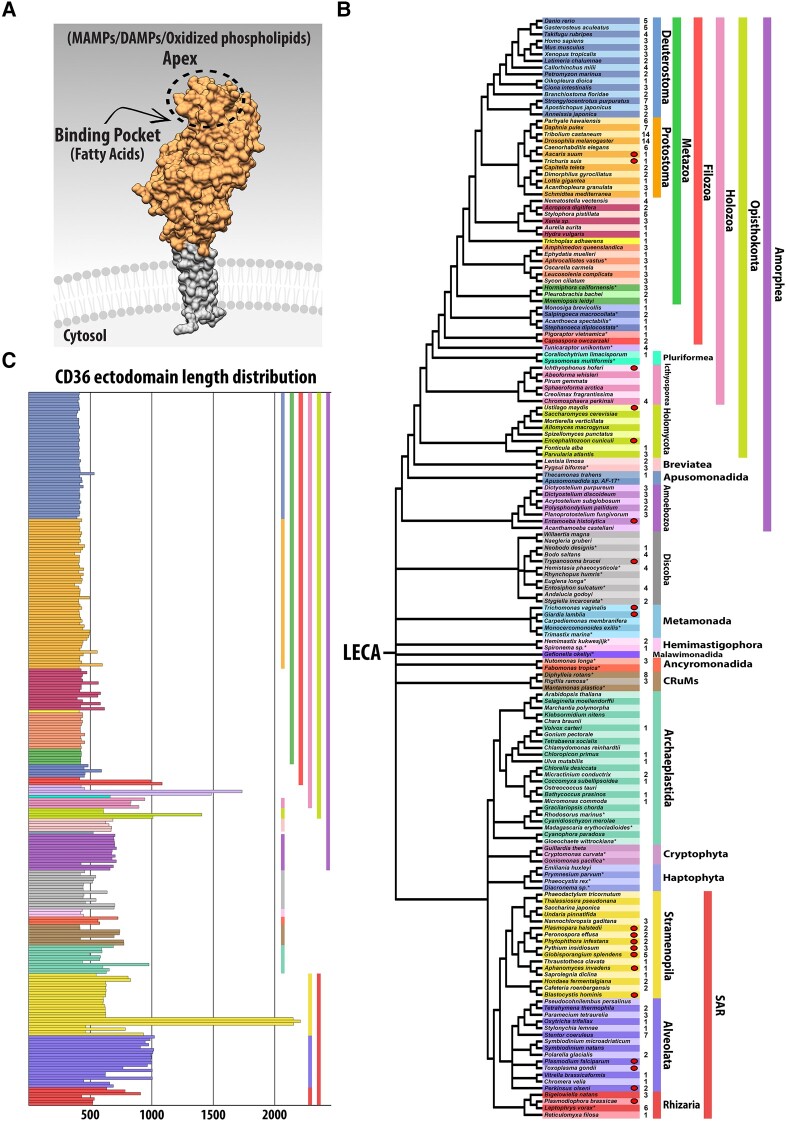
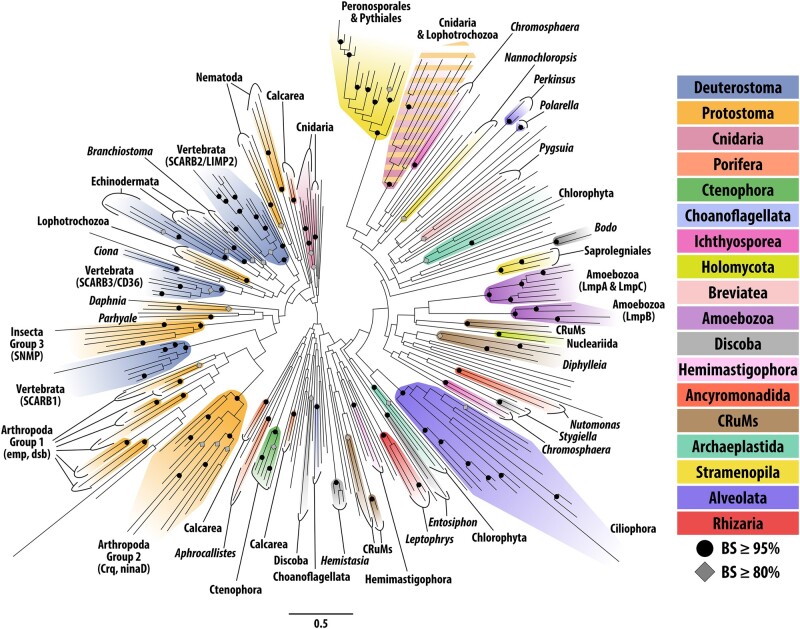
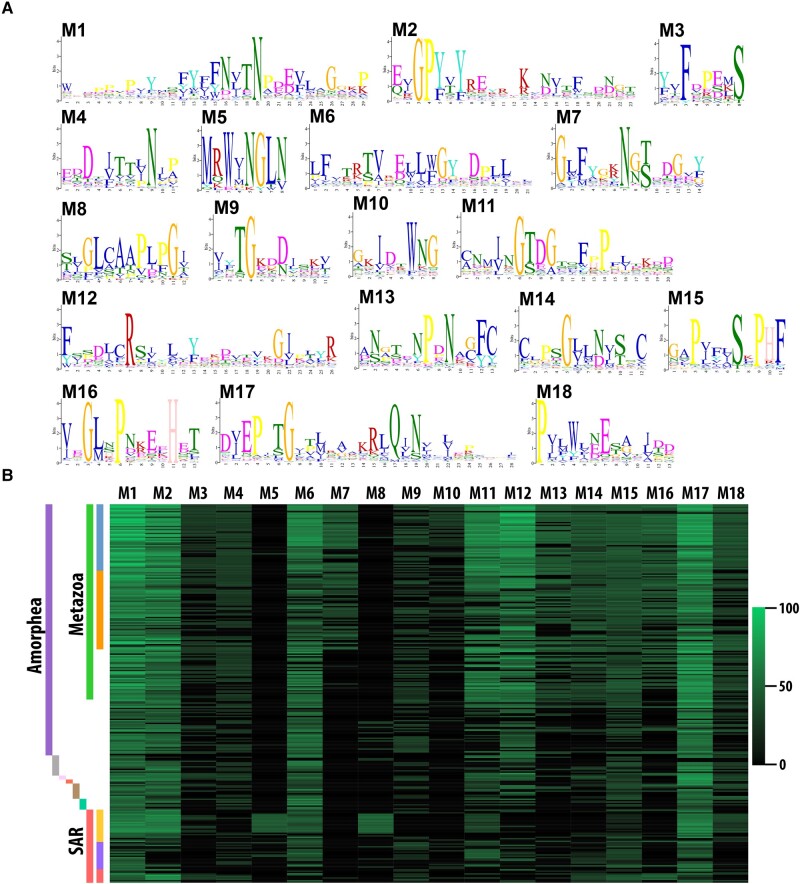
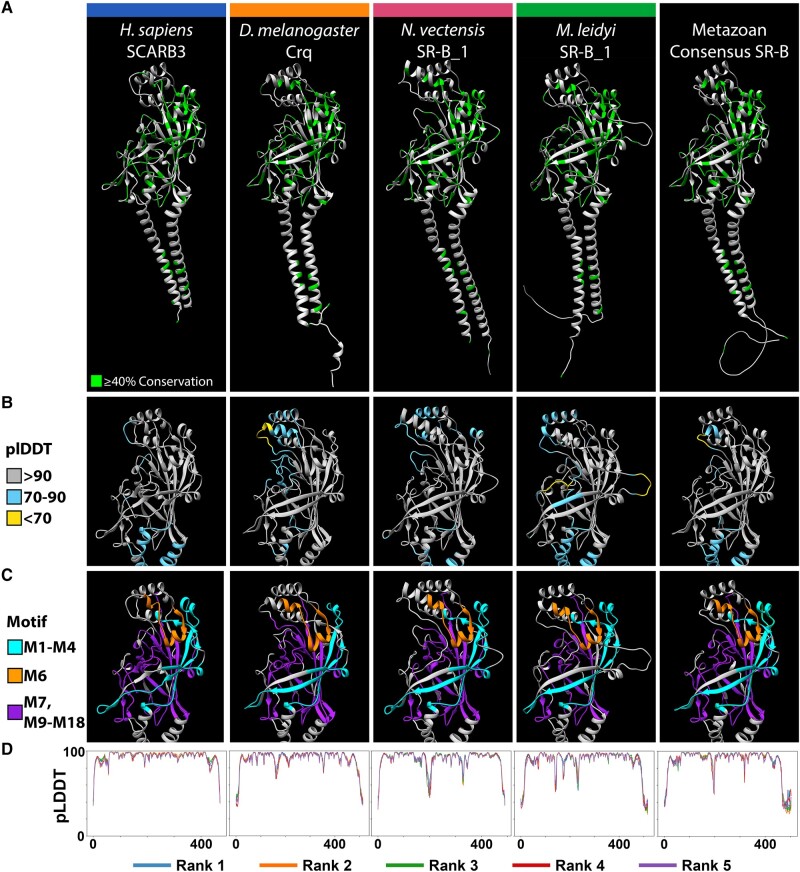
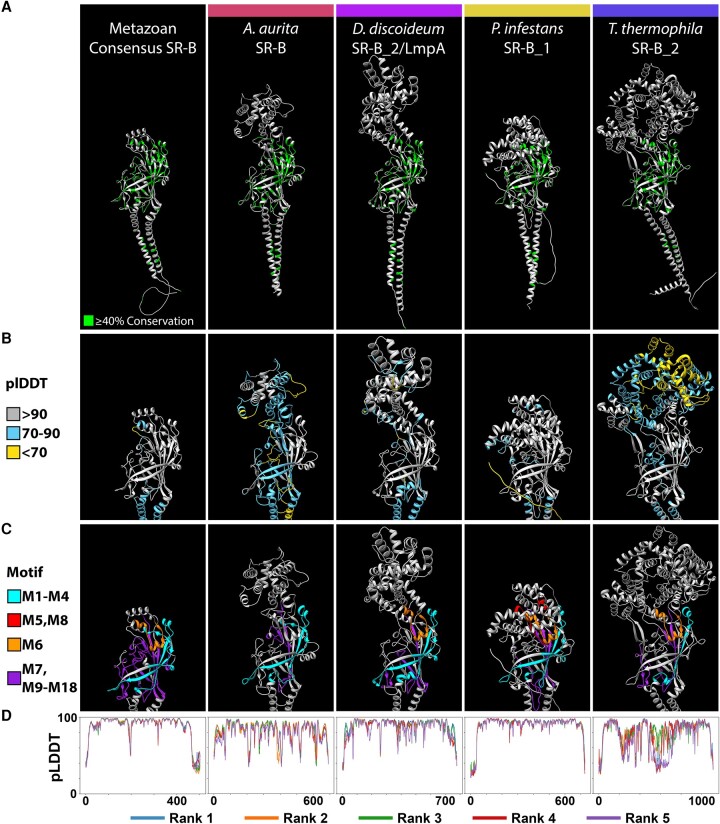
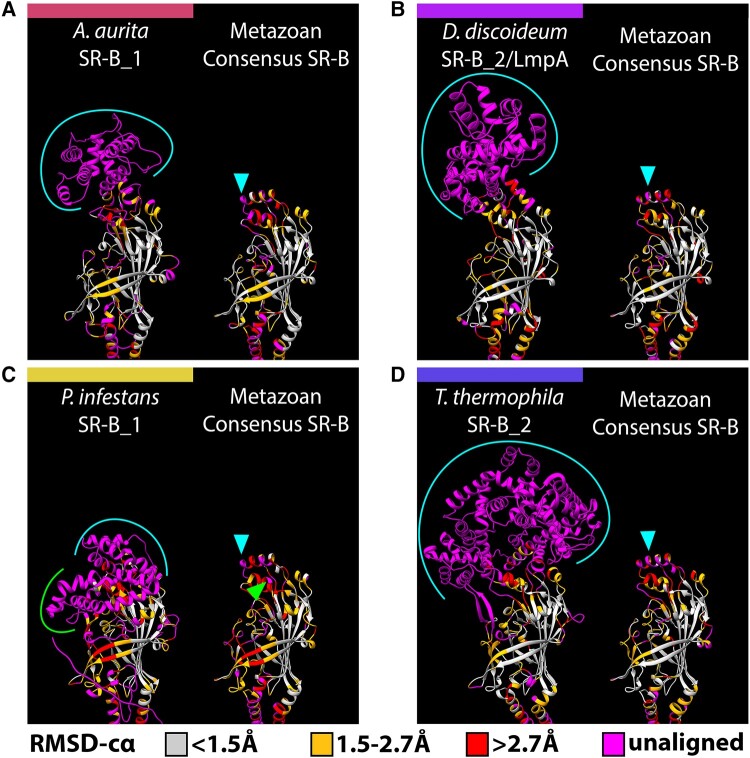
The cluster of differentiation 36 (CD36) domain defines the characteristic ectodomain associated with scavenger receptor class B (SR-B) proteins. In bilaterians, SR-Bs play critical roles in diverse biological processes including innate immunity functions such as pathogen recognition and apoptotic cell clearance, as well as metabolic sensing associated with fatty acid uptake and cholesterol transport. While previous studies suggest this protein family is ancient, SR-B diversity across Eukarya has not been robustly characterized. We analyzed SR-B homologs identified from the genomes and transcriptomes of 165 diverse eukaryotic species. The presence of highly conserved amino acid motifs across major eukaryotic supergroups supports the presence of a SR-B homolog in the last eukaryotic common ancestor (LECA). Our comparative analyses of SR-B protein structure identifies the retention of a canonical asymmetric beta barrel tertiary structure within the CD36 ectodomain across Eukarya. We also identify multiple instances of independent lineage-specific sequence expansions in the apex region of the CD36 ectodomain — a region functionally associated with ligand-sensing. We hypothesize that a combination of both sequence expansion and structural variation in the CD36 apex region may reflect the evolution of SR-B ligand sensing specificity between diverse eukaryotic clades. Significance Statement: SR-Bs are well-described in bilaterians, however the diversity and evolution of this ancient receptor protein family is poorly understood across Eukarya. Our analyses reveal a conserved beta barrel tertiary structure across eukaryotic SR-Bs that correlates with the presence of an intramolecular tunnel. In contrast, the putative ligand-sensing region associated with the apex of the protein can be highly divergent in both sequence and structure within and between taxa. Our data confirm the antiquity of the SR-B receptor protein family in Eukaryota and improve characterization of SR-B diversity outside of Metazoa. We hypothesize that eukaryotic SR-B diversity may be used as a model to explore receptor protein evolution driven by lineage-specific ligand specificity.
Overview
The claims and statistics of this paper haven’t been checked yet.
Run the check — free, no account needed. It reads the open-access text and checks the sources it cites.
Integrity signals
Registry
Cites
Statistics
Figures
Verification
Claims the paper makes
The claims and statistics of this paper haven’t been checked yet.
Run the check — free, no account needed. It reads the open-access text and checks the sources it cites.
Self-check
Percentages, sums and reported differences re-computed from the paper’s own numbers.
The self-check needs the paper’s full text.
Citations
Cites
Highly accurate protein structure prediction with AlphaFold
Jumper, J., Evans, R., Pritzel, A., Green, T., Figurnov, M., Ronneberger, O., Tunyasuvunakool, K., Bates, R., Žídek, A., Potapenko, A., et al. (2021) · Nature · doi:10.1038/s41586-021-03819-2 · Cited by 43,764
Research works printed but not linked: 76
- 10.1038/ni1253 · DOI
- 10.1126/science.abj8754 · DOI · Paper page
- 10.1093/bioinformatics/btab203 · DOI
- 10.1016/j.dci.2015.02.001 · DOI
- 10.1016/j.tree.2019.08.008 · DOI · Paper page
- 10.1093/bioinformatics/btp348 · DOI
- 10.1016/j.ympev.2016.10.011 · DOI
- 10.1084/jem.20211314 · DOI
- 10.1371/journal.pcbi.1002708 · DOI
- 10.1038/s41467-017-02044-8 · DOI
- 10.1093/molbev/msz189 · DOI
- 10.1093/molbev/msw168 · DOI
- 10.1016/j.molbiopara.2005.12.010 · DOI
- 10.1016/j.neuroscience.2020.11.003 · DOI
- 10.1093/bioinformatics/14.9.755 · DOI · Paper page
- 10.4049/jimmunol.0901374 · DOI
- 10.1093/gbe/evaa241 · DOI
- 10.1016/S1074-7613(00)80410-0 · DOI
- 10.1093/bioinformatics/bts565 · DOI · Paper page
- 10.1194/jlr.R082933 · DOI
- 10.1038/ncomms11866 · DOI
- 10.1038/s41592-022-01685-y · DOI · Paper page
- 10.1038/s41467-019-11425-0 · DOI · Paper page
- 10.1038/s41467-021-21511-x · DOI · Paper page
- 10.1038/ncomms12837 · DOI
- 10.1002/prot.22458 · DOI
- 10.1074/jbc.M114.627026 · DOI
- 10.1074/jbc.M709195200 · DOI
- 10.1083/jcb.145.1.167 · DOI
- 10.1093/molbev/mst010 · DOI · Paper page
- 10.1093/nar/gkh468 · DOI
- 10.1126/science.1102218 · DOI
- 10.1006/jmbi.2000.4315 · DOI · Paper page
- 10.1074/jbc.M113.473298 · DOI
- 10.1093/gbe/evab101 · DOI
- 10.1093/molbev/msab170 · DOI · Paper page
- 10.1093/bioinformatics/btt473 · DOI · Paper page
- 10.1096/fasebj.10.1.8566545 · DOI
- 10.1084/jem.20082109 · DOI
- 10.1038/s41592-022-01488-1 · DOI · Paper page
- 10.1093/nar/gkaa913 · DOI · Paper page
- 10.1186/1471-2164-15-316 · DOI
- 10.1093/database/baaa029 · DOI
- 10.1242/jcs.01083 · DOI
- 10.1038/nature12684 · DOI
- 10.7717/peerj.2692 · DOI
- 10.1016/j.ibmb.2007.11.003 · DOI
- 10.1091/mbc.E10-03-0251 · DOI · Paper page
- 10.1021/bi2005625 · DOI
- 10.1073/pnas.1300021110 · DOI
- 10.1002/jcc.20084 · DOI
- 10.4049/jimmunol.1700373 · DOI
- 10.1371/journal.pone.0009490 · DOI · Paper page
- 10.1093/nar/gki442 · DOI
- 10.1046/j.1432-1327.1998.2570488.x · DOI
- 10.7554/eLife.34226 · DOI
- 10.1016/j.gde.2019.09.002 · DOI
- 10.24072/pcjournal.173 · DOI
- 10.1093/bioinformatics/btg180 · DOI
- 10.1242/jcs.218040 · DOI
- 10.1074/jbc.R114.619304 · DOI
- 10.1038/ni.2639 · DOI · Paper page
- 10.1126/scisignal.272re3 · DOI · Paper page
- 10.1093/bioinformatics/btu033 · DOI · Paper page
- 10.1038/ni.1836 · DOI · Paper page
- 10.1038/s41467-021-22044-z · DOI · Paper page
- 10.1074/jbc.M702887200 · DOI
- 10.1186/s12964-021-00812-0 · DOI
- 10.1006/bbrc.1997.7755 · DOI
- 10.1093/nar/gky473 · DOI · Paper page
- 10.1093/nar/gkab1061 · DOI · Paper page
- 10.1534/genetics.107.085936 · DOI
- 10.1111/j.1742-4658.2007.06178.x · DOI
- 10.1006/jmbi.2000.3975 · DOI
- 10.1021/bi301203x · DOI
- 10.1002/prot.20264 · DOI · Paper page
Metadata
- Authors
- Boohar, R. T., Vandepas, L. E., Traylor-Knowles, N., & Browne, W. E.
- Affiliations
- University of Miami (US)
- Corresponding author
- Browne, William E.
- Venue
- Genome Biology and Evolution
- Publisher
- openRxiv
- Published
- 2023-11-16
- Volume
- 15
- Issue
- 12
- ISSN
- 1759-6653 (ISSN-L)
- PMC
- PMC10715195
- OpenAlex
- W4389208207
- Cited by
- 11
- References
- 1
- Citations by year
- 2026: 2 · 2024: 9
- FWCI
- 5.07
- Type
- journal article
- Language
- en
- Open access
- gold
- doi.org
- Licence
- cc-by
- Locations
- Genome Biology and Evolution (publishedVersion, cc-by)
- bioRxiv (Cold Spring Harbor Laboratory) (acceptedVersion, cc-by-nc-nd)
- PubMed Central (publishedVersion, cc-by)
- PubMed (publishedVersion)
- Funders
- National Science Foundation (2013692)
- Topics
- Life Sciences › Biochemistry, Genetics and Molecular Biology › Biochemistry › Cholesterol and Lipid Metabolism
- Life Sciences › Biochemistry, Genetics and Molecular Biology › Molecular Biology › Genomics and Phylogenetic Studies
- Life Sciences › Biochemistry, Genetics and Molecular Biology › Molecular Biology › Protein Structure and Dynamics
- Keywords
- scavenger receptor class B, protein evolution, last eukaryotic common ancestor, eukaryotic supergroups, innate immunity, fatty acid uptake, cholesterol transport, efferocytosis, pathogen recognition
- MeSH terms
- Ligands, Phylogeny, CD36 Antigens, Scavenger Receptors, Class B, Eukaryota
About these checks
Registry, retraction, Cites and statistics results are computed, not judged, with one exception: a printed reference that no index lists is read once by a model before it counts as a citation error. Claims are extracted by a model and kept only when their quote appears verbatim in the text; each cited source is then checked, with a model’s help, for whether it says what the claim relies on. Those verdicts can be wrong — read the claim’s quote and the cited source before relying on one.
Statistics and arithmetic are recomputed, not judged.
Confidence bands are shown only for fields calibrated on our annotated test set. None is calibrated yet, so no band is shown.
What counts as a claim ›How we measure confidence ›How we check this ›
Are you an author, or do you see a problem with this page? Request a review
How to cite
Cite CoChat for the checks on this page, and the paper for its own findings.
- This page
- CoChat. (2026). Citation check: Phylogenetic and protein structure analyses provide insight into the evolution and diversification of the CD36 domain ‘apex’ among scavenger receptor class B proteins across Eukarya. https://app.cochat.ai/papers/10.1101/2023.11.13.566873
- The paper
- Boohar, R. T., Vandepas, L. E., Traylor-Knowles, N., & Browne, W. E. (2023). Phylogenetic and protein structure analyses provide insight into the evolution and diversification of the CD36 domain ‘apex’ among scavenger receptor class B proteins across Eukarya. Genome Biology and Evolution. https://doi.org/10.1101/2023.11.13.566873
