

The DOI matches its Crossref record; 1 of the 1 references it cites were found in a registry or an index.
VirtuousPocketome: A Computational Tool for Screening Protein-ligand Complexes to Identify Similar Binding Sites
Open accessPreprint — published as 10.1038/s41598-024-56893-7 · Paper page
Abstract
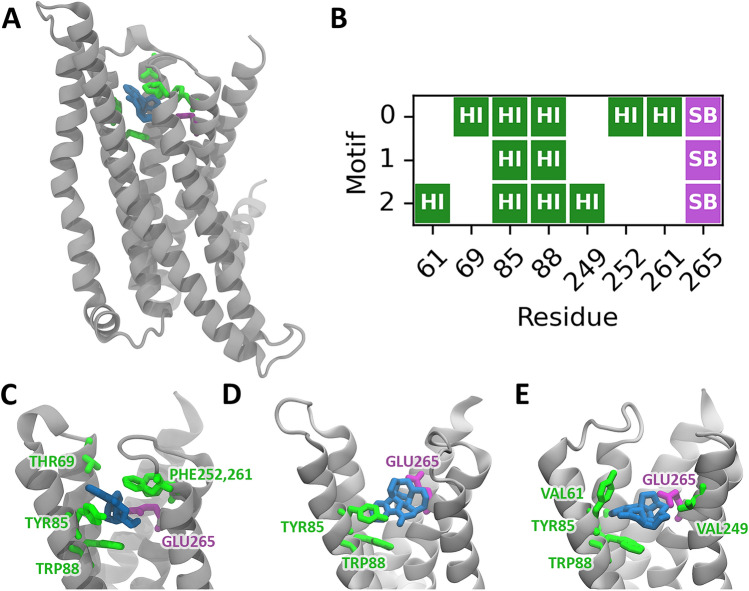
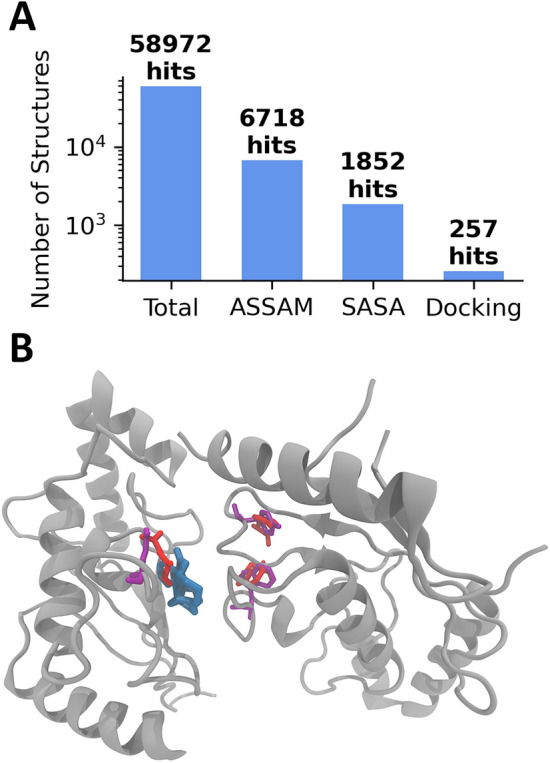
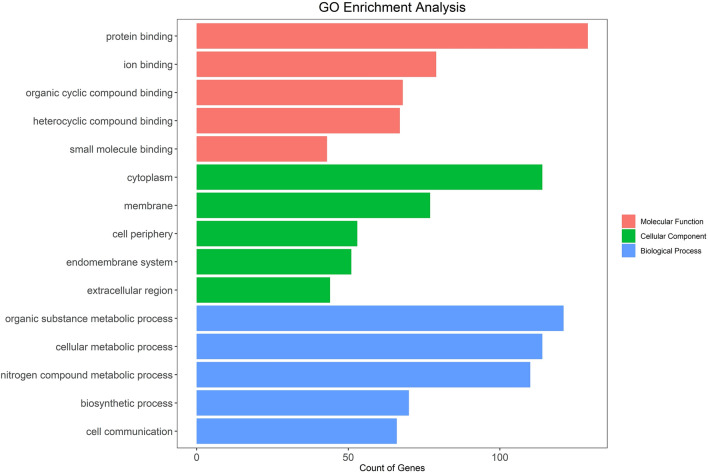
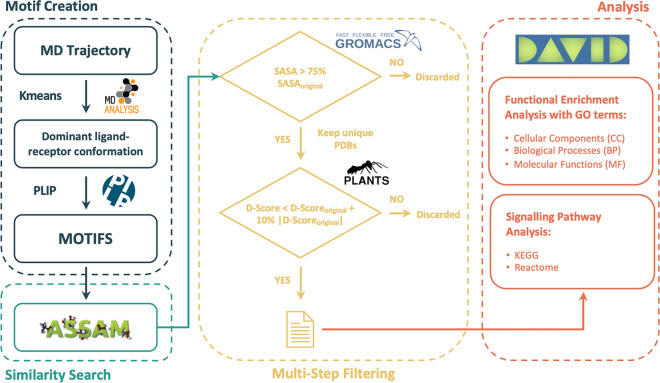
Protein residues within binding pockets play a critical role in determining the range of ligands that can interact with a protein, influencing its structure and function. Identifying structural similarities in proteins offers valuable insights into their function and activation mechanisms, aiding in predicting protein-ligand interactions, anticipating off-target effects, and facilitating the development of therapeutic agents. Numerous computational methods assessing global or local similarity in protein cavities have emerged, but their utilization is impeded by complexity, impractical automation for amino acid pattern searches, and an inability to evaluate the dynamics of scrutinized protein-ligand systems. Here, we present a general, automatic and unbiased computational pipeline, named VirtuousPocketome , aimed at screening huge databases of proteins for similar binding pockets starting from an interested protein-ligand complex. We demonstrate the pipeline’s potential by exploring a recently-solved human bitter taste receptor, i.e. the TAS2R46, complexed with strychnine. We pinpointed 145 proteins sharing similar binding sites compared to the analysed bitter taste receptor and the enrichment analysis highlighted the related biological processes, molecular functions and cellular components. This work represents the foundation for future studies aimed at understanding the effective role of tastants outside the gustatory system: this could pave the way towards the rationalization of the diet as a supplement to standard pharmacological treatments and the design of novel tastants-inspired compounds to target other proteins involved in specific diseases or disorders. The proposed pipeline is publicly accessible, can be applied to any protein-ligand complex, and could be expanded to screen any database of protein structures.
Overview
The claims and statistics of this paper haven’t been checked yet.
Run the check — free, no account needed. It reads the open-access text and checks the sources it cites.
Integrity signals
Registry
Cites
Statistics
Figures
Verification
Claims the paper makes
The claims and statistics of this paper haven’t been checked yet.
Run the check — free, no account needed. It reads the open-access text and checks the sources it cites.
Self-check
Percentages, sums and reported differences re-computed from the paper’s own numbers.
The self-check needs the paper’s full text.
Citations
Cites
Highly accurate protein structure prediction with AlphaFold
Jumper, J., Evans, R., Pritzel, A., Green, T., Figurnov, M., Ronneberger, O., Tunyasuvunakool, K., Bates, R., Žídek, A., Potapenko, A., et al. (2021) · Nature · doi:10.1038/s41586-021-03819-2 · Cited by 43,764
Research works printed but not linked: 121
- 10.1038/40310 · DOI
- 2018, A benchmark driven guide to binding site comparison: An exhaustive evaluation using tailor-made data sets (ProSPECCTs), PLoS Comput Biol, 14, e1006483, 10.1371/journal.pcbi.1006483 · DOI
- 2016, In silico methods for drug repurposing and pharmacology, WIREs Mechanisms of Disease, 8, 186, 10.1002/wsbm.1337 · DOI
- Independent Interdisciplinary Consultant, Oxford, United Kingdom & Flower, D, 2020, Drug Discovery: Today and Tomorrow, Bioinformation, 16, 1, 10.6026/97320630016001 · DOI
- 10.1016/j.phrs.2021.106055 · DOI
- 2020, An up-to-date overview of computational polypharmacology in modern drug discovery, Expert Opinion on Drug Discovery, 15, 1025, 10.1080/17460441.2020.1767063 · DOI
- 10.1371/journal.pone.0270955 · DOI
- 2022, Estimating the Similarity between Protein Pockets, IJMS, 23, 12462, 10.3390/ijms232012462 · DOI
- 2018, A benchmark driven guide to binding site comparison: An exhaustive evaluation using tailor-made data sets (ProSPECCTs), PLoS Comput Biol, 14, e1006483, 10.1371/journal.pcbi.1006483 · DOI
- 10.1002/prot.10339 · DOI
- 10.1016/S0022-2836(03)00045-7 · DOI
- 2004, Identification of Protein Biochemical Function by Searching the Similar Shape and Electrostatic Potential on the Molecular Surface of Proteins, Seibutsu Butsuri, 44, 150, 10.2142/biophys.44.150 · DOI
- 10.1093/nar/gki524 · DOI · Paper page
- 10.1093/nar/gki482 · DOI
- 10.1093/nar/gkl788 · DOI
- 10.1109/ParCompTech.2013.6621397 · DOI
- 10.1186/1471-2105-9-543 · DOI
- 10.1002/prot.21858 · DOI
- 10.1093/nar/gkn185 · DOI
- 10.1016/j.jmb.2008.12.072 · DOI
- 10.1093/nar/gkp900 · DOI
- 10.1093/bioinformatics/btp220 · DOI
- 10.1093/bioinformatics/btq288 · DOI
- 10.1093/bioinformatics/btq116 · DOI
- 10.1186/1471-2105-11-555 · DOI
- 10.1021/ci900349y · DOI
- 10.1021/ci300184x · DOI
- 10.1021/ci3000776 · DOI
- 10.1093/nar/gks435 · DOI
- 10.1093/nar/gkr1130 · DOI
- 10.1093/nar/gks372 · DOI
- 10.1093/nar/gks401 · DOI
- 10.1093/bioinformatics/bts095 · DOI
- 2013, IsoCleft Finder – a web-based tool for the detection and analysis of protein binding-site geometric and chemical similarities, F1000Res, 2, 117, 10.12688/f1000research.2-117.v1 · DOI
- 10.1093/nar/gkt403 · DOI
- 10.1093/nar/gkt431 · DOI
- 10.1093/bioinformatics/btt024 · DOI
- 10.1021/ci300566n · DOI
- 10.1093/bioinformatics/btt664 · DOI
- 2014, SiteHopper - a unique tool for binding site comparison, J Cheminform, 6, P57, 10.1186/1758-2946-6-S1-P57 · DOI
- 10.1093/bioinformatics/btv616 · DOI
- 10.1021/acs.jcim.5b00333 · DOI
- 2015, Large-Scale Mining for Similar Protein Binding Pockets: With RAPMAD Retrieval on the Fly Becomes Real, J. Chem. Inf. Model., 55, 165, 10.1021/ci5005898 · DOI
- 10.1002/pro.2890 · DOI
- 2016, Geomfinder: a multi-feature identifier of similar three-dimensional protein patterns: a ligand-independent approach, Cheminform, 8, 19, 10.1186/s13321-016-0131-9 · DOI
- 2019, PatchSearch: a web server for off-target protein identification, Nucleic Acids Research, 47, W365, 10.1093/nar/gkz478 · DOI
- 2019, Drug ReposER: a web server for predicting similar amino acid arrangements to known drug binding interfaces for potential drug repositioning, Nucleic Acids Research, 47, W350, 10.1093/nar/gkz391 · DOI
- 10.1021/acs.jcim.9b00554 · DOI
- 10.1016/j.cub.2013.04.010 · DOI
- 10.1111/exd.14250 · DOI
- 10.1371/journal.pone.0205322 · DOI
- 10.1016/j.bbrc.2011.02.016 · DOI
- Kyriazis, G. A. , Soundarapandian, M. M. & Tyrberg, B. Sweet taste receptor signaling in beta cells mediates fructose-induced potentiation of glucose-stimulated insulin secretion. Proc. Natl. Acad. Sci. U.S.A. 109, (2012). · DOI
- 10.1210/en.2013-2015 · DOI
- 10.1371/journal.pone.0064579 · DOI
- 10.1096/fj.14-256305 · DOI
- 10.1073/pnas.1402436111 · DOI
- 10.1038/nm.2237 · DOI
- 2015, Targeting extra-oral bitter taste receptors modulates gastrointestinal motility with effects on satiation, Scientific Reports, 5, 1
- 10.1254/jphs.11R08CP · DOI
- 10.1152/ajpendo.00036.2019 · DOI
- 2019, Taste Receptors in Upper Airway Innate Immunity, Nutrients, 11, 2017, 10.3390/nu11092017 · DOI
- 2022, Extra-Oral Taste Receptors—Function, Disease, and Perspectives, Front. Nutr., 9, 881177, 10.3389/fnut.2022.881177 · DOI
- 10.18632/oncotarget.8549 · DOI
- 10.1016/S0092-8674(00)80706-0 · DOI
- 10.1074/jbc.REV120.009348 · DOI
- 2016, Comparing Class A GPCRs to bitter taste receptors, Biophysical Methods in Cell Biology, 132, 401, 10.1016/bs.mcb.2015.10.005 · DOI
- 10.1073/pnas.0913862107 · DOI
- 10.1016/j.cub.2010.04.043 · DOI
- 10.1093/chemse/bjp092 · DOI
- 10.25080/Majora-629e541a-00e · DOI
- 10.1126/science.abo1633 · DOI
- 10.1523/JNEUROSCI.3248-12.2013 · DOI
- 10.1016/j.ejphar.2006.04.010 · DOI
- DiPizio, A. , et al. Rational design of agonists for bitter taste receptor TAS2R14: from modeling to bench and back. Cellular and Molecular Life Sciences 77, (2020). · DOI
- 2019, Dual binding mode of “bitter sugars” to their human bitter taste receptor target, Scientific Reports, 9, 1
- 10.1021/acs.jcim.1c01056 · DOI
- Topin, J. , et al. Functional molecular switches of mammalian G protein-coupled bitter-taste receptors. Cellular and Molecular Life Sciences 6, 2020.10.23.348706 (2021). · DOI
- 10.1124/mol.51.5.889 · DOI
- 10.1038/360161a0 · DOI
- 1991, A point mutation in the seventh hydrophobic domain of the alpha 2 adrenergic receptor increases its affinity for a family of beta receptor antagonists, J Biol Chem, 266, 15488, 10.1016/S0021-9258(18)98642-4 · DOI
- 1993, Amino acid substitutions at position 312 in the seventh hydrophobic segment of the beta 2-adrenergic receptor modify ligand-binding specificity, Mol Pharmacol, 44, 111
- 10.1074/jbc.270.9.4185 · DOI
- 10.1124/mol.52.3.499 · DOI
- 10.1074/jbc.270.10.5019 · DOI
- 10.1093/chemse/bjh064 · DOI
- 1994, Inhibitory effect of strychnine on acetylcholine receptor activation in bovine adrenal medullary chromaffin cells, British J Pharmacology, 113, 471, 10.1111/j.1476-5381.1994.tb17013.x · DOI
- 10.1073/pnas.96.7.4113 · DOI
- 10.1039/D1NP00079A · DOI
- 10.1016/j.softx.2015.06.001 · DOI · Paper page
- 2018, pdb-tools: a swiss army knife for molecular structures, F1000Res, 7, 1961, 10.12688/f1000research.17456.1 · DOI
- 10.1093/NAR/GKAB294 · DOI
- 10.1021/ci0255984 · DOI
- 1973, Algorithm 457: finding all cliques of an undirected graph, Commun. ACM, 16, 575, 10.1145/362342.362367 · DOI
- 2006, PLANTS: Application of Ant Colony Optimization to Structure-Based Drug Design, Ant Colony Optimization and Swarm Intelligence, 4150, 247
- 10.1007/s11721-007-0006-9 · DOI
- 10.1021/acs.jcim.9b00346 · DOI
- 10.1023/A:1007996124545 · DOI
- 10.1021/ci3004094 · DOI
- 10.1021/acs.jcim.5b00066 · DOI
- 2022, Sodium or Not Sodium: Should Its Presence Affect the Accuracy of Pose Prediction in Docking GPCR Antagonists?, Pharmaceuticals, 15, 346, 10.3390/ph15030346 · DOI
- 10.1038/srep28288 · DOI
- 10.1021/jm2011589 · DOI
- 10.1038/nprot.2008.211 · DOI · Paper page
- 10.1093/NAR/GKAC194 · DOI
- 10.1093/nar/gkm883 · DOI
- 10.1093/nar/gkab1028 · DOI
- 10.1093/nar/28.1.27 · DOI · Paper page
- 2023, KEGG for taxonomy-based analysis of pathways and genomes, Nucleic Acids Research, 51, D587, 10.1093/nar/gkac963 · DOI · Paper page
- 2006, On the Benjamini–Hochberg method, The Annals of Statistics, 34, 1827
- 10.1093/nar/gkx1095 · DOI
- 10.1093/nar/28.1.235 · DOI · Paper page
- 10.1002/jcc.20945 · DOI · Paper page
- 10.1021/acs.jctc.1c01217 · DOI
- 2020, ff19SB: Amino-Acid-Specific Protein Backbone Parameters Trained against Quantum Mechanics Energy Surfaces in Solution, J. Chem. Theory Comput., 16, 528, 10.1021/acs.jctc.9b00591 · DOI
- 10.1002/jcc.20035 · DOI
- 10.1063/1.448118 · DOI
- 10.1063/1.447334 · DOI
- 10.1063/1.328693 · DOI
- 10.1002/(SICI)1096-987X(199709)18:12<1463::AID-JCC4>3.3.CO;2-L · DOI
- 10.1016/0263-7855(96)00018-5 · DOI · Paper page
Metadata
- Authors
- Pallante, L., Cannariato, M., Androutsos, L., Zizzi, E. A., Bompotas, A., Hada, X., Grasso, G., Kalogeras, A., Mavroudi, S., di Benedetto, G., Theofilatos, K., & Deriu, M. A.
- Affiliations
- Politecnico di Torino (IT)
- Industrial Systems Institute (GR)
- University of Applied Sciences and Arts of Southern Switzerland (CH)
- University of Patras (GR)
- Corresponding author
- Deriu, Marco A.
- ORCID
- Venue
- Scientific Reports
- Publisher
- openRxiv
- Published
- 2023-12-13
- Volume
- 14
- Issue
- 1
- Pages
- 6296-6296
- ISSN
- 2045-2322 (ISSN-L)
- PMC
- PMC10943019
- OpenAlex
- W4392847330
- Cited by
- 12
- References
- 1
- Citations by year
- 2026: 1 · 2025: 6 · 2024: 5
- FWCI
- 2.54
- Type
- journal article
- Language
- en
- Open access
- gold
- doi.org
- Licence
- cc-by
- Locations
- Scientific Reports (publishedVersion, cc-by)
- bioRxiv (Cold Spring Harbor Laboratory) (acceptedVersion, cc-by-nc-nd)
- PubMed Central (publishedVersion, cc-by)
- PubMed (publishedVersion)
- PORTO@Iris (submittedVersion, cc-by)
- DOAJ (DOAJ: Directory of Open Access Journals) (submittedVersion)
- Funders
- European Commission (872181, HORIZON2020)
- H2020 Marie Skłodowska-Curie Actions (872181)
- Topics
- Life Sciences › Pharmacology, Toxicology and Pharmaceutics › Drug Discovery › Computational Drug Discovery Methods
- Life Sciences › Biochemistry, Genetics and Molecular Biology › Molecular Biology › Protein Structure and Dynamics
- Life Sciences › Biochemistry, Genetics and Molecular Biology › Structural Biology › Enzyme Structure and Function
- Keywords
- protein pockets, protein-ligand complex, binding site similarity, protein structure comparison, strychnine, off-target effects
- MeSH terms
- Binding Sites, Humans, Ligands, Protein Binding, Proteins, Taste, Taste Buds
About these checks
Registry, retraction, Cites and statistics results are computed, not judged, with one exception: a printed reference that no index lists is read once by a model before it counts as a citation error. Claims are extracted by a model and kept only when their quote appears verbatim in the text; each cited source is then checked, with a model’s help, for whether it says what the claim relies on. Those verdicts can be wrong — read the claim’s quote and the cited source before relying on one.
Statistics and arithmetic are recomputed, not judged.
Confidence bands are shown only for fields calibrated on our annotated test set. None is calibrated yet, so no band is shown.
What counts as a claim ›How we measure confidence ›How we check this ›
Are you an author, or do you see a problem with this page? Request a review
How to cite
Cite CoChat for the checks on this page, and the paper for its own findings.
- This page
- CoChat. (2026). Citation check: VirtuousPocketome: A Computational Tool for Screening Protein-ligand Complexes to Identify Similar Binding Sites. https://app.cochat.ai/papers/10.1101/2023.12.12.571207
- The paper
- Pallante, L., Cannariato, M., Androutsos, L., Zizzi, E. A., Bompotas, A., Hada, X., Grasso, G., Kalogeras, A., Mavroudi, S., di Benedetto, G., Theofilatos, K., & Deriu, M. A. (2023). VirtuousPocketome: A Computational Tool for Screening Protein-ligand Complexes to Identify Similar Binding Sites. Scientific Reports. https://doi.org/10.1101/2023.12.12.571207
