Student or educator? Sign up with your school email and get 6 months of Pro free.
PreprintCited by 15Bacteriophages and microbial interactionsBacterial Genetics and BiotechnologyCRISPR and Genetic Engineering

The DOI matches its Crossref record; 1 of the 1 references it cites were found in a registry or an index.

The vibriophage-encoded inhibitor OrbA abrogates BREX-mediated defense through the ATPase BrxC

Open access
Oshiro, Reid T, Dunham, Drew T, Seed, Kimberley D·2024·Journal of Bacteriology

Preprint — published as 10.1128/jb.00206-24 · Paper page

Abstract

Bacteria and phages are locked in a co-evolutionary arms race where each entity evolves mechanisms to restrict the proliferation of the other. Phage-encoded defense inhibitors have proven powerful tools to interrogate how defense systems function. A relatively common defense system is BREX (Bacteriophage exclusion); however, how BREX functions to restrict phage infection remains poorly understood. A BREX system encoded by the SXT integrative and conjugative element, Vch Ind5, was recently identified in Vibrio cholerae , the causative agent of the diarrheal disease cholera. The lytic phage ICP1 that co-circulates with V. cholerae encodes the BREX inhibitor OrbA, but how OrbA inhibits BREX is unclear. Here, we determine that OrbA inhibits BREX using a unique mechanism from known BREX inhibitors by directly binding to the BREX component BrxC. BrxC has a functional ATPase domain that, when mutated, not only disrupts BrxC function but also alters how BrxC multimerizes. Furthermore, we find that OrbA binding disrupts BrxC-BrxC interactions. We determine that OrbA cannot bind BrxC encoded by the distantly related BREX system encoded by the SXT Vch Ban9, and thus fails to inhibit this BREX system that also circulates in epidemic V. cholerae . Lastly, we find that homologs of the Vch Ind5 BrxC are more diverse than the homologs of the Vch Ban9 BrxC. These data provide new insight into the function of the BrxC ATPase and highlight how phage-encoded inhibitors can disrupt phage defense systems using different mechanisms. Importance: With renewed interest in phage therapy to combat antibiotic-resistant pathogens, understanding the mechanisms bacteria use to defend themselves against phages and the counter-strategies phages evolve to inhibit defenses is paramount. Bacteriophage exclusion (BREX) is a common defense system with few known inhibitors. Here, we probe how the vibriophage-encoded inhibitor OrbA inhibits the BREX system of Vibrio cholerae , the causative agent of the diarrheal disease cholera. By interrogating OrbA function, we have begun to understand the importance and function of a BREX component. Our results demonstrate the importance of identifying inhibitors against defense systems, as they are powerful tools for dissecting defense activity and can inform strategies to increase the efficacy of some phage therapies.

Overview

The claims and statistics of this paper haven’t been checked yet.

Run the check — free, no account needed. It reads the open-access text and checks the sources it cites.

A few free checks a day · papers already verified open instantly · results are public

Integrity signals

Registry

Crossref · 10.1101/2024.05.09.593382

Cites

1 of 1 references verified0 citation errors · 0 not checkable

Statistics

Figures

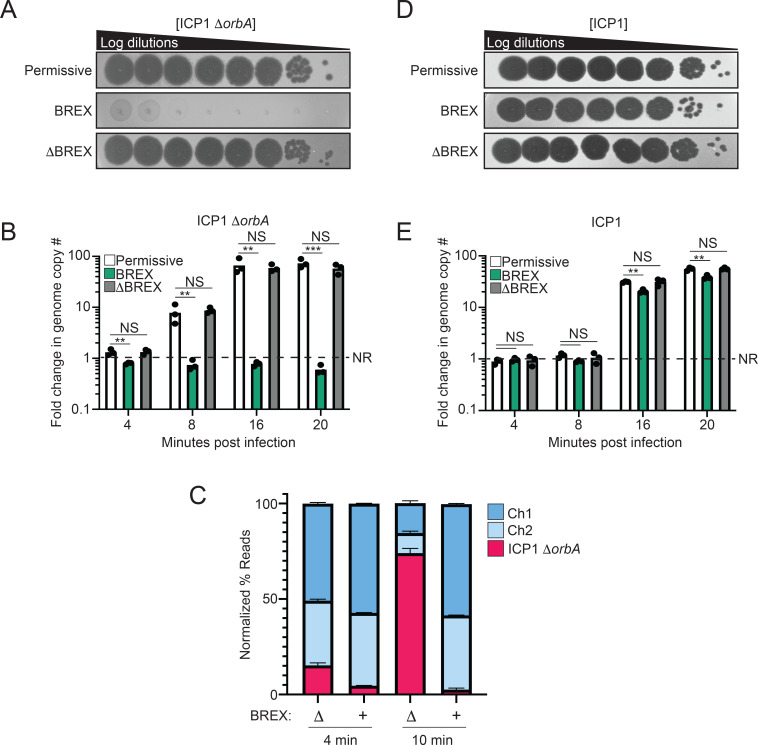
Fig 1 OrbA restores phage genome replication in the presence of BREX. (A) 10-fold serial dilutions of ICP1 ΔorbA spotted on a lawn of bacteria (gray background). (B) Quantification of ICP1 ΔorbA genome replication in the presence and absence of BREX. V. cholerae strains were infected at a multiplicity of infection (MOI) of 0.1. Samples were taken at the addition of phage (Time 0) and at the indicated time points. Each dot represents an individual biological replicate. NR, no replication. NS, not significant. (C) Deep sequencing of total DNA extracted from cells infected with ICP1 ΔorbA at an MOI of 1 at the indicated time points. The percentage of reads mapping to either the V. cholerae chromosome 1 or 2 (Ch1 or Ch2) or ICP1 was calculated by dividing the number of reads by the length of each element and then dividing by the total number of reads of all elements. (D) 10-fold serial dilutions of ICP1 spotted on the same lawns of bacteria (gray background) in panel A. (E) Quantification of ICP1 genome replication in the presence and absence of BREX, as in panel B. For all panels, The V. cholerae strain E7946 was used as a permissive background (permissive), E7946 encoding the SXT ICE VchInd5 is indicated as BREX, and E7946 encoding the SXT ICE VchInd5 with a deletion of the entire hotspot 5 region is indicated as ΔBREX. Statistical analysis for panels B and E was performed using a one-way analysis of variance (* = P < 0.01, ** = P < 0.001, *** = P < 0.0001, **** = P < 0.00001).
Fig 1 OrbA restores phage genome replication in the presence of BREX. (A) 10-fold serial dilutions of ICP1 ΔorbA spotted on a lawn of bacteria (gray background). (B) Quantification of ICP1 ΔorbA genome replication in the presence and absence of BREX. V. cholerae strains were infected at a multiplicity of infection (MOI) of 0.1. Samples were taken at the addition of phage (Time 0) and at the indicated time points. Each dot represents an individual biological replicate. NR, no replication. NS, not significant. (C) Deep sequencing of total DNA extracted from cells infected with ICP1 ΔorbA at an MOI of 1 at the indicated time points. The percentage of reads mapping to either the V. cholerae chromosome 1 or 2 (Ch1 or Ch2) or ICP1 was calculated by dividing the number of reads by the length of each element and then dividing by the total number of reads of all elements. (D) 10-fold serial dilutions of ICP1 spotted on the same lawns of bacteria (gray background) in panel A. (E) Quantification of ICP1 genome replication in the presence and absence of BREX, as in panel B. For all panels, The V. cholerae strain E7946 was used as a permissive background (permissive), E7946 encoding the SXT ICE VchInd5 is indicated as BREX, and E7946 encoding the SXT ICE VchInd5 with a deletion of the entire hotspot 5 region is indicated as ΔBREX. Statistical analysis for panels B and E was performed using a one-way analysis of variance (* = P < 0.01, ** = P < 0.001, *** = P < 0.0001, **** = P < 0.00001).CC BY · PubMed Central
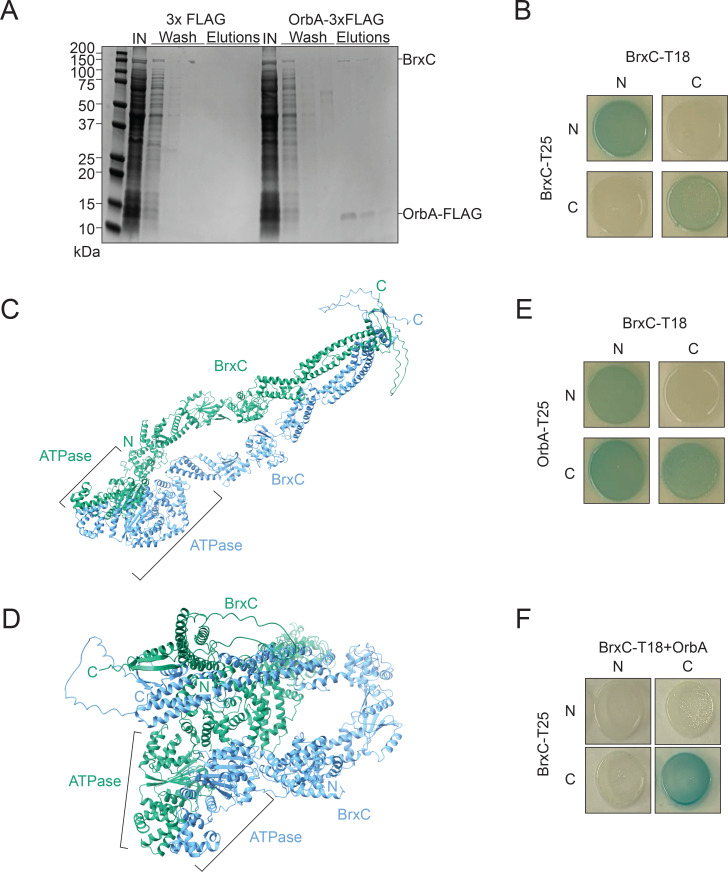
Fig 2 OrbA directly interacts with BrxC from VchInd5. (A) A representative gel image of samples from 3xFLAG and OrbA-3xFLAG resolved by SDS-PAGE and stained with Coomassie brilliant blue. IN, input. For additional biological replicates, see Fig. S3. (B) Bacterial two-hybrid analysis of the interaction between BrxC-BrxC. N- and C- indicate the terminus of each half of the adenylate cyclase enzyme that was translationally fused to the protein of interest. (C and D) Structural prediction of a BrxC dimer by ColabFold. (C) Open conformation of the BrxC dimer. we note that the N-terminus of the right dimer is behind the ATPase and is not visible. (D) Closed conformation of the BrxC dimer. N, N terminus. C, C terminus. (E and F) Bacterial two-hybrid analysis of the interaction between (E) BrxC-OrbA and (F) BrxC-BrxC with OrbA also being expressed from the T18 plasmids. Performed the same as in panel B.
Fig 2 OrbA directly interacts with BrxC from VchInd5. (A) A representative gel image of samples from 3xFLAG and OrbA-3xFLAG resolved by SDS-PAGE and stained with Coomassie brilliant blue. IN, input. For additional biological replicates, see Fig. S3. (B) Bacterial two-hybrid analysis of the interaction between BrxC-BrxC. N- and C- indicate the terminus of each half of the adenylate cyclase enzyme that was translationally fused to the protein of interest. (C and D) Structural prediction of a BrxC dimer by ColabFold. (C) Open conformation of the BrxC dimer. we note that the N-terminus of the right dimer is behind the ATPase and is not visible. (D) Closed conformation of the BrxC dimer. N, N terminus. C, C terminus. (E and F) Bacterial two-hybrid analysis of the interaction between (E) BrxC-OrbA and (F) BrxC-BrxC with OrbA also being expressed from the T18 plasmids. Performed the same as in panel B.CC BY · PubMed Central
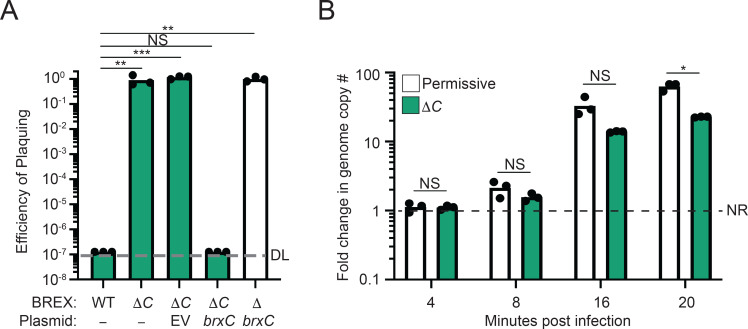
Fig 3 BrxC is required for inhibition of phage genome replication. (A) EOP of ICP1 ΔorbA on V. cholerae with the genotype indicated relative to the ΔBREX strain background. ΔC, deletion of brxC. EV, empty vector. DL, detection limit. Statistical analysis was performed using a one-way analysis of variance (* = P < 0.01, ** = P < 0.001, *** = P < 0.0001, **** = P < 0.00001). (B) Quantification of ICP1 ΔorbA replication in a ΔBREX and brxC-deletion background (ΔC). NR, no replication. Statistical analysis was performed using a Student’s t-test (* = P < 0.01, ** = P < 0.001, *** = P < 0.0001, **** = P < 0.00001). NS, not significant. Each dot represents an individual biological replicate.
Fig 3 BrxC is required for inhibition of phage genome replication. (A) EOP of ICP1 ΔorbA on V. cholerae with the genotype indicated relative to the ΔBREX strain background. ΔC, deletion of brxC. EV, empty vector. DL, detection limit. Statistical analysis was performed using a one-way analysis of variance (* = P < 0.01, ** = P < 0.001, *** = P < 0.0001, **** = P < 0.00001). (B) Quantification of ICP1 ΔorbA replication in a ΔBREX and brxC-deletion background (ΔC). NR, no replication. Statistical analysis was performed using a Student’s t-test (* = P < 0.01, ** = P < 0.001, *** = P < 0.0001, **** = P < 0.00001). NS, not significant. Each dot represents an individual biological replicate.CC BY · PubMed Central
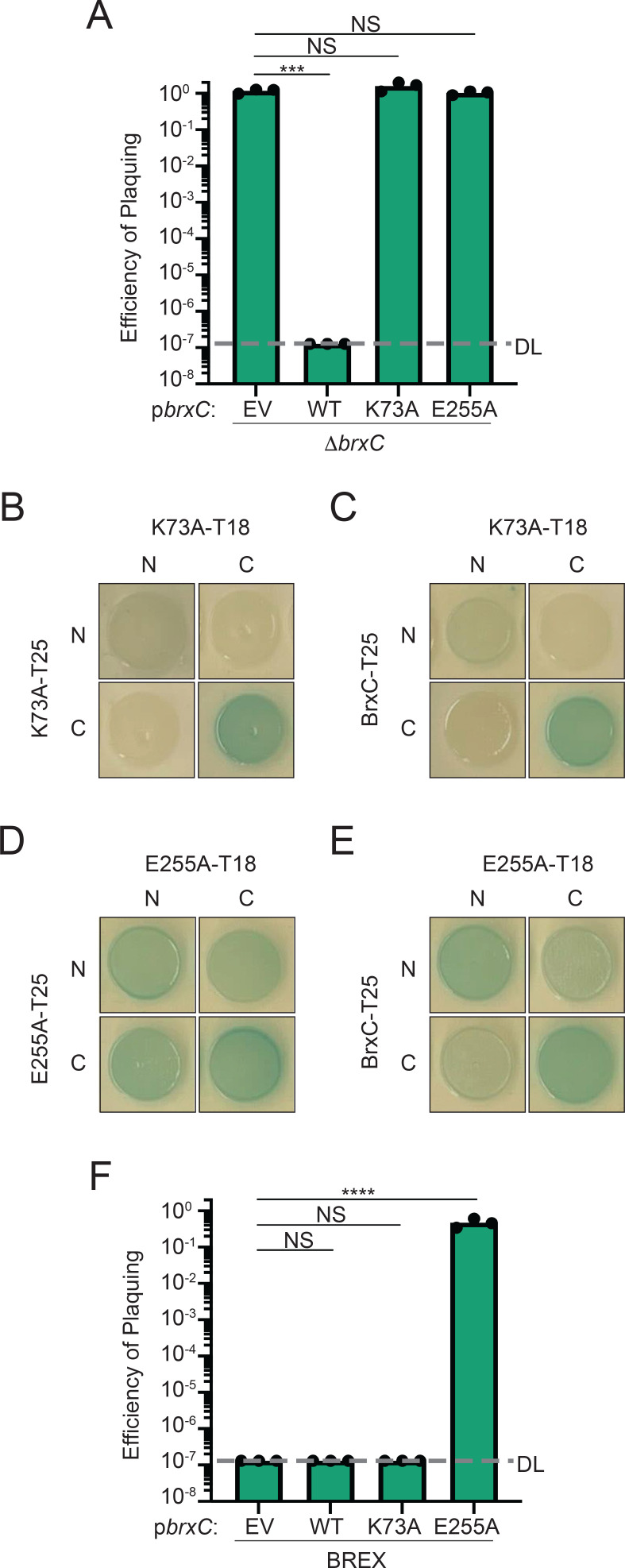
Fig 4 ATP-binding and hydrolysis activity of BrxC is required for function and interactions. (A) EOP of ICP1 ΔorbA on a brxC-deletion background harboring a plasmid that either encodes wild-type BrxC, the Walker A (K73A), or Walker B (E255A) mutant relative to the brxC-deletion strain harboring an empty vector. DL, detection limit. EV, empty vector. Each dot represents a biological replicate. (B–E) Bacterial two-hybrid analysis of the interaction between (B) BrxCK73A-BrxCK73A, (C) BrxCK73A-BrxC, (D) BrxCE255A-BrxCE255A, and (E) BrxCE255A-BrxC. N- and C- indicate the terminus of each half of the adenylate cyclase enzyme was fused to the protein of interest. (F) EOP of ICP1 ΔorbA on V. cholerae encoding a wild-type BREX system and harboring a plasmid that expresses the allele of BrxC indicated relative to the permissive strain V. cholerae E7946 lacking VchInd5 and harboring an empty vector. Statistical analysis for panels A and F was performed using a one-way analysis of variance (* = P < 0.01, ** = P < 0.001, *** = P < 0.0001, **** = P < 0.00001). Each dot represents an independent biological replicate.
Fig 4 ATP-binding and hydrolysis activity of BrxC is required for function and interactions. (A) EOP of ICP1 ΔorbA on a brxC-deletion background harboring a plasmid that either encodes wild-type BrxC, the Walker A (K73A), or Walker B (E255A) mutant relative to the brxC-deletion strain harboring an empty vector. DL, detection limit. EV, empty vector. Each dot represents a biological replicate. (B–E) Bacterial two-hybrid analysis of the interaction between (B) BrxCK73A-BrxCK73A, (C) BrxCK73A-BrxC, (D) BrxCE255A-BrxCE255A, and (E) BrxCE255A-BrxC. N- and C- indicate the terminus of each half of the adenylate cyclase enzyme was fused to the protein of interest. (F) EOP of ICP1 ΔorbA on V. cholerae encoding a wild-type BREX system and harboring a plasmid that expresses the allele of BrxC indicated relative to the permissive strain V. cholerae E7946 lacking VchInd5 and harboring an empty vector. Statistical analysis for panels A and F was performed using a one-way analysis of variance (* = P < 0.01, ** = P < 0.001, *** = P < 0.0001, **** = P < 0.00001). Each dot represents an independent biological replicate.CC BY · PubMed Central
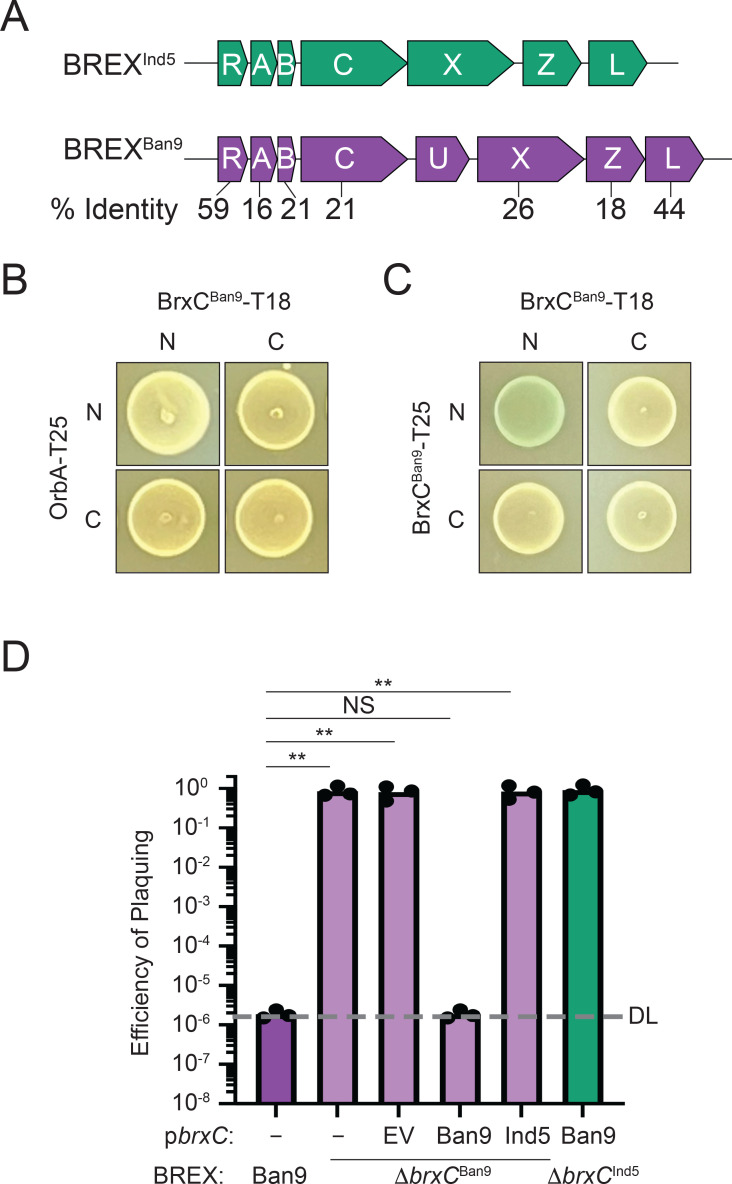
Fig 5 BrxCBan9 does not interact with OrbA and cannot functionally complement a brxCInd5-deletion. (A) Schematic of the BREX system encoded by SXT ICE VchInd5 (BREXInd5) and VchBan9 (BREXBan9) (not drawn to scale). The percent amino acid identity between each BREX protein is indicated below each BREX component: BrxR (R), BrxA (A), BrxC (C), BrxU (U), BrxX (X), BrxZ (Z), and BrxL (L). (B and C) Bacterial two-hybrid analysis of the interaction between (B) BrxCBan9-OrbA and (C) BrxCBan9- BrxCBan9. N- and C- indicate the terminus of each half of the adenylate cyclase enzyme was fused to the protein of interest. (D) EOP of ICP1 on V. cholerae encoding either a wild-type BREX system from VchBan9 (Ban9), a BREX system from VchBan9 with brxC deleted (∆brxCBan9), or a BREX system from VchInd5 with brxC deleted (∆brxCInd5) and the plasmid expressing brxC as indicated relative to either the permissive V. cholerae E7946 lacking an SXT or E7946 lacking an SXT ICE and harboring an empty vector plasmid. Statistical analysis was performed using a one-way analysis of variance (* = P < 0.01, ** = P < 0.001, *** = P < 0.0001, **** = P < 0.00001). Each dot represents an individual biological replicate. DL, detection limit. EV, empty vector.
Fig 5 BrxCBan9 does not interact with OrbA and cannot functionally complement a brxCInd5-deletion. (A) Schematic of the BREX system encoded by SXT ICE VchInd5 (BREXInd5) and VchBan9 (BREXBan9) (not drawn to scale). The percent amino acid identity between each BREX protein is indicated below each BREX component: BrxR (R), BrxA (A), BrxC (C), BrxU (U), BrxX (X), BrxZ (Z), and BrxL (L). (B and C) Bacterial two-hybrid analysis of the interaction between (B) BrxCBan9-OrbA and (C) BrxCBan9- BrxCBan9. N- and C- indicate the terminus of each half of the adenylate cyclase enzyme was fused to the protein of interest. (D) EOP of ICP1 on V. cholerae encoding either a wild-type BREX system from VchBan9 (Ban9), a BREX system from VchBan9 with brxC deleted (∆brxCBan9), or a BREX system from VchInd5 with brxC deleted (∆brxCInd5) and the plasmid expressing brxC as indicated relative to either the permissive V. cholerae E7946 lacking an SXT or E7946 lacking an SXT ICE and harboring an empty vector plasmid. Statistical analysis was performed using a one-way analysis of variance (* = P < 0.01, ** = P < 0.001, *** = P < 0.0001, **** = P < 0.00001). Each dot represents an individual biological replicate. DL, detection limit. EV, empty vector.CC BY · PubMed Central
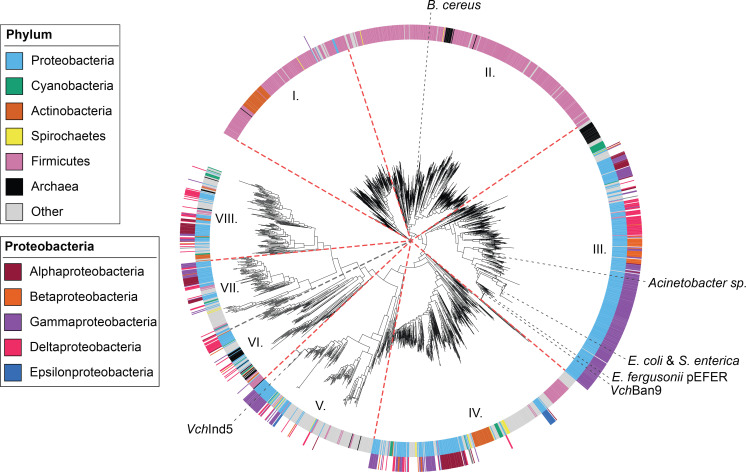
Fig 6 Homologs of BrxCInd5 are more diverse than homologs of BrxCBan9. A phylogenetic tree of BrxC homologs was generated by performing a PSI-BLAST search using the primary sequence for BrxCInd5 and BrxCBan9. From the search, 10,000 sequences were identified (5,000 for each allele of BrxC) that were reduced to 1,860 unique sequences sharing less than 80% amino acid identity. The inner ring indicates the phylum of the organism that encodes the allele of BrxC. The outer ring indicates the specific class of Proteobacteria that encodes the allele of BrxC. The red dashed lines separate the BrxC homologs into eight different clades. The gray dashed lines indicate the alleles of BrxC from this study and the alleles of BrxC from BREX systems that have been studied elsewhere. Bacillus cereus (WP._001993018.1) (15), Acinetobacter sp. NEB394 (WP_176538601) (19), Escherichia coli HS (ABV04726.1) (16), Salmonella enterica LT2 (NP_463355.1) (20), and Escherichia fergusonii pEFER (WP_000687848.1) (18).
Fig 6 Homologs of BrxCInd5 are more diverse than homologs of BrxCBan9. A phylogenetic tree of BrxC homologs was generated by performing a PSI-BLAST search using the primary sequence for BrxCInd5 and BrxCBan9. From the search, 10,000 sequences were identified (5,000 for each allele of BrxC) that were reduced to 1,860 unique sequences sharing less than 80% amino acid identity. The inner ring indicates the phylum of the organism that encodes the allele of BrxC. The outer ring indicates the specific class of Proteobacteria that encodes the allele of BrxC. The red dashed lines separate the BrxC homologs into eight different clades. The gray dashed lines indicate the alleles of BrxC from this study and the alleles of BrxC from BREX systems that have been studied elsewhere. Bacillus cereus (WP._001993018.1) (15), Acinetobacter sp. NEB394 (WP_176538601) (19), Escherichia coli HS (ABV04726.1) (16), Salmonella enterica LT2 (NP_463355.1) (20), and Escherichia fergusonii pEFER (WP_000687848.1) (18).CC BY · PubMed Central
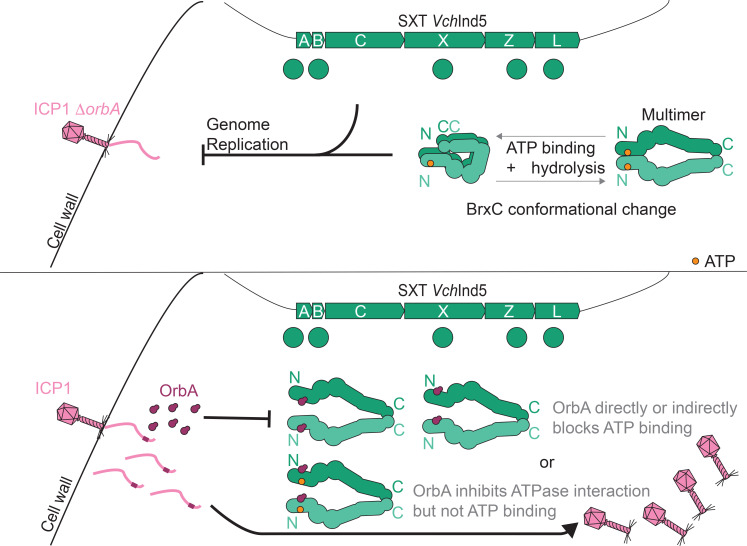
Fig 7 Model for BrxC conformational changes and OrbA inhibition. (Top) V. cholerae infected by ICP1 ΔorbA in the presence of BREX that inhibits phage progeny production. BrxC forms a multimer and goes through conformational changes that are dependent on ATP binding and hydrolysis. BrxC requires other BREX components to inhibit ICP1 ΔorbA genome replication. (Bottom) V. cholerae infected by ICP1 in the presence of BREX cannot inhibit the production of phage progeny. ICP1 expresses OrbA, and OrbA directly binds to BrxC, altering the interaction state of BrxC and disrupting its function. OrbA either inhibits ATP binding by BrxC as a direct inhibitor blocking the ATP-binding site or non-competitively by binding a different location of BrxC that disrupts ATP binding. An alternative hypothesis is OrbA does not disrupt BrxC ATP binding but prevents BrxC from multimerizing.
Fig 7 Model for BrxC conformational changes and OrbA inhibition. (Top) V. cholerae infected by ICP1 ΔorbA in the presence of BREX that inhibits phage progeny production. BrxC forms a multimer and goes through conformational changes that are dependent on ATP binding and hydrolysis. BrxC requires other BREX components to inhibit ICP1 ΔorbA genome replication. (Bottom) V. cholerae infected by ICP1 in the presence of BREX cannot inhibit the production of phage progeny. ICP1 expresses OrbA, and OrbA directly binds to BrxC, altering the interaction state of BrxC and disrupting its function. OrbA either inhibits ATP binding by BrxC as a direct inhibitor blocking the ATP-binding site or non-competitively by binding a different location of BrxC that disrupts ATP binding. An alternative hypothesis is OrbA does not disrupt BrxC ATP binding but prevents BrxC from multimerizing.CC BY · PubMed Central

Verification

Claims the paper makes

The claims and statistics of this paper haven’t been checked yet.

Run the check — free, no account needed. It reads the open-access text and checks the sources it cites.

A few free checks a day · papers already verified open instantly · results are public

Self-check

Percentages, sums and reported differences re-computed from the paper’s own numbers.

The self-check needs the paper’s full text.

Citations

Cites

Show all 1 references

Research works printed but not linked: 51

  1. 10.1016/j.mib.2005.06.003 · DOI · Paper page
  2. 10.1038/nrmicro2315 · DOI
  3. 10.1146/annurev.micro.112408.134123 · DOI · Paper page
  4. 2022, Structural biology of CRISPR–Cas immunity and genome editing enzymes, Nat. Rev. Microbiol, 20, 641, 10.1038/s41579-022-00739-4 · DOI
  5. 10.1038/s41467-022-30269-9 · DOI · Paper page
  6. 10.1038/s41564-022-01219-4 · DOI · Paper page
  7. 10.1016/j.chom.2022.09.017 · DOI · Paper page
  8. 10.1126/science.aar4120 · DOI · Paper page
  9. 10.1126/science.aba0372 · DOI · Paper page
  10. 10.1038/s41579-019-0299-x · DOI · Paper page
  11. 2020, CRISPR-Cas systems: Overview, innovations and applications in human disease research and gene therapy, Comput. Struct. Biotechnol. J, 18, 2401, 10.1016/j.csbj.2020.08.031 · DOI · Paper page
  12. 2021, Structure-based functional mechanisms and biotechnology applications of anti-CRISPR proteins, Nat. Rev. Mol. Cell Biol, 22, 563, 10.1038/s41580-021-00371-9 · DOI
  13. 10.1146/annurev-biochem-011520-105250 · DOI · Paper page
  14. 2023, Bacteriophages suppress CRISPR–Cas immunity using RNA-based anti-CRISPRs, Nature, 623, 601, 10.1038/s41586-023-06612-5 · DOI
  15. 10.15252/embj.201489455 · DOI · Paper page
  16. 10.1093/nar/gky1125 · DOI
  17. 10.1093/nar/gkac334 · DOI
  18. 10.1093/NAR/GKAB906 · DOI
  19. 10.1093/nar/gkac311 · DOI
  20. 2022, Reassembling a cannon in the DNA defense arsenal: Genetics of StySA, a BREX phage exclusion system in Salmonella lab strains, Plos Genet, 18, e1009943, 10.1371/journal.pgen.1009943 · DOI
  21. 2022, Crystal structure of the BREX phage defence protein BrxA, Curr. Res. Struct. Biol, 4, 211, 10.1016/j.crstbi.2022.06.001 · DOI
  22. 10.1093/nar/gkad083 · DOI
  23. 2020, Phage T7 DNA mimic protein Ocr is a potent inhibitor of BREX defence, Nucleic Acids Res, 48, 5397, 10.1093/nar/gkaa290 · DOI
  24. 10.1016/j.celrep.2023.112972 · DOI
  25. 10.1126/science.abg2166 · DOI
  26. 10.1016/0022-2836(85)90242-6 · DOI
  27. 10.1016/S1097-2765(02)00435-5 · DOI
  28. 10.1093/nar/gks516 · DOI
  29. 10.1128/JVI.19.1.136-145.1976 · DOI
  30. 10.1371/journal.pgen.1000786 · DOI · Paper page
  31. 2020, Genome replication dynamics of a bacteriophage and its satellite reveal strategies for parasitism and viral restriction, Nucleic Acids Res, 48, 249
  32. 2022, A phage parasite deploys a nicking nuclease effector to inhibit viral host replication, Nucleic Acids Res, 50, gkac002.
  33. 10.1146/annurev.ge.25.120191.003101 · DOI · Paper page
  34. 10.1073/pnas.95.10.5752 · DOI · Paper page
  35. 10.1038/S41592-022-01488-1 · DOI · Paper page
  36. 10.1016/j.jmb.2017.12.007 · DOI · Paper page
  37. 2020, Protein Sequence Analysis Using the MPI Bioinformatics Toolkit, Curr. Protoc. Bioinform, 72, e108, 10.1002/cpbi.108 · DOI · Paper page
  38. 2020, Pfam: The protein families database in 2021, Nucleic Acids Res, 49, gkaa913.
  39. 10.1038/nprot.2015.053 · DOI · Paper page
  40. 10.1111/j.1600-0854.2007.00642.x · DOI
  41. 10.1046/j.1365-2443.2001.00447.x · DOI · Paper page
  42. 10.1038/nature14239 · DOI
  43. 10.1073/pnas.131006898 · DOI
  44. 10.1038/nrg.2017.80 · DOI · Paper page
  45. 10.1073/pnas.1406478111 · DOI
  46. 10.1145/3093338.3093390 · DOI
  47. 2024, COSMIC2: A global resource for structure prediction and structural analysis, Biophys. J, 123, 334a, 10.1016/j.bpj.2023.11.2036 · DOI
  48. 10.1002/PRO.4792 · DOI · Paper page
  49. 10.1093/bioinformatics/bts565 · DOI · Paper page
  50. 10.1093/molbev/mst010 · DOI · Paper page
  51. 2021, Interactive Tree Of Life (iTOL) v5: an online tool for phylogenetic tree display and annotation, Nucleic Acids Res, 49, gkab301.

Metadata

Authors
Oshiro, R. T., Dunham, D. T., & Seed, K. D.
Affiliations
University of California, Berkeley (US)
Corresponding author
Seed, Kimberley D
Venue
Journal of Bacteriology
Publisher
openRxiv
Published
2024-05-09
Volume
206
Issue
11
Pages
e0020624-e0020624
ISSN
0021-9193 (ISSN-L)
OpenAlex
W4403406635
Cited by
15
References
1
Citations by year
2026: 8 · 2025: 7
FWCI
4.12
Type
journal article
Language
en
Open access
Licence
cc-by
Locations
  • Journal of Bacteriology (publishedVersion, cc-by)
  • bioRxiv (Cold Spring Harbor Laboratory) (acceptedVersion, cc-by-nd)
  • PubMed Central (publishedVersion, cc-by)
  • PubMed (publishedVersion)
  • eScholarship (California Digital Library) (submittedVersion, cc-by)
  • PubMed Central (submittedVersion)
Funders
  • National Institutes of Health
  • National Institute of Allergy and Infectious Diseases (R01AI153303)
Topics
  • Life Sciences › Immunology and Microbiology › Virology › Bacteriophages and microbial interactions
  • Life Sciences › Biochemistry, Genetics and Molecular Biology › Genetics › Bacterial Genetics and Biotechnology
  • Life Sciences › Biochemistry, Genetics and Molecular Biology › Molecular Biology › CRISPR and Genetic Engineering
Keywords
Vibrio cholerae, phage-bacteria coevolution, integrative and conjugative elements, protein-protein interaction, phage therapy, antibiotic resistance, cholera

About these checks

Registry, retraction, Cites and statistics results are computed, not judged, with one exception: a printed reference that no index lists is read once by a model before it counts as a citation error. Claims are extracted by a model and kept only when their quote appears verbatim in the text; each cited source is then checked, with a model’s help, for whether it says what the claim relies on. Those verdicts can be wrong — read the claim’s quote and the cited source before relying on one.

Statistics and arithmetic are recomputed, not judged.

Confidence bands are shown only for fields calibrated on our annotated test set. None is calibrated yet, so no band is shown.

What counts as a claim ›How we measure confidence ›How we check this ›

Are you an author, or do you see a problem with this page? Request a review

How to cite

Cite CoChat for the checks on this page, and the paper for its own findings.

This page
CoChat. (2026). Citation check: The vibriophage-encoded inhibitor OrbA abrogates BREX-mediated defense through the ATPase BrxC. https://app.cochat.ai/papers/10.1101/2024.05.09.593382
The paper
Oshiro, R. T., Dunham, D. T., & Seed, K. D. (2024). The vibriophage-encoded inhibitor OrbA abrogates BREX-mediated defense through the ATPase BrxC. Journal of Bacteriology. https://doi.org/10.1101/2024.05.09.593382

Data sources

Bibliographic data: Semantic Scholar, OpenAlex, Crossref.

Contains information from the Semantic Scholar Academic Graph Datasets, made available under the ODC Attribution License (ODC-BY 1.0).

Semantic Scholar’s data is described in: Kinney, R., et al. (2023). The Semantic Scholar Open Data Platform. arXiv:2301.10140.