

The DOI matches its Crossref record; 1 of the 1 references it cites were found in a registry or an index.
Systematic, high-throughput characterization of bacteriophage gene essentiality on diverse hosts
Open accessPreprint — published as 10.1016/j.chom.2025.06.018 · Paper page
Abstract
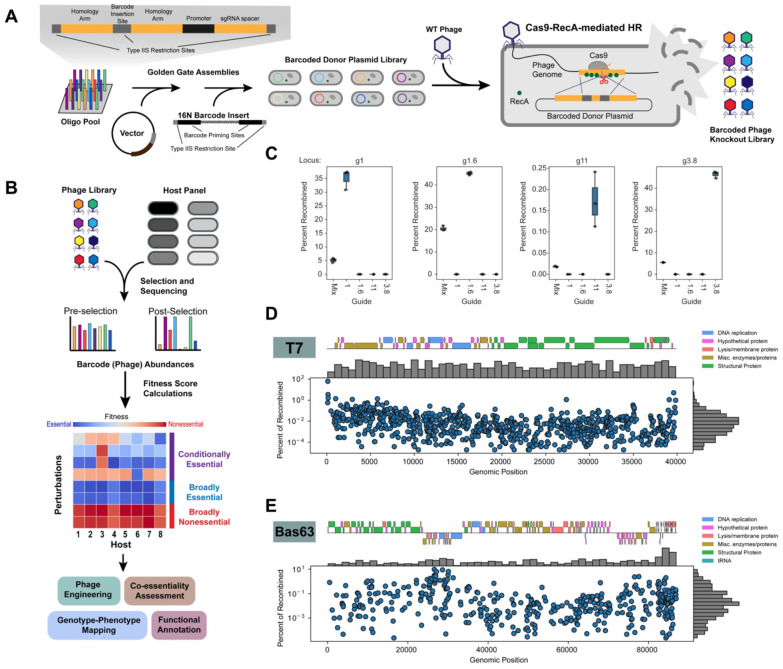
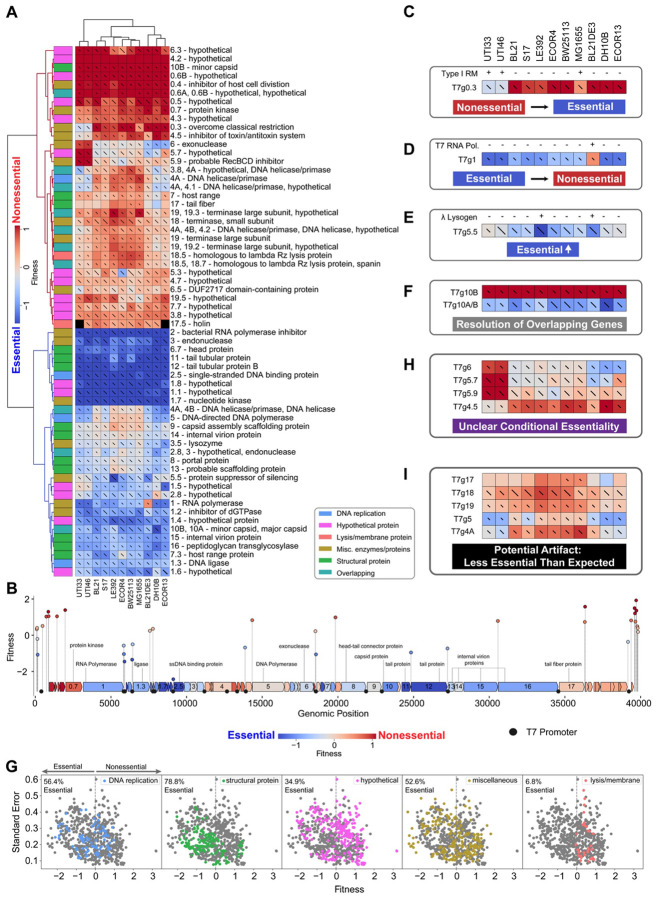
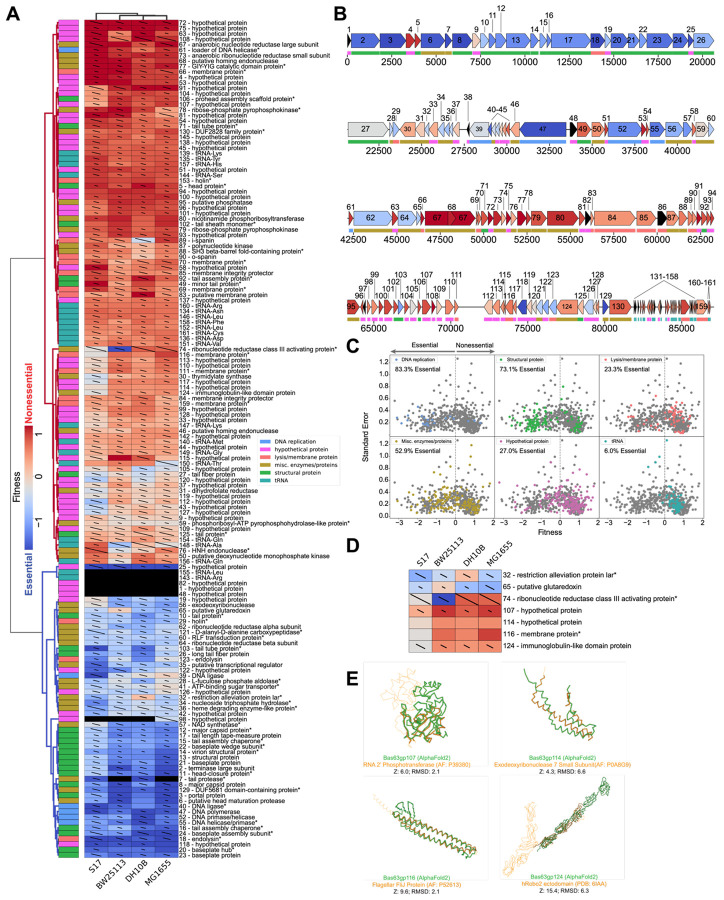
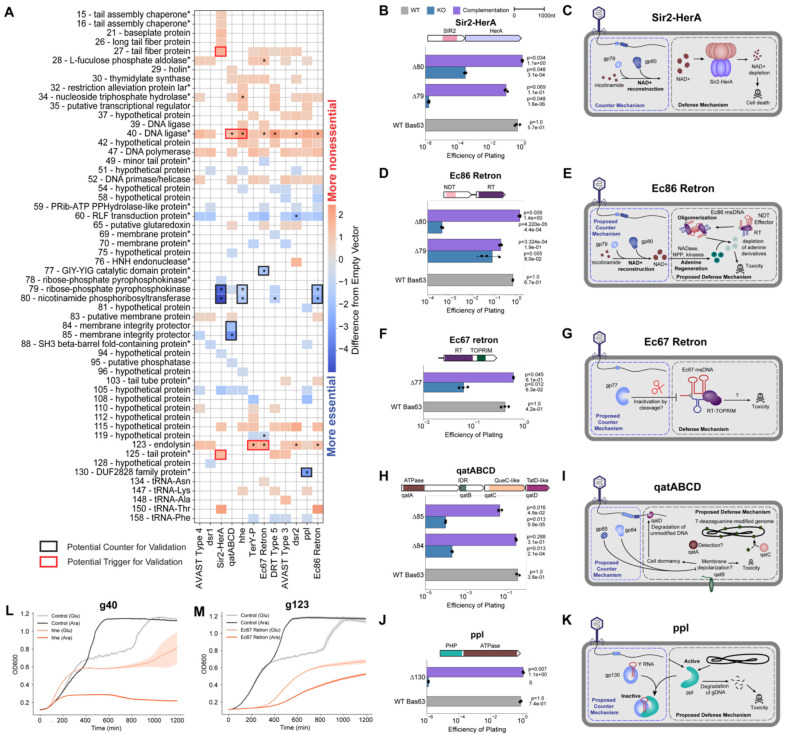
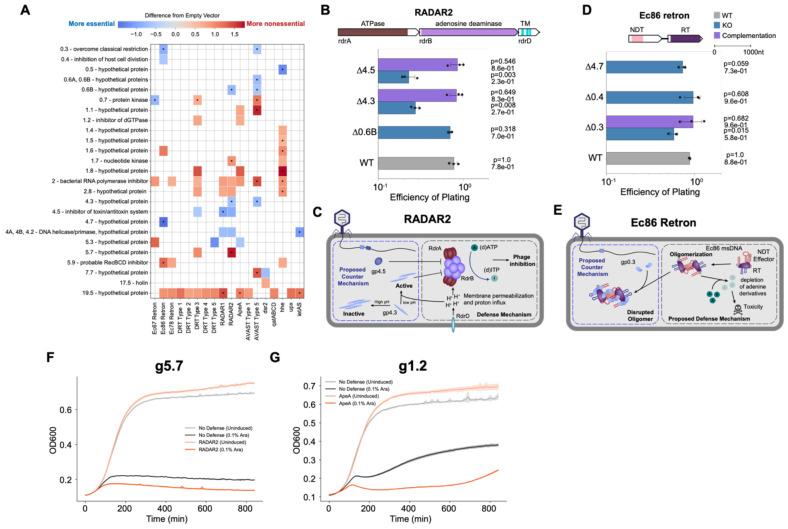
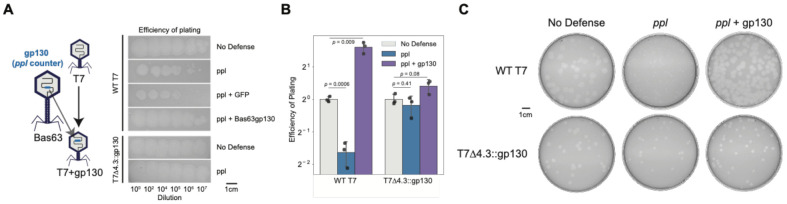
Understanding core and conditional gene essentiality is crucial for decoding genotype-phenotype relationships in organisms. We present PhageMaP, a high-throughput method to create genome-scale phage knockout libraries for systematically assessing gene essentiality in bacteriophages. Using PhageMaP, we generate gene essentiality maps across hundreds of genes in the model phage T7 and the non-model phage Bas63, on diverse hosts. These maps provide fundamental insights into genome organization, gene function, and host-specific conditional essentiality. By applying PhageMaP to a collection of anti-phage defense systems, we uncover phage genes that either inhibit or activate eight defenses and offer novel mechanistic hypotheses. Furthermore, we engineer synthetic phages with enhanced infectivity by modular transfer of a PhageMaP-discovered defense inhibitor from Bas63 to T7. PhageMaP is generalizable, as it leverages homologous recombination, a universal cellular process, for locus-specific barcoding. This versatile tool advances bacteriophage functional genomics and accelerates rational phage design for therapy.
Overview
The claims and statistics of this paper haven’t been checked yet.
Run the check — free, no account needed. It reads the open-access text and checks the sources it cites.
Integrity signals
Registry
Cites
Statistics
Figures
Verification
Claims the paper makes
The claims and statistics of this paper haven’t been checked yet.
Run the check — free, no account needed. It reads the open-access text and checks the sources it cites.
Self-check
Percentages, sums and reported differences re-computed from the paper’s own numbers.
The self-check needs the paper’s full text.
Citations
Cites
Highly accurate protein structure prediction with AlphaFold
Jumper, J., Evans, R., Pritzel, A., Green, T., Figurnov, M., Ronneberger, O., Tunyasuvunakool, K., Bates, R., Žídek, A., Potapenko, A., et al. (2021) · Nature · doi:10.1038/s41586-021-03819-2 · Cited by 43,764
Research works printed but not linked: 130
- 10.1016/j.cell.2021.01.029 · DOI · Paper page
- 10.1038/s41579-019-0311-5 · DOI · Paper page
- 10.1016/j.coviro.2011.06.009 · DOI · Paper page
- 10.1186/s40168-021-01017-w · DOI
- 10.1128/MMBR.67.1.86-156.2003 · DOI · Paper page
- 10.1101/gr.2875304 · DOI
- 10.1038/46558 · DOI · Paper page
- 10.7554/eLife.23570 · DOI
- 10.1038/s41586-018-0124-0 · DOI · Paper page
- 10.1128/jb.00184-23 · DOI
- 10.1371/journal.ppat.1007652 · DOI
- 10.1128/mbio.02096-17 · DOI · Paper page
- 10.1038/msb4100050 · DOI · Paper page
- 10.1073/pnas.231275498 · DOI · Paper page
- 10.1128/JB.00740-06 · DOI · Paper page
- 10.1016/j.gde.2019.07.015 · DOI
- 10.1038/nrg.2017.74 · DOI · Paper page
- 10.1016/j.jmb.2011.11.015 · DOI
- 10.1016/j.tibs.2022.08.012 · DOI
- 10.1016/j.tibtech.2022.08.008 · DOI
- 10.1128/microbiolspec.bad-0003-2016 · DOI
- 10.1128/mBio.00019-20 · DOI
- 10.1016/j.celrep.2021.109930 · DOI
- 10.1016/j.chom.2019.05.001 · DOI · Paper page
- 10.1371/journal.pone.0003957 · DOI
- 10.1101/2024.04.14.589459 · DOI
- 10.1073/pnas.1222538110 · DOI
- 10.1093/nar/gkac1168 · DOI
- 10.1371/journal.pbio.3002416 · DOI · Paper page
- 10.1101/2023.09.18.558157 · DOI
- 10.1016/j.cell.2016.05.003 · DOI · Paper page
- 10.1371/journal.pbio.3001424 · DOI · Paper page
- 10.1126/science.aba0372 · DOI · Paper page
- 10.3390/microorganisms9040844 · DOI
- 10.1021/acssynbio.1c00525 · DOI
- 10.1021/acssynbio.2c00419 · DOI
- 10.1021/acssynbio.7b00179 · DOI
- 10.1126/sciadv.aav3335 · DOI
- 10.1016/0022-2836(83)90062-1 · DOI
- 10.1073/pnas.111008398 · DOI · Paper page
- 10.7554/eLife.83409 · DOI
- 10.1128/iai.58.2.471-479.1990 · DOI
- Standard reference strains of Escherichia coli from natural populations. - PMC. https://www.ncbi.nlm.nih.gov/pmc/articles/PMC215307/ (accessed 2024-07-06).
- 10.1016/0022-2836(75)90083-2 · DOI
- 10.1128/jb.02418-14 · DOI
- 10.1073/pnas.90.5.1761 · DOI
- 10.1128/jb.173.21.6998-7003.1991 · DOI
- 10.1128/jvi.23.3.543-553.1977 · DOI
- 10.1093/nar/gkx370 · DOI
- 10.1073/pnas.0804164105 · DOI
- 10.1093/nar/gkaa290 · DOI
- 10.1128/JVI.03274-13 · DOI
- 10.1016/S0022-2836(99)80012-6 · DOI
- 10.1093/nar/gkad382 · DOI · Paper page
- 10.1016/j.molcel.2013.02.002 · DOI
- 10.1111/j.1365-2958.1994.tb00391.x · DOI
- 10.1016/j.virol.2005.06.039 · DOI
- 10.1016/bs.enz.2016.02.001 · DOI
- 10.1038/313818a0 · DOI
- 10.1101/gr.6649807 · DOI · Paper page
- 10.7554/eLife.85183 · DOI
- 10.1111/j.1365-2958.1995.tb02438.x · DOI
- 10.1111/j.1574-6976.1998.tb00355.x · DOI
- 10.1016/j.jmb.2005.02.049 · DOI
- 10.1007/s12275-015-5304-0 · DOI
- 10.1016/j.tim.2010.03.002 · DOI
- 10.1016/j.cell.2019.02.004 · DOI
- 10.1007/978-3-030-28151-9_9 · DOI
- 10.1073/pnas.74.11.5104 · DOI
- 10.1016/j.mib.2007.05.018 · DOI
- 10.1038/s41579-023-00934-x · DOI · Paper page
- 10.1126/science.aar4120 · DOI · Paper page
- 10.1038/s41586-023-06869-w · DOI
- 10.1016/j.cell.2023.02.029 · DOI · Paper page
- 10.1038/s41467-024-45068-7 · DOI
- 10.3389/fmicb.2023.1211793 · DOI
- 10.1016/j.molcel.2023.11.007 · DOI
- 10.1089/ars.2017.7216 · DOI · Paper page
- 10.1101/2024.02.11.579819 · DOI
- 10.1038/s41564-022-01197-7 · DOI
- 10.1101/2023.08.16.553469 · DOI
- 10.3390/molecules25214966 · DOI
- 10.1007/s00018-020-03742-1 · DOI
- 10.1016/j.cell.2020.09.065 · DOI · Paper page
- 10.1016/j.jmb.2009.01.048 · DOI
- 10.1101/2023.03.15.532788 · DOI
- 10.1038/s41467-019-13384-y · DOI
- 10.1093/nar/gku732 · DOI
- 10.1007/s00294-021-01183-2 · DOI
- 10.1016/j.cell.2023.01.012 · DOI
- 10.3389/fmicb.2023.1268820 · DOI
- 10.1038/s41422-024-00981-w · DOI
- 10.1038/s41598-021-83498-1 · DOI
- 10.1080/10409238.2019.1608902 · DOI
- 10.1093/nar/gkv1267 · DOI
- 10.1093/emboj/20.24.6990 · DOI
- 10.1016/S0969-2126(97)00272-4 · DOI
- 10.1074/jbc.M003859200 · DOI
- 10.7554/eLife.52125 · DOI
- 10.1073/pnas.1800429115 · DOI
- 10.1038/s41564-022-01158-0 · DOI
- 10.1073/pnas.2123092119 · DOI
- 10.1080/10409238.2020.1856769 · DOI
- 10.1073/pnas.2001888117 · DOI
- 10.1371/journal.pbio.3000877 · DOI · Paper page
- 10.1038/s41586-022-05091-4 · DOI · Paper page
- 10.1101/2023.04.06.535777 · DOI
- 10.7554/eLife.63775 · DOI
- 10.1016/j.cell.2019.09.015 · DOI · Paper page
- 10.1101/2024.01.28.577628 · DOI
- 10.1128/mBio.00262-15 · DOI
- 10.1074/jbc.M800052200 · DOI
- 10.1038/s43705-023-00297-7 · DOI
- 10.1016/j.tim.2022.08.001 · DOI
- 10.1038/s41586-018-0767-x · DOI
- 10.3390/pathogens10091100 · DOI
- 10.1128/JB.00687-20 · DOI
- 10.1038/s41385-019-0250-5 · DOI
- 10.1038/s41598-021-81580-2 · DOI
- 10.3389/fmicb.2017.00403 · DOI
- 10.1093/nar/gkac400 · DOI
- SpCas9 activity prediction by DeepSpCas9, a deep learning–based model with high generalization performance | Science Advances. https://www.science.org/doi/10.1126/sciadv.aax9249 (accessed 2024-07-06). · DOI
- 10.1038/s41467-021-23576-0 · DOI · Paper page
- 10.1093/bioinformatics/bty560 · DOI · Paper page
- 10.14806/ej.17.1.200 · DOI · Paper page
- 10.1186/s13059-017-1272-5 · DOI · Paper page
- 10.1038/s41592-022-01488-1 · DOI · Paper page
- 10.1186/1471-2105-10-421 · DOI · Paper page
- 10.1002/pro.4519 · DOI · Paper page
- 10.1093/bioinformatics/bty560 · DOI · Paper page
Metadata
- Authors
- Chen, J., Nilsen, E. D., Chitboonthavisuk, C., Mo, C. Y., & Raman, S.
- Affiliations
- University of Wisconsin–Madison (US)
- Corresponding author
- Raman, Srivatsan
- Venue
- Cell Host & Microbe
- Publisher
- openRxiv
- Published
- 2024-10-11
- Volume
- 33
- Issue
- 8
- Pages
- 1363-1380.e11
- ISSN
- 1931-3128 (ISSN-L)
- PMC
- PMC11482910
- OpenAlex
- W4412570740
- Cited by
- 16
- References
- 1
- Citations by year
- 2026: 9 · 2025: 6 · 2024: 1
- FWCI
- 4.39
- Type
- journal article
- Language
- en
- Open access
- bronze
- doi.org
- Locations
- Cell Host & Microbe (acceptedVersion)
- bioRxiv (Cold Spring Harbor Laboratory) (acceptedVersion, cc-by-nc-nd)
- PubMed (publishedVersion)
- PubMed Central (submittedVersion, cc-by-nc-nd)
- PubMed Central (submittedVersion)
- Funders
- National Science Foundation (2237251, CAREER)
- University of Wisconsin-Madison (SCR_017759)
- National Institutes of Health
- National Institute of General Medical Sciences (T32GM135066)
- National Institute of Allergy and Infectious Diseases (R21AI156785)
- Division of Microbiology and Infectious Diseases, National Institute of Allergy and Infectious Diseases (R21AI156785)
- Topics
- Life Sciences › Immunology and Microbiology › Virology › Bacteriophages and microbial interactions
- Life Sciences › Biochemistry, Genetics and Molecular Biology › Genetics › Bacterial Genetics and Biotechnology
- Life Sciences › Biochemistry, Genetics and Molecular Biology › Genetics › Evolution and Genetic Dynamics
- Keywords
- bacteriophage T7, bacteriophage T4, anti-phage defense systems, phage therapy
About these checks
Registry, retraction, Cites and statistics results are computed, not judged, with one exception: a printed reference that no index lists is read once by a model before it counts as a citation error. Claims are extracted by a model and kept only when their quote appears verbatim in the text; each cited source is then checked, with a model’s help, for whether it says what the claim relies on. Those verdicts can be wrong — read the claim’s quote and the cited source before relying on one.
Statistics and arithmetic are recomputed, not judged.
Confidence bands are shown only for fields calibrated on our annotated test set. None is calibrated yet, so no band is shown.
What counts as a claim ›How we measure confidence ›How we check this ›
Are you an author, or do you see a problem with this page? Request a review
How to cite
Cite CoChat for the checks on this page, and the paper for its own findings.
- This page
- CoChat. (2026). Citation check: Systematic, high-throughput characterization of bacteriophage gene essentiality on diverse hosts. https://app.cochat.ai/papers/10.1101/2024.10.10.617714
- The paper
- Chen, J., Nilsen, E. D., Chitboonthavisuk, C., Mo, C. Y., & Raman, S. (2024). Systematic, high-throughput characterization of bacteriophage gene essentiality on diverse hosts. Cell Host & Microbe. https://doi.org/10.1101/2024.10.10.617714
Data sources
Bibliographic data: Semantic Scholar, OpenAlex, Crossref.
Contains information from the Semantic Scholar Academic Graph Datasets, made available under the ODC Attribution License (ODC-BY 1.0).
Semantic Scholar’s data is described in: Kinney, R., et al. (2023). The Semantic Scholar Open Data Platform. arXiv:2301.10140.
