

The DOI matches its Crossref record; 1 of the 1 references it cites were found in a registry or an index.
Type I partition-related proteins enhance conjugative transfer through transcriptional activation and oriT region binding
Open accessPreprint — published as 10.1128/mbio.01600-25 · Paper page
Abstract
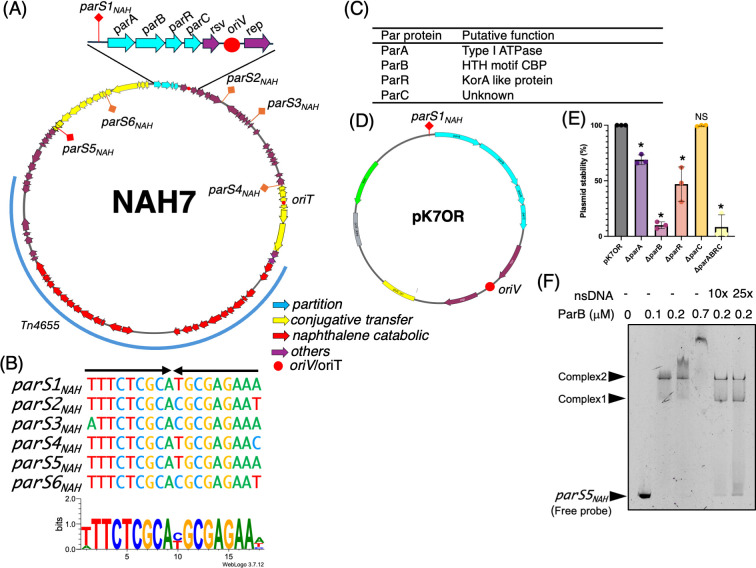
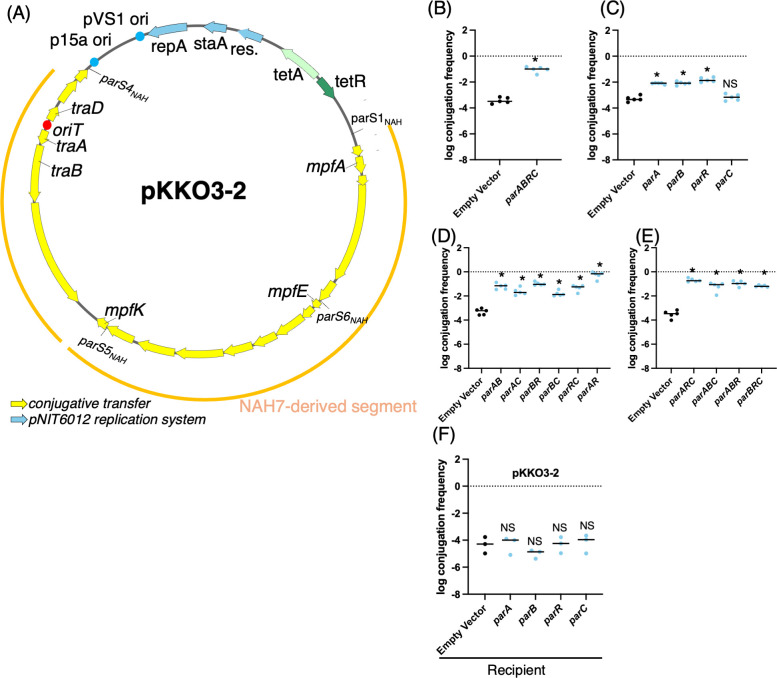
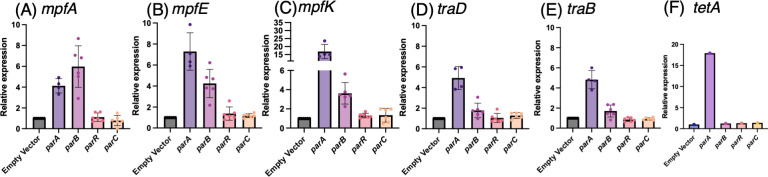
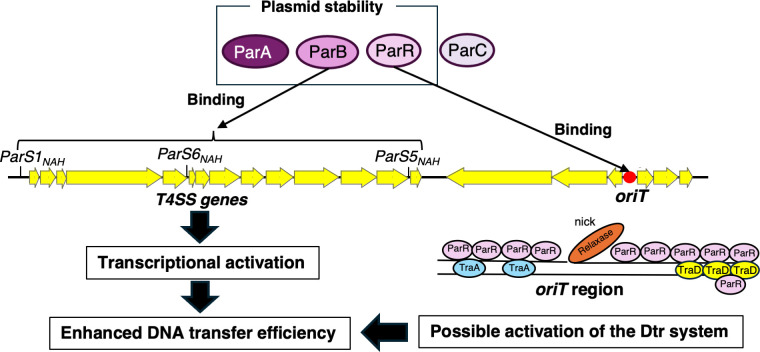
Plasmid partitioning and bacterial conjugation are critical processes ensuring plasmid maintenance and dissemination, respectively, within bacterial populations. Although traditionally regarded as distinct phenomena, these two processes are increasingly recognized as interconnected. While partitioning ensures plasmid inheritance during cell division, its potential influence on conjugative transfer remains poorly understood. A major impediment to understanding their interplay is that partition systems are often essential for plasmid stability, making it difficult to distinguish their direct effects on conjugation. In this study, we addressed this challenge using a mini-conjugative plasmid derived from the Pseudomonas putida NAH7 plasmid. This engineered plasmid, containing all conjugation-related genes, was cloned into an E. coli-compatible vector. Additionally, the par genes from NAH7 were expressed from a separate plasmid to investigate their roles in conjugative transfer. Our results revealed that the par gene cluster plays a significant role in enhancing the conjugative transfer of the mini-conjugative plasmid. Specifically, ParB, a centromere-binding protein, functions as a transcriptional activator of conjugation-related genes with binding parS NAH site. In contrast, ParR, a KorA homolog, was not found to enhance transcription directly but binds extensively to the oriT region. This binding probably facilitates the recruitment or stabilization of the relaxosome, thereby enhancing conjugation efficiency. Together, these findings unveil a previously unappreciated role for partition proteins in stimulating bacterial conjugation, providing new insights into how plasmids coordinate vertical and horizontal dissemination, highlighting that these processes can occur simultaneously within bacterial communities.
Overview
The claims and statistics of this paper haven’t been checked yet.
Run the check — free, no account needed. It reads the open-access text and checks the sources it cites.
Integrity signals
Registry
Cites
Statistics
Figures
Verification
Claims the paper makes
The claims and statistics of this paper haven’t been checked yet.
Run the check — free, no account needed. It reads the open-access text and checks the sources it cites.
Self-check
Percentages, sums and reported differences re-computed from the paper’s own numbers.
The self-check needs the paper’s full text.
Citations
Cites
Varadi, M., Bertoni, D., Magana, P., Paramval, U., Pidruchna, I., Radhakrishnan, M., Tsenkov, M., Nair, S., Mirdita, M., Yeo, J., et al. (2024) · Nucleic Acids Research · doi:10.1093/nar/gkad1011 · Cited by 2,052
Research works printed but not linked: 47
- 10.1111/1574-6976.12085 · DOI · Paper page
- Waksman G . 2019. From conjugation to T4S systems in Gram-negative bacteria: a mechanistic biology perspective. EMBO Rep 20. · DOI
- 10.1111/mmi.14507 · DOI
- 10.1006/jmbi.1997.1082 · DOI
- 10.1038/s41579-023-00974-3 · DOI
- 10.1111/mmi.14670 · DOI
- Bouet JY , Funnell BE . 2019. Plasmid Localization and Partition in Enterobacteriaceae. EcoSal Plus 8. · DOI
- 10.1016/j.plasmid.2011.08.003 · DOI
- 10.1016/j.plasmid.2023.102694 · DOI
- Baxter JC , Funnell BE . 2014. Plasmid Partition Mechanisms. Microbiol Spectr 2. · DOI
- 10.1016/j.plasmid.2008.02.001 · DOI
- 10.1128/AEM.03541-15 · DOI
- Tisma M , Kaljevic J , Gruber S , Le TBK , Dekker C. 2024. Connecting the dots: key insights on ParB for chromosome segregation from single-molecule studies. FEMS Microbiol Rev 48. · DOI
- 2016, Conjugative DNA Transfer Is Enhanced by Plasmid R1 Partitioning Proteins, Front Mol Biosci, 3, 32
- 10.1099/mic.0.2008/017939-0 · DOI
- 10.1101/2024.09.03.610885:2024.09.03.610885 · DOI
- Kishida K , Inoue K , Ohtsubo Y , Nagata Y , Tsuda M . 2017. Host Range of the Conjugative Transfer System of IncP-9 Naphthalene-Catabolic Plasmid NAH7 and Characterization of Its oriT Region and Relaxase. Appl Environ Microbiol 83. · DOI
- Kishida K , Nonoyama S , Lukas T , Kawahara S , Kudo K , Nagata Y , Ohtsubo Y , Tsuda M . 2019. Conjugative Transfer of IncP-9 Catabolic Plasmids Requires a Previously Uncharacterized Gene, mpfK, Whose Homologs Are Conserved in Various MPF(T)-Type Plasmids. Appl Environ Microbiol 85. · DOI
- Sakuda A , Suzuki-Minakuchi C , Okada K , Nojiri H. 2018. Conjugative Selectivity of Plasmids Is Affected by Coexisting Recipient Candidates. mSphere 3. · DOI
- 10.1111/1574-6968.12188 · DOI
- 10.1128/JB.00709-08 · DOI
- 10.1128/AEM.02571-13 · DOI
- 10.1007/978-4-431-54520-0_5 · DOI
- 10.1094/MPMI.2000.13.2.232 · DOI
- 10.1128/mra.00394-22 · DOI
- 10.1128/JB.00185-06 · DOI
- 10.1371/journal.pgen.1004171 · DOI
- 10.3389/fmicb.2020.01125 · DOI
- 10.1128/mBio.01629-21 · DOI
- 2022, IncFV plasmid pED208: Sequence analysis and evidence for translocation of maintenance/leading region proteins through diverse type IV secretion systems, Plasmid, 123-124, 102652, 10.1016/j.plasmid.2022.102652 · DOI
- 10.1128/mbio.01629-21 · DOI
- 10.1128/JB.183.3.1022-1031.2001 · DOI
- McLean TC , Balaguer-Perez F , Chandanani J , Thomas CM , Aicart-Ramos C , Burick S , Olinares PDB , Gobbato G , Mundy JE , Chait BT . 2024. Molecular switching of a DNA-sliding clamp to a repressor mediates long-range gene silencing. bioRxiv:2024.02.16.579611. · DOI
- 10.1128/mbio.02143-23 · DOI
- 10.1111/mmi.15147 · DOI
- 10.1038/sj.emboj.7601696 · DOI
- 10.1016/0378-1119(87)90149-1 · DOI
- 10.1016/0378-1119(83)90040-9 · DOI
- 1992, DNA sequencing by the chemical method, Current Protocols in Molecular Biology, 17, 7.5. 1
- 10.1038/srep41769 · DOI
- 10.1038/S41586-024-07487-W · DOI · Paper page
- 10.1093/nar/gkae869 · DOI
- 2017, MAFFT online service: multiple sequence alignment, interactive sequence choice and visualization, Briefings in Bioinformatics, 20, 1160
- 10.1093/nar/gkae268 · DOI · Paper page
- 10.1101/gr.849004 · DOI · Paper page
- 10.1016/0022-2836(86)90385-2 · DOI
- 10.1007/s00253-006-0671-4 · DOI
Metadata
- Authors
- Kishida, K., Kudo, K., Kumagai, R., Deng, W., Stari, L., Ogawa-Kishida, N., Ohtsubo, Y., Nagata, Y., & Tsuda, M.
- Affiliations
- Tohoku University (JP)
- Corresponding author
- Kishida, Kouhei
- Venue
- mBio
- Publisher
- openRxiv
- Published
- 2025-01-22
- Volume
- 16
- Issue
- 9
- Pages
- e0160025-e0160025
- ISSN
- 2150-7511 (ISSN-L)
- PMC
- PMC12421886
- OpenAlex
- W4412782267
- Cited by
- 1
- References
- 1
- Citations by year
- 2026: 1
- FWCI
- 0.58
- Type
- journal article
- Language
- en
- Open access
- gold
- doi.org
- Licence
- Locations
- mBio (publishedVersion, cc-by)
- bioRxiv (Cold Spring Harbor Laboratory) (acceptedVersion)
- Europe PMC (PubMed Central) (publishedVersion, cc-by)
- PubMed (publishedVersion)
- PubMed Central (publishedVersion, cc-by)
- DOAJ (DOAJ: Directory of Open Access Journals) (submittedVersion, cc-by-sa)
- Funders
- Institute for Fermentation, Osaka (Y-2024-1-007)
- Japan Society for the Promotion of Science (19K15725, 21H05315)
- Topics
- Life Sciences › Biochemistry, Genetics and Molecular Biology › Genetics › Bacterial Genetics and Biotechnology
- Health Sciences › Medicine › Microbiology (medical) › Antibiotic Resistance in Bacteria
- Life Sciences › Immunology and Microbiology › Virology › Bacteriophages and microbial interactions
- Keywords
- plasmid partitioning, bacterial conjugation, ParB, parr, transcriptional activation, relaxosome, plasmid maintenance, plasmid dissemination, horizontal gene transfer
- MeSH terms
- Bacterial Proteins, Conjugation, Genetic, Escherichia coli, Multigene Family, Plasmids, Protein Binding, Transcriptional Activation, Gene Expression Regulation, Bacterial, Pseudomonas putida, Replication Origin
About these checks
Registry, retraction, Cites and statistics results are computed, not judged, with one exception: a printed reference that no index lists is read once by a model before it counts as a citation error. Claims are extracted by a model and kept only when their quote appears verbatim in the text; each cited source is then checked, with a model’s help, for whether it says what the claim relies on. Those verdicts can be wrong — read the claim’s quote and the cited source before relying on one.
Statistics and arithmetic are recomputed, not judged.
Confidence bands are shown only for fields calibrated on our annotated test set. None is calibrated yet, so no band is shown.
What counts as a claim ›How we measure confidence ›How we check this ›
Are you an author, or do you see a problem with this page? Request a review
Data sources
Bibliographic data: Semantic Scholar, OpenAlex, Crossref.
Contains information from the Semantic Scholar Academic Graph Datasets, made available under the ODC Attribution License (ODC-BY 1.0).
Semantic Scholar’s data is described in: Kinney, R., et al. (2023). The Semantic Scholar Open Data Platform. arXiv:2301.10140.
