PreprintCited by 3Genomics and Chromatin DynamicsProtein Structure and DynamicsNuclear Structure and Function

The DOI matches its Crossref record; 1 of the 1 references it cites were found in a registry or an index.

Mechanistic basis for the opposing effects of H2A and H2B ubiquitination on nucleosome stability and dynamics

Open access
Baweja, Lokesh, Wereszczynski, Jeff·2025·Epigenetics & Chromatin

Preprint — published as 10.1186/s13072-025-00635-0 · Paper page

Abstract

Nucleosome ubiquitination at lysine 119 of histone H2A (H2AK119ub) and lysine 120 of histone H2B (H2BK120ub) are prominent post-translational modifications with opposing roles in chromatin regulation. Although H2AK119ub is associated with transcriptional repression and H2BK120ub with activation, the molecular basis for these contrasting effects has remained unclear. Here, we use microsecond all-atom and millisecond coarse-grained molecular dynamics simulations to reveal how the position of ubiquitin reshapes nucleosome structure and assembly. H2AK119ub rigidifies the histone core by indirectly reinforcing the L1–L1 interface between H2A histones, strengthening both tetramer–dimer and dimer–dimer interactions, and slowing complete nucleosome assembly. In contrast, H2BK120ub disrupts these interfaces, weakens the histone core, and favors partially assembled hexasome and tetrasome states. Both modifications cause dramatic slowdowns in nucleosome folding, with H2BK120ub producing an order-of-magnitude greater effect. These simulations establish clear molecular mechanisms by which site-specific ubiquitination alters nucleosome stability and assembly kinetics. Our findings quantitatively explain how H2A and H2B ubiquitination exert opposing effects on chromatin regulation. This mechanism is directly relevant to the opposing roles of these marks in transcriptional activation and repression, and may represent one way that combinations of histone modifications modulate chromatin function in vivo .

Overview

The claims and statistics of this paper haven’t been checked yet.

Run the check — free, no account needed. It reads the open-access text and checks the sources it cites.

A few free checks a day · papers already verified open instantly · results are public

Integrity signals

Registry

Crossref · 10.1101/2025.02.13.638112

Cites

1 of 1 references verified0 citation errors · 0 not checkable

Statistics

Figures

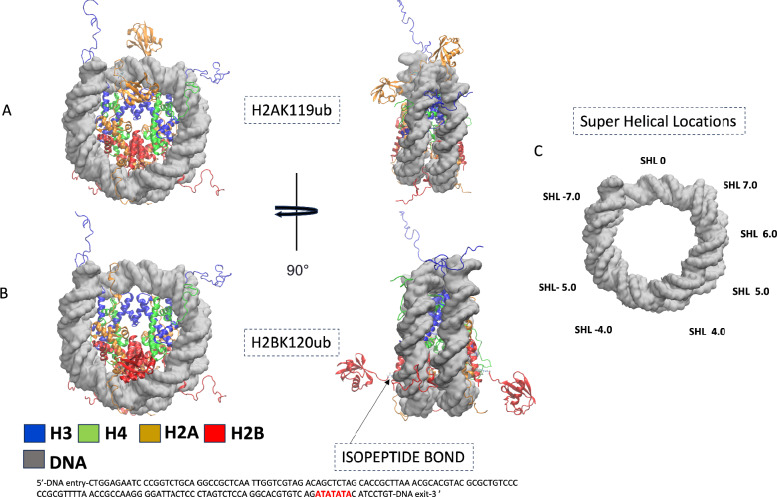
Fig. 1 A, B Initial conformations of the H2AK119ub and H2BK120ub nucleosome systems generated with Chimera and the Widom 601 nucleotide sequence in 5’ to 3’ orientation. The DNA exit end is AT-rich. C Super helical locations (SHLs) are sites marked on the nucleosomal DNA
Fig. 1 A, B Initial conformations of the H2AK119ub and H2BK120ub nucleosome systems generated with Chimera and the Widom 601 nucleotide sequence in 5’ to 3’ orientation. The DNA exit end is AT-rich. C Super helical locations (SHLs) are sites marked on the nucleosomal DNACC BY-NC-ND · PubMed Central
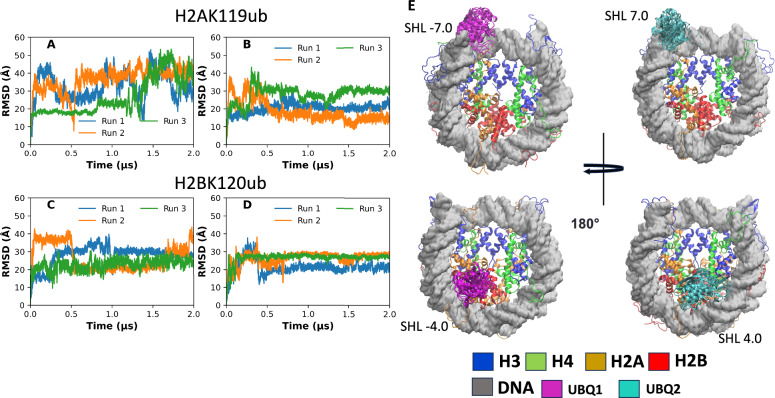
Fig. 2 A–D Root mean squared deviations (RMSD) of ubiquitin in H2A119ub and H2BK120ub nucleosome systems in all-atom MD simulations, which quantify its motion relative to the histone core. Ubiquitin has more restricted dynamics in the H2BK120ub system. E Representative configurations from the five most populated structural clusters, based on RMSD in the equilibrated portions of the trajectories
Fig. 2 A–D Root mean squared deviations (RMSD) of ubiquitin in H2A119ub and H2BK120ub nucleosome systems in all-atom MD simulations, which quantify its motion relative to the histone core. Ubiquitin has more restricted dynamics in the H2BK120ub system. E Representative configurations from the five most populated structural clusters, based on RMSD in the equilibrated portions of the trajectoriesCC BY-NC-ND · PubMed Central
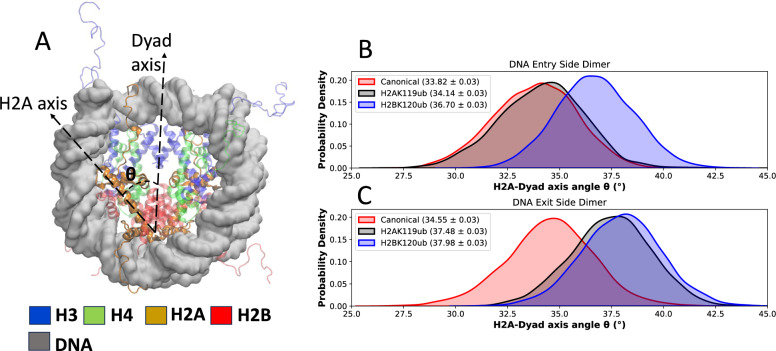
Fig. 3 A Schematic of the dyad axis and the H2A axis, illustrating the angle measured to quantify dimer motion within the nucleosome core. B, C Distribution and mean values of the H2A-dyad angle in all-atom MD simulations. Both H2AK119ub (grey) and H2BK120ub (blue) systems exhibit increased outward tilting of the H2A-H2B dimers relative to the canonical nucleosome (red)
Fig. 3 A Schematic of the dyad axis and the H2A axis, illustrating the angle measured to quantify dimer motion within the nucleosome core. B, C Distribution and mean values of the H2A-dyad angle in all-atom MD simulations. Both H2AK119ub (grey) and H2BK120ub (blue) systems exhibit increased outward tilting of the H2A-H2B dimers relative to the canonical nucleosome (red)CC BY-NC-ND · PubMed Central
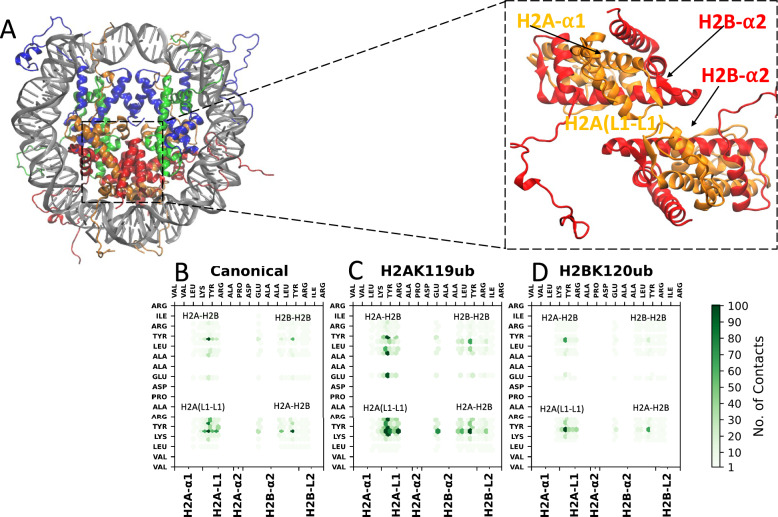
Fig. 4 A Structural view of the H2A-H2B dimer-dimer interface in the nucleosome, highlighting the roles of the H2A L1-L1 loops and H2B \upalpha 2 helices. B–D Per-residue contact maps showing inter-dimer interactions in the canonical, H2AK119ub, and H2BK120ub in all-atom MD simulations. The H2A L1-L1 region in H2AK119ub shows a pronounced increase in contacts. The color bar indicates the total number of contacts per residue pair
Fig. 4 A Structural view of the H2A-H2B dimer-dimer interface in the nucleosome, highlighting the roles of the H2A L1-L1 loops and H2B \upalpha 2 helices. B–D Per-residue contact maps showing inter-dimer interactions in the canonical, H2AK119ub, and H2BK120ub in all-atom MD simulations. The H2A L1-L1 region in H2AK119ub shows a pronounced increase in contacts. The color bar indicates the total number of contacts per residue pairCC BY-NC-ND · PubMed Central
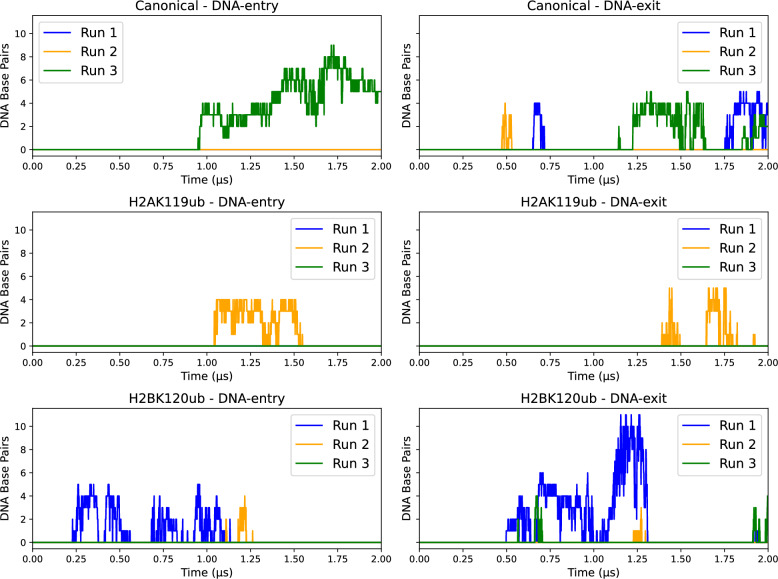
Fig. 5 DNA unwrapping (“breathing”) at the nucleosome entry and exit sites, quantified by the number of base pairs unwrapped from the superhelical axis over time in all-atom MD simulations. Both the canonical and H2BK120ub nucleosomes show greater DNA unwrapping than the H2AK119ub system
Fig. 5 DNA unwrapping (“breathing”) at the nucleosome entry and exit sites, quantified by the number of base pairs unwrapped from the superhelical axis over time in all-atom MD simulations. Both the canonical and H2BK120ub nucleosomes show greater DNA unwrapping than the H2AK119ub systemCC BY-NC-ND · PubMed Central
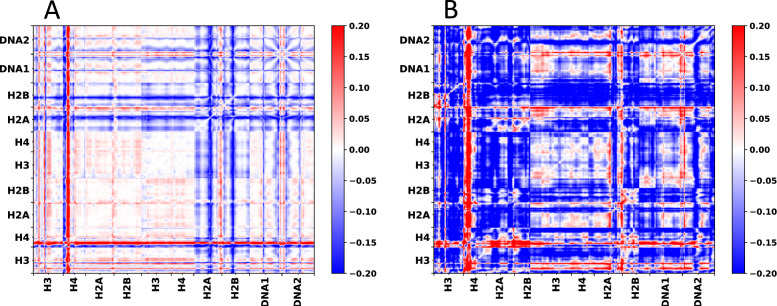
Fig. 6 A, B Differences in atomic mutual information (dynamical correlations) between H2AK119ub and H2BK120ub nucleosomes, relative to the canonical system, in all-atom MD simulations. Positive values reflect increased coupling; negative values reflect reduced coupling. Diagonal blocks represent intra-molecular correlations; off-diagonal blocks indicate inter-molecular correlations between histones and DNA. These maps highlight how H2AK119ub enhances coupling at the DNA entry and exit regions, whereas H2BK120ub reduces histone-DNA correlations within the nucleosome core
Fig. 6 A, B Differences in atomic mutual information (dynamical correlations) between H2AK119ub and H2BK120ub nucleosomes, relative to the canonical system, in all-atom MD simulations. Positive values reflect increased coupling; negative values reflect reduced coupling. Diagonal blocks represent intra-molecular correlations; off-diagonal blocks indicate inter-molecular correlations between histones and DNA. These maps highlight how H2AK119ub enhances coupling at the DNA entry and exit regions, whereas H2BK120ub reduces histone-DNA correlations within the nucleosome coreCC BY-NC-ND · PubMed Central
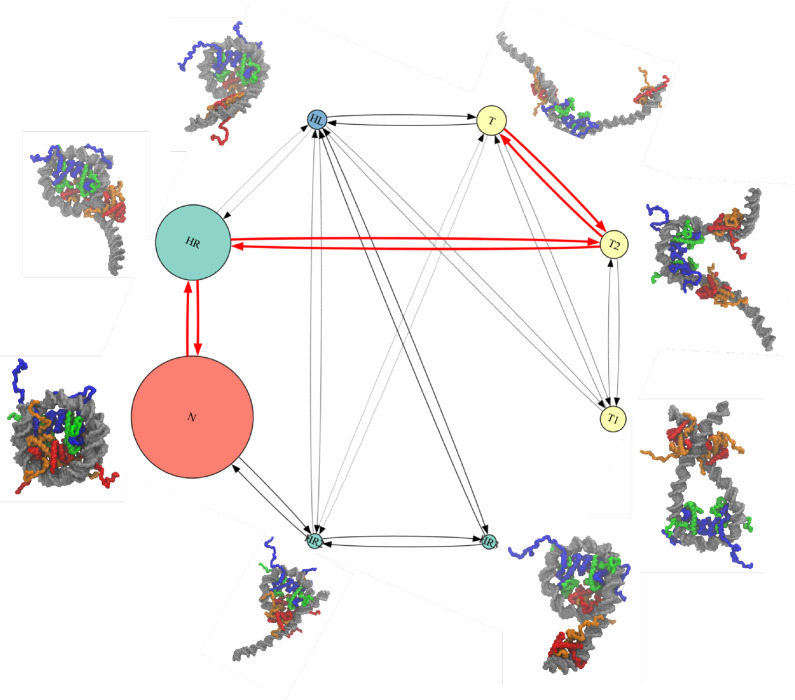
Fig. 7 Top six assembly pathways for the canonical nucleosome, as identified by transition path theory from the coarse-grain Markov State Model. Each node represents a macrostate, with size proportional to equilibrium free energy. Arrow thickness indicates pathway dominance. The pathways highlight transitions between tetrasomal (T, T1, T2), hexasomal (HR, HR1, HR2, HR3, HL), and nucleosomal (N) states
Fig. 7 Top six assembly pathways for the canonical nucleosome, as identified by transition path theory from the coarse-grain Markov State Model. Each node represents a macrostate, with size proportional to equilibrium free energy. Arrow thickness indicates pathway dominance. The pathways highlight transitions between tetrasomal (T, T1, T2), hexasomal (HR, HR1, HR2, HR3, HL), and nucleosomal (N) statesCC BY-NC-ND · PubMed Central
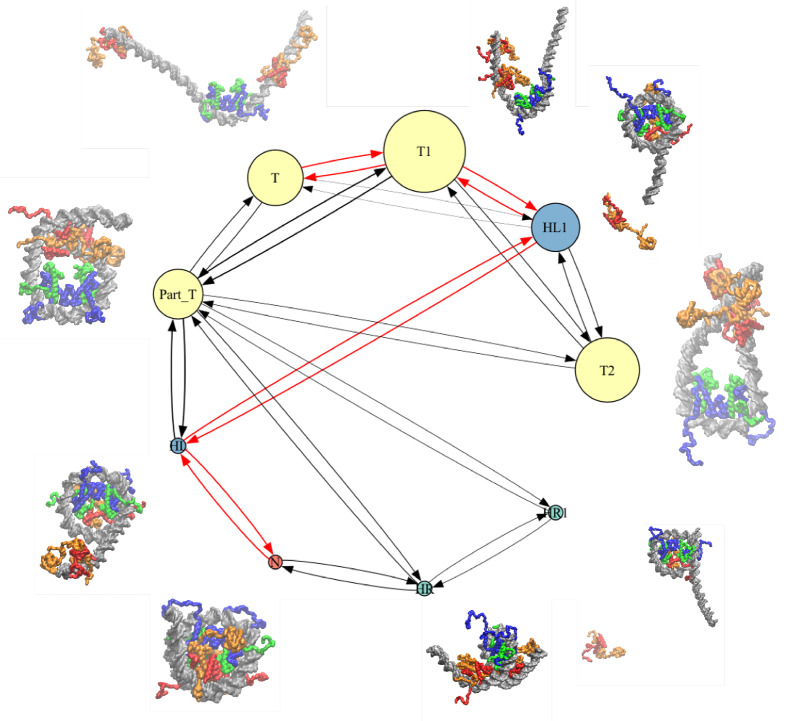
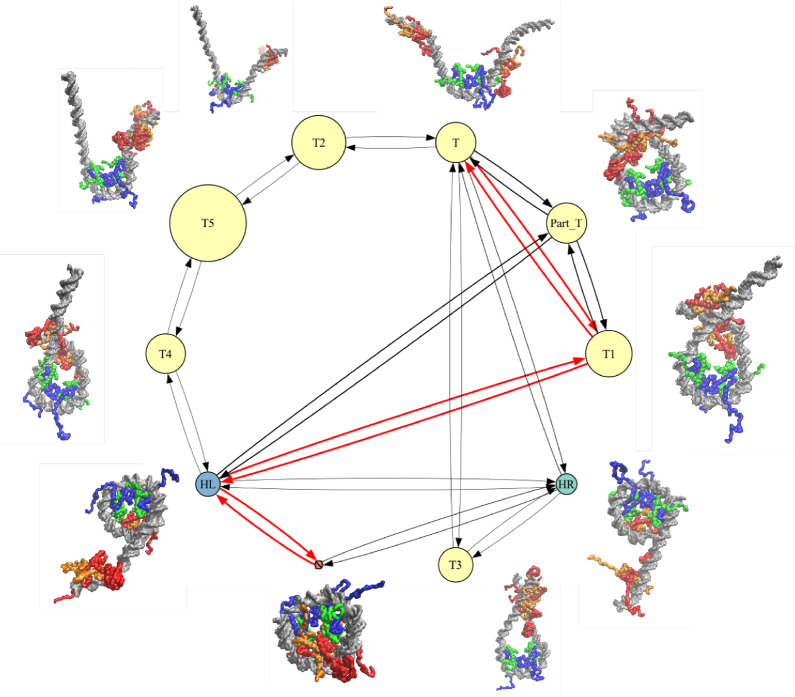
Fig. 8 Top six assembly pathways for the H2AK119ub-modified nucleosome, as identified by transition path theory from Markov State Model analysis of the coarse-grain MD simulations. Each node represents a macrostate, with its size proportional to the equilibrium free energy. The arrow thickness indicates the pathway’s dominance. Compared to the canonical system, the nucleosomal state (N) is destabilized, while extended (T, T1) and compact (T2, Part_T) tetrasomal states remain low in free energy. The HL1 hexasomal state also appears as a relatively stable intermediate, contributing to the dominant folding routes
Fig. 8 Top six assembly pathways for the H2AK119ub-modified nucleosome, as identified by transition path theory from Markov State Model analysis of the coarse-grain MD simulations. Each node represents a macrostate, with its size proportional to the equilibrium free energy. The arrow thickness indicates the pathway’s dominance. Compared to the canonical system, the nucleosomal state (N) is destabilized, while extended (T, T1) and compact (T2, Part_T) tetrasomal states remain low in free energy. The HL1 hexasomal state also appears as a relatively stable intermediate, contributing to the dominant folding routesCC BY-NC-ND · PubMed Central
Fig. 9 Top six assembly pathways for the H2BK120ub-modified nucleosome, as identified by transition path theory from Markov State Model analysis of the coarse-grain MD simulations. Each node represents a macrostate, with its size proportional to the equilibrium free energy. The arrow thickness indicates the pathway’s dominance. Compared to both the canonical and H2AK119ub systems, the nucleosomal state (N) is sparsely populated and high in free energy, while multiple tetrasomal states are strongly stabilized. Folding pathways are highly diffuse, with many weakly populated routes, consistent with slower and less efficient nucleosome assembly
Fig. 9 Top six assembly pathways for the H2BK120ub-modified nucleosome, as identified by transition path theory from Markov State Model analysis of the coarse-grain MD simulations. Each node represents a macrostate, with its size proportional to the equilibrium free energy. The arrow thickness indicates the pathway’s dominance. Compared to both the canonical and H2AK119ub systems, the nucleosomal state (N) is sparsely populated and high in free energy, while multiple tetrasomal states are strongly stabilized. Folding pathways are highly diffuse, with many weakly populated routes, consistent with slower and less efficient nucleosome assemblyCC BY-NC-ND · PubMed Central
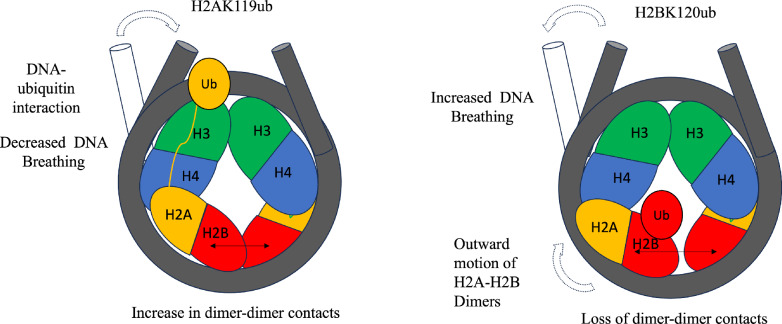
Fig. 10 Illustration depicting the distinct mechanisms by which H2AK119ub and H2BK120ub alter nucleosome stability and assembly. H2AK119ub indirectly strengthens the L1-L1 interface between H2A histones, stabilizing the nucleosome core and slowing assembly. In contrast, H2BK120ub disrupts these contacts and weakens the histone core, promoting partially assembled hexasome and tetrasome states. Arrows and annotations indicate the sites of ubiquitination, key affected interfaces, and the resulting structural and kinetic effects on nucleosome folding
Fig. 10 Illustration depicting the distinct mechanisms by which H2AK119ub and H2BK120ub alter nucleosome stability and assembly. H2AK119ub indirectly strengthens the L1-L1 interface between H2A histones, stabilizing the nucleosome core and slowing assembly. In contrast, H2BK120ub disrupts these contacts and weakens the histone core, promoting partially assembled hexasome and tetrasome states. Arrows and annotations indicate the sites of ubiquitination, key affected interfaces, and the resulting structural and kinetic effects on nucleosome foldingCC BY-NC-ND · PubMed Central

Verification

Claims the paper makes

The claims and statistics of this paper haven’t been checked yet.

Run the check — free, no account needed. It reads the open-access text and checks the sources it cites.

A few free checks a day · papers already verified open instantly · results are public

Self-check

Percentages, sums and reported differences re-computed from the paper’s own numbers.

The self-check needs the paper’s full text.

Citations

Cites

Show all 1 references

Research works printed but not linked: 74

  1. 10.1038/38444 · DOI · Paper page
  2. 10.1021/cr500373h · DOI · Paper page
  3. 10.1038/s41594-017-0005-5 · DOI
  4. 10.1586/14789450.2.5.719 · DOI
  5. 10.1016/j.sbi.2020.10.018 · DOI
  6. 10.1021/bi9518858 · DOI
  7. 10.1016/j.bpj.2015.07.004 · DOI
  8. 10.3390/molecules23102614 · DOI
  9. 10.7554/eLife.13450 · DOI · Paper page
  10. 10.1146/annurev.biophys.27.1.285 · DOI
  11. 10.4161/epi.4.1.7733 · DOI
  12. 10.1038/s41576-022-00468-7 · DOI · Paper page
  13. 2014, Post-translational modifications of histones that influence nucleosome dynamics, Chemical reviews, 115, 2274
  14. Chen, J. J. ; Stermer, D. ; Tanny, J. C. Decoding histone ubiquitylation. Frontiers in Cell and Developmental Biology 2022, 10, 968398. · DOI
  15. 10.1101/gad.1156403 · DOI
  16. 10.1073/pnas.74.3.864 · DOI
  17. Weake, V. M. Histone ubiquitylation control of gene expression. Fundamentals of Chromatin 2013, 257–307. · DOI
  18. 10.1016/j.dnarep.2015.09.016 · DOI
  19. 10.1101/gad.1404206 · DOI
  20. 10.1016/j.molcel.2006.03.035 · DOI
  21. 10.1126/sciadv.adl4529 · DOI
  22. 10.3390/cells11152404 · DOI
  23. 10.1016/j.molcel.2019.11.021 · DOI
  24. Ciapponi, M. ; Karlukova, E. ; Schkölziger, S. ; Benda, C. ; Müller, J. Structural basis of the histone ubiquitination read–write mechanism of RYBP–PRC1. Nature Structural & Molecular Biology 2024, 1–5. · DOI
  25. 10.1021/jacs.9b12448 · DOI
  26. Luo, A. ; Kong, J. ; Chen, J. ; Xiao, X. ; Lan, J. ; Li, X. ; Liu, C. ; Wang, P. Y. ; Li, G. ; Li, W. ; Chen, P . H2B ubiquitination recruits FACT to maintain a stable altered nucleosome state for transcriptional activation. Nat Commun 2023, 14, 741. · DOI
  27. 10.1021/bi200946z · DOI
  28. 10.1016/j.bpj.2019.11.3395 · DOI
  29. 10.1093/nar/gkaa121 · DOI
  30. 10.1038/s41467-021-22636-9 · DOI
  31. 10.1371/journal.pcbi.1009253 · DOI
  32. Portillo-Ledesma, S. ; Tsao, L. H. ; Wagley, M. ; Lakadamyali, M. ; Cosma, M. P. ; Schlick, T . Nucleosome clutches are regulated by chromatin internal parameters. Journal of Molecular Biology 2021, 433, 166701. · DOI
  33. Li, S. ; Wei, T. ; Panchenko, A . Histone variant H2A. Z modulates nucleosome dynamics to promote DNA accessibility. Biophysical Journal 2023, 122, 218a. · DOI
  34. Patel, R. ; Onyema, A. ; Tang, P. K. ; Loverde, S. M . Conformational Dynamics of the Nucleosomal Histone H2B Tails Revealed by Molecular Dynamics Simulations. Journal of Chemical Information and Modeling 2024, · DOI
  35. 10.1002/wcms.1728 · DOI
  36. 10.1021/acs.jpcb.4c04223 · DOI
  37. 10.1021/jacs.7b12191 · DOI
  38. 10.1016/S0022-2836(02)00386-8 · DOI
  39. 10.1002/jcc.20084 · DOI
  40. 10.1017/S0033583501003699 · DOI · Paper page
  41. 10.1002/jcc.20290 · DOI · Paper page
  42. 2019, ; others ff19SB: amino-acid-specific protein backbone parameters trained against quantum mechanics energy surfaces in solution, Journal of chemical theory and computation, 16, 528
  43. 10.1038/nmeth.3658 · DOI
  44. 10.1021/jz501780a · DOI
  45. 10.1021/ct5010406 · DOI
  46. 10.1016/0021-9991(77)90098-5 · DOI
  47. 10.1016/0263-7855(96)00018-5 · DOI · Paper page
  48. 2002, ; others Pymol: An open-source molecular graphics tool, CCP4 Newsl. Protein Crystallogr, 40, 82
  49. 10.1021/ct400341p · DOI
  50. 10.1073/pnas.1402768111 · DOI
  51. Freeman, G. S. ; Hinckley, D. M. ; Lequieu, J. P. ; Whitmer, J. K. ; De Pablo, J. J . Coarse-grained modeling of DNA curvature. The Journal of chemical physics 2014, 141. · DOI
  52. 10.1371/journal.pcbi.1005880 · DOI
  53. 10.1021/ct4007162 · DOI
  54. 10.1002/prot.22568 · DOI
  55. 10.1016/j.bpj.2011.08.003 · DOI
  56. 10.1093/nar/gkab246 · DOI
  57. 10.1021/ct2001045 · DOI
  58. 10.1021/ja308908p · DOI
  59. 10.1021/acs.jctc.1c00273 · DOI
  60. 10.1021/acs.jctc.5b00743 · DOI
  61. 10.1016/S0031-3203(02)00060-2 · DOI
  62. 10.1002/jcc.21787 · DOI
  63. 10.1109/mcse.2007.55 · DOI · Paper page
  64. 10.1021/ct300418h · DOI
  65. Shirts, M. R. ; Chodera, J. D . Statistically optimal analysis of samples from multiple equilibrium states. The Journal of chemical physics 2008, 129. · DOI
  66. 10.1021/acs.jcim.1c00742 · DOI
  67. 10.1038/cdd.2017.42 · DOI
  68. 10.1016/j.tig.2020.12.005 · DOI
  69. 10.1093/nar/gkae698 · DOI
  70. 10.1093/nar/gks865 · DOI
  71. 2018, Unique Dynamics in Asymmetric macroH2A–H2A Hybrid Nucleosomes Result in Increased Complex Stability, The Journal of Physical Chemistry B, 123, 419
  72. 10.1074/jbc.M602258200 · DOI
  73. 10.1063/1.472046 · DOI
  74. Pan, A. C. ; Roux, B . Building Markov state models along pathways to determine free energies and rates of transitions. The Journal of chemical physics 2008, 129. · DOI

Metadata

Authors
Baweja, L., & Wereszczynski, J.
Affiliations
Illinois Institute of Technology (US)
Corresponding author
Wereszczynski, Jeff
Venue
Epigenetics & Chromatin
Publisher
openRxiv
Published
2025-02-14
Volume
18
Issue
1
Pages
74-74
ISSN
1756-8935 (ISSN-L)
OpenAlex
W4416392468
Cited by
3
References
1
Citations by year
2026: 2 · 2025: 1
FWCI
0.90
Type
journal article
Language
en
Open access
Locations
  • Epigenetics & Chromatin (publishedVersion, cc-by-nc-nd)
  • bioRxiv (Cold Spring Harbor Laboratory) (acceptedVersion, cc-by)
  • Europe PMC (PubMed Central) (publishedVersion, cc-by-nc-nd)
  • PubMed (publishedVersion)
  • PubMed Central (submittedVersion, cc-by-nc)
  • DOAJ (DOAJ: Directory of Open Access Journals) (submittedVersion, cc-by-sa)
Funders
National Institute of General Medical Sciences (R35GM119647)
Topics
  • Life Sciences › Biochemistry, Genetics and Molecular Biology › Molecular Biology › Genomics and Chromatin Dynamics
  • Life Sciences › Biochemistry, Genetics and Molecular Biology › Molecular Biology › Protein Structure and Dynamics
  • Life Sciences › Biochemistry, Genetics and Molecular Biology › Molecular Biology › Nuclear Structure and Function
Keywords
histone H2A ubiquitination, histone H2B ubiquitination, H2AK119ub, nucleosome stability, hexasome, chromatin regulation, transcriptional repression, transcriptional activation, histone modifications

About these checks

Registry, retraction, Cites and statistics results are computed, not judged, with one exception: a printed reference that no index lists is read once by a model before it counts as a citation error. Claims are extracted by a model and kept only when their quote appears verbatim in the text; each cited source is then checked, with a model’s help, for whether it says what the claim relies on. Those verdicts can be wrong — read the claim’s quote and the cited source before relying on one.

Statistics and arithmetic are recomputed, not judged.

Confidence bands are shown only for fields calibrated on our annotated test set. None is calibrated yet, so no band is shown.

What counts as a claim ›How we measure confidence ›How we check this ›

Are you an author, or do you see a problem with this page? Request a review

How to cite

Cite CoChat for the checks on this page, and the paper for its own findings.

This page
CoChat. (2026). Citation check: Mechanistic basis for the opposing effects of H2A and H2B ubiquitination on nucleosome stability and dynamics. https://app.cochat.ai/papers/10.1101/2025.02.13.638112
The paper
Baweja, L., & Wereszczynski, J. (2025). Mechanistic basis for the opposing effects of H2A and H2B ubiquitination on nucleosome stability and dynamics. Epigenetics & Chromatin. https://doi.org/10.1101/2025.02.13.638112