

The DOI matches its Crossref record; its reference list is not available.
SenolyticSynergy: An Attention-Based Network for Discovering Novel Senolytic Combinations via Human Aging Genomics
Open accessPreprint — published as 10.3390/ijms26189004 · Paper page
Abstract
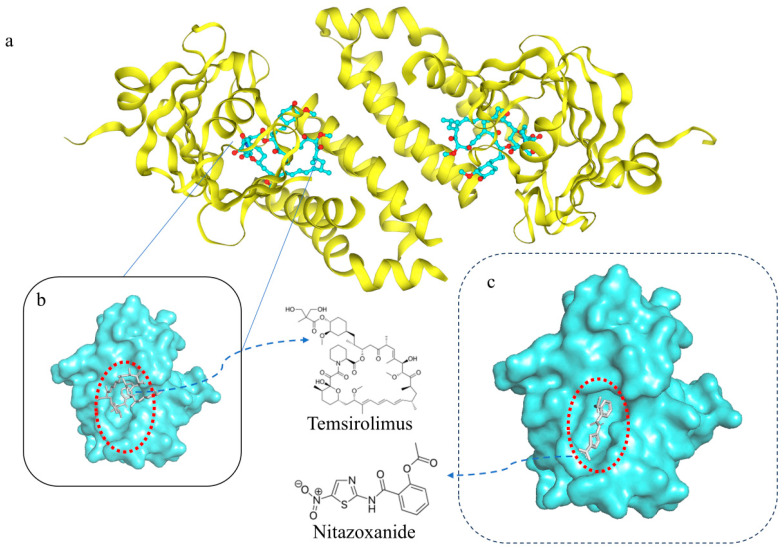
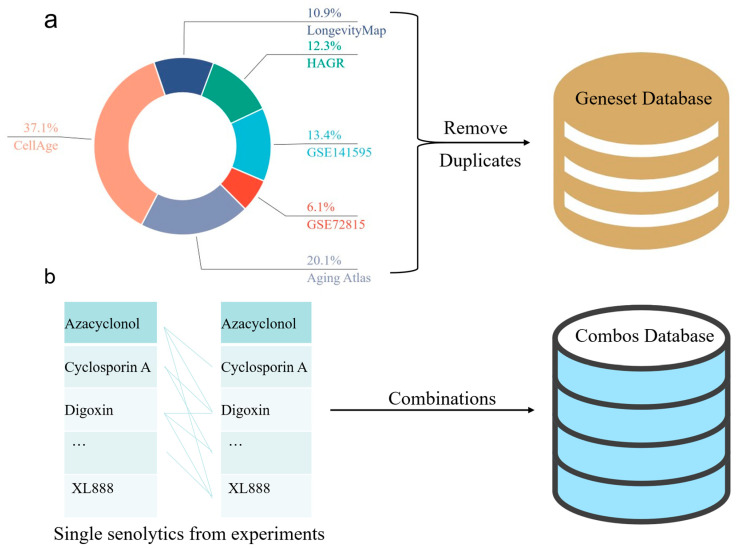
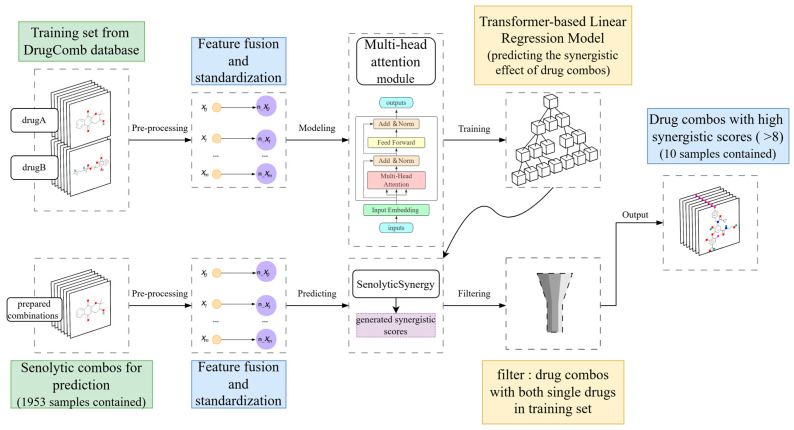
Senolytics, a category of drugs targeting aging processes, have garnered significant attention since their emergence in 2015. Unlike traditional drug development approaches that rely on randomized screening, research on aging-related pharmaceuticals has employed mechanism-based strategies, resulting in the discovery of the pioneering combination therapy of dasatinib (D) and quercetin (Q). Although preliminary studies with senolytic drug combinations have shown promising outcomes, the predictive capabilities of the research in this field remain limited by the extensive experimental data requirements. In this study, we employed differential gene expression analysis and machine learning techniques to investigate the combinatorial effects of senolytic drugs. We identified 1624 core aging-related genes and used this dataset to retrain a multimodal attention mechanism model, creating a specialized framework: SenolyticSynergy for predicting effective senolytic drug combinations. We then utilized 63 established senolytic compounds as starting points for combination testing, developing a comprehensive dataset of 1953 potential drug combinations for aging interventions. Following rigorous filtration, we identified 190 high-confidence drug combinations and predicted their synergistic scores. Among these combinations, ten demonstrated exceptionally high synergistic scores, exceeding 8. The combination of temsirolimus and nitazoxanide ranked first and may be the most promising candidate. The analysis of literature data and computational studies of molecular structures using 3D modeling validated the accuracy of these predictions. This framework paves the way for large-scale research into anti-aging drug combinations, advancing research capabilities in this field. GRAPH ABSTRACT:
Overview
The claims and statistics of this paper haven’t been checked yet.
Run the check — free, no account needed. It reads the open-access text and checks the sources it cites.
Integrity signals
Registry
Cites
Statistics
Figures
Verification
Claims the paper makes
The claims and statistics of this paper haven’t been checked yet.
Run the check — free, no account needed. It reads the open-access text and checks the sources it cites.
Self-check
Percentages, sums and reported differences re-computed from the paper’s own numbers.
The self-check needs the paper’s full text.
Citations
No citation lists for this paper
No citation lists for this paper yet — checked again daily.
References 71
Research works printed but not linked: 59
- 10.1111/acel.13133 · DOI · Paper page
- 10.1093/nar/gkaa894 · DOI
- 10.18632/aging.101633 · DOI · Paper page
- 10.1016/j.tig.2013.08.003 · DOI
- 10.1186/s12964-023-01094-4 · DOI
- 10.1016/j.cell.2006.10.018 · DOI · Paper page
- 10.1038/s41467-024-48807-y · DOI
- 10.1007/978-3-540-47648-1_5724 · DOI
- 10.1093/nar/gkad927 · DOI
- 10.1021/acs.jcim.1c00203 · DOI
- 10.1038/onc.2010.49 · DOI
- 10.1038/s41401-019-0220-1 · DOI
- 10.1371/journal.pone.0138347 · DOI · Paper page
- 2020, STRATEGIES TO FIGHT IBRUTINIB-RESISTANCE IN CHRONIC LYMPHOCYTIC LEUKEMIA, HAEMATOLOGICA, 105, S97
- 10.1038/s41467-017-00314-z · DOI · Paper page
- 10.1093/bib/bbae069 · DOI
- 10.1158/2159-8290.CD-21-1059 · DOI · Paper page
- 10.17179/excli2021-4622 · DOI · Paper page
- 10.1186/s13024-017-0197-5 · DOI · Paper page
- 10.1002/mgg3.613 · DOI
- 10.1093/nar/28.1.27 · DOI · Paper page
- 10.3390/biom9050174 · DOI · Paper page
- 10.3389/fphar.2022.968148 · DOI
- 10.1093/nar/gkad976 · DOI
- 10.3390/cancers13030386 · DOI · Paper page
- 10.3390/ijms25063178 · DOI · Paper page
- 10.1074/jbc.M210432200 · DOI
- 10.1093/bioinformatics/btae551 · DOI
- 10.1093/bib/bbab421 · DOI
- 10.18632/oncotarget.7183 · DOI
- 10.1016/j.cell.2022.11.001 · DOI · Paper page
- 10.1371/journal.pcbi.1006752 · DOI
- 10.1186/s12859-024-05925-0 · DOI
- Na W. , Ju-xin Z. , & Guang-zhi L. I. U . (2014, July 1). Inducing Apoptosis of Norcantharidin in Combination with ABT-737 on Cervical Cancer Cells . | Journal of International Reproductive Health/Family Planning | EBSCOhost. https://openurl.ebsco.com/contentitem/gcd:97451081?sid=ebsco:plink:crawler&id=ebsco:gcd:97451081
- 10.3389/fendo.2024.1304188 · DOI
- 10.1182/blood-2009-07-231233 · DOI
- 10.1038/srep02640 · DOI
- 10.1016/j.cellsig.2019.03.014 · DOI
- 10.3748/wjg.v22.i15.3962 · DOI
- 10.1038/s41598-017-01964-1 · DOI · Paper page
- 10.1152/ajpcell.00366.2020 · DOI
- 10.22038/IJBMS.2024.72049.15662 · DOI
- 10.1038/s41467-023-39120-1 · DOI · Paper page
- 10.1073/pnas.0506580102 · DOI · Paper page
- 10.29219/fnr.v65.6355 · DOI
- 10.1371/journal.pone.0294236 · DOI
- Vaswani, A. , Shazeer, N. , Parmar, N. , Uszkoreit, J. , Jones, L. , Gomez, A. N. , Kaiser, Ł. , & Polosukhin, I . (2017). Attention is all you need. Proceedings of the 31st International Conference on Neural Information Processing Systems, 6000–6010.
- 10.18632/aging.101787 · DOI · Paper page
- 10.1016/j.artmed.2024.103029 · DOI
- 10.18632/aging.101100 · DOI · Paper page
- 10.1038/s43587-023-00415-z · DOI · Paper page
- 10.1038/s41420-024-01832-8 · DOI
- 10.1186/s13321-023-00690-3 · DOI
- 10.1016/j.intimp.2024.112426 · DOI
- 10.1038/ncomms11190 · DOI · Paper page
- 10.1016/j.ebiom.2018.09.015 · DOI · Paper page
- 10.1124/pharmrev.120.000086 · DOI
- 10.3390/molecules24040708 · DOI
- 10.1111/acel.12445 · DOI · Paper page
Metadata
- Authors
- Ye, Y., & Ming, D.
- Affiliations
- Nanjing Tech University (CN)
- Corresponding author
- Ming, Dengming
- Venue
- International Journal of Molecular Sciences
- Publisher
- openRxiv
- Published
- 2025-05-30
- Volume
- 26
- Issue
- 18
- Pages
- 9004-9004
- ISSN
- 1422-0067 (ISSN-L)
- PMC
- PMC12469854
- OpenAlex
- W4414244012
- Cited by
- 0
- References
- 71
- FWCI
- 0.00
- Type
- journal article
- Language
- en
- Open access
- gold
- doi.org
- Licence
- Locations
- International Journal of Molecular Sciences (publishedVersion, cc-by)
- bioRxiv (Cold Spring Harbor Laboratory) (acceptedVersion)
- Europe PMC (PubMed Central) (publishedVersion, cc-by)
- PubMed (publishedVersion)
- PubMed Central (publishedVersion, cc-by)
- Topics
- Life Sciences › Pharmacology, Toxicology and Pharmaceutics › Drug Discovery › Computational Drug Discovery Methods
- Life Sciences › Biochemistry, Genetics and Molecular Biology › Cell Biology › Telomeres, Telomerase, and Senescence
- Life Sciences › Biochemistry, Genetics and Molecular Biology › Aging › Genetics, Aging, and Longevity in Model Organisms
- Keywords
- senolytics, drug combination prediction, drug synergy, aging, dasatinib, quercetin, temsirolimus, nitazoxanide, aging-related genes, differential gene expression
- MeSH terms
- Dasatinib, Machine Learning, Senotherapeutics, Aging, Drug Combinations, Drug Synergism, Humans, Quercetin, Genomics
About these checks
Registry, retraction, Cites and statistics results are computed, not judged, with one exception: a printed reference that no index lists is read once by a model before it counts as a citation error. Claims are extracted by a model and kept only when their quote appears verbatim in the text; each cited source is then checked, with a model’s help, for whether it says what the claim relies on. Those verdicts can be wrong — read the claim’s quote and the cited source before relying on one.
Statistics and arithmetic are recomputed, not judged.
Confidence bands are shown only for fields calibrated on our annotated test set. None is calibrated yet, so no band is shown.
What counts as a claim ›How we measure confidence ›How we check this ›
Are you an author, or do you see a problem with this page? Request a review
How to cite
Cite CoChat for the checks on this page, and the paper for its own findings.
- This page
- CoChat. (2026). Citation check: SenolyticSynergy: An Attention-Based Network for Discovering Novel Senolytic Combinations via Human Aging Genomics. https://app.cochat.ai/papers/10.1101/2025.05.28.655258
- The paper
- Ye, Y., & Ming, D. (2025). SenolyticSynergy: An Attention-Based Network for Discovering Novel Senolytic Combinations via Human Aging Genomics. International Journal of Molecular Sciences. https://doi.org/10.1101/2025.05.28.655258
