

QSProteome: A Community-Driven Interactive Platform for Large-Scale Exploration and Evaluation of Predicted Protein Complex Structures
Open accessPreprint — published as 10.1093/nar/gkaf1099
The DOI matches its Crossref record; 2 of the 2 references it cites were found in a registry or an index.
Abstract
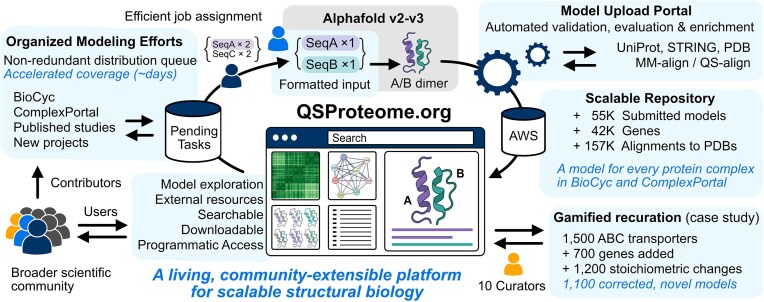
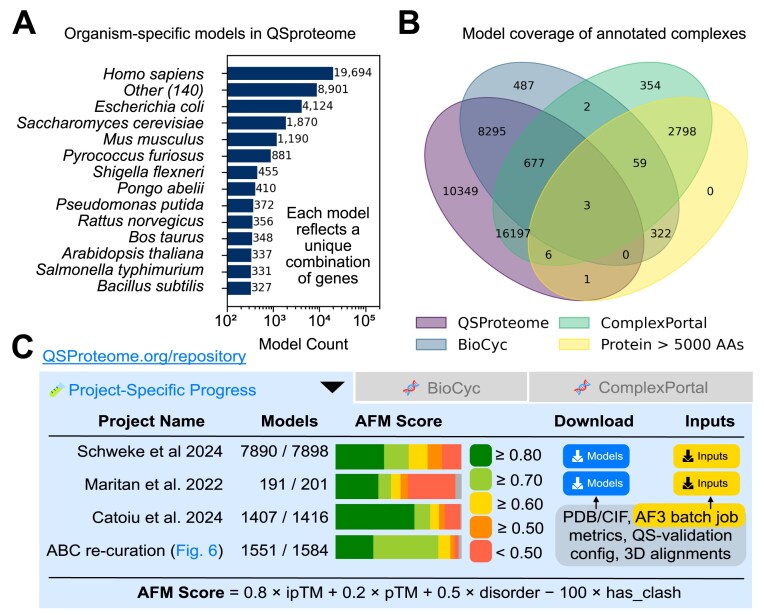
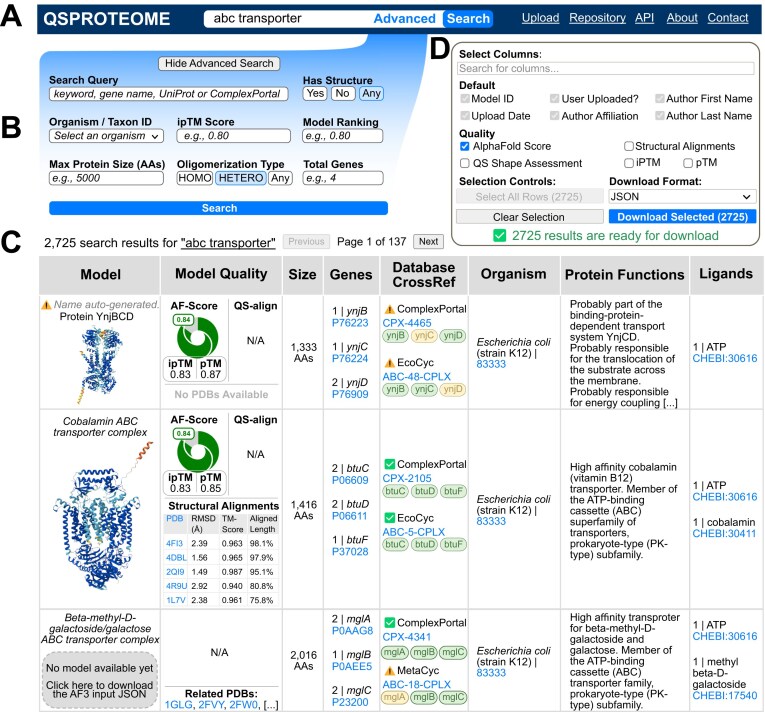
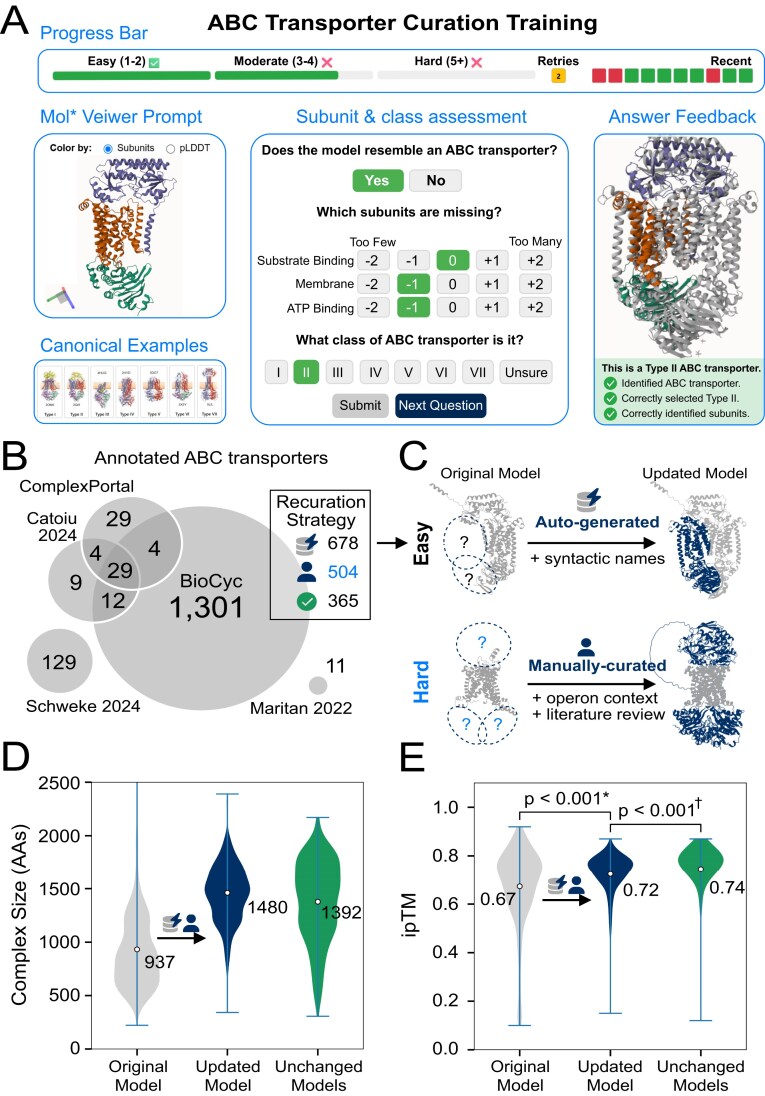
QSProteome ( https://QSProteome.org ) is a community-scale platform for modeling, evaluating, and refining quaternary protein structure. The resource hosts 35,528 unique modeled assemblies spanning over 42,000 genes, covering nearly all curated complexes in BioCyc and ComplexPortal databases. Each model is displayed on an interactive page with 3D visualization, chain-level confidence metrics, structural alignments, functional annotations, and automated stoichiometry checks against database expectations. A cloud-based server supports continuous user uploads and automated processing pipelines—enabling submission and validation of >54,000 models within 14 weeks. To promote iterative refinement, QSProteome includes a gamified re-curation workflow that transitions users from training modules into live curation, enabling the community-led assessment of 1,547 ABC transporter complexes. Together, these components form a dynamic, scalable infrastructure for proteome-scale structural biology. By unifying modeling, validation, and annotation in a reusable, searchable, and community-extensible framework, QSProteome enables proteome-scale structure accessibility and reuse—powering discovery, annotation, and collaborative refinement across the structural biology community.
Overview
The claims and statistics of this paper haven’t been checked yet.
Free: it reads the open-access text and checks the first 5 claims that cite a source we can check. Create a free account to check every claim.
Integrity signals
Registry
Cites
Statistics
Figures



Verification
Claims the paper makes
The claims and statistics of this paper haven’t been checked yet.
Free: it reads the open-access text and checks the first 5 claims that cite a source we can check. Create a free account to check every claim.
Self-check
Percentages, sums and reported differences re-computed from the paper’s own numbers.
The self-check needs the paper’s full text.
Citations
Cites
Highly accurate protein structure prediction with AlphaFold
Jumper, J., Evans, R., Pritzel, A., Green, T., Figurnov, M., Ronneberger, O., Tunyasuvunakool, K., Bates, R., Žídek, A., Potapenko, A., et al. (2021) · Nature · doi:10.1038/s41586-021-03819-2 · Cited by 43,764
Varadi, M., Bertoni, D., Magana, P., Paramval, U., Pidruchna, I., Radhakrishnan, M., Tsenkov, M., Nair, S., Mirdita, M., Yeo, J., et al. (2024) · Nucleic Acids Research · doi:10.1093/nar/gkad1011 · Cited by 2,052
Research works printed but not linked: 44
- 10.1038/s41592-022-01488-1 · doi:10.1038/s41592-022-01488-1 · Paper page
- 10.1042/BCJ20200963 · DOI · Paper page
- 10.1002/prot.26237 · DOI · Paper page
- 10.1101/2021.10.04.463034 · DOI · Paper page
- 10.1016/j.jmb.2025.168996 · DOI · Paper page
- 10.1038/nmeth.4510 · DOI
- 10.1016/j.str.2021.07.012 · DOI
- 10.3389/fmolb.2021.787510 · DOI
- 10.1002/pmic.202200323 · DOI · Paper page
- 10.1016/j.cell.2024.01.022 · DOI · Paper page
- 10.1093/nar/gkae1010 · DOI · Paper page
- 10.1093/nar/gkab991 · DOI · Paper page
- 10.1093/nar/gkac1000 · DOI · Paper page
- 10.1038/s41586-024-07487-w · DOI · Paper page
- 10.1093/bib/bbx085 · DOI · Paper page
- 10.1128/ecosalplus.ESP-0002-2023 · DOI
- 10.1093/nar/gkz862 · DOI · Paper page
- 10.7554/eLife.100485.1 · DOI
- 10.1016/j.jmb.2021.167351 · DOI · Paper page
- 10.1093/nar/gkaf394 · DOI · Paper page
- 10.1093/nar/gkae1091 · DOI · Paper page
- 10.1093/nar/gkp318 · DOI · Paper page
- 10.1038/s41597-024-03571-y · DOI · Paper page
- 10.1093/nar/gkv1031 · DOI · Paper page
- 10.1093/nar/gkab314 · DOI · Paper page
- 10.1101/2025.02.10.637595 · DOI · Paper page
- 10.1038/nrm2646 · DOI · Paper page
- 10.1128/msystems · DOI
- 10.3389/fmicb.2024.1469915 · DOI
- 10.1039/C5RA05304H · DOI
- 10.1016/j.febslet.2010.04.043 · DOI · Paper page
- 10.1038/s41587-023-01773-0 · DOI · Paper page
- 10.1007/978-3-030-78397-6_2 · DOI
- 10.1146/annurev.micro.091208.073214 · DOI · Paper page
- 10.1038/s41579-023-00974-3 · DOI · Paper page
- 10.4161/rna.24538 · DOI
- 10.1002/prot.26617 · DOI · Paper page
- 10.1093/bioinformatics/btaf107 · DOI · Paper page
- 10.1093/bioinformatics/btx283 · DOI
- 10.1038/s41587-024-02175-6 · DOI · Paper page
- 10.1371/journal.pcbi.1006302 · DOI · Paper page
- 10.1073/pnas.1705524114 · DOI · Paper page
- 10.1371/journal.pcbi.1011865 · DOI
- 10.1038/nbt.3597 · DOI · Paper page
Metadata
- Authors
- Catoiu, E. A., Kambo, D., Rodriguez, B., Vear, K., Wang, Z., Akpata, J., Shah, J., Ayoub, R., Hofmann, M., Ananda, K., Tantry, A., Gupta, I., Anwyl, R., Faucher, C., Nichols, J., Ton, B., Marchal, L. O., & Palsson, B. O.
- Affiliations
- University of California San Diego (US)
- Corresponding author
- Catoiu, Edward A.
- Venue
- Nucleic Acids Research
- Publisher
- openRxiv
- Published
- 2025-09-16
- Volume
- 54
- Issue
- D1
- Pages
- D661-D672
- ISSN
- 0305-1048 (ISSN-L)
- PMC
- PMC12807603
- OpenAlex
- W4415721619
- Cited by
- 4
- References
- 2
- Citations by year
- 2026: 3 · 2025: 1
- FWCI
- 1.20
- Type
- journal article
- Language
- en
- Open access
- gold
- doi.org
- Licence
- Locations
- Nucleic Acids Research (publishedVersion, cc-by-nc)
- bioRxiv (Cold Spring Harbor Laboratory) (acceptedVersion, other-oa)
- PubMed (publishedVersion)
- PubMed Central (publishedVersion, cc-by-nc)
- PubMed Central (submittedVersion)
- Funders
- Novo Nordisk Foundation (NNF20CC0035580)
- National Institutes of Health (R01 GM057089)
- Topics
- Life Sciences › Biochemistry, Genetics and Molecular Biology › Molecular Biology › Protein Structure and Dynamics
- Life Sciences › Biochemistry, Genetics and Molecular Biology › Structural Biology › Enzyme Structure and Function
- Life Sciences › Biochemistry, Genetics and Molecular Biology › Molecular Biology › Bioinformatics and Genomic Networks
- Keywords
- protein complex structure prediction, structural alignment, 3D visualization
About these checks
Registry, retraction, Cites and statistics results are computed, not judged, with one exception: a printed reference that no index lists is read once by a model before it counts as a citation error. Claims are extracted by a model and kept only when their quote appears verbatim in the text; each cited source is then checked, with a model’s help, for whether it says what the claim relies on. Those verdicts can be wrong — read the claim’s quote and the cited source before relying on one.
Statistics and arithmetic are recomputed, not judged.
Confidence bands are shown only for fields calibrated on our annotated test set. None is calibrated yet, so no band is shown.
What counts as a claim ›How we measure confidence ›How we check this ›
Are you an author, or do you see a problem with this page? Request a review
How to cite
Cite CoChat for the checks on this page, and the paper for its own findings.
- This page
- CoChat. (2026). Citation check: QSProteome: A Community-Driven Interactive Platform for Large-Scale Exploration and Evaluation of Predicted Protein Complex Structures. https://app.cochat.ai/papers/10.1101/2025.09.10.675416
- The paper
- Catoiu, E. A., Kambo, D., Rodriguez, B., Vear, K., Wang, Z., Akpata, J., Shah, J., Ayoub, R., Hofmann, M., Ananda, K., Tantry, A., Gupta, I., Anwyl, R., Faucher, C., Nichols, J., Ton, B., Marchal, L. O., & Palsson, B. O. (2025). QSProteome: A Community-Driven Interactive Platform for Large-Scale Exploration and Evaluation of Predicted Protein Complex Structures. Nucleic Acids Research. https://doi.org/10.1101/2025.09.10.675416
Data sources
Bibliographic data: Semantic Scholar, OpenAlex, Crossref.
Contains information from the Semantic Scholar Academic Graph Datasets, made available under the ODC Attribution License (ODC-BY 1.0).
Semantic Scholar’s data is described in: Kinney, R., et al. (2023). The Semantic Scholar Open Data Platform. arXiv:2301.10140.
