

The DOI matches its Crossref record; 26 of the 26 references it cites were found in a registry or an index; 5 of the 15 sources its claims cite were checked for support.
BRAKER3: Fully automated genome annotation using RNA-seq and protein evidence with GeneMark-ETP, AUGUSTUS, and TSEBRA
Open accessPublished version of a preprint
Abstract
Gene prediction has remained an active area of bioinformatics research for a long time. Still, gene prediction in large eukaryotic genomes presents a challenge that must be addressed by new algorithms. The amount and significance of the evidence available from transcriptomes and proteomes vary across genomes, between genes, and even along a single gene. User-friendly and accurate annotation pipelines that can cope with such data heterogeneity are needed. The previously developed annotation pipelines BRAKER1 and BRAKER2 use RNA-seq or protein data, respectively, but not both. A further significant performance improvement integrating all three data types was made by the recently released GeneMark-ETP. We here present the BRAKER3 pipeline that builds on GeneMark-ETP and AUGUSTUS, and further improves accuracy using the TSEBRA combiner. BRAKER3 annotates protein-coding genes in eukaryotic genomes using both short-read RNA-seq and a large protein database, along with statistical models learned iteratively and specifically for the target genome. We benchmarked the new pipeline on genomes of 11 species under an assumed level of relatedness of the target species proteome to available proteomes. BRAKER3 outperforms BRAKER1 and BRAKER2. The average transcript-level F1-score is increased by about 20 percentage points on average, whereas the difference is most pronounced for species with large and complex genomes. BRAKER3 also outperforms other existing tools, MAKER2, Funannotate, and FINDER. The code of BRAKER3 is available on GitHub and as a ready-to-run Docker container for execution with Docker or Singularity. Overall, BRAKER3 is an accurate, easy-to-use tool for eukaryotic genome annotation.
Overview
AI snapshot
Written from the paper’s full text.
TL;DR
BRAKER3 is a fully automated eukaryotic genome annotation pipeline that integrates RNA-seq and protein evidence using GeneMark-ETP, AUGUSTUS, and TSEBRA. It outperforms BRAKER1, BRAKER2, and other existing tools in benchmarks, with the largest gains on large and complex genomes.
Key findings
- On 11 species with order-excluded protein databases, BRAKER3 had the highest average accuracy; the average transcript-level F1-score increased by about 20 percentage points relative to BRAKER1/BRAKER2, with the highest increase in *G. gallus* (gene/transcript F1 improved by 55/48 points compared with TSEBRA combining BRAKER1 and BRAKER2).
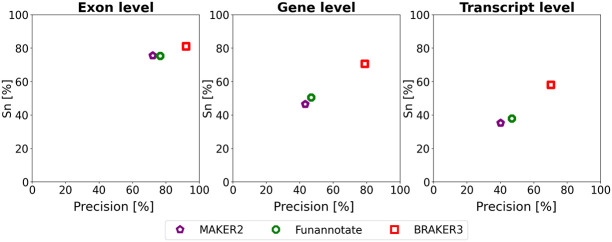
- Compared with MAKER2 and Funannotate on eight species using close-relatives-included protein databases, BRAKER3’s F1-scores were higher than Funannotate by 10.2 points at exon level, 25.9 at gene level, and 21.6 at transcript level; Funannotate exceeded MAKER2 by 2.2, 3.8, and 4.4 points at exon, gene, and transcript levels, respectively. FINDER completed only 7 of 11 species and its best result (*D. melanogaster*, approximately 15 gene F1 and 11 transcript F1) was much below other methods.
- Transcript-level sensitivity increased with expression: 23% of low-expression transcripts, 55% of medium-expression transcripts, and 76% of highly expressed transcripts were correctly identified. BRAKER3 predicted acceptor/donor splice sites with F1 >87% averaged over species, and start/stop codons with F1 of 70%/76%.
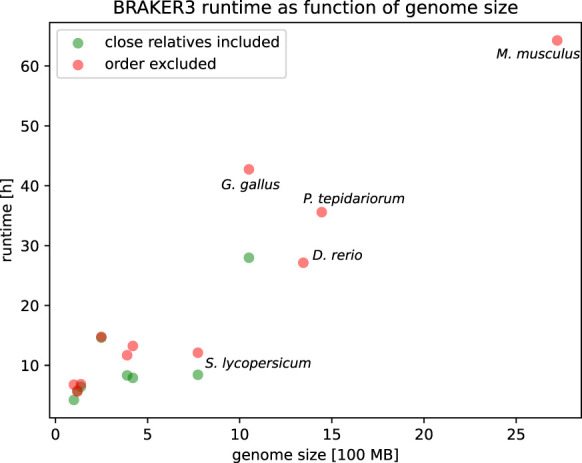
- BUSCO completeness averaged 96% for well-annotated compact genomes, 83.6% for well-annotated large genomes, 91% for other genomes with reference annotation, and 93.7% for three recently sequenced genomes. Runtime ranged from 5 h 37 min for *A. thaliana* to 64 h 16 min for *M. musculus*.
Methods
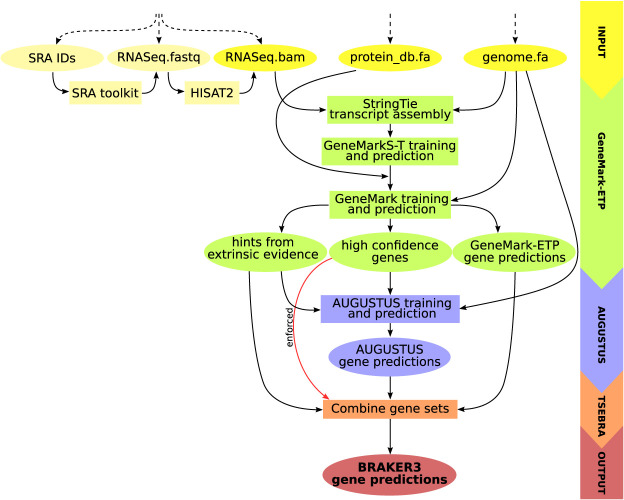
- BRAKER3 requires a genome sequence, short-read RNA-seq data (BAM, FASTQ, or SRA library IDs), and a protein database. It runs GeneMark-ETP for iterative training and prediction with RNA-seq/protein hints, trains AUGUSTUS on high-confidence genes, and uses TSEBRA to combine GeneMark-ETP and AUGUSTUS predictions while ensuring inclusion of high-confidence genes.
- Benchmarks used 11 species plus three recently sequenced genomes without established reference annotations. Protein databases were prepared as species excluded, order excluded, and close relatives included; comparisons included BRAKER1, BRAKER2, TSEBRA, GeneMark-ETP, MAKER2, FINDER, and Funannotate.
- Accuracy was assessed against reference annotations at exon, gene, and transcript levels using sensitivity, precision, and F1-score; BUSCO was used for genomes lacking reference annotations. Runtime was measured on an HPC node with 48 threads.
Limitations
- The paper states that BRAKER3 cannot be used without RNA-seq evidence, performs worse for weakly expressed transcripts, and currently predicts only protein-coding genes. It also notes benchmark sampling bias toward well-annotated, early-sequenced species, limited RNA-seq input to at most six libraries, eliminated same-order homology evidence, and cautions that reference annotations may fall short and BUSCO does not fully evaluate gene-structure errors or false-positive genes.
- The paper states that the close-relatives-included protein database was manually selected and would not scale well to very large numbers of annotated species.
- Evident from the text: FINDER completed only 7 of 11 species; Funannotate or MAKER2 failed on some large genomes; MAKER2 was trained on the reference annotation, so its reported accuracy is an upper limit; and BRAKER3 had the longest runtime among the compared methods.
Model-written summary. Check it against the paper before relying on it.
Integrity signals
Registry
Cites
Statistics
Figures
Verification
Claims the paper makes
49 Own result · 20 Own interpretation · 11 No basis given · 8 Own method · 5 Sources not found · 4 Not checked yet · 3 Partly supported · 1 Supported · accuracy not yet measured
The cited sources support only part of this claim — read each source’s verdict below.
In the paper
“Therefore, more precise gene predictions are made when predictions based on statistical models are corrected by extrinsic evidence (Stanke et al. 2008; Lomsadze et al. 2014; Brůna et al. 2020).”
§ BRAKER3: Fully automated genome annotation using RNA-seq and protein evidence with GeneMark-ETP, AUGUSTUS, and TSEBRA > Abstract
What the sources say
- Supportedcites Stanke et al. 2008 source
The Introduction describes extending the statistical-model-based gene finder AUGUSTUS to incorporate extrinsic evidence and reports higher prediction accuracy. The Results section says the authors evaluated predictions using different combinations of evidence on human ENCODE regions. This supports the claim that extrinsic evidence can make model-based gene predictions more accurate. (LLM, conf=0.92)
- Partly supportedcites Lomsadze et al. 2014 sourceExperimental — accuracy not yet measured
The Results and Discussion report that RNA-Seq evidence improved GeneMark-ET’s prediction accuracy compared with unsupervised GeneMark-ES. But the Discussion distinguishes using that evidence to improve model training from using it to correct predictions directly; the paper does not establish the latter mechanism. (LLM, conf=0.87)
- Not matchedcites Brůna et al. 2020
Couldn’t be matched to a paper in Crossref, so it can’t be checked.
plaindirect- Asserted: passes — The authors put it forward as true.
- Checkable: passes — It can be checked against evidence.
- Load-bearing: passes — The paper’s conclusions depend on it.
- Based: passes — The paper gives a reason why it holds.
- Supported
Every source the paper cites for this claim was checked and supports it.
In the paper
“Although MAKER2 can provide training sets for SNAP and AUGUSTUS, it does not train the ab initio models automatically.”
§ BRAKER3: Fully automated genome annotation using RNA-seq and protein evidence with GeneMark-ETP, AUGUSTUS, and TSEBRA > Abstract
What the sources say
- Supportedcites Holt and Yandell 2011 source
The Implementation section (De novo annotation of second-generation genomes; page unavailable) describes converting gene models with a script bundled with MAKER2, then training SNAP separately according to its documentation. That workflow supports the attributed point that MAKER2 does not automatically train the ab initio model. (LLM, conf=0.88)
plain- Asserted: passes — The authors put it forward as true.
- Checkable: passes — It can be checked against evidence.
- Load-bearing: passes — The paper’s conclusions depend on it.
- Based: passes — The paper gives a reason why it holds.
- Supported
The paper states this without a source or data behind it here, so there is nothing to check it against. The quote shows it is in the paper.
In the paper
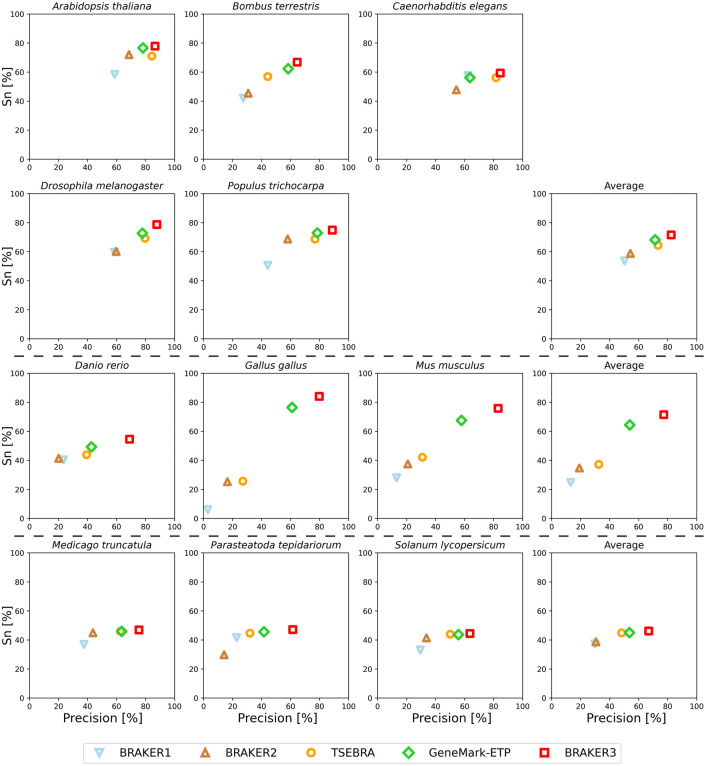
“The average transcript-level F1-score is increased by about 20 percentage points on average, whereas the difference is most pronounced for species with large and complex genomes.”
§ BRAKER3: Fully automated genome annotation using RNA-seq and protein evidence with GeneMark-ETP, AUGUSTUS, and TSEBRA > Abstract
plaincorrelational- Asserted: passes — The authors put it forward as true.
- Checkable: passes — It can be checked against evidence.
- Load-bearing: unclear — It is unclear whether the paper’s conclusions depend on it.
- Based: passes — The paper gives a reason why it holds.
- The authors state this as an assumption: The reference annotations used as ground truth are sufficiently accurate for benchmarking.
- The authors state this as an assumption: The target species' proteome has an assumed level of relatedness to available proteomes.
- Rests on an assumption: The five or six randomly selected short-read RNA-seq libraries per species are sufficient and representative for annotation.
- Rests on an assumption: The OrthoDB-based protein databases from the broad clade contain useful homologous informants for the target species.
A result the paper reports from its own data — it cites no other source for it, so there is none to check. The quote shows it is in the paper.
In the paper
“The average transcript-level F1-score is increased by about 20 percentage points on average, whereas the difference is most pronounced for species with large and complex genomes.”
§ BRAKER3: Fully automated genome annotation using RNA-seq and protein evidence with GeneMark-ETP, AUGUSTUS, and TSEBRA > Abstract
plaindirect- Asserted: passes — The authors put it forward as true.
- Checkable: passes — It can be checked against evidence.
- Load-bearing: passes — The paper’s conclusions depend on it.
- Based: passes — The paper gives a reason why it holds.
- The authors state this as an assumption: The reference annotations used as ground truth are sufficiently accurate for benchmarking.
- The authors state this as an assumption: The target species' proteome has an assumed level of relatedness to available proteomes.
- Rests on an assumption: The five or six randomly selected short-read RNA-seq libraries per species are sufficient and representative for annotation.
- Rests on an assumption: The OrthoDB-based protein databases from the broad clade contain useful homologous informants for the target species.
A result the paper reports from its own data — it cites no other source for it, so there is none to check. The quote shows it is in the paper.
In the paper
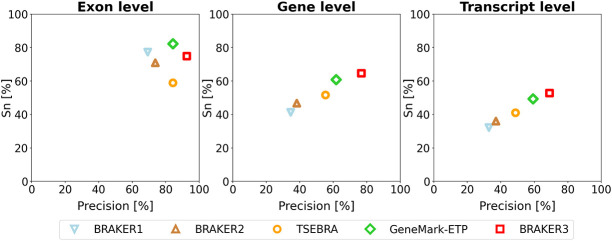
“BRAKER3 outperforms BRAKER1 and BRAKER2.”
- Also stated in: § BRAKER3 performance assessment · boosted
“Notably, there was a significant improvement of BRAKER3 in comparison with BRAKER1 and BRAKER2 in species with GC-heterogeneous or large genomes (Fig. 3).”
§ BRAKER3: Fully automated genome annotation using RNA-seq and protein evidence with GeneMark-ETP, AUGUSTUS, and TSEBRA > Abstract
boosteddirect- Asserted: passes — The authors put it forward as true.
- Checkable: passes — It can be checked against evidence.
- Load-bearing: passes — The paper’s conclusions depend on it.
- Based: passes — The paper gives a reason why it holds.
- The authors state this as an assumption: The reference annotations used as ground truth are sufficiently accurate for benchmarking.
- The authors state this as an assumption: The target species' proteome has an assumed level of relatedness to available proteomes.
- Rests on an assumption: The five or six randomly selected short-read RNA-seq libraries per species are sufficient and representative for annotation.
- Rests on an assumption: The OrthoDB-based protein databases from the broad clade contain useful homologous informants for the target species.
- Also stated in: § BRAKER3 performance assessment · boosted
The paper states this without a source or data behind it here, so there is nothing to check it against. The quote shows it is in the paper.
In the paper
“BRAKER3 also outperforms other existing tools, MAKER2, Funannotate, and FINDER.”
§ BRAKER3: Fully automated genome annotation using RNA-seq and protein evidence with GeneMark-ETP, AUGUSTUS, and TSEBRA > Abstract
plaindirect- Asserted: passes — The authors put it forward as true.
- Checkable: passes — It can be checked against evidence.
- Load-bearing: passes — The paper’s conclusions depend on it.
- Based: passes — The paper gives a reason why it holds.
- The authors state this as an assumption: The reference annotations used as ground truth are sufficiently accurate for benchmarking.
- The authors state this as an assumption: The target species' proteome has an assumed level of relatedness to available proteomes.
- Rests on an assumption: The five or six randomly selected short-read RNA-seq libraries per species are sufficient and representative for annotation.
- Rests on an assumption: The OrthoDB-based protein databases from the broad clade contain useful homologous informants for the target species.
A result the paper reports from its own data — it cites no other source for it, so there is none to check. The quote shows it is in the paper.
In the paper
“When given a large protein database as input (2,588,444 proteins), MAKER2 took 16 h and BRAKER3 took 2.5 h.”
§ BRAKER3: Fully automated genome annotation using RNA-seq and protein evidence with GeneMark-ETP, AUGUSTUS, and TSEBRA > Results > Runtime
plainSingle case- Asserted: passes — The authors put it forward as true.
- Checkable: passes — It can be checked against evidence.
- Load-bearing: passes — The paper’s conclusions depend on it.
- Based: passes — The paper gives a reason why it holds.
A result the paper reports from its own data — it cites no other source for it, so there is none to check. The quote shows it is in the paper.
In the paper
“The highest exon-level F1-score of ∼88% is achieved for internal CDS (Supplemental Fig. S3).”
§ BRAKER3: Fully automated genome annotation using RNA-seq and protein evidence with GeneMark-ETP, AUGUSTUS, and TSEBRA > Results > BRAKER3 performance assessment
plain- Asserted: passes — The authors put it forward as true.
- Checkable: passes — It can be checked against evidence.
- Load-bearing: unclear — It is unclear whether the paper’s conclusions depend on it.
- Based: passes — The paper gives a reason why it holds.
The paper states this without a source or data behind it here, so there is nothing to check it against. The quote shows it is in the paper.
In the paper
“As a result, this AUGUSTUS prediction using extrinsic evidence of BRAKER3 had a higher sensitivity than GeneMark-ETP at the gene, transcript, and exon level at the cost of lower precisions.”
§ BRAKER3: Fully automated genome annotation using RNA-seq and protein evidence with GeneMark-ETP, AUGUSTUS, and TSEBRA > Results > BRAKER3 performance assessment
plain- Asserted: passes — The authors put it forward as true.
- Checkable: passes — It can be checked against evidence.
- Load-bearing: passes — The paper’s conclusions depend on it.
- Based: passes — The paper gives a reason why it holds.
- The authors state this as an assumption: The reference annotations used as ground truth are sufficiently accurate for benchmarking.
- The authors state this as an assumption: The target species' proteome has an assumed level of relatedness to available proteomes.
- Rests on an assumption: The five or six randomly selected short-read RNA-seq libraries per species are sufficient and representative for annotation.
- Rests on an assumption: The OrthoDB-based protein databases from the broad clade contain useful homologous informants for the target species.
The paper states this without a source or data behind it here, so there is nothing to check it against. The quote shows it is in the paper.
In the paper
“In fact, the combined BRAKER3 transcripts have a higher F1-score than either of the combined GeneMark-ETP and AUGUSTUS transcript sets.”
§ BRAKER3: Fully automated genome annotation using RNA-seq and protein evidence with GeneMark-ETP, AUGUSTUS, and TSEBRA > Discussion
plain- Asserted: passes — The authors put it forward as true.
- Checkable: passes — It can be checked against evidence.
- Load-bearing: passes — The paper’s conclusions depend on it.
- Based: passes — The paper gives a reason why it holds.
- Probably not a substantial claim. 15
- It may state two separate claims as one. 31
- The quote only partly states this claim. 1
The cited sources support only part of this claim — read each source’s verdict below.
In the paper
“In their study, a manual selection of libraries from different experiments and tissues was compared with an automatic sampling from diverse libraries for complementary data. The latter yields, on average, slightly better performances in BRAKER1 when the number of reads was similar.”
§ BRAKER3: Fully automated genome annotation using RNA-seq and protein evidence with GeneMark-ETP, AUGUSTUS, and TSEBRA > Discussion
What the sources say
- Partly supportedcites Stanke et al. (2019) sourceExperimental — accuracy not yet measured
Split into 2 atoms — 1 confirmed, 1 partially supported, 0 disputed, 0 misattributed, 0 unverifiable. Expand the claim to see per-atom verdicts.
plaindirect- Asserted: passes — The authors put it forward as true.
- Checkable: passes — It can be checked against evidence.
- Load-bearing: fails — The paper’s conclusions may not depend on it.
- Based: passes — The paper gives a reason why it holds.
Probably not a substantial claim. The paper’s conclusions may not depend on it. It may state two separate claims as one.
- Partly supported
The cited sources support only part of this claim — read each source’s verdict below.
In the paper
“FINDER follows an approach similar to BRAKER3. It uses RNA-seq assemblies with predicted open reading frames, in conjunction with BRAKER1 and homologous protein predictions.”
§ BRAKER3: Fully automated genome annotation using RNA-seq and protein evidence with GeneMark-ETP, AUGUSTUS, and TSEBRA > Abstract
What the sources say
- Partly supportedcites Banerjee et al. 2021 sourceExperimental — accuracy not yet measured
The Implementation section says FINDER assembles RNA-Seq reads into transcripts, predicts their coding regions with GeneMarkS-T, and incorporates protein-derived gene models. It identifies the accompanying gene predictor as BRAKER2, not BRAKER1. (LLM, conf=0.92)
plain- Asserted: passes — The authors put it forward as true.
- Checkable: passes — It can be checked against evidence.
- Load-bearing: fails — The paper’s conclusions may not depend on it.
- Based: passes — The paper gives a reason why it holds.
Probably not a substantial claim. The paper’s conclusions may not depend on it.
- Partly supported
A result the paper reports from its own data — it cites no other source for it, so there is none to check. The quote shows it is in the paper.
In the paper
“In each species, BRAKER3 was more precise in predicting exons compared with GeneMark-ETP, which in turn predicted exons more sensitively compared with BRAKER3 (Supplemental Table S4).”
§ BRAKER3: Fully automated genome annotation using RNA-seq and protein evidence with GeneMark-ETP, AUGUSTUS, and TSEBRA > Results > BRAKER3 performance assessment
plaincorrelational- Asserted: passes — The authors put it forward as true.
- Checkable: passes — It can be checked against evidence.
- Load-bearing: unclear — It is unclear whether the paper’s conclusions depend on it.
- Based: passes — The paper gives a reason why it holds.
It may state two separate claims as one.
A result the paper reports from its own data — it cites no other source for it, so there is none to check. The quote shows it is in the paper.
In the paper
“BRAKER3 shows better performance than Funannotate and MAKER2 for all species and individual metrics, except at the exon level for C. elegans, for which BRAKER3 had a sensitivity 3.3 percentage points lower than the one of Funannotate (Supplemental Table S8).”
§ BRAKER3: Fully automated genome annotation using RNA-seq and protein evidence with GeneMark-ETP, AUGUSTUS, and TSEBRA > Results > Comparison of BRAKER3 to MAKER2, Funannotate, and FINDER
plain- Asserted: passes — The authors put it forward as true.
- Checkable: passes — It can be checked against evidence.
- Load-bearing: passes — The paper’s conclusions depend on it.
- Based: passes — The paper gives a reason why it holds.
It may state two separate claims as one.
A result the paper reports from its own data — it cites no other source for it, so there is none to check. The quote shows it is in the paper.
In the paper
“On average, the BRAKER3 transcript-level sensitivity was improved by approximately three percentage points, and the precision was improved slightly (less than one percentage point).”
§ BRAKER3: Fully automated genome annotation using RNA-seq and protein evidence with GeneMark-ETP, AUGUSTUS, and TSEBRA > Results > BRAKER3 performance assessment
plaindirect- Asserted: passes — The authors put it forward as true.
- Checkable: passes — It can be checked against evidence.
- Load-bearing: unclear — It is unclear whether the paper’s conclusions depend on it.
- Based: passes — The paper gives a reason why it holds.
It may state two separate claims as one.
A result the paper reports from its own data — it cites no other source for it, so there is none to check. The quote shows it is in the paper.
In the paper
“However, the relative ranking of the methods and the comparison of BRAKER3 with other methods remain unchanged.”
§ BRAKER3: Fully automated genome annotation using RNA-seq and protein evidence with GeneMark-ETP, AUGUSTUS, and TSEBRA > Results > BRAKER3 performance assessment
plain- Asserted: passes — The authors put it forward as true.
- Checkable: passes — It can be checked against evidence.
- Load-bearing: unclear — It is unclear whether the paper’s conclusions depend on it.
- Based: passes — The paper gives a reason why it holds.
It may state two separate claims as one.
A result the paper reports from its own data — it cites no other source for it, so there is none to check. The quote shows it is in the paper.
In the paper
“For example, in the group of well-annotated large genomes, AUGUSTUS is 6.6 percentage points more BUSCO-complete than BRAKER3, but BRAKER3 is 30.5 percentage points more precise than AUGUSTUS.”
§ BRAKER3: Fully automated genome annotation using RNA-seq and protein evidence with GeneMark-ETP, AUGUSTUS, and TSEBRA > Results > BUSCO gene set completeness
plaincorrelational- Asserted: passes — The authors put it forward as true.
- Checkable: passes — It can be checked against evidence.
- Load-bearing: passes — The paper’s conclusions depend on it.
- Based: passes — The paper gives a reason why it holds.
It may state two separate claims as one.
A result the paper reports from its own data — it cites no other source for it, so there is none to check. The quote shows it is in the paper.
In the paper
“As a trend, a relatively large advantage of BRAKER3 in gene precision stands against a relatively small advantage of AUGUSTUS in BUSCO completeness.”
§ BRAKER3: Fully automated genome annotation using RNA-seq and protein evidence with GeneMark-ETP, AUGUSTUS, and TSEBRA > Results > BUSCO gene set completeness
plaincorrelational- Asserted: passes — The authors put it forward as true.
- Checkable: passes — It can be checked against evidence.
- Load-bearing: passes — The paper’s conclusions depend on it.
- Based: passes — The paper gives a reason why it holds.
It may state two separate claims as one.
A result the paper reports from its own data — it cites no other source for it, so there is none to check. The quote shows it is in the paper.
In the paper
“This pattern is consistent across all 11 species and applies to both spliced and unspliced transcripts.”
§ BRAKER3: Fully automated genome annotation using RNA-seq and protein evidence with GeneMark-ETP, AUGUSTUS, and TSEBRA > Results > BRAKER3 performance assessment
plaincorrelational- Asserted: passes — The authors put it forward as true.
- Checkable: passes — It can be checked against evidence.
- Load-bearing: passes — The paper’s conclusions depend on it.
- Based: passes — The paper gives a reason why it holds.
It may state two separate claims as one.
A result the paper reports from its own data — it cites no other source for it, so there is none to check. The quote shows it is in the paper.
In the paper
“However, it adds single-exon genes predicted by AUGUSTUS, which increases the percentage of single-exon genes correctly identified by 5.5 percentage points on average.”
§ BRAKER3: Fully automated genome annotation using RNA-seq and protein evidence with GeneMark-ETP, AUGUSTUS, and TSEBRA > Results > BRAKER3 performance assessment
plaindirect- Asserted: passes — The authors put it forward as true.
- Checkable: passes — It can be checked against evidence.
- Load-bearing: passes — The paper’s conclusions depend on it.
- Based: passes — The paper gives a reason why it holds.
It may state two separate claims as one.
A result the paper reports from its own data — it cites no other source for it, so there is none to check. The quote shows it is in the paper.
In the paper
“For each of the groups of species, AUGUSTUS had a higher BUSCO completeness score compared with GeneMark-ETP, which in turn had a higher score compared with BRAKER3.”
§ BRAKER3: Fully automated genome annotation using RNA-seq and protein evidence with GeneMark-ETP, AUGUSTUS, and TSEBRA > Results > BUSCO gene set completeness
plaincorrelational- Asserted: passes — The authors put it forward as true.
- Checkable: passes — It can be checked against evidence.
- Load-bearing: unclear — It is unclear whether the paper’s conclusions depend on it.
- Based: passes — The paper gives a reason why it holds.
It may state two separate claims as one.
A result the paper reports from its own data — it cites no other source for it, so there is none to check. The quote shows it is in the paper.
In the paper
“The average BUSCO completeness (single copy or duplicate) of BRAKER3 is 96% for the group of well-annotated and compact genomes, 83.6% for the group of well-annotated and large genomes, 91% for the group of other genomes with a reference annotation (M. truncatula, P. tepidariorum, S. lycopersicum), and 93.7% for the group of three recent genomes (Supplemental Fig. S9).”
§ BRAKER3: Fully automated genome annotation using RNA-seq and protein evidence with GeneMark-ETP, AUGUSTUS, and TSEBRA > Results > BUSCO gene set completeness
plain- Asserted: passes — The authors put it forward as true.
- Checkable: passes — It can be checked against evidence.
- Load-bearing: unclear — It is unclear whether the paper’s conclusions depend on it.
- Based: passes — The paper gives a reason why it holds.
It may state two separate claims as one.
A result the paper reports from its own data — it cites no other source for it, so there is none to check. The quote shows it is in the paper.
In the paper
“On average, BRAKER3's F1-scores were higher than the ones of Funannotate by 10.2 points at the exon level, 25.9 points at the gene level, and 21.6 points at the transcript level.”
§ BRAKER3: Fully automated genome annotation using RNA-seq and protein evidence with GeneMark-ETP, AUGUSTUS, and TSEBRA > Results > Comparison of BRAKER3 to MAKER2, Funannotate, and FINDER
plain- Asserted: passes — The authors put it forward as true.
- Checkable: passes — It can be checked against evidence.
- Load-bearing: passes — The paper’s conclusions depend on it.
- Based: passes — The paper gives a reason why it holds.
It may state two separate claims as one.
A result the paper reports from its own data — it cites no other source for it, so there is none to check. The quote shows it is in the paper.
In the paper
“BRAKER3 had the highest sensitivities and precisions for each species at the transcript and gene level but often had a somewhat lower exon-level F1-score compared with GeneMark-ETP (Supplemental Table S5).”
§ BRAKER3: Fully automated genome annotation using RNA-seq and protein evidence with GeneMark-ETP, AUGUSTUS, and TSEBRA > Results > BRAKER3 performance assessment
plaincorrelational- Asserted: passes — The authors put it forward as true.
- Checkable: passes — It can be checked against evidence.
- Load-bearing: passes — The paper’s conclusions depend on it.
- Based: passes — The paper gives a reason why it holds.
It may state two separate claims as one.
A result the paper reports from its own data — it cites no other source for it, so there is none to check. The quote shows it is in the paper.
In the paper
“However, this is also the order of tools sorted by decreasing numbers of predicted genes; that is, there is a (perhaps unsurprising) tendency that a tool that predicts more genes genome-wide also reports more of the universal single-copy genes that are counted by BUSCO.”
§ BRAKER3: Fully automated genome annotation using RNA-seq and protein evidence with GeneMark-ETP, AUGUSTUS, and TSEBRA > Results > BUSCO gene set completeness
hedgedcorrelational- Asserted: passes — The authors put it forward as true.
- Checkable: passes — It can be checked against evidence.
- Load-bearing: fails — The paper’s conclusions may not depend on it.
- Based: passes — The paper gives a reason why it holds.
Probably not a substantial claim. The paper’s conclusions may not depend on it.
A result the paper reports from its own data — it cites no other source for it, so there is none to check. The quote shows it is in the paper.
In the paper
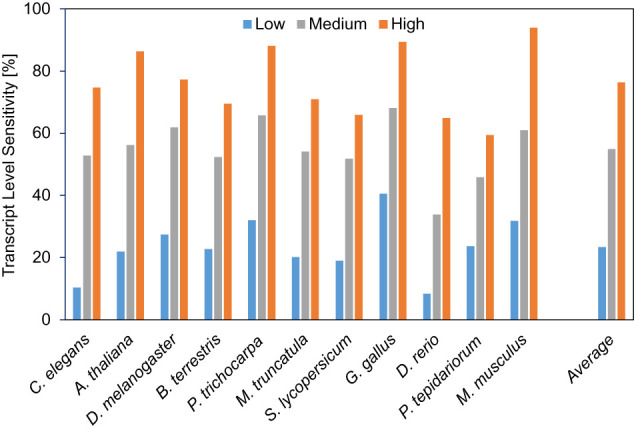
“When averaging over all species, only 23% of low-expression transcripts are correctly identified, 55% of medium-expression transcripts, and 76% of highly expressed transcripts.”
§ BRAKER3: Fully automated genome annotation using RNA-seq and protein evidence with GeneMark-ETP, AUGUSTUS, and TSEBRA > Results > BRAKER3 performance assessment
plaincorrelational- Asserted: passes — The authors put it forward as true.
- Checkable: passes — It can be checked against evidence.
- Load-bearing: unclear — It is unclear whether the paper’s conclusions depend on it.
- Based: passes — The paper gives a reason why it holds.
It may state two separate claims as one.
A result the paper reports from its own data — it cites no other source for it, so there is none to check. The quote shows it is in the paper.
In the paper
“The averaged F1-score for stop and start codons are 76% and 70%, respectively (Supplemental Fig. S5).”
§ BRAKER3: Fully automated genome annotation using RNA-seq and protein evidence with GeneMark-ETP, AUGUSTUS, and TSEBRA > Results > BRAKER3 performance assessment
plain- Asserted: passes — The authors put it forward as true.
- Checkable: passes — It can be checked against evidence.
- Load-bearing: unclear — It is unclear whether the paper’s conclusions depend on it.
- Based: passes — The paper gives a reason why it holds.
It may state two separate claims as one.
A result the paper reports from its own data — it cites no other source for it, so there is none to check. The quote shows it is in the paper.
In the paper
“We have shown that BRAKER3 consistently outperformed the other gene finding tools.”
§ BRAKER3: Fully automated genome annotation using RNA-seq and protein evidence with GeneMark-ETP, AUGUSTUS, and TSEBRA > Abstract
boosted- Asserted: passes — The authors put it forward as true.
- Checkable: passes — It can be checked against evidence.
- Load-bearing: passes — The paper’s conclusions depend on it.
- Based: passes — The paper gives a reason why it holds.
The quote only partly states this claim.
- The authors state this as an assumption: The reference annotations used as ground truth are sufficiently accurate for benchmarking.
- The authors state this as an assumption: The target species' proteome has an assumed level of relatedness to available proteomes.
- Rests on an assumption: The five or six randomly selected short-read RNA-seq libraries per species are sufficient and representative for annotation.
- Rests on an assumption: The OrthoDB-based protein databases from the broad clade contain useful homologous informants for the target species.
The paper states this without a source or data behind it here, so there is nothing to check it against. The quote shows it is in the paper.
In the paper
“BRAKER3's performance drops for transcripts that are weakly represented in the RNA-seq data.”
§ BRAKER3: Fully automated genome annotation using RNA-seq and protein evidence with GeneMark-ETP, AUGUSTUS, and TSEBRA > Discussion
plaindirect- Asserted: passes — The authors put it forward as true.
- Checkable: passes — It can be checked against evidence.
- Load-bearing: fails — The paper’s conclusions may not depend on it.
- Based: fails — The paper may give no reason why it holds.
Probably not a substantial claim. The paper’s conclusions may not depend on it. The paper may give no reason why it holds.
A result the paper reports from its own data — it cites no other source for it, so there is none to check. The quote shows it is in the paper.
In the paper
“AUGUSTUS’ average gene- and transcript-level F1-scores of 59.6 and 51.3, respectively, exceeded the F1-scores of the AUGUSTUS predictions in BRAKER1 and BRAKER2 and are slightly lower than the F1-scores of GeneMark-ETP (see Supplemental Table S10).”
§ BRAKER3: Fully automated genome annotation using RNA-seq and protein evidence with GeneMark-ETP, AUGUSTUS, and TSEBRA > Results > BRAKER3 performance assessment
plain- Asserted: passes — The authors put it forward as true.
- Checkable: passes — It can be checked against evidence.
- Load-bearing: passes — The paper’s conclusions depend on it.
- Based: passes — The paper gives a reason why it holds.
It may state two separate claims as one.
- The authors state this as an assumption: The reference annotations used as ground truth are sufficiently accurate for benchmarking.
- The authors state this as an assumption: The target species' proteome has an assumed level of relatedness to available proteomes.
- Rests on an assumption: The five or six randomly selected short-read RNA-seq libraries per species are sufficient and representative for annotation.
- Rests on an assumption: The OrthoDB-based protein databases from the broad clade contain useful homologous informants for the target species.
In the paper
“A more integrated approach is the GeneMark-ETP pipeline (Brůna et al. 2024), which integrates both sources of extrinsic evidence in a new workflow that outperforms all previously mentioned methods, particularly in species with large and complex genomes.”
§ BRAKER3: Fully automated genome annotation using RNA-seq and protein evidence with GeneMark-ETP, AUGUSTUS, and TSEBRA > Abstract
What the sources say
- Not matchedcites Brůna et al. 2024
Couldn’t be matched to a paper in Crossref, so it can’t be checked.
plaindirect- Asserted: passes — The authors put it forward as true.
- Checkable: passes — It can be checked against evidence.
- Load-bearing: passes — The paper’s conclusions depend on it.
- Based: passes — The paper gives a reason why it holds.
It may state two separate claims as one.
- Not matched
None of the sources cited for this claim have been checked yet.
In the paper
“Therefore, we developed a combiner tool, TSEBRA (Gabriel et al. 2021). It selects transcripts from BRAKER1 and BRAKER2 annotations, considering thereby the joint extrinsic evidence, and therefore generates a prediction based on both RNA-seq and protein evidence, thus improving the F1-scores.”
§ BRAKER3: Fully automated genome annotation using RNA-seq and protein evidence with GeneMark-ETP, AUGUSTUS, and TSEBRA > Abstract
What the sources say
- Not checked yetcites Gabriel et al. 2021 source
Checked before — its earlier verdict is held back until a new check runs.
plaindirect- Asserted: passes — The authors put it forward as true.
- Checkable: passes — It can be checked against evidence.
- Load-bearing: passes — The paper’s conclusions depend on it.
- Based: passes — The paper gives a reason why it holds.
It may state two separate claims as one.
- Not checked yet
A conclusion the paper draws from its own results — it cites no other source for it, so there is none to check. The quote shows it is in the paper.
In the paper
“BRAKER3 annotates protein-coding genes in eukaryotic genomes using both short-read RNA-seq and a large protein database, along with statistical models learned iteratively and specifically for the target genome.”
§ BRAKER3: Fully automated genome annotation using RNA-seq and protein evidence with GeneMark-ETP, AUGUSTUS, and TSEBRA > Abstract
plain- Asserted: passes — The authors put it forward as true.
- Checkable: passes — It can be checked against evidence.
- Load-bearing: passes — The paper’s conclusions depend on it.
- Based: passes — The paper gives a reason why it holds.
It may state two separate claims as one.
A conclusion the paper draws from its own results — it cites no other source for it, so there is none to check. The quote shows it is in the paper.
In the paper
“BRAKER3 outperforms by a large margin its predecessors BRAKER1 and BRAKER2, as well as publicly available pipelines such as MAKER2, FINDER, and Funannotate.”
§ BRAKER3: Fully automated genome annotation using RNA-seq and protein evidence with GeneMark-ETP, AUGUSTUS, and TSEBRA > Discussion
boosteddirect- Asserted: passes — The authors put it forward as true.
- Checkable: passes — It can be checked against evidence.
- Load-bearing: passes — The paper’s conclusions depend on it.
- Based: passes — The paper gives a reason why it holds.
It may state two separate claims as one.
None of the sources cited for this claim have been checked yet.
In the paper
“These findings agree with previous research indicating that gene finders generally show a decreased performance on unspliced transcripts (Scalzitti et al. 2020).”
§ BRAKER3: Fully automated genome annotation using RNA-seq and protein evidence with GeneMark-ETP, AUGUSTUS, and TSEBRA > Results > BRAKER3 performance assessment
What the sources say
- Not checked yetcites Scalzitti et al. 2020 source
Checked before — its earlier verdict is held back until a new check runs.
hedgedcorrelational- Asserted: passes — The authors put it forward as true.
- Checkable: passes — It can be checked against evidence.
- Load-bearing: fails — The paper’s conclusions may not depend on it.
- Based: passes — The paper gives a reason why it holds.
Probably not a substantial claim. The paper’s conclusions may not depend on it.
- Not checked yet
In the paper
“The Funannotate pipeline, which was not described in an article, was initially designed as a pipeline for analyzing fungal genomes; however, it has since been further developed to support the annotation of larger genomes as well.”
§ BRAKER3: Fully automated genome annotation using RNA-seq and protein evidence with GeneMark-ETP, AUGUSTUS, and TSEBRA > Abstract
What the sources say
- Not matchedcites https://github.com/nextgenusfs/funannotate
Couldn’t be matched to a paper in Crossref, so it can’t be checked.
plain- Asserted: passes — The authors put it forward as true.
- Checkable: passes — It can be checked against evidence.
- Load-bearing: fails — The paper’s conclusions may not depend on it.
- Based: passes — The paper gives a reason why it holds.
Probably not a substantial claim. The paper’s conclusions may not depend on it. It may state two separate claims as one.
- Not matched
None of the sources cited for this claim have been checked yet.
In the paper
“Funannotate failed to run on most of the large OrthoDB-based protein databases, and MAKER2 was designed to be used with a smaller protein database, too.”
§ BRAKER3: Fully automated genome annotation using RNA-seq and protein evidence with GeneMark-ETP, AUGUSTUS, and TSEBRA > Methods > Test data
What the sources say
- Not checked yetcites Holt and Yandell 2011 source
Checked before — its earlier verdict is held back until a new check runs.
plain- Asserted: passes — The authors put it forward as true.
- Checkable: passes — It can be checked against evidence.
- Load-bearing: fails — The paper’s conclusions may not depend on it.
- Based: passes — The paper gives a reason why it holds.
Probably not a substantial claim. The paper’s conclusions may not depend on it.
- Not checked yet
A conclusion the paper draws from its own results — it cites no other source for it, so there is none to check. The quote shows it is in the paper.
In the paper
“Currently, BRAKER3 predicts only protein-coding genes.”
§ BRAKER3: Fully automated genome annotation using RNA-seq and protein evidence with GeneMark-ETP, AUGUSTUS, and TSEBRA > Discussion
plain- Asserted: passes — The authors put it forward as true.
- Checkable: passes — It can be checked against evidence.
- Load-bearing: fails — The paper’s conclusions may not depend on it.
- Based: passes — The paper gives a reason why it holds.
Probably not a substantial claim. The paper’s conclusions may not depend on it.
The paper states this without a source or data behind it here, so there is nothing to check it against. The quote shows it is in the paper.
In the paper
“TSEBRA heavily relies on intron position information, which can make it challenging to evaluate single-exon transcripts.”
§ BRAKER3: Fully automated genome annotation using RNA-seq and protein evidence with GeneMark-ETP, AUGUSTUS, and TSEBRA > Methods > TSEBRA
plaindirect- Asserted: passes — The authors put it forward as true.
- Checkable: passes — It can be checked against evidence.
- Load-bearing: passes — The paper’s conclusions depend on it.
- Based: passes — The paper gives a reason why it holds.
It may state two separate claims as one.
A conclusion the paper draws from its own results — it cites no other source for it, so there is none to check. The quote shows it is in the paper.
In the paper
“Here, BRAKER3 greatly benefited from the high accuracy of GeneMark-ETP and managed to exceed the sensitivity and precision on gene and transcript levels even further.”
§ BRAKER3: Fully automated genome annotation using RNA-seq and protein evidence with GeneMark-ETP, AUGUSTUS, and TSEBRA > Results > BRAKER3 performance assessment
plaindirect- Asserted: passes — The authors put it forward as true.
- Checkable: passes — It can be checked against evidence.
- Load-bearing: passes — The paper’s conclusions depend on it.
- Based: passes — The paper gives a reason why it holds.
It may state two separate claims as one.
- The authors state this as an assumption: The reference annotations used as ground truth are sufficiently accurate for benchmarking.
- The authors state this as an assumption: The target species' proteome has an assumed level of relatedness to available proteomes.
- Rests on an assumption: The five or six randomly selected short-read RNA-seq libraries per species are sufficient and representative for annotation.
- Rests on an assumption: The OrthoDB-based protein databases from the broad clade contain useful homologous informants for the target species.
A conclusion the paper draws from its own results — it cites no other source for it, so there is none to check. The quote shows it is in the paper.
In the paper
“In conclusion, for these gene sets, a better BUSCO score comes at the expense of more false-positive genes, and BRAKER3 weights the trade-off between fewer missing genes and fewer false-positive genes in favor of the latter.”
§ BRAKER3: Fully automated genome annotation using RNA-seq and protein evidence with GeneMark-ETP, AUGUSTUS, and TSEBRA > Results > BUSCO gene set completeness
plaindirect- Asserted: passes — The authors put it forward as true.
- Checkable: passes — It can be checked against evidence.
- Load-bearing: passes — The paper’s conclusions depend on it.
- Based: passes — The paper gives a reason why it holds.
It may state two separate claims as one.
In the paper
“The method also benefited from the GC-content-specific model training and from estimating species-specific repeat penalties.”
§ BRAKER3: Fully automated genome annotation using RNA-seq and protein evidence with GeneMark-ETP, AUGUSTUS, and TSEBRA > Abstract
What the sources say
- Not matchedcites Brůna et al. 2024
Couldn’t be matched to a paper in Crossref, so it can’t be checked.
plaindirect- Asserted: passes — The authors put it forward as true.
- Checkable: passes — It can be checked against evidence.
- Load-bearing: unclear — It is unclear whether the paper’s conclusions depend on it.
- Based: passes — The paper gives a reason why it holds.
It may state two separate claims as one.
- Not matched
A conclusion the paper draws from its own results — it cites no other source for it, so there is none to check. The quote shows it is in the paper.
In the paper
“Specifically, BUSCO's design does not encompass the detection of various gene structure errors, nor does it impose penalties for the presence of false-positive genes.”
§ BRAKER3: Fully automated genome annotation using RNA-seq and protein evidence with GeneMark-ETP, AUGUSTUS, and TSEBRA > Discussion
plain- Asserted: passes — The authors put it forward as true.
- Checkable: passes — It can be checked against evidence.
- Load-bearing: passes — The paper’s conclusions depend on it.
- Based: unclear — It is unclear why the paper says it holds.
It may state two separate claims as one.
What the paper did — it cites no source for this, so there is none to check. The quote shows it is in the paper.
In the paper
“With our diverse species selection, it was not feasible to use RNA-seq sets that are comparable across different species.”
§ BRAKER3: Fully automated genome annotation using RNA-seq and protein evidence with GeneMark-ETP, AUGUSTUS, and TSEBRA > Discussion
plaindirect- Asserted: passes — The authors put it forward as true.
- Checkable: passes — It can be checked against evidence.
- Load-bearing: fails — The paper’s conclusions may not depend on it.
- Based: passes — The paper gives a reason why it holds.
Probably not a substantial claim. The paper’s conclusions may not depend on it.
In the paper
“Also, the self-training of GeneMark.hmm models (Lomsadze et al. 2005) has to be performed outside of MAKER2.”
§ BRAKER3: Fully automated genome annotation using RNA-seq and protein evidence with GeneMark-ETP, AUGUSTUS, and TSEBRA > Abstract
What the sources say
- Not matchedcites Lomsadze et al. 2005
Couldn’t be matched to a paper in Crossref, so it can’t be checked.
plain- Asserted: passes — The authors put it forward as true.
- Checkable: passes — It can be checked against evidence.
- Load-bearing: fails — The paper’s conclusions may not depend on it.
- Based: passes — The paper gives a reason why it holds.
Probably not a substantial claim. The paper’s conclusions may not depend on it.
- Not matched
What the paper did — it cites no source for this, so there is none to check. The quote shows it is in the paper.
In the paper
“This long-established approach to benchmark gene prediction methods allows measurement of grave as well as subtle errors and is informative in absolute terms if the reference annotations are of high quality.”
§ BRAKER3: Fully automated genome annotation using RNA-seq and protein evidence with GeneMark-ETP, AUGUSTUS, and TSEBRA > Methods > Experiments
plaindirect- Asserted: passes — The authors put it forward as true.
- Checkable: passes — It can be checked against evidence.
- Load-bearing: passes — The paper’s conclusions depend on it.
- Based: passes — The paper gives a reason why it holds.
Probably not a substantial claim. It may state two separate claims as one.
- The authors state this as an assumption: The reference annotations used as ground truth are sufficiently accurate for benchmarking.
A conclusion the paper draws from its own results — it cites no other source for it, so there is none to check. The quote shows it is in the paper.
In the paper
“BRAKER3 combines these sets of transcripts and can be seen as an ensemble learning approach that improves each of its inputs.”
§ BRAKER3: Fully automated genome annotation using RNA-seq and protein evidence with GeneMark-ETP, AUGUSTUS, and TSEBRA > Discussion
plaindirect- Asserted: passes — The authors put it forward as true.
- Checkable: passes — It can be checked against evidence.
- Load-bearing: unclear — It is unclear whether the paper’s conclusions depend on it.
- Based: passes — The paper gives a reason why it holds.
It may state two separate claims as one.
A conclusion the paper draws from its own results — it cites no other source for it, so there is none to check. The quote shows it is in the paper.
In the paper
“It should be noted that the species for the close relatives included database were manually selected, and the procedure would not scale well when very large numbers of species are annotated.”
§ BRAKER3: Fully automated genome annotation using RNA-seq and protein evidence with GeneMark-ETP, AUGUSTUS, and TSEBRA > Methods > Test data
hedgeddirect- Asserted: passes — The authors put it forward as true.
- Checkable: passes — It can be checked against evidence.
- Load-bearing: fails — The paper’s conclusions may not depend on it.
- Based: passes — The paper gives a reason why it holds.
Probably not a substantial claim. The paper’s conclusions may not depend on it. It may state two separate claims as one.
A conclusion the paper draws from its own results — it cites no other source for it, so there is none to check. The quote shows it is in the paper.
In the paper
“It should be noted that some of the reference annotations may fall short of the desired accuracy, potentially leading to an underestimation of accuracy or a bias in our analysis.”
§ BRAKER3: Fully automated genome annotation using RNA-seq and protein evidence with GeneMark-ETP, AUGUSTUS, and TSEBRA > Methods > Experiments
hedgedconditional- Asserted: passes — The authors put it forward as true.
- Checkable: passes — It can be checked against evidence.
- Load-bearing: fails — The paper’s conclusions may not depend on it.
- Based: passes — The paper gives a reason why it holds.
Probably not a substantial claim. The paper’s conclusions may not depend on it. It may state two separate claims as one.
- The authors state this as an assumption: The reference annotations used as ground truth are sufficiently accurate for benchmarking.
A conclusion the paper draws from its own results — it cites no other source for it, so there is none to check. The quote shows it is in the paper.
In the paper
“Notably, BRAKER3 cannot be used without RNA-seq evidence.”
§ BRAKER3: Fully automated genome annotation using RNA-seq and protein evidence with GeneMark-ETP, AUGUSTUS, and TSEBRA > Discussion
plaindirect- Asserted: passes — The authors put it forward as true.
- Checkable: passes — It can be checked against evidence.
- Load-bearing: passes — The paper’s conclusions depend on it.
- Based: fails — The paper may give no reason why it holds.
Probably not a substantial claim. The paper may give no reason why it holds.
None of the sources cited for this claim have been checked yet.
In the paper
“However, Stanke et al. (2019) investigated the impact of an RNA-seq sampling method on the performance of BRAKER1.”
§ BRAKER3: Fully automated genome annotation using RNA-seq and protein evidence with GeneMark-ETP, AUGUSTUS, and TSEBRA > Discussion
What the sources say
- Not checked yetcites Stanke et al. (2019) source
Checked before — its earlier verdict is held back until a new check runs.
plain- Asserted: passes — The authors put it forward as true.
- Checkable: passes — It can be checked against evidence.
- Load-bearing: fails — The paper’s conclusions may not depend on it.
- Based: passes — The paper gives a reason why it holds.
Probably not a substantial claim. The paper’s conclusions may not depend on it.
- Not checked yet
What the paper did — it cites no source for this, so there is none to check. The quote shows it is in the paper.
In the paper
“When comparing these runtimes, one has to consider that the figures for MAKER2 do not include the considerable times for training gene finders and or for transcriptome assembly. In contrast, BRAKER3 performs these steps as part of the pipeline.”
§ BRAKER3: Fully automated genome annotation using RNA-seq and protein evidence with GeneMark-ETP, AUGUSTUS, and TSEBRA > Results > Runtime
plaindirect- Asserted: passes — The authors put it forward as true.
- Checkable: passes — It can be checked against evidence.
- Load-bearing: passes — The paper’s conclusions depend on it.
- Based: passes — The paper gives a reason why it holds.
It may state two separate claims as one.
The authors state this as an assumption.
The reference annotations used as ground truth are sufficiently accurate for benchmarking.
“This long-established approach to benchmark gene prediction methods allows measurement of grave as well as subtle errors and is informative in absolute terms if the reference annotations are of high quality.”
The authors state this as an assumption.
The target species' proteome has an assumed level of relatedness to available proteomes.
“We benchmarked the new pipeline on genomes of 11 species under an assumed level of relatedness of the target species proteome to available proteomes.”
The authors state this as an assumption.
The order excluded protein database is a conservative assumption.
“we performed experiments with the particularly favorable case of the species excluded database and with the rather conservative assumption of the order excluded database.”
The paper relies on this without support.
The five or six randomly selected short-read RNA-seq libraries per species are sufficient and representative for annotation.
“For each species, we retrieved genome assemblies, five or six randomly selected short-read RNA-seq libraries from NCBI's Sequence Read Archive (https://www.ncbi.nlm.nih.gov/sra) (for detailed list, see Supplemental Table S15), a protein database, and a reference genome annotation (for detailed list, see Supplemental Table S1).”
The paper relies on this without support.
The OrthoDB-based protein databases from the broad clade contain useful homologous informants for the target species.
“The protein database is a FASTA file with proteins from the broad clade of the target genome in question, for example, a subset from the partitioning of OrthoDB that we provide (see Supplemental Methods).”
The paper relies on this without support.
Modern genome annotation pipelines depend on an increasing number of tools, which can make their installation and maintenance difficult.
“One problem with modern genome annotation pipelines is their dependence on an increasing number of tools, which can make their installation and maintenance difficult.”
The paper relies on this without support.
BUSCO uses a set of genes that are well conserved and, therefore, arguably relatively easy to predict.
“Moreover, BUSCO uses a set of genes that are well conserved and, therefore, arguably relatively easy to predict.”
The paper relies on this without support.
A comprehensive gold-standard annotation for a set of test genomes representing the whole space of eukaryotic genomes does not exist.
“However, a comprehensive gold-standard annotation for such a set of genomes does not exist.”
The paper relies on this without support.
The error rates in eukaryotic gene annotation remain significant.
“As long as the error rates in eukaryotic gene annotation remain significant, a trade-off between the numbers of false-positive and false-negative genes has to be made.”
Citations
Cites
Graph-based genome alignment and genotyping with HISAT2 and HISAT-genotype
Kim, D., Paggi, J. M., Park, C., Bennett, C., & Salzberg, S. L. (2019) · Nature Biotechnology · doi:10.1038/s41587-019-0201-4 · Cited by 15,022
BUSCO: assessing genome assembly and annotation completeness with single-copy orthologs
Simão, F. A., Waterhouse, R. M., Ioannidis, P., Kriventseva, E. V., & Zdobnov, E. M. (2015) · Bioinformatics · doi:10.1093/bioinformatics/btv351 · Cited by 13,344
Near-optimal probabilistic RNA-seq quantification
Bray, N. L., Pimentel, H., Melsted, P., & Pachter, L. (2016) · Nature Biotechnology · doi:10.1038/nbt.3519 · Cited by 9,723
RepeatModeler2 for automated genomic discovery of transposable element families
Flynn, J. M., Hubley, R., Goubert, C., Rosen, J., Clark, A. G., Feschotte, C., & Smit, A. F. (2020) · Proceedings of the National Academy of Sciences · doi:10.1073/pnas.1921046117 · Cited by 3,848
Korf, I. F. (2004) · BMC Bioinformatics · doi:10.1186/1471-2105-5-59 · Cited by 3,228
Leinonen, R., Sugawara, H., & Shumway, M. F. (2010) · Nucleic Acids Research · doi:10.1093/nar/gkq1019 · Cited by 2,872
AUGUSTUS: ab initio prediction of alternative transcripts
Stanke, M., Keller, O., Gunduz, I., Hayes, A., Waack, S., & Morgenstern, B. (2006) · Nucleic Acids Research · doi:10.1093/nar/gkl200 · Cited by 2,829
Self-citationSingularity: Scientific containers for mobility of compute
Kurtzer, G. M., Sochat, V., & Bauer, M. W. (2017) · PLOS ONE · doi:10.1371/journal.pone.0177459 · Cited by 2,740
Using native and syntenically mapped cDNA alignments to improve de novo gene finding
Stanke, M., Diekhans, M., Baertsch, R., & Haussler, D. (2008) · Bioinformatics · doi:10.1093/bioinformatics/btn013 · Cited by 2,605
Self-citationHolt, C., & Yandell, M. (2011) · BMC Bioinformatics · doi:10.1186/1471-2105-12-491 · Cited by 2,118
Cited by
Sorted by citations
Items 501–600 of 678
A chromosome-scale genome assembly of Tigridiopalma magnifica
Vu, D. Q., Xiao, T., Wang, Z., & Ge, X. (2026) · Scientific Data · doi:10.1038/s41597-026-07127-0
Zhang, X., He, W., Wang, X., Charlesworth, D., & Wang, W. (2026) · New Phytologist · doi:10.1111/nph.71149
Xue, D., Duanmu, H., Fei, L. I., & Wu, Y. (2026) · Scientific Data · doi:10.1038/s41597-026-07190-7
Wang, Y., Chen, Y., Kang, D., Yao, Z., Qi, Y., Fan, Z., Fu, J., & Yang, W. (2026) · Journal of Systematics and Evolution · doi:10.1111/jse.70070
Lv, Q., Liu, Y., Xu, N., Zhang, X., Yang, Y., Li, C., Mao, H., Liu, M., & Liu, X. (2026) · Advanced Science · doi:10.1002/advs.202523161
A chromosome-level genome assembly of the panda loach (Yaoshania pachychilus)
Lin, F., Wang, L.-K., Yuan, Z.-Y., Shi, J., Liu, C.-X., Wu, D., Han, Y.-Q., Li, Y., Qin, K., Huang, Y.-Y., et al. (2026) · Scientific Data · doi:10.1038/s41597-026-07141-2
Ojaswini, Pal, S., Dhibar, A., Chandra, K., Rangarajan, A., & Shukla, S. P. (2026) · Proceedings of the National Academy of Sciences · doi:10.1073/pnas.2532091123
Chiang, J., Khodikian, E., Phelan, O., Nuñez, A. K. P., Peach, D. A. H., Durant, A. C., & Matthews, B. J. (2026) · iScience · doi:10.1016/j.isci.2026.118153
Liber, J. A., Coelho, M. A., & He, S. Y. (2026) · bioRxiv (Cold Spring Harbor Laboratory) · doi:10.64898/2026.04.08.717246
Lu, Y., Liu, J. H., Deng, L., Wei, X., Zhang, J., Wu, H., Luo, J., Liu, X., Zhao, G., Gong, H., et al. (2026) · Horticulture Research · doi:10.1093/hr/uhag141
Prebble, J. M., Forsdick, N. J., Park, D., Verry, A. J. F., Bodley, E., & Buckley, T. R. (2026) · Ecology and Evolution · doi:10.1002/ece3.73352
Chromosome-level genome assembly of the sponge Halisarca dujardinii
Zubarev, V. M., Cherkasov, A., Sidorov, L., Adameyko, K. I., Finoshin, A. D., Ryabova, A., Kashtanova, A., Gazizova, G. R., Gogoleva, N. M., Burakov, A. V., et al. (2026) · Scientific Data · doi:10.1038/s41597-026-07161-y
Bolder, M. F., Möllmann, J. S., Colgan, T. J., & Libbrecht, R. (2026) · Molecular Ecology · doi:10.1111/mec.70360
A neofunctionalized S-locus enables partial self-incompatibility in alfalfaPreprint
Xue, Y., Song, L., Zhao, H., Zhang, H., Zhou, L., Ye, F., Zhou, F., Li, J., & Cheng, Y. (2026) · Research Square · doi:10.21203/rs.3.rs-8740276/v1
Parrish, S. B., Ashfaq, H., Hassan, H. W., & Deng, Z. (2026) · Current Plant Biology · doi:10.1016/j.cpb.2026.100619
Revealing nutrient interactions in sponge holobionts through genome-scale metabolic modelling
Zhang, Z. (2026) · UNSWorks (University of New South Wales, Sydney, Australia) · doi:10.26190/unsworks/32248
Large population sizes shape genome evolution in barnaclesPreprint
Rivera‐Colón, A. G., Small, S. T., Jezuit, E., Wares, J. P., & Kern, A. D. (2026) · bioRxiv (Cold Spring Harbor Laboratory) · doi:10.64898/2026.04.27.721231
Ndou, M., Potts, W. M., Duong, T. A., Teske, P. R., Childs, A.-R., & Henriques, R. (2026) · Evolutionary Applications · doi:10.1111/eva.70247
Wang, X.-F., Liu, T., Wang, Y.-B., Chen, X.-L., Yan, H., & Wu, X. (2026) · Scientific Data · doi:10.1038/s41597-026-07386-x
Chromosome-level haplotype-resolved genome assembly of kiwifruit (Actinidia eriantha)
Jiang, Q., Zhang, S., Tang, D., Zhong, W., Zheng, Q., Liu, Q., Qi, Y., Shi, B., Yao, X., & Zhou, J. (2026) · Scientific Data · doi:10.1038/s41597-026-07414-w
Boyko, A. V., & Dolmatov, I. Y. (2026) · Scientific Data · doi:10.1038/s41597-026-07395-w
The heterozygous pineapple genome demonstrates the importance of haplotype-resolved plant genomes
Fang, J., Mason, P. J., Sanewski, G. M., Webb, M., Zhou, L., Wang, J., Copeland, R. G. R., Zhuang, Y., Chitikineni, A., Garg, V., et al. (2026) · Horticulture Research · doi:10.1093/hr/uhag189
Kippes, N., Lieberman, M. C., Culp, D., DeMarco, I. J., Tsai, H., Masuda, K., Terzaroli, N., Lopez, J., Wilson, R., Comai, L., et al. (2026) · Proceedings of the National Academy of Sciences · doi:10.1073/pnas.2532794123
Lu, Z., Ran, H., Chen, Y., Gao, Z., & Dong, X. (2026) · Scientific Data · doi:10.1038/s41597-026-07373-2
Gao, Y., Wang, W. B., Liu, Y. H., Wu, J., Wang, L., Wei, J., 戴美松, Wei, C., Tian, L., Jiang, C., et al. (2026) · bioRxiv (Cold Spring Harbor Laboratory) · doi:10.64898/2026.05.08.723691
Chromosome-level genome assembly of the sacoglossan sea slug Elysia atroviridis
Guo, B., & Kong, L. (2026) · Journal of Heredity · doi:10.1093/jhered/esag037
Progress and disparities in fungal genomics in the long-read era
Kroll, E., Zoclanclounon, Y. A. B., Urban, M., Hill, R., & Hammond-Kosack, K. E. (2026) · Nature Genetics · doi:10.64898/2026.05.12.724544
Chromosome-Level Reference Genome of the Beach False Foxglove, Agalinis fasciculata (Orobanchaceae)
Pezzi, P. H., & Latvis, M. (2026) · Genome Biology and Evolution · doi:10.1093/gbe/evag116
Chromosome-level genome assemblies of the red algae Porphyra dioica and Porphyra linearisPreprint
Baeza, J. M., D’hondt, S., Lipinska, A. P., Bouckenooghe, S., Noyen, L., de Vloet, A. V., Vranken, S., Knoop, J., Leliaert, F., & Clerck, O. D. (2026) · bioRxiv (Cold Spring Harbor Laboratory) · doi:10.64898/2026.05.14.725108
Théodorou, I., Godfroy, O., Boscq, S., Billoud, B., Dusabyinema, Y., & Charrier, B. (2026) · bioRxiv (Cold Spring Harbor Laboratory) · doi:10.64898/2026.05.13.724814
Medina-Feliciano, J. G., Ryan, J., Grapin, M., Tirado-Alicea, J., Hernandez-Perez, A., & García‐Arrarás, J. E. (2026) · BMC Biology · doi:10.1186/s12915-026-02779-1
Ivanov, V., Uludağ, K. Ö., Schneider, J. M., Schöneberg, Y., Kennedy, S. R., Hamadou, A. B., Vink, C. J., & Krehenwinkel, H. (2026) · Gigabyte · doi:10.46471/gigabyte.181
Nam, Y., Hue, Y., An, S., Jeon, J., Kim, J., Park, S.-J., Kim, S., Chi, W., & Kim, K.-T. (2026) · Mycobiology · doi:10.1080/12298093.2026.2674329
Rencken, S. D., Tushev, G., Hain, D., Ciirdaeva, E., Simakov, O., & Laurent, G. (2026) · eLife · doi:10.7554/elife.107393.3.sa4
Draft genome sequence of a Globisporangium polare strain isolated from Antarctic moss
Shima, Y., Ashida, A., Saga, N., Akimoto, Y., Camagna, M., Newsham, K. K., Uchida, M., Tojo, M., & Takemoto, D. (2026) · Microbiology Resource Announcements · doi:10.1128/mra.01271-25
Hsu, S.-Y., Mishra, B., Huang, H.-Y., Lin, Y., Xu, Y.-C., Ploch, S., Hsu, C.-Y., Wang, J.-P., Elgorban, A. M., Alarjani, K. M., et al. (2026) · IMA Fungus · doi:10.3897/imafungus.17.192779
Genetic and Pathogenic Differentiation of Fusarium oxysporum Isolates from Ginger
Matthews, A., Le, D. P., Hamill, S., Villajuan, J., Gardiner, D. M., Aitken, E. A. B., & Chen, A. (2026) · Journal of Fungi · doi:10.3390/jof12060390
A Panax ginseng pangenome reveals two independent alleles underlying yellow berry colorPreprint
Cho, W. H., Liao, X., Ahn, J.-Y., Shim, H., Lee, J.-W., Kim, Y. W., Park, Y. C., Um, Y., Moh, S. H., Hu, H., et al. (2026) · Research Square · doi:10.21203/rs.3.rs-9694379/v1
Zhou, Y., Mu, H., Nie, X., Gao, Y., Wang, H., Fang, L., Luan, T., Ganmanee, M., Qiu, J., Sun, J., et al. (2026) · Advanced Science · doi:10.1002/advs.202522371
Arkhipov, A. A., Bolsheva, N. L., Pushkova, E. N., Babenko, V. V., Zubarev, Y. A., Krasnova, V. A., Kovalenko, V. L., Kostromskoy, F. D., Ivankina, E. A., Dvorianinova, E. M., et al. (2026) · Plants · doi:10.3390/plants15111726
Pan, X., Lu, J., Wang, C., Song, Y., Li, H., Wan, M., Xiao, L., Feng, Y., & Yuan, D. (2026) · BMC Genomics · doi:10.1186/s12864-026-13012-2
Genomic analysis of Tulasnella spp. associated with Cypripedium macranthos var. rebunense
Kambara, K., Jin, C., Fujino, K., & Shimura, H. (2026) · Mycoscience · doi:10.47371/mycosci.2026.04.002
Chromosome-level genome assembly of the Australian Chenopodium trigonon reveals a new subgenome type
Marcheschi, A. K., Krak, K., Mandák, B., Sproul, J. S., Jarvis, D. E., Jellen, E. N., & Maughan, P. J. (2026) · Frontiers in Plant Science · doi:10.3389/fpls.2026.1841078
Mohan, M., Aneesha, P. J., Ashok, K. R., Gracy, R. G., Venkatesan, T., Doddchowdappa, S., Subaharan, K., Jambagi, S. R., Anilkumar, B., Vijayakumari, N., et al. (2026) · BMC Genomic Data · doi:10.1186/s12863-026-01446-2
Li, M., Ma, B., Shen, X., Li, C., Simakov, O., Liu, Y., & Meyer, A. (2026) · Water Biology and Security · doi:10.1016/j.watbs.2026.100681
Dewals, B. G., Lastik, D., Zhao, H., Piedfort, O., Flih, M., Maréchal, F., Deiana, M., Morris, E., Maziarski, O. K., Compère, P., et al. (2026) · Research Square · doi:10.21203/rs.3.rs-9890174/v1
Wu, X.-L., Jin, P.-F., Liu, H.-L., Chen, Z.-T., Liu, S., Li, M., & Pu, D.-Q. (2026) · Journal of Heredity · doi:10.1093/jhered/esag050
Assembly of a high-quality reference genome for the rat tapeworm Hymenolepis diminuta
Choudhary, S., Sundaresha, N., Ye, K., Bergman, C., & Rozario, T. (2026) · G3 Genes Genomes Genetics · doi:10.1093/g3journal/jkag298
Agricultural landscapes reshape progeny through transcriptomic and physiological changes
Costantini, D., Berardi, B., Cannarella, S., Damiani, G., Filippi, S., Czirják, G. Á., Messina, S., Franchini, P., & Dell’Omo, G. (2026) · Comparative Biochemistry and Physiology Part A Molecular & Integrative Physiology · doi:10.1016/j.cbpa.2026.112039
The first reference genome assembly of the Chilean sea fig ( Carpobrotus chilensis )Preprint
Lee, H., D’Antonio, C. M., & Yi, S. V. (2026) · bioRxiv (Cold Spring Harbor Laboratory) · doi:10.64898/2026.06.15.732467
The dynamic genomes of Salvinia reshape our understanding of fern chromosome evolution
Rizzieri, Y. C., Limpanasittichai, P., Hernández, F., Mendez-Reneau, J. I., Holt, S. D., Sutherland, B., Mandáková, T. M., Beck, J. B., Kuo, L., Kooyers, N. J., et al. (2026) · Proceedings of the National Academy of Sciences · doi:10.1073/pnas.2602084123
Assembly of a high-quality reference genome for the rat tapeworm Hymenolepis diminutaPreprint
Choudhary, S., Sundaresha, N., Ye, K., Bergman, C., & Rozario, T. (2026) · bioRxiv (Cold Spring Harbor Laboratory) · doi:10.64898/2026.06.23.734100
Deng, R., Yu, S., Tian, H., Jander, G., Zhou, S., & Li, W. (2026) · The Plant Journal · doi:10.1111/tpj.71000
RAMSES: Secure high-performance computing for sensitive dataPreprint
Heger, P., Nieroda, L., Pabel, R., Stollwerk, C., Borowski, S., Tokmakov, K., Commer, M., Peifer, M., Wesner, S., & Achter, V. (2026) · arXiv (Cornell University) · doi:10.48550/arxiv.2606.27919
Garcia, E. L., Kulkarni, S., Graham, M. R., Santibáñez‐López, C. E., & Sharma, P. P. (2026) · bioRxiv (Cold Spring Harbor Laboratory) · doi:10.64898/2026.06.25.734573
Cutti, L., Filho, D. F. D. S., Lara, G. E. G., Matheson, J., Johnson, N. A., Montgomery, J. S., Hall, N. D., Murphy, B. P., Gaines, T. A., & Patterson, E. L. (2026) · The Plant Genome · doi:10.1002/tpg2.70270
Akter, R., Miya, M. S., Szalanski, A. L., McKenna, D. D., & Adams, R. (2026) · Journal of Heredity · doi:10.1093/jhered/esag053
Hicks, M., Pham, T. N., Seudre, O., Escalante‐Arteaga, Z., Knowles, L. S., Gallice, G. R., & Oostra, V. (2026) · G3 Genes Genomes Genetics · doi:10.1093/g3journal/jkag174
Annual life-history strategy hitchhikes low-light adaptation in a clonal seagrassPreprint
Zhang, X., Zhang, F., Suonan, Z., Zhang, Y., Li, Y., Li, X. F., Kim, S. H., Zhou, Y., Lee, K., & Yu, L. (2026) · bioRxiv (Cold Spring Harbor Laboratory) · doi:10.64898/2026.06.29.735426
Nissolia brasiliensis as a nonnodulating model legume
Girou, C., Keller, J., Libourel, C., van Beveren, F., Bianconi, M. E., Dufau, I., Cravero, C., Callot, C., Rodde, N., Cauet, S., et al. (2026) · PLANT PHYSIOLOGY · doi:10.1093/plphys/kiag479
Yu, X., Zhao, B., Han, W., Liu, Y., Wang, Z., Zhu, X., Wang, Y., Fang, L., Wang, S., Hu, J., et al. (2026) · The Innovation Life · doi:10.59717/j.xinn-life.2026.100236
First Genome Assembly of the Critically Endangered Arabian Leopard (Panthera pardus nimr)
Alqahtani, F., Măndoiu, I., Al-Shomrani, B. M., Al‐Hashmi, S., Jamshidi‐Adegani, F., Al‐Kindi, J., Golachowski, A., Golachowska, B., Al-Jabri, A. K., & Manee, M. M. (2026) · International Journal of Molecular Sciences · doi:10.3390/ijms27146115
A Chromosome-Level Genome Assembly of the Potato Leafhopper Empoasca fabae (Hemiptera: Cicadellidae)
Molligan, J., Sylvestre, F., & Pérez‐López, E. (2026) · Genome Biology and Evolution · doi:10.1093/gbe/evag207
Zhao, B., Jin, C., Liu, M., Tang, H., Zheng, D., Wang, M., Wang, B., Bao, Z., & Hu, J. (2026) · Evolutionary Applications · doi:10.1111/eva.70296
Chen, H., Emmerson, R. A., & Mosher, R. A. (2026) · bioRxiv (Cold Spring Harbor Laboratory) · doi:10.64898/2026.07.10.737683
Hexokinase expansion in thermophilic snails supports extreme heat tolerance
Ma, C., Shi, Q., Qiu, X.-B., Zhang, X.-L., Liao, M., Zhou, J.-F., & Dong, Y.-W. (2026) · Science China Life Sciences · doi:10.1007/s11427-025-3320-5
Kuo, C.-Y. T.-U., Liu, Y.-C., Yang, C.-J., Lin, C.-P., Chen, H., Hsieh, H., Ju, Y., Liu, T.-H., Lee, Y.-C., & Tsai, I. J. (2026) · G3 Genes Genomes Genetics · doi:10.1093/g3journal/jkag192
Nezamivand-Chegini, M., Duchoslav, M., Wijfjes, R. Y., Šrámková, G., Nosková, J., Bureš, V., Koberová, T., Mandáková, T. M., Mišljenović, T., Jakovljević, K., et al. (2026) · Research Square · doi:10.21203/rs.3.rs-8960457/v1
Jenkins, S. F., & Rhode, C. (2026) · Marine Genomics · doi:10.1016/j.margen.2026.101265
Pipettes and Pipelines: The Weapons of Omics Sciences for a New Age of Clinical Studies
Lopes, Í. S., Fukutani, E. R., Mota, T. F., Andrade, B. B., Araújo‐Pereira, M., & Queiroz, A. T. L. (2026) · Current Issues in Molecular Biology · doi:10.3390/cimb48070734
A rhizarian genome reveals an osmotrophic route to extracellular digestion in eukaryotesPreprint
Öztoprak, H., Graf, J., Jacobs, R., Kaiser, F., & Dumack, K. (2026) · bioRxiv (Cold Spring Harbor Laboratory) · doi:10.64898/2026.07.16.738196
Transcriptomic analysis of oriental tea tortrix infected with male-killing virus
Takamatsu, T., Xie, X., & Inoue, M. N. (2026) · Molecular Biology Reports · doi:10.1007/s11033-026-12386-6
Allele-specific methylation of MRP3 drives mating type determination in a marine diatom
Ruggiero, A., Manfellotto, F., Mager, S., Costanzo, F. D., Gerber, T., Broccoli, A., Tuccio, V. D., Nishimura, T., Sollitto, M., Pan, L., et al. (2026) · Science Advances · doi:10.1126/sciadv.adz2992
Evolution of compound eye cell types shapes visual behaviors across Heliconius butterfliesPreprint
Lu, W., VanKuren, N. W., Catalano, C., Levine, M. S., Wallsten, C., & Kronforst, M. R. (2026) · bioRxiv (Cold Spring Harbor Laboratory) · doi:10.64898/2026.07.22.740151
Zhang, C., Liu, C., Hua, J., Wang, H., Wang, L., Zhang, Y., Dong, Y., Li, H., Chen, T., Yang, X., et al. (2026) · Molecular Ecology Resources · doi:10.1111/1755-0998.70180
Ma, Z., Gao, H., Xie, C., Ji, D., Lu, Y., Wang, H., Cui, Y., Sassi, F. D. M. C., Yuan, D., Liu, H., et al. (2026) · Molecular Phylogenetics and Evolution · doi:10.1016/j.ympev.2026.108696
Yamano, K., Yunoki, S., Higuchi, K., Pachakkil, B., Tanaka, K., Isobe, S., Shirasawa, K., Hirakawa, H., & Onodera, Y. (2026) · Journal of Experimental Botany · doi:10.1093/jxb/erag330
Chromosome-scale Genome Assembly and Annotation of Anise Hyssop (Agastache foeniculum)
Sung, Y., Jeon, D., & Kim, C. (2026) · Scientific Data · doi:10.1038/s41597-026-07741-y
Avelino, C. D., Karp, R. F., Baker, A., Metz, S., Sweet, M. J., Oatley, G., Sinclair, E., Aunin, E., Gettle, N., dos Santos, C. I., et al. (2026) · Wellcome Open Research · doi:10.12688/wellcomeopenres.27286.1
O’Donnell, S., Rezende, G. D., Vernadet, J., Snirc, A., Labat, A., Coton, M., Poirier, E., Weber, B., Schnitzler, J., Giraud, T., et al. (2026) · bioRxiv (Cold Spring Harbor Laboratory) · doi:10.64898/2026.07.27.740988
A horizontally acquired and recurrently expanded glycoside hydrolase subfamily across leafhoppersPreprint
Molligan, J., Fantino, E. I., Santos, A. A., & Pérez‐López, E. (2026) · bioRxiv (Cold Spring Harbor Laboratory) · doi:10.64898/2026.07.27.741091
De novo haplotype-resolved genome assembly of the endemic kiwifruit Actinidia hubeiensis
Wang, Z., Hu, G., Zhang, Y., Gao, L., Luo, X., Xiao, Q., Ye, L., Huang, Q., Xiao, T., Zhang, L., et al. (2026) · Scientific Data · doi:10.1038/s41597-026-08011-7
Uncovering the mechanism of female restitution in sugarcane hybrids
Zhu, S., Tang, H., Jones, T., Fumia, N., Zhou, J., Cai, L., Wang, W., Zhou, Y., Mao, H., Zuo, L., et al. (2026) · Nature · doi:10.1038/s41586-026-10863-3
De novo genome assembly of the deepwater rice (Oryza sativa) cultivar Pin Gaew 56
Seong, H. J., Huh, S. U., Lee, T.-H., & Choi, D. (2026) · BMC Genomic Data · doi:10.1186/s12863-026-01476-w
Stark, G. F., van der Burg, K. R. L., Coverley, A. J., Marshall, K. E., & Sheldon, K. S. (2026) · G3 Genes Genomes Genetics · doi:10.1093/g3journal/jkag194
Multi‐Omics Unveils the Dual‐Life of the Aquatic Plant Potamogeton nodosus
Berthelier, T. H., Cabanac, S. C., Callot, C., Marande, W., Clemente, H. S., Perez, A., Marti, G., Jamet, É., & Dunand, C. (2026) · Physiologia Plantarum · doi:10.1111/ppl.71037
Genomics and CT imaging reveal diversity in silk genes and gland morphology of webspinnersPreprint
Markee, A., Davis, L. J., Davis, D., Edgerly, J. S., Stanley, E. L., Ware, J. L., Kawahara, A. Y., Powell, A., Hayashi, C. Y., Baker, R. H., et al. (2026) · bioRxiv (Cold Spring Harbor Laboratory) · doi:10.64898/2026.08.07.743568
Santos, H. M., Cavallaro, A. S., Ross, E. M., Siddle, H. V. T., Boe-Hansen, G. B., Raza, A., Nguyen, L. T., & Tabor, A. E. (2026) · Parasitology · doi:10.1017/s0031182026102716
Genome assembly and Full-length transcriptome of Malabar Red Snapper, Lutjanus malabaricus
Vij, S., Vu, N. T., Purushothaman, K., Huerlimann, R., Tan, J. K. H., Liang, B., Shen, X., Loo, G., Jerry, D. R., & Domingos, J. A. (2026) · Scientific Data · doi:10.1038/s41597-026-07784-1
Modeling reptile virus infection in vitro using Python regius airway organoids
Willemsen, S., van Son, G. J. F., Rissmann, M., Akkerman, N., Begthel, H., Korving, J., Ammerlaan, C. M. E., Haagmans, B. L., van Es, J. H., & Clevers, H. C. (2026) · Nature Communications · doi:10.1038/s41467-026-76411-9
Potato Agent: AI-Driven Data and Knowledge Exploration on an Agent-Ready Potato Multi-Omics PlatformPreprint
Dong, Y., Li, J., Li, F., Luo, J., Jia, Y., Li, D., Wang, L., Su, X., Su, X., Shang, Y., et al. (2026) · bioRxiv (Cold Spring Harbor Laboratory) · doi:10.64898/2026.08.12.744101
Applications and advances of artificial intelligence in plant genome annotation
Yu, Z. (2026) · Gene Reports · doi:10.1016/j.genrep.2026.102611
Gap-free T2T genomic landscape of an XY male Larimichthys crocea
Xiao, J., He, Q., Wang, J., Pu, F., Li, N., Zhou, T., & Xu, P. (2026) · Scientific Data · doi:10.1038/s41597-026-08087-1
A chromosome-level genome of Eutrema heterophyllum, an edible and medicinal plant of Brassicaceae
Wang, S., Chen, P., Li, N., Jiao, P., Wu, X., Wang, S., Mao, Y., Liu, H., & Hu, Q. (2026) · Scientific Data · doi:10.1038/s41597-026-08039-9
Genome-wide characterisation of extant clonal diversity in Chilean Carménère
García, J. F., Cochetel, N., Balic, J., Barros, S., Figueroa-Balderas, R. E., Castro, Á., & Cantù, D. (2026) · OENO One · doi:10.20870/oeno-one.2026.60.3.10011
João, M. E. D., Antoniolli, H., Kmetzsch, L., & Staats, C. C. (2026) · SSRN Electronic Journal · doi:10.2139/ssrn.7576991
Metadata
- Authors
- Gabriel, L., Brůna, T., Hoff, K. J., Ebel, M., Lomsadze, A., Borodovsky, M., & Stanke, M.
- Affiliations
- Universität Greifswald (DE)
- Lawrence Berkeley National Laboratory (US)
- Georgia Institute of Technology (US)
- Corresponding author
- Hoff, Katharina J.
- Lomsadze, Alexandre
- ORCID
- Venue
- Genome Research
- Publisher
- Cold Spring Harbor Laboratory
- Published
- 2024-05
- Volume
- 34
- Issue
- 5
- Pages
- 769-777
- ISSN
- 1088-9051 (ISSN-L)
- 1549-5469
- PMC
- PMC11216308
- OpenAlex
- W4399560644
- Cited by
- 676
- References
- 26
- Citations by year
- 2026: 360 · 2025: 245 · 2024: 63
- Type
- posted content
- Language
- en
- Open access
- green
- www.ncbi.nlm.nih.gov
- Licence
- cc-by-nc-sa
- Locations
- Genome Research (publishedVersion)
- PubMed Central (publishedVersion, cc-by-nc-sa)
- PubMed (publishedVersion)
- OSTI OAI (U.S. Department of Energy Office of Scientific and Technical Information) (submittedVersion, other-oa)
- HighWire Press Open Archive (submittedVersion)
- Funders
- U.S. National Institutes of Health (GM128145)
- Topics
- Life Sciences › Biochemistry, Genetics and Molecular Biology › Molecular Biology › Genomics and Phylogenetic Studies
- Life Sciences › Biochemistry, Genetics and Molecular Biology › Genetics › Chromosomal and Genetic Variations
- Life Sciences › Biochemistry, Genetics and Molecular Biology › Molecular Biology › RNA and protein synthesis mechanisms
- Keywords
- BRAKER3, genome annotation, gene prediction, RNA-seq, Augustus, eukaryotic genomes, transcriptome, proteome, annotation pipeline, Funannotate, Finder, Docker containers
- MeSH terms
- RNA-Seq, Algorithms, Animals, Humans, Software, Genome, Computational Biology, Genomics, Molecular Sequence Annotation, Transcriptome
About these checks
Registry, retraction, Cites and statistics results are computed, not judged, with one exception: a printed reference that no index lists is read once by a model before it counts as a citation error. Claims are extracted by a model and kept only when their quote appears verbatim in the text; each cited source is then checked, with a model’s help, for whether it says what the claim relies on. Those verdicts can be wrong — read the claim’s quote and the cited source before relying on one.
A language model drew the claims from the paper on 2026-11-10, under version 3 of the claim definition (model deepseek-v4.1-flash, prompt extract-v3).
A second model labelled each claim on 2026-11-10 (model jev-1.13-20260917, definition revision gold-guideline-v0.2).
Cited sources are checked with a language model’s help (gpt-6-sol).
Statistics and arithmetic are recomputed, not judged.
Confidence bands are shown only for fields calibrated on our annotated test set. None is calibrated yet, so no band is shown.
What counts as a claim ›How we measure confidence ›How we check this ›
Are you an author, or do you see a problem with this page? Request a review
