

The Challenge of Remanufactured Products: The Role of Returns Policy and Channel Structure to Reduce Consumers’ Perceived Risk
Open accessThe DOI matches its Crossref record; 102 of the 102 references it cites were found in a registry or an index.
Abstract
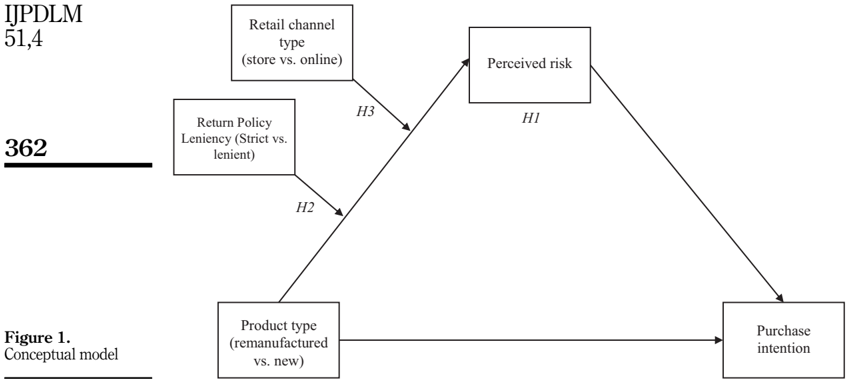
Purpose: While remanufactured products represent an increasingly researched phenomenon in the literature, not much is known about consumers' understanding and acceptance of such products. This study explores this issue in the context of the theory of perceived risk (TPR), investigating return policy leniency and distribution channel choice as potential factors to foster remanufactured products' sales. Design/methodology/approach: This research utilizes an experimental design composed of a pre-test and a scenario-based main experiment to explore how return policy leniency might mitigate consumers' perceived risk and how their related purchase intention differs across two types of retail distribution channel structures (i.e. brick-and-mortar vs. online). Findings: The investigation into the efficacy of return policy leniency within two retail distribution channel settings (i.e. brick-and-mortar vs. online) illustrates that providing a lenient return policy is an effective “cue” in increasing consumer purchase intention for remanufactured products. While prior literature has established that consumers value return policy leniency for new products, the authors provide empirical evidence that this preference also applies to remanufactured products. Notably, that return policy preference holds true in both channel settings (i.e. brick-and-mortar vs. online) under consideration. Additionally, and contrary to the authors’ predictions, consumers perceived remanufactured products sold via both channel settings as equally risky, thus highlighting that both are appropriate distribution channels for remanufactured products. Finally, while research on new products provides some initial guidance on consumer perceptions of quality and risk, the study provides empirical evidence into the difference of perceived risk with regard to new versus remanufactured products. Originality/value: By employing the TPR, this research explored the role played by two supply chain management related factors (returns policy and channel structure) in reducing consumer's perceived risk and increasing purchase intention. In doing so, this study answers the call for more consumer-based supply chain management research in a controlled experimental research setting.
Overview
The claims and statistics of this paper haven’t been checked yet.
Free: it reads the open-access text and checks the first 5 claims that cite a source we can check. Create a free account to check every claim.
Integrity signals
Registry
Cites
Statistics
Figures
Verification
Claims the paper makes
The claims and statistics of this paper haven’t been checked yet.
Free: it reads the open-access text and checks the first 5 claims that cite a source we can check. Create a free account to check every claim.
Claims other papers make about this one
Each is checked against this paper’s own text: does it say what the citing paper says it does?
The cited source says what the claim attributes to it.
In the citing paper
“lenient return policies increase purchase intention for remanufactured products [30]”
From Substantiated vs. Vague Circular Economy Claims in Fashion Brands: Claim Support Credibility, Authenticity, and Trust in Greece vs. the UK (2026) · cites this paper as [30]
The cited source says what the claim attributes to it.
In the citing paper
“For example, the effects of performance risk differ depending on the circular form and cultural orientation [26,27], and market cues can sometimes help with quality uncertainty [29-31].”
From Substantiated vs. Vague Circular Economy Claims in Fashion Brands: Claim Support Credibility, Authenticity, and Trust in Greece vs. the UK (2026) · cites this paper as [30]
Self-check
Percentages, sums and reported differences re-computed from the paper’s own numbers.
The self-check needs the paper’s full text.
Citations
Cites
Evaluating Structural Equation Models with Unobservable Variables and Measurement Error
Fornell, C., & Larcker, D. F. (1981) · Journal of Marketing Research · doi:10.2307/3151312 · Cited by 109,314
Evaluating structural equation models with unobservable variables and measurement error
Fornell, C., & Larcker, D. F. (1981) · Journal of Marketing Research · doi:10.1177/002224378101800104 · Cited by 109,190
Prospect Theory: An Analysis of Decision under Risk
Kahneman, D., & Tversky, A. (1979) · Econometrica · doi:10.2307/1914185 · Cited by 48,524
Prospect theory: An analysis of decision under risk
Kahneman, D., & Tversky, A. (1988) · Decision, Probability and Utility · doi:10.1017/cbo9780511609220.014 · Cited by 32,474
Consumer Perceptions of Price, Quality, and Value: A Means-End Model and Synthesis of Evidence
Zeithaml, V. A. (1988) · Journal of Marketing · doi:10.1177/002224298805200302 · Cited by 18,292
Hu, L.-T., & Bentler, P. M. (1998) · Psychological Methods · doi:10.1037/1082-989x.3.4.424 · Cited by 12,298
The Circular Economy–A new sustainability paradigm?
Geissdoerfer, M., Savaget, P., Bocken, N. M. P., & Hultink, E. J. (2017) · Journal of Cleaner Production · doi:10.1016/j.jclepro.2016.12.048 · Cited by 9,360
Signaling Theory: A Review and Assessment
Connelly, B. L., Certo, S. T., Ireland, R. D., & Reutzel, C. R. (2011) · Journal of Management · doi:10.1177/0149206310388419 · Cited by 6,735
An Examination of Selected Marketing Mix Elements and Brand Equity
Yoo, B., Donthu, N., & Lee, S. (2000) · Journal of the Academy of Marketing Science · doi:10.1177/0092070300282002 · Cited by 3,363
The role of perceived risk in the quality-value relationship: A study in a retail environment
Sweeney, J. C., Soutar, G. N., & Johnson, L. W. (1999) · Journal of Retailing · doi:10.1016/s0022-4359(99)80005-0 · Cited by 1,675
Research works printed but not linked: 11
- Aiken, L.S. and West, S.G. (1991), Multiple Regression: Testing and Interpreting Interactions, Sage, Thousand Oaks, California, CA.
- Bauer, R.A. (1960), "Consumer behaviour as risk taking, in dynamic marketing for a changing world", Proceedings of the 43rd National Conference of the American Marketing Association in Chicago, USA, 1960, American Marketing Association, Chicago, IL, pp. 389-398.
- Hayes, A.F. (2013), Introduction to Mediation, Moderation, and Conditional Process Analysis. A Regression Based Approach, The Guilford Press, New York, NY.
- Kirk, R.E. (2012), "Experimental design", Handbook of Psychology, 2nd ed., p.
- Lind, A.E. and Tyler, T.R. (1988), The Social Psychology of Procedural Justice, Plenum Press, New York, NY.
- Lund, R.I. (1984), "Remanufacturing", Technology Review, Vol. 87 No. 2, pp. 18-23.
- Miller, A. (2002), Subset Selection in Regression, CRC Press, New York.
- Mowen, J. and Minor, M. (1998), Consumer Behavior, Prentice-Hall, Englewood Cliffs, New Jerssey, NJ.
- Nunally, J.C. and Bernstein, I.H. (1994), Psychometric Theory, 3rd ed., McGraw-Hill, New York, NY.
- Supply Chain Quarterly (staff) (2020 online), "Survey: returns experience critical to customer satisfaction", available at: https://www.supplychainquarterly.com/articles/3625-survey-returns- experience-critical-to-customer-satisfaction.
- Taylor, J.W. (1974), "The role of risk in consumer behavior", The Journal of Marketing, Vol. 38 No. 2, pp. 54-60.
Cited by
Alyahya, M. A., Agag, G., Aliedan, M. M., & Abdelmoety, Z. H. S. (2023) · Journal of Retailing and Consumer Services · doi:10.1016/j.jretconser.2023.103492 · Cited by 83
Ta, H., Esper, T. L., Hofer, A. R., & Sodero, A. C. (2023) · Journal of Business Logistics · doi:10.1111/jbl.12327 · Cited by 62
Consumer‐Centric Supply Chain Management: A Literature Review, Framework, and Research Agenda
Baldi, B., Confente, I., Russo, I., & Gaudenzi, B. (2024) · Journal of Business Logistics · doi:10.1111/jbl.12399 · Cited by 65
Self-citationChun, Y.-Y., Matsumoto, M., Chinen, K., Endo, H., Gan, S., & Tahara, K. (2022) · Sustainable Production and Consumption · doi:10.1016/j.spc.2022.06.015 · Cited by 66
Russo, I., Masorgo, N., & Gligor, D. M. (2022) · International Journal of Physical Distribution & Logistics Management · doi:10.1108/ijpdlm-07-2021-0301 · Cited by 60
Self-citationSharkasi, N., Maeyer, P. D., Lababdi, H. C., AlMansoori, S., & Agag, G. (2024) · Journal of Retailing and Consumer Services · doi:10.1016/j.jretconser.2024.104115 · Cited by 48
Remanufactured products: A systematic review from the consumer perspective
Belbağ, A. G., & Belbağ, S. (2023) · Journal of remanufacturing · doi:10.1007/s13243-023-00125-0 · Cited by 43
“of articles % Exemplary studies Countries Advanced Markets US 12 %24 [1–4, 20, 25, 34–36, 49, 77, 94] UK 3 %5 [19, 37, 81] France 1 %1 [53] Japan 2 %3 [49, 50] Germany 1 %1 [3] Canada 1 %1 [31] Spain 1 %1 [38] Sweden 2 %3 [39, 54] Finland 1 %1 [83] Emerging Markets Portugal 1 %1 [74] Brazil 1 %1 [41] Mexico 1 %1 [63]…”
BackgroundInfluentialYu, Z., Hassan, N. M., & Sheikh, A. A. (2023) · Journal of Environmental Management · doi:10.1016/j.jenvman.2023.119790 · Cited by 45
Vhatkar, M. S., Raut, R. D., Gokhale, R. S., Cheikhrouhou, N., & Akarte, M. (2024) · Journal of Cleaner Production · doi:10.1016/j.jclepro.2024.141111 · Cited by 53
Show, Don't Tell: Education and Physical Experience Effects in Remanufactured Product Markets
Abdulla, H., Abbey, J. D., Atalay, A. S., & Meloy, M. G. (2020) · Journal of Operations Management · doi:10.1002/joom.1248 · Cited by 34
Paluzzi, H., Chen, H., Howe, M. D., Daugherty, P. J., & Tokar, T. (2024) · International Journal of Physical Distribution & Logistics Management · doi:10.1108/ijpdlm-03-2024-0102 · Cited by 38
Impact of return leniency on retailers’ profit and social welfare in monopoly markets
Chaleshtarti, A. S., Elahi, E., Fathi, M., & Khakifirooz, M. (2022) · Computers & Industrial Engineering · doi:10.1016/j.cie.2022.108149 · Cited by 28
Electric Vehicle Owners’ Perception of Remanufactured Batteries: An Empirical Study in China
Chinen, K., Matsumoto, M., Tong, P., Han, Y. S., & Niu, K. (2022) · Sustainability · doi:10.3390/su141710846 · Cited by 19
The decision-making of internet recycler considering Internet-of-Things application
Khan, S. A. R., Piprani, A. Z., & Yu, Z. (2023) · International Journal of Retail & Distribution Management · doi:10.1108/ijrdm-03-2023-0177 · Cited by 19
Alam, S. S., Ahsan, M. N., Kokash, H. A., Ahmed, S., & Di, W. (2025) · Journal of remanufacturing · doi:10.1007/s13243-025-00152-z · Cited by 20
“Combined with the perceived risks of purchasing these products, such as reduced performance or reliability, these concerns significantly deter purchase intentions [15].”
Consumer Behavior in the Circular Economy: A Systematic Review of High-impact Studies
Serra, L. S., & Alfinito, S. (2025) · Circular Economy and Sustainability · doi:10.1007/s43615-025-00679-0 · Cited by 33
“Consequently, waste reduction and material reuse enable sustainable products at more affordable prices [27 , 34 , 78 ].”
Biswas, A., Chattopadhyay, S., Barai, P., & Samanta, P. (2024) · Cogent Business & Management · doi:10.1080/23311975.2024.2402510 · Cited by 31
“Perceived risk associated with a product can also influence channel preference (confente et al., 2021; Harris-lagoudakis, 2023; Huang & Oppewal, 2006; Joshi et al., 2024; Szopiński et al., 2019). certain products, like high-value electronics or luxury items, may be perceived as risky to purchase…”
Khan, K. A., Ma, F., Akbar, M. A., Islam, M. S., Ali, M., & Noor, S. (2024) · Sustainability · doi:10.3390/su16083223 · Cited by 27
The decision analysis of consumer purchasing for refurbished products
Khan, S. A. R., Tabish, M., & Yu, Z. (2025) · Waste Management & Research The Journal for a Sustainable Circular Economy · doi:10.1177/0734242x251328890 · Cited by 21
“It is challenging to sell refurbished products because it is hard to get returned products into a reverse SC that has been repaired to function and appear new (Confente et al., 2021).”
Agrawal, S., Jain, V. K., & Verma, H. (2024) · Circular Economy and Sustainability · doi:10.1007/s43615-024-00451-w · Cited by 15
“Technically adept handling of reverse flows also cultivates efficiency gains derived from scale, learning curves, and centralization, further bolstering the economic viability of circular strategies [ 14].”
Consumer inoculation and gender in combating negative product reviews
Li, Y., Sun, Q., & Sheng, F. (2024) · Journal of Retailing and Consumer Services · doi:10.1016/j.jretconser.2023.103703 · Cited by 11
Fu, H., He, W., Guo, X., & Hou, C. (2023) · Environment Development and Sustainability · doi:10.1007/s10668-023-03943-1 · Cited by 13
“For example, consumers may be concerned about expending too much effort and time on repairs when making a wrong purchasing decision (Confente et al., 2021).”
Pillai, Ben‐Nasr, H., Hassen, T. B., & Al‐Yafei, W. B. (2025) · Sustainability · doi:10.3390/su17219532 · Cited by 13
Rose, W. J., Confente, I., Peinkofer, S. T., & Russo, I. (2025) · International Journal of Physical Distribution & Logistics Management · doi:10.1108/ijpdlm-01-2024-0005 · Cited by 17
Self-citationStemming the tide of increasing retail returns: Implications of targeted returns policies
Overstreet, R. E., Morgan, T. R., Laczniak, R. N., & Daugherty, P. J. (2022) · Journal of Business Research · doi:10.1016/j.jbusres.2022.07.011 · Cited by 10
Li, K., Li, Y., & Zhao, N. (2023) · Frontiers of Engineering Management · doi:10.1007/s42524-023-0251-7 · Cited by 7
“To mitigate consumers’ concerns and increase the high flow of remanufactured products, firms have taken several measures, such as money-back guarantee, false warranty claims, and end-of-life returns (Chen et al., 2019b; Assarzadegan and Rasti-Barzoki, 2020; Liu et al., 2020; Confente et al., 2021).”
Machine Learning Algorithms for Pricing End-of-Life Remanufactured Laptops
Türkölmez, G. B., Hathat, Z. E., Subramanian, N., Kuppusamy, S., & Sreedharan, V. R. (2024) · Information Systems Frontiers · doi:10.1007/s10796-024-10515-9 · Cited by 10
Hazen, B., Confente, I., Pellathy, D. A., & Russo, I. (2022) · Emerald Group Publishing Limited eBooks · doi:10.1108/978-1-83982-544-620221008 · Cited by 7
Self-citationAn empirical exploration of the antecedents to consumer acceptance of refurbished digital products
Zhang, X., Wang, X., & Gao, X. S. (2025) · Information Technology and Management · doi:10.1007/s10799-025-00459-0 · Cited by 11
“Consumers have been involved in comparing the refurbished with brand-new products, assessing the trade-offs of risks and benefits [21–23].”
InfluentialLastovetskaia, V., Arsenovic, J. F., Kurilova-Palisaitienė, J., & Witell, L. (2025) · Spanish Journal of Marketing - ESIC · doi:10.1108/sjme-11-2024-0294 · Cited by 7
Identifying effective signaling approaches for remanufacturing
Shi, J., & Zhu, Q. (2023) · Journal of Purchasing and Supply Management · doi:10.1016/j.pursup.2023.100891 · Cited by 7
Srisathan, W. A., Srikhanthon, B., Sawai, K., Kumwong, P., & Naruetharadhol, P. (2025) · Journal of Open Innovation Technology Market and Complexity · doi:10.1016/j.joitmc.2025.100571 · Cited by 4
Study of Purchase Behaviour Using Black Box Model
Wesley, J. R., Logeshwari, G. R., Freeda, K. M., Pavithra, G., & Prathiksha, R. (2023) · Advances in economics, business and management research/Advances in Economics, Business and Management Research · doi:10.2991/978-94-6463-162-3_2 · Cited by 3
The Role of Marketing Efforts in Enhancing Closed-Loop Supply Chains Under Recycling Competition
Tian, X., Lei, W., & Luo, Z. (2025) · Sustainability · doi:10.3390/su17062531 · Cited by 4
Domínguez, H. S. R., Herrera, I. M. R., & Carrillo, E. P. M. (2022) · NovaRUA · doi:10.20983/novarua.2022.24.3 · Cited by 5
Dangelico, R. M., & Fraccascia, L. (2025) · Resources Conservation & Recycling Advances · doi:10.1016/j.rcradv.2025.200297 · Cited by 5
Zhao, J., Zhang, H., Zhang, Y., & Xie, D. (2025) · International Journal of Production Economics · doi:10.1016/j.ijpe.2025.109863 · Cited by 2
Lenient return policies and religiosity: enhancing consumer confidence, well-being and intentions
Jamil, R. A., & Khan, T. I. (2025) · Journal of Islamic marketing · doi:10.1108/jima-03-2024-0143 · Cited by 11
Scoping innovative retail product returns pathways
Frei, R., Zhang, D., Parry, G., Wood, S., & Merlano, E. F. (2025) · Strategy and Leadership · doi:10.1108/sl-04-2025-0062 · Cited by 2
Marlina, W. A. (2024) · JURNAL MANAJEMEN DAN KEWIRAUSAHAAN · doi:10.26905/jmdk.v12i1.12289 · Cited by 2
“This risk may arise when the purchased product fails to meet their needs and has a negative impact as a result of purchasing the product (Confente et al., 2021).”
BackgroundLastovetskaia, V., Kurilova-Palisaitienė, J., Arsenovic, J. F., Guyader, H., Strömbäck, C., Witell, L., & Lundkvist, A. (2025) · Procedia CIRP · doi:10.1016/j.procir.2025.01.074 · Cited by 2
Sectoral Patterns in Pro-circularity Behaviors: A Bibliometric and Systematic Literature Review
Gomes, A., Eusébio, C., & Robaina, M. (2026) · Circular Economy and Sustainability · doi:10.1007/s43615-026-00848-9 · Cited by 1
“Having placed consumers in the CE and defined their main behaviors, it is relevant to define the theories behind the factors influencing the adoption of these behaviors (Table 2).”
The evolution of demand for last-mile fulfillment services in the US: a regionalized perspective
Marzolf, M. J., Miller, J. W., & Peinkofer, S. T. (2026) · International Journal of Physical Distribution & Logistics Management · doi:10.1108/ijpdlm-06-2025-0299 · Cited by 1
Self-citationShow, Don't Tell: Education and Physical Experience Effects in Remanufactured Product MarketsPreprint
Abdulla, H., Abbey, J. D., Atalay, S., & Meloy, M. (2020) · SSRN Electronic Journal · doi:10.2139/ssrn.3666732 · Cited by 1
Balaskas, S., Yfantidou, I., & Skandali, D. (2026) · Sustainability · doi:10.3390/su18062869
Refurbished IT as a driver of sustainable community development in France
Bensefia, S. (2026) · Asian Education and Development Studies · doi:10.1108/aeds-10-2025-0564
Liu, P. (2025) · International Conference on Computational Modeling, Simulation and Data Analysis (CMSDA) · doi:10.1145/3796731.3796938
“In the field of remanufacturing research in closed-loop supply chains, scholars have extensively discussed recycling [4, 5], reman-ufacturing [6–8], and sales [9–11].”
Wei, Y., Sun, G., Wang, S., & Li, J. (2026) · Journal of Retailing and Consumer Services · doi:10.1016/j.jretconser.2026.104924
Ok, Ş. (2026) · Uluslararası Ekonomi İşletme ve Politika Dergisi · doi:10.29216/ueip.1861236
Ratnasari, A., Mohamed, I. S., & Mohamed, N. (2026) · Advanced International Journal of Business Entrepreneurship and SMEs · doi:10.35631/aijbes.829048
Metadata
- Authors
- Confente, I., Russo, I., Peinkofer, S., & Frankel, R.
- Affiliations
- University of Verona (IT)
- Michigan State University (US)
- Corresponding author
- Confente, Ilenia
- Venue
- International Journal of Physical Distribution & Logistics Management
- Publisher
- Emerald
- Published
- 2021-03-24
- Volume
- 51
- Issue
- 4
- Pages
- 350-380
- ISSN
- 0960-0035 (ISSN-L)
- OpenAlex
- W3152369300
- Semantic Scholar
- b28501f84aec4a94fc828ed4cb0e6c85af679d66
- Cited by
- 50
- References
- 102
- Citations by year
- 2026: 7 · 2025: 15 · 2024: 10 · 2023: 10 · 2022: 7
- FWCI
- 6.02
- Type
- journal article
- Language
- en
- Open access
- hybrid
- doi.org
- Licence
- cc-by
- www.emerald.com/insight/site-policies (tdm)
- Locations
- International Journal of Physical Distribution & Logistics Management (publishedVersion, cc-by)
- University of North Florida Digital Commons (University of North Florida) (submittedVersion)
- Topics
- Social Sciences › Business, Management and Accounting › Strategy and Management › Sustainable Supply Chain Management
- Social Sciences › Business, Management and Accounting › Marketing › Consumer Market Behavior and Pricing
- Social Sciences › Decision Sciences › Management Science and Operations Research › Supply Chain and Inventory Management
- Keywords
- remanufactured products, risk perception, distribution channel choice, brick-and-mortar retail, online retail, purchase intention, consumer acceptance, supply chain management
About these checks
Registry, retraction, Cites and statistics results are computed, not judged, with one exception: a printed reference that no index lists is read once by a model before it counts as a citation error. Claims are extracted by a model and kept only when their quote appears verbatim in the text; each cited source is then checked, with a model’s help, for whether it says what the claim relies on. Those verdicts can be wrong — read the claim’s quote and the cited source before relying on one.
Statistics and arithmetic are recomputed, not judged.
Confidence bands are shown only for fields calibrated on our annotated test set. None is calibrated yet, so no band is shown.
What counts as a claim ›How we measure confidence ›How we check this ›
Are you an author, or do you see a problem with this page? Request a review
Data sources
Bibliographic data: Semantic Scholar, OpenAlex, Crossref.
Contains information from the Semantic Scholar Academic Graph Datasets, made available under the ODC Attribution License (ODC-BY 1.0).
Semantic Scholar’s data is described in: Kinney, R., et al. (2023). The Semantic Scholar Open Data Platform. arXiv:2301.10140.
