

Reframing service innovation: COVID-19 as a catalyst for imposed service innovation
Open accessThe DOI matches its Crossref record; 22 of the 22 references it cites were found in a registry or an index; 5 of the 12 sources its claims cite were checked for support.
Abstract
The paper introduces the concept of imposed service innovation as a strategic lens for reconfiguring service provision during severe disruption.
Overview
CoChat Summary
TL;DR
The paper introduces “imposed service innovation” as a strategic lens for service innovation forced by severe disruption, using COVID-19 as a catalyst. Drawing on 221 crowdsourced pandemic-related innovations, it categorizes them into 11 themes and four strategic ideal types defined by strategic horizon and strategic stretch.
Key findings
- The final dataset contained 221 innovations; 11 thematic categories emerged, including social initiative (N=33), delivery (N=32), physical distancing (N=30), remote presence (N=26), entertainment (N=21), health and well-being (N=20), professional consultation (N=18), social connection (N=18), education (N=11), COVID-19 experience (N=8), and public (N=3).
- Innovations were characterized by spatial flexibility, social and health outreach, and technology exploitation; the paper states they seem to reflect a latent demand and were triggered by the pandemic.
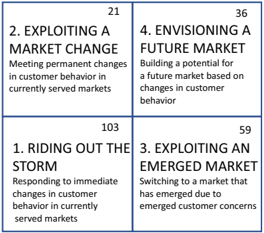
- Four strategic ideal types were identified: Type 1 short-term/low strategic stretch (N=103), Type 2 long-term/low strategic stretch (N=21), Type 3 short-term/high strategic stretch (N=59), and Type 4 long-term/high strategic stretch (N=36). Type 1 was the largest and Type 4 the smallest; all thematic categories were present in all four types.
- The paper argues imposed service innovations are forced responses for resilience and renewal, contrasting with discretionary innovations aimed at differentiation and growth; many focus on the short term, “riding out the storm.”
Methods
- The empirical study was conducted with the Dutch consumer foresight company TrendWatching and its Business of Purpose initiative, using a public database at www.covidinnovations.com. Initiated in March 2020, the database contains voluntary crowdsourced pandemic-related innovations with time tag, description, and sector categorization.
- By April 27, the database included 702 innovations covering 24 sectors; largest categories were health and fitness (103), food and beverages (76), information technology (75), media and entertainment (74), and retail (57). After removing 179 duplicates and 385 innovations via elimination criteria, the final dataset included 221 innovations. Exclusions covered vaccines, medicine, medical services/equipment, protective gear, sanitization products, ventilators, and hands-free devices; only innovations for consumers and citizens as users/customers were included.
- The authors coded innovations inductively into thematic categories and along two strategic management dimensions—strategic stretch and strategic horizon—grounded in dynamic capabilities and managerial sense-making. They focused on technical, functional, temporal, spatial, and social value components.
Limitations
- Stated: the study would benefit from longitudinal data; at the time of writing, the success of the innovations remains unclear for organizations and for customers/users. It also provides no information about service development and design processes or organizational reasoning.
- Stated: future research should examine how national and local government approaches created different business circumstances, the specific reasons and triggers for imposed service innovations, and how imposed innovations trigger new insights that traditional discretionary service innovation fails to disclose.
- Evident from the text: the database is voluntary and crowdsourced, the analysis is cross-sectional, and the authors state the intention was not to assess uniqueness or success. The reported thematic category counts sum to 220 and the strategic ideal type counts sum to 219, while the final dataset is described as 221 innovations, suggesting possible overlap or reporting inconsistency in the counts.
Model-written summary. Check it against the paper before relying on it.
Integrity signals
Registry
Cites
Statistics
Figures
Verification
Claims the paper makes
4 Valid · 5 Not valid · 2 Not checked · 27 Own results and interpretations
A result the paper reports from its own data — it cites no other source for it, so there is none to check. The quote shows it is in the paper.
In the paper
“In combination with the thematic analysis, this strategic categorization of innovations shows that all the thematic categories are present in all four types, indicating that all of these are possible options for any organization.”
§ Reframing service innovation: COVID-19 as a catalyst for imposed service innovation > Imposed innovations: strategic ideal types
hedged- Asserted: passes — The authors put it forward as true.
- Checkable: passes — It can be checked against evidence.
- Load-bearing: passes — The paper’s conclusions depend on it.
- Based: passes — The paper gives a reason why it holds.
- Rests on an assumption not shown here.
A result the paper reports from its own data — it cites no other source for it, so there is none to check. The quote shows it is in the paper.
In the paper
“In the present case, the imposed innovations in the database can be categorized into ideal types that range from minor adjustment of the service offering to profound changes in the service offering or business model.”
§ Reframing service innovation: COVID-19 as a catalyst for imposed service innovation > Imposed innovations: strategic ideal types
plain- Asserted: passes — The authors put it forward as true.
- Checkable: passes — It can be checked against evidence.
- Load-bearing: passes — The paper’s conclusions depend on it.
- Based: passes — The paper gives a reason why it holds.
- Rests on an assumption not shown here.
A result the paper states — it cites no source for it, so there is none to check. The quote shows it is in the paper.
In the paper
“Type 4 represents the smallest number, indicating that more advanced situations require profound reflection and involve greater uncertainty.”
§ Reframing service innovation: COVID-19 as a catalyst for imposed service innovation > Imposed innovations: strategic ideal types
hedged- Asserted: passes — The authors put it forward as true.
- Checkable: passes — It can be checked against evidence.
- Load-bearing: unclear — It is unclear whether the paper’s conclusions depend on it.
- Based: passes — The paper gives a reason why it holds.
- Rests on an assumption not shown here.
A result the paper states — it cites no source for it, so there is none to check. The quote shows it is in the paper.
In the paper
“Type 1 accounts for the largest number of service innovations, which is logical, as these are the least demanding to envision and implement.”
§ Reframing service innovation: COVID-19 as a catalyst for imposed service innovation > Imposed innovations: strategic ideal types
plain- Asserted: passes — The authors put it forward as true.
- Checkable: passes — It can be checked against evidence.
- Load-bearing: unclear — It is unclear whether the paper’s conclusions depend on it.
- Based: passes — The paper gives a reason why it holds.
- Rests on an assumption not shown here.
The paper states this without a source or data behind it here, so there is nothing to check it against. The quote shows it is in the paper.
In the paper
“Still, many of the imposed service innovations that emerged from the pandemic are focused on the short termriding out the stormrather than envisioning future market opportunities.”
§ Reframing service innovation: COVID-19 as a catalyst for imposed service innovation > Discussion
plain- Asserted: passes — The authors put it forward as true.
- Checkable: passes — It can be checked against evidence.
- Load-bearing: unclear — It is unclear whether the paper’s conclusions depend on it.
- Based: unclear — It is unclear why the paper says it holds.
- Rests on an assumption not shown here.
11 more claims
Create a free account to see all 38 claims and to verify the 1 reference still open.
- Probably not a substantial claim. 17
- It may state two separate claims as one. 11
Self-check
Percentages, sums and reported differences re-computed from the paper’s own numbers.
Each contradiction between two passages listed here was confirmed by an independent check.
Rated major: it would touch a result — a value a result rests on, reported and recomputed p-values on opposite sides of the significance level, two passages that conflict with no sign which is right, or a cited work retracted before this paper was published.
In the paper
§ Reframing service innovation: COVID-19 as a catalyst for imposed service innovation > Imposed innovations: strategic ideal types
“In combination with the thematic analysis, this strategic categorization of innovations shows that all the thematic categories are present in all four types, indicating that all of these are possible options for any organization.”
§ Reframing service innovation: COVID-19 as a catalyst for imposed service innovation > Thematic categories
“Public innovations (N 5 3).”
Rated minor: it would not touch a result — a value no result rests on, a p-value that stays on the same side of the significance level, or a conflict that is clerical, resolved elsewhere in the paper, or outside its own findings.
In the paper
§ Reframing service innovation: COVID-19 as a catalyst for imposed service innovation > Imposed innovations: strategic ideal types
“Type 1. Short-time horizon/low strategic stretch (N 5 103).The first type of service innovation addresses customers' immediate concerns and relates essentially to coping strategies for "riding out the storm."New services of this type modify or adjust existing services to meet the new requirements without changing the business model or strategy.A majority of these are social initiatives.”
§ Reframing service innovation: COVID-19 as a catalyst for imposed service innovation > Thematic categories
“Social initiative innovations (N 5 33).”
Citations
Cites
Teece, D. J. (2007) · Strategic Management Journal · doi:10.1002/smj.640 · Cited by 16,825
Management. Tasks, Responsibilities, Practices.
Hague, D. C., & Drucker, P. (1975) · The Economic Journal · doi:10.2307/2230551 · Cited by 1,905
Impact of Covid-19 on consumer behavior: Will the old habits return or die?
Sheth, J. (2020) · Journal of Business Research · doi:10.1016/j.jbusres.2020.05.059 · Cited by 1,766
Mora Cortez, R., & Johnston, W. J. (2020) · Industrial Marketing Management · doi:10.1016/j.indmarman.2020.05.004 · Cited by 472
Identifying categories of service innovation: A review and synthesis of the literature
Snyder, H., Witell, L., Gustafsson, A., Fombelle, P., & Kristensson, P. (2016) · Journal of Business Research · doi:10.1016/j.jbusres.2016.01.009 · Cited by 401
Customer dominant value formation in service
Heinonen, K., Strandvik, T., & Voima, P. (2013) · European Business Review · doi:10.1108/09555341311302639 · Cited by 353
Self-citationTuzovic, S., & Kabadayi, S. (2021) · Journal of Service Management · doi:10.1108/josm-05-2020-0140 · Cited by 255
Archetypes of Service Innovation: Implications for Value Cocreation
Helkkula, A., Kowalkowski, C., & Tronvoll, B. (2018) · Journal of Service Research · doi:10.1177/1094670517746776 · Cited by 224
Big Data, Big Insights? Advancing Service Innovation and Design With Machine Learning
Antons, D., & Breidbach, C. F. (2018) · Journal of Service Research · doi:10.1177/1094670517738373 · Cited by 205
Service Innovation: A New Conceptualization and Path Forward
Gustafsson, A., Snyder, H., & Witell, L. (2020) · Journal of Service Research · doi:10.1177/1094670520908929 · Cited by 172
Research works printed but not linked: 2
- 10. Hamel, G. and Prahalad, C.K. (1994), "Competing for the future", Harvard Business Review, Vol. 72 No. 4, pp. 122-128.
- 17. Levitt, T. (1960), "Marketing myopia", Harvard Business Review, Vol. 38 No. 4, pp. 45-56. Imposed service innovation and COVID-19
Cited by
Items 101–200 of 280
Bellini, N., & Raglianti, M. (2023) · Administrative Sciences · doi:10.3390/admsci13030083 · Cited by 20
Video-ethnography during Covid-19 and beyond: Generating user foresights in a virtual world
Sakellariou, E., Karantinou, K., & Goffin, K. (2021) · Technological Forecasting and Social Change · doi:10.1016/j.techfore.2021.120817 · Cited by 11
Drăgan, G. B., Bleoju, G., Căpățînă, A., & Woodside, A. G. (2022) · Management Decision · doi:10.1108/md-11-2021-1428 · Cited by 14
Gallan, A. S., & Helkkula, A. (2022) · AMS Review · doi:10.1007/s13162-022-00223-5 · Cited by 12
“Rather than finding reasons to develop new services, businesses may be subject to imposed service innovation, which triggers “a change of mindset and stimulat[es] business opportunities that would not have been considered under normal circumstances” (Heinonen & Strandvik, 2020, p. 102).”
BackgroundPrysmakova, S., & Pysmenna, O. O. (2024) · Public Performance & Management Review · doi:10.1080/15309576.2024.2397131 · Cited by 16
“The study’s findings align with the concept of “imposed service inno-vation” proposed by Heinonen and Strandvik (2020).”
Somera, F. A. R., & Petrova, K. (2024) · Businesses · doi:10.3390/businesses4040043 · Cited by 20
Tonjang, S., & Thawesaengskulthai, N. (2022) · Applied System Innovation · doi:10.3390/asi5040070 · Cited by 15
Advanced Health Control Consultation Application at Clinic B White C Based on Android
Zermane, H., Aman, A., Miyanti, D., et al. (2022) · Ceddi Journal of Information System and Technology (JST) · doi:10.56134/jst.v1i1.4 · Cited by 10
Sudarmo, S. (2021) · International journal of business economics & management · doi:10.31295/ijbem.v4n1.825 · Cited by 16
“These business options and strategies are in line with the concept of Heinonen & Strandvik (2020) which is the reframing of business service innovations by eliminating the COVID-19 response policy as an effort to implement service innovations so that the business remains sustainable.”
MethodLapierre, S., Vincent, A., Brunet, M., Frenette, M., & Côté, I. (2022) · Journal of Gender-Based Violence · doi:10.1332/239868021x16432014139971 · Cited by 10
From crisis to opportunity through innovation
Montes, J. O., Gómez-Cruz, N. A., Batz, A., Cárdenas, L. F. S., & Holguín, H. M. (2024) · Management Research Review · doi:10.1108/mrr-05-2023-0324 · Cited by 12
Shahmehr, F. S., Sohal, A. S., & Khaksar, S. M. S. (2024) · Journal of Services Marketing · doi:10.1108/jsm-03-2023-0096 · Cited by 12
(2022) · Journal of Competitiveness · doi:10.7441/joc.2022.04.03 · Cited by 14
Jang, H.-W., & Lee, S.-B. (2021) · Sustainability · doi:10.3390/su13179870 · Cited by 14
“Complex social issues such as the COVID-19 pandemic and the Fourth Industrial Revolution have created a new service environment [2].”
BackgroundSeet, P., & Jones, J. T. (2021) · Journal of Teaching and Learning for Graduate Employability · doi:10.21153/jtlge2021vol12no1art1317 · Cited by 8
“0), the COVID-19 pandemic has accelerated the adoption of digital technologies by enterprises, underscoring the need for workers to continuously upskill their digital competencies in order to remain relevant (Heinonen & Strandvik, 2021).”
BackgroundFombella, P. G., West, S., Mühlberger, M., Sautter, T., Zepf, G., & Harrison, D. K. (2022) · Continuity & Resilience Review · doi:10.1108/crr-12-2021-0044 · Cited by 14
A temporal approach to innovation management in recessionary times
Chen, S., & Habibi, M. R. (2023) · Industrial Marketing Management · doi:10.1016/j.indmarman.2023.06.007 · Cited by 8
COVID-19 crisis management in Greek airlines
Paraschi, E. P., Panagopoulos, A., & Fragkogianni, M. (2024) · Journal of the Air Transport Research Society · doi:10.1016/j.jatrs.2024.100032 · Cited by 13
Михайловна, Б. С., Ребязина, В., & Muravskaia, S. (2021) · BRICS Journal of Economics · doi:10.38050/2712-7508-2021-29 · Cited by 13
Bonciani, M., Corazza, I., & Rosis, S. D. (2022) · Italian Journal of Marketing · doi:10.1007/s43039-021-00045-6 · Cited by 10
“Hence, as outlined by Heinonen and Strandvik (2021), this era settled the opportunity to define the concept of “imposed service innovation”, as counter posed to the traditional view of services innovation as a primarily discretionary activity (Heinonen & Strandvik, 2021).”
BackgroundBianchi, C. (2021) · Journal of Services Marketing · doi:10.1108/jsm-06-2021-0192 · Cited by 8
Meng, J., Begum, M., Na, M., & Alam, S. S. (2025) · Journal of Quality Assurance in Hospitality & Tourism · doi:10.1080/1528008x.2025.2509230 · Cited by 12
Stress and coping: exploring the experiences of travellers during COVID-19 hotel quarantine
Peterkin, K. Y., Badu‐Baiden, F., & Alhuqbani, F. M. (2022) · Tourism Recreation Research · doi:10.1080/02508281.2022.2114747 · Cited by 7
“Investigations also reveal that new complementary lines of business, including equipment rental, meals plans and wellness packages could be a boon to revenue for both hotels and external service providers (Heinonen & Strandvik, 2020).”
Educational Innovation amidst Globalization: Higher Education Institutions and Societal Integration
Zainab, R. (2023) · IgMin Research · doi:10.61927/igmin131 · Cited by 7
“Other than that, in society, just as many other organizations like educational institutions are also impacted by innovation requirements [2].”
InfluentialDuque, C. M., Fernández-Muñóz, J. J., Moguerza, J. M., & Ruíz-Rúa, A. (2023) · Journal of Tourism Futures · doi:10.1108/jtf-09-2022-0228 · Cited by 8
From care packages to Zoom cookery classes: youth work during the COVID-19 “lockdown”
Shaw, A., Brady, B., & Dolan, P. (2022) · Journal of Children s Services · doi:10.1108/jcs-06-2021-0027 · Cited by 7
In Times of Pandemic - How Generation XYZ Looks at Digital Banking
Rodrigues, L. F., Rodrigues, H., & Oliveira, A. (2022) · AHFE international · doi:10.54941/ahfe1001742 · Cited by 6
Laudański, K., Scruth, E. A., Winterbottom, F. A., Rastrepo, M., Dugar, S. P., Herasevich, V., Villanueva, I., Armaignac, D. L., & Scott, B. K. (2022) · Healthcare · doi:10.3390/healthcare10081445 · Cited by 6
“The survey results should not be used to estimate the effect of COVID-19 on TCC, as it was deployed early in the pandemic [23,45,46].”
BackgroundMethodThe effect of perceived threat on online service reviews
Kim, J. M., & Lee, E. (2022) · Journal of Services Marketing · doi:10.1108/jsm-06-2021-0220 · Cited by 10
HEALTHCARE FINANCING AND BUDGETING: THE REGIONAL POLICY PRIORITIES IN RESPONSE TO COVID-19
Kuzmenko, O. V., Каща, М., Shvindina, H., et al. (2021) · Financial and credit activity problems of theory and practice · doi:10.18371/fcaptp.v2i37.230267 · Cited by 6
Prasetya, B., Wahono, D. R., Yopi, Y., & Prasetya, C. (2022) · Standards · doi:10.3390/standards2010006 · Cited by 7
Is Service Management Experiencing a Change of Era?
Pels, J., & Mele, C. (2022) · Springer eBooks · doi:10.1007/978-3-030-91828-6_5 · Cited by 7
Action learning and innovation
Boak, G. (2022) · Action Learning Research and Practice · doi:10.1080/14767333.2022.2130721 · Cited by 9
“…repurposing of manufacturing facilities, the move to online working practices and online education, and entrepreneurial social initiatives to support the more vulnerable (Cohen and Campbell 2021; George, Lakhani, and Puranam 2020; Heinonen and Strandvik 2021; Netz, Reinmoeller, and Axelson 2022).”
BackgroundWu, T.-C., & Ho, C. B. (2025) · Journal of Medical Internet Research · doi:10.2196/53306 · Cited by 11
“A substantial disruption such as a pandemic can act as a catalyst for the acceptance of telemedicine services, potentially leading to a shift in users’ perceptions and attitudes [3].”
Mulcahy, R. F., Burgess, J., Parkinson, J. E., Schuster, L., & Grace, A. (2025) · Journal of Services Marketing · doi:10.1108/jsm-05-2024-0215 · Cited by 5
Malaysia, U. P., Sharipudin, M.-N. S., Rejab, M. M., Malaysia, U. U., Tugiman, N., Malaysia, U. U., Indiyati, D., Andriani, A. D., & Universitas Putra Indonesia, I. (2024) · Jurnal Komunikasi Malaysian Journal of Communication · doi:10.17576/jkmjc-2024-4001-23 · Cited by 12
Kilábalás – Újranyitás – Növekedés
Kőműves, Z. S., Dajnoki, K., Pató Gáborné Szűcs, B., Poór, J., Szabó, K., Szabó, K., & Szabó, S. (2022) · Wolters Kluwer Hungary Kft. eBooks · doi:10.55413/9789635940615 · Cited by 7
Sun, M., & Zhao, X. (2023) · Sustainability · doi:10.3390/su152014969 · Cited by 12
E-banking usage by Gen X, Y, and Z generations
Rodrigues, L. F., Oliveira, A., & Rodrigues, H. (2023) · AHFE international · doi:10.54941/ahfe1004320 · Cited by 5
Ng, D. W. L., & Keng, L. K. N. (2023) · Emerald Group Publishing Limited eBooks · doi:10.1108/978-1-80382-459-820231005 · Cited by 7
Drysdale, K., Bates, S. M., Ritter, A. J., Smyth, C., de Leeuw, E., & Katz, I. (2023) · Australian Journal of Public Administration · doi:10.1111/1467-8500.12621 · Cited by 7
Automation and redistribution of work: the impact of social distancing on live TV production
Okopnyi, P., Guribye, F., Caruso, V., & Juhlin, O. (2021) · Human-Computer Interaction · doi:10.1080/07370024.2021.1984917 · Cited by 6
“Heinonen and Strandvik (2020), in an analysis of the implications of the pandemic on service innovation, make a distinction between how service innovation has usually been driven by discretionary activities aimed at securing their position in a market and imposed innovation that is driven by…”
BackgroundLaudański, K. (2022) · Journal of Clinical Medicine · doi:10.3390/jcm11041135 · Cited by 4
A koronavírus-járvány kezelése a külföldi tulajdonú magyarországi vállalatoknál
Sass, M., Gál, Z., Gubik, A. S., Szunomár, Á., & Túry, G. (2022) · Közgazdasági Szemle · doi:10.18414/ksz.2022.6.758 · Cited by 8
Кompanets, K., Lytvyshko, L., Fedoryak, R., & Krasnoshtan, O. (2022) · AIP conference proceedings · doi:10.1063/5.0079789 · Cited by 11
Angriawan, A., Thakur, R., & Baker, D. S. (2023) · International Marketing Review · doi:10.1108/imr-03-2022-0058 · Cited by 3
Determinantes del impacto financiero de la pandemia sobre las mipymes de Colombia
Navas, E. B. G., Suárez, J. E. S., & Montañéz, J. R. (2023) · Equidad y Desarrollo · doi:10.19052/eq.vol1.iss41.8 · Cited by 5
Khalil, Z. T., & Rahman, S. M. (2023) · Emerald Group Publishing Limited eBooks · doi:10.1108/978-1-80455-640-520231012 · Cited by 6
A new business model (BM) for small independent retailers
Cassidy, K. J., Grimsey, W., & Yostrakul, A. (2024) · Journal of Place Management and Development · doi:10.1108/jpmd-08-2023-0082 · Cited by 5
Building ingenuity in tourism organizations during crises
Lin, X. (., Wong, I. A., & Fong, V. H. I. (2025) · Tourism Management · doi:10.1016/j.tourman.2025.105165 · Cited by 8
Effect of Covid-19 in Jordan: Conceptual Analysis of Different Economic Sectors
Shatnawi, S. A., & Sakarneh, B. K. (2021) · Business and Economic Research · doi:10.5296/ber.v11i2.18672 · Cited by 4
“The speedy eruption of the COVID-19 pandemic casts a first-time effect on the services industry globally, including Jordan (Heinonen & Strandvik, 2020).”
BackgroundThe Effect of COVID-19 Measures in Hotels on Tourists' Perceptions of Safe Tourism Service
Demir, Ş. Ş. (2021) · Advances in hospitality, tourism and the services industry (AHTSI) book series · doi:10.4018/978-1-7998-8231-2.ch018 · Cited by 4
Crisis innovation: a study of Michelin-starred restaurants' strategic renewal and alignment
Gottardello, D., & Karabağ, S. F. (2022) · International Hospitality Review · doi:10.1108/ihr-03-2022-0010 · Cited by 12
Technology Integration in Care Service Systems: The Required Actions of Technology Developers
Watanabe, K., Miwa, H., & Wakui, T. (2023) · IEEE Engineering Management Review · doi:10.1109/emr.2023.3237516 · Cited by 5
“This digital shift driven by the reaction toward the pandemic has already been reported in the recent studies [44], [45]; nevertheless, this article provided new evidence of this shift.”
ResultShonubi, O. A. (2023) · European Journal of Business and Innovation Research · doi:10.37745/ejbir.2013/vol11n474104 · Cited by 11
Linh, D. H., Dung, N. D., Tu, L. M., Son, H. N., & Kingsbury, A. J. (2021) · Journal of Electronic Commerce in Organizations · doi:10.4018/jeco.2021070105 · Cited by 4
Simulation of Comprehensive Assessments of Personnel Innovation Development Management System
Novykova, I. V., Chornyi, R., Chorna, N., Roman, B., & Leszczynski, V. P. (2022) · Lecture notes in networks and systems · doi:10.1007/978-3-031-08087-6_7 · Cited by 12
Essential service worker valorization: a deonance perspective
Horan, K. A., Beltramo, J. M. D., Mejia, C., & Shoss, M. K. (2022) · Current Issues in Tourism · doi:10.1080/13683500.2022.2090909 · Cited by 3
“The public only began to appreciate the work conducted by essential service workers, their innovation to stay in business (Heinonen & Strandvik, 2020), and their underappreciated roles critical in a functioning society (Mejia et al., 2021).”
BackgroundDigital Transformation in Back-Offices of German Insurance Companies
Schwarzbach, C., Eden, T., Werth, O., Lohse, U., Breitner, M. H., & von der Schulenburg, J. G. (2023) · International Journal of Innovation and Technology Management · doi:10.1142/s0219877023500505 · Cited by 5
Arıkan, E. (2021) · Advances in human services and public health (AHSPH) book series · doi:10.4018/978-1-7998-8674-7.ch002 · Cited by 3
Innovativeness in Enterprise Strategies Value Creation and Innovation Multidimensionality
Skowron-Grabowska, B. (2023) · Management and Production Engineering Review · doi:10.24425/mper.2023.147188 · Cited by 3
“In these operations of entities, the multidimen-sions of cooperation concerning external subject relations, impulses of new concepts, and places of innovation are important (Heinonen & Strandvik, 2021).”
BackgroundNguyen, T. T., Le–Anh, T., Nguyen, Q. A., & Pham, H. Q. (2024) · Springer eBooks · doi:10.1007/978-981-99-8472-5_48 · Cited by 3
González, S. T. G., & Bravo, A. H. (2024) · Revista CEA · doi:10.22430/24223182.2618 · Cited by 10
Innovation and business survival during Covid-19 pandemic: firm-level evidence from Europe
Fatema, F., Bhuiyan, M. R. U., Islam, M. M., & Rahman, M. R. (2025) · Innovation The European Journal of Social Science Research · doi:10.1080/13511610.2025.2475287 · Cited by 4
Polese, F., Troisi, O., & Grimaldi, M. (2022) · Hawaii International Conference on System Sciences (HICSS) · doi:10.24251/hicss.2022.253 · Cited by 4
“…and organizations all around the world to comply with a complex set of technological, political, social, and managerial evolutions, which are changing dramatically business management, people’s interactions, daily lives, and work environment (Kabadayi et al., 2020; Heinonen and Strandvik, 2020).”
Digital Entrepreneurship in Russia: Development during the Pandemic
Abalakin, A., Yakovlev, A. A., Akimenko, V., & Denisova, E. (2023) · Bulletin of Kemerovo State University Series Political Sociological and Economic sciences · doi:10.21603/2500-3372-2023-8-2-148-159 · Cited by 2
Heinonen, K., & Sörhammar, D. (2024) · Journal of Service Theory and Practice · doi:10.1108/jstp-05-2024-328 · Cited by 3
Self-citationBibliometric Mapping of Organizational Resilience Research
Khan, N., Khalique, F., & Saini, K. (2025) · Advances in logistics, operations, and management science book series · doi:10.4018/979-8-3693-8809-9.ch006 · Cited by 2
Can Small Firms Innovate Away From Competition?
Cowling, M., Sclip, A., & Velliscig, G. (2025) · British Journal of Management · doi:10.1111/1467-8551.12913 · Cited by 2
Shahzad, F., Poudel, D., & Ferreira, J. J. (2026) · The International Journal of Entrepreneurship and Innovation · doi:10.1177/14657503261421099 · Cited by 13
Adapting Culinary Business Model as a Source of Teaching Material in Hospitality Business Course
Suni, M., Muh. Taufik, S., & Ridwan, M. (2022) · AL-ISHLAH Jurnal Pendidikan · doi:10.35445/alishlah.v14i3.1369 · Cited by 4
Disrupted Diners: Impacts of COVID-19 on Restaurant Service Systems and Technological Adaptations
Mohanty, P., Singh, A. M., Hussain, S., & Gavinolla, M. R. (2022) · Springer eBooks · doi:10.1007/978-981-19-5763-5_8 · Cited by 4
Inovação em tempos de pandemia: o caso de uma indústria de transformação da construção civil
Ceolin, M. J. A., Damke, F., da Silva, E., et al. (2023) · International Journal of Innovation · doi:10.5585/2023.21862 · Cited by 2
Are We Losing Connection? Lived Experience of Online Mutual Aid Groups During the COVID-19 Pandemic
Lee, D., & Antonino, R. (2023) · Contemporary Drug Problems · doi:10.1177/00914509231170773 · Cited by 2
“…to slow the spread of coronavirus, and this extended to clinical medicine and education (Ramdas et al., 2020), business, shopping and entertainment (Heinonen & Strandvik, 2020), psychotherapy (Békés & Aafjes-van Doorn, 2020; Weinberg, 2020) and mutual aid groups for addiction (Bergman & Kelly,…”
BackgroundCultural and Creative Industries
Zayani, M., & Khalil, J. F. (2023) · Oxford University Press eBooks · doi:10.1093/oso/9780197508626.003.0010 · Cited by 3
Zayani, M., & Khalil, J. F. (2023) · Oxford University Press eBooks · doi:10.1093/oso/9780197508626.003.0001 · Cited by 3
Effect of Technological Innovations on Restaurant Sustainability in Nairobi County, Kenya
Gikonyo, R. K., Mwenda, L. K. M., & Wachira, A. W. (2024) · African Journal of Tourism and Hospitality Management · doi:10.37284/ajthm.3.1.1741 · Cited by 6
Villumsen, K., Elmer, H., & Schmeltz, L. (2024) · Corporate Communications An International Journal · doi:10.1108/ccij-06-2023-0083 · Cited by 3
Liu, Q.-X. (2024) · PLoS ONE · doi:10.1371/journal.pone.0299951 · Cited by 2
Apriza, S., Kuncoro, E. A., Alamsjah, F., & Furinto, A. (2024) · Problems and Perspectives in Management · doi:10.21511/ppm.22(3).2024.48 · Cited by 3
“The form of successful partnership collaboration in the health service ecosystem is when the partnership can support each other economically and build social relationships (Heinonen et al., 2021).”
BackgroundPreferential segmentation in F&B service innovation
Chiang, C.-F., & Yen, Y.-L. (2024) · Journal of Foodservice Business Research · doi:10.1080/15378020.2024.2430068 · Cited by 5
“Central to service innovation is learning about customers’ unmet service needs and developing new services based on a wide range of customer preferences and needs (Heinonen & Strandvik, 2020).”
Vlados, C. M., & Chatzinikolaou, D. (2021) · Palgrave studies in cross-disciplinary business research, in association with EuroMed Academy of Business · doi:10.1007/978-3-030-76575-0_4 · Cited by 2
Hossain, M. Z., & Yasmin, T. (2022) · International Review of Public Administration · doi:10.1080/12294659.2022.2044105 · Cited by 5
“Appearance of novel viruses and their outbreak as pandemic has increased substantially in recent times (Klaiman & Ibrahim, 2010).”
BackgroundDeployment of Tele-ICU Respiratory Therapy and the Creation of an eRT Service Line
Laudański, K., Scott, M. J., Huffenberger, A. M., Wain, J., & Hanson, C. W. (2022) · NEJM Catalyst · doi:10.1056/cat.21.0239 · Cited by 3
“The abatement of the pandemic urgency changed the forces governing the innovation implementation.(3,5,8) For example, personal protective equipment (PPE) supply improved concomitantly with increasing knowledge of how to safely treat patients with Covid-19.”
BackgroundMethodInfluentialROLE OF ARTIFICIAL INTELLIGENCE (AI) TOOLS FOR ASSURING QUALITY IN SOFTWARE
Qazi, S., Memon, M. S., Ali, A., et al. (2022) · Journal of Southwest Jiaotong University · doi:10.35741/issn.0258-2724.57.2.5 · Cited by 2
Wang, J., & Shaheen, M. (2022) · Frontiers in Psychology · doi:10.3389/fpsyg.2022.989961 · Cited by 7
“It is because of these characteristics that many countries while trying to get the journey of their development on the track of innovation tend to considermany different factors and still, sometimes, these efforts do not lead to the desired results (Heinonen and Strandvik, 2021).”
BackgroundService innovation in government: evidence from the UAE
Alosani, M. S., & Al-Dhaafri, H. S. (2023) · Management & Sustainability An Arab Review · doi:10.1108/msar-11-2022-0057 · Cited by 10
Proactive personality and organisational performance of hotels in Cyprus
Irani, F., Rahimizhian, S., Eluwole, K. K., & Lasisi, T. T. (2023) · European Journal of Tourism Research · doi:10.54055/ejtr.v34i.2541 · Cited by 7
PINZARU, F. –. M., & Zbuchea, A. (2020) · Proccedings of the International Management Conference · doi:10.24818/imc/2020/02.07 · Cited by 3
Innowacje w turystyce w dobie pandemii COVID-19 – perspektywa ekspertów
Gruszka, I., & Manczak, I. (2022) · Horyzonty Polityki · doi:10.35765/hp.2226 · Cited by 4
The bed bath with or without water? It’s a wash!
Groven, F. M. V. (2021) · Research Publications (Maastricht University) · doi:10.26481/dis.20211207fg · Cited by 2
Budler, M., & Božič, K. (2024) · Journal of Small Business Strategy · doi:10.53703/001c.92989 · Cited by 6
Editorial: Designing for complexity and regeneration: new perspectives in service design
Heinonen, K. (2025) · Journal of Services Marketing · doi:10.1108/jsm-06-2025-0432 · Cited by 2
Self-citationMusesengwa, L., & Zvikaramba, A. (2023) · Journal of Research and Innovation for Sustainable Society · doi:10.33727/jriss.2023.1.7:58-71 · Cited by 1
“The pandemic prompted companies to adopt to remote working models, online service delivery became rampant for business continuity (Heinonen & Strandvik, 2020;Schmid, et al., 2021).”
InfluentialSocial Lab: Toward Value-Driven R&D&I in Collaboration with Citizens
Watanabe, K., Akasaka, F., Mitake, Y., & Kojima, K. (2023) · Linköping electronic conference proceedings · doi:10.3384/ecp203063 · Cited by 3
A Bibliometric Analysis of Dynamic Capabilities and Resilience Using VOSviewer
Otola, I., & Szczepańczyk, M. (2024) · Springer proceedings in business and economics · doi:10.1007/978-981-97-0996-0_25 · Cited by 3
Working it out: service displacement and the dynamics of consumer adaptation
Mulvey, M. S., Belanger, C., & Bakker, D. (2025) · Journal of Services Marketing · doi:10.1108/jsm-06-2024-0302 · Cited by 2
Mastering Digital Communication and Online Image
Zulkifli, M. I., & Roslan, N. W. (2026) · IGI Global eBooks · doi:10.4018/979-8-3373-5263-3.ch005 · Cited by 1
Service Innovation of Platform Ecosystem: A Case Study of Smart Campus in China
Zhou, M., & Gao, P. (2026) · IEEE Engineering Management Review · doi:10.1109/emr.2026.3674150 · Cited by 2
“Heinonen and Strandvik [34] introduced the concept of imposed service innovation in the context of the COVID-19 pandemic.”
Zhao, C., Leong, A. M. W., Hollebeek, L. D., Bai, J., & Liu, Y. (2026) · International Journal of Physical Distribution & Logistics Management · doi:10.1108/ijpdlm-04-2025-0184 · Cited by 1
Metadata
- Authors
- Heinonen, K., & Strandvik, T.
- Affiliations
- Hanken School of Economics (FI)
- Corresponding author
- Heinonen, Kristina
- Venue
- Journal of Service Management
- Publisher
- Emerald
- Published
- 2020-09-15
- Volume
- 32
- Issue
- 1
- Pages
- 101-112
- ISSN
- 1757-5818 (ISSN-L)
- OpenAlex
- W3086819598
- Semantic Scholar
- 71a3ff073161c8cfbab6f87862c9a95aa3f59e59
- Cited by
- 280
- References
- 20
- Citations by year
- 2026: 10 · 2025: 19 · 2024: 41 · 2023: 68 · 2022: 77 · 2021: 55 · 2020: 10
- FWCI
- 54.11
- Type
- journal article
- Language
- en
- Open access
- hybrid
- doi.org
- Licence
- cc-by
- www.emerald.com/insight/site-policies (tdm)
- Locations
- Journal of service management (publishedVersion, cc-by)
- Työväentutkimus Vuosikirja (submittedVersion)
- Topics
- Social Sciences › Business, Management and Accounting › Marketing › Service and Product Innovation
- Social Sciences › Business, Management and Accounting › Strategy and Management › Business Strategies and Innovation
- Social Sciences › Economics, Econometrics and Finance › Economics and Econometrics › COVID-19 Pandemic Impacts
- Keywords
- service innovation, COVID-19 pandemic, organizational resilience, strategic horizon, service delivery, institutional weakness, technology exploitation, social outreach
About these checks
Registry, retraction, Cites and statistics results are computed, not judged, with one exception: a printed reference that no index lists is read once by a model before it counts as a citation error. Claims are extracted by a model and kept only when their quote appears verbatim in the text; each cited source is then checked, with a model’s help, for whether it says what the claim relies on. Those verdicts can be wrong — read the claim’s quote and the cited source before relying on one.
The claim verdicts this report counts are experimental: their accuracy is not yet measured.
A language model drew the claims from the paper on 2026-10-10, under version 3 of the claim definition (model deepseek-v4.1-flash, prompt extract-v3).
A second model labelled each claim on 2026-10-10 (model jev-1.13-20260917, definition revision gold-guideline-v0.2).
Statistics and arithmetic are recomputed, not judged.
Confidence bands are shown only for fields calibrated on our annotated test set. None is calibrated yet, so no band is shown.
What counts as a claim ›How we measure confidence ›How we check this ›
Are you an author, or do you see a problem with this page? Request a review
Data sources
Bibliographic data: Semantic Scholar, OpenAlex, Crossref.
Contains information from the Semantic Scholar Academic Graph Datasets, made available under the ODC Attribution License (ODC-BY 1.0).
Semantic Scholar’s data is described in: Kinney, R., et al. (2023). The Semantic Scholar Open Data Platform. arXiv:2301.10140.
