

Reframing service innovation: COVID-19 as a catalyst for imposed service innovation
Open accessThe DOI matches its Crossref record; 22 of the 22 references it cites were found in a registry or an index; 5 of the 12 sources its claims cite were checked for support.
Abstract
The paper introduces the concept of imposed service innovation as a strategic lens for reconfiguring service provision during severe disruption.
Overview
CoChat Summary
TL;DR
The paper introduces “imposed service innovation” as a strategic lens for service innovation forced by severe disruption, using COVID-19 as a catalyst. Drawing on 221 crowdsourced pandemic-related innovations, it categorizes them into 11 themes and four strategic ideal types defined by strategic horizon and strategic stretch.
Key findings
- The final dataset contained 221 innovations; 11 thematic categories emerged, including social initiative (N=33), delivery (N=32), physical distancing (N=30), remote presence (N=26), entertainment (N=21), health and well-being (N=20), professional consultation (N=18), social connection (N=18), education (N=11), COVID-19 experience (N=8), and public (N=3).
- Innovations were characterized by spatial flexibility, social and health outreach, and technology exploitation; the paper states they seem to reflect a latent demand and were triggered by the pandemic.
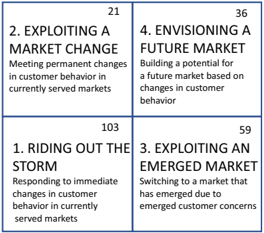
- Four strategic ideal types were identified: Type 1 short-term/low strategic stretch (N=103), Type 2 long-term/low strategic stretch (N=21), Type 3 short-term/high strategic stretch (N=59), and Type 4 long-term/high strategic stretch (N=36). Type 1 was the largest and Type 4 the smallest; all thematic categories were present in all four types.
- The paper argues imposed service innovations are forced responses for resilience and renewal, contrasting with discretionary innovations aimed at differentiation and growth; many focus on the short term, “riding out the storm.”
Methods
- The empirical study was conducted with the Dutch consumer foresight company TrendWatching and its Business of Purpose initiative, using a public database at www.covidinnovations.com. Initiated in March 2020, the database contains voluntary crowdsourced pandemic-related innovations with time tag, description, and sector categorization.
- By April 27, the database included 702 innovations covering 24 sectors; largest categories were health and fitness (103), food and beverages (76), information technology (75), media and entertainment (74), and retail (57). After removing 179 duplicates and 385 innovations via elimination criteria, the final dataset included 221 innovations. Exclusions covered vaccines, medicine, medical services/equipment, protective gear, sanitization products, ventilators, and hands-free devices; only innovations for consumers and citizens as users/customers were included.
- The authors coded innovations inductively into thematic categories and along two strategic management dimensions—strategic stretch and strategic horizon—grounded in dynamic capabilities and managerial sense-making. They focused on technical, functional, temporal, spatial, and social value components.
Limitations
- Stated: the study would benefit from longitudinal data; at the time of writing, the success of the innovations remains unclear for organizations and for customers/users. It also provides no information about service development and design processes or organizational reasoning.
- Stated: future research should examine how national and local government approaches created different business circumstances, the specific reasons and triggers for imposed service innovations, and how imposed innovations trigger new insights that traditional discretionary service innovation fails to disclose.
- Evident from the text: the database is voluntary and crowdsourced, the analysis is cross-sectional, and the authors state the intention was not to assess uniqueness or success. The reported thematic category counts sum to 220 and the strategic ideal type counts sum to 219, while the final dataset is described as 221 innovations, suggesting possible overlap or reporting inconsistency in the counts.
Model-written summary. Check it against the paper before relying on it.
Integrity signals
Registry
Cites
Statistics
Figures
Verification
Claims the paper makes
4 Valid · 5 Not valid · 2 Not checked · 27 Own results and interpretations
A result the paper reports from its own data — it cites no other source for it, so there is none to check. The quote shows it is in the paper.
In the paper
“In combination with the thematic analysis, this strategic categorization of innovations shows that all the thematic categories are present in all four types, indicating that all of these are possible options for any organization.”
§ Reframing service innovation: COVID-19 as a catalyst for imposed service innovation > Imposed innovations: strategic ideal types
hedged- Asserted: passes — The authors put it forward as true.
- Checkable: passes — It can be checked against evidence.
- Load-bearing: passes — The paper’s conclusions depend on it.
- Based: passes — The paper gives a reason why it holds.
- Rests on an assumption not shown here.
A result the paper reports from its own data — it cites no other source for it, so there is none to check. The quote shows it is in the paper.
In the paper
“In the present case, the imposed innovations in the database can be categorized into ideal types that range from minor adjustment of the service offering to profound changes in the service offering or business model.”
§ Reframing service innovation: COVID-19 as a catalyst for imposed service innovation > Imposed innovations: strategic ideal types
plain- Asserted: passes — The authors put it forward as true.
- Checkable: passes — It can be checked against evidence.
- Load-bearing: passes — The paper’s conclusions depend on it.
- Based: passes — The paper gives a reason why it holds.
- Rests on an assumption not shown here.
A result the paper states — it cites no source for it, so there is none to check. The quote shows it is in the paper.
In the paper
“Type 4 represents the smallest number, indicating that more advanced situations require profound reflection and involve greater uncertainty.”
§ Reframing service innovation: COVID-19 as a catalyst for imposed service innovation > Imposed innovations: strategic ideal types
hedged- Asserted: passes — The authors put it forward as true.
- Checkable: passes — It can be checked against evidence.
- Load-bearing: unclear — It is unclear whether the paper’s conclusions depend on it.
- Based: passes — The paper gives a reason why it holds.
- Rests on an assumption not shown here.
A result the paper states — it cites no source for it, so there is none to check. The quote shows it is in the paper.
In the paper
“Type 1 accounts for the largest number of service innovations, which is logical, as these are the least demanding to envision and implement.”
§ Reframing service innovation: COVID-19 as a catalyst for imposed service innovation > Imposed innovations: strategic ideal types
plain- Asserted: passes — The authors put it forward as true.
- Checkable: passes — It can be checked against evidence.
- Load-bearing: unclear — It is unclear whether the paper’s conclusions depend on it.
- Based: passes — The paper gives a reason why it holds.
- Rests on an assumption not shown here.
The paper states this without a source or data behind it here, so there is nothing to check it against. The quote shows it is in the paper.
In the paper
“Still, many of the imposed service innovations that emerged from the pandemic are focused on the short termriding out the stormrather than envisioning future market opportunities.”
§ Reframing service innovation: COVID-19 as a catalyst for imposed service innovation > Discussion
plain- Asserted: passes — The authors put it forward as true.
- Checkable: passes — It can be checked against evidence.
- Load-bearing: unclear — It is unclear whether the paper’s conclusions depend on it.
- Based: unclear — It is unclear why the paper says it holds.
- Rests on an assumption not shown here.
11 more claims
Create a free account to see all 38 claims and to verify the 1 reference still open.
- Probably not a substantial claim. 17
- It may state two separate claims as one. 11
Self-check
Percentages, sums and reported differences re-computed from the paper’s own numbers.
Each contradiction between two passages listed here was confirmed by an independent check.
Rated major: it would touch a result — a value a result rests on, reported and recomputed p-values on opposite sides of the significance level, two passages that conflict with no sign which is right, or a cited work retracted before this paper was published.
In the paper
§ Reframing service innovation: COVID-19 as a catalyst for imposed service innovation > Imposed innovations: strategic ideal types
“In combination with the thematic analysis, this strategic categorization of innovations shows that all the thematic categories are present in all four types, indicating that all of these are possible options for any organization.”
§ Reframing service innovation: COVID-19 as a catalyst for imposed service innovation > Thematic categories
“Public innovations (N 5 3).”
Rated minor: it would not touch a result — a value no result rests on, a p-value that stays on the same side of the significance level, or a conflict that is clerical, resolved elsewhere in the paper, or outside its own findings.
In the paper
§ Reframing service innovation: COVID-19 as a catalyst for imposed service innovation > Imposed innovations: strategic ideal types
“Type 1. Short-time horizon/low strategic stretch (N 5 103).The first type of service innovation addresses customers' immediate concerns and relates essentially to coping strategies for "riding out the storm."New services of this type modify or adjust existing services to meet the new requirements without changing the business model or strategy.A majority of these are social initiatives.”
§ Reframing service innovation: COVID-19 as a catalyst for imposed service innovation > Thematic categories
“Social initiative innovations (N 5 33).”
Citations
Cites
Teece, D. J. (2007) · Strategic Management Journal · doi:10.1002/smj.640 · Cited by 16,825
Management. Tasks, Responsibilities, Practices.
Hague, D. C., & Drucker, P. (1975) · The Economic Journal · doi:10.2307/2230551 · Cited by 1,905
Impact of Covid-19 on consumer behavior: Will the old habits return or die?
Sheth, J. (2020) · Journal of Business Research · doi:10.1016/j.jbusres.2020.05.059 · Cited by 1,766
Mora Cortez, R., & Johnston, W. J. (2020) · Industrial Marketing Management · doi:10.1016/j.indmarman.2020.05.004 · Cited by 472
Identifying categories of service innovation: A review and synthesis of the literature
Snyder, H., Witell, L., Gustafsson, A., Fombelle, P., & Kristensson, P. (2016) · Journal of Business Research · doi:10.1016/j.jbusres.2016.01.009 · Cited by 401
Customer dominant value formation in service
Heinonen, K., Strandvik, T., & Voima, P. (2013) · European Business Review · doi:10.1108/09555341311302639 · Cited by 353
Self-citationTuzovic, S., & Kabadayi, S. (2021) · Journal of Service Management · doi:10.1108/josm-05-2020-0140 · Cited by 255
Archetypes of Service Innovation: Implications for Value Cocreation
Helkkula, A., Kowalkowski, C., & Tronvoll, B. (2018) · Journal of Service Research · doi:10.1177/1094670517746776 · Cited by 224
Big Data, Big Insights? Advancing Service Innovation and Design With Machine Learning
Antons, D., & Breidbach, C. F. (2018) · Journal of Service Research · doi:10.1177/1094670517738373 · Cited by 205
Service Innovation: A New Conceptualization and Path Forward
Gustafsson, A., Snyder, H., & Witell, L. (2020) · Journal of Service Research · doi:10.1177/1094670520908929 · Cited by 172
Research works printed but not linked: 2
- 10. Hamel, G. and Prahalad, C.K. (1994), "Competing for the future", Harvard Business Review, Vol. 72 No. 4, pp. 122-128.
- 17. Levitt, T. (1960), "Marketing myopia", Harvard Business Review, Vol. 38 No. 4, pp. 45-56. Imposed service innovation and COVID-19
Cited by
Items 201–280 of 280
A meta-analytic study on the relationship between service innovation and firm performance
Wei, S., Lu, Y., & Su, L.-X. (2026) · Journal of service theory and practice · doi:10.1108/jstp-06-2025-0238 · Cited by 1
Reconfiguration of the Indian Film Industry During the COVID-19 Pandemic
Selvalakshmi, M., & Kabila, R. M. (2021) · Advances in finance, accounting, and economics book series · doi:10.4018/978-1-7998-8678-5.ch011 · Cited by 1
Connecting Key Organizational Dimensions for Creating Value Focused on Service in the New Era
Duncan, L. L. (2021) · Journal of Creating Value · doi:10.1177/23949643211041663 · Cited by 1
“Recent studies have analysed some important issues as innovation in order to promote that practice for rethinking and renewing services (Heinonen & Strandvik, 2021), the implications of using robots to complement or replace service employees (McLeay et al., 2021; Yoganathan et al., 2021; Paluch et…”
BackgroundCheng, C. Y. L., & Jiang, N. (2022) · Journal of Gerontological Social Work · doi:10.1080/01634372.2022.2083282 · Cited by 1
“Next, CES may implement and evaluate changes, such as remote service delivery, building social connections, and educational development during the pandemic (Heinonen & Strandvik, 2020).”
Norrgrann, A., Lammi, M., & Shah, S. (2022) · Proceedings of DRS · doi:10.21606/drs.2022.687 · Cited by 2
The Role of Sustainability and Innovation in Financial Services Business Transformation
Mousa, S., & Bouraoui, T. (2023) · Theoretical Economics Letters · doi:10.4236/tel.2023.131005 · Cited by 1
Dynamic Capabilities, Human Capital, Firm Innovation: Evidence from Nairobi, Kenya, During COVID-19
Muriuki, B. K., Awino, Z. B., Ogot, M. M., & Muranga, J. N. (2023) · International Journal of Business and Management · doi:10.5539/ijbm.v18n2p132 · Cited by 3
Systematization of the factors of consumer participation in the sharing economy
Antonova, N. G., Ребязина, В., & Олегович, Т. Э. (2022) · Russian Management Journal · doi:10.21638/spbu18.2022.203 · Cited by 1
Drivers of Service Transformation
Madlberger, M. (2023) · Forum Dienstleistungsmanagement · doi:10.1007/978-3-658-41813-7_7 · Cited by 1
ASSESSING THE INNOVATION ACTIVITIES OF THE RETAIL COMPANY AFFECTED BY THE COVID-19 PANDEMIC
Henryanto, A. G. (2023) · JMBI UNSRAT (Jurnal Ilmiah Manajemen Bisnis dan Inovasi Universitas Sam Ratulangi) · doi:10.35794/jmbi.v10i1.47580 · Cited by 1
“This study uses measurements based on innovations in technical, functional, temporal, spatial, and social components (Heinonen & Strandvik, 2020).”
MethodWellbeing: Decision making and behavior during COVID-19
Kliger, D., Levy, M., & Rachevski, I. (2024) · Journal of Behavioral and Experimental Economics · doi:10.1016/j.socec.2024.102180 · Cited by 1
Elements of Formal Support for Youth Workers in Croatia
Potočnik, D. (2024) · Sociologija i prostor · doi:10.5673/sip.61.3.5 · Cited by 1
“According to Heinonen and Strandvik (2020), a crisis can serve as a catalyst for reorientation of existing management strategies, and acceleration of critical thinking by questioning the fundamental assumptions of the previous operating model.”
BackgroundCerdan-Chiscano, M., & Darcy, S. (2024) · Journal of Enabling Technologies · doi:10.1108/jet-09-2023-0031 · Cited by 3
Lantai, T., Hauge, A., & Mei, X. Y. (2024) · Tourism and Hospitality · doi:10.3390/tourhosp5040061 · Cited by 1
“Thus, maintaining the lifestyle they have at present emerges as the goal for hospitality IME owners who have already experienced business stability.”
Wu, S., Rao‐Nicholson, R., Su, Y., & Fan, D. (2025) · Technovation · doi:10.1016/j.technovation.2025.103426 · Cited by 1
COVID-19 Crisis: Exploring Challenges, Opportunities, and CautionsPreprint
Chakravarthy, K. K. J., Brahmanandam, P. S., Potukuchi, D. M., et al. (2024) · Qeios · doi:10.32388/lv7klk · Cited by 1
The application of External and Mixed Idea Management Systems during COVID19 time
Miķelsone, E., Volkova, T., Spilbergs, A., & Lielā, E. (2021) · SHS Web of Conferences · doi:10.1051/shsconf/20219201032
“looking for partnership innovations [9], customer relationships innovation [10-11], value innovations, supply chain innovations [12-14], customer experience management innovations [15], sustainable human resources development [16], [17], etc.”
BackgroundJamgade, S. R., & Mathew, A. (2021) · Atna Journal of Tourism Studies · doi:10.12727/ajts.25.5
COVID-19 PANDEMIC, SERVICE INDUS-TRY INNOVATION AND COMPETITIVE-NESS
", F. S. B. E. I. O. H. E., Kuchumov, A. V., Pecheritsa, E. V., Kuchumova, V. N., & Intesa, J. B. (2022) · ECONOMIC VECTOR · doi:10.36807/2411-7269-2022-1-28-108-114 · Cited by 1
موسى, ا. (2022) · المجلة العلمية للدراسات والبحوث المالية والتجارية · doi:10.21608/cfdj.2022.230664
An ISM Modeling for The Innovation Barrier in Processed Food Industry
Ernawati, E., Machfud, M., Fahmi, I., et al. (2022) · Jurnal Manajemen dan Agribisnis · doi:10.17358/jma.19.1.1
Baranauskas, G. (2022) · Lecture notes in networks and systems · doi:10.1007/978-3-031-16598-6_17
The Psychological Burden of Social Workers During the Covid-19 Pandemic
Urban, D., Kajanová, A., & Ondrášek, S. (2022) · Caritas et Veritas · doi:10.32725/cetv.2022.015
Psychická zátěž sociálních pracovníků během pandemie covidu-19
Urban, D., Kajanová, A., & Ondrášek, S. (2022) · Caritas et Veritas · doi:10.32725/cetv.2022.014
A Conceptual Model Supporting Systematic Design of Service Governance Systems
Wang, Z., Shi, H., He, X., & Xu, H. (2022) · IEEE International Symposium on Service-Oriented System Engineering (SOSE) · doi:10.1109/sose55356.2022.00018
“on reducing the spread of epidemic [2].”
Pérez-Ruiz, P. (2022) · RiuNet (Universitat Politècnica de València) · doi:10.4995/thesis/10251/191534
Optimized Layout: A Genetic Algorithm for Industrial and Business Application
Fotia, P., & Феррара, М. (2022) · Communications in computer and information science · doi:10.1007/978-3-031-24801-6_9
ECONOMIC ESSENCE OF TOURISM SERVICES MANAGEMENT
Zaynalov, J. (2022) · doi:10.55439/eced/vol23_iss5/a58
The Globalized and Changing Landscape of the Arts: The Era of Post-Pandemic and Civil Unrest
Sacco, P. L. (2023) · Oxford University Press eBooks · doi:10.1093/oxfordhb/9780197621615.013.45
Gollo, R. D. S., da Motta, M. E. V., Camargo, M. E., Priesnitz, M. C., & Triches, D. (2023) · Revista de Gestão e Secretariado (Management and Administrative Professional Review) · doi:10.7769/gesec.v14i3.1798 · Cited by 2
Gestaltung des Wandels im Dienstleistungsmanagement – Ursachen, Konzepte, Strategien
Bruhn, M., & Hadwich, K. (2023) · Forum Dienstleistungsmanagement · doi:10.1007/978-3-658-41813-7_1
Gestaltung des Wandels im Dienstleistungsmanagement – Ursachen, Konzepte, Strategien
Bruhn, M., & Hadwich, K. (2023) · Forum Dienstleistungsmanagement · doi:10.1007/978-3-658-41815-1_1
Towards change – from classical to contemporary approaches and classification of innovation
Reformat, B. (2023) · Scientific Papers of Silesian University of Technology Organization and Management Series · doi:10.29119/1641-3466.2023.170.27
Graciá, V. B. (2023) · International Journal of Marketing Communication and New Media · doi:10.54663/2182-9306.2023.sn13.56-76 · Cited by 2
Marczewska, M., & Weresa, M. A. (2023) · Przegląd europejski · doi:10.31338/1641-2478pe.1.23.2 · Cited by 1
Technologies of Center and Periphery
Zayani, M., & Khalil, J. F. (2023) · Oxford University Press eBooks · doi:10.1093/oso/9780197508626.003.0004
The Enticement of Digital Citizenship
Zayani, M., & Khalil, J. F. (2023) · Oxford University Press eBooks · doi:10.1093/oso/9780197508626.003.0006 · Cited by 1
Collectivity, Identity, and Multivocality
Zayani, M., & Khalil, J. F. (2023) · Oxford University Press eBooks · doi:10.1093/oso/9780197508626.003.0014
Zayani, M., & Khalil, J. F. (2023) · Oxford University Press eBooks · doi:10.1093/oso/9780197508626.003.0015
The Demographics of a Connected Culture
Zayani, M., & Khalil, J. F. (2023) · Oxford University Press eBooks · doi:10.1093/oso/9780197508626.003.0013
Zayani, M., & Khalil, J. F. (2023) · Oxford University Press eBooks · doi:10.1093/oso/9780197508626.002.0004
Zayani, M., & Khalil, J. F. (2023) · Oxford University Press eBooks · doi:10.1093/oso/9780197508626.003.0005
Digital Adaptations and Disruptive Power
Zayani, M., & Khalil, J. F. (2023) · Oxford University Press eBooks · doi:10.1093/oso/9780197508626.003.0008
Zayani, M., & Khalil, J. F. (2023) · Oxford University Press eBooks · doi:10.1093/oso/9780197508626.002.0008
Zayani, M., & Khalil, J. F. (2023) · Oxford University Press eBooks · doi:10.1093/oso/9780197508626.003.0003
Zayani, M., & Khalil, J. F. (2023) · Oxford University Press eBooks · doi:10.1093/oso/9780197508626.002.0005
Collective Voices and Digital Contention
Zayani, M., & Khalil, J. F. (2023) · Oxford University Press eBooks · doi:10.1093/oso/9780197508626.003.0007
Zayani, M., & Khalil, J. F. (2023) · Oxford University Press eBooks · doi:10.1093/oso/9780197508626.003.0002
In Pursuit of the Knowledge Economy
Zayani, M., & Khalil, J. F. (2023) · Oxford University Press eBooks · doi:10.1093/oso/9780197508626.003.0009
Zayani, M., & Khalil, J. F. (2023) · Oxford University Press eBooks · doi:10.1093/oso/9780197508626.003.0011
Virtual Lives and Digital Spaces
Zayani, M., & Khalil, J. F. (2023) · Oxford University Press eBooks · doi:10.1093/oso/9780197508626.003.0012
Mante, G. D. K., & Kohar, U. H. A. (2024) · International Journal of Academic Research in Business and Social Sciences · doi:10.6007/ijarbss/v14-i1/20620
Mante, G. D. K., & Kohar, U. H. A. (2024) · International Journal of Academic Research in Accounting Finance and Management Sciences · doi:10.6007/ijarafms/v14-i1/20638
Sukiennik, K., Dziadkiewicz, M., Kabus, J., et al. (2023) · Scientific Papers of Silesian University of Technology Organization and Management Series · doi:10.29119/1641-3466.2023.189.38
Pesqueira, A. M., Bolog, S., & Machado, A. D. B. (2024) · SSRN Electronic Journal · doi:10.2139/ssrn.4781839
ANÁLISE DOS MODELOS DE NEGÓCIOS DE HEALTHTECHS COM BASE NO BUSINESS MODEL CANVAS
Santos, A. C. C. P., & de Oliveira, P. C. (2023) · Advances in Global Innovation & Technology · doi:10.29327/2384439.1.2-4
Filling in the gaps: a service ecosystem perspective on purchase groups as interstitial markets
Gupta, A. K., Roy, S. N., & Kamath, R. (2024) · Journal of Services Marketing · doi:10.1108/jsm-08-2023-0302
(2024) · Scientific Papers of Silesian University of Technology Organization and Management Series · doi:10.29119/1641-3466.2024.195.42
Forecasts for generational background of consumer behavior in ecological and economic terms
Sukiennik, K., & Dziadkiewicz, M. (2024) · Scientific Papers of Silesian University of Technology Organization and Management Series · doi:10.29119/1641-3466.2024.194.29 · Cited by 1
Actuarial Risk Management Practices and Firm Performance: The Mediating Role of E-Service Innovation
Widianto, D., Arief, M., Hamsal, M., & Elidjen, E. (2024) · Journal of risk and financial management · doi:10.3390/jrfm17050204
Amy, Y. C. M., Ming, L. J., & Carter, S. (2024) · International Journal of Application on Economics and Business · doi:10.24912/ijaeb.v2i1.2870-2884
“…OC and TR, which the researchers also believed that their findings carried significant meaning during the Covid-19 pandemic, especially when society had been affected chronically and many of them were being terminated by their employers consequently (Tang et al., 2021)(Heinonen & Strandvik, 2020).”
BackgroundStein, V., & Uebach, C. (2024) · Forum Dienstleistungsmanagement · doi:10.1007/978-3-658-45146-2_7
Insurance 4.0: Smart Insurance Technologies and Challenges Ahead
Kewal, T., & Saxena, C. (2024) · Lecture notes in networks and systems · doi:10.1007/978-981-97-0892-5_15 · Cited by 1
Deb, S. K., Jain, R., Marwah, S., & Deb, V. (2024) · Journal of Science and Technology Policy Management · doi:10.1108/jstpm-01-2024-0011 · Cited by 1
Customer Compliance: an analysis of publications and a research agenda proposal
Damázio, L. F., Shigaki, H. B., Soares, J. L., et al. (2024) · Revista de Administração da UFSM · doi:10.5902/1983465980264
“It is possible to verify that these calls for papers address marketing phenomena with an emphasis on (a) a new service delivery (Heinonen & Strandvik, 2021) considering the entire ecosystem, (b) restrictions imposed by the epidemiological context of COVID-19, mainly regarding diversity and social…”
Constructing recreational farm operator strategic leadership in VUCA environment
Hsiao, C. Y. (2025) · Frontiers in Sustainable Tourism · doi:10.3389/frsut.2025.1536837 · Cited by 2
Morphing management methods to build rapid resiliency during crisis
Oliver, K. L., Simon, A., & Marfil, J. A. C. (2025) · Canadian Journal of Administrative Sciences / Revue Canadienne des Sciences de l Administration · doi:10.1002/cjas.1779
НОВІ ГОРИЗОНТИ ЦИФРОВОЇ ТРАНСФОРМАЦІЇ РОЗДРІБНОГО БАНКІНГУ
Тур, Г. О. (2025) · Економіка та суспільство · doi:10.32782/2524-0072/2025-71-110
Institutional impulse in wine innovation within the EU framework programs
Meleddu, M., Vecco, M., & Pascale, A. D. (2025) · Journal of Wine Research · doi:10.1080/09571264.2025.2537011
“Specifically, the so-called imposed service innovation (Heinonen & Strandvik, 2020) did not impact enti-ties´ choices.”
Borrero, M. Á. F., Pietro, C. D., Sibilla, M., et al. (2025) · Cuadernos de Trabajo Social · doi:10.5209/cuts.99675
Jabbar, S. N., & Hamid, S. (2025) · Journal of Economics and Administrative Sciences · doi:10.33095/bnpdy547
Creating value through service innovation: an effectual design thinking framework
Schuld, L., Antonites, A., Bornman, D., & Serfontein-Jordaan, M. (2025) · Prometheus · doi:10.13169/prometheus.40.4.0003 · Cited by 1
Sass, M., Gubik, A. S., & Túry, G. (2025) · Vezetéstudomány / Budapest Management Review · doi:10.14267/veztud.2025.12.02
Harnessing technopreneurial mindset and social innovation: a framework for Industry 5.0
Jawo, M., Fernando, Y., & Wijayanti, R. (2025) · Journal of Science and Technology Policy Management · doi:10.1108/jstpm-10-2024-0416 · Cited by 1
Human–Technology Interaction in Smart Hospitality Services
Chang, H. S. (2026) · International Journal of Technology and Human Interaction · doi:10.4018/ijthi.408725
Bruhn, M., & Hadwich, K. (2026) · Springer eBooks · doi:10.1007/978-3-658-49371-4_9
Jiang, L., Xuan, Y., & Zhang, K. (2026) · Journal of Intellectual Capital · doi:10.1108/jic-03-2025-0067 · Cited by 1
Crisis governance, legitimacy, and consumer ethics in service systems
Koufodontis, N. I., & Gala, P. (2026) · Journal of Services Marketing · doi:10.1108/jsm-01-2026-0093
Lee, M. K., Quiroga, B. F., Roth, A. V., & Verma, R. (2026) · Cornell Hospitality Quarterly · doi:10.1177/19389655261481131
Metadata
- Authors
- Heinonen, K., & Strandvik, T.
- Affiliations
- Hanken School of Economics (FI)
- Corresponding author
- Heinonen, Kristina
- Venue
- Journal of Service Management
- Publisher
- Emerald
- Published
- 2020-09-15
- Volume
- 32
- Issue
- 1
- Pages
- 101-112
- ISSN
- 1757-5818 (ISSN-L)
- OpenAlex
- W3086819598
- Semantic Scholar
- 71a3ff073161c8cfbab6f87862c9a95aa3f59e59
- Cited by
- 280
- References
- 20
- Citations by year
- 2026: 10 · 2025: 19 · 2024: 41 · 2023: 68 · 2022: 77 · 2021: 55 · 2020: 10
- FWCI
- 54.11
- Type
- journal article
- Language
- en
- Open access
- hybrid
- doi.org
- Licence
- cc-by
- www.emerald.com/insight/site-policies (tdm)
- Locations
- Journal of service management (publishedVersion, cc-by)
- Työväentutkimus Vuosikirja (submittedVersion)
- Topics
- Social Sciences › Business, Management and Accounting › Marketing › Service and Product Innovation
- Social Sciences › Business, Management and Accounting › Strategy and Management › Business Strategies and Innovation
- Social Sciences › Economics, Econometrics and Finance › Economics and Econometrics › COVID-19 Pandemic Impacts
- Keywords
- service innovation, COVID-19 pandemic, organizational resilience, strategic horizon, service delivery, institutional weakness, technology exploitation, social outreach
About these checks
Registry, retraction, Cites and statistics results are computed, not judged, with one exception: a printed reference that no index lists is read once by a model before it counts as a citation error. Claims are extracted by a model and kept only when their quote appears verbatim in the text; each cited source is then checked, with a model’s help, for whether it says what the claim relies on. Those verdicts can be wrong — read the claim’s quote and the cited source before relying on one.
The claim verdicts this report counts are experimental: their accuracy is not yet measured.
A language model drew the claims from the paper on 2026-10-10, under version 3 of the claim definition (model deepseek-v4.1-flash, prompt extract-v3).
A second model labelled each claim on 2026-10-10 (model jev-1.13-20260917, definition revision gold-guideline-v0.2).
Statistics and arithmetic are recomputed, not judged.
Confidence bands are shown only for fields calibrated on our annotated test set. None is calibrated yet, so no band is shown.
What counts as a claim ›How we measure confidence ›How we check this ›
Are you an author, or do you see a problem with this page? Request a review
Data sources
Bibliographic data: Semantic Scholar, OpenAlex, Crossref.
Contains information from the Semantic Scholar Academic Graph Datasets, made available under the ODC Attribution License (ODC-BY 1.0).
Semantic Scholar’s data is described in: Kinney, R., et al. (2023). The Semantic Scholar Open Data Platform. arXiv:2301.10140.
