

An Optimization Method for Intrusion Detection Classification Model Based on Deep Belief Network
Open accessThe DOI matches its Crossref record; 20 of the 20 references it cites were found in a registry or an index.
Abstract
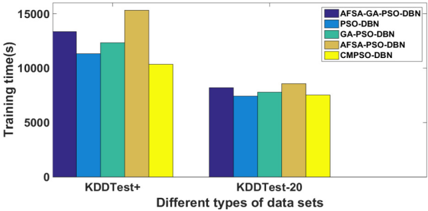
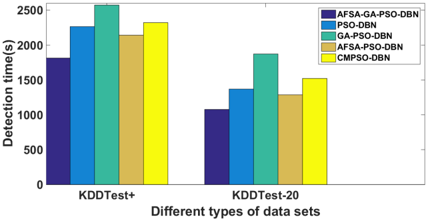
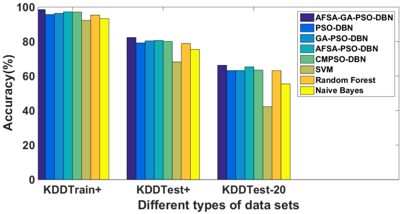
The rapid development and popularization of the network have brought many problems to network security. Intrusion detection technology is often used as an effective security technology to protect the network. The deep belief network (DBN), as a classic model of deep learning, has good classification performance and is often used in the field of intrusion detection. However, the network structure of DBN is generally set through practical experience. For the optimization problem of the DBN-based intrusion detection classification model (DBN-IDS), this paper proposes a new joint optimization algorithm to optimize the DBN's network structure. First, we design a particle swarm optimization (PSO) based on the adaptive inertia weight and learning factor. Second, we use the fish swarm behavior of cluster, foraging, and other behaviors to optimize the PSO to find the initial optimization solution. Then, based on the initial optimization solution, we use the genetic operators with self-adjusting crossover probability and mutation probability to optimize the PSO to search the global optimization solution. Finally, the global optimization solution constructed by the above-mentioned joint optimization algorithm is used as the network structure of the intrusion detection classification model. The experimental results show that compared with other DBN-IDS optimization algorithms, our algorithm shortens the average detection time by at least 24.69% on the premise of increasing the average training time by 6.9%; compared with the tested classification algorithms, our DBN-IDS improves the average classification accuracy by at least 1.3% and up to 14.80% in the five-category classification, which is proved to be an efficient DBN-IDS optimization method.
Overview
The claims and statistics of this paper haven’t been checked yet.
Free: it reads the open-access text and checks the first 5 claims that cite a source we can check. Create a free account to check every claim.
Integrity signals
Registry
Cites
Statistics
Figures





Verification
Claims the paper makes
The claims and statistics of this paper haven’t been checked yet.
Free: it reads the open-access text and checks the first 5 claims that cite a source we can check. Create a free account to check every claim.
Self-check
Percentages, sums and reported differences re-computed from the paper’s own numbers.
The self-check needs the paper’s full text.
Citations
Cites
Chen, F.-C., & Jahanshahi, M. R. (2018) · IEEE Transactions on Industrial Electronics · doi:10.1109/tie.2017.2764844 · Cited by 930
Wang, W., Sheng, Y., Wang, J., Zeng, X., Ye, X., Huang, Y., & Zhu, M. (2018) · IEEE Access · doi:10.1109/access.2017.2780250 · Cited by 655
Fuzziness based semi-supervised learning approach for intrusion detection system
Ashfaq, R. A. R., Wang, X.-Z., Huang, J. Z., Abbas, H., & He, Y.-L. (2017) · Information Sciences · doi:10.1016/j.ins.2016.04.019 · Cited by 552
Deep Learning Approach Combining Sparse Autoencoder With SVM for Network Intrusion Detection
Al-Qatf, M., Lasheng, Y., Al-Habib, M., & Al-Sabahi, K. (2018) · IEEE Access · doi:10.1109/access.2018.2869577 · Cited by 550
An Intrusion Detection Model Based on Deep Belief Networks
Gao, N., Gao, L., Gao, Q., & Wang, H. (2014) · 2014 Second International Conference on Advanced Cloud and Big Data · doi:10.1109/cbd.2014.41 · Cited by 293
A Set-Based Genetic Algorithm for Interval Many-Objective Optimization Problems
Gong, D., Sun, J., & Miao, Z. (2018) · IEEE Transactions on Evolutionary Computation · doi:10.1109/tevc.2016.2634625 · Cited by 261
Network Anomaly Detection: A Machine Learning Perspective
Bhattacharyya, D. K., & Kalita, J. K. (2013) · Cited by 187
Introducing Deep Learning Self-Adaptive Misuse Network Intrusion Detection Systems
Papamartzivanos, D., Gomez Marmol, F., & Kambourakis, G. (2019) · IEEE Access · doi:10.1109/access.2019.2893871 · Cited by 174
A DBN-based resampling SVM ensemble learning paradigm for credit classification with imbalanced data
Yu, L., Zhou, R., Tang, L., & Chen, R. (2018) · Applied Soft Computing · doi:10.1016/j.asoc.2018.04.049 · Cited by 161
An Adaptive-PSO-Based Self-Organizing RBF Neural Network
Han, H., Lü, W., Hou, Y., & Qiao, J. (2016) · IEEE Transactions on Neural Networks and Learning Systems · doi:10.1109/tnnls.2016.2616413 · Cited by 156
Intrusion Detection Using Deep Belief Network and Probabilistic Neural Network
Zhao, G., Zhang, C., & Zheng, L. (2017) · 22017 IEEE International Conference on Computational Science and Engineering (CSE) and IEEE International Conference on Embedded and Ubiquitous Computing (EUC) · doi:10.1109/cse-euc.2017.119 · Cited by 149
Bhattacharyya, D. K., & Kalita, J. K. (2013) · Chapman & Hall/CRC eBooks · doi:10.1201/b15088 · Cited by 141
Self-generation RBFNs using evolutional PSO learning
Feng, H.-M. (2006) · Neurocomputing · doi:10.1016/j.neucom.2006.03.007 · Cited by 132
An improved genetic algorithm for numerical function optimization
Song, Y., Wang, F., & Chen, X. (2018) · Applied Intelligence · doi:10.1007/s10489-018-1370-4 · Cited by 126
Learning Subspace-Based RBFNN Using Coevolutionary Algorithm for Complex Classification Tasks
Tian, J., Li, M., Chen, F., & Feng, N. (2015) · IEEE Transactions on Neural Networks and Learning Systems · doi:10.1109/tnnls.2015.2411615 · Cited by 49
Particle Swarm Optimisation with genetic operators for feature selection
Nguyen, B. H., Xue, B., Andreae, P. M., & Zhang, M. (2017) · IEEE Congress on Evolutionary Computation (CEC) · doi:10.1109/cec.2017.7969325 · Cited by 48
Zhou, G. T., Li, Y., He, Y., Wang, X., & Yu, M. (2018) · IET Communications · doi:10.1049/iet-com.2017.0149 · Cited by 39
Self-citationPSO-BPNN-Based Prediction of Network Security Situation
Lin, Z., Chen, G., Guo, W., & Liu, Y. (2008) · International Conference on Innovative Computing, Information and Control · doi:10.1109/icicic.2008.436 · Cited by 27
Approach to WTA in air combat using IAFSA-IHS algorithm
Zhanwu, L. I., Chang, Y., Kou, Y., Yang, H., An, X., & Li, Y. (2018) · Journal of Systems Engineering and Electronics · doi:10.21629/jsee.2018.03.09 · Cited by 19
Self-citationRate-coded DBN: An online strategy for spike-based deep belief networks
Fatahi, M., Shahsavari, M., Ahmadi, M., Ahmadi, A., Boulet, P., & Devienne, P. (2018) · Biologically Inspired Cognitive Architectures · doi:10.1016/j.bica.2018.04.009 · Cited by 12
Research works printed but not linked: 7
- zhan, 2015, The applications of deep learning on traffic identification, Proceedings of BlackHat, 1411
- bao, 2006, Intrusion detection based on KCPA and SVM, Applied Soft Computing, 2, 125
- wei, 2018, Research on optimal strategy of multi-stage intrusion detection game in WSNs, J Electron Inf Technol, 40, 63
- liu, 2011, Research on inertia weight control method based on particle swarm optimization algorithm, J Nanjing Univ Natural Sci Ed, 47, 364
- qiang, 2012, VNE-AFS: Network virtualization mapping algorithm based on artificial fish stocks, Trans Commun, 1, 170
- 2016, Weka 3-Data Mining with Open Source Machine Learning Software in Java
- 2018, The UCI KDD Archive ’ Department of Information and Computer Science
Cited by
Machine learning: Algorithms, real-world applications and research directions
Sarker, I. H. (2021) · SN Computer Science · doi:10.1007/s42979-021-00592-x · Cited by 5,583
Sarker, I. H. (2021) · SN Computer Science · doi:10.1007/s42979-021-00815-1 · Cited by 2,678
Ahmad, Z., Shahid Khan, A., Wai Shiang, C., Abdullah, J., & Ahmad, F. (2021) · Transactions on Emerging Telecommunications Technologies · doi:10.1002/ett.4150 · Cited by 1,288
“Figure 3 depicts a passive deployment of NIDS, where it is connected to a network switch configured with the port mirroring technology.”
MethodInfluentialSarker, I. H. (2021) · SN Computer Science · doi:10.1007/s42979-021-00765-8 · Cited by 570
Mishra, N., & Pandya, S. (2021) · IEEE Access · doi:10.1109/access.2021.3073408 · Cited by 421
“Wei et al. [157] structure is acquired by comparing the DBN structure from five optimization algorithms.”
Method
Metadata
- Authors
- Wei, P., Li, Y., Zhang, Z., Hu, T., Li, Z., & Liu, D.
- Affiliations
- Shanghai University (CN)
- Venue
- IEEE Access
- Published
- 2019
- Volume
- 7
- Pages
- 87593-87605
- ISSN
- 2169-3536 (ISSN-L)
- OpenAlex
- W2960015156
- Cited by
- 144
- References
- 20
- Citations by year
- 2026: 7 · 2025: 18 · 2024: 23 · 2023: 29 · 2022: 31 · 2021: 22 · 2020: 13 · 2019: 1
- FWCI
- 9.17
- Type
- journal article
- Language
- en
- Open access
- gold
- doi.org
- Locations
- IEEE Access (publishedVersion, cc-by)
- DOAJ (DOAJ: Directory of Open Access Journals) (submittedVersion, cc-by-sa)
- Funders
- Research and Development Program in Key Areas of Guangdong Province (2018B010113001)
- National Key Research and Development Program of China (2017YFB0803201)
- National Natural Science Foundation of China (61521003)
- Topics
- Physical Sciences › Computer Science › Computer Networks and Communications › Network Security and Intrusion Detection
- Physical Sciences › Computer Science › Artificial Intelligence › Artificial Immune Systems Applications
- Physical Sciences › Computer Science › Hardware and Architecture › Network Packet Processing and Optimization
- Keywords
- intrusion detection, deep belief network, network structure optimization, particle swarm optimization, adaptive inertia weight, artificial fish swarm algorithm, network security, intrusion classification
About these checks
Registry, retraction, Cites and statistics results are computed, not judged, with one exception: a printed reference that no index lists is read once by a model before it counts as a citation error. Claims are extracted by a model and kept only when their quote appears verbatim in the text; each cited source is then checked, with a model’s help, for whether it says what the claim relies on. Those verdicts can be wrong — read the claim’s quote and the cited source before relying on one.
Statistics and arithmetic are recomputed, not judged.
Confidence bands are shown only for fields calibrated on our annotated test set. None is calibrated yet, so no band is shown.
What counts as a claim ›How we measure confidence ›How we check this ›
Are you an author, or do you see a problem with this page? Request a review
Data sources
Bibliographic data: Semantic Scholar, OpenAlex, Crossref.
Contains information from the Semantic Scholar Academic Graph Datasets, made available under the ODC Attribution License (ODC-BY 1.0).
Semantic Scholar’s data is described in: Kinney, R., et al. (2023). The Semantic Scholar Open Data Platform. arXiv:2301.10140.
