

Pixel-Based Image Encryption Without Key Management for Privacy-Preserving Deep Neural Networks
Open accessThe DOI matches its Crossref record; 48 of the 52 references it cites were found in a registry or an index.
Abstract
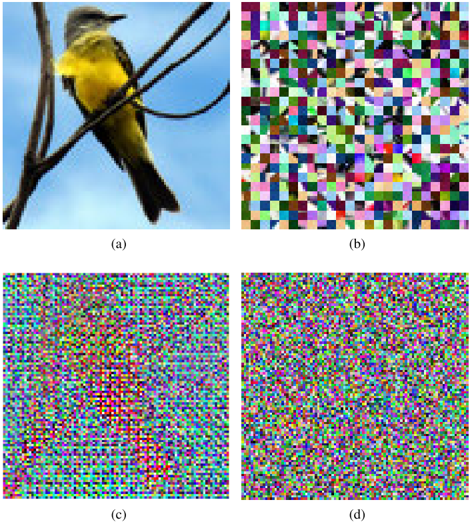
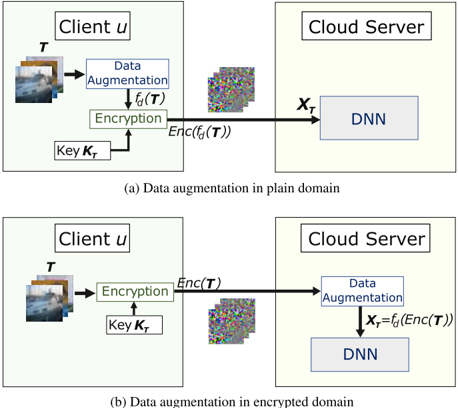
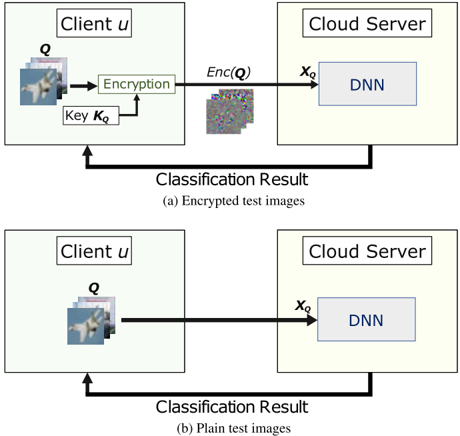
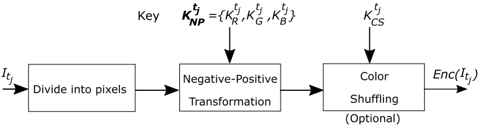
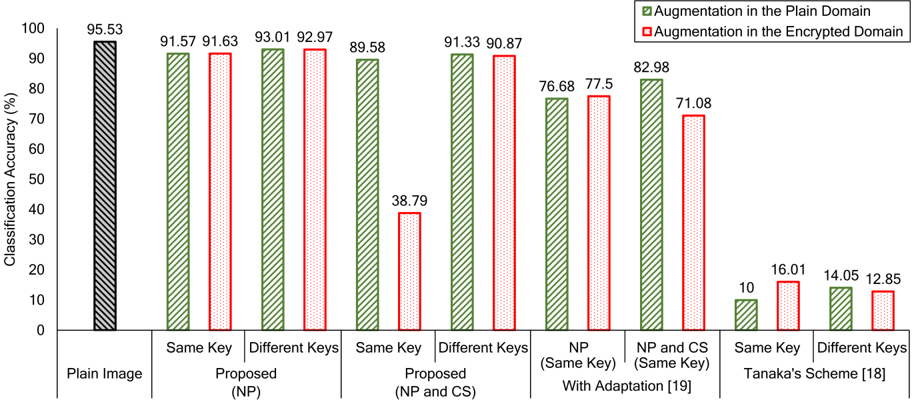
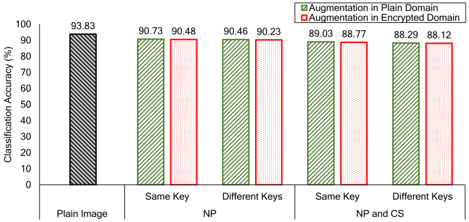
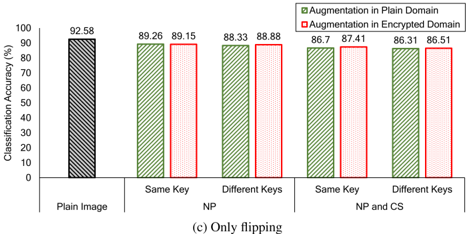
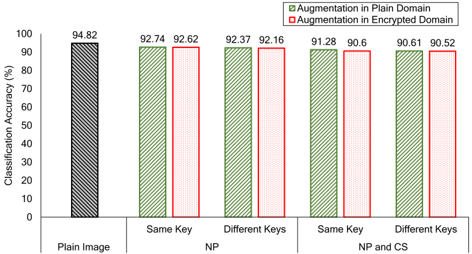
We present a novel privacy-preserving scheme for deep neural networks (DNNs) that enables us not to only apply images without visual information to DNNs but to also consider the use of independent encryption keys for both training and testing images for the first time. In this paper, a novel pixel-based image encryption method that maintains important features of original images is proposed for privacy-preserving DNNs. For training, a DNN model is trained with images encrypted by using the proposed method with independent encryption keys. For testing, the model enables us to apply both encrypted images and plain images for image classification. Therefore, there is no need to manage keys. In addition, the proposed method allows us to perform data augmentation in the encrypted domain. In an experiment, the proposed method is applied to well-known networks, that is, deep residual networks and densely connected convolutional networks, for image classification. The experimental results demonstrate that the proposed method, under the use of independent encryption keys, can maintain a high classification performance, and it is robust against ciphertext-only attacks (COAs). Moreover, the results confirm that the proposed scheme is able to classify plain images as well as encrypted images, even when data augmentation is carried out in the encrypted domain.
Overview
The claims and statistics of this paper haven’t been checked yet.
Free: it reads the open-access text and checks the first 5 claims that cite a source we can check. Create a free account to check every claim.
Integrity signals
Registry
Cites
Statistics
Figures





Verification
Claims the paper makes
The claims and statistics of this paper haven’t been checked yet.
Free: it reads the open-access text and checks the first 5 claims that cite a source we can check. Create a free account to check every claim.
Claims other papers make about this one
Each is checked against this paper’s own text: does it say what the citing paper says it does?
The source backs part of the claim, not all of it — or backs it for a different population, condition or comparison.
In the citing paper
“The local spatial structure of the local regions might be destroyed by the shuf ing of the pixels in an image, which prevents the network from extracting valuable features.”
From Generalization of Forgery Detection With Meta Deepfake Detection Model (2023) · cites this paper as [53]
Experimental — accuracy not yet measured
Self-check
Percentages, sums and reported differences re-computed from the paper’s own numbers.
The self-check needs the paper’s full text.
Citations
Cites
Deep Residual Learning for Image Recognition
He, K., Zhang, X., Ren, S., & Sun, J. (2016) · 2016 IEEE Conference on Computer Vision and Pattern Recognition (CVPR) · doi:10.1109/cvpr.2016.90 · Cited by 235,474
ImageNet classification with deep convolutional neural networks
Krizhevsky, A., Sutskever, I., & Hinton, G. E. (2017) · Communications of the ACM · doi:10.1145/3065386 · Cited by 112,155
LeCun, Y., Bengio, Y., & Hinton, G. (2015) · Nature · doi:10.1038/nature14539 · Cited by 84,126
Densely Connected Convolutional Networks
Huang, G., Liu, Z., Van Der Maaten, L., & Weinberger, K. Q. (2017) · 2017 IEEE Conference on Computer Vision and Pattern Recognition (CVPR) · doi:10.1109/cvpr.2017.243 · Cited by 48,566
Learning Multiple Layers of Features from Tiny Images
Krizhevsky, A. (2024) · doi:10.57702/zp44cu3g · Cited by 23,395
Identity mappings in deep residual networks
He, K., Zhang, X., Ren, S., & Sun, J. (2016) · Lecture Notes in Computer Science · doi:10.1007/978-3-319-46493-0_38 · Cited by 10,741
Towards Evaluating the Robustness of Neural Networks
Carlini, N., & Wagner, D. (2017) · 2017 IEEE Symposium on Security and Privacy (SP) · doi:10.1109/sp.2017.49 · Cited by 8,859
Intriguing properties of neural networks
Szegedy, C., Zaremba, W., Sutskever, I., Bruna, J., Erhan, D., Goodfellow, I., & Fergus, R. (2013) · arXiv · doi:10.48550/arxiv.1312.6199 · Cited by 8,143
Towards Deep Learning Models Resistant to Adversarial Attacks
Madry, A., Makelov, A., Schmidt, L., Tsipras, D., & Vladu, A. (2017) · arXiv · doi:10.48550/arxiv.1706.06083 · Cited by 6,602
Membership Inference Attacks Against Machine Learning Models
Shokri, R., Stronati, M., Song, C., & Shmatikov, V. (2017) · 2017 IEEE Symposium on Security and Privacy (SP) · doi:10.1109/sp.2017.41 · Cited by 4,754 · cited 1×
“One is membership inference [23], which has been proposed to identify whether a data record was trained by a model.”
Background
Research works printed but not linked: 1
- szegedy, 2013, Intriguing properties of neural networks, arXiv 1312 6199
Cited by
Items 101–111 of 111
Systematic review of modern image encryption techniques: Emerging trends in digital security
Chaudhary, A., Ramu, N., Suneetha, K., Singh, T., Louis, M. T., & Nayak, P. P. (2025) · Multidisciplinary Reviews · doi:10.31893/multirev.2025ss0125
Study of Encryption Techniques for Secure Computation on Images Without Compromising Privacy
Srivani, N., Devi, K. Y., Anusha, P., Chary, P. D., Kumar, Y. R., & Jyothsna, K. (2025) · IEEE International Conference on Advanced Computing Technologies (ICACT) · doi:10.1109/icact67549.2025.11351501
Adaptive compressed domain video encryption
Ghasempour, M., yuan, Y., Amirpour, H., He, H., & Timmerer, C. (2026) · Expert Systems with Applications · doi:10.1016/j.eswa.2026.131360
Privacy-Preserving Transfer Learning using Learnable Encryption
Ahmad, I., Kim, J., & Shin, S. (2025) · International Conference on Information and Communication Technology Convergence (ICTC) · doi:10.1109/ictc66702.2025.11389013
Traitement dans le domaine chiffré par l'intelligence artificielle
Saj, R. E. (2023) · theses.fr (ABES) · doi:10.70675/fc22f63dze074z433dz9f5ezcd79b43ba3d8 · Cited by 1
Privacy-Preserving Clothing Classification Using Vision Transformer for Thermal Comfort Estimation
Chuman, T., Udagawa, Y., & Kiya, H. (2026) · IEEE International Conference on Consumer Electronics - Taiwan (ICCE-Taiwan) · doi:10.1109/icce-taiwan71481.2026.11652588
Self-citationA Lightweight Deep Learning based Image Encryption System for Secure Telemedicine Applications
S, P. V., & Juliet, A. H. (2025) · International Conference on Sustainable Computing and Smart Systems (ICSCSS) · doi:10.1109/icscss64956.2025.11500781
An Overview of Format-Compliant Encryption for Images Distributed via Cloud Platforms
Shimizu, K. (2026) · IEICE ESS FUNDAMENTALS REVIEW · doi:10.1587/essfr.20.1_15
Ahmad, I., Kim, J., & Shin, S. (2026) · IEEE Internet of Things Journal · doi:10.1109/jiot.2026.3718530
Beyond Classification: Task-Dependent Learnability under Privacy-Motivated Image TransformationsPreprint
Ranke, L., Hübner, W., Hug, R., Arens, M., & Beyerer, J. (2026) · arXiv (Cornell University) · doi:10.48550/arxiv.2608.27066
Saini, A., & Sehrawat, R. (2026) · Optical Memory and Neural Networks · doi:10.3103/s1060992x26700098
Metadata
- Authors
- Sirichotedumrong, W., Kinoshita, Y., & Kiya, H.
- Affiliations
- Tokyo Metropolitan University (JP)
- Venue
- IEEE Access
- Published
- 2019
- Volume
- 7
- Pages
- 177844-177855
- ISSN
- 2169-3536 (ISSN-L)
- OpenAlex
- W2995164854
- Cited by
- 105
- References
- 52
- Citations by year
- 2026: 4 · 2025: 12 · 2024: 17 · 2023: 16 · 2022: 21 · 2021: 19 · 2020: 16
- FWCI
- 6.26
- Type
- journal article
- Language
- en
- Open access
- gold
- doi.org
- Locations
- IEEE Access (publishedVersion, cc-by)
- DOAJ (DOAJ: Directory of Open Access Journals) (submittedVersion, cc-by-sa)
- Funders
- Japan Society for the Promotion of Science (17H03267)
- Topics
- Physical Sciences › Computer Science › Computer Vision and Pattern Recognition › Chaos-based Image/Signal Encryption
- Physical Sciences › Computer Science › Computer Networks and Communications › Cryptography and Data Security
- Physical Sciences › Computer Science › Artificial Intelligence › Cryptographic Implementations and Security
- Keywords
- key management, ciphertext-only attack, ResNet, DenseNet, image privacy
About these checks
Registry, retraction, Cites and statistics results are computed, not judged, with one exception: a printed reference that no index lists is read once by a model before it counts as a citation error. Claims are extracted by a model and kept only when their quote appears verbatim in the text; each cited source is then checked, with a model’s help, for whether it says what the claim relies on. Those verdicts can be wrong — read the claim’s quote and the cited source before relying on one.
Statistics and arithmetic are recomputed, not judged.
Confidence bands are shown only for fields calibrated on our annotated test set. None is calibrated yet, so no band is shown.
What counts as a claim ›How we measure confidence ›How we check this ›
Are you an author, or do you see a problem with this page? Request a review
Data sources
Bibliographic data: Semantic Scholar, OpenAlex, Crossref.
Contains information from the Semantic Scholar Academic Graph Datasets, made available under the ODC Attribution License (ODC-BY 1.0).
Semantic Scholar’s data is described in: Kinney, R., et al. (2023). The Semantic Scholar Open Data Platform. arXiv:2301.10140.
