

Data Fusion for Intelligent Crowd Monitoring and Management Systems: A Survey
Open accessThe DOI matches its Crossref record; 85 of the 86 references it cites were found in a registry or an index.
Abstract
Intelligent Crowd Monitoring and Management Systems (ICMMSs) have become effective resources for strengthening safety and security along with enhancing early-warning capabilities to manage emergencies in crowded situations of smart cities and massive gatherings events. The main advantage of such systems is their ability to detect multiple features associated with the crowd gathering, as they enable multi-source sensors, multi-modal data, and powerful intelligent and analytical methods. Unlike traditional crowd monitoring systems, which make use of simplex forms of different data types, data and information associated with crowded scenarios can be collected, fused, processed and analyzed in large quantities for accurate global assessment and enhanced decision making processes in an ICMMS. Therefore, data fusion is introduced as an enabler to decrease data quantity, reduce data dimensions, and improve data quality. In this paper, we first survey the literature on data fusion application in crowd monitoring systems as we are developing a state-of-the-art ICMMS with data fusion as a major platform enabler. Next, we discuss some popular data fusion architectures and classifications from different perspectives. Based on this, we propose a multi-sensor, multi-modal, and dimensional ICMMS architecture based on data fusion. Then, we identify the data fusion processes in the ICMMS and classify them into sensor fusion, feature-based data fusion, and decision fusion. Relevant algorithms, applications and examples of three classes are elaborated. Finally, future data fusion research directions are discussed.
Overview
The claims and statistics of this paper haven’t been checked yet.
Free: it reads the open-access text and checks the first 5 claims that cite a source we can check. Create a free account to check every claim.
Integrity signals
Registry
Cites
Statistics
Figures





Verification
Claims the paper makes
The claims and statistics of this paper haven’t been checked yet.
Free: it reads the open-access text and checks the first 5 claims that cite a source we can check. Create a free account to check every claim.
Claims other papers make about this one
Each is checked against this paper’s own text: does it say what the citing paper says it does?
The source backs part of the claim, not all of it — or backs it for a different population, condition or comparison.
In the citing paper
“Among the commonly adopted approaches (i.e., statistical, probabilistic, and data-driven ones [58]), probabilistic-based methods seem to be more suitable in our scenario.”
From Sensing Technologies for Crowd Management, Adaptation, and Information Dissemination in Public Transportation Systems: A Review (2023) · cites this paper as [58]
Experimental — accuracy not yet measured
Self-check
Percentages, sums and reported differences re-computed from the paper’s own numbers.
The self-check needs the paper’s full text.
Citations
Cites
An Introduction to the Kalman Filter
Welch, G., & Bishop, G. (1995) · CiteSeer X (The Pennsylvania State University) · Cited by 7,039
No-Reference Image Quality Assessment in the Spatial Domain
Mittal, A., Moorthy, A. K., & Bovik, A. C. (2012) · IEEE Transactions on Image Processing · doi:10.1109/tip.2012.2214050 · Cited by 6,064 · cited 1×
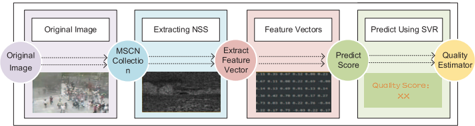
“The BRISQUE algorithm [63] can be used to train an offline eval-uator and is configured at the software layer for calling.”
MethodChen, M., Mao, S., & Liu, Y. (2014) · Mobile Networks and Applications · doi:10.1007/s11036-013-0489-0 · Cited by 2,913
An introduction to multisensor data fusion
Hall, D. L., & Llinas, J. (1997) · Proceedings of the IEEE · doi:10.1109/5.554205 · Cited by 2,629
Bleiholder, J., & Naumann, F. (2009) · ACM Computing Surveys · doi:10.1145/1456650.1456651 · Cited by 1,838 · cited 1×
“with data fusion [46] have great advantages in many aspects, such as space coverage, monitoring time span, data redundancy, data source reliability, system robustness, data complexity, storage resources, computing performance requirements, and application services [47].”
BackgroundDistributed Detection and Data Fusion
Varshney, P. K. (1997) · Springer eBooks · doi:10.1007/978-1-4612-1904-0 · Cited by 1,788
A Review of Data Fusion Techniques
Castanedo, F. (2013) · The Scientific World Journal · doi:10.1155/2013/704504 · Cited by 1,027 · cited 1×
“Therefore, some research has been conducted on data fusion classification according to different system structures [7], [40], [41].”
BackgroundHandbook of multisensor data fusion
Hall, D. L., & Llinas, J. (2001) · CRC Press eBooks · Cited by 784
Sensor fusion potential exploitation-innovative architectures and illustrative applications
Dasarathy, B. V. (1997) · Proceedings of the IEEE · doi:10.1109/5.554206 · Cited by 498 · cited 1×
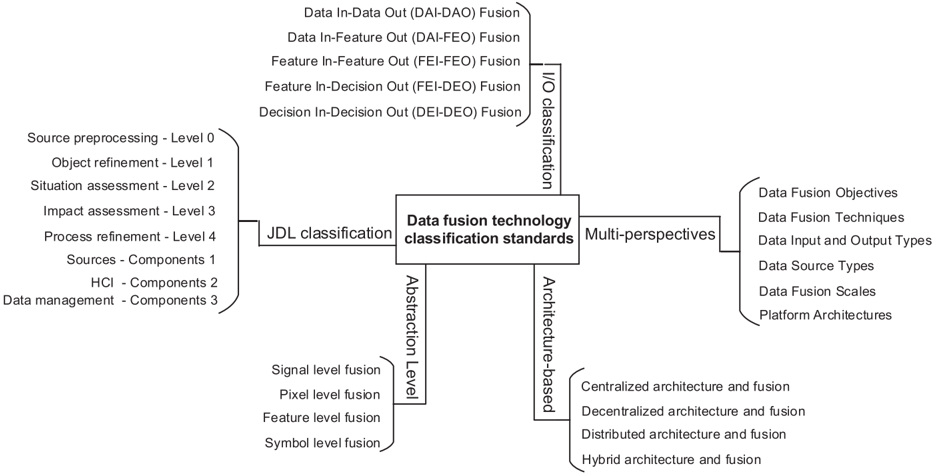
“To provide an unambiguous classification standard for many uncertain or ambiguous data fusion types, Dasarathy divided data fusion architecture into five processes based on I/O characterization and categories of data, features, and decision-making in 1997 [36], [37].”
MethodData fusion in robotics and machine intelligence
Abidi, M. A., & Gonzalez, R. C. (1992) · Academic Press Professional, Inc. eBooks · Cited by 447
Research works printed but not linked: 3
- 72. B. V. Dasarathy, Decision Fusion. Washington, DC, USA: IEEE Computer Society Press, 1993.
- 82. QIAO YU is currently a Senior Student with the Huazhong University of Science and Technology. During the University, she has won a variety of scholarships, and also achieved good results in scientific research and competition. In Septem- ber 2018, she successfully recommended for admission to the Huazhong University of Sci- ence and Technology to become the Doctor of the Embedded and Pervasive Computing (EPIC) Lab for learning and scientific research. BANDER ALZAHRANI (Member, IEEE) received the M.Sc. degree in computer security and the Ph.D. degree in computer science from the Univer- sity of Essex, U.K., in 2010 and 2015, respectively. He is currently an Associate Professor with the Faculty of Computing and Information Technol- ogy, King Abdulaziz University, Saudi Arabia. He has led more than ten national research projects and coauthored more than 45 research articles in peer reviewed journals and conferences. His current research interests include WSN, ICN, and secure content routing.
- 5. J. E. Mallah, F. Carrino, O. A. Khaled, and E. Mugellini, ''Crowd monitor- ing,'' in Distributed, Ambient, and Pervasive Interactions, N. Streitz and P. Markopoulos, Eds. Cham, Switzerland: Springer, 2015, pp. 496-505.
Cited by
Aboualola, M., Abualsaud, K., Khattab, T. M., Zorba, N., & Hassanein, H. S. (2023) · IEEE Access · doi:10.1109/access.2023.3293035 · Cited by 166
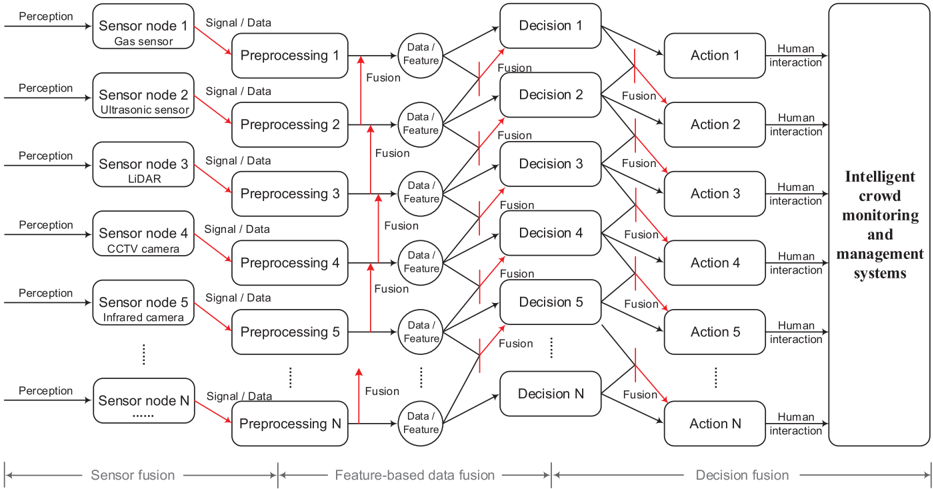
“The focus of [7] is to evaluate the usage of data fusion in crowd monitoring system, to create an intelligent crowd monitoring and management systems through data fusion designs.”
BackgroundResearch Advancements in Key Technologies for Space-Based Situational Awareness
Wang, B., Li, S., Mu, J., Hao, X., Zhu, W., & Hu, J. (2022) · Space Science & Technology · doi:10.34133/2022/9802793 · Cited by 128
“Based on the relative research on data fusion [62 – 64], the process primarily consists of data collection, signal conversion, preprocessing, feature extraction, and fusion algorithms [65, 66].”
MethodDarsena, D., Gelli, G., Iudice, I., & Verde, F. (2023) · IEEE Sensors Journal · doi:10.1109/jsen.2022.3223297 · Cited by 71
“, statistical, probabilistic, and data-driven ones [58]), probabilistic-based methods seem to be more suitable in our scenario.”
BackgroundNon-contact multimodal indoor human monitoring systems: A survey
Nguyen, L. N., Susarla, P., Mukherjee, A., Cañellas, M. L., Casado, C. Á., Wu, X., Sílven, O., Jayagopi, D. B., & López, M. B. (2024) · Information Fusion · doi:10.1016/j.inffus.2024.102457 · Cited by 52
SIMCD: SIMulated crowd data for anomaly detection and prediction
Bamaqa, A., Sedky, M., Bosakowski, T., Bastaki, B. B., & Alshammari, N. O. (2022) · Expert Systems with Applications · doi:10.1016/j.eswa.2022.117475 · Cited by 49
Metadata
- Authors
- Li, X., Yu, Q., Alzahrani, B., Barnawi, A., Alhindi, A., Alghazzawi, D., & Miao, Y.
- Affiliations
- Chinese University of Hong Kong (HK)
- King Abdulaziz University (SA)
- Huazhong University of Science and Technology (CN)
- ORCID
- Venue
- IEEE Access
- Published
- 2021
- Volume
- 9
- Pages
- 47069-47083
- ISSN
- 2169-3536 (ISSN-L)
- OpenAlex
- W3130416586
- Cited by
- 49
- References
- 86
- Citations by year
- 2026: 8 · 2025: 10 · 2024: 14 · 2023: 5 · 2022: 12
- FWCI
- 2.79
- Type
- journal article
- Language
- en
- Open access
- gold
- doi.org
- Locations
- IEEE Access (publishedVersion, cc-by)
- DOAJ (DOAJ: Directory of Open Access Journals) (submittedVersion, cc-by-sa)
- Funders
- Deputyship for Research & Innovation, Ministry of Education in Saudi Arabia (227)
- Topics
- Physical Sciences › Computer Science › Computer Vision and Pattern Recognition › Video Surveillance and Tracking Methods
- Physical Sciences › Computer Science › Artificial Intelligence › Target Tracking and Data Fusion in Sensor Networks
- Physical Sciences › Computer Science › Computer Science Applications › Mobile Crowdsensing and Crowdsourcing
- Keywords
- data fusion, sensor fusion, decision fusion, multi-sensor systems, multimodal data, smart cities, emergency management
About these checks
Registry, retraction, Cites and statistics results are computed, not judged, with one exception: a printed reference that no index lists is read once by a model before it counts as a citation error. Claims are extracted by a model and kept only when their quote appears verbatim in the text; each cited source is then checked, with a model’s help, for whether it says what the claim relies on. Those verdicts can be wrong — read the claim’s quote and the cited source before relying on one.
Statistics and arithmetic are recomputed, not judged.
Confidence bands are shown only for fields calibrated on our annotated test set. None is calibrated yet, so no band is shown.
What counts as a claim ›How we measure confidence ›How we check this ›
Are you an author, or do you see a problem with this page? Request a review
Data sources
Bibliographic data: Semantic Scholar, OpenAlex, Crossref.
Contains information from the Semantic Scholar Academic Graph Datasets, made available under the ODC Attribution License (ODC-BY 1.0).
Semantic Scholar’s data is described in: Kinney, R., et al. (2023). The Semantic Scholar Open Data Platform. arXiv:2301.10140.
