

Decentralized and Self-Sovereign Identity: Systematic Mapping Study
Open accessThe DOI matches its Crossref record; 129 of the 129 references it cites were found in a registry or an index; 12 of the 54 sources its claims cite were checked for support.
Abstract
Self-Sovereign Identity is an emerging, user-centric, decentralized identity approach utilizing some form of decentralized technology. It provides a means for digital identification without reliance on any external authority, enabling entities to control their identity and data flow during digital interactions while enhancing security and privacy. With the rise of blockchain technology, Self-Sovereign Identity is gathering momentum in academia and industry while the number of research papers increases rapidly. Yet Self-Sovereign Identity is still in a young unstructured field in its early stages of research. Thus, a systematic mapping methodology was adopted to provide a coarse-grained overview of decentralized and Self-Sovereign Identity and structure the research area by identifying, analyzing, and classifying the research papers according to predefined parameters, precisely according to their contribution, application domain, IT field, research type, research method, and place of publication. Furthermore, the nature and scope of the research are determined, meanwhile existing research topics, gained insights into trends, demographics, challenges, gaps, and opportunities for future research are also presented.
Overview
CoChat Summary
TL;DR
This paper is a systematic mapping study of decentralized identity and Self-Sovereign Identity (SSI) research, classifying 120 included papers to map contributions, domains, IT fields, research types, methods, and publication venues. It finds rapid growth in the literature, with most work still concentrated on validation/solution proposals, systems/architectures, and general rather than domain-specific applications.
Key findings
- The review included 120 papers: 108 (90%) from IEEE Xplore and 12 (10%) from ScienceDirect. The number of papers grew by 83.3% from 2017 to 2018, 58.6% from 2018 to 2019, 50.0% from 2019 to 2020, and 96.7% overall from 2017 to 2021.
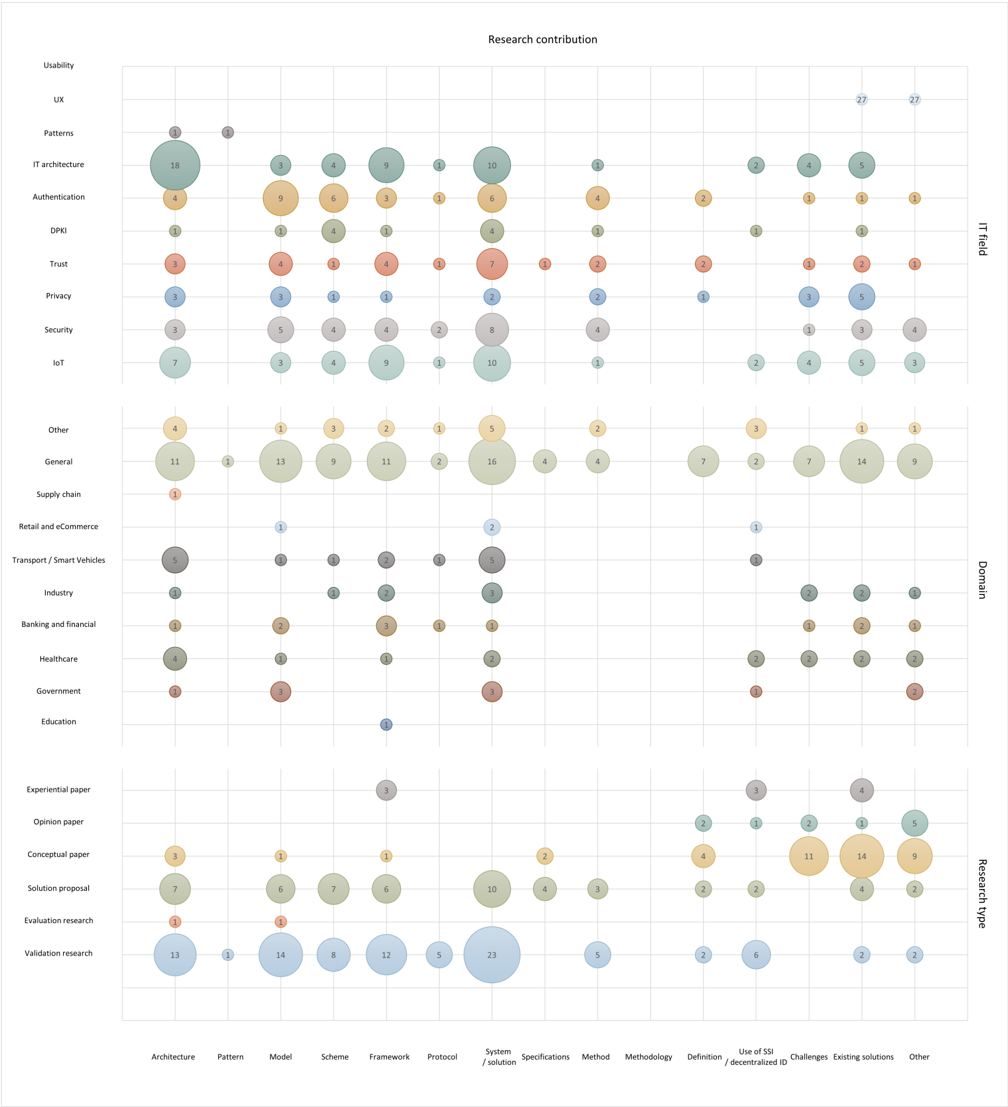
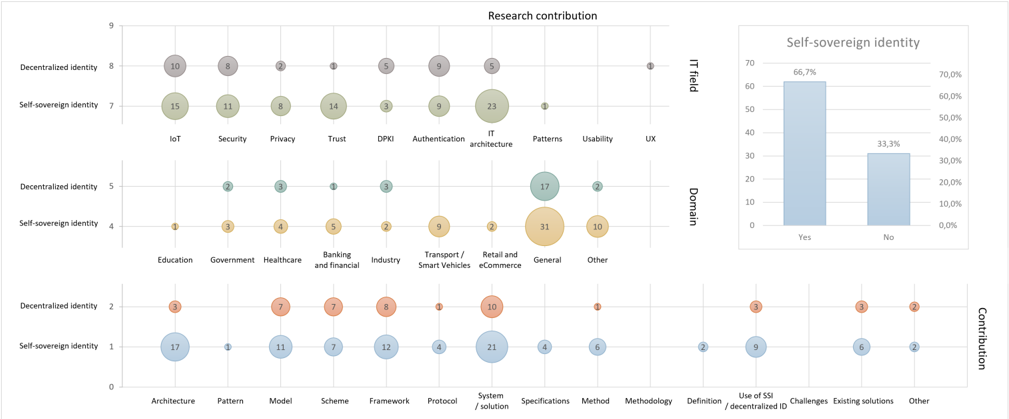
- The dominant contribution types were system/solution (32 studies, 26.7%), architecture (22, 18.3%), and framework (22, 18.3%); secondary papers most often compare/evaluate existing solutions (22, 18.3%).
- By research type, validation research (57 studies, 47.5%) and solution proposals (36, 30.0%) dominated; by method, prototyping was the most common, producing proofs of concept (40.0%).
- The field is still mostly general-purpose: 69 studies (57.5%) addressed decentralized identity in general, while specific domains included IoT (29 studies, 24.2%), transport/smart vehicles (10, 8.3%), healthcare (9, 7.5%), and banking/finance (8, 6.7%).
Methods
- The paper conducted a systematic mapping study (SMS) to provide a coarse-grained overview and classify studies by contribution, domain, IT field, research type, research method, and place of publication.
- Search covered IEEE Xplore and ScienceDirect, using keywords such as “self-sovereign identity,” “decentralized identity,” “blockchain identity,” and “decentralized identifier,” with publication years limited to January 2013 to January 2021 and English papers only.
- Screening proceeded through database search, year/publication-type filtering, title/abstract/keyword screening, and full-text screening; 120 studies were retained for classification and mapping.
Limitations
- The paper explicitly states its scope was limited to two databases, English-language papers, and papers published between January 2013 and January 2021.
- It also notes that the search was conducted in January 2021, so papers added later would not be included.
- Evident from the method: the review may miss relevant work outside IEEE Xplore and ScienceDirect, and the mapping is only as complete as the selected keywords and screening criteria.
Model-written summary. Check it against the paper before relying on it.
Integrity signals
Registry
Cites
Statistics
Figures






Verification
Claims the paper makes
10 Valid · 6 Not valid · 26 Not checked · 82 Own results and interpretations
The cited sources support only part of this claim — read each source’s verdict below.
In the paper
“And usually relies on some form of decentralized ledger technology (DLT), blockchain, distributed file system, or another decentralized system, such as Hashgraphes and Tangle [12].”
§ Decentralized and Self-Sovereign Identity: Systematic Mapping Study > II. DECENTRALIZED IDENTITY
What the sources say
- Partly supportedcites [12] 12. L. Stockburger, G. Kokosioulis, A. Mukkamala, R. R. Mukkamala, and M. Avital, "Blockchain- enabled decentralized identity management: The case of self-sovereign identity in public transportation," Blockchain: Research and Applications, p. 100 014, 2021, ISSN: 2096-7209. DOI: https : / / doi . org / 10 . 1016/j.bcra.2021.100014. [Online]. Available: https: / / www . sciencedirect . com / science / article / pii / S2096720921000099. sourceExperimental — accuracy not yet measured
Our copy supports the core of the attribution: Section 2.3 ('Blockchain technology in identity management') describes a 'DLT-based SSI system' in which 'a distributed system relies on a shared ledger, which is validated and stored by several network nodes', and states that identity management networks 'utilize blockchain technology to eliminate the need for any intermediary as an identity provider'; Section 3.2.6 adds the distributed-file-system element ('uPort utilizes IPFS (InterPlanetary File System, a distributed file system) for storage'). However, the claim's final alternative — 'another decentralized system, such as Hashgraphes and Tangle' — is not stated: Hashgraph is absent from our copy entirely, and Tangle/IOTA appears only as a DLT used in one healthcare data-sharing study (Zheng et al., Section 3.1), not as a substrate that decentralized identity usually relies on. So the enumerated non-DLT/non-blockchain examples are attributed to a source that does not make that point. (LLM, conf=0.72)
plainstates an association- Asserted: passes — The authors put it forward as true.
- Checkable: passes — It can be checked against evidence.
- Load-bearing: unclear — It is unclear whether the paper’s conclusions depend on it.
- Based: passes — The paper gives a reason why it holds.
- Partly supported
The cited sources support only part of this claim — read each source’s verdict below.
In the paper
“However, the central IdP is accompanied by decentralized storage, where validated attestations are stored on a distributed ledger for later validation, presenting main differentiation [10].”
§ Decentralized and Self-Sovereign Identity: Systematic Mapping Study > II. DECENTRALIZED IDENTITY
What the sources say
- Partly supportedcites [10] 10. M. Schanzenbach, G. Bramm, and J. Schütte, "Re- claimid: Secure, self-sovereign identities using name systems and attribute-based encryption," in 2018 17th IEEE International Conference On Trust, Security And Privacy In Computing And Communications/ 12th IEEE International Conference On Big Data Science And Engineering (TrustCom/BigDataSE), 2018, pp. 946-957. DOI: 10 . 1109 / TrustCom / BigDataSE.2018.00134. sourceExperimental — accuracy not yet measured
Section II (p. 2) describes NameID as combining a central IdP with decentralized storage, and Related Work (p. 11) says its attributes are stored on the Namecoin blockchain. But Related Work explicitly says those attributes are self-issued, with no third party certifying them; the paper therefore does not support describing them as validated attestations. The paper also distinguishes NameID from its own reclaimID system, which has no central IdP (Introduction, p. 2). (LLM, conf=0.87)
plainstates an association- Asserted: passes — The authors put it forward as true.
- Checkable: passes — It can be checked against evidence.
- Load-bearing: unclear — It is unclear whether the paper’s conclusions depend on it.
- Based: passes — The paper gives a reason why it holds.
- Partly supported
The cited sources support only part of this claim — read each source’s verdict below.
In the paper
“Meanwhile, Gans et al. [49] focus on SSI possibilities for undocumented individuals during the pandemic.”
§ Decentralized and Self-Sovereign Identity: Systematic Mapping Study > (RQ2.2).
What the sources say
- Partly supportedcites [49] 49. M. Shuaib, S. Alam, M. Shahnawaz Nasir, and M. Shabbir Alam, "Immunity credentials using self- sovereign identity for combating covid-19 pan- demic," Materials Today: Proceedings, 2021, ISSN: 2214-7853. DOI: https : / / doi . org / 10 . 1016 / j . matpr . 2021 . 03 . 096. [Online]. Available: https : / / www . sciencedirect . com / science / article / pii / S2214785321021155. sourceExperimental — accuracy not yet measured
The title in our copy identifies the paper as a study of self-sovereign identity for COVID-19 immunity credentials, supporting the general SSI-and-pandemic connection. It names Mohammed and colleagues, not Gans et al., and the available passages do not address undocumented individuals. (LLM, conf=0.86)
plain- Asserted: passes — The authors put it forward as true.
- Checkable: passes — It can be checked against evidence.
- Load-bearing: unclear — It is unclear whether the paper’s conclusions depend on it.
- Based: passes — The paper gives a reason why it holds.
- Partly supported
The cited sources that could be checked couldn’t confirm or dispute this claim.
In the paper
“With the COVID-19 outbreak, the potential and the need for decentralized and Self-Sovereign Identities was further recognized [48][49][50][51] [52].”
§ Decentralized and Self-Sovereign Identity: Systematic Mapping Study > (RQ2.2).
What the sources say
- Not checked — no full text of the sourcecites [48] 48. A. Abraham, K. Theuermann, and E. Kirchengast, "Qualified eid derivation into a distributed ledger based idm system," in 2018 17th IEEE Interna- tional Conference On Trust, Security And Privacy In Computing And Communications/ 12th IEEE Inter- national Conference On Big Data Science And En- gineering (TrustCom/BigDataSE), 2018, pp. 1406- 1412. DOI: 10 . 1109 / TrustCom / BigDataSE . 2018 . 00195. source
- Could not verifycites [49] 49. M. Shuaib, S. Alam, M. Shahnawaz Nasir, and M. Shabbir Alam, "Immunity credentials using self- sovereign identity for combating covid-19 pan- demic," Materials Today: Proceedings, 2021, ISSN: 2214-7853. DOI: https : / / doi . org / 10 . 1016 / j . matpr . 2021 . 03 . 096. [Online]. Available: https : / / www . sciencedirect . com / science / article / pii / S2214785321021155. sourceExperimental — accuracy not yet measured
The available copy contains the paper’s title and a withdrawal notice, but no substantive discussion of whether COVID-19 increased recognition of the potential or need for decentralized, self-sovereign identities. Searches for that claim and for decentralized identity credentials returned no further passages. (LLM, conf=0.75)
- Not checked — no full text of the sourcecites [50] 50. R. B. Gans, J. Ubacht, and M. Janssen, "Self- sovereign identities for fighting the impact of covid- 19 pandemic," Digital Government: Research and Practice, vol. 2, no. 2, pp. 1-4, 2021. DOI: https : / / doi.org/10.1145/3429629. [Online]. Available: https: //dl.acm.org/doi/abs/10.1145/3429629. source
plainstates a cause- Asserted: passes — The authors put it forward as true.
- Checkable: passes — It can be checked against evidence.
- Load-bearing: unclear — It is unclear whether the paper’s conclusions depend on it.
- Based: passes — The paper gives a reason why it holds.
A result the paper reports from its own data — it cites no other source for it, so there is none to check. The quote shows it is in the paper.
In the paper
“there are hardly any studies addressing usability (0 studies)”
§ Decentralized and Self-Sovereign Identity: Systematic Mapping Study > (RQ2.2).
plain- Asserted: passes — The authors put it forward as true.
- Checkable: passes — It can be checked against evidence.
- Load-bearing: passes — The paper’s conclusions depend on it.
- Based: passes — The paper gives a reason why it holds.
59 more claims
Create a free account to see all 124 claims and to verify the 3 references still open.
- Probably not a substantial claim. 42
- It may state two separate claims as one. 37
- The quote only partly states this claim. 1
Self-check
Percentages, sums and reported differences re-computed from the paper’s own numbers.
Self-check results appear here once an independent check has confirmed them.
Cited works that were retracted
Works this paper cites that were later retracted, from the retraction notices publishers deposit. Major when the notice came out before this paper was published.
A note, not an issue: for example, a cited work that was retracted only after this paper was published, which its authors could not have known.
In the paper
“[48] reviewed the aspects of SSI application.”
Cited work 10.1016/j.matpr.2021.03.096 · retracted 2021-03-22 · notice 10.1016/j.matpr.2021.03.096 · this paper published 2021
Citations
Cites
1 retracted
(2021) · doi:10.1016/j.matpr.2021.03.096 · Cited by 26 · cited 2×
“[48] reviewed the aspects of SSI application.”
BackgroundRetractedSystematic Mapping Studies in Software Engineering
Petersen, K., Feldt, R., Mujtaba, S., & Mattsson, M. (2008) · Electronic Workshops in Computing · doi:10.14236/ewic/ease2008.8 · Cited by 3,239
Guidelines for conducting systematic mapping studies in software engineering: An update
Petersen, K., Vakkalanka, S., & Kuzniarz, L. (2015) · Information and Software Technology · doi:10.1016/j.infsof.2015.03.007 · Cited by 2,669 · cited 2×
“[41], [42] and conducted an SMS process, performing the following steps:”
BackgroundMethodRequirements engineering paper classification and evaluation criteria: a proposal and a discussion
Wieringa, R., Maiden, N., Mead, N., & Rolland, C. (2006) · Requirements Engineering · doi:10.1007/s00766-005-0021-6 · Cited by 940 · cited 2×
“[43], which have proposed the classification of research papers with evaluation criteria extension.”
BackgroundA survey on essential components of a self-sovereign identity
Mühle, A., Grüner, A., Gayvoronskaya, T., & Meinel, C. (2018) · Computer Science Review · doi:10.1016/j.cosrev.2018.10.002 · Cited by 483
Privacy-Preserving Solutions for Blockchain: Review and Challenges
Bernal Bernabe, J., Canovas, J. L., Hernandez-Ramos, J. L., Torres Moreno, R., & Skarmeta, A. (2019) · IEEE Access · doi:10.1109/access.2019.2950872 · Cited by 459
A first look at identity management schemes on the blockchain
Dunphy, P., & Petitcolas, F. A. P. (2018) · IEEE Security & Privacy · doi:10.1109/msp.2018.3111247 · Cited by 416 · cited 4×
“After verifying, validated identity attestations are recorded on a distributed ledger for later verification by third parties [11], [18], [26].”
BackgroundMethodInfluentialBlockchain 3.0 applications survey
Di Francesco Maesa, D., & Mori, P. (2020) · Journal of Parallel and Distributed Computing · doi:10.1016/j.jpdc.2019.12.019 · Cited by 372 · cited 3×
“Maesa and Mori [2] have surveyed six applications of blockchain, specifically (i) electronic voting, (ii) healthcare records, (iii) identity management, (iv) access control, (v) decentralized notary, and (vi) supply chain.”
BackgroundBlockchain-based identity management systems: A review
Liu, Y., He, D., Obaidat, M. S., Kumar, N., Khan, M. K., & Raymond Choo, K.-K. (2020) · Journal of Network and Computer Applications · doi:10.1016/j.jnca.2020.102731 · Cited by 314
Security, Performance, and Applications of Smart Contracts: A Systematic Survey
Rouhani, S., & Deters, R. (2019) · IEEE Access · doi:10.1109/access.2019.2911031 · Cited by 309
Research works printed but not linked: 10
- wagner, 2018, Self-sovereing identity A position paper on blockchain enabled identity and the road ahead
- allen, 2016, The Path to Self-Sovereign Identity
- 2021, Hyperledger Indy
- 2021, Hyperledger Indy
- 2021, EBSI Documentation
- preukschat, 2021, Self-Sovereign Identity Decentralized Digital Identity and Verifiable Credentials
- 2021, Verifiable credentials data model 1 0 Expressing verifiable information on the web
- 2021, Decentralized identifiers (DIDs) v1 0 Core architecture data model and representations
- 2021, Commission Proposes a Trusted and Secure Digital Identity for All Europeans
- 2021, DIF—Decentralized Identity Foundation
Cited by
The transparency challenge of blockchain in organizations
Sedlmeir, J., Lautenschlager, J., Fridgen, G., & Urbach, N. (2022) · Electronic Markets · doi:10.1007/s12525-022-00536-0 · Cited by 160
“This decentralized or self-sovereign identity (SSI) paradigm was largely motivated by the digital wallets that became popular through blockchains and is also often affiliated with blockchains (Čučko & Turkanovic, 2021; Soltani et al., 2021).”
BackgroundAhmed, M. R., Islam, A. K. M. M., Shatabda, S., & Islam, S. (2022) · IEEE Access · doi:10.1109/access.2022.3216643 · Cited by 194
“With DTI, a user is not associated with any IdP or central registry [65].”
BackgroundSelf-Sovereign Identity: A Systematic Review, Mapping and Taxonomy
Schardong, F., & Custódio, R. F. (2022) · Sensors · doi:10.3390/s22155641 · Cited by 189
“[10] presented a systematic map of decentralized identity.”
BackgroundMethodInfluentialGlöckler, J., Sedlmeir, J., Frank, M., & Fridgen, G. (2023) · Business & Information Systems Engineering · doi:10.1007/s12599-023-00830-x · Cited by 108
A Taxonomy of Challenges for Self-Sovereign Identity Systems
Satybaldy, A., Ferdous, M. S., & Nowostawski, M. (2024) · IEEE Access · doi:10.1109/access.2024.3357940 · Cited by 70
“Čučko et al. [4] presented a systematic map of decentralized and self-sovereign identity solutions, classifying research papers based on predefined parameters such as contribution, application domain, IT field, research type, research method, and place of publication.”
Background
Metadata
- Authors
- Cucko, S., & Turkanovic, M.
- Affiliations
- Faculty of Electrical Engineering and Computer Science, University of Maribor, Maribor, Slovenia
- Venue
- IEEE Access
- Published
- 2021
- Volume
- 9
- Pages
- 139009-139027
- ISSN
- 2169-3536 (ISSN-L)
- OpenAlex
- W3202149324
- Cited by
- 117
- References
- 49
- Citations by year
- 2026: 20 · 2025: 35 · 2024: 21 · 2023: 26 · 2022: 15
- FWCI
- 14.01
- Type
- journal article
- Language
- en
- Open access
- gold
- doi.org
- Locations
- IEEE Access (publishedVersion, cc-by)
- Zenodo (CERN European Organization for Nuclear Research) (submittedVersion, cc-by)
- DOAJ (DOAJ: Directory of Open Access Journals) (submittedVersion, cc-by-sa)
- Funders
- Slovenian Research Agency (P2-00577)
- European Union’s Horizon 2020 Research and Innovation Program [Digital Europe for All (DE4A)] (870635)
- Topics
- Physical Sciences › Computer Science › Information Systems › Blockchain Technology Applications and Security
- Physical Sciences › Computer Science › Information Systems › Blockchain Technology in Education and Learning
- Social Sciences › Sociology and Political Science › Privacy, Security, and Data Protection
- Keywords
- self-sovereign identity, decentralized identity, blockchain, digital identity, user-centric identity management, privacy, research trends, research gaps
About these checks
Registry, retraction, Cites and statistics results are computed, not judged, with one exception: a printed reference that no index lists is read once by a model before it counts as a citation error. Claims are extracted by a model and kept only when their quote appears verbatim in the text; each cited source is then checked, with a model’s help, for whether it says what the claim relies on. Those verdicts can be wrong — read the claim’s quote and the cited source before relying on one.
The claim verdicts this report counts are experimental: their accuracy is not yet measured.
A language model drew the claims from the paper on 2026-10-10, under version 3 of the claim definition (model deepseek-v4.1-flash, prompt extract-v3).
A second model labelled each claim on 2026-10-10 (model jev-1.13-20260917, definition revision gold-guideline-v0.2).
Cited sources are checked with a language model’s help (qwen3.8-omni-flash and gpt-6-sol).
Statistics and arithmetic are recomputed, not judged.
Confidence bands are shown only for fields calibrated on our annotated test set. None is calibrated yet, so no band is shown.
What counts as a claim ›How we measure confidence ›How we check this ›
Are you an author, or do you see a problem with this page? Request a review
How to cite
Cite CoChat for the checks on this page, and the paper for its own findings.
- This page
- CoChat. (2026). Citation check: Decentralized and Self-Sovereign Identity: Systematic Mapping Study. https://app.cochat.ai/papers/10.1109/access.2021.3117588
- The paper
- Cucko, S., & Turkanovic, M. (2021). Decentralized and Self-Sovereign Identity: Systematic Mapping Study. IEEE Access. https://doi.org/10.1109/access.2021.3117588
Data sources
Bibliographic data: Semantic Scholar, OpenAlex, Crossref.
Contains information from the Semantic Scholar Academic Graph Datasets, made available under the ODC Attribution License (ODC-BY 1.0).
Semantic Scholar’s data is described in: Kinney, R., et al. (2023). The Semantic Scholar Open Data Platform. arXiv:2301.10140.
