

Machine Learning Methods in Smart Lighting Toward Achieving User Comfort: A Survey
Open accessThe DOI matches its Crossref record; 416 of the 431 references it cites were found in a registry or an index; 13 of the 141 sources its claims cite were checked for support.
Abstract
Smart lighting has become a universal smart product solution, with global revenues of up to US $5.9 billion by 2021. Six main factors drive the technology: light-emitting diode (LED) lighting, sensors, control, analytics, and intelligence.
Overview
CoChat Summary
## TL;DR
This survey reviews smart lighting research from 1993 to 2021 and maps how machine learning is used to solve smart lighting problems, especially for user comfort. It argues that activity recognition is the most promising direction for improving user comfort, but current solutions still face cost, accuracy, and real-time constraints.
## Key findings
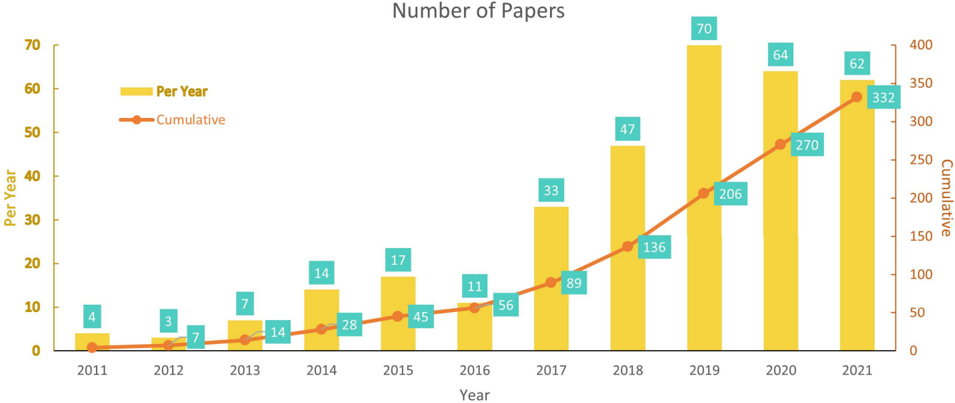
- The authors surveyed 332 papers on smart lighting and report that 59% of the publications were from 2019–2021.
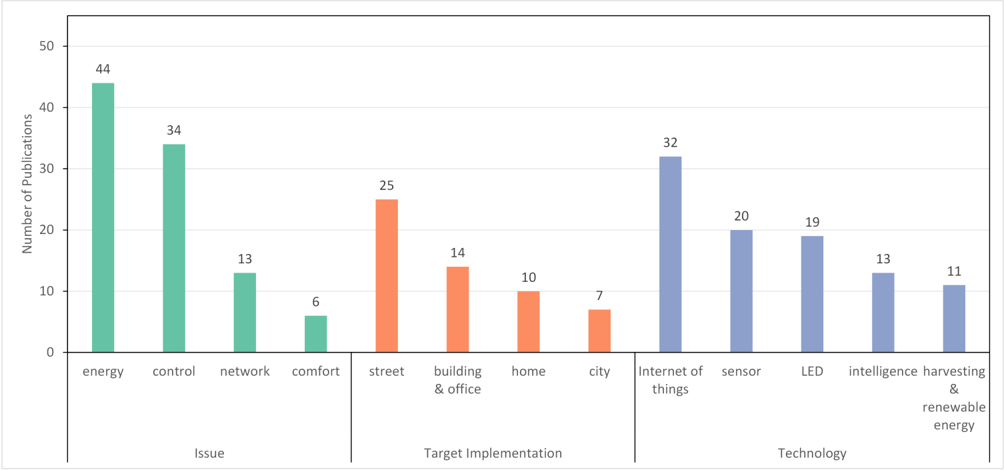
- From keyword-based classification, they found 4 main issues in smart lighting research (energy efficiency, computer network performance, control performance, and user comfort), 4 implementation targets (street lighting, building/office, home, and city), and 6 leading technologies (IoT, sensors, LED lights, intelligence, renewable energy, and energy harvesting).
- They identify 8 machine learning application areas in recent smart lighting research: predictive control, intelligent control, hand-gesture recognition, clustering, activity recognition, anomaly detection, optimization, computer vision, and elderly management.
- The paper reports that energy was the most popular topic with 44 papers, and only 6 papers discussed comfort in smart lighting.
- For user comfort metrics, the survey lists LUR, UNC, LCR, PRR, CCT, and others, and states that LUR = 1 is optimal while UNC is better when closer to 0.
## Methods
- The study is a systematic literature review (SLR) with stages of research question formulation, search strategy and selection, data extraction, and synthesis.
- Search and selection used inclusion criteria based on the strings “smart lighting,” “machine learning,” “user comfort,” and “activity recognition” in the title, with English or Indonesian papers from 1993 to 2021, available in Google Scholar, and in PDF or HTML format.
- The review analyzes the literature through topic classification, keyword extraction, and quality assessment, then synthesizes the results around smart lighting topics, machine learning methods, and user-comfort-related applications.
## Limitations
- The paper states that no survey paper had thoroughly discussed all machine learning techniques used in smart lighting research to achieve user comfort before this review.
- It says there is no existing research on activity recognition smart lighting that measures user comfort; this is explicitly presented as a research gap.
- Evident from the text: the review’s literature search is limited to papers available in Google Scholar and to English/Indonesian documents from 1993–2021, which may exclude relevant work in other languages or sources.
Model-written summary. Check it against the paper before relying on it.
Integrity signals
Registry
Cites
Statistics
Figures







Verification
Claims the paper makes
13 Valid · 36 Not valid · 136 Not checked · 97 Own results and interpretations
Every source the paper cites for this claim was checked and supports it.
In the paper
“Several environmental sensors play a role in this aspect, including magnetic switches, PIR sensors, and floor sensors [316].”
§ Machine Learning Methods in Smart Lighting Toward Achieving User Comfort: A Survey > 9) ELDERLY MANAGEMENT
What the sources say
- Supportedcites [316] source
The Introduction describes magnetic switches used to monitor an elderly person's movement. Sections 2.1 and 2.5 describe PIR motion sensors and floor sensors, respectively, as tools for elderly monitoring and care. (LLM, conf=0.91)
plainstates an association- Asserted: passes — The authors put it forward as true.
- Checkable: passes — It can be checked against evidence.
- Load-bearing: unclear — It is unclear whether the paper’s conclusions depend on it.
- Based: passes — The paper gives a reason why it holds.
- Supported
A result the paper reports from its own data — it cites no other source for it, so there is none to check. The quote shows it is in the paper.
In the paper
“We found six leading technologies through keyword searches in technology: IoT, sensors, LED lights, intelligence, renewable energy, and energy harvesting.”
§ Machine Learning Methods in Smart Lighting Toward Achieving User Comfort: A Survey > D. LITERATURE DEMOGRAPHICS
plain- Asserted: passes — The authors put it forward as true.
- Checkable: passes — It can be checked against evidence.
- Load-bearing: unclear — It is unclear whether the paper’s conclusions depend on it.
- Based: passes — The paper gives a reason why it holds.
- Rests on an assumption not shown here.
A result the paper reports from its own data — it cites no other source for it, so there is none to check. The quote shows it is in the paper.
In the paper
“The four main implementation targets obtained through keyword searches are street lighting, building and office, home, and city.”
§ Machine Learning Methods in Smart Lighting Toward Achieving User Comfort: A Survey > D. LITERATURE DEMOGRAPHICS
plain- Asserted: passes — The authors put it forward as true.
- Checkable: passes — It can be checked against evidence.
- Load-bearing: unclear — It is unclear whether the paper’s conclusions depend on it.
- Based: passes — The paper gives a reason why it holds.
- Rests on an assumption not shown here.
A result the paper reports from its own data — it cites no other source for it, so there is none to check. The quote shows it is in the paper.
In the paper
“Based on the keyword search on the issue, there are four main issues when people conduct smart lighting research: energy efficiency, computer network performance, control performance, and user comfort.”
§ Machine Learning Methods in Smart Lighting Toward Achieving User Comfort: A Survey > D. LITERATURE DEMOGRAPHICS
plain- Asserted: passes — The authors put it forward as true.
- Checkable: passes — It can be checked against evidence.
- Load-bearing: unclear — It is unclear whether the paper’s conclusions depend on it.
- Based: passes — The paper gives a reason why it holds.
- Rests on an assumption not shown here.
A result the paper reports from its own data — it cites no other source for it, so there is none to check. The quote shows it is in the paper.
In the paper
“There is an increasing trend where 59% of the publication year is within the range of 2019 -2021.”
§ Machine Learning Methods in Smart Lighting Toward Achieving User Comfort: A Survey > D. LITERATURE DEMOGRAPHICS
plainstates an association- Asserted: passes — The authors put it forward as true.
- Checkable: passes — It can be checked against evidence.
- Load-bearing: unclear — It is unclear whether the paper’s conclusions depend on it.
- Based: passes — The paper gives a reason why it holds.
- Rests on an assumption not shown here.
36 more claims
Create a free account to see all 282 claims and to verify the 26 references still open.
- Probably not a substantial claim. 225
- It may state two separate claims as one. 58
Self-check
Percentages, sums and reported differences re-computed from the paper’s own numbers.
Each contradiction between two passages listed here was confirmed by an independent check.
Rated minor: it would not touch a result — a value no result rests on, a p-value that stays on the same side of the significance level, or a conflict that is clerical, resolved elsewhere in the paper, or outside its own findings.
In the paper
§ Machine Learning Methods in Smart Lighting Toward Achieving User Comfort: A Survey > Abstract
“Six main factors drive the technology: light-emitting diode (LED) lighting, sensors, control, analytics, and intelligence.”
§ Machine Learning Methods in Smart Lighting Toward Achieving User Comfort: A Survey > A. MARKET TRENDS OF SMART LIGHTING
“There are six main driving factors in smart lighting: 1. light-emitting diode (LED) lighting, 2. sensors, 3. controls, 4. connectivity, 5. analytics, 6. intelligence.”
Citations
Cites
Guidance on Conducting a Systematic Literature Review
Xiao, Y., & Watson, M. (2019) · Journal of Planning Education and Research · doi:10.1177/0739456x17723971 · Cited by 3,467 · cited 1×
“All topics searched for and not related to RQ should be excluded [15].”
BackgroundSagi, O., & Rokach, L. (2018) · WIREs Data Mining and Knowledge Discovery · doi:10.1002/widm.1249 · Cited by 3,103 · cited 1×
“This method is considered a state-of-the-art method in the field of machine learning [218].”
MethodDeep learning for sensor-based activity recognition: A survey
Wang, J., Chen, Y., Hao, S., Peng, X., & Hu, L. (2019) · Pattern Recognition Letters · doi:10.1016/j.patrec.2018.02.010 · Cited by 2,014 · cited 1×
“The primary process of activity recognition is to detect high-level user activity from raw sensors [292].”
BackgroundA Review on Linear Regression Comprehensive in Machine Learning
Maulud, D., & Abdulazeez, A. M. (2020) · Journal of Applied Science and Technology Trends · doi:10.38094/jastt1457 · Cited by 1,262 · cited 1×
“Among the existing regression analysis methods, the simplest and most commonly used way is linear regression [194].”
MethodDeep Learning for Anomaly Detection: A Survey
Chalapathy, R., & Chawla, S. (2019) · arXiv · doi:10.48550/arxiv.1901.03407 · Cited by 1,240 · cited 1×
“Anomaly detection is implementable in intrusion detection systems (IDS), fraud detection, medical anomaly detection, industrial anomaly detection, or time-series anomaly data [299].”
BackgroundFast and wild: Bootstrap inference in Stata using boottest
Roodman, D., Nielsen, M. Ø., MacKinnon, J. G., & Webb, M. D. (2019) · The Stata Journal: Promoting communications on statistics and Stata · doi:10.1177/1536867x19830877 · Cited by 1,007 · cited 1×
“Bootstrap is a method of replicating multiple datasets from the main dataset using a sampling method [221].”
MethodLSTM-CNN Architecture for Human Activity Recognition
Xia, K., Huang, J., & Wang, H. (2020) · IEEE Access · doi:10.1109/access.2020.2982225 · Cited by 851 · cited 1×
“Xia et al. [332] compares three deep learning methods, namely LSTM, CNN, and a combination of LSTM and CNN. Predictions run on three different datasets with six movement classes.”
MethodLearning-Based Model Predictive Control: Toward Safe Learning in Control
Hewing, L., Wabersich, K. P., Menner, M., & Zeilinger, M. N. (2020) · Annual Review of Control, Robotics, and Autonomous Systems · doi:10.1146/annurev-control-090419-075625 · Cited by 835 · cited 1×
“The model is used to predict the future based on training data and then take control to deal with predicted future events [273].”
MethodAn overview of the supervised machine learning methods
Nasteski, V. (2017) · HORIZONS.B · doi:10.20544/horizons.b.04.1.17.p05 · Cited by 712 · cited 1×
“The class can be categorical or numerical, furtherly dividing the supervised method into classification and regression methods [177].”
MethodDeep Learning for Sensor-based Human Activity Recognition
Chen, K., Zhang, D., Yao, L., Guo, B., Yu, Z., & Liu, Y. (2022) · ACM Computing Surveys · doi:10.1145/3447744 · Cited by 690 · cited 1×
“Chen et al. [418] reveals that deep models can learn descriptive features from complex sensor data.”
Background
Research works printed but not linked: 23
- 2022, Gartner Says Smart Lighting has the Potential to Reduce Energy Costs by 90 Percent
- Shaulova, 2022, Smart Home Report 2021—Comfort and Lighting
- 10.3390/su13116198 · DOI · Paper page
- Smys, 2020, Artificial neural network based power management for smart street lighting systems, J. Artif. Intell., 2, 42
- Braw, 2014, Illuminating cities with sustainable smart lighting systems, Guardian, 12, 1
- Lakade, 2019, Intelligent lighting system for classrooms and mall using iot, Int. Res. J. Eng. Technol., 6, 3223
- Mahandran, 2021, IoT based smart lighting system in an auditorium, Prog. Eng. Appl. Technol., 2, 8
- Fanoon, 2030, Smart lighting system for efficient street lighting, J. Technol. Value Addition, 1, 36
- Kim, 2019, Design of path prediction smart street lighting system on the Internet of Things, J. Chosun Natural Sci., 12, 14
- Khachane, 2018, Intelligent street lighting system, Int. J. Eng. Res. Comput. Sci. Eng, 5, 587
- 10.1051/itmconf/20213701024 · DOI · Paper page
- Saepurohman, 2019, Analisis principal component analysis (PCA) untuk mereduksi faktor-faktor Yang mempengaruhi kualitas kulit kikil sapi, Prosiding Seminar Konferensi Nasional IDEC, 6, C01
- Dharma, 2015, Implementasi principal component analysis pada sistem rekomendasi film dengan pendekatan user based collaborative filtering skripsi, 2, 3464
- Manju, 2011, An analysis of q-learning algorithms with strategies of reward function, Int. J. Comput. Sci. Eng., 3, 814
- 10.1109/SGCF.2018.8408951 · DOI · Paper page
- Divya, 2016, Survey on outlier detection techniques using categorical data, Int. Res. J. Eng. Technol., 3, 899
- Gao, 2020, Human action classification using adaptive boosting algorithm, Int. J. Elect., Electron., Comput. Eng. Technol., 1, 6
- Almeida, 2015, Computer vision based adaptive lighting solutions for smart and efficient system, J. Impact Factor, 6, 1
- Edition, 2010, Energy standard for buildings except low-rise residential buildings
- 10.1109/ACCESS.2019.2932055 · DOI
- Abdullayev, Mimo ann to daylight harvested hybrid lighting control for an office building, 169
- 10.1109/ACCESS.2020.2995461 · DOI · Paper page
- Daely, Implementation and analysis of real time scheduling for IoT: A case study of smart led street light, 622
Cited by
Human Activity Recognition via Wi-Fi and Inertial Sensors With Machine Learning
Guo, W., Yamagishi, S., & Jing, L. (2024) · IEEE Access · doi:10.1109/access.2024.3360490 · Cited by 66
“To tackle these issues, studies introduce HAR systems based on acoustic signals [18], Millimeter Wave (mmWave) [19], Ultra-Wideband (UWB) [20] and Wi-Fi devices [21].”
BackgroundScandurra, G., Arena, A., & Ciofi, C. (2023) · Sensors · doi:10.3390/s23115264 · Cited by 51
Smart Street Light Control: A Review on Methods, Innovations, and Extended Applications
Agramelal, F., Sadik, M., Moubarak, Y., & Abouzahir, S. (2023) · Energies · doi:10.3390/en16217415 · Cited by 66
Ramadhan, N. G., Adiwijaya, A., Maharani, W., & Gozali, A. A. (2024) · IEEE Access · doi:10.1109/access.2024.3406748 · Cited by 54
“Extraction data has two stages, namely: (i) collecting paper information based on extraction form (Table 3), and (ii) find more in-depth information on quality assessments (QA) (Table 3) [30].”
BackgroundSystematic Review of Extended Reality for Smart Built Environments Lighting Design Simulations
Mohammadrezaei, E., Ghasemi, S., Dongre, P., Gračanin, D., & Zhang, H. (2024) · IEEE Access · doi:10.1109/access.2024.3359167 · Cited by 36
“…human-centric lighting, gesture and voice control, energy management, occupancy sensing, personalized lighting profiles, data analytics, predictive design, security and safety integration, sustainability efforts, IoT integration [296], user feedback analysis, and creative lighting displays.”
Background
Metadata
- Authors
- Putrada, A. G., Abdurohman, M., Perdana, D., & Nuha, H. H.
- Affiliations
- Telkom University (ID)
- Venue
- IEEE Access
- Published
- 2022
- Volume
- 10
- Pages
- 45137-45178
- ISSN
- 2169-3536 (ISSN-L)
- OpenAlex
- W4226062023
- Cited by
- 101
- References
- 431
- Citations by year
- 2026: 15 · 2025: 31 · 2024: 22 · 2023: 24 · 2022: 9
- FWCI
- 9.40
- Type
- journal article
- Language
- en
- Open access
- gold
- doi.org
- Locations
- IEEE Access (publishedVersion, cc-by)
- DOAJ (DOAJ: Directory of Open Access Journals) (submittedVersion)
- Funders
- Telkom University through the Doctoral Dissertation Research Scheme and the Doctoral Study Program
- Biofarma Corporation
- Industri Telekomunikasi Indonesia (INTI) Corporation
- Lembaga Pengelola Dana Pendidikan (LPDP) of Ministry of Finance of Republic Indonesia through Riset Inovatif Produktif (Rispro) Scheme
- Topics
- Physical Sciences › Engineering › Building and Construction › Building Energy and Comfort Optimization
- Physical Sciences › Computer Science › Computer Vision and Pattern Recognition › Context-Aware Activity Recognition Systems
- Physical Sciences › Engineering › Electrical and Electronic Engineering › IoT-based Smart Home Systems
- Keywords
- smart lighting, user comfort, machine learning, activity recognition, Internet of Things, LED lighting, light-emitting diodes, correlated color temperature, flicker perception, energy efficiency, lighting control
About these checks
Registry, retraction, Cites and statistics results are computed, not judged, with one exception: a printed reference that no index lists is read once by a model before it counts as a citation error. Claims are extracted by a model and kept only when their quote appears verbatim in the text; each cited source is then checked, with a model’s help, for whether it says what the claim relies on. Those verdicts can be wrong — read the claim’s quote and the cited source before relying on one.
The claim verdicts this report counts are experimental: their accuracy is not yet measured.
A language model drew the claims from the paper on 2026-10-10, under version 3 of the claim definition (model deepseek-v4.1-flash, prompt extract-v3).
A second model labelled each claim on 2026-10-10 (model jev-1.13-20260917, definition revision gold-guideline-v0.2).
Cited sources are checked with a language model’s help (gpt-6-sol).
Statistics and arithmetic are recomputed, not judged.
Confidence bands are shown only for fields calibrated on our annotated test set. None is calibrated yet, so no band is shown.
What counts as a claim ›How we measure confidence ›How we check this ›
Are you an author, or do you see a problem with this page? Request a review
How to cite
Cite CoChat for the checks on this page, and the paper for its own findings.
- This page
- CoChat. (2026). Citation check: Machine Learning Methods in Smart Lighting Toward Achieving User Comfort: A Survey. https://app.cochat.ai/papers/10.1109/access.2022.3169765
- The paper
- Putrada, A. G., Abdurohman, M., Perdana, D., & Nuha, H. H. (2022). Machine Learning Methods in Smart Lighting Toward Achieving User Comfort: A Survey. IEEE Access. https://doi.org/10.1109/access.2022.3169765
Data sources
Bibliographic data: Semantic Scholar, OpenAlex, Crossref.
Contains information from the Semantic Scholar Academic Graph Datasets, made available under the ODC Attribution License (ODC-BY 1.0).
Semantic Scholar’s data is described in: Kinney, R., et al. (2023). The Semantic Scholar Open Data Platform. arXiv:2301.10140.
