

The DOI matches its Crossref record; 37 of the 37 references it cites were found in a registry or an index; 4 of the 22 sources its claims cite were checked for support.
Framework for In-Memory Computing Based on Memristor and Memcapacitor for On-Chip Training
Open accessAbstract
Memristive crossbar arrays have gained considerable attention from researchers to perform analog in-memory vector-matrix multiplications in machine learning accelerators with low power and constant computational time. This work introduces a comprehensive framework for co-designing the software and hardware for deep neural networks (DNN) based on memristive and memcapacitive crossbars while considering various non-idealities. The model takes into account device-level factors, including conductance variation, cycle-to-cycle variation, device-to-device variation, peripheral circuits for error/weight gradient computation, and high tolerance. The overall neural network performance is thoroughly assessed by integrating these elements into a unified DNN training process. The proposed framework is implemented using a hybrid approach with Python and PyTorch. Performance evaluation was conducted using a simplified 8-layer VGG network on a measured 128×128 array with weight resolution. Remarkably, the memristive and memcapacitive crossbar arrays achieved outstanding training accuracies of 90.02% and 91.03%, respectively, for the CIFAR-10 dataset. Additionally, detailed hardware estimation for both mem-elements devices is provided, enabling meaningful comparisons with prior works.
Overview
CoChat Summary
## TL;DR
The paper presents a Python/PyTorch NeuroSim-based framework for evaluating on-chip training in memristor and memcapacitor in-memory computing systems while accounting for device, array, and peripheral non-idealities. Using a simplified 8-layer VGG on CIFAR-10 with a 128×128 array, it reports training accuracies of 90.02% for memristor and 91.03% for memcapacitor.
## Key findings
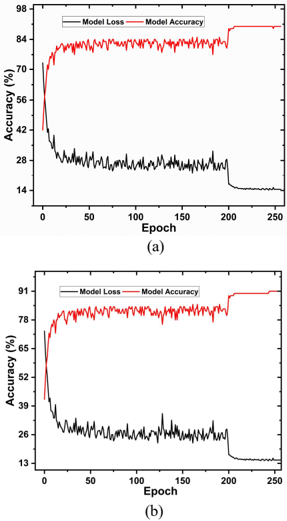
- The proposed framework was tested on a simplified 8-layer VGG network with a 128×128 RRAM array, and achieved training accuracies of 90.02% (memristor) and 91.03% (memcapacitor) on CIFAR-10.
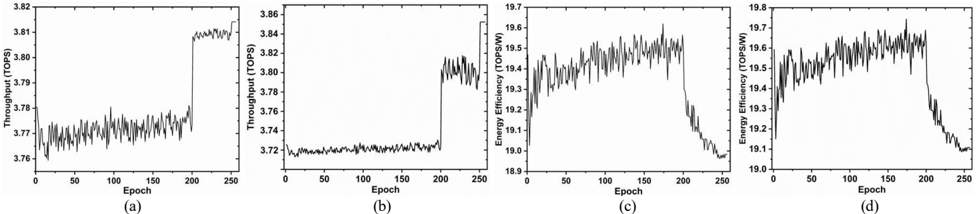
- The paper reports estimated training dynamic energy per epoch of 108.36 J and training latency per epoch of 104.31 sec.
- In the reported hardware results, the memristor and memcapacitor designs achieved training throughput of 1.51 TOPS and 1.54 TOPS, respectively, with training energy efficiency of 2.10 TOPS/W and 2.32 TOPS/W.
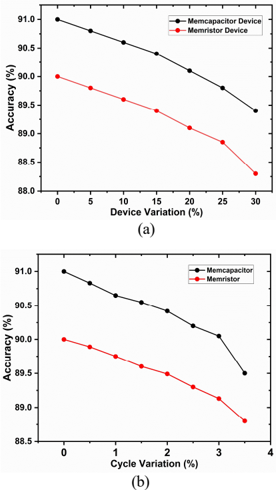
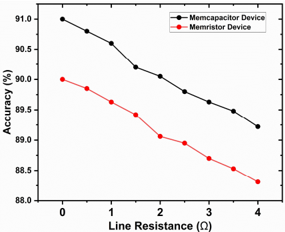
- The paper states that training accuracy is more strongly affected by line resistance than by device-to-device or cycle-to-cycle variation, and that device-to-device and cycle-to-cycle variation were well managed.
## Methods
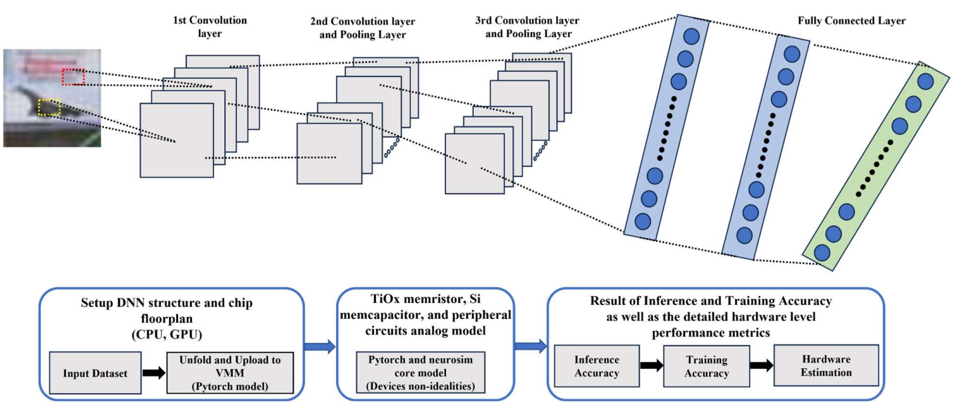
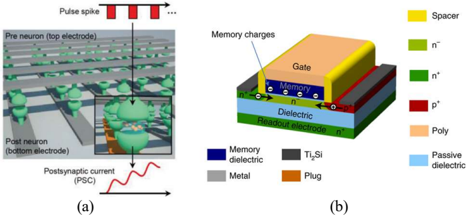
- The authors built a hybrid Python + PyTorch CUDA framework extending NeuroSim for compute-in-memory on-chip training, with hardware-extracted models for TiOx memristor and Si memcapacitor devices.
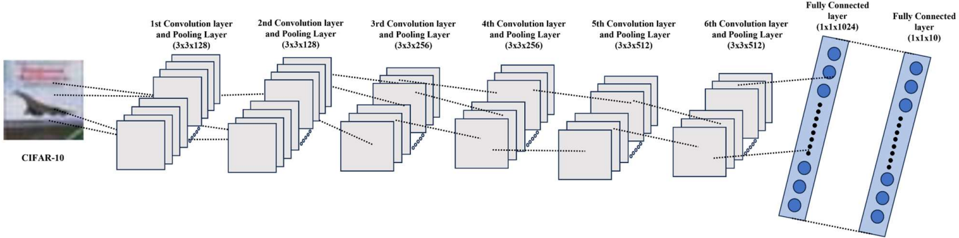
- They evaluated the framework on a simplified 8-layer VGG network (6 convolutional layers and 2 fully connected layers) using the CIFAR-10 dataset, and also report a ResNet-34 experiment.
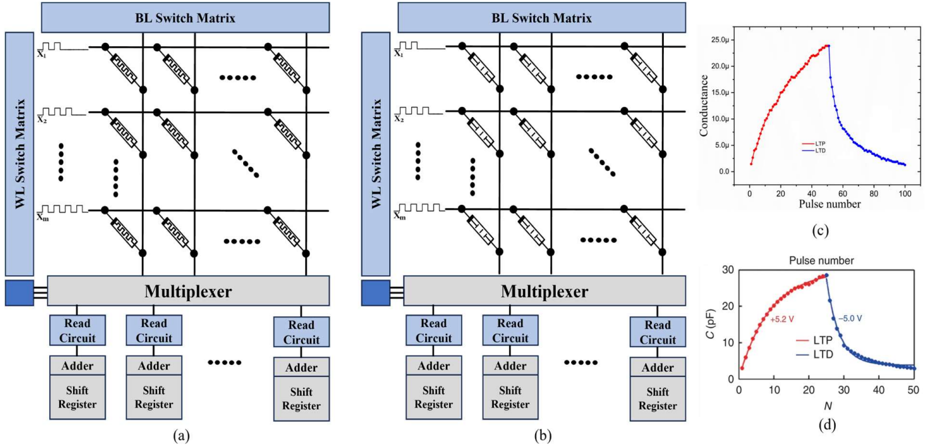
- The analysis incorporated non-idealities such as conductance/capacitance variation, nonlinearity, asymmetry, sneak paths, line resistance, peripheral circuits, and ADC quantization, with hardware configuration including 128×128 crossbars and 5-bit ADC precision.
## Limitations
- The paper explicitly says it does not specify the exact on-chip storage capacity required for intermediate results or routing to multiple arrays.
- The authors state they have not developed a comprehensive analysis of offloading performance and power overheads yet; they note this work is ongoing.
- They also state that they have not incorporated a read noise model yet and intend to do so in future work.
- Evident from the text: the evaluation is centered on a simplified 8-layer VGG and a CIFAR-10 benchmark, with the paper itself noting that future iterations should include a wider range of networks and more complex datasets.
Model-written summary. Check it against the paper before relying on it.
Integrity signals
Registry
Cites
Statistics
Figures





Verification
Claims the paper makes
4 Valid · 1 Not valid · 15 Not checked · 37 Own results and interpretations
A result the paper reports from its own data — it cites no other source for it, so there is none to check. The quote shows it is in the paper.
In the paper
“The estimated training dynamic energy per epoch amounts to 108.36 J, while the training latency per epoch is calculated at 104.31 sec.”
plain- Asserted: passes — The authors put it forward as true.
- Checkable: passes — It can be checked against evidence.
- Load-bearing: unclear — It is unclear whether the paper’s conclusions depend on it.
- Based: passes — The paper gives a reason why it holds.
- Rests on 2 assumptions not shown here.
A result the paper states — it cites no source for it, so there is none to check. The quote shows it is in the paper.
In the paper
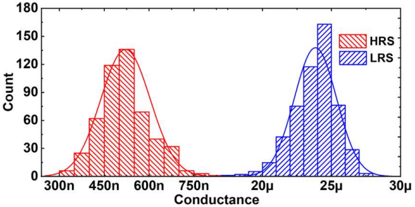
“In practice, the memductance tends to undergo rapid changes during the initial stages of LTP and LTD, eventually reaching a saturation point, as depicted in Fig. 3 (c) and (d) for TiOx-based memristive and Si-based memcapacitive devices, respectively.”
plainstates a cause- Asserted: passes — The authors put it forward as true.
- Checkable: passes — It can be checked against evidence.
- Load-bearing: unclear — It is unclear whether the paper’s conclusions depend on it.
- Based: passes — The paper gives a reason why it holds.
A result the paper reports from its own data — it cites no other source for it, so there is none to check. The quote shows it is in the paper.
In the paper
“The latency and energy breakdown analysis reveals that, due to substantial on-chip data transfer, the primary bottlenecks are buffer latency and DRAM energy consumption.”
plainstates a cause- Asserted: passes — The authors put it forward as true.
- Checkable: passes — It can be checked against evidence.
- Load-bearing: unclear — It is unclear whether the paper’s conclusions depend on it.
- Based: passes — The paper gives a reason why it holds.
- Rests on 2 assumptions not shown here.
A result the paper states — it cites no source for it, so there is none to check. The quote shows it is in the paper.
In the paper
“The estimated training dynamic energy per epoch amounts to 108.36 J, while the training latency per epoch is calculated at 104.31 sec.”
hedged- Asserted: passes — The authors put it forward as true.
- Checkable: passes — It can be checked against evidence.
- Load-bearing: unclear — It is unclear whether the paper’s conclusions depend on it.
- Based: passes — The paper gives a reason why it holds.
- Rests on an assumption not shown here.
A result the paper reports from its own data — it cites no other source for it, so there is none to check. The quote shows it is in the paper.
In the paper
“In our results, we observed that the training accuracy of both VMM approaches is more significantly influenced by the line resistance than by the variations between individual devices and cycles.”
plainstates a cause- Asserted: passes — The authors put it forward as true.
- Checkable: passes — It can be checked against evidence.
- Load-bearing: passes — The paper’s conclusions depend on it.
- Based: passes — The paper gives a reason why it holds.
23 more claims
Create a free account to see all 57 claims and to verify the 1 reference still open.
- It may state two separate claims as one. 16
- Probably not a substantial claim. 15
Self-check
Percentages, sums and reported differences re-computed from the paper’s own numbers.
Each contradiction between two passages listed here was confirmed by an independent check.
Rated major: it would touch a result — a value a result rests on, reported and recomputed p-values on opposite sides of the significance level, two passages that conflict with no sign which is right, or a cited work retracted before this paper was published.
In the paper
“| Con (C) | 2 x 10 -12 |”
Reported 2 · recomputed 20
Rated major: it would touch a result — a value a result rests on, reported and recomputed p-values on opposite sides of the significance level, two passages that conflict with no sign which is right, or a cited work retracted before this paper was published.
In the paper
§ V. CONCLUSION
“The memristive and memcapacitive vector-matrix multiplication (VMM) accelerators achieved impressive training accuracies of 90.02% and 91.03% on the CIFAR-10 dataset, respectively.”
§ I. INTRODUCTION
“The results demonstrated an impressive 90.02% and 91.03% inference accuracy with memristive and memcapacitive crossbar array on the CIFAR10 dataset.”
Citations
Cites
Nanoscale Memristor Device as Synapse in Neuromorphic Systems
Jo, S. H., Chang, T., Ebong, I., Bhadviya, B. B., Mazumder, P., & Lu, W. (2010) · Nano Letters · doi:10.1021/nl904092h · Cited by 4,174
Memristive devices for computing
Yang, J. J., Strukov, D. B., & Stewart, D. R. (2013) · Nature Nanotechnology · doi:10.1038/nnano.2012.240 · Cited by 3,885 · cited 1×
“…such as driver resistance, sensing resistance, sneak paths, interconnect parasitics, analog-to-digital converter (ADC) and digital-to-analog converter (DAC) nonlinearity, stochastic write operations, and process variations, can introduce errors into the computed VMM [7], [8], [9], [10], [11].”
BackgroundFully hardware-implemented memristor convolutional neural network
Yao, P., Wu, H., Gao, B., Tang, J., Zhang, Q., Zhang, W., Yang, J. J., & Qian, H. (2020) · Nature · doi:10.1038/s41586-020-1942-4 · Cited by 2,179 · cited 1×
“As a result, a myriad of CNN hardware designs featuring mem-elements-based VMM accelerators have been proposed [4], [5], [6], and their efficacy has been impressively demonstrated.”
BackgroundDeep Learning with Limited Numerical Precision
Gupta, S., Agrawal, A., Gopalakrishnan, K., & Narayanan, P. (2015) · arXiv · doi:10.48550/arxiv.1502.02551 · Cited by 1,364 · cited 1×
“While DNN do exhibit some level of tolerance to calculation imprecision [12], [13], [14] it is vital to acknowledge the limitations of this resilience.”
BackgroundEfficient and self-adaptive in-situ learning in multilayer memristor neural networks
Li, C., Belkin, D., Li, Y., Yan, P., Hu, M., Ge, N., Jiang, H., Montgomery, E., Lin, P., Wang, Z., et al. (2018) · Nature Communications · doi:10.1038/s41467-018-04484-2 · Cited by 931 · cited 1×
“As a result, a myriad of CNN hardware designs featuring mem-elements-based VMM accelerators have been proposed [4], [5], [6], and their efficacy has been impressively demonstrated.”
BackgroundChoi, S., Tan, S. H., Li, Z., Kim, Y., Choi, C., Chen, P.-Y., Yeon, H., Yu, S., & Kim, J. (2018) · Nature Materials · doi:10.1038/s41563-017-0001-5 · Cited by 690 · cited 2×
“The size of the crossbar in [30] and [32] is large, leading to impractical area consumption, whereas our proposed VMM accelerator achieves a smaller footprint compared to [32], [33], [34], and [35].”
BackgroundResultFerroelectric FET analog synapse for acceleration of deep neural network training
Jerry, M., Chen, P.-Y., Zhang, J., Sharma, P., Ni, K., Yu, S., & Datta, S. (2017) · 2017 IEEE International Electron Devices Meeting (IEDM) · doi:10.1109/iedm.2017.8268338 · Cited by 599
Woo, J., Moon, K., Song, J., Lee, S., Kwak, M., Park, J., & Hwang, H. (2016) · IEEE Electron Device Letters · doi:10.1109/led.2016.2582859 · Cited by 512
Understanding memristive switching via in situ characterization and device modeling
Sun, W., Gao, B., Chi, M., Xia, Q., Yang, J. J., Qian, H., & Wu, H. (2019) · Nature Communications · doi:10.1038/s41467-019-11411-6 · Cited by 482 · cited 1×
“…such as driver resistance, sensing resistance, sneak paths, interconnect parasitics, analog-to-digital converter (ADC) and digital-to-analog converter (DAC) nonlinearity, stochastic write operations, and process variations, can introduce errors into the computed VMM [7], [8], [9], [10], [11].”
BackgroundPeng, X., Huang, S., Jiang, H., Lu, A., & Yu, S. (2021) · IEEE Transactions on Computer-Aided Design of Integrated Circuits and Systems · doi:10.1109/tcad.2020.3043731 · Cited by 317 · cited 1×
“The framework is implemented using a hybrid approach with Python and PyTorch CUDA together, incorporating an accurate VMM computation core [26].”
Method
Research works printed but not linked: 1
- LeCun, 1998, The MNIST Database of Handwritten Digits
Cited by
Analysis and fully memristor-based reservoir computing for temporal data classification
Singh, A., Choi, S., Wang, G., Daimari, M., & Lee, B. (2024) · Neural Networks · doi:10.1016/j.neunet.2024.106925 · Cited by 47
“This relationship underscores the interdependence of these parameters in modelling the complex dynamics of memristive devices within VMM operations [41-42].”
Self-citationNeuromorphic Computing with Memcapacitors: Advancements, Challenges, and Future Directions
AbuHamra, N., Khan, M. U., Hassan, E., Al‐Qutayri, M., & Mohammad, B. S. (2025) · Advanced Electronic Materials · doi:10.1002/aelm.202500250 · Cited by 21
A High-Frequency CMOS Meminductor Emulator for Spiking Neuron
Singh, A., Kim, D., Lee, H., & Lee, B. (2024) · IEEE Transactions on Circuits and Systems I Regular Papers · doi:10.1109/tcsi.2024.3454553 · Cited by 14
“The results of this implementation demonstrate the suitability of meminductors across various applications [29], [30], [31].”
Self-citationMemcapacitors in neuromorphic architectures: the mechanisms, challenges, and applications
Chen, K., Shih, L., Chen, Y.-C., Lin, K., & Chen, J. (2025) · Journal of Materials Chemistry C · doi:10.1039/d5tc00993f · Cited by 16
Zhang, W., Xu, J., Wang, Y., Zhang, Y., Wang, Y., Li, P., Jia, Y., Zhao, Z., Li, C., Yang, B., et al. (2025) · Journal of Materiomics · doi:10.1016/j.jmat.2025.101051 · Cited by 11
Metadata
- Authors
- Singh, A., & Lee, B.-G.
- Affiliations
- Gwangju Institute of Science and Technology (KR)
- Venue
- IEEE Access
- Published
- 2023
- Volume
- 11
- Pages
- 112590-112599
- ISSN
- 2169-3536 (ISSN-L)
- OpenAlex
- W4387623795
- Cited by
- 19
- References
- 37
- Citations by year
- 2026: 5 · 2025: 9 · 2024: 5
- FWCI
- 1.41
- Type
- journal article
- Language
- en
- Open access
- gold
- doi.org
- Licence
- Locations
- IEEE Access (publishedVersion, cc-by-nc-nd)
- DOAJ (DOAJ: Directory of Open Access Journals) (submittedVersion, cc-by-sa)
- Funders
- National Research Foundation of Korea (NRF) Grant through the Korean Government (2021R1A2C22013480)
- Nano-Material Technology Development Program through NRF
- Ministry of Science and ICT (NRF-2022M3H4A1A01009658)
- Topics
- Physical Sciences › Engineering › Electrical and Electronic Engineering › Advanced Memory and Neural Computing
- Physical Sciences › Engineering › Electrical and Electronic Engineering › Ferroelectric and Negative Capacitance Devices
- Physical Sciences › Computer Science › Computer Vision and Pattern Recognition › Advanced Neural Network Applications
- Keywords
- in-memory computing, memristors, memcapacitor, memristor crossbar, on-chip learning, deep neural network accelerators, conductance variation, cycle-to-cycle variation, device-to-device variation, VGG, CIFAR-10, hardware-software co-design
About these checks
Registry, retraction, Cites and statistics results are computed, not judged, with one exception: a printed reference that no index lists is read once by a model before it counts as a citation error. Claims are extracted by a model and kept only when their quote appears verbatim in the text; each cited source is then checked, with a model’s help, for whether it says what the claim relies on. Those verdicts can be wrong — read the claim’s quote and the cited source before relying on one.
The claim verdicts this report counts are experimental: their accuracy is not yet measured.
A language model drew the claims from the paper on 2026-10-10, under version 3 of the claim definition (model deepseek-v4.1-flash, prompt extract-v3).
A second model labelled each claim on 2026-10-10 (model jev-1.13-20260917, definition revision gold-guideline-v0.2).
Statistics and arithmetic are recomputed, not judged.
Confidence bands are shown only for fields calibrated on our annotated test set. None is calibrated yet, so no band is shown.
What counts as a claim ›How we measure confidence ›How we check this ›
Are you an author, or do you see a problem with this page? Request a review
How to cite
Cite CoChat for the checks on this page, and the paper for its own findings.
- This page
- CoChat. (2026). Citation check: Framework for In-Memory Computing Based on Memristor and Memcapacitor for On-Chip Training. https://app.cochat.ai/papers/10.1109/access.2023.3324375
- The paper
- Singh, A., & Lee, B.-G. (2023). Framework for In-Memory Computing Based on Memristor and Memcapacitor for On-Chip Training. IEEE Access. https://doi.org/10.1109/access.2023.3324375
Data sources
Bibliographic data: Semantic Scholar, OpenAlex, Crossref.
Contains information from the Semantic Scholar Academic Graph Datasets, made available under the ODC Attribution License (ODC-BY 1.0).
Semantic Scholar’s data is described in: Kinney, R., et al. (2023). The Semantic Scholar Open Data Platform. arXiv:2301.10140.
