

Devising and Detecting Phishing Emails Using Large Language Models
Open accessThe DOI matches its Crossref record; 31 of the 31 references it cites were found in a registry or an index.
Abstract
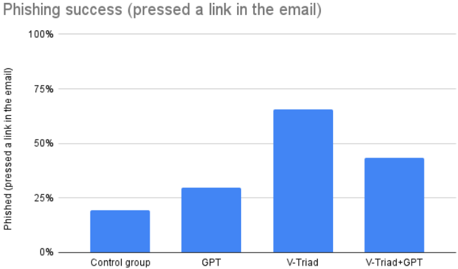
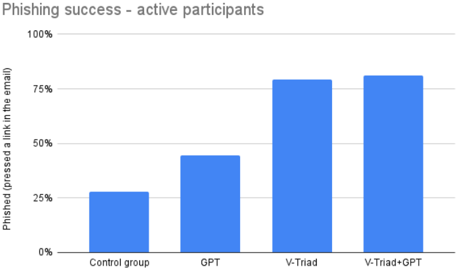
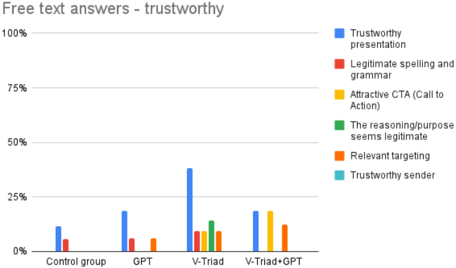
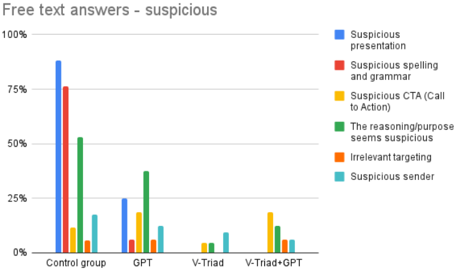
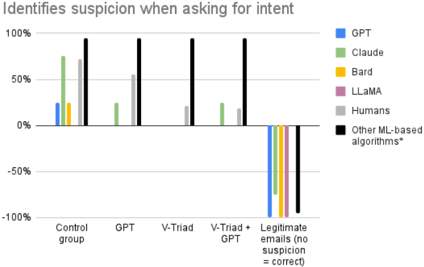
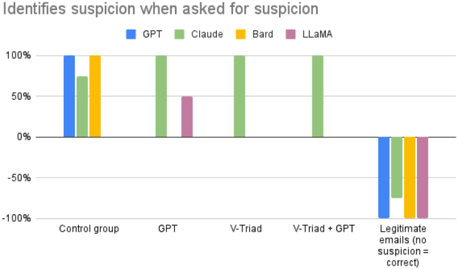
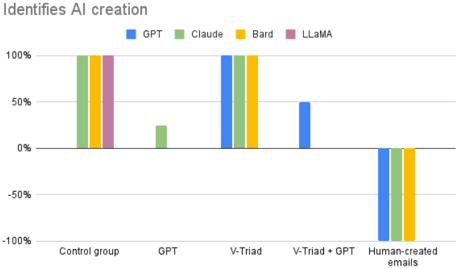
AI programs, built using large language models, make it possible to automatically create phishing emails based on a few data points about a user. The V-Triad is a set of rules for manually designing phishing emails to exploit our cognitive heuristics and biases. In this study, we compare the performance of phishing emails created automatically by GPT-4 and manually using the V-Triad. We also combine GPT-4 with the V-Triad to assess their combined potential. A fourth group, exposed to generic phishing emails, was our control group. We sent emails to 112 participants recruited for the study. The control group emails received a click-through rate between 19-28%, the GPT-generated emails 30-44%, emails generated by the V-Triad 69-79%, and emails generated by GPT and the V-Triad 43-81%. Each participant was asked to explain why they pressed or did not press a link in the email. These answers often contradict each other, highlighting the importance of personal differences. Next, we used four popular large language models (GPT, Claude, PaLM, and LLaMA) to detect the intention of phishing emails and compare the results to human detection. The language models demonstrated a strong ability to detect malicious intent, even in non-obvious phishing emails. They sometimes surpassed human detection, although often being slightly less accurate than humans. Finally, we make an analysis of the economic aspects of AI-enabled phishing attacks, showing how large language models increase the incentives of phishing and spear phishing by reducing their costs.
Overview
The claims and statistics of this paper haven’t been checked yet.
Free: it reads the open-access text and checks the first 5 claims that cite a source we can check. Create a free account to check every claim.
Integrity signals
Registry
Cites
Statistics
Figures






Verification
Claims the paper makes
The claims and statistics of this paper haven’t been checked yet.
Free: it reads the open-access text and checks the first 5 claims that cite a source we can check. Create a free account to check every claim.
Claims other papers make about this one
Each is checked against this paper’s own text: does it say what the citing paper says it does?
The check wasn’t confident either way, so it gives no verdict — never disputed.
In the citing paper
“Among its versions, CERT 4.2 was chosen for this work as it contains data from 1000 users over 501 days, including 70 malicious actors and over 32 million possible activities with 7327 malicious actions [7] .”
From User Behavior Analytics for Insider Threat using Transformer Based Approach (2026) · cites this paper as [7]
Experimental — accuracy not yet measuredThe check wasn’t confident either way, so it gives no verdict — never disputed.
In the citing paper
“The CERT Insider Threat Dataset, developed by the CERT Division at Carnegie Mellon University, is a widely used synthetic dataset for insider threat research, offering realistic, privacy free data for benchmarking and model development [6] .”
From User Behavior Analytics for Insider Threat using Transformer Based Approach (2026) · cites this paper as [6]
Experimental — accuracy not yet measured
Self-check
Percentages, sums and reported differences re-computed from the paper’s own numbers.
The self-check needs the paper’s full text.
Citations
Cites
LLaMA: Open and Efficient Foundation Language Models
Touvron, H., Lavril, T., Izacard, G., Martinet, X., Lachaux, M.-A., Lacroix, T., Rozière, B., Goyal, N., Hambro, E., Azhar, F., et al. (2023) · arXiv · doi:10.48550/arxiv.2302.13971 · Cited by 4,602 · cited 1×
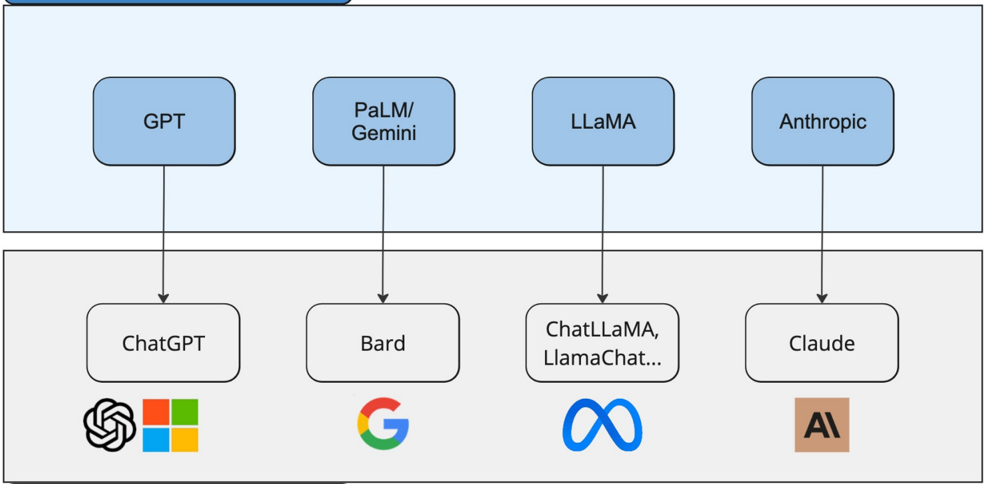
“LLMs come in different versions (such as GPT [29] created by OpenAI, Anthropic’s LLM 3 , PaLM [1] and Gemini [34] created by Google, and LLaMA [36] from Meta).”
Influence: The Psychology of Persuasion
Cialdini, R. B. (1993) · Cited by 2,563
Dhamija, R., Tygar, J. D., & Hearst, M. (2006) · Proceedings of the SIGCHI Conference on Human Factors in Computing Systems · doi:10.1145/1124772.1124861 · Cited by 1,376 · cited 2×
“We are also training an LLM to be specifically tuned for creating and detecting deceptive content by exposing it to the Cambridge Cybercrime Dataset 8 .”
Gemini: A Family of Highly Capable Multimodal Models
Gemini Team, Anil, R., Borgeaud, S., Alayrac, J.-B., Yu, J., Soricut, R., Schalkwyk, J., Dai, A. M., Hauth, A., Millican, K., et al. (2023) · arXiv · doi:10.48550/arxiv.2312.11805 · Cited by 990
Anil, R., Dai, A. M., Firat, O., Johnson, M., Lepikhin, D., Passos, A., Shakeri, S., Taropa, E., Bailey, P., Chen, Z., et al. (2023) · arXiv · doi:10.48550/arxiv.2305.10403 · Cited by 834 · cited 2×
“LLMs come in different versions (such as GPT [29] created by OpenAI, Anthropic’s LLM 3 , PaLM [1] and Gemini [34] created by Google, and LLaMA [36] from Meta).”
Puhakainen, P., & Siponen, M. (2010) · MIS Quarterly · doi:10.2307/25750704 · Cited by 638 · cited 1×
“Frequently mentioned problems include a lack of engagement, failure to personalize the content, irrelevant training material, and too infrequent training, [5], [3], [22, 5, 27, 30, 5, 27, 30, 5, 3].”
A comprehensive survey of AI-enabled phishing attacks detection techniques
Basit, A., Zafar, M., Liu, X., Javed, A. R., Jalil, Z., & Kifayat, K. (2021) · Telecommunication Systems · doi:10.1007/s11235-020-00733-2 · Cited by 429 · cited 1×
“For comparison, we also included a bar representing other ML-based phishing detection techniques that often reach an accuracy well above 95% [13, 2, 9].”
Social Engineering: The Science of Human Hacking
Hadnagy, C. (2018) · Wiley eBooks · doi:10.1002/9781119433729 · Cited by 331
Individual differences and Information Security Awareness
McCormac, A., Zwaans, T., Parsons, K., Calic, D., Butavicius, M., & Pattinson, M. (2017) · Computers in Human Behavior · doi:10.1016/j.chb.2016.11.065 · Cited by 300 · cited 1×
“Frequently mentioned problems include a lack of engagement, failure to personalize the content, irrelevant training material, and too infrequent training, [5], [3], [22, 5, 27, 30, 5, 27, 30, 5, 3].”
Deep Learning for Phishing Detection: Taxonomy, Current Challenges and Future Directions
Do, N. Q., Selamat, A., Krejcar, O., Herrera-Viedma, E., & Fujita, H. (2022) · IEEE Access · doi:10.1109/access.2022.3151903 · Cited by 221 · cited 1×
“For comparison, we also included a bar representing other ML-based phishing detection techniques that often reach an accuracy well above 95% [13, 2, 9].”
Research works printed but not linked: 5
- 6. Casino giant MGM expects $100 million hit from hack that led to data breach | Reuters. URL: https://www.re uters.com/business/mgm-expects-cybersecurity-issue -negatively-impact-third-quarter-earnings-2023-10-0 5/.
- 10. Email Marketing Benchmarks and Statistics for 2022 | Campaign Monitor. URL: https://www.campaignmonit or.com/resources/guides/email-marketing-benchmark s/.
- 11. Email Marketing Statistics & Benchmarks | Mailchimp. URL: https://mailchimp.com/resources/email-marketi ng-benchmarks/.
- 33. Security awareness training: Top challenges and what to do about them | Security Magazine. URL: https://ww w.securitymagazine.com/articles/96565-security-awa reness-training-top-challenges-and-what-to-do-about -them.
- 35. Positive Technologies. Cybersecurity threatscape: Q3 2022. 2022.
Cited by
Items 101–177 of 177
DRILL: Dual-Reasoning Large Language Models for Phishing Email Detection with Limited Data
Greenewald, C., Ashmore, B., Poon, C.-S., & Chen, L. (2025) · Communications in computer and information science · doi:10.1007/978-981-96-6966-0_18
Mareedu, A. (2024) · International Journal of Emerging Research in Engineering and Technology · doi:10.63282/3050-922x.ijeret-v5i4p107
Sood, A. K., & Zeadally, S. (2025) · IEEE Technology and Society Magazine · doi:10.1109/mts.2025.3582667
“From generating phishing emails [6] nearly indistinguishable from legitimate communications to crafting persuasive disinformation campaigns and malicious code, LLMs have become potent tools for those with malicious intent.”
Social Engineering Attacks Models
Lysenko, S., Савенко, О., Bokhonko, O., & Gaj, P. (2024) · International Conference on Dependable Systems, Services and Technologies (DESSERT) · doi:10.1109/dessert65323.2024.11122124
“The study [56] compares the effectiveness of phishing emails generated automatically using GPT-4 with those created manually using V-Triad.”
A Framework for Evaluating the Implementation Cost of Attacks on Large Language Models
Casalnuovo, C., (NNSA), U. N. N. S. A., Sandia National Laboratories (SNL-CA), L., Farrell, M., Heidbrink, S., Kavaler, D., & Lee, J. (2024) · OSTI OAI (U.S. Department of Energy Office of Scientific and Technical Information) · doi:10.2172/2584781
LLM-Powered Intent-Based Categorization of Phishing Emails
Eilertsen, E., Mavroeidis, V., & Grov, G. (2025) · IEEE International Conference on Cyber Security and Resilience (CSR) · doi:10.1109/csr64739.2025.11130105 · Cited by 2
“Phishing via Attachment refers to the method of delivering malicious code through a file that is attached to an email.”
de Jesus, T. O. B., de Santi, J., & Pigatto, D. F. (2025) · Simpósio Brasileiro de Cibersegurança (SBSeg) · doi:10.5753/sbseg.2025.9799
Ethical safeguards and vulnerabilities in large language models
(2025) · Issues in Information Systems · doi:10.48009/3_iis_2025_2025_125
Zlatohlávková, S., & Oravec, M. (2025) · International Symposium ELMAR (ELMAR) · doi:10.1109/elmar66948.2025.11194019
Leveraging Large Language Models for Detection and Intelligent Analysis of Phishing Threats
Tashtoush, Y. M., Al-Nemrawi, M., Masa’Deh, L., Al-Qudah, B., & Alqahtani, S. (2025) · International Conference on Cybersecurity and AI-Based Systems (Cyber-AI) · doi:10.1109/cyber-ai66431.2025.11233620
“Recent studies show promising evidence of the potential of LLMs not only in generating highly convincing phishing emails, but also in showing strong performance in detecting malicious intent, sometimes rivaling human capabilities [14].”
МОДЕЛІ АТАК СОЦІАЛЬНОЇ ІНЖЕНЕРІЇ
БОХОНЬКО, О., & ЛИСЕНКО, С. (2025) · Measuring and computing devices in technological processes · doi:10.31891/2219-9365-2025-81-55 · Cited by 1
A Review of the Use of Large Language Models to Generate Synthetic Cybersecurity Datasets
Gadsby, J., & Sabrina, F. (2025) · International Telecommunication Networks and Applications Conference (ITNAC) · doi:10.1109/itnac66378.2025.11302633 · Cited by 1
“Heiding et al. [26] explain that LLM generated phishing content can have the same effectiveness as human generated content.”
Advanced Phishing Email Detection via a Recurrent Neural Network with a Deep Neural Network
Alotaibi, A. (2026) · Lecture notes in networks and systems · doi:10.1007/978-981-96-8895-1_38
Keerthi Kumar., M., Joginpelly, S. K., Khemka, S., R, L. S., & Chhibber, N. (2025) · International Conference on Software, Systems and Information Technology (SSITCON) · doi:10.1109/ssitcon66133.2025.11342046 · Cited by 1
An Arms Race in the Inbox: A Systematic Review of Phishing Generation and the Rise of LLMs
Liu, Z., Chen, Y., He, Y., Wang, Z., Lu, H. D., Zhang, X., & Wu, J. (2025) · IEEE International Conference on Data Science in Cyberspace · doi:10.1109/dsc67331.2025.00021 · Cited by 1
“Recent academic studies have provided conclusive data to support the great potential of LLM in phishing attacks [8], [35].”
A Hybrid CNN-XGBoost Framework for Phishing Email Detection Using Statistical and Semantic Features
Liu, L.-H., Liu, D.-J., Zhang, Y.-Y., Jin, X.-B., Wu, X.-C., & Geng, G. (2026) · Computers, materials & continua/Computers, materials & continua (Print) · doi:10.32604/cmc.2026.074253
“Second, creation barriers are minimal—even attackers without technical backgrounds can easily craft convincing phishing emails using AI tools or readily available malicious programs [1].”
InfluentialMansoori, F. A. (2024) · Euro vantage journal of artificial intelligence · doi:10.65923/dj93ax66
Blockchain-Supported Intelligent Systems for Privacy-Preserving Data Analytics
Stacy, E. (2024) · Euro vantage journal of artificial intelligence · doi:10.65923/xtb1gb25
Multi-Agent Phishing Detection And Deletion via Small VLM and LLM Reasoning
Ayrin, F. J., Rahman, M. M., Rahman, M. A., Akuthota, V., Ghosh, A. K., Khondaker, M. M. H., Haque, M. U., Quader, M. A., & Reza, M. T. (2026) · International Conference on Electrical, Computer & Telecommunication Engineering (ICECTE) · doi:10.1109/icecte69292.2026.11429303
“Heiding et al. [2] examined GPT-4’s dual function in creating and identifying phishing emails, reducing click-through rates from 81% to detection success rates that varied according to the email’s level of complexity.”
InfluentialAbbas, I. A., & Hasan, T. M. (2026) · International Conference on Computing and Emerging Sciences · doi:10.1145/3797491.3797499
“The client-side integrated detection systems like that suggested by [34] combine phishing and XSS protection, but create complexity in architecture as there is need to coordinate the front-end and back-end elements.”
Kulkarni, N. S., & Kharade, K. G. (2026) · International Journal of Versatile Research and Analysis · doi:10.56975/ijvra.v4i4.704995
Assessing the Detectability of AI-Generated Phishing Emails by Modern Email Filters
Itua, R., Okolo, A. O., Ikuni, I. A., Anumaka, C., & Obeta, S. (2026) · Journal of Artificial Intelligence and AI Ethics · doi:10.64978/jaiae.2026.0130004
Hybrid Email Phishing Detection Using Large Language Models and Bayes Classifiers
Chiosa, C., & Pungilă, C. (2026) · Communications in computer and information science · doi:10.1007/978-3-032-19770-2_12
Trustworthy Phishing Detection: Leveraging BERT and Explainable AI for Secure Email Communication
(2026) · International Research Journal of Modernization in Engineering Technology and Science · doi:10.56726/irjmets80313
Human-Centered Artificial Intelligence in Cybersecurity
Chen, J., Garcia, K. R., Zhang, Y. “., Dudley, L. E., & Warren, A. D. (2026) · Springer eBooks · doi:10.1007/978-981-95-3658-0_99 · Cited by 1
Lee, K.-H., Lee, Y., Jeong, J., Choi, Y.-H., & Shin, D. (2026) · Electronics · doi:10.3390/electronics15102196
SpAI Phishing: A design and evaluation of AI-assisted large spear phishing cybersecurity drill
Wang, R.-C., Chen, M.-C., Chang, K.-T., & Hsueh, T.-Y. (2026) · Systems and Soft Computing · doi:10.1016/j.sasc.2026.200518
Ethical hacking based on trust tests: A vision oriented to cybersecurity and risk mitigation
Maldonado, J. J. C., Buitrago, P., Zapata-Baena, B. D. J., & Urda-Benitez, R. D. (2026) · Revista Politécnica · doi:10.33571/rpolitec.v22n43a5
“In critical sectors such as energy, manufacturing, and telecommunications, security must not compromise essential operations [10]; [83]; [93]; [30]; [43]; [50]; [77].”
InfluentialRoy, A., Sarkar, A., & Joseph, P. J. (2026) · Springer eBooks · doi:10.1007/978-3-032-29942-0_21
MALLM: Malware Analysis with Large Language Models
Yangoti, S. B., Dumpala, R., & Muppalaneni, N. B. (2026) · International Conference on Intelligent Systems and Computational Networks (ICISCN) · doi:10.1109/iciscn67954.2026.11566437
“…surveyed in the literature by Ferrag et al. [1], the potential applications of LLMs are numerous and varied, ranging from detecting vulnerabilities and conducting penetration tests to automatically generate and detect sophisticated phishing emails [2] and deobfuscating malicious code [3].”
SocialPhishGuard: Enhancing Social Engineering Phishing Detection Using LLM-Based Techniques
Bakhshi, T., Sheikh-Akbari, A., & Yousaf, F. (2026) · International Conference on IT and Industrial Technologies (ICIT) · doi:10.1109/icit68548.2026.11577689
“Although machine learning methods that use word patterns and website address length can be up to 90% accurate, they often miss new types of online scams [6].”
InfluentialFrom Trust to Compromise: Outcome-Verified LLM Phishing Simulation and Real-Time Defense
Tewari, T., Arachchilage, N. A. G., Challa, J. S., & Kumar, D. (2026) · Proceedings of the conference - Association for Computational Linguistics. Meeting · doi:10.18653/v1/2026.acl-long.543 · Cited by 1
LLM-PEA: Leveraging Large Language Models Against Phishing Email Attacks
Hasan, N., Busireddygari, P., Zhao, H., Ren, Y., Xu, J., & Zhang, S. (2026) · International Conference on Dependable Systems and Networks workshops · doi:10.1109/dsn-w70714.2026.00038 · Cited by 2
“Heiding et al. [25] revealed these same models generate convincing phishing emails, creating a paradox where detection and attack capabilities emerge from identical architectures.”
Malicious Web Links Detection with Large Language Models
Coste, C.-I., & Kaisser, T. (2026) · Lecture notes in business information processing · doi:10.1007/978-3-032-25534-1_6
Leveraging AI-Synthesized OSINT for Spear Phishing Detection
Stavrakas, J., Crichigno, J., & Hikmet, N. (2026) · IEEE International Black Sea Conference on Communications and Networking · doi:10.1109/blackseacom69760.2026.11598138
“To maximize ecological validity, the evaluation corpus consisted of legitimate and phishing emails collected directly from a production enterprise email environment at a large R1 university ( > 50,000 users) [7], [10].”
¿Es posible reconocer el origen robótico de textos mediante conocimiento lingüístico?
Cesteros, A. M. F. (2026) · Linred: Lingüística en la Red · doi:10.37536/linred.2025.xxii.3250
Can LLMs Keep Up? Evaluating Phishing Detection on Telegram
Erfan, M., Branco, P., & Jourdan, G.-V. (2026) · Digital Threats Research and Practice · doi:10.1145/3829369
Sentrashield: Guarding your Digital Frontiers with Precision
Thejaswini, S., Anjithkrishnan, K., Sajith, D. K., Riya, S., & Mohan, M. (2026) · IEEE Nexo-Tech International Conference on Advanced Technologies and Innovations (ICATI) · doi:10.1109/icati69399.2026.11604422
Aditya, N. R., Hidayat, N., & Servanda, Y. (2026) · Jurnal Sains dan Teknologi (JSIT) · doi:10.47233/jsit.v6i2.4962
Serracín, J., Gómez, J. M., Bruce, C. V., & Carmona, K. (2026) · Revista Veritas de Difusão Cientifica. · doi:10.61616/rvdc.v7i2.1654
Betancourt, A., COYAGO, G. A. A., Sangoluisa, K., Auz-Torres, M., & Yoo, S. G. (2026) · IEEE Access · doi:10.1109/access.2026.3718389
Plugin for E-mail Automation Using Large Language Models – A Design and Specification Proposal
Correia, P., Paiva, S., Garcia, J. E., & Ribeiro, J. (2026) · Lecture notes in networks and systems · doi:10.1007/978-3-032-32023-0_48
A Four-Axis Systematization of AI and Cybersecurity in the Era of Large Language Models
Farin, M. A., & Thuraisingham, B. M. (2026) · IEEE Conference on Big Data Security on Cloud (BigDataSecurity) · doi:10.1109/bigdatasecurity69476.2026.00009
“They enhance SOC automation, CTI synthesis [134], and vulnerability analysis [30], while also democratizing offensive This dual-use nature necessitates combining LLM-enabled cybersecurity tools with strong governance, continuous evaluation, and safeguards against misuse.”
Kodali, R., & Ramakrishna, D. T. S. (2026) · International Journal of Innovative Research in Engineering · doi:10.59256/ijire.20260704015
Attacks via AI Agents: How Autonomous Systems Are Becoming the New Weapon of Cybercriminals
Segizbayev, D., Bakhtiyar, K., Sultan, O., & Abzal, S. (2026) · International Conference on Cybersecurity, Digital Forensics, and AI Applications (ICCSDFAI) · doi:10.1109/iccsdfai70505.2026.11647861
Kim, Y., Kim, J., Kwon, Y., Ahn, S., & Cho, S. (2026) · International Journal of Information Security · doi:10.1007/s10207-026-01311-4
“Deep learning allows for phishing detection from raw data without the need for extensive feature engineering [17, 18].”
Çetlenbik, O. C., & Süzen, A. A. (2026) · Applied Sciences · doi:10.3390/app16168274
Kara, M., Burus, H., & Balık, H. H. (2026) · Electronics · doi:10.3390/electronics15173792
Khalid, H., & Khir, M. F. A. (2026) · e-Jurnal Penyelidikan dan Inovasi · doi:10.53840/e-jpi.v13i2.426
Detection and Analysis of Phishing Emails Using Time-Series Models
Yan, J.-L., Hsieh, Y.-H., Chiang, D.-L., & Chiao, H.-T. (2026) · IEEE International Conference on Intelligent Engineering Systems (INES) · doi:10.1109/ines69513.2026.11661058
“Studies show that phishing emails generated by advanced LLMs like GPT-4 achieve a click-through rate of up to 44%, significantly higher than the 20% rate of traditional phishing emails [2].”
The Imitation Game: Using Large Language Models to Disrupt Chinese Chat-Based Cybercrime
Yao, Y., Wang, B., Duan, J., Xu, K., Guo, C., Sun, Z., & Zhang, Y. (2026) · International Workshop on Quality of Service · doi:10.1109/iwqos70441.2026.11661137
“For phishing and social engineering counter-measures, LLMs excel at identifying manipulative linguistic techniques, including emotional appeals, false urgency, and impersonation tactics commonly employed in these attacks [1], [4], [10], [12]–[14], [19].”
Warka, H., & Boukhari, H. E. (2026) · Information systems engineering and management · doi:10.1007/978-3-032-22426-2_30
A Defensive Mirroring Framework for Explainable Detection of AI-Enabled Spear Phishing
Stavrakas, J., Crichigno, J., & Hikmet, N. (2026) · IEEE/IFIP Network Operations and Management Symposium (NOMS) · doi:10.1109/noms69089.2026.11668411
“Emails preserved original formatting, sender information, embedded links, and message tone, reflecting the cues users encounter in operational inboxes [7], [10].”
InfluentialPicard: Phishing Intelligence Corpus for Artificial Intelligence Research and Defense
Hagen, J., Stoltenburg, J., & Vanamala, M. (2026) · IEEE International Conference on Electro Information Technology · doi:10.1109/eit68936.2026.11670363
“In particular, the ability for AI-driven phishing campaigns to be semi or fully autonomous and scalable makes it potentially more dangerous than a comparable human-driven spearphishing campaign [20][21].”
Teaching LLMs to Phish LLMs: How Feature-Conditioned Generation ImpactsDetectionPreprint
Sáez, J. P., & Hernández-Ramos, J. L. (2026) · SSRN Electronic Journal · doi:10.2139/ssrn.7477419
Detection of Artificial Intelligence-Generated Phishing Attacks Using Transformer Models
Nnaji, S. O., Nneamaka, A. F., Uchenwa, C. L., & Nwoka, A. E. (2026) · International Journal of Computer Applications · doi:10.5120/ijca209cd5833714
Girászi, T., Papp, N., Oláh, N., & Huszti, A. (2026) · International Conference on Applied Informatics (ICAI) · doi:10.17048/icai.2026.107
Evaluating the Generation and Detection of Arabic-Based Phishing Attacks Using LLMsPreprint
AlAmeeri, A. A., & Kuhail, M. A. (2026) · Research Square · doi:10.21203/rs.3.rs-10979307/v1
Abir, C. M., Das, P., Jayaraman, V., Parthasarathy, S., & Biswas, S. (2026) · International Conference on Secure Information Systems and Technologies (ICSIST) · doi:10.1109/icsist70215.2026.11706387
“Phishing emails generated using GPT-4 and V-Triad are examined using large language models that can effectively identify phishing intent with high accuracy, sometimes surpassing human-level detection performance [22].”
APPLICATION OF GENERATIVE AI MODELS FOR ATTACKS AND DEFENSE
Батырханова, А., Bekmukhan, A. S., Abildayeva, T., & Yeskendirova, D. M. (2026) · Herald of Kazakh-British technical university · doi:10.55452/1998-6688-2026-23-3-176-187
Usifoh, S., & Umegbewe, N. (2026) · SSRN Electronic Journal · doi:10.2139/ssrn.7544920
PhishRoute: Cost-Aware Multi-Agent Gating for Phishing Email Detection
Singh, V. D., Acharya, S., Kumar, V., & Gupta, S. (2026) · IEEE World Conference on Applied Intelligence and Computing (AIC) · doi:10.1109/aic70896.2026.11717282
“The Anti-Phishing Working Group recorded 963,994 unique phishing attacks in Q1 2024 alone [1], and frontier LLMs can now generate grammatically clean, personalized phishing content that defeats rule-based filters [2].”
Odunayo, J. J. (2026) · SSRN Electronic Journal · doi:10.2139/ssrn.7569780
Rahman, M. H., & Rahman, M. H. (2026) · doi:10.63125/8m7wek47
(2026) · Ìnformatika, kulʹtura, tehnìka. · doi:10.15276/ict.03.2026.56
Cross-Model Study of LLM Capabilities for Phishing Content Generation
Bontu, M. (2026) · Communications in computer and information science · doi:10.1007/978-3-032-28469-3_13
Dorneles, B., & Quincozes, S. (2026) · Simpósio Brasileiro de Cibersegurança (SBSeg) · doi:10.5753/sbseg_estendido.2026.29777
“…a criação de mensagens convincentes, automatizar variações lin-guísticas e potencializar campanhas de spear phishing , também podem ser emprega-dos na classificação, triagem e justificativa de e-mails suspeitos (Heiding et al. 2024, Nahmias et al. 2024, Koide et al. 2024a, Chataut et al. 2024).”
Digital Trust, AI-Enabled Phishing, and Fraud Victimization: A User-Centric Web Security Study
Tran-Nam, Q., & Dang, H. M. Q. (2026) · Communications in computer and information science · doi:10.1007/978-981-92-6621-0_5
da Silva, J. M., Duarte, J. D., de Mendonça, F. L. L., & de Melo, L. P. (2026) · Simpósio Brasileiro de Cibersegurança (SBSeg) · doi:10.5753/sbseg.2026.27021
Spotlight on AI-Based Hybrid Phishing Detection Strategies: A Systematic Review
Tamal, M. A., Kabir, K. I., Islam, R., Chowdhury, F., Rahman, M. M., Rezaul, K. M., Siddiquee, K. N. E. A., & Islam, M. S. (2026) · Computers · doi:10.3390/computers15110746
Vörös, B., & Sik‐Lányi, C. (2026) · Information · doi:10.3390/info17111065
Phishing Susceptibility Among University Students: A Conceptual Framework for an Experimental Study
Ruzaili, H. H. H. (2026) · Journal of Art Design and Creative Media · doi:10.37134/jadcm.vol1.1.8.2026
Aziz, M. S., Ali, M., Manzoor, A. R., Younis, M., & Khabirova, Z. (2026) · Research Square · doi:10.21203/rs.3.rs-11434787/v1
Sada, S. M. (2026) · Scholars Journal of Engineering and Technology · doi:10.36347/sjet.2026.v14i10.005
Bibi, M., Awan, K. A., Liu, L.-C., Chen, C.-L., Alanazi, F., Alanazi, M. H., & Uddin, M. (2026) · Journal of King Saud University - Computer and Information Sciences · doi:10.1007/s44443-026-01351-9
Metadata
- Authors
- Heiding, F., Schneier, B., Vishwanath, A., Bernstein, J., & Park, P. S.
- Affiliations
- Harvard John A. Paulson School of Engineering And Applied Sciences, Harvard University, Cambridge, MA, USA
- Harvard University (US)
- Avant Research Group, Buffalo, NY, USA
- Massachusetts Institute of Technology (US)
- Venue
- IEEE Access
- Published
- 2024
- Volume
- 12
- Pages
- 42131-42146
- ISSN
- 2169-3536 (ISSN-L)
- OpenAlex
- W4392667162
- Cited by
- 123
- References
- 29
- Citations by year
- 2026: 61 · 2025: 46 · 2024: 16
- FWCI
- 46.25
- Type
- journal article
- Language
- en
- Open access
- gold
- doi.org
- Licence
- Locations
- IEEE Access (publishedVersion, cc-by-nc-nd)
- DOAJ (DOAJ: Directory of Open Access Journals) (submittedVersion, cc-by-sa)
- Topics
- Physical Sciences › Computer Science › Information Systems › Spam and Phishing Detection
- Social Sciences › Sociology and Political Science › Misinformation and Its Impacts
- Physical Sciences › Computer Science › Artificial Intelligence › Adversarial Robustness in Machine Learning
- Keywords
- phishing emails, large language models, GPT-4, phishing email detection, click-through rate, AI-generated phishing, spear phishing
About these checks
Registry, retraction, Cites and statistics results are computed, not judged, with one exception: a printed reference that no index lists is read once by a model before it counts as a citation error. Claims are extracted by a model and kept only when their quote appears verbatim in the text; each cited source is then checked, with a model’s help, for whether it says what the claim relies on. Those verdicts can be wrong — read the claim’s quote and the cited source before relying on one.
Statistics and arithmetic are recomputed, not judged.
Confidence bands are shown only for fields calibrated on our annotated test set. None is calibrated yet, so no band is shown.
What counts as a claim ›How we measure confidence ›How we check this ›
Are you an author, or do you see a problem with this page? Request a review
Data sources
Bibliographic data: Semantic Scholar, OpenAlex, Crossref.
Contains information from the Semantic Scholar Academic Graph Datasets, made available under the ODC Attribution License (ODC-BY 1.0).
Semantic Scholar’s data is described in: Kinney, R., et al. (2023). The Semantic Scholar Open Data Platform. arXiv:2301.10140.
